Click to edit Master title style
1
CHAPTER lll. Linguistic and Literacy
Development of Children and
Adolescents
L e a r n i n g O u t c o m e s :
A t t h e e n d o f t h e t o p i c s e s s i o n , t h e s t u d e n t s h o u l d b e a b l e t o :
a . E x p l a i n t h e n a t u r a l h i s t o r y o f l a n g u a g e d e v e l o p m e n t
b . D e s c r i b e b i l i n g u a l d e v e l o p m e n t
Click to edit Master title style
2
NATURAL HISTORY OF LANGUAGE DEVELOPMENT
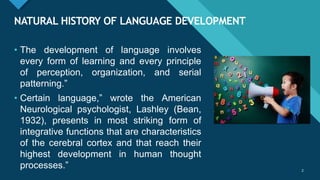
• The development of language involves
every form of learning and every principle
of perception, organization, and serial
patterning.”
• Certain language,” wrote the American
Neurological psychologist, Lashley (Bean,
1932), presents in most striking form of
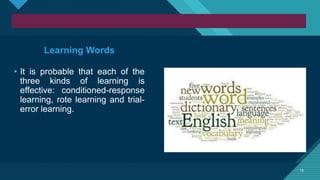
integrative functions that are characteristics
of the cerebral cortex and that reach their
highest development in human thought
processes.” 2
Click to edit Master title style
3 3
Development of Language
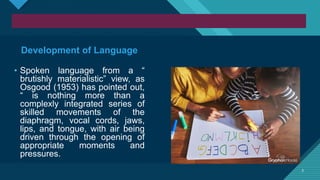
• Spoken language from a “
brutishly materialistic” view, as
Osgood (1953) has pointed out,
“ is nothing more than a
complexly integrated series of
skilled movements of the
diaphragm, vocal cords, jaws,
lips, and tongue, with air being
driven through the opening of
appropriate moments and
pressures.
Click to edit Master title style
4 4
Development of Sound
Patterns
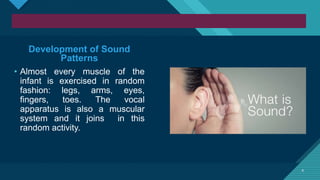
• Almost every muscle of the
infant is exercised in random
fashion: legs, arms, eyes,
fingers, toes. The vocal
apparatus is also a muscular
system and it joins in this
random activity.
Click to edit Master title style
5
Development of Sound Patterns
5
Volume
• the aspect of sound that control.
A sound is pronounced by the
baby and then he “practices” it
again and again, first with this
volume, and then with that.
• the infants repeats a sound initially
produced at random, and then he
varies the pitch.
Pitch
Click to edit Master title style
6
Development of Sound Patterns
6
Sequence
• the sounds seems to be begin. • repeated combined words.
Syllabic babbling
Click to edit Master title style
7 7
Acquisition of Meaning
• The development of differential
patterns of sounds is not done
altogether as “ sheer play”
without any attention to
environment consequences or
extrinsic rewards delivered from
the outside.
Click to edit Master title style
8 8
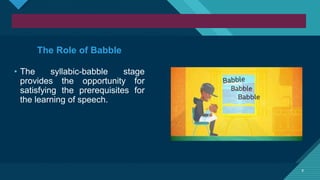
The Role of Babble
• The syllabic-babble stage
provides the opportunity for
satisfying the prerequisites for
the learning of speech.
Click to edit Master title style
9 9
Improvement of Speech
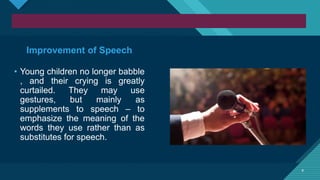
• Young children no longer babble
, and their crying is greatly
curtailed. They may use
gestures, but mainly as
supplements to speech – to
emphasize the meaning of the
words they use rather than as
substitutes for speech.
Click to edit Master title style
10
10
Pronunciation of Words
• Early childhood is normally a
time when rapid strides are
made in the major tasks of
learning tasks to speak ,
building up a vocabulary ,
mastering pronunciation, and
combining words into
sentences.
Click to edit Master title style
11
11
Vocabulary
• Young children’s vocabularies
increase rapidly as they learn
new words and new meaning
for old words.
Click to edit Master title style
12
12
Sentences
• Three or four –words sentences
are used as early as two years
of age and commonly at three.
Click to edit Master title style
13
13
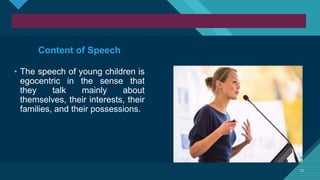
Content of Speech
• The speech of young children is
egocentric in the sense that
they talk mainly about
themselves, their interests, their
families, and their possessions.
Click to edit Master title style
14
14
Amount of Talking
• Early childhood is popularly
known as the Chatterbox age.
Click to edit Master title style
15
Amount of Talking
15
1. Intelligence
• The brighter the child, the more
quickly speech skills will be
mastered and, consequently,
the ability to talk.
• Children who grow up in homes
where discipline tends to be
permissive, talk more then those
whose parents are authoritarian
and who believe that “ children
should be seen but not heard”.
2. Type of Discipline
Click to edit Master title style
16
Amount of Talking
16
3. Ordinal Position
• Firstborn children are
encouraged to talk/more than
their later-born siblings and their
parents have more time to talk
to them.
• Only children are encouraged to
talk more than children from large
families and their parents have
more time to talk to them.
4. Family Size
Click to edit Master title style
17
Amount of Talking
17
5. Socioeconomic Status
• In lower class families, family
activities tend to be less
organized than those in middle
and upper class families.
• The poorer quality of speech and
of conversational skills of many
young children may due in part to
the fact that they have grown up in
homes where the father is absent,
or where family life is disorganized
because there are many children,
or because the mother must work
outside the home.
6. Racial Status
Click to edit Master title style
18
Amount of Talking
18
7. Bilingualism
• While young children from
bilingual homes may talk as
much at home as children from
monolingual homes, their
speech is usually very limited
when they are with members of
their peer group.
Click to edit Master title style
19
19
Learning Words
• It is probable that each of the
three kinds of learning is
effective: conditioned-response
learning, rote learning and trial-
error learning.
Click to edit Master title style
20
Learning Words
20
1. Conditioned –response
learning
• F.H.Allport (2005) has given the
classical description of how
conditioning may play a role.
The mother holds up a doll and
at the same time pronounces “
doll”.
• phrases and sentences can be
learned, presumably , via the rote-
memory process. The child is not
given his pieces of candy until
repeats after his mother.
2. Rote- memory process
Click to edit Master title style
21
Learning Words
21
3. Trial and Error learning
• opportunities n for the trial and
error learning also abound.
When the child wants a
particular toy he may babble
any number of what appear to
him to be appropriate sounds
until he finally receives his toy.
Click to edit Master title style
22
Theories of Language Development
22
1. The Innatist theory
• Noam Chomsky (1965) which
postulates that humans have an
innate ability to acquire
language.
• Asserts that children develop
knowledge of the world and then
“map” this knowledge onto
language categories and relations.
2. The Cognitivist Theory
Click to edit Master title style
23
Theories of Language Development
23
3. The Social Contextual
Theory
• States that the social interaction
influences both language and
cognitive development.
Click to edit Master title style
24
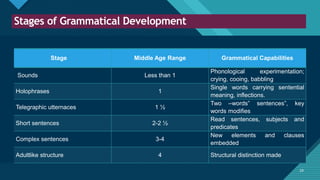
Stages of Grammatical Development
Stage Middle Age Range Grammatical Capabilities
Sounds Less than 1
Phonological experimentation;
crying, cooing, babbling
Holophrases 1
Single words carrying sentential
meaning, inflections.
Telegraphic utternaces 1 ½
Two –words” sentences”, key
words modifies
Short sentences 2-2 ½
Read sentences, subjects and
predicates
Complex sentences 3-4
New elements and clauses
embedded
Adultlike structure 4 Structural distinction made
24
Click to edit Master title style
25
BILINGUALISM
25
The Filipino learner is a bilingual.
With English as medium of
instruction in all public and private
school, the Filipino child has to
learn a foreign language apart
from his native tongue.
• is inextricably linked not only to
culture but in the Philippines, to
economic survival. While it is
primary means by which people
express their cultural values, it is
also a way of putting oneself in an
occupational stability.
Language
Click to edit Master title style
26
26
Bilingualism
• a term used to refers to people
who can speak fluently in two
different languages.
• generally defined as an
educational program that involves
the use of two language instruction
at some point in a student’s school
career.
Bilingualism Education
Click to edit Master title style
27
Approaches to Bilingualism Education
27
a. Transitional bilingualism
education
• student receives their content
area instruction in their native
language while learning English
as a second language.
• is more comprehensive and long
term model.
b. Maintenance bilingualism
education
Click to edit Master title style
28
Approaches to Bilingualism Education
28
c. Two way bilingualism
education
• is a program model for
integrating students whose
language is English with
students for whom English is a
second language.
• students are generally immersed in
their second language for a year or
two before their native language is
introduced as a medium.
d. Immersion bilingualism
education
Click to edit Master title style
29
29
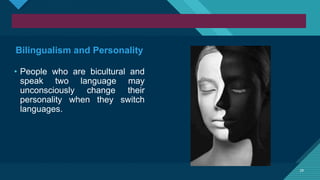
Bilingualism and Personality
• People who are bicultural and
speak two language may
unconsciously change their
personality when they switch
languages.
Click to edit Master title style
30
Thank You

GROUP 1 REPORT.pptx

  • 1.
    Click to editMaster title style 1 CHAPTER lll. Linguistic and Literacy Development of Children and Adolescents L e a r n i n g O u t c o m e s : A t t h e e n d o f t h e t o p i c s e s s i o n , t h e s t u d e n t s h o u l d b e a b l e t o : a . E x p l a i n t h e n a t u r a l h i s t o r y o f l a n g u a g e d e v e l o p m e n t b . D e s c r i b e b i l i n g u a l d e v e l o p m e n t
  • 2.
    Click to editMaster title style 2 NATURAL HISTORY OF LANGUAGE DEVELOPMENT • The development of language involves every form of learning and every principle of perception, organization, and serial patterning.” • Certain language,” wrote the American Neurological psychologist, Lashley (Bean, 1932), presents in most striking form of integrative functions that are characteristics of the cerebral cortex and that reach their highest development in human thought processes.” 2
  • 3.
    Click to editMaster title style 3 3 Development of Language • Spoken language from a “ brutishly materialistic” view, as Osgood (1953) has pointed out, “ is nothing more than a complexly integrated series of skilled movements of the diaphragm, vocal cords, jaws, lips, and tongue, with air being driven through the opening of appropriate moments and pressures.
  • 4.
    Click to editMaster title style 4 4 Development of Sound Patterns • Almost every muscle of the infant is exercised in random fashion: legs, arms, eyes, fingers, toes. The vocal apparatus is also a muscular system and it joins in this random activity.
  • 5.
    Click to editMaster title style 5 Development of Sound Patterns 5 Volume • the aspect of sound that control. A sound is pronounced by the baby and then he “practices” it again and again, first with this volume, and then with that. • the infants repeats a sound initially produced at random, and then he varies the pitch. Pitch
  • 6.
    Click to editMaster title style 6 Development of Sound Patterns 6 Sequence • the sounds seems to be begin. • repeated combined words. Syllabic babbling
  • 7.
    Click to editMaster title style 7 7 Acquisition of Meaning • The development of differential patterns of sounds is not done altogether as “ sheer play” without any attention to environment consequences or extrinsic rewards delivered from the outside.
  • 8.
    Click to editMaster title style 8 8 The Role of Babble • The syllabic-babble stage provides the opportunity for satisfying the prerequisites for the learning of speech.
  • 9.
    Click to editMaster title style 9 9 Improvement of Speech • Young children no longer babble , and their crying is greatly curtailed. They may use gestures, but mainly as supplements to speech – to emphasize the meaning of the words they use rather than as substitutes for speech.
  • 10.
    Click to editMaster title style 10 10 Pronunciation of Words • Early childhood is normally a time when rapid strides are made in the major tasks of learning tasks to speak , building up a vocabulary , mastering pronunciation, and combining words into sentences.
  • 11.
    Click to editMaster title style 11 11 Vocabulary • Young children’s vocabularies increase rapidly as they learn new words and new meaning for old words.
  • 12.
    Click to editMaster title style 12 12 Sentences • Three or four –words sentences are used as early as two years of age and commonly at three.
  • 13.
    Click to editMaster title style 13 13 Content of Speech • The speech of young children is egocentric in the sense that they talk mainly about themselves, their interests, their families, and their possessions.
  • 14.
    Click to editMaster title style 14 14 Amount of Talking • Early childhood is popularly known as the Chatterbox age.
  • 15.
    Click to editMaster title style 15 Amount of Talking 15 1. Intelligence • The brighter the child, the more quickly speech skills will be mastered and, consequently, the ability to talk. • Children who grow up in homes where discipline tends to be permissive, talk more then those whose parents are authoritarian and who believe that “ children should be seen but not heard”. 2. Type of Discipline
  • 16.
    Click to editMaster title style 16 Amount of Talking 16 3. Ordinal Position • Firstborn children are encouraged to talk/more than their later-born siblings and their parents have more time to talk to them. • Only children are encouraged to talk more than children from large families and their parents have more time to talk to them. 4. Family Size
  • 17.
    Click to editMaster title style 17 Amount of Talking 17 5. Socioeconomic Status • In lower class families, family activities tend to be less organized than those in middle and upper class families. • The poorer quality of speech and of conversational skills of many young children may due in part to the fact that they have grown up in homes where the father is absent, or where family life is disorganized because there are many children, or because the mother must work outside the home. 6. Racial Status
  • 18.
    Click to editMaster title style 18 Amount of Talking 18 7. Bilingualism • While young children from bilingual homes may talk as much at home as children from monolingual homes, their speech is usually very limited when they are with members of their peer group.
  • 19.
    Click to editMaster title style 19 19 Learning Words • It is probable that each of the three kinds of learning is effective: conditioned-response learning, rote learning and trial- error learning.
  • 20.
    Click to editMaster title style 20 Learning Words 20 1. Conditioned –response learning • F.H.Allport (2005) has given the classical description of how conditioning may play a role. The mother holds up a doll and at the same time pronounces “ doll”. • phrases and sentences can be learned, presumably , via the rote- memory process. The child is not given his pieces of candy until repeats after his mother. 2. Rote- memory process
  • 21.
    Click to editMaster title style 21 Learning Words 21 3. Trial and Error learning • opportunities n for the trial and error learning also abound. When the child wants a particular toy he may babble any number of what appear to him to be appropriate sounds until he finally receives his toy.
  • 22.
    Click to editMaster title style 22 Theories of Language Development 22 1. The Innatist theory • Noam Chomsky (1965) which postulates that humans have an innate ability to acquire language. • Asserts that children develop knowledge of the world and then “map” this knowledge onto language categories and relations. 2. The Cognitivist Theory
  • 23.
    Click to editMaster title style 23 Theories of Language Development 23 3. The Social Contextual Theory • States that the social interaction influences both language and cognitive development.
  • 24.
    Click to editMaster title style 24 Stages of Grammatical Development Stage Middle Age Range Grammatical Capabilities Sounds Less than 1 Phonological experimentation; crying, cooing, babbling Holophrases 1 Single words carrying sentential meaning, inflections. Telegraphic utternaces 1 ½ Two –words” sentences”, key words modifies Short sentences 2-2 ½ Read sentences, subjects and predicates Complex sentences 3-4 New elements and clauses embedded Adultlike structure 4 Structural distinction made 24
  • 25.
    Click to editMaster title style 25 BILINGUALISM 25 The Filipino learner is a bilingual. With English as medium of instruction in all public and private school, the Filipino child has to learn a foreign language apart from his native tongue. • is inextricably linked not only to culture but in the Philippines, to economic survival. While it is primary means by which people express their cultural values, it is also a way of putting oneself in an occupational stability. Language
  • 26.
    Click to editMaster title style 26 26 Bilingualism • a term used to refers to people who can speak fluently in two different languages. • generally defined as an educational program that involves the use of two language instruction at some point in a student’s school career. Bilingualism Education
  • 27.
    Click to editMaster title style 27 Approaches to Bilingualism Education 27 a. Transitional bilingualism education • student receives their content area instruction in their native language while learning English as a second language. • is more comprehensive and long term model. b. Maintenance bilingualism education
  • 28.
    Click to editMaster title style 28 Approaches to Bilingualism Education 28 c. Two way bilingualism education • is a program model for integrating students whose language is English with students for whom English is a second language. • students are generally immersed in their second language for a year or two before their native language is introduced as a medium. d. Immersion bilingualism education
  • 29.
    Click to editMaster title style 29 29 Bilingualism and Personality • People who are bicultural and speak two language may unconsciously change their personality when they switch languages.
  • 30.
    Click to editMaster title style 30 Thank You