Chapter 9 Physical and Cognitive Development in Middle and Late Childhood
Body Growth and Proportion Proportional changes:  Cephalocaudal pattern Head and waist circumference decrease when compared to height Muscle mass/tone improve Strength doubles Weight gain: about 5-7 lbs/year Increased size of the skeletal and muscular systems, and the size of some organs.
Motor Development Smoother and  more coordinated Gross muscle skills: Skipping rope, swimming, bike riding, skating, and climbing are mastered. Fine motor skills improve—increased myelination CNS Hands are used as tools—hammering, pasting, tying shoes, and fastening clothes. By 10-12 years similar to adult like
Exercise and Sports Only 22% of children in grades 4-12  were physically active for 30 minutes daily (1997) 34% attended daily P.E.  23% had no P.E.
Participation in Sports Positive and negative consequences for children Positives opportunity for exercise, healthy competition, building self-esteem, peer relations and friendships. Negatives: pressure to achieve to win, physical injuries, distractions from school, unrealistic expectations.
Obesity Overall, 20% of children are overweight 10% are obese Girls are more likely to be obese More common: White:  childhood African American: adolescence Chances of obesity in adulthood: At age 6 results in approximately a 25%  At age 12 results in approximately a 75%
Consequences of Obesity in Children Risk factor for many medical and psychological problems Pulmonary problems, such as sleep apnea Hip problems High blood pressure and elevated cholesterol levels Low self-esteem and depression  Exclusion from peer groups
Treatment of Obesity Exercise is most successful for children Experts recommend diet, exercise, and behavior modification Behavior modification teaches children to monitor their own behavior ex) keeping a food diary Makes a more permanent change
Accidents and Injuries Most common injury/death: motor vehicle accidents; pedestrian or a passenger. Seat-belts very important Other serious injuries involve: skateboards, roller skates, and other sports equipment. Appropriate safety helmets, protective eye and mouth shields, and protective padding are recommended.
Cancer Second leading cause of death (5-14 years)  1 in every 330 (before 19) The incidence is increasing Mainly effects: white blood cells, brain, bone, lymph system,  muscles, kidneys, and nervous system.
Who Are Children with Disabilities? Approximately 10% receive special education or related services. (US) More than half have a learning disability. Of children with disabilities: 21% have speech or language impairments 12% have mental retardation 9% have serious emotional disturbance Boys 3 times more likely to be classified as having a learning disability.
Learning Disabilities Children with a learning disability: are of normal intelligence or above. difficulties in one academic or more  difficulty is not attributable to other diagnosed problem or disorder Most common learning disability is  dyslexia. Difficulties in reading, possibly handwriting, spelling, or composition. Successful intervention programs exist
Attention Deficit Hyperactivity Disorder ADHD:  children consistently show one or more of the following characteristics: inattention hyperactivity Impulsivity 4-9 times more likely in boys  Higher failure rate in school (2-3 x higher)
Causes of ADHD No definitive cause(s) found Possible Causes: Low levels of certain neurotransmitters  Pre- and postnatal abnormalities Environmental toxins such as lead  Heredity  30-50% have parent/sibling with
Treatment of ADHD Combined approach is recommended Academic, behavioral, and medical  Requires parents, school personnel, and health-care professionals to cooperate Controversial drug treatments Ex) Ritalin slows down nervous system and behavior
Educational Issues Public Law 94-142 is the Education for All Handicapped Children Act  (1975) Requires free, appropriate public education for children with disabilities Renamed IDEA (1983) spells out mandates for services to children with disabilities Evaluation/eligibility determination, appropriate education individualized education plan (IEP)  least restrictive environment (LRE).
The IEP Individualized Education Plan (IEP) spells out a program specifically tailored for the student with a disability. Requirement for students with disabilities  Generally, the IEP should: relate to child’s learning capacity specially constructed to meet individual needs not copy of what is offered to other children. designed to provide educational benefits.
The LRE LRE:  least restrictive environment Similar as possible to the one in which children who do not have a disability are educated. Inclusion - educating children with a disability in the regular classroom. Mainstreaming - educating partially in a special education classroom and partially in a regular classroom.
Piaget’s Theory: Concrete Operational Stage Age Range:  7-12 Concrete operational thinking involves: mental operations replacing physical actions reversible mental actions coordinating several characteristics of objects
Contributions & Criticisms of Piaget Contributions: Helped us understand children’s cognitive development  Ex) assimilation, accommodation, object permanence His observation yielded advances in cognitive development, such as shifts in thinking   Criticisms Underestimation of children’s competence Stages Didn’t recognize the effects of training, culture or education
What Is Intelligence? Intelligence verbal ability, problem-solving skills, and the  ability to adapt to and learn from life’s everyday experiences . Cannot be directly measured IQ tests can only provide an  estimate  of a student’s intelligence.
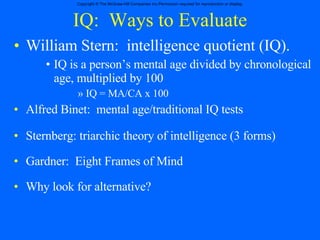
IQ:  Ways to Evaluate William Stern:  intelligence quotient (IQ). IQ is a person’s mental age divided by chronological age, multiplied by 100 IQ = MA/CA x 100 Alfred Binet:  mental age/traditional IQ tests Sternberg: triarchic theory of intelligence (3 forms) Gardner:  Eight Frames of Mind Why look for alternative?
Evaluating the Multiple Intelligence Approaches Educators must consider: What makes up children’s competencies? Instruction in multiple domains Assessment and learning in innovative ways Critics:  No research base to support the theory of multiple intelligences.
Ethnicity and Culture Racial differences in IQ tests African American and Latino score below White children Consensus:  differences are based on environmental differences Many early tests were culturally biased Favored urban children over rural children, children from  middle SES families over children from low-income families, and White children over minority children Culture-fair tests are tests of intelligence that attempt to be free of cultural bias.
The Use and Misuse of Intelligence Tests Effectiveness depends on the knowledge, skill, and integrity of the user Positive uses or misuses Some cautions about IQ: Scores can lead to stereotypes and expectations. A high IQ is not the ultimate human value. A single, overall IQ score is limiting.
Mental Retardation Characterized by:  low IQ (70 or lower) difficulty adapting to everyday life (BIGGEST) Causes can be organic or social and cultural  Stats on MR: 89% mildly retarded (IQs of 55-70). 6%  moderately retarded (IQs of 40-54). 3.5% severely retarded (IQs of 25-39).
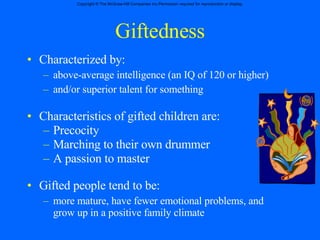
Giftedness Characterized by: above-average intelligence (an IQ of 120 or higher) and/or superior talent for something Characteristics of gifted children are: Precocity Marching to their own drummer A passion to master Gifted people tend to be: more mature, have fewer emotional problems, and grow up in a positive family climate
Creativity Unique problem solving through novel and unusual thinking Convergent thinking vs. Divergent thinking Creative, usually    intelligence Developing creativity Brainstorming Provide environments that stimulate creativity Don’t over-control Encourage internal motivation Foster flexible and playful thinking Introduce children to creative people
Bilingualism About 10 million children (English not primary) Bilingual education (preferred strategy) Teach in their native language then add English instruction Critics vs. supporters Fluency in two language results in: Better performance on IQ tests More conscious of language structure (written/spoken) Notice errors in grammar/meaning better More cognitive flexibility and complexity
Industry Versus Inferiority Ages 6 to 12  Focus Attainment of competence  Meeting the challenges presented by parents, peers, school, and the other complexities of the modern world Industry: Want to know how things are made and how they work Encouragement to make, build, and work, increases industry. The view of these creations as “making mischief” or “making a mess” increases feelings of inferiority.
The Development of Self-Understanding Continue to ask “who am I”? View less external/physical, more in terms of internal/psychological traits Self definitions:  social characteristics. Social comparison—what they can do in comparison with others—becomes key
What Are Self-Esteem and Self-Concept? Self-esteem - global evaluations of the self AKA:  self-worth or self-image Self-concept - domain-specific evaluations of the self Evaluations include: academics, athletics, appearance, etc. Increasing self-esteem: Identify the causes of low self-esteem Identify domains of competence important to the self Emotional support and social approval Achievement
The Influence of Friendships Friends are important because: Information about the world Emotional support/Buffer stress  Manage and control emotions Communication with others Foster intellectual growth Practice relationship skills
Stages of Friendship Stages of childhood friendship: 1. Basing friendship on other’s behavior. Age 4-7; friends are children who like you and with whom you share toys and activities. 2.  Basing friendship on trust.  Age 8-10; focus on mutual trust. 3. Basing friendship on psychological closeness. Age 11-15; focus on intimacy and loyalty.
Peer Statuses:  High vs. Low High (popular, possibly controversial): Tend to have greater access to resources (toys, books, information, etc) Interact with other high status students More likely to form exclusive and desirable cliques  Tend to play with a greater number of children Low (rejected/neglected): Tend to follow the lead of higher status children More likely to play with younger or less popular children Form friendships with other lower status children.
Bullying:  Characteristics of Victims About 160,000 children stay home each day because of bullies Loners Fairly passive Cry easily Lack social cues Have parents who are intrusive and demanding  Boys with intensely close relationships with their parents
Characteristics of Bullies About 15% of children Half come from abusive homes Prefer violent TV Misbehave at home more than other children When caught—lie and show little remorse More likely to break laws as adults
Developmental Changes More able to understand complex emotions  pride and shame One situation    more than one emotion  Tend to take a fuller context of emotional reactions Improved suppression/concealment of negative emotions
Emotional Intelligence Type of social intelligence that involves:  ability to monitor one’s own and others’ feelings and emotions,  discriminate among them,  use this information to guide one’s thinking and action. Goleman’s view of emotional intelligence involves: Developing Emotional Self-Awareness Managing Emotions Reading Emotions Handling Relationships
The Transition to Elementary School New Role:  School Child  New interactions and relationships with new significant others New reference groups  New standards for judging themselves. School provides children with a rich source of new ideas to shape their sense of self.
The Education of Students from Low Socioeconomic Backgrounds Poverty can present barriers to learning Schools in impoverished areas have fewer resources Emphasize rote learning over thinking skills Sub-standard learning environments
Ethnicity in Schools Ethnicity in schools can vary considerably School segregation by location  Issues of: Inferior educational opportunities Low expectations Negative stereotypes
Strategies for Improving Relations Between Ethnically Diverse Students Encourage positive contact with diverse students Encourage perspective taking Encourage critical thinking emotional intelligence Reduce bias View the school and community as a team to help support teaching efforts Be a competent cultural mediator

Chap9 10

  • 1.
    Chapter 9 Physicaland Cognitive Development in Middle and Late Childhood
  • 2.
    Body Growth andProportion Proportional changes: Cephalocaudal pattern Head and waist circumference decrease when compared to height Muscle mass/tone improve Strength doubles Weight gain: about 5-7 lbs/year Increased size of the skeletal and muscular systems, and the size of some organs.
  • 3.
    Motor Development Smootherand more coordinated Gross muscle skills: Skipping rope, swimming, bike riding, skating, and climbing are mastered. Fine motor skills improve—increased myelination CNS Hands are used as tools—hammering, pasting, tying shoes, and fastening clothes. By 10-12 years similar to adult like
  • 4.
    Exercise and SportsOnly 22% of children in grades 4-12 were physically active for 30 minutes daily (1997) 34% attended daily P.E. 23% had no P.E.
  • 5.
    Participation in SportsPositive and negative consequences for children Positives opportunity for exercise, healthy competition, building self-esteem, peer relations and friendships. Negatives: pressure to achieve to win, physical injuries, distractions from school, unrealistic expectations.
  • 6.
    Obesity Overall, 20%of children are overweight 10% are obese Girls are more likely to be obese More common: White: childhood African American: adolescence Chances of obesity in adulthood: At age 6 results in approximately a 25% At age 12 results in approximately a 75%
  • 7.
    Consequences of Obesityin Children Risk factor for many medical and psychological problems Pulmonary problems, such as sleep apnea Hip problems High blood pressure and elevated cholesterol levels Low self-esteem and depression Exclusion from peer groups
  • 8.
    Treatment of ObesityExercise is most successful for children Experts recommend diet, exercise, and behavior modification Behavior modification teaches children to monitor their own behavior ex) keeping a food diary Makes a more permanent change
  • 9.
    Accidents and InjuriesMost common injury/death: motor vehicle accidents; pedestrian or a passenger. Seat-belts very important Other serious injuries involve: skateboards, roller skates, and other sports equipment. Appropriate safety helmets, protective eye and mouth shields, and protective padding are recommended.
  • 10.
    Cancer Second leadingcause of death (5-14 years) 1 in every 330 (before 19) The incidence is increasing Mainly effects: white blood cells, brain, bone, lymph system, muscles, kidneys, and nervous system.
  • 11.
    Who Are Childrenwith Disabilities? Approximately 10% receive special education or related services. (US) More than half have a learning disability. Of children with disabilities: 21% have speech or language impairments 12% have mental retardation 9% have serious emotional disturbance Boys 3 times more likely to be classified as having a learning disability.
  • 12.
    Learning Disabilities Childrenwith a learning disability: are of normal intelligence or above. difficulties in one academic or more difficulty is not attributable to other diagnosed problem or disorder Most common learning disability is dyslexia. Difficulties in reading, possibly handwriting, spelling, or composition. Successful intervention programs exist
  • 13.
    Attention Deficit HyperactivityDisorder ADHD: children consistently show one or more of the following characteristics: inattention hyperactivity Impulsivity 4-9 times more likely in boys Higher failure rate in school (2-3 x higher)
  • 14.
    Causes of ADHDNo definitive cause(s) found Possible Causes: Low levels of certain neurotransmitters Pre- and postnatal abnormalities Environmental toxins such as lead Heredity 30-50% have parent/sibling with
  • 15.
    Treatment of ADHDCombined approach is recommended Academic, behavioral, and medical Requires parents, school personnel, and health-care professionals to cooperate Controversial drug treatments Ex) Ritalin slows down nervous system and behavior
  • 16.
    Educational Issues PublicLaw 94-142 is the Education for All Handicapped Children Act (1975) Requires free, appropriate public education for children with disabilities Renamed IDEA (1983) spells out mandates for services to children with disabilities Evaluation/eligibility determination, appropriate education individualized education plan (IEP) least restrictive environment (LRE).
  • 17.
    The IEP IndividualizedEducation Plan (IEP) spells out a program specifically tailored for the student with a disability. Requirement for students with disabilities Generally, the IEP should: relate to child’s learning capacity specially constructed to meet individual needs not copy of what is offered to other children. designed to provide educational benefits.
  • 18.
    The LRE LRE: least restrictive environment Similar as possible to the one in which children who do not have a disability are educated. Inclusion - educating children with a disability in the regular classroom. Mainstreaming - educating partially in a special education classroom and partially in a regular classroom.
  • 19.
    Piaget’s Theory: ConcreteOperational Stage Age Range: 7-12 Concrete operational thinking involves: mental operations replacing physical actions reversible mental actions coordinating several characteristics of objects
  • 20.
    Contributions & Criticismsof Piaget Contributions: Helped us understand children’s cognitive development Ex) assimilation, accommodation, object permanence His observation yielded advances in cognitive development, such as shifts in thinking Criticisms Underestimation of children’s competence Stages Didn’t recognize the effects of training, culture or education
  • 21.
    What Is Intelligence?Intelligence verbal ability, problem-solving skills, and the ability to adapt to and learn from life’s everyday experiences . Cannot be directly measured IQ tests can only provide an estimate of a student’s intelligence.
  • 22.
    IQ: Waysto Evaluate William Stern: intelligence quotient (IQ). IQ is a person’s mental age divided by chronological age, multiplied by 100 IQ = MA/CA x 100 Alfred Binet: mental age/traditional IQ tests Sternberg: triarchic theory of intelligence (3 forms) Gardner: Eight Frames of Mind Why look for alternative?
  • 23.
    Evaluating the MultipleIntelligence Approaches Educators must consider: What makes up children’s competencies? Instruction in multiple domains Assessment and learning in innovative ways Critics: No research base to support the theory of multiple intelligences.
  • 24.
    Ethnicity and CultureRacial differences in IQ tests African American and Latino score below White children Consensus: differences are based on environmental differences Many early tests were culturally biased Favored urban children over rural children, children from middle SES families over children from low-income families, and White children over minority children Culture-fair tests are tests of intelligence that attempt to be free of cultural bias.
  • 25.
    The Use andMisuse of Intelligence Tests Effectiveness depends on the knowledge, skill, and integrity of the user Positive uses or misuses Some cautions about IQ: Scores can lead to stereotypes and expectations. A high IQ is not the ultimate human value. A single, overall IQ score is limiting.
  • 26.
    Mental Retardation Characterizedby: low IQ (70 or lower) difficulty adapting to everyday life (BIGGEST) Causes can be organic or social and cultural Stats on MR: 89% mildly retarded (IQs of 55-70). 6% moderately retarded (IQs of 40-54). 3.5% severely retarded (IQs of 25-39).
  • 27.
    Giftedness Characterized by:above-average intelligence (an IQ of 120 or higher) and/or superior talent for something Characteristics of gifted children are: Precocity Marching to their own drummer A passion to master Gifted people tend to be: more mature, have fewer emotional problems, and grow up in a positive family climate
  • 28.
    Creativity Unique problemsolving through novel and unusual thinking Convergent thinking vs. Divergent thinking Creative, usually  intelligence Developing creativity Brainstorming Provide environments that stimulate creativity Don’t over-control Encourage internal motivation Foster flexible and playful thinking Introduce children to creative people
  • 29.
    Bilingualism About 10million children (English not primary) Bilingual education (preferred strategy) Teach in their native language then add English instruction Critics vs. supporters Fluency in two language results in: Better performance on IQ tests More conscious of language structure (written/spoken) Notice errors in grammar/meaning better More cognitive flexibility and complexity
  • 30.
    Industry Versus InferiorityAges 6 to 12 Focus Attainment of competence Meeting the challenges presented by parents, peers, school, and the other complexities of the modern world Industry: Want to know how things are made and how they work Encouragement to make, build, and work, increases industry. The view of these creations as “making mischief” or “making a mess” increases feelings of inferiority.
  • 31.
    The Development ofSelf-Understanding Continue to ask “who am I”? View less external/physical, more in terms of internal/psychological traits Self definitions: social characteristics. Social comparison—what they can do in comparison with others—becomes key
  • 32.
    What Are Self-Esteemand Self-Concept? Self-esteem - global evaluations of the self AKA: self-worth or self-image Self-concept - domain-specific evaluations of the self Evaluations include: academics, athletics, appearance, etc. Increasing self-esteem: Identify the causes of low self-esteem Identify domains of competence important to the self Emotional support and social approval Achievement
  • 33.
    The Influence ofFriendships Friends are important because: Information about the world Emotional support/Buffer stress Manage and control emotions Communication with others Foster intellectual growth Practice relationship skills
  • 34.
    Stages of FriendshipStages of childhood friendship: 1. Basing friendship on other’s behavior. Age 4-7; friends are children who like you and with whom you share toys and activities. 2. Basing friendship on trust. Age 8-10; focus on mutual trust. 3. Basing friendship on psychological closeness. Age 11-15; focus on intimacy and loyalty.
  • 35.
    Peer Statuses: High vs. Low High (popular, possibly controversial): Tend to have greater access to resources (toys, books, information, etc) Interact with other high status students More likely to form exclusive and desirable cliques Tend to play with a greater number of children Low (rejected/neglected): Tend to follow the lead of higher status children More likely to play with younger or less popular children Form friendships with other lower status children.
  • 36.
    Bullying: Characteristicsof Victims About 160,000 children stay home each day because of bullies Loners Fairly passive Cry easily Lack social cues Have parents who are intrusive and demanding Boys with intensely close relationships with their parents
  • 37.
    Characteristics of BulliesAbout 15% of children Half come from abusive homes Prefer violent TV Misbehave at home more than other children When caught—lie and show little remorse More likely to break laws as adults
  • 38.
    Developmental Changes Moreable to understand complex emotions pride and shame One situation  more than one emotion Tend to take a fuller context of emotional reactions Improved suppression/concealment of negative emotions
  • 39.
    Emotional Intelligence Typeof social intelligence that involves: ability to monitor one’s own and others’ feelings and emotions, discriminate among them, use this information to guide one’s thinking and action. Goleman’s view of emotional intelligence involves: Developing Emotional Self-Awareness Managing Emotions Reading Emotions Handling Relationships
  • 40.
    The Transition toElementary School New Role: School Child New interactions and relationships with new significant others New reference groups New standards for judging themselves. School provides children with a rich source of new ideas to shape their sense of self.
  • 41.
    The Education ofStudents from Low Socioeconomic Backgrounds Poverty can present barriers to learning Schools in impoverished areas have fewer resources Emphasize rote learning over thinking skills Sub-standard learning environments
  • 42.
    Ethnicity in SchoolsEthnicity in schools can vary considerably School segregation by location Issues of: Inferior educational opportunities Low expectations Negative stereotypes
  • 43.
    Strategies for ImprovingRelations Between Ethnically Diverse Students Encourage positive contact with diverse students Encourage perspective taking Encourage critical thinking emotional intelligence Reduce bias View the school and community as a team to help support teaching efforts Be a competent cultural mediator