Topical Approach to Lifespan Development 8th Edition Santrock Solutions Manual
Topical Approach to Lifespan Development 8th Edition Santrock Solutions Manual
Topical Approach to Lifespan Development 8th Edition Santrock Solutions Manual
Topical Approach to Lifespan Development 8th Edition Santrock Solutions Manual
Topical Approach to Lifespan Development 8th Edition Santrock Solutions Manual
1.
Visit https://testbankfan.com todownload the full version and
browse more test banks or solution manuals
Topical Approach to Lifespan Development 8th
Edition Santrock Solutions Manual
_____ Press the link below to begin your download _____
https://testbankfan.com/product/topical-approach-to-
lifespan-development-8th-edition-santrock-solutions-manual/
Access testbankfan.com now to download high-quality
test banks or solution manuals
2.
Here are somerecommended products for you. Click the link to
download, or explore more at testbankfan.com
Topical Approach to Lifespan Development 8th Edition
Santrock Test Bank
https://testbankfan.com/product/topical-approach-to-lifespan-
development-8th-edition-santrock-test-bank/
Topical Approach to Lifespan Development 7th Edition
Santrock Solutions Manual
https://testbankfan.com/product/topical-approach-to-lifespan-
development-7th-edition-santrock-solutions-manual/
Topical Approach to Lifespan Development 7th Edition
Santrock Test Bank
https://testbankfan.com/product/topical-approach-to-lifespan-
development-7th-edition-santrock-test-bank/
Principles of Economics 5th Edition Mankiw Solutions
Manual
https://testbankfan.com/product/principles-of-economics-5th-edition-
mankiw-solutions-manual/
3.
Essentials of Psychology6th Edition Bernstein Test Bank
https://testbankfan.com/product/essentials-of-psychology-6th-edition-
bernstein-test-bank/
Calculus Concepts and Contexts 4th Edition Stewart Test
Bank
https://testbankfan.com/product/calculus-concepts-and-contexts-4th-
edition-stewart-test-bank/
Business Communication Developing Leaders for a Networked
World 2nd Edition Cardon Test Bank
https://testbankfan.com/product/business-communication-developing-
leaders-for-a-networked-world-2nd-edition-cardon-test-bank/
Social Work Policy Practice Changing Our Community Nation
And The World 1st Edition Ritterr Test Bank
https://testbankfan.com/product/social-work-policy-practice-changing-
our-community-nation-and-the-world-1st-edition-ritterr-test-bank/
International Economics 9th Edition Appleyard Solutions
Manual
https://testbankfan.com/product/international-economics-9th-edition-
appleyard-solutions-manual/
had passed Statelaws and committed acts interfering with their
legal and constitutional right of seizing them on Northern territory.
There was no pretence that there was any tyrannical usurpation of
undelegated authority by the United States, such as the Virginia
resolutions referred to. Prof. Bazil L. Gildersleeve, a confederate
soldier, in the Atlantic Monthly Magazine, says in a paper called “The
Creed of the old South,” that the cause of secession was, that “the
extreme Southern States considered their rights menaced by the
issue of the presidential election.”[114]
Upon the choice of Lincoln, and while Buchanan was President,
preparations were made by the South for a disruption of the Union.
Reuben Davis, a distinguished lawyer and a member of Congress
from Mississippi, in his autobiography, informs us that he spent
much time with Floyd, the Secretary of War, who had been for
twelve months sending arms to Southern arsenals and had put the
forts in condition to be captured. He estimated that one half of the
munitions of war was in the South.[115]
South Carolina again took the
initiative and seceded on the ground that as a sovereign State she
had the right to withdraw from the compact she had entered into;
and for the second time in our history did a State, and the same
State, assert its sovereign right against the supreme authority of the
United States. The other plantation States quickly followed South
Carolina; generally there was no elaborate statement by them of
their grievances, nor did they explain why the doctrines they
abhorred less than thirty years before, they now asserted and so
courageously fought for. Virginia joined the Southern Confederacy
without passing any formal act of secession. Her convention, called
for the purpose of considering the matter, voted not to secede. In an
address delivered in October, 1887, at Richmond, on the dedication
of a statue to Lee, the orator, a descendant of the great Chief-Justice
Marshall, undertakes to explain and defend Virginia’s course in
joining the South. He does not claim the right of secession and
apparently agrees with Lee, and puts in italics what Lee wrote on
the 23d of January, 1861, that “Secession is nothing but revolution.”
He states also that secession was unjustifiable, because the
27.
opponents of Lincolnhad the majority in the National House of
Representatives and Senate; but that the method of Lincoln of
composing the troubles of the country brought Virginia into the
contest. Following, as Southern writers and speakers do, the
extravagant denunciations of Calhoun, he says: “Instead of
maintaining the honor, the integrity of our National Union, it
destroyed that Union in all but a territorial sense, as effectually as
secession, by substituting conquered provinces for free States, and
repeating in America the shameful history of Russia and Poland.” As
our Poland when he spoke had an executive of its own choice and a
majority of the House of Representatives, it was its own fault, if its
inhabitants were in that abject condition. Is it not absurd to talk in
this way, when no secessionist has been hung for treason, and a
silver crown a short time since, at a public meeting, was prepared by
some admirer for the dethroned autocrat of our Poland? At any rate
we have no sedition law now, and freedom of speech against the
government passes without comment. An unsuccessful revolution is
rebellion, generally punished in other countries by death. It has not
been so in our Russia. Jefferson Davis was indicted for treason; his
trial never took place, as President Johnson issued a general
amnesty proclamation.
Undoubtedly the confidence of the South in its assumed
superiority in courage and fighting qualities had great influence in
inducing its attempted secession. Jefferson Davis in his history gives
instances of advantages gained at the outset by the Southern
soldiers through their skill in the use of firearms. He did not tell us,
and it seems to have escaped notice generally, that the Southern
States had also the great benefit of the military academies they had
established, which furnished at once trained officers for their troops.
Their renowned general, Stonewall Jackson, was a professor in that
of Virginia, and went from the academy to the Confederate army.[116]
The seceding States in forming their new compact, in article
after article followed the Constitution they rejected, prefacing it with
the declaration, “We, the people of the Confederate States, each
28.
State acting inits sovereign and independent character, in order to
form a more permanent Federal Government,” instead of “We, the
people of the United States, in order to form a more perfect Union,
for ourselves and our posterity.” They took particular care, however,
by their new “Compact,” to provide for the perpetuity of slavery in
their Confederacy,—and, looking to conquests, in any new territory
that might be acquired.
Instead of slavery being perpetuated, the whole system was
annihilated under and within the Constitution. The amendment
abolishing it forever was passed in the manner required in the
Constitution by all the States that had refused an obedience to the
United States laws. No longer is the declaration of independence
that all men are born free and equal, in the language of Calhoun, “a
glittering generality.”
The seceding States were not without their internal trouble, and
the authority of the Confederate Government was questioned by
Georgia.
We all know how patiently and assiduously Lincoln tried to keep
the Southern States in the Union and how ineffectually; and when
he found that his effort was of no avail, with how firm a hand he
wielded the powers of the Executive. In Merriam’s case, he
maintained his suspension of the habeas corpus, although Chief-
Justice Taney held it was illegal. His decreeing freedom to the slaves
of those in rebellion, as a war measure, was an act of imperial
power seldom surpassed. Our whole history, as well as the epoch of
the civil war, has proved how unfounded was Hamilton’s fear that
the government was not strong enough.
How wonderfully well the founders of our Constitution did their
work, is shown by the fact that so few amendments have been
made, while the constitutions of the different States have been
changed again and again. The ten articles declaring certain rights to
be in the people were adopted in 1791, then in 1798 the article
taking away from the United States the jurisdiction of suits of
29.
individuals against aState; afterwards in 1804 two articles changing
the manner of electing the President and Vice-President. The theory
of the founders of the Constitution, that it would be best to leave to
men of prominence as electors to confer and choose those most fit
for President and Vice-President, has failed. The electors chosen by
the people are pledged to vote for candidates nominated at party
conventions. After these few amendments, none were passed until
those as to slavery, following the civil war.
A strict construction of the powers granted by the Constitution is
a “State’s rights” that those who believe in the supremacy of the
National Union can well favor. It is beyond human wisdom to enact
laws of which there can be no question; the decisions of the
Supreme Court show how hard it is to make a law whose
constitutionality is not disputed. Government would have been
impossible, if the power had been in each State to decide for itself
as to the validity of every law passed and every act of the General
Government, and to secede at its will whenever it chose. Yet this is
the government that the South claimed our forefathers established.
In forming the Confederacy of the Revolution, it was declared in
its articles that it was indissoluble; the same declaration is in the
Constitution when the States “formed a more perfect Union” than
that of the Confederacy “for ourselves and our posterity,” and were
merged into one Nation. This Constitution and the laws of the United
States are declared there, “as the supreme law of the land; and the
judges in every State shall be bound thereby, anything in the
Constitution or laws of any State to the contrary notwithstanding.”
Supreme over what, if not over the States that should adopt it?
Historically that supremacy has been maintained and enforced by
the United States Courts and Executive and Legislature.
In resisting the supremacy of this Constitution no State,
dismembered Virginia perhaps excepted, has suffered more than
South Carolina. It is truly pathetic in passing through the streets of
Charleston, the home of the great planters and politicians that
shaped the destinies of the State, to hear the names of the foreign
30.
bankers and merchantsthat have taken the place and the homes of
the old leaders or who have built more pretentious abodes, to see
the buildings with walls cracked and fissured by the earthquake
mended by contributions cheerfully given by Northern friends, to
read the newspapers lamenting the loss of their trade to Savannah
and calling on the United States for larger appropriations to deepen
the channels of their harbor. Then to look upon their statues of
those distinguished at different periods: the mutilated one of the
great Earl of Chatham, the friend of American freedom in Colony
times; those of the heroes of the Revolution and the war of 1812;
and in the square opposite the barracks of her Military Academy, the
great glittering bronze of Calhoun,[117]
who brought so much misery
to them all. But as we go Westward, where the sandy soil of the
plains yields to the clay of the foothills, and find the streams turning
the wheels of the factory, and hear the whirl of the spindle tended
by white operatives, and see the plough, generally followed by a
white man, turning over the soil amidst the stumps of trees in fields
newly reclaimed; and come at last to Spartanburg and read the
inscription there on the monument recently raised to those who fell
at Cowpens, by the old thirteen States and Tennessee, bringing to
memory the days of Greene and Morgan, we cannot but believe
instead of four and forty sovereign States, we shall, in Webster’s
words, have for all time, “one Nation, one Union, one Destiny.”
31.
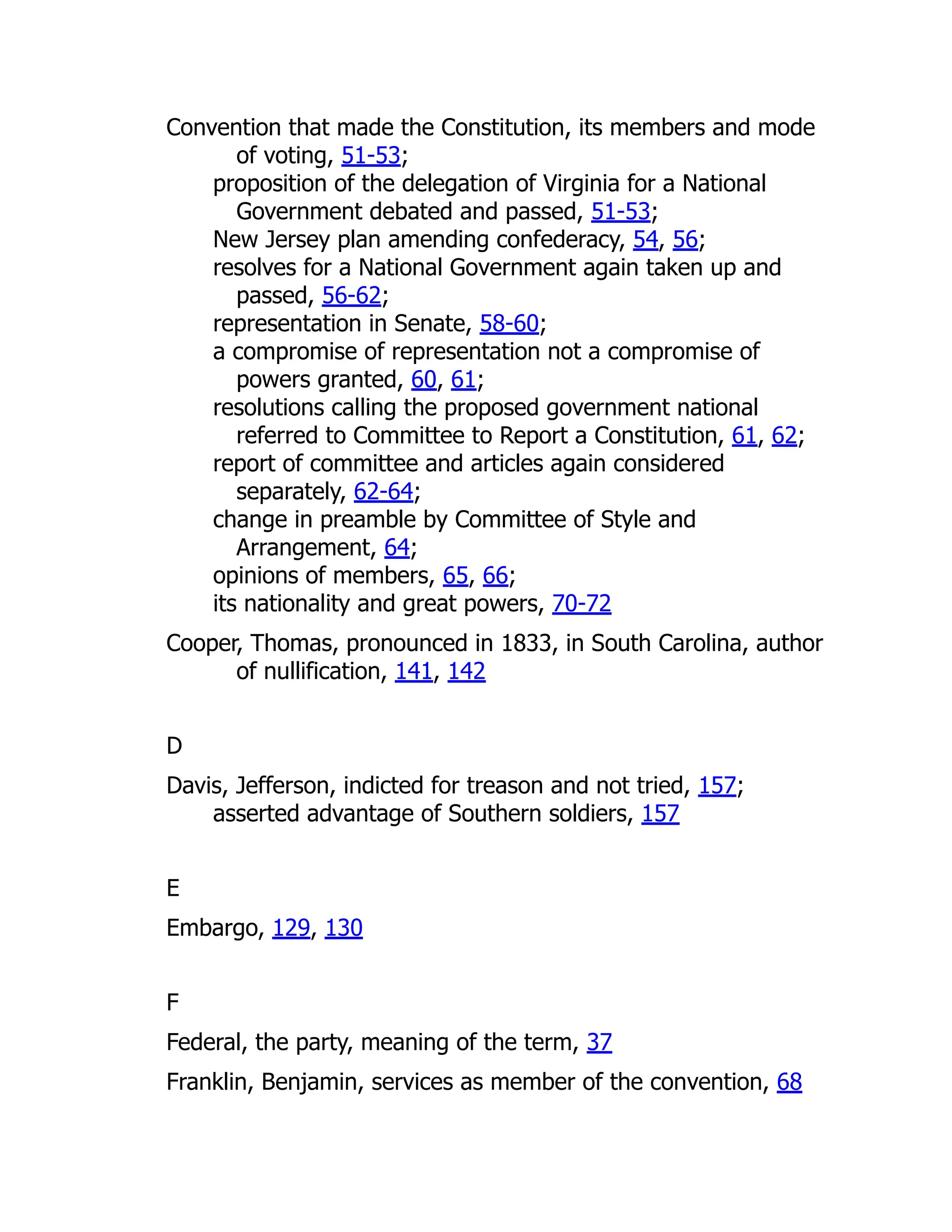
INDEX.
A
Adams, Charles Francis,Minister to England, 3
Adams, Henry, opinion concerning Virginia’s estimation of
validity of United States laws, 100;
controverted, 113-115
Adams, John, influence of Alien and Sedition laws on re-
election, 112
Alien and Sedition laws of 1798, 88;
Jefferson’s opposition to, 88;
influence in defeating federal party, 112
Amendments to Constitution, how made, 40;
first ten articles, 78, 79
B
British opinion of right of secession, 2-3
Bryce, James, on right of Southern States, 3;
theory of his book, 3, note
C
Calhoun, John C., United States a confederacy, not a nation, 24;
his youthful prominence in Congress, 34;
his early opinions of the Constitution, 134, 135;
change of opinion, 137, 138;
personal appearance, 138, 139;
his reasoning on right of nullification, 140;
32.
his argument considered,140, 141
Chase, Salmon P., decision on secession, 34, 35
Clay, Henry, tariff compromise, 23
Clinton, George, his opinion as stated by Mr. Lodge, 5;
his written declaration that the United States Government is
perpetual, 77, 78
Compact, may be for national, indissoluble government, 28, 29;
a voluntary union of independent nations must be by
compact, 28;
Southern views of, 30
Confederacy of the Southern States, constitution and compact
as to slavery, 158
Confederacy of the United States, its failure, 31, 32;
dependent upon the States, 48
Constitution of United States, adoption by Continental Congress,
States, and people, 32;
perpetuity declared in preamble, 33, 34;
supremacy, 35, 36, 49;
oath of every State officer and judge to support, 36;
supremacy in all sovereign powers, 37, 38;
prohibitions to States, 38, 39, 47;
power to coerce States in articles punishing treason, 41, 42,
43;
can take all powers from States by amendments, 45, 46;
made States suable, 44;
powers given by Constitution to States, 46;
naturalization, 47;
takes from States powers of resistance, 47, 48;
its excellence proved by few amendments, 159, 160;
its adoption opposed on account of its nationality and of
excessive powers given, 69-73;
no claim of right of secession or nullification suggested in
the conventions adopting the Constitution, 73
33.
Convention that madethe Constitution, its members and mode
of voting, 51-53;
proposition of the delegation of Virginia for a National
Government debated and passed, 51-53;
New Jersey plan amending confederacy, 54, 56;
resolves for a National Government again taken up and
passed, 56-62;
representation in Senate, 58-60;
a compromise of representation not a compromise of
powers granted, 60, 61;
resolutions calling the proposed government national
referred to Committee to Report a Constitution, 61, 62;
report of committee and articles again considered
separately, 62-64;
change in preamble by Committee of Style and
Arrangement, 64;
opinions of members, 65, 66;
its nationality and great powers, 70-72
Cooper, Thomas, pronounced in 1833, in South Carolina, author
of nullification, 141, 142
D
Davis, Jefferson, indicted for treason and not tried, 157;
asserted advantage of Southern soldiers, 157
E
Embargo, 129, 130
F
Federal, the party, meaning of the term, 37
Franklin, Benjamin, services as member of the convention, 68
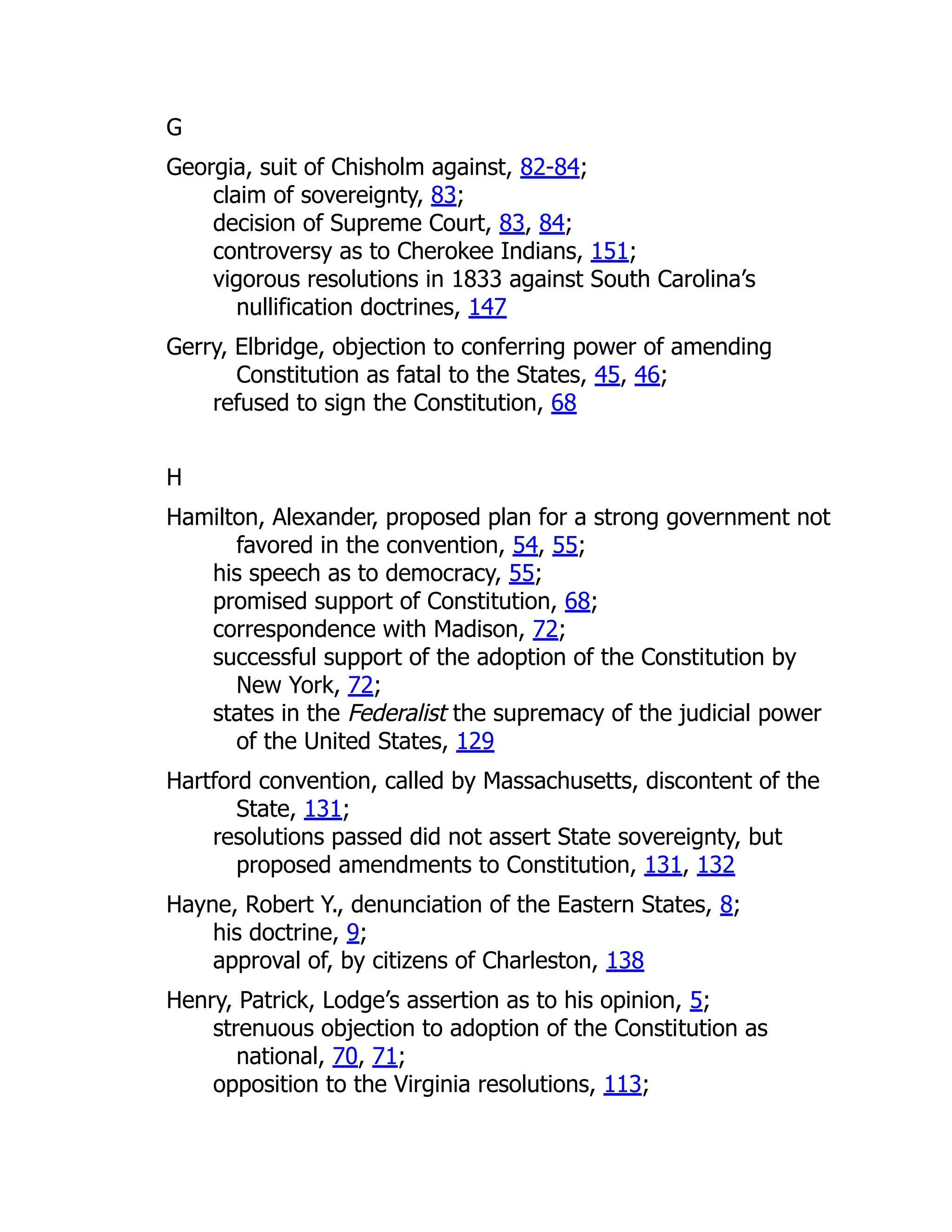
34.
G
Georgia, suit ofChisholm against, 82-84;
claim of sovereignty, 83;
decision of Supreme Court, 83, 84;
controversy as to Cherokee Indians, 151;
vigorous resolutions in 1833 against South Carolina’s
nullification doctrines, 147
Gerry, Elbridge, objection to conferring power of amending
Constitution as fatal to the States, 45, 46;
refused to sign the Constitution, 68
H
Hamilton, Alexander, proposed plan for a strong government not
favored in the convention, 54, 55;
his speech as to democracy, 55;
promised support of Constitution, 68;
correspondence with Madison, 72;
successful support of the adoption of the Constitution by
New York, 72;
states in the Federalist the supremacy of the judicial power
of the United States, 129
Hartford convention, called by Massachusetts, discontent of the
State, 131;
resolutions passed did not assert State sovereignty, but
proposed amendments to Constitution, 131, 132
Hayne, Robert Y., denunciation of the Eastern States, 8;
his doctrine, 9;
approval of, by citizens of Charleston, 138
Henry, Patrick, Lodge’s assertion as to his opinion, 5;
strenuous objection to adoption of the Constitution as
national, 70, 71;
opposition to the Virginia resolutions, 113;
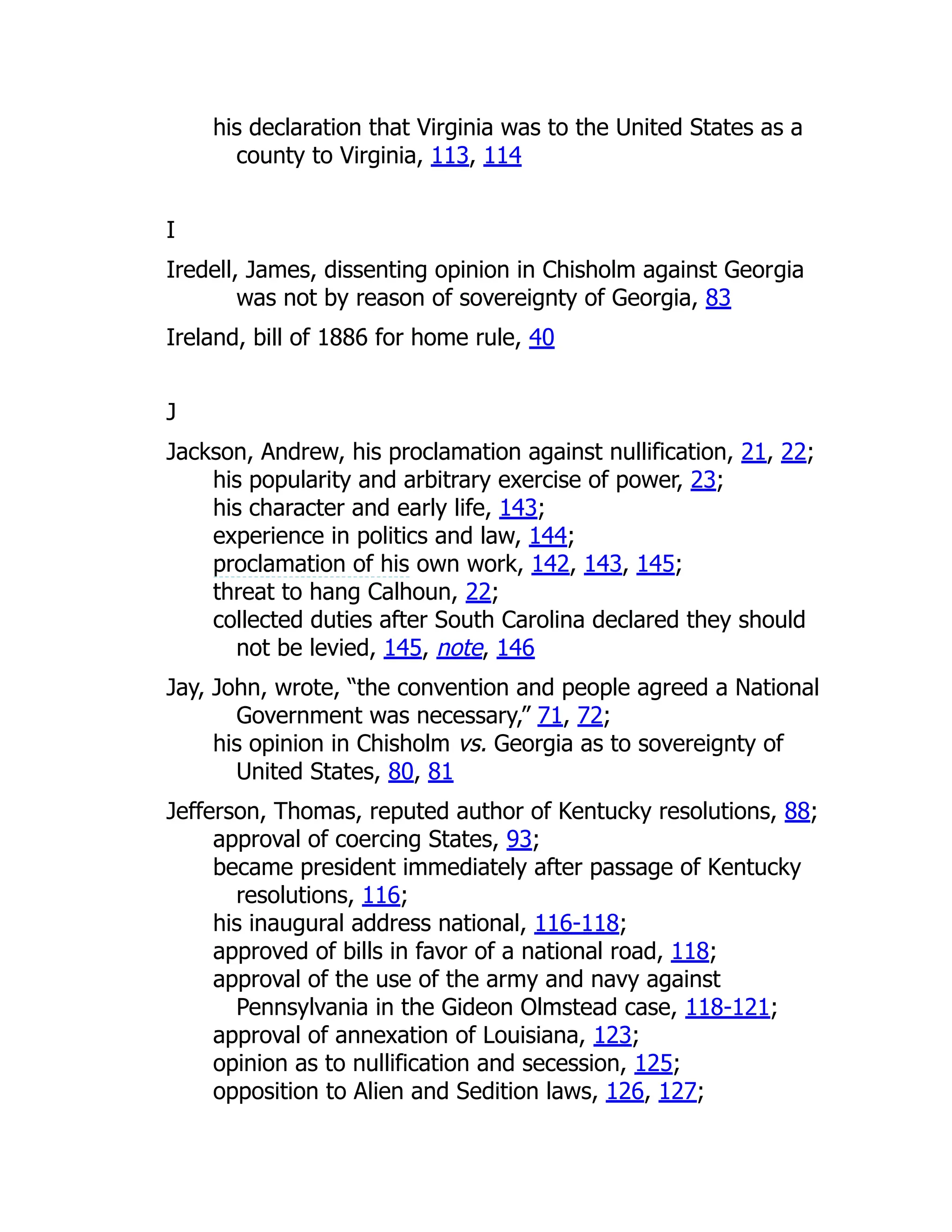
35.
his declaration thatVirginia was to the United States as a
county to Virginia, 113, 114
I
Iredell, James, dissenting opinion in Chisholm against Georgia
was not by reason of sovereignty of Georgia, 83
Ireland, bill of 1886 for home rule, 40
J
Jackson, Andrew, his proclamation against nullification, 21, 22;
his popularity and arbitrary exercise of power, 23;
his character and early life, 143;
experience in politics and law, 144;
proclamation of his own work, 142, 143, 145;
threat to hang Calhoun, 22;
collected duties after South Carolina declared they should
not be levied, 145, note, 146
Jay, John, wrote, “the convention and people agreed a National
Government was necessary,” 71, 72;
his opinion in Chisholm vs. Georgia as to sovereignty of
United States, 80, 81
Jefferson, Thomas, reputed author of Kentucky resolutions, 88;
approval of coercing States, 93;
became president immediately after passage of Kentucky
resolutions, 116;
his inaugural address national, 116-118;
approved of bills in favor of a national road, 118;
approval of the use of the army and navy against
Pennsylvania in the Gideon Olmstead case, 118-121;
approval of annexation of Louisiana, 123;
opinion as to nullification and secession, 125;
opposition to Alien and Sedition laws, 126, 127;
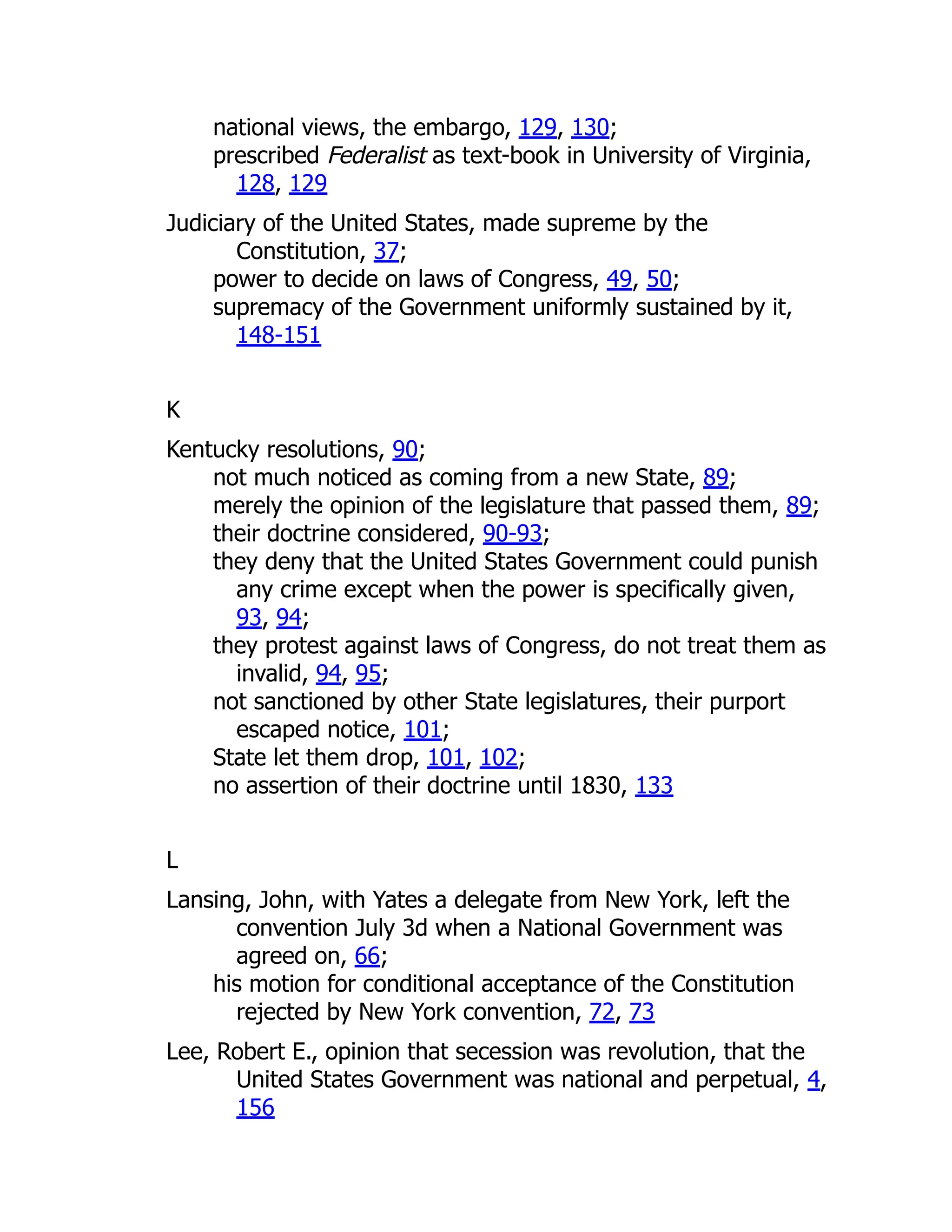
36.
national views, theembargo, 129, 130;
prescribed Federalist as text-book in University of Virginia,
128, 129
Judiciary of the United States, made supreme by the
Constitution, 37;
power to decide on laws of Congress, 49, 50;
supremacy of the Government uniformly sustained by it,
148-151
K
Kentucky resolutions, 90;
not much noticed as coming from a new State, 89;
merely the opinion of the legislature that passed them, 89;
their doctrine considered, 90-93;
they deny that the United States Government could punish
any crime except when the power is specifically given,
93, 94;
they protest against laws of Congress, do not treat them as
invalid, 94, 95;
not sanctioned by other State legislatures, their purport
escaped notice, 101;
State let them drop, 101, 102;
no assertion of their doctrine until 1830, 133
L
Lansing, John, with Yates a delegate from New York, left the
convention July 3d when a National Government was
agreed on, 66;
his motion for conditional acceptance of the Constitution
rejected by New York convention, 72, 73
Lee, Robert E., opinion that secession was revolution, that the
United States Government was national and perpetual, 4,
156
37.
Lieber, Francis, onWebster’s oratory, 13
Lincoln, Abraham, acts in Merriam’s case, declaration of freedom
to slaves, 46, 159
Livingston, Edward, Jackson’s proclamation, 142, 143
Lodge, Henry Cabot, on secession and Webster’s argument, 5,
6;
on Josiah Quincy and Hartford convention, 132
M
Madison, James, protective duties, 26;
as to compact, 29;
suggestions as to convention to form government, 51;
letter to Hamilton on adoption of Constitution, 72;
wrongly accused of support of nullification, 96;
author of Virginia resolutions of 1798 and explanation of
1799, 102;
a strict constructionist, 82;
signed re-charter of the United States Bank, 133;
see Virginia resolutions
Marshall, John, Chief-Justice, declaration concerning supremacy
of United States, 142;
that State courts had invariably yielded, 150
Martin, Luther, definition of extent of judicial power of United
States, 20;
objection to punishing treason, 43
Mason, George, insisted on National Government, 57;
refused to sign Constitution, reasons, 69
Massachusetts, acceptance of Constitution and use of word
compact, 75;
submission to embargo, 30
Military academies in Southern States, 158
38.
Missouri Compromise, 135,136
Morley, John, on British opinion, 2, 3
Morris, Gouverneur, report of draft of Constitution, 64;
on the importance of the Mississippi, 123
N
New England, discontent with embargo and submission, 130
New York, consideration of the acceptance of the Constitution,
72, 73;
unanimous assertion of its convention that the adoption
was for perpetuity, 77, 78
Nullification, claim that validity of laws of general government
are at the caprice of each State, 25, 26;
no suggestion of such right in conventions, 75;
no claim of such right save in Kentucky resolutions until
1830, 133;
so stated by Jackson, Marshall, and the nullifiers of South
Carolina, 141, 142
P
Pennsylvania, resistance to excise law, 84, 85;
resistance to United States in Gideon Olmstead case, 118-
122;
proposition to Virginia for amendment of Constitution as to
questions between States and United States, 122, 123
Pinckney, Charles C., declaration in convention of South Carolina
that the States never had sovereignty, 74;
satisfaction with Constitution, 67
Pinckney, Charles, declaration as to nationality of the
Constitution, 74
39.
Q
Quincy, Josiah, hisdeclaration a threat of rebellion, not a claim
of right of secession, 124, 125;
non-concurrence of Massachusetts, 124, 130, 131;
not made delegate to Hartford convention, 132
R
Randolph, Edmund, introduced national resolutions in
convention, 51;
did not sign Constitution, 69;
supported it in Virginia convention, 71
Resolutions of State legislatures are mere opinions, 89;
even when declaring laws of United States null and void,
148
S
Secession, general belief in right of, by Southern and English
writers, 1-4;
belief of some Northern writers, 5, 6;
impracticability of claim, 25;
declaration of perpetuity in preamble of Constitution, 33,
34;
historically no claim of such right until 1830, 142
Senate, equality of States in, merely a compromise of
representation, 60, 61
Slavery abolished by power given in Constitution, 46, 158
South Carolina, declaration concerning tariff, warlike
preparations, 138;
original adoption of the Constitution, 73, 74;
nationality asserted in convention, 74;
only State asserting right of nullification in 1833, 146;
40.
resolutions of otherSouthern States opposing her opinions,
146-148;
collection of duties after State ordinance, 145, 146, and
note;
submission to judgment overruling taxation of United States
Bank, 150;
first State to secede, 155;
statue of Calhoun and monument at Spartanburg, 161, 162
Southern States, satisfaction with Constitution at first, 67;
opposition to secession in 1833, 146;
resolves of legislatures, 146-148;
change of views, 154;
control of the government before the Civil War, 153;
laws of United States and decision of Supreme Court
establishing right to introduce slaves into territories, 154;
preparations for secession, 155;
confidence of success, 157
State governments, powers derived from Constitutions, 27;
subordinate and local, 39, 40;
limited under the Constitution of United States, 46;
original sovereignty questioned, 79-81;
admitted by Webster, 80;
denied in convention of South Carolina, 74;
resolutions of legislatures mere opinions, 148
Stephens, Alexander H., on secession, 1, 2
Story, Joseph, Judge of Supreme Court, doctrine of supremacy
of United States, tenacity in his belief, 152, 153
Supreme Court of United States, its powers principally those of
restraint, 152;
see Judiciary of the United States
T
41.
Taney, Roger B.,Chief-Justice, maintained authority of United
States, 151 and note
Tariffs, for revenue and protection, second act, first Congress,
26;
no question of power then, 81, 82
Taylor, John, views concerning the government, 114, 115
Treason, crime according to the Constitution, 41;
right of government to punish, implies its citizens owe
allegiance, 41;
a confederacy does not punish it, 41;
the old confederacy, 41;
consideration of the clauses of punishment of, 41, 42
U
United States Government, limited to powers granted by the
Constitution, 27;
was a nation or a confederacy made? 28, 29;
the compact was for a nation, 30;
perpetuity declared in preamble, 34;
its supremacy expressly declared and nature of powers
granted, 35, 36;
great powers over States, 38, 44;
can be extended by amendment, 45, 46;
see Judiciary of the United States
V
Virginia, acceptance of Constitution, 76;
its powers derived from the people of the United States,
76;
approval by legislature of the supremacy of the United
States judiciary, 122, 123;
did not secede, reasons for joining the South, 156
42.
Virginia resolutions, statementof, 98, 99;
did not declare a State could interpose, 99;
a denunciation of assumption of undelegated powers by
United States, 99;
opposed by other States, 100, 101;
explanation of their meaning, 102-111;
State means people of the State, 103, 104;
of rights of States in case of usurpations, 105;
right to redress usurpations, 105, 106;
admission of authority of judiciary, 106;
allegation that assumption of undelegated powers would
end in monarchy, 108;
attack on Alien and Sedition laws, 109, 111, 112;
assertion that resolutions are mere opinions, 109, 110;
patriotism of the State, 111;
remedial methods suggested, 112
W
Walker, Robert J., as to Jefferson’s views of nullification, 125;
successful canvass of Mississippi, 147
Washington, George, services in convention, 67, 68;
suppression of insurrection by military force, 84;
letter on disbanding the army, 86;
letter submitting Constitution to each State as to
consolidation of Union, 86;
farewell address, on unity of government, 86;
action on the Virginia resolutions, 113
Webster, Daniel, personal appearance, 1;
reply to Hayne’s attack on the East, 11, 12;
the coalition and Banquo’s ghost, 10, 11;
eulogium of South Carolina, 13;
declaration that the government was made by the people,
for the people, 16;
supremacy and nationality of government, 16-21
43.
Wilson, James, servicesin the general and State conventions,
70
Wolseley, Lord, as to Lee and secession, 4
44.
FOOTNOTES:
[1] Bryce’s AmericanCommonwealth, vol. i., pages 409 and seq. Yet Mr. Bryce’s whole
work is in accordance with the theory he asserts at the beginning of chapter iv., vol. i.,
page 29: “The acceptance of the Constitution of 1789 made the American people a
nation. It turned what had been a league of States into a Federal State by giving it a
National Government with a direct authority over all citizens.”
[2] General Long’s Memoirs of Lee, page 88.
[3] Lodge’s Webster, p. 187.
[4] Chief-Justice Marshall, in his opinion in the case of Cohens vs. Virginia, says that its
requisitions were habitually disregarded by the States. Mr. John Fiske, in his admirable
work, called The Critical Period of American History, fully shows the inefficiency and
inadequacy of the government of the Confederacy.
[5] See Webster’s speech in answer to Calhoun, Webster’s Speeches, vol. ii., page 180.
Ed. of 1850.
[6] Webster’s definition of constitution apparently is not a full one. A constitution is the
fundamental statement of the powers granted to the government established by it; and
it may, as Webster says, also contain the regulation under which its authority is to be
executed.
[7] As the whole question of nullification depends upon whether a State is bound by a
decision of the United States Court we give Mr. Martin’s succinct and comprehensive
statement of the power that the third article of the Constitution conferred on the United
States. “Whether, therefore, any laws or regulations of the Congress, any acts of its
President or other officers, are contrary to, or not warranted by the Constitution, rests
only with the judges, who are appointed by Congress, to determine; by whose
determination every State must be bound.” Luther Martin’s letter, Elliot’s Debates
(second ed.), 1863, vol. i., p. 380.
[8] Jackson’s proclamation, Elliot’s Debates, 582. Elliot’s Debates were published by
authority of Congress, Calhoun highly praising them. See his letter in the beginning of
vol. i.
[9] Great Senators, by Oliver Dyer, p. 153.
[10] See 4 Elliot’s Debates, pp. 345 and 349, showing at the inception and in the early
period of our government protective duties were apparently universally approved by
Congress and the Presidents.
[11] See also, to same effect, North American Review, Oct., 1830, p. 537. Madison’s
letter to Edward Everett.
[12] Webster’s Speeches, vol. ii., ed. 1850, p. 177.
[13] The condition of affairs then is well stated in Fiske’s Critical Period of American
45.
History.
[14] 7 WallaceReports, p. 700.
[15] In case of White vs. Hart, 13 Wallace, 646.
[16] Keith vs. Clark, 97 United States Reports, 476.
[17] See Constitution of United States, Article I., Sections 8, 9, and 10, for statement of
granted powers and restrictions on States.
[18] Martin’s Letter, Elliot’s Debates, vol. I., pp. 382, 383.
[19] 5 Elliot, p. 530. The clause was altered so that the ratification of three fourths of
the Legislatures of the States was required, though two thirds of the States can call a
new convention, and two thirds of Congress propose amendments to the Constitution.
[20] 5 Elliot, 132-34.
[21] 1 Elliot, 391 and 392. Yates’ minutes.
[22] 5 Elliot, 189-90 states the resolutions.
[23] 5 Elliot, 192, sixth resolve.
[24] 5 Elliot, 199.
[25] See his plan, 5 Elliot, 205.
[26] 5 Elliot, 212.
[27] Elliot, 423; also 5 Elliot, p. 206 note.
[28] 5 Elliot, 212.
[29] 5 Elliot, 216, 217.
[30] 5 Elliot, 223.
[31] 5 Elliot, 240 and note.
[32] 1 Elliot, 469.
[33] See estimates, Note 160, 5 Elliot, 598.
[34] 1 Elliot, 472.
[35] 5 Elliot, 357.
[36] 5 Elliot, 357.
[37] 5 Elliot, 374-6.
[38] Copy of Constitution as reported, 5 Elliot, 376-81.
[39] 5 Elliot, 447.
[40] 5 Elliot, 451. Article VII., Sec. 2, was then agreed to nem-con.
[41] 5 Elliot, 467.
[42] 5 Elliot, 310.
[43] 1 Elliot, 480.
46.
[44] Virginia opposedthe importation of slaves. Mason particularly condemned it. 5
Elliot, 458.
[45] 5 Elliot, 489.
[46] 5 Elliot, 278.
[47] 2 Elliot, 526.
[48] 3 Elliot, 22.
[49] See Mason’s objections, 1 Elliot, 494, also Debates.
[50] 3 Elliot, 64.
[51] 1 Elliot, 496.
[52] 2 Elliot, 412. The acceptance was passed in full confidence that the bill of rights
proposed by New York would be passed.
[53] 4 Elliot, 256.
[54] 4 Elliot, 301.
[55] 4 Elliot, 313. The objections to the Constitution came very generally from the
interior western parts of the State. They were so in Massachusetts, Virginia, and New
York.
[56] Circular-letter from the convention of New York to the governors of the several
States of the Union. Elliot’s Debates, vol. ii., pages 413, 414.
[57] See 2 Dallas Reports, p. 471, for opinion in full.
[58] Madison’s letter to Jos. C. Cabell: Consideration No. 8. 4 Elliot, 602.
[59] 2 Dallas Reports, 419.
[60] Providence Bank vs. Billings, 4 Peters, 514.
[61] Chief-Justice Marshall’s remarks in Cohens vs. Virginia, 6 Wallace, 264.
[62] Hildreth’s History, vol. iv., p. 515.
[63] Eliot’s Manual of United States History, 266.
[64] Sparks’ Washington, vol. xii., p. 214.
[65] Two drafts of the resolutions in his handwriting were found amongst his papers
and are published in his writings.
[66] Article III., Sec. 1, of the Constitution.
[67] Washington’s letter to Dr. Wm. Gordon. Bancroft’s History of the Constitution, vol.
i., p. 320, Appendix.
See also in Jefferson’s Works, letter to Madison, April 16, 1781, approving of coercion
by a party to a compact.
[68] Kentucky resolutions, 4 Elliot, 540.
[69] See vol. i., Bryce’s American Commonwealth, p. 328.
[70] Bledsoe, Is Jefferson Davis a Traitor, p. 173.
47.
[71] There areseveral works on the Constitution by Story, Bancroft, G. T. Curtis, and
others, but none of them that we have seen, except the recent work of Professor Hare,
that ably treats the matter, has taken up the question of nullification and secession.
Apparently the authors did not think such a claim could be made. Some editions
recently published have notes on this matter.
[72] Virginia’s resolutions and explanations, 4 Elliot, 528, 529, 546 to 580.
[73] Hildreth’s History of U. S., vol. v., p. 296.
[74] 4 Elliot, pp. 532-9.
[75] Hildreth’s History, vol. v., 296.
[76] 4 Elliot, 545.
[77] 4 Elliot, 578.
[78] Madison’s letter to Everett, before referred to. Oct. No. N. Amer. Review, 1830.
[79] Washington’s letter to Henry, Sparks’ Washington, vol. xi., p. 387. The letter also
contains his opinion of those in opposition to the government.
[80] Wirt’s Life of Patrick Henry, pp. 393, 394. Moses Coit Tyler’s Life of Patrick Henry,
p. 373.
[81] H. Adams, vol. i., p. 200.
[82] H. Adams, vol. i., p. 203.
[83] A full account of this case, though well known and reported, is not to be found in
the histories. The case was referred to as the Gideon Olmstead case in the debates in
Congress at the time of South Carolina’s threatened nullification in 1833. The account of
the trial of General Bright is taken from Carson’s History of the Supreme Court of the
United States, p. 213 and seq.
[84] Webster’s Speeches, 8th ed., 1850, vol. i., pp. 427, 428. See part of report and
resolutions of Virginia in Mr. Pinckney’s argument in Cohens vs. Virginia, 6 Wheaton,
Rep., 264.
[85] 5 Elliot, 526.
[86] H. Adams’ History, vol. v., p. 326.
[87] See No. lxxx. of the Federalist for Hamilton’s clear and able statement of the
powers of the judicial department. He says it is a political axiom, that the judicial power
of a government should be co-extensive with its legislative, and that the government
should and did have the power over States and their judiciary in all cases arising under
the Constitution and United States laws.
[88] Lodge’s Life of George Cabot, p. 518.
[89] History of Hartford Convention, by Theo. Dwight.
[90] Madison’s letter, 4 Elliot’s Debates, 615.
[91] H. Adams, vol. vi., p. 143.
[92] H. Adams, vol. ix., p. 115. Annals of Congress, 1815-1816, p. 1272.
48.
[93] H. Adams,vol. ix., p. 116.
[94] H. Adams, vol. ix., p. 148.
[95] See H. Adams, vol. ix., pp. 149 to 153, for debate and Calhoun’s views.
[96] Oliver Dyer’s Great Senators, pp. 183, 184.
[97] 4 Elliot, 584.
[98] Niles’ Register, p. 335, July 20, 1833. Cooper was President of the University of
South Carolina. The University of Virginia would not have him as professor on account
of his Unitarian belief, though Jefferson wished it. Is it possible that he was the original
author of the Kentucky Resolutions, and furnished them to Jefferson? Jefferson’s
correspondence, as far as we have examined, shows no belief in that doctrine.
[99] Parton’s Life of Jackson, vol. iii., p. 466.
[100] Alex. Johnston, in Winsor’s History of America, vol. vii., p. 286, says that Jackson
collected the duties at Charleston by naval and military force, and that the day before
February 1st a meeting of “leading nullifiers” agreed to avoid all collision with the
Federal Government.
[101] Article by R. J. Walker on “Nullification and Secession,” February, 1863, p. 179,
Continental Monthly Magazine.
[102] State papers on nullification, collected and published in 1834 by order of the
General Court of Massachusetts. The volume contains the remonstrances of many State
Legislatures besides those quoted. It has also the ordinance of the South Carolina
convention at the adjournment, held March 19, 1833, in which the convention declared
the State’s nullification of the force bill of Congress of March 2d then enforced: this
declaration was mere brutum fulmen.
[103] United States vs. Peters, 5 Cranch, 115.
[104] McKim vs. Voorhies, 7 Cranch, 279.
[105] Green vs. Biddle, 8 Wheaton, 1.
[106] McCulloch vs. Maryland, 4 Wheaton, 316.
[107] Cohens vs. Virginia, 6 Wheaton, 264.
[108] Bank of U. S. vs. Osborn, 9 Wheaton, 738.
[109] Weston vs. Charleston, 2 Peters, 449.
[110] Cohens vs. Virginia.
[111] See 22 Howard, 227; Sinnott vs. Davenport, 21 Howard, 506; Ableman vs. Booth,
5 Howard, 134; Rowan vs. Runnells. In these two last cases Taney and the Court put
aside the decrees of the Supreme Courts of Wisconsin and Mississippi, because they
were in conflict with the powers given to the United States; in the latter case, overruling
and even reversing the decision of the Supreme Court of Mississippi as to when its
constitution took effect.
[112] General Jackson’s sympathy was with Georgia in this matter, and he is reported as
saying: “John Marshall has made the decision, now let him execute it.” The missionary
49.
that Georgia hadimprisoned was, however, released by the State.
[113] Ex parte Milligan, 4, Wallace, 2.
[114] Atlantic Monthly, January, 1892.
[115] Reuben Davis’ Recollections, p. 395.
[116] See article by John S. Wise in the Century Magazine, Jan., 1890. The Virginia
Military Academy was established by the State in 1839. Col. Smith, a graduate of West
Point, was at the head. It was continued during the civil war under the charge of
disabled officers. In 1860 a professor in this school informed the writer that there were
similar academies in all the Southern States. Apparently they have been discontinued in
most of them, South Carolina, however, yet maintaining hers.
[117] This was written four years ago: Charleston now shows few signs of the
earthquake, and Calhoun’s statue has mellowed into a pleasing bronze color.
Transcriber’s Note:
Punctuation has been standardised—in particular, missing periods
and quotation marks have been supplied where obviously
required. All other original errors and inconsistencies have been
retained, except as follows (the first line is the original text, the
second the passage as currently stands):
Page iv:
and not “We the States,”
and not “We, the States,”
Page 10:
they had ‘filled their mind,’ that their
they had ‘filed their mind,’ that their
Page 18:
political system which it established
political system which is established
Page 18:
sovereign powers a government.
sovereign powers a government?
50.
Page 83:
reasoned opinions.Iredell a member
reasoned opinions. Iredell, a member
Page 101:
United States laws though asserted
United States laws, though asserted
Page 128:
the pleasing collonaded buildings
the pleasing colonnaded buildings
Page 163:
right of secession, 213
right of secession, 2-3
Page 166:
proclamation his own work
proclamation of his own work
Footnote 1:
of chapter iv., vol. 1, page 29:
of chapter iv., vol. i., page 29:
Footnote 25:
See his plan, 5 Elliott, 205.
See his plan, 5 Elliot, 205.
Footnote 68:
Kentucky resolutions, 4 Elliott, 540.
Kentucky resolutions, 4 Elliot, 540.
Footnote 80:
pp. 393, 394. John Coit Tyler’s
pp. 393, 394. Moses Coit Tyler’s
Footnote 84:
Virginia in Mr. Pinkney’s argument
Virginia in Mr. Pinckney’s argument
51.
*** END OFTHE PROJECT GUTENBERG EBOOK NULLIFICATION,
SECESSION, WEBSTER'S ARGUMENT, AND THE KENTUCKY AND
VIRGINIA RESOLUTIONS ***
Updated editions will replace the previous one—the old editions
will be renamed.
Creating the works from print editions not protected by U.S.
copyright law means that no one owns a United States
copyright in these works, so the Foundation (and you!) can copy
and distribute it in the United States without permission and
without paying copyright royalties. Special rules, set forth in the
General Terms of Use part of this license, apply to copying and
distributing Project Gutenberg™ electronic works to protect the
PROJECT GUTENBERG™ concept and trademark. Project
Gutenberg is a registered trademark, and may not be used if
you charge for an eBook, except by following the terms of the
trademark license, including paying royalties for use of the
Project Gutenberg trademark. If you do not charge anything for
copies of this eBook, complying with the trademark license is
very easy. You may use this eBook for nearly any purpose such
as creation of derivative works, reports, performances and
research. Project Gutenberg eBooks may be modified and
printed and given away—you may do practically ANYTHING in
the United States with eBooks not protected by U.S. copyright
law. Redistribution is subject to the trademark license, especially
commercial redistribution.
START: FULL LICENSE
PLEASE READ THISBEFORE YOU DISTRIBUTE OR USE THIS WORK
To protect the Project Gutenberg™ mission of promoting the
free distribution of electronic works, by using or distributing this
work (or any other work associated in any way with the phrase
“Project Gutenberg”), you agree to comply with all the terms of
the Full Project Gutenberg™ License available with this file or
online at www.gutenberg.org/license.
Section 1. General Terms of Use and
Redistributing Project Gutenberg™
electronic works
1.A. By reading or using any part of this Project Gutenberg™
electronic work, you indicate that you have read, understand,
agree to and accept all the terms of this license and intellectual
property (trademark/copyright) agreement. If you do not agree
to abide by all the terms of this agreement, you must cease
using and return or destroy all copies of Project Gutenberg™
electronic works in your possession. If you paid a fee for
obtaining a copy of or access to a Project Gutenberg™
electronic work and you do not agree to be bound by the terms
of this agreement, you may obtain a refund from the person or
entity to whom you paid the fee as set forth in paragraph 1.E.8.
1.B. “Project Gutenberg” is a registered trademark. It may only
be used on or associated in any way with an electronic work by
people who agree to be bound by the terms of this agreement.
There are a few things that you can do with most Project
Gutenberg™ electronic works even without complying with the
full terms of this agreement. See paragraph 1.C below. There
are a lot of things you can do with Project Gutenberg™
electronic works if you follow the terms of this agreement and
help preserve free future access to Project Gutenberg™
electronic works. See paragraph 1.E below.
54.
1.C. The ProjectGutenberg Literary Archive Foundation (“the
Foundation” or PGLAF), owns a compilation copyright in the
collection of Project Gutenberg™ electronic works. Nearly all the
individual works in the collection are in the public domain in the
United States. If an individual work is unprotected by copyright
law in the United States and you are located in the United
States, we do not claim a right to prevent you from copying,
distributing, performing, displaying or creating derivative works
based on the work as long as all references to Project
Gutenberg are removed. Of course, we hope that you will
support the Project Gutenberg™ mission of promoting free
access to electronic works by freely sharing Project Gutenberg™
works in compliance with the terms of this agreement for
keeping the Project Gutenberg™ name associated with the
work. You can easily comply with the terms of this agreement
by keeping this work in the same format with its attached full
Project Gutenberg™ License when you share it without charge
with others.
1.D. The copyright laws of the place where you are located also
govern what you can do with this work. Copyright laws in most
countries are in a constant state of change. If you are outside
the United States, check the laws of your country in addition to
the terms of this agreement before downloading, copying,
displaying, performing, distributing or creating derivative works
based on this work or any other Project Gutenberg™ work. The
Foundation makes no representations concerning the copyright
status of any work in any country other than the United States.
1.E. Unless you have removed all references to Project
Gutenberg:
1.E.1. The following sentence, with active links to, or other
immediate access to, the full Project Gutenberg™ License must
appear prominently whenever any copy of a Project
Gutenberg™ work (any work on which the phrase “Project
55.
Gutenberg” appears, orwith which the phrase “Project
Gutenberg” is associated) is accessed, displayed, performed,
viewed, copied or distributed:
This eBook is for the use of anyone anywhere in the United
States and most other parts of the world at no cost and
with almost no restrictions whatsoever. You may copy it,
give it away or re-use it under the terms of the Project
Gutenberg License included with this eBook or online at
www.gutenberg.org. If you are not located in the United
States, you will have to check the laws of the country
where you are located before using this eBook.
1.E.2. If an individual Project Gutenberg™ electronic work is
derived from texts not protected by U.S. copyright law (does not
contain a notice indicating that it is posted with permission of
the copyright holder), the work can be copied and distributed to
anyone in the United States without paying any fees or charges.
If you are redistributing or providing access to a work with the
phrase “Project Gutenberg” associated with or appearing on the
work, you must comply either with the requirements of
paragraphs 1.E.1 through 1.E.7 or obtain permission for the use
of the work and the Project Gutenberg™ trademark as set forth
in paragraphs 1.E.8 or 1.E.9.
1.E.3. If an individual Project Gutenberg™ electronic work is
posted with the permission of the copyright holder, your use and
distribution must comply with both paragraphs 1.E.1 through
1.E.7 and any additional terms imposed by the copyright holder.
Additional terms will be linked to the Project Gutenberg™
License for all works posted with the permission of the copyright
holder found at the beginning of this work.
1.E.4. Do not unlink or detach or remove the full Project
Gutenberg™ License terms from this work, or any files
56.
containing a partof this work or any other work associated with
Project Gutenberg™.
1.E.5. Do not copy, display, perform, distribute or redistribute
this electronic work, or any part of this electronic work, without
prominently displaying the sentence set forth in paragraph 1.E.1
with active links or immediate access to the full terms of the
Project Gutenberg™ License.
1.E.6. You may convert to and distribute this work in any binary,
compressed, marked up, nonproprietary or proprietary form,
including any word processing or hypertext form. However, if
you provide access to or distribute copies of a Project
Gutenberg™ work in a format other than “Plain Vanilla ASCII” or
other format used in the official version posted on the official
Project Gutenberg™ website (www.gutenberg.org), you must,
at no additional cost, fee or expense to the user, provide a copy,
a means of exporting a copy, or a means of obtaining a copy
upon request, of the work in its original “Plain Vanilla ASCII” or
other form. Any alternate format must include the full Project
Gutenberg™ License as specified in paragraph 1.E.1.
1.E.7. Do not charge a fee for access to, viewing, displaying,
performing, copying or distributing any Project Gutenberg™
works unless you comply with paragraph 1.E.8 or 1.E.9.
1.E.8. You may charge a reasonable fee for copies of or
providing access to or distributing Project Gutenberg™
electronic works provided that:
• You pay a royalty fee of 20% of the gross profits you derive
from the use of Project Gutenberg™ works calculated using the
method you already use to calculate your applicable taxes. The
fee is owed to the owner of the Project Gutenberg™ trademark,
but he has agreed to donate royalties under this paragraph to
the Project Gutenberg Literary Archive Foundation. Royalty
57.
payments must bepaid within 60 days following each date on
which you prepare (or are legally required to prepare) your
periodic tax returns. Royalty payments should be clearly marked
as such and sent to the Project Gutenberg Literary Archive
Foundation at the address specified in Section 4, “Information
about donations to the Project Gutenberg Literary Archive
Foundation.”
• You provide a full refund of any money paid by a user who
notifies you in writing (or by e-mail) within 30 days of receipt
that s/he does not agree to the terms of the full Project
Gutenberg™ License. You must require such a user to return or
destroy all copies of the works possessed in a physical medium
and discontinue all use of and all access to other copies of
Project Gutenberg™ works.
• You provide, in accordance with paragraph 1.F.3, a full refund of
any money paid for a work or a replacement copy, if a defect in
the electronic work is discovered and reported to you within 90
days of receipt of the work.
• You comply with all other terms of this agreement for free
distribution of Project Gutenberg™ works.
1.E.9. If you wish to charge a fee or distribute a Project
Gutenberg™ electronic work or group of works on different
terms than are set forth in this agreement, you must obtain
permission in writing from the Project Gutenberg Literary
Archive Foundation, the manager of the Project Gutenberg™
trademark. Contact the Foundation as set forth in Section 3
below.
1.F.
1.F.1. Project Gutenberg volunteers and employees expend
considerable effort to identify, do copyright research on,
transcribe and proofread works not protected by U.S. copyright
58.
law in creatingthe Project Gutenberg™ collection. Despite these
efforts, Project Gutenberg™ electronic works, and the medium
on which they may be stored, may contain “Defects,” such as,
but not limited to, incomplete, inaccurate or corrupt data,
transcription errors, a copyright or other intellectual property
infringement, a defective or damaged disk or other medium, a
computer virus, or computer codes that damage or cannot be
read by your equipment.
1.F.2. LIMITED WARRANTY, DISCLAIMER OF DAMAGES - Except
for the “Right of Replacement or Refund” described in
paragraph 1.F.3, the Project Gutenberg Literary Archive
Foundation, the owner of the Project Gutenberg™ trademark,
and any other party distributing a Project Gutenberg™ electronic
work under this agreement, disclaim all liability to you for
damages, costs and expenses, including legal fees. YOU AGREE
THAT YOU HAVE NO REMEDIES FOR NEGLIGENCE, STRICT
LIABILITY, BREACH OF WARRANTY OR BREACH OF CONTRACT
EXCEPT THOSE PROVIDED IN PARAGRAPH 1.F.3. YOU AGREE
THAT THE FOUNDATION, THE TRADEMARK OWNER, AND ANY
DISTRIBUTOR UNDER THIS AGREEMENT WILL NOT BE LIABLE
TO YOU FOR ACTUAL, DIRECT, INDIRECT, CONSEQUENTIAL,
PUNITIVE OR INCIDENTAL DAMAGES EVEN IF YOU GIVE
NOTICE OF THE POSSIBILITY OF SUCH DAMAGE.
1.F.3. LIMITED RIGHT OF REPLACEMENT OR REFUND - If you
discover a defect in this electronic work within 90 days of
receiving it, you can receive a refund of the money (if any) you
paid for it by sending a written explanation to the person you
received the work from. If you received the work on a physical
medium, you must return the medium with your written
explanation. The person or entity that provided you with the
defective work may elect to provide a replacement copy in lieu
of a refund. If you received the work electronically, the person
or entity providing it to you may choose to give you a second
opportunity to receive the work electronically in lieu of a refund.
59.
Welcome to ourwebsite – the perfect destination for book lovers and
knowledge seekers. We believe that every book holds a new world,
offering opportunities for learning, discovery, and personal growth.
That’s why we are dedicated to bringing you a diverse collection of
books, ranging from classic literature and specialized publications to
self-development guides and children's books.
More than just a book-buying platform, we strive to be a bridge
connecting you with timeless cultural and intellectual values. With an
elegant, user-friendly interface and a smart search system, you can
quickly find the books that best suit your interests. Additionally,
our special promotions and home delivery services help you save time
and fully enjoy the joy of reading.
Join us on a journey of knowledge exploration, passion nurturing, and
personal growth every day!
testbankfan.com




![had passed State laws and committed acts interfering with their
legal and constitutional right of seizing them on Northern territory.
There was no pretence that there was any tyrannical usurpation of
undelegated authority by the United States, such as the Virginia
resolutions referred to. Prof. Bazil L. Gildersleeve, a confederate
soldier, in the Atlantic Monthly Magazine, says in a paper called “The
Creed of the old South,” that the cause of secession was, that “the
extreme Southern States considered their rights menaced by the
issue of the presidential election.”[114]
Upon the choice of Lincoln, and while Buchanan was President,
preparations were made by the South for a disruption of the Union.
Reuben Davis, a distinguished lawyer and a member of Congress
from Mississippi, in his autobiography, informs us that he spent
much time with Floyd, the Secretary of War, who had been for
twelve months sending arms to Southern arsenals and had put the
forts in condition to be captured. He estimated that one half of the
munitions of war was in the South.[115]
South Carolina again took the
initiative and seceded on the ground that as a sovereign State she
had the right to withdraw from the compact she had entered into;
and for the second time in our history did a State, and the same
State, assert its sovereign right against the supreme authority of the
United States. The other plantation States quickly followed South
Carolina; generally there was no elaborate statement by them of
their grievances, nor did they explain why the doctrines they
abhorred less than thirty years before, they now asserted and so
courageously fought for. Virginia joined the Southern Confederacy
without passing any formal act of secession. Her convention, called
for the purpose of considering the matter, voted not to secede. In an
address delivered in October, 1887, at Richmond, on the dedication
of a statue to Lee, the orator, a descendant of the great Chief-Justice
Marshall, undertakes to explain and defend Virginia’s course in
joining the South. He does not claim the right of secession and
apparently agrees with Lee, and puts in italics what Lee wrote on
the 23d of January, 1861, that “Secession is nothing but revolution.”
He states also that secession was unjustifiable, because the](https://image.slidesharecdn.com/20455-250319160428-f606b4ff/75/Topical-Approach-to-Lifespan-Development-8th-Edition-Santrock-Solutions-Manual-26-2048.jpg)
![opponents of Lincoln had the majority in the National House of
Representatives and Senate; but that the method of Lincoln of
composing the troubles of the country brought Virginia into the
contest. Following, as Southern writers and speakers do, the
extravagant denunciations of Calhoun, he says: “Instead of
maintaining the honor, the integrity of our National Union, it
destroyed that Union in all but a territorial sense, as effectually as
secession, by substituting conquered provinces for free States, and
repeating in America the shameful history of Russia and Poland.” As
our Poland when he spoke had an executive of its own choice and a
majority of the House of Representatives, it was its own fault, if its
inhabitants were in that abject condition. Is it not absurd to talk in
this way, when no secessionist has been hung for treason, and a
silver crown a short time since, at a public meeting, was prepared by
some admirer for the dethroned autocrat of our Poland? At any rate
we have no sedition law now, and freedom of speech against the
government passes without comment. An unsuccessful revolution is
rebellion, generally punished in other countries by death. It has not
been so in our Russia. Jefferson Davis was indicted for treason; his
trial never took place, as President Johnson issued a general
amnesty proclamation.
Undoubtedly the confidence of the South in its assumed
superiority in courage and fighting qualities had great influence in
inducing its attempted secession. Jefferson Davis in his history gives
instances of advantages gained at the outset by the Southern
soldiers through their skill in the use of firearms. He did not tell us,
and it seems to have escaped notice generally, that the Southern
States had also the great benefit of the military academies they had
established, which furnished at once trained officers for their troops.
Their renowned general, Stonewall Jackson, was a professor in that
of Virginia, and went from the academy to the Confederate army.[116]
The seceding States in forming their new compact, in article
after article followed the Constitution they rejected, prefacing it with
the declaration, “We, the people of the Confederate States, each](https://image.slidesharecdn.com/20455-250319160428-f606b4ff/75/Topical-Approach-to-Lifespan-Development-8th-Edition-Santrock-Solutions-Manual-27-2048.jpg)
![bankers and merchants that have taken the place and the homes of
the old leaders or who have built more pretentious abodes, to see
the buildings with walls cracked and fissured by the earthquake
mended by contributions cheerfully given by Northern friends, to
read the newspapers lamenting the loss of their trade to Savannah
and calling on the United States for larger appropriations to deepen
the channels of their harbor. Then to look upon their statues of
those distinguished at different periods: the mutilated one of the
great Earl of Chatham, the friend of American freedom in Colony
times; those of the heroes of the Revolution and the war of 1812;
and in the square opposite the barracks of her Military Academy, the
great glittering bronze of Calhoun,[117]
who brought so much misery
to them all. But as we go Westward, where the sandy soil of the
plains yields to the clay of the foothills, and find the streams turning
the wheels of the factory, and hear the whirl of the spindle tended
by white operatives, and see the plough, generally followed by a
white man, turning over the soil amidst the stumps of trees in fields
newly reclaimed; and come at last to Spartanburg and read the
inscription there on the monument recently raised to those who fell
at Cowpens, by the old thirteen States and Tennessee, bringing to
memory the days of Greene and Morgan, we cannot but believe
instead of four and forty sovereign States, we shall, in Webster’s
words, have for all time, “one Nation, one Union, one Destiny.”](https://image.slidesharecdn.com/20455-250319160428-f606b4ff/75/Topical-Approach-to-Lifespan-Development-8th-Edition-Santrock-Solutions-Manual-30-2048.jpg)

![FOOTNOTES:
[1] Bryce’s American Commonwealth, vol. i., pages 409 and seq. Yet Mr. Bryce’s whole
work is in accordance with the theory he asserts at the beginning of chapter iv., vol. i.,
page 29: “The acceptance of the Constitution of 1789 made the American people a
nation. It turned what had been a league of States into a Federal State by giving it a
National Government with a direct authority over all citizens.”
[2] General Long’s Memoirs of Lee, page 88.
[3] Lodge’s Webster, p. 187.
[4] Chief-Justice Marshall, in his opinion in the case of Cohens vs. Virginia, says that its
requisitions were habitually disregarded by the States. Mr. John Fiske, in his admirable
work, called The Critical Period of American History, fully shows the inefficiency and
inadequacy of the government of the Confederacy.
[5] See Webster’s speech in answer to Calhoun, Webster’s Speeches, vol. ii., page 180.
Ed. of 1850.
[6] Webster’s definition of constitution apparently is not a full one. A constitution is the
fundamental statement of the powers granted to the government established by it; and
it may, as Webster says, also contain the regulation under which its authority is to be
executed.
[7] As the whole question of nullification depends upon whether a State is bound by a
decision of the United States Court we give Mr. Martin’s succinct and comprehensive
statement of the power that the third article of the Constitution conferred on the United
States. “Whether, therefore, any laws or regulations of the Congress, any acts of its
President or other officers, are contrary to, or not warranted by the Constitution, rests
only with the judges, who are appointed by Congress, to determine; by whose
determination every State must be bound.” Luther Martin’s letter, Elliot’s Debates
(second ed.), 1863, vol. i., p. 380.
[8] Jackson’s proclamation, Elliot’s Debates, 582. Elliot’s Debates were published by
authority of Congress, Calhoun highly praising them. See his letter in the beginning of
vol. i.
[9] Great Senators, by Oliver Dyer, p. 153.
[10] See 4 Elliot’s Debates, pp. 345 and 349, showing at the inception and in the early
period of our government protective duties were apparently universally approved by
Congress and the Presidents.
[11] See also, to same effect, North American Review, Oct., 1830, p. 537. Madison’s
letter to Edward Everett.
[12] Webster’s Speeches, vol. ii., ed. 1850, p. 177.
[13] The condition of affairs then is well stated in Fiske’s Critical Period of American](https://image.slidesharecdn.com/20455-250319160428-f606b4ff/75/Topical-Approach-to-Lifespan-Development-8th-Edition-Santrock-Solutions-Manual-44-2048.jpg)
![History.
[14] 7 Wallace Reports, p. 700.
[15] In case of White vs. Hart, 13 Wallace, 646.
[16] Keith vs. Clark, 97 United States Reports, 476.
[17] See Constitution of United States, Article I., Sections 8, 9, and 10, for statement of
granted powers and restrictions on States.
[18] Martin’s Letter, Elliot’s Debates, vol. I., pp. 382, 383.
[19] 5 Elliot, p. 530. The clause was altered so that the ratification of three fourths of
the Legislatures of the States was required, though two thirds of the States can call a
new convention, and two thirds of Congress propose amendments to the Constitution.
[20] 5 Elliot, 132-34.
[21] 1 Elliot, 391 and 392. Yates’ minutes.
[22] 5 Elliot, 189-90 states the resolutions.
[23] 5 Elliot, 192, sixth resolve.
[24] 5 Elliot, 199.
[25] See his plan, 5 Elliot, 205.
[26] 5 Elliot, 212.
[27] Elliot, 423; also 5 Elliot, p. 206 note.
[28] 5 Elliot, 212.
[29] 5 Elliot, 216, 217.
[30] 5 Elliot, 223.
[31] 5 Elliot, 240 and note.
[32] 1 Elliot, 469.
[33] See estimates, Note 160, 5 Elliot, 598.
[34] 1 Elliot, 472.
[35] 5 Elliot, 357.
[36] 5 Elliot, 357.
[37] 5 Elliot, 374-6.
[38] Copy of Constitution as reported, 5 Elliot, 376-81.
[39] 5 Elliot, 447.
[40] 5 Elliot, 451. Article VII., Sec. 2, was then agreed to nem-con.
[41] 5 Elliot, 467.
[42] 5 Elliot, 310.
[43] 1 Elliot, 480.](https://image.slidesharecdn.com/20455-250319160428-f606b4ff/75/Topical-Approach-to-Lifespan-Development-8th-Edition-Santrock-Solutions-Manual-45-2048.jpg)
![[44] Virginia opposed the importation of slaves. Mason particularly condemned it. 5
Elliot, 458.
[45] 5 Elliot, 489.
[46] 5 Elliot, 278.
[47] 2 Elliot, 526.
[48] 3 Elliot, 22.
[49] See Mason’s objections, 1 Elliot, 494, also Debates.
[50] 3 Elliot, 64.
[51] 1 Elliot, 496.
[52] 2 Elliot, 412. The acceptance was passed in full confidence that the bill of rights
proposed by New York would be passed.
[53] 4 Elliot, 256.
[54] 4 Elliot, 301.
[55] 4 Elliot, 313. The objections to the Constitution came very generally from the
interior western parts of the State. They were so in Massachusetts, Virginia, and New
York.
[56] Circular-letter from the convention of New York to the governors of the several
States of the Union. Elliot’s Debates, vol. ii., pages 413, 414.
[57] See 2 Dallas Reports, p. 471, for opinion in full.
[58] Madison’s letter to Jos. C. Cabell: Consideration No. 8. 4 Elliot, 602.
[59] 2 Dallas Reports, 419.
[60] Providence Bank vs. Billings, 4 Peters, 514.
[61] Chief-Justice Marshall’s remarks in Cohens vs. Virginia, 6 Wallace, 264.
[62] Hildreth’s History, vol. iv., p. 515.
[63] Eliot’s Manual of United States History, 266.
[64] Sparks’ Washington, vol. xii., p. 214.
[65] Two drafts of the resolutions in his handwriting were found amongst his papers
and are published in his writings.
[66] Article III., Sec. 1, of the Constitution.
[67] Washington’s letter to Dr. Wm. Gordon. Bancroft’s History of the Constitution, vol.
i., p. 320, Appendix.
See also in Jefferson’s Works, letter to Madison, April 16, 1781, approving of coercion
by a party to a compact.
[68] Kentucky resolutions, 4 Elliot, 540.
[69] See vol. i., Bryce’s American Commonwealth, p. 328.
[70] Bledsoe, Is Jefferson Davis a Traitor, p. 173.](https://image.slidesharecdn.com/20455-250319160428-f606b4ff/75/Topical-Approach-to-Lifespan-Development-8th-Edition-Santrock-Solutions-Manual-46-2048.jpg)
![[71] There are several works on the Constitution by Story, Bancroft, G. T. Curtis, and
others, but none of them that we have seen, except the recent work of Professor Hare,
that ably treats the matter, has taken up the question of nullification and secession.
Apparently the authors did not think such a claim could be made. Some editions
recently published have notes on this matter.
[72] Virginia’s resolutions and explanations, 4 Elliot, 528, 529, 546 to 580.
[73] Hildreth’s History of U. S., vol. v., p. 296.
[74] 4 Elliot, pp. 532-9.
[75] Hildreth’s History, vol. v., 296.
[76] 4 Elliot, 545.
[77] 4 Elliot, 578.
[78] Madison’s letter to Everett, before referred to. Oct. No. N. Amer. Review, 1830.
[79] Washington’s letter to Henry, Sparks’ Washington, vol. xi., p. 387. The letter also
contains his opinion of those in opposition to the government.
[80] Wirt’s Life of Patrick Henry, pp. 393, 394. Moses Coit Tyler’s Life of Patrick Henry,
p. 373.
[81] H. Adams, vol. i., p. 200.
[82] H. Adams, vol. i., p. 203.
[83] A full account of this case, though well known and reported, is not to be found in
the histories. The case was referred to as the Gideon Olmstead case in the debates in
Congress at the time of South Carolina’s threatened nullification in 1833. The account of
the trial of General Bright is taken from Carson’s History of the Supreme Court of the
United States, p. 213 and seq.
[84] Webster’s Speeches, 8th ed., 1850, vol. i., pp. 427, 428. See part of report and
resolutions of Virginia in Mr. Pinckney’s argument in Cohens vs. Virginia, 6 Wheaton,
Rep., 264.
[85] 5 Elliot, 526.
[86] H. Adams’ History, vol. v., p. 326.
[87] See No. lxxx. of the Federalist for Hamilton’s clear and able statement of the
powers of the judicial department. He says it is a political axiom, that the judicial power
of a government should be co-extensive with its legislative, and that the government
should and did have the power over States and their judiciary in all cases arising under
the Constitution and United States laws.
[88] Lodge’s Life of George Cabot, p. 518.
[89] History of Hartford Convention, by Theo. Dwight.
[90] Madison’s letter, 4 Elliot’s Debates, 615.
[91] H. Adams, vol. vi., p. 143.
[92] H. Adams, vol. ix., p. 115. Annals of Congress, 1815-1816, p. 1272.](https://image.slidesharecdn.com/20455-250319160428-f606b4ff/75/Topical-Approach-to-Lifespan-Development-8th-Edition-Santrock-Solutions-Manual-47-2048.jpg)
![[93] H. Adams, vol. ix., p. 116.
[94] H. Adams, vol. ix., p. 148.
[95] See H. Adams, vol. ix., pp. 149 to 153, for debate and Calhoun’s views.
[96] Oliver Dyer’s Great Senators, pp. 183, 184.
[97] 4 Elliot, 584.
[98] Niles’ Register, p. 335, July 20, 1833. Cooper was President of the University of
South Carolina. The University of Virginia would not have him as professor on account
of his Unitarian belief, though Jefferson wished it. Is it possible that he was the original
author of the Kentucky Resolutions, and furnished them to Jefferson? Jefferson’s
correspondence, as far as we have examined, shows no belief in that doctrine.
[99] Parton’s Life of Jackson, vol. iii., p. 466.
[100] Alex. Johnston, in Winsor’s History of America, vol. vii., p. 286, says that Jackson
collected the duties at Charleston by naval and military force, and that the day before
February 1st a meeting of “leading nullifiers” agreed to avoid all collision with the
Federal Government.
[101] Article by R. J. Walker on “Nullification and Secession,” February, 1863, p. 179,
Continental Monthly Magazine.
[102] State papers on nullification, collected and published in 1834 by order of the
General Court of Massachusetts. The volume contains the remonstrances of many State
Legislatures besides those quoted. It has also the ordinance of the South Carolina
convention at the adjournment, held March 19, 1833, in which the convention declared
the State’s nullification of the force bill of Congress of March 2d then enforced: this
declaration was mere brutum fulmen.
[103] United States vs. Peters, 5 Cranch, 115.
[104] McKim vs. Voorhies, 7 Cranch, 279.
[105] Green vs. Biddle, 8 Wheaton, 1.
[106] McCulloch vs. Maryland, 4 Wheaton, 316.
[107] Cohens vs. Virginia, 6 Wheaton, 264.
[108] Bank of U. S. vs. Osborn, 9 Wheaton, 738.
[109] Weston vs. Charleston, 2 Peters, 449.
[110] Cohens vs. Virginia.
[111] See 22 Howard, 227; Sinnott vs. Davenport, 21 Howard, 506; Ableman vs. Booth,
5 Howard, 134; Rowan vs. Runnells. In these two last cases Taney and the Court put
aside the decrees of the Supreme Courts of Wisconsin and Mississippi, because they
were in conflict with the powers given to the United States; in the latter case, overruling
and even reversing the decision of the Supreme Court of Mississippi as to when its
constitution took effect.
[112] General Jackson’s sympathy was with Georgia in this matter, and he is reported as
saying: “John Marshall has made the decision, now let him execute it.” The missionary](https://image.slidesharecdn.com/20455-250319160428-f606b4ff/75/Topical-Approach-to-Lifespan-Development-8th-Edition-Santrock-Solutions-Manual-48-2048.jpg)
![that Georgia had imprisoned was, however, released by the State.
[113] Ex parte Milligan, 4, Wallace, 2.
[114] Atlantic Monthly, January, 1892.
[115] Reuben Davis’ Recollections, p. 395.
[116] See article by John S. Wise in the Century Magazine, Jan., 1890. The Virginia
Military Academy was established by the State in 1839. Col. Smith, a graduate of West
Point, was at the head. It was continued during the civil war under the charge of
disabled officers. In 1860 a professor in this school informed the writer that there were
similar academies in all the Southern States. Apparently they have been discontinued in
most of them, South Carolina, however, yet maintaining hers.
[117] This was written four years ago: Charleston now shows few signs of the
earthquake, and Calhoun’s statue has mellowed into a pleasing bronze color.
Transcriber’s Note:
Punctuation has been standardised—in particular, missing periods
and quotation marks have been supplied where obviously
required. All other original errors and inconsistencies have been
retained, except as follows (the first line is the original text, the
second the passage as currently stands):
Page iv:
and not “We the States,”
and not “We, the States,”
Page 10:
they had ‘filled their mind,’ that their
they had ‘filed their mind,’ that their
Page 18:
political system which it established
political system which is established
Page 18:
sovereign powers a government.
sovereign powers a government?](https://image.slidesharecdn.com/20455-250319160428-f606b4ff/75/Topical-Approach-to-Lifespan-Development-8th-Edition-Santrock-Solutions-Manual-49-2048.jpg)