



BARKATULLAH
UNIVERSITY,
BHOPAL
ENZYME LINKED
IMMUNOSORBENT ESSAY (ELISA)
Presented by:
Navjot Singh
M.Sc. 3rd semester
Enrollment Number – R218145050002
Roll Number – 2181400013
INTRODUCTION
 ELISA is a qualitative or quantitative immunological
procedures in which the Ag-Ab reaction is monitored by
enzyme measurements.
 The term ELISA was first used by Engvall & Perlma in
1971.
 The ELISA test was the first screening test commonly
employed for HIV. It has a high sensitivity.
Principle
 Its principle is similar to RIA but depends on an enzyme
rather than a radioactive label.
 An enzyme conjugated with an antibody reacts with a
colorless substrate to generate a colored reaction
product. Such a substrate is called a chromogenic
substrate.
 A number of enzymes have been employed for ELISA
including alkaline phosphatase, horseradish peroxidase
and β-galactosidase.
Equipment's
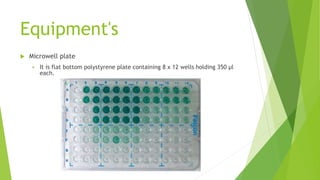
 Microwell plate
 It is flat bottom polystyrene plate containing 8 x 12 wells holding 350 µl
each.
Equipment's
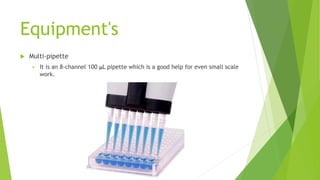
 Multi-pipette
 It is an 8-channel 100 μL pipette which is a good help for even small scale
work.
Equipment's
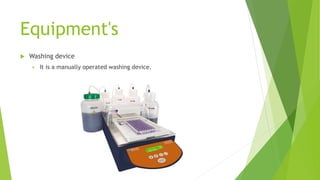
 Washing device
 It is a manually operated washing device.
Equipment's
 Microplate washer
 These are very efficient with very low carry over contamination.
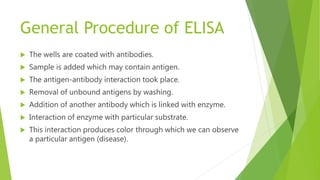
General Procedure of ELISA
 The wells are coated with antibodies.
 Sample is added which may contain antigen.
 The antigen-antibody interaction took place.
 Removal of unbound antigens by washing.
 Addition of another antibody which is linked with enzyme.
 Interaction of enzyme with particular substrate.
 This interaction produces color through which we can observe
a particular antigen (disease).
Types of ELISA
 There are three types of ELISA :-
 Indirect ELISA
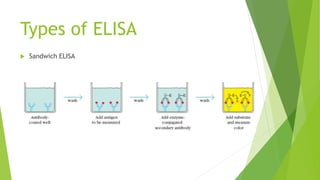
 Sandwich ELISA
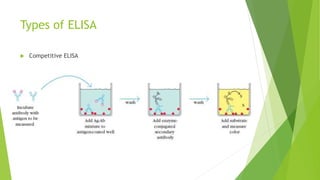
 Competitive ELISA
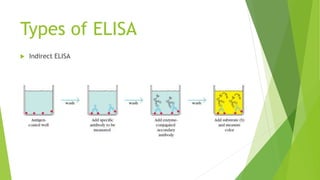
Types of ELISA
 Indirect ELISA
Types of ELISA
 Sandwich ELISA
Types of ELISA
 Competitive ELISA
Advantages of ELISA
 Reagents are relatively cheap and have a long shelf life.
 ELISA is highly specific and sensitive.
 No radiation hazards occur during labelling or disposal of
waste.
 Easy to perform and quick procedures.
 Equipment's are inexpensive and widely available.
 ELISA can be used to detect variety of infections.
Disadvantages of ELISA
 Measurement of enzyme can be more complex.
 Enzyme activity may be affected by plasma constituents.
 Kits are commercially available, but not cheap.
 Very specific to a particular antigen. Won’t recognize any
other antigen.
 False positives/negatives possible, especially with
mutated/ altered antigen.
References
 Kuby J., Osborne B.A, Goldsby R.A, “Immunology”, 5th edition. Pg. no 148-150
 Ochei, J. and Kolhatkar A., (2015), Medical Laboratory Science, Theory and
Practices, Tata McGraw-Hill.
Thank You

Elisa

  • 1.
    BARKATULLAH UNIVERSITY, BHOPAL ENZYME LINKED IMMUNOSORBENT ESSAY(ELISA) Presented by: Navjot Singh M.Sc. 3rd semester Enrollment Number – R218145050002 Roll Number – 2181400013
  • 2.
    INTRODUCTION  ELISA isa qualitative or quantitative immunological procedures in which the Ag-Ab reaction is monitored by enzyme measurements.  The term ELISA was first used by Engvall & Perlma in 1971.  The ELISA test was the first screening test commonly employed for HIV. It has a high sensitivity.
  • 3.
    Principle  Its principleis similar to RIA but depends on an enzyme rather than a radioactive label.  An enzyme conjugated with an antibody reacts with a colorless substrate to generate a colored reaction product. Such a substrate is called a chromogenic substrate.  A number of enzymes have been employed for ELISA including alkaline phosphatase, horseradish peroxidase and β-galactosidase.
  • 4.
    Equipment's  Microwell plate It is flat bottom polystyrene plate containing 8 x 12 wells holding 350 µl each.
  • 5.
    Equipment's  Multi-pipette  Itis an 8-channel 100 μL pipette which is a good help for even small scale work.
  • 6.
    Equipment's  Washing device It is a manually operated washing device.
  • 7.
    Equipment's  Microplate washer These are very efficient with very low carry over contamination.
  • 8.
    General Procedure ofELISA  The wells are coated with antibodies.  Sample is added which may contain antigen.  The antigen-antibody interaction took place.  Removal of unbound antigens by washing.  Addition of another antibody which is linked with enzyme.  Interaction of enzyme with particular substrate.  This interaction produces color through which we can observe a particular antigen (disease).
  • 9.
    Types of ELISA There are three types of ELISA :-  Indirect ELISA  Sandwich ELISA  Competitive ELISA
  • 10.
    Types of ELISA Indirect ELISA
  • 11.
    Types of ELISA Sandwich ELISA
  • 12.
    Types of ELISA Competitive ELISA
  • 13.
    Advantages of ELISA Reagents are relatively cheap and have a long shelf life.  ELISA is highly specific and sensitive.  No radiation hazards occur during labelling or disposal of waste.  Easy to perform and quick procedures.  Equipment's are inexpensive and widely available.  ELISA can be used to detect variety of infections.
  • 14.
    Disadvantages of ELISA Measurement of enzyme can be more complex.  Enzyme activity may be affected by plasma constituents.  Kits are commercially available, but not cheap.  Very specific to a particular antigen. Won’t recognize any other antigen.  False positives/negatives possible, especially with mutated/ altered antigen.
  • 15.
    References  Kuby J.,Osborne B.A, Goldsby R.A, “Immunology”, 5th edition. Pg. no 148-150  Ochei, J. and Kolhatkar A., (2015), Medical Laboratory Science, Theory and Practices, Tata McGraw-Hill.
  • 16.