Population
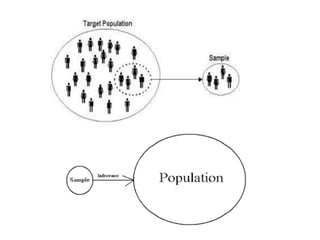
• The groupof individuals under study is known as a
population or a universe.
• Types of population (based on countability):
1. Finite population: which can be counted
2. Infinite population: cannot be counted
4.
Sample
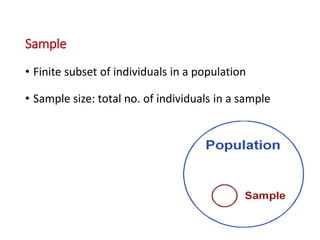
• Finite subsetof individuals in a population
• Sample size: total no. of individuals in a sample
Examples of sample/sampling:
•A housewife just picks up few grains of rice from
the cooking vessel and gets a fairly good idea
whether entire lot of rice is fully cooked or it
requires more cooking.
• Blood test, stool test, urine test
7.
Objectives of sampling
•To minimize time, money and manpower, without
losing the accuracy of the conclusion
• Estimation of population parameters from the
sample statistics
• To test the hypothesis about the population from
which the sample/samples are drawn
9.
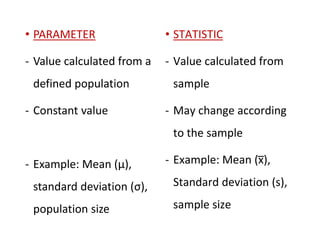
• PARAMETER
- Valuecalculated from a
defined population
- Constant value
- Example: Mean (µ),
standard deviation (σ),
population size
• STATISTIC
- Value calculated from
sample
- May change according
to the sample
- Example: Mean (x̅),
Standard deviation (s),
sample size
10.
Sampling frame:
• Thelist of population units from which the sample
units are to be selected is sampling frame.
• A good sampling frame is crucial to good sampling.
11.
Qualities of samplingframe
• It should be exhaustive. i.e. all population units
must be included in the list.
• It should be up to date.
• The unit must not be repeated in the list.
• It must be maintained by an authority that can be
relied upon.
PROBABILITY SAMPLING/RANDOM SAMPLING:
•For each element in the sample, the probability is
known and non-zero
• Every element of the population has the same
chance at being included in the sample
15.
Simple random sampling:
•technique of drawing a sample in such a way that each
unit of the population has equal and independent
chance of being selected
• The sample can be selected either with replacement or
without replacement.
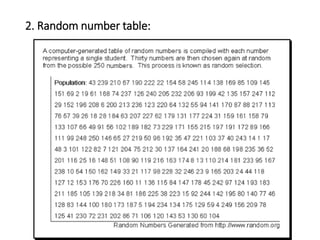
• It can be done in two ways:
1. Lottery method
2. Random number table
16.
1. Lottery Method:
•Each of the ‘N’ population member is assigned a
unique number
• The numbers are placed in a bowl and thoroughly
mixed. Then a blind folded researcher selects ‘n’
numbers.
• Population members having the selected numbers
are included in the sample.
17.
• For example;let us assume that we want to put 30
patients on a clinical trial out of 100 patients. To
ensure randomness of selection of 30 patients, we
may adopt lottery method by numbering the total
individuals from 1 to 100. Then we note down the
serial numbers of patients on 100 slips of papers, put
all the slips into a drum and shake well so that all the
slips are thoroughly mixed up and then pull 30 slips
out one by one.
Advantages:
• This methodeliminates personal bias and more
representative than non probability sampling.
• The results are accurate as the sample size increases.
20.
Disadvantages:
• It requirescomplete and up to date list of the
population.
• If unit selected in a study is random, samples are
dispersed widely.
• This method can be disruptive to isolate members from
a group.
• Numbering the population is too much tedious and
time consuming.
21.
Systematic sampling:
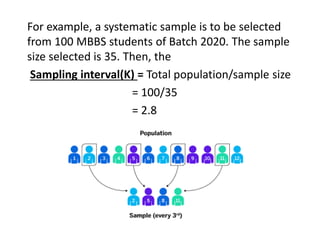
• Individualsare chosen at regular intervals (for
example: every sixth unit) from the sampling frame
• Ideally, we randomly select a number to tell us
where to start selecting individuals from the list
22.
For example, asystematic sample is to be selected
from 100 MBBS students of Batch 2020. The sample
size selected is 35. Then, the
Sampling interval(K) = Total population/sample size
= 100/35
= 2.8
23.
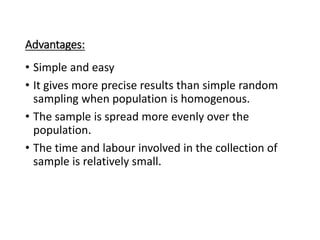
Advantages:
• Simple andeasy
• It gives more precise results than simple random
sampling when population is homogenous.
• The sample is spread more evenly over the
population.
• The time and labour involved in the collection of
sample is relatively small.
24.
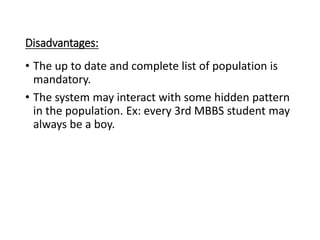
Disadvantages:
• The upto date and complete list of population is
mandatory.
• The system may interact with some hidden pattern
in the population. Ex: every 3rd MBBS student may
always be a boy.
25.
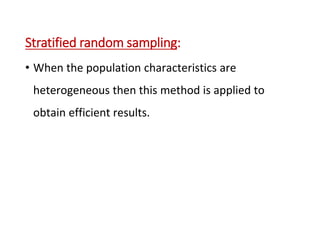
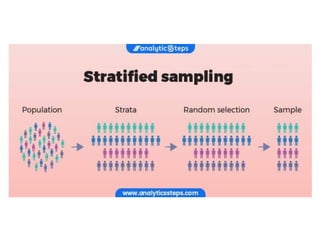
Stratified random sampling:
•When the population characteristics are
heterogeneous then this method is applied to
obtain efficient results.
26.
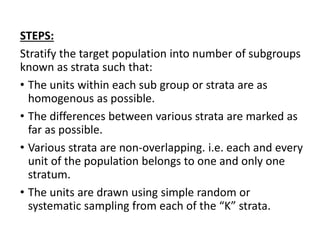
STEPS:
Stratify the targetpopulation into number of subgroups
known as strata such that:
• The units within each sub group or strata are as
homogenous as possible.
• The differences between various strata are marked as
far as possible.
• Various strata are non-overlapping. i.e. each and every
unit of the population belongs to one and only one
stratum.
• The units are drawn using simple random or
systematic sampling from each of the “K” strata.
28.
Advantages:
• Every unitin a stratum has a chance of being
selected.
• Minimum knowledge of population needed.
• Easy to analyze data.
• Using the same sampling fraction for all strata
ensures proportionate representation in the sample
of the characteristic being stratified.
29.
Disadvantages:
• It requiressample frame.
• The sampling frame has to be prepared separately
for each stratum.
• Not useful when there are no homogenous
subgroups.
30.
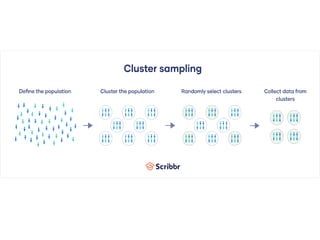
Cluster sampling:
• Itis a method in which population is classified into
different sub groups called cluster in such a way that
the characteristics within the cluster are heterogeneous
and between the clusters are homogeneous.
• Used where a complete list of subjects is impossible or
impractical to construct.
• A random sampling technique is then used on any
relevant clusters to choose which clusters to use in
study.
• Often used to evaluate vaccination coverage in EPI
32.
Advantages:
• It cutsdown cost of preparing sampling frame and
has a greater speed.
• The sampling frame is required only for the selected
clusters and individuals in selected clusters.
• One can take a larger sample with cluster sampling
than with the other methods for given fixed budget.
33.
Disadvantages:
• Higher samplingerror.
• Further analysis is difficult.
• Standard errors of the estimates are high compared
to other sampling designs with same sample size.
• Cluster may not be the representative of the whole
population.
34.
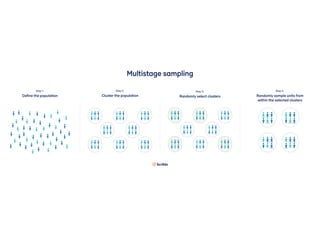
Multistage sampling:
• Acomplex form of cluster sampling and involves
several stages in which the sampling process is carried
out
• In the first stage, large groups or clusters are selected.
• These clusters are designed to contain more
population units than are required for the final
sample.
• In the second stage, population units are chosen from
selected clusters to derive a final sample.
• This type of sampling is frequently used in national
level health research.
36.
Advantages:
• It isflexible and economic.
• It does not require a complete list of members.
• It greatly reduces the field cost.
NON-PROBABILITY SAMPLING
• Non-probability sampling is the process where the
probability of selection of the elements is not
considered.
• The choice of the selection of the items depends
largely upon the judgment of the researcher.
39.
When to usenon-probability sampling techniques:
• This type of sampling can be used when demonstrating
that a particular trait exists in the population.
• It can also be used when the researcher aims to do
a qualitative, pilot or exploratory study.
• It can be used when randomization is impossible like
when the population is almost limitless.
40.
• It canbe used when the research does not aim to
generate results that will be used to generalize to the
entire population.
• It is also useful when the researcher has limited
budget, time and workforce.
41.
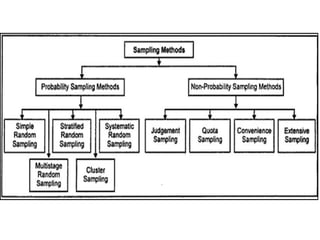
Techniques of non-probabilitysampling:
• Purposive or Judgmental Sampling
• Convenient Sampling
• Quota Sampling
• Snowball Sampling
42.
Convenience sampling:
• Haphazard/Accidentalsampling
• The researcher using such a sample cannot
scientifically make generalizations about the total
population.
• It involves the sample being drawn from that part
of the population which is close to hand.
• A sample that can be taken easily without random
selection.eg. People walking by on the street or
samples which are easily available without much
effort on time, energy and cost.
43.
Examples:
• A reportercan take the views of people in certain
issues at street.
• In clinical practice, we might use clients who are
available to us as our sample
44.
Advantages:
• Useful formaking pilot studies, particularly for
testing the research instruments.
• Cheap and quick.
45.
Disadvantages:
• Difficult togeneralize the population from sampling
results.
• Result obtained by this method are generally
biased and unsatisfactory, since the result obtained
can hardly be representative of the population
parameters.
46.
• Sample unitis selected deliberately or purposively
depending upon the objective of study.
• The researcher includes only those items in the
sample which he thinks are most typical with
regards to the characteristics under investigation.
Purposive/Judgmental sampling:
47.
Advantages:
• It isvery cheap and if selection is done carefully,
gives relevant results.
48.
Disadvantages:
• It ishighly subjective in nature since the selection
of the sample entirely depends upon the personal
convenience, beliefs and prejudices of the
investigator.
49.
Quota sampling:
• Inquota sampling, a population is first segmented
into mutually exclusive sub-groups i.e. quota just
as in stratified sampling.
• Then judgment or convenience sampling is used to
select the subjects or units from each segment
based on a specified proportion.
50.
Advantages:
• Easy toconduct and easy to get the information in
short period of time.
• The cost and time involved in getting information from
the sample will be relatively less for quota sampling.
• It is very useful in public opinion studies, election
forecast polls, as there is not sufficient time to adopt a
probability sampling scheme.
51.
Disadvantages
• Does notrepresent the population.
• Selection of the sample is non-random so the
samples may be biased.
52.
Snowball sampling:
• Itis also called as a chain or a network sampling.
• This technique can be used to assess “hard to
reach” or hidden population like: drug addicts,
homeless people, individuals with HIV/AIDS, STIs,
prostitutes and so on.
53.
Advantages:
• This methodis cheap, simple and cost effective.
• The chain of referral allows researcher to reach
population that are difficult to sample when other
sampling techniques are used.
54.
Disadvantage:
• The maindrawback of this sampling technique is
that the sample is not representative of the
population.