MS. PRIYANKA SOLANKI
Identification of
variables
• Variables are qualities, properties, or
characteristics of person, things, or
situations that change or vary.
• Chinn & Kramer stated that ‘variables are
concepts at different level of abstraction
that are concisely defined to promote
their measurement or manipulation within
study’.
• Variables are classified based on their
nature, actions, & effects on the variables
INTRODUCTION
• Independent Variables
• Dependent Variables
• Research Variable
• Demographic Variables
• Extraneous Variables
TYPES OF VARIABLES
• These are to two variables which are
interrelated & mainly observed in
correlational, interventional, pre-
experimental, quasi-experimental,
experimental research studies.
An independent variable:
It is a stimulus or activity that
is manipulated or varied by the
researcher to create the effect on
the dependent variable.
A dependent variable:
It is the outcome or response
due to the effect of the
independent variable, which
researcher wants to predict or
explain.
For example;
“Effectiveness of planned teaching on the
knowledge of staff nurses working in
psychiatric unit regarding Physical
Restraints for psychiatric patient in
selected hospital of Vidharbha region”.
in this study planned teaching is
an independent variable & knowledge
is the dependent variable.
RESEARCH VARIABLE
 In descriptive, exploratory, comparative, &
qualitative research studies, variable are observed
or measured in natural setting as they exist,
without manipulating or imposing the effect of
intervention or treatment.
 Here no independent variable is manipulated & no
cause-effect relationship is examined; these
variable are considered as research variable.
Research variable;
 Therefore, research variables can be defined as
qualities, attributes, properties or characteristics
which are observed or measured in a natural setting
without manipulating & establishing cause-&-effect
relationship.
For example;
„An exploratory study on factors
contributing to sleep disturbance among
patients admitted in selected intensive care
unit of AIMS, New Delhi‟.
In this research study, “factors contributing
to sleep disturbance” is a research variable,
which is observed in natural setting without
manipulating it.
DEMOGRAPHIC VARIABLES
 In most of the research studies, researchers
make the attempt to study the sample
characteristics & present them in research
findings.
 Sometimes researchers even try to establish
relations of the demographic variables with
the research variables.
DEMOGRAPHIC VARIABLES;
These characteristics & attributes of the
study subjects are considered as
demographic variables.
Common demographic variables are age,
gender, educational status, religion, social
class, marital status, habitat, occupation,
income, & medical diagnosis etc.
EXTRANEOUS VARIABLES
Extraneous variables are the factors which are not
the part of the study but may affect the
measurement of the study variables.
These variables are usually recognized & controlled
by researchers in quasi- experimental &
experimental studies.
Generally, specific research design & sample inclusion
& exclusion criteria are used to control the influence of
extraneous variables.
For example:
‘A study is conducted to assess the effect of
two different pin site care protocols on
prevention of pin site infection among
patients with external skeletal fixation’.
 In this study, pin site care protocols are
independent variable, pin site infection is
the dependent variable .
• However, the dependent variable, pin site
infection may also be influenced by some of
the other factors such as low hemoglobin
level or higher blood sugar level among
these patients; these factors are considered
as extraneous variables, which may have
unwanted effect on dependent variable or
research variable.
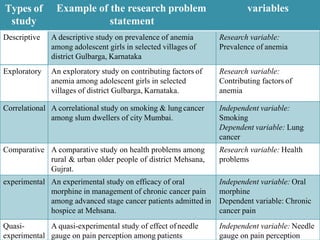
EXAMPLE OF THE
STATEMENT
OF RESEARCH
PROBLEMS AND
VARIABLES IN
QUANTITATIVE
RESEARCH STUDIES
Types of
study
Example of the research problem
statement
variables
Descriptive A descriptive study on prevalence of anemia
among adolescent girls in selected villages of
district Gulbarga, Karnataka
Research variable:
Prevalence of anemia
Exploratory An exploratory study on contributing factors of
anemia among adolescent girls in selected
villages of district Gulbarga, Karnataka.
Research variable:
Contributing factors of
anemia
Correlational A correlational study on smoking & lungcancer
among slum dwellers of city Mumbai.
Independent variable:
Smoking
Dependent variable: Lung
cancer
Comparative A comparative study on health problems among
rural & urban older people of district Mehsana,
Gujrat.
Research variable: Health
problems
experimental An experimental study on efficacy of oral
morphine in management of chronic cancer pain
among advanced stage cancer patients admitted in
hospice at Mehsana.
Independent variable: Oral
morphine
Dependent variable: Chronic
cancer pain
Quasi-
experimental
A quasi-experimental study of effect ofneedle
gauge on pain perception among patients
Independent variable: Needle
gauge on pain perception
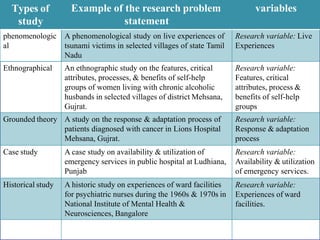
EXAMPLE OF THE
STATEMENT
OF RESEARCH
PROBLEMS AND
VARIABLES IN
QUALITATIVE
RESEARCH STUDIES
vvbbbvbbbvvbTypes of
study
Example of the research problem
statement
variables
phenomenologic
al
A phenomenological study on live experiences of
tsunami victims in selected villages of state Tamil
Nadu
Research variable: Live
Experiences
Ethnographical An ethnographic study on the features, critical
attributes, processes, & benefits of self-help
groups of women living with chronic alcoholic
husbands in selected villages of district Mehsana,
Gujrat.
Research variable:
Features, critical
attributes, process &
benefits of self-help
groups
Grounded theory A study on the response & adaptation process of
patients diagnosed with cancer in Lions Hospital
Mehsana, Gujrat.
Research variable:
Response & adaptation
process
Case study A case study on availability & utilization of
emergency services in public hospital at Ludhiana,
Punjab
Historical study A historic study on experiences of ward facilities
for psychiatric nurses during the 1960s & 1970s in
National Institute of Mental Health &
Neurosciences, Bangalore
Research variable:
Availability & utilization
of emergency services.
Research variable:
Experiences of ward
facilities.
OPERATIONAL DEFINITION
 In research study, each variable or concept must
be operationally defined.
 An operational definition of variable provides
the theoretical or conceptual meaning of
variable under study.
 This definition of the variables may be derived
from conceptual or theoretical framework on
which study is based or may be stated in a form
in which variables are expected to be studied in
present study.
For example:
“Effectiveness of planned teaching on the
knowledge of staff nurses working in
psychiatric unit regarding Physical
Restraints for psychiatric patient in
selected hospital of Vidharbha region”.
In this problem statement there are five
variables, effectiveness, planned teaching,
knowledge, nurse & physical restraint, which
need to operationally defined.
Identification of variables

Identification of variables

  • 1.
  • 2.
    • Variables arequalities, properties, or characteristics of person, things, or situations that change or vary. • Chinn & Kramer stated that ‘variables are concepts at different level of abstraction that are concisely defined to promote their measurement or manipulation within study’. • Variables are classified based on their nature, actions, & effects on the variables INTRODUCTION
  • 3.
    • Independent Variables •Dependent Variables • Research Variable • Demographic Variables • Extraneous Variables TYPES OF VARIABLES
  • 4.
    • These areto two variables which are interrelated & mainly observed in correlational, interventional, pre- experimental, quasi-experimental, experimental research studies.
  • 5.
    An independent variable: Itis a stimulus or activity that is manipulated or varied by the researcher to create the effect on the dependent variable.
  • 6.
    A dependent variable: Itis the outcome or response due to the effect of the independent variable, which researcher wants to predict or explain.
  • 7.
    For example; “Effectiveness ofplanned teaching on the knowledge of staff nurses working in psychiatric unit regarding Physical Restraints for psychiatric patient in selected hospital of Vidharbha region”. in this study planned teaching is an independent variable & knowledge is the dependent variable.
  • 8.
    RESEARCH VARIABLE  Indescriptive, exploratory, comparative, & qualitative research studies, variable are observed or measured in natural setting as they exist, without manipulating or imposing the effect of intervention or treatment.  Here no independent variable is manipulated & no cause-effect relationship is examined; these variable are considered as research variable.
  • 9.
    Research variable;  Therefore,research variables can be defined as qualities, attributes, properties or characteristics which are observed or measured in a natural setting without manipulating & establishing cause-&-effect relationship.
  • 10.
    For example; „An exploratorystudy on factors contributing to sleep disturbance among patients admitted in selected intensive care unit of AIMS, New Delhi‟. In this research study, “factors contributing to sleep disturbance” is a research variable, which is observed in natural setting without manipulating it.
  • 11.
    DEMOGRAPHIC VARIABLES  Inmost of the research studies, researchers make the attempt to study the sample characteristics & present them in research findings.  Sometimes researchers even try to establish relations of the demographic variables with the research variables.
  • 12.
    DEMOGRAPHIC VARIABLES; These characteristics& attributes of the study subjects are considered as demographic variables. Common demographic variables are age, gender, educational status, religion, social class, marital status, habitat, occupation, income, & medical diagnosis etc.
  • 13.
    EXTRANEOUS VARIABLES Extraneous variablesare the factors which are not the part of the study but may affect the measurement of the study variables. These variables are usually recognized & controlled by researchers in quasi- experimental & experimental studies. Generally, specific research design & sample inclusion & exclusion criteria are used to control the influence of extraneous variables.
  • 14.
    For example: ‘A studyis conducted to assess the effect of two different pin site care protocols on prevention of pin site infection among patients with external skeletal fixation’.  In this study, pin site care protocols are independent variable, pin site infection is the dependent variable .
  • 15.
    • However, thedependent variable, pin site infection may also be influenced by some of the other factors such as low hemoglobin level or higher blood sugar level among these patients; these factors are considered as extraneous variables, which may have unwanted effect on dependent variable or research variable.
  • 16.
    EXAMPLE OF THE STATEMENT OFRESEARCH PROBLEMS AND VARIABLES IN QUANTITATIVE RESEARCH STUDIES
  • 17.
    Types of study Example ofthe research problem statement variables Descriptive A descriptive study on prevalence of anemia among adolescent girls in selected villages of district Gulbarga, Karnataka Research variable: Prevalence of anemia Exploratory An exploratory study on contributing factors of anemia among adolescent girls in selected villages of district Gulbarga, Karnataka. Research variable: Contributing factors of anemia Correlational A correlational study on smoking & lungcancer among slum dwellers of city Mumbai. Independent variable: Smoking Dependent variable: Lung cancer Comparative A comparative study on health problems among rural & urban older people of district Mehsana, Gujrat. Research variable: Health problems experimental An experimental study on efficacy of oral morphine in management of chronic cancer pain among advanced stage cancer patients admitted in hospice at Mehsana. Independent variable: Oral morphine Dependent variable: Chronic cancer pain Quasi- experimental A quasi-experimental study of effect ofneedle gauge on pain perception among patients Independent variable: Needle gauge on pain perception
  • 18.
    EXAMPLE OF THE STATEMENT OFRESEARCH PROBLEMS AND VARIABLES IN QUALITATIVE RESEARCH STUDIES
  • 19.
    vvbbbvbbbvvbTypes of study Example ofthe research problem statement variables phenomenologic al A phenomenological study on live experiences of tsunami victims in selected villages of state Tamil Nadu Research variable: Live Experiences Ethnographical An ethnographic study on the features, critical attributes, processes, & benefits of self-help groups of women living with chronic alcoholic husbands in selected villages of district Mehsana, Gujrat. Research variable: Features, critical attributes, process & benefits of self-help groups Grounded theory A study on the response & adaptation process of patients diagnosed with cancer in Lions Hospital Mehsana, Gujrat. Research variable: Response & adaptation process Case study A case study on availability & utilization of emergency services in public hospital at Ludhiana, Punjab Historical study A historic study on experiences of ward facilities for psychiatric nurses during the 1960s & 1970s in National Institute of Mental Health & Neurosciences, Bangalore Research variable: Availability & utilization of emergency services. Research variable: Experiences of ward facilities.
  • 20.
    OPERATIONAL DEFINITION  Inresearch study, each variable or concept must be operationally defined.  An operational definition of variable provides the theoretical or conceptual meaning of variable under study.  This definition of the variables may be derived from conceptual or theoretical framework on which study is based or may be stated in a form in which variables are expected to be studied in present study.
  • 21.
    For example: “Effectiveness ofplanned teaching on the knowledge of staff nurses working in psychiatric unit regarding Physical Restraints for psychiatric patient in selected hospital of Vidharbha region”. In this problem statement there are five variables, effectiveness, planned teaching, knowledge, nurse & physical restraint, which need to operationally defined.