INDIVIDUAL & SOCIETY
outlines
• Society & community
• Nature of society
• Difference between society & community
• Process of socialization and individualization
• Personal disorganization
Individual & society
• man is a social animal.
• He can not live alone and he needs society.
• Society not only control our movements but
also shape our identity, our thoughts and our
emotions.
SOCIETY
• Society derived by Latin word “Socious’’ it
means companionship or friendship.]
• In sociology the term ‘society’ refers not a
group of people but to the complex pattern of
the norms of interaction that arise among them.
DEFINITION OF SOCIETY
• Maclver has said that society is a web of social
relationship.
• Wright- society is not a group of people. It is the
system of relationship that exists between the
individual of the group.
• G.D.H cole- Society is a complex of organized
association and community with a community.
• Green- society is the larger group to which only
individual belongs.
NATURE OF SOCIETY
• Man is a social human being by nature. There
is close relationship between man and society.
There are two theories which describes the
nature of society. These are:
Social contract theory
The organic theory
1. Social contract theory
• According to social contract theory:
All human beings are born free and equal
Society is created by mutual agreements of
individuals
Various authors such as Hobbes, Locke has given
their views under social contract theory.
According to Hobbes
Life of man was:
•Solitary
•Poor
•Nasty
Individual were
enemy to each other
To protect themselves
Against civil consequences
Organised themselves in society To live in
peace
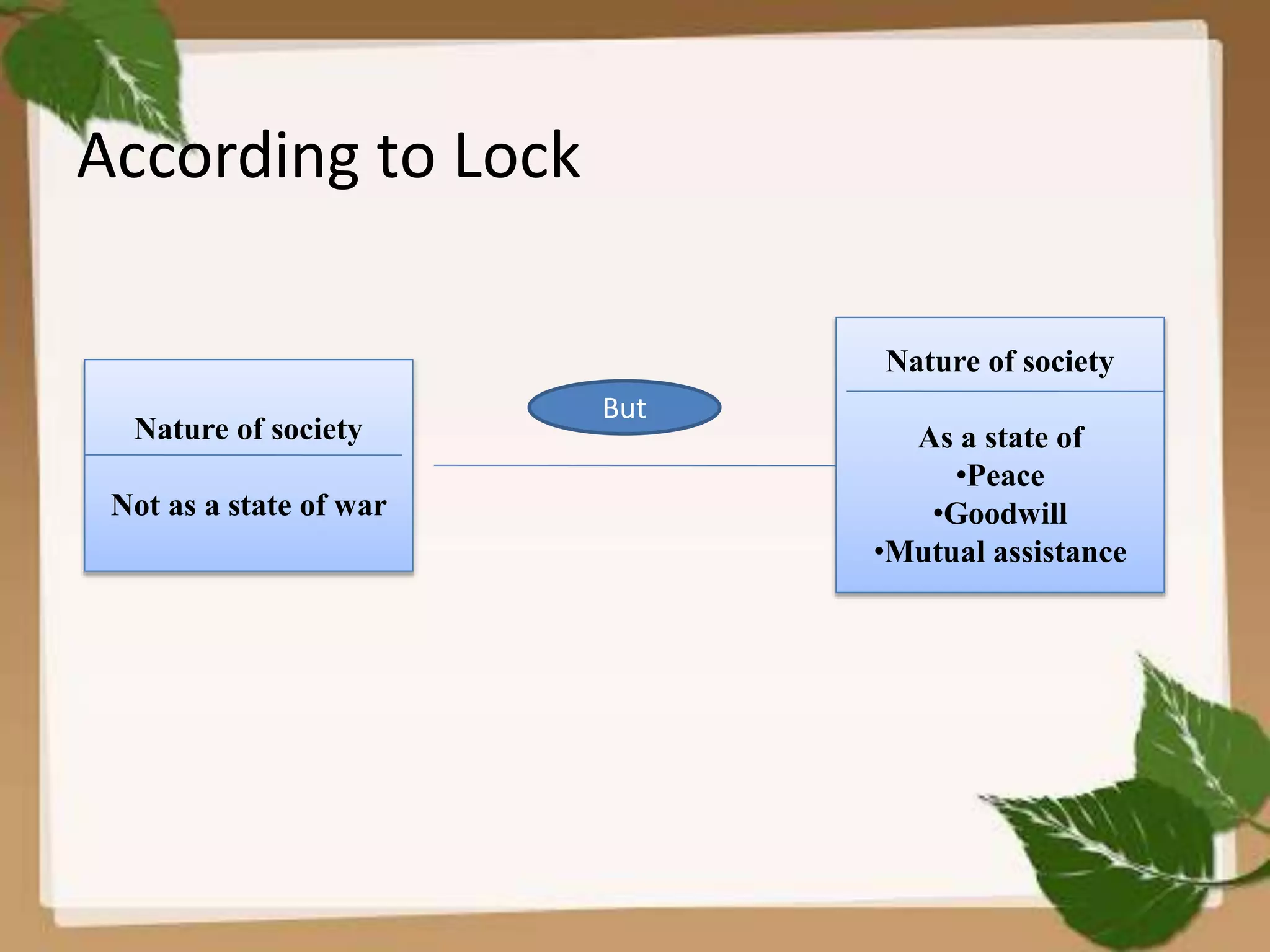
According to Lock
Nature of society
Not as a state of war
Nature of society
As a state of
•Peace
•Goodwill
•Mutual assistance
But
2. Organic theory
• This theory is very old.
• According to Aristotle, the symmetry of state is
same as of individual & individual is an intrinsic
part of society.
• On these basis it can be concluded that society is
an organism. The individuals are its limbs and
behave like cells of body. If the limbs are
removed from body, then there is no life in limbs.
Similarly when individuals are separated from
society, they have no life.
COMMUNITY
• An area of social living.
• When members of any group small or large
live together in such a way that they share
food, shelter etc. A society includes many
small communities like tribal, rural and urban
communities.
DEFINITION OF COMMUNITY
• According to Bogardus, Community is a
social group with some degree of “ we feeling”
and living in given area.It means close
relationship between the members, feeling of
security and common residence.
• According to Ogburn & Nimkoff,
community is the total organisation of social
life with a limited area.
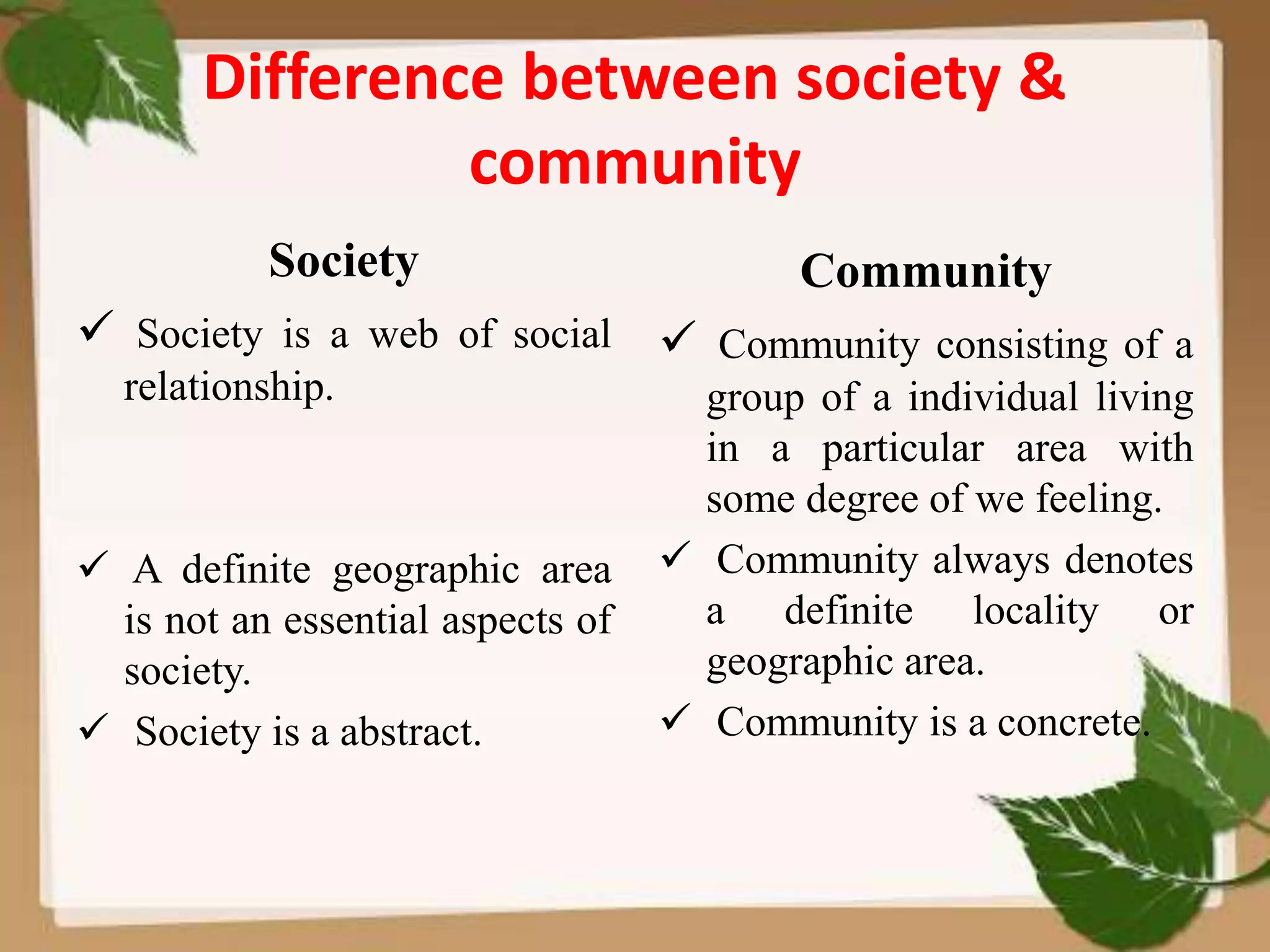
Difference between society &
community
Society
 Society is a web of social
relationship.
 A definite geographic area
is not an essential aspects of
society.
 Society is a abstract.
Community
 Community consisting of a
group of a individual living
in a particular area with
some degree of we feeling.
 Community always denotes
a definite locality or
geographic area.
 Community is a concrete.
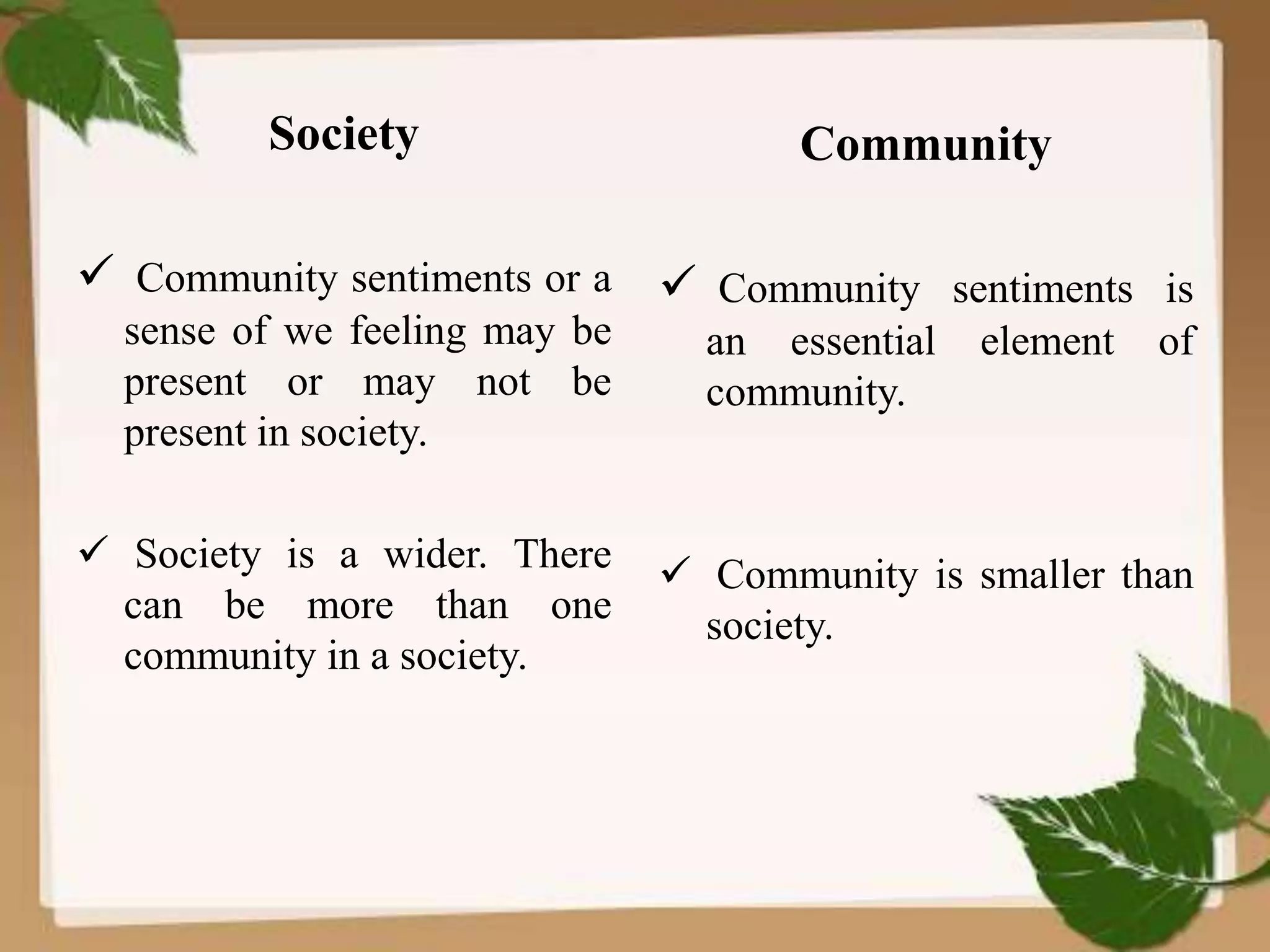
Society
 Community sentiments or a
sense of we feeling may be
present or may not be
present in society.
 Society is a wider. There
can be more than one
community in a society.
Community
 Community sentiments is
an essential element of
community.
 Community is smaller than
society.
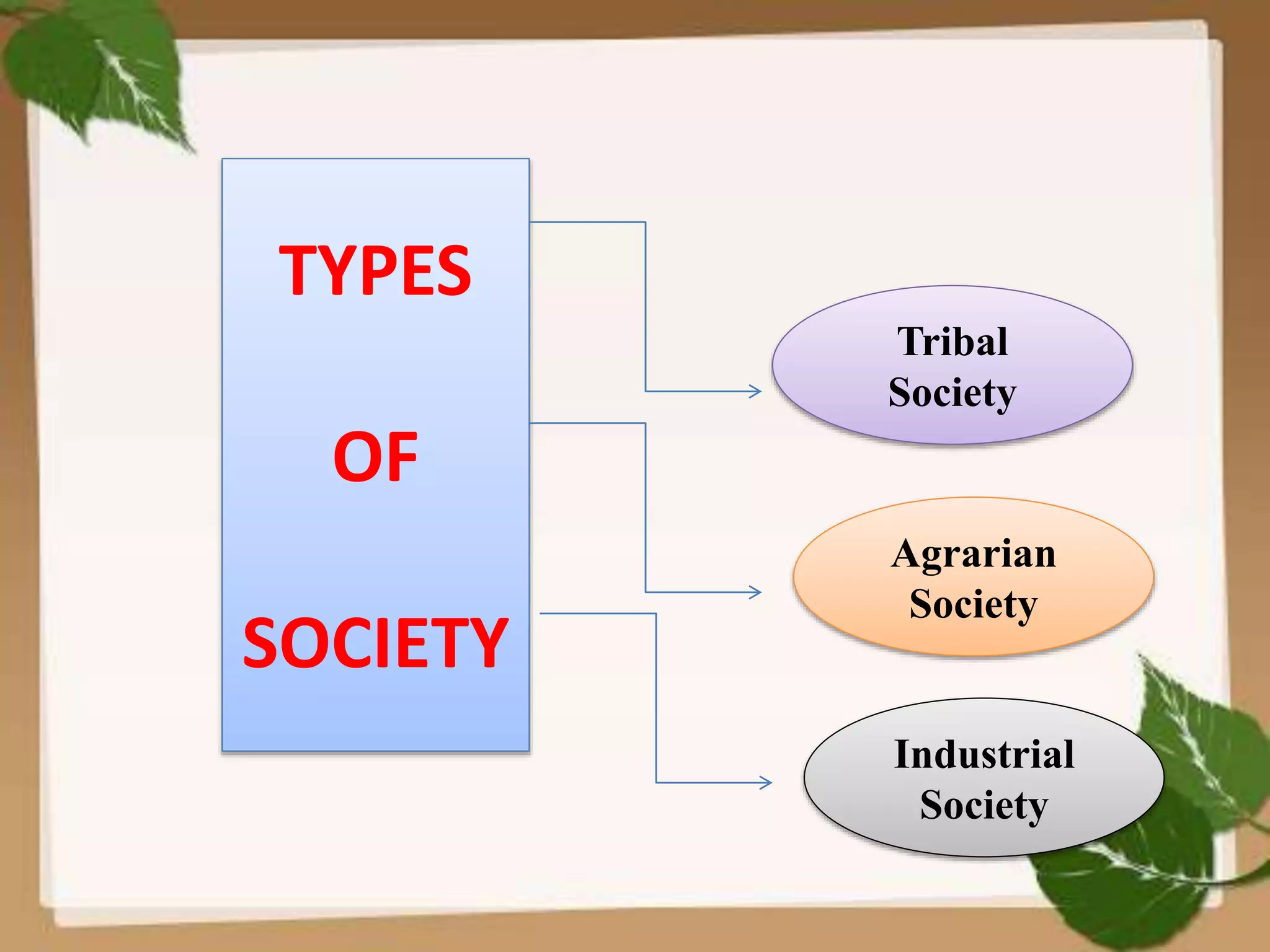
TYPES
OF
SOCIETY
Tribal
Society
Agrarian
Society
Industrial
Society
1. Tribal Society
• The tribe is a group of persons having a
common definite territory, common name ,
religion and culture. They are united by blood
relationship.
• It can be found in the regions of Africa, Asia
and Europe.
• Their main economic activity is hunting,
fishing and food gathering.
2. Agrarian Society
• In an Agrarian society the dominant type of
economic activity is agriculture e.g, India is an
agrarian society.
• It is associated with the domestication of
plants and animals.
• People in agrarian society leads simple life.
• An agrarian society is regionally divided into
villages.
Cont….
• The members of village community helps one
another & share joy and sorrow. This society is
marked by Simplicity and uniformity.
• An agrarian society is religious society.
3. Industrial Society
• The economic activity of industrial society is
factory production.
• Men & women have equal rights and they are
working together in factories.
• The industrial society is marked by a new
system of production, distribution and
exchange.
• There is division of labour in an industrial
society.
PROCESS OF SOCIALIZATION
AND
INDIVIDUALISATION
Socialization
• Man is not only social but also cultural being.
• The culture provides opportunities for man to
develop his personality.
• The development process is not an automatic
process.
• It is social training to the individual that kind of
training is called socialization.
• Socialization is a process of moulding a human
infant to a member of society to which he
belongs.
Cont….
• This socialization is differ from society to
society. Because of this process involves by
culture.
• He is gradually moulded into a social being
and he learns social ways of acting and feeling.
• The process of moulding and shaping the
personality of the human infant is called
socialization.
Definition of Socialization
• W.H. Ogburn says, “Socialization is a process
by which the individual learns to conform to
the norms of the group.”
• Bogardus define “ Socialization as the
process of working together of developing
group responsibility, of being guided by
welfaare needs of others.”
Process of Socialization
• Socialization is the process of learning group
norms, ideals, habits, behaviors and customs.
• The process of socialization starts long before
the child is born.
• Whole system of cultural practices
surrounding the family are important for
child’s growth.
• But direct socialization begins only after birth.
Factors of the Process of Socialization
• There are four factors of this process of
learning, these are as below:
Imitation
 Suggestion
Identification
Language
1. Imitation
• Imitation is copying the acts or actions of an
other.
• this copying is done consciously or
unconsciously
• It has an important role in the process of
socialization.
• Ex- a girl child imitates and do the same as her
mother does.
• another example is related to language which a
child learns by imitation.
2. Suggestion
• Suggestion is the way of communicating
information without logic.
• The suggestions can be conveyed through
language, pictures etc.
• Suggestion influences one’s own as well as of
other individuals behavior.
3. Identification
• with the growth of child age, child become
aware of the nature of things which satisfy the
needs. This things become the object of
identification.
• Through this identification, he becomes
sociable.
• he starts playing with the toys and enjoys it
due to identification.
4. Language
• Language is the way of transmitting culture
and moulds the personality of individual in
accordance to society.
Agencies of Socialization
• Socialization is the process which begins at
birth and continues till death of an individual.
• Socialization makes the child a useful member
of society. This socialization occur by two
sources.
 First sources include those who have authority
over him. Ex- teacher, parents, elderly persons.
 Second sources include who are equal in
authority. Ex- friends, playmates, fellow on job
or in club.
INDIVIDUALIZATION
• It is the process of in which man comes to
know himself and acquire the sense of inner
responsibility.
• It is simply the process of attaining to one’s
own self.
• He is carried by his own individuality which
is a quality to him.
• the process of individualization is carried not
only by the individual himself but also by the
society.
Aspects of Individualization
• Karl Mannheim has distinguished four main
aspects of individualization.
 individualization as a process of learning
different from other people.
 individualization on the level of new forms of
self regarding attitudes.
 individualization through objects.
 individualization as a kind of depending into
ourselves.
PERSONAL DISORGANIZATION
• Concept of Individual disorganization:
Individual & society are closely related. When society is
disorganized, then individual is also disorganized.
• Definition:
Prof. E.M Lemert, “ Individual disorganization
is a condition or process in which the person
has not stabilized his behavior around major
roles. Such disorganization may be transitional
or it may be continuous.”
Causes of individual inability
• Lack of personal resources
• Mental deficiency
• Physical deficiency
• Biological inheritance
• Cultural level
Forms of personal disorganization
• Juvenile delinquency
• Crime
• Drink
• Sex
• mental deficiency
• Suicide
• Insanity
Relationship between social
disorganization & personal
disorganization
• Both are closely related to each other. Individual
disorganization leads to social disorganization.
• society consists of the network of relationships
that binds individuals together on a functioning
whole.
• social disorganization not only disorganizes
society but it also disorganizes the individuals.
Unit 2 individual & society