Basic Concepts of Sampling Theory
By: Dr. Rajni Goel
Census Survey
If we study each and every unit of a population, it is known as population survey
or census survey. In a census investigation, intensive information is obtained from
each and every item; thus, many faces of the problem are brought to light.
Through, the data collection through census method are more true and
reliable, it is appropriate only when units of the population are diverse
characteristics or when the population is not too large. Census method of
investigation is costly and much time-consuming. It needs a big organization to
handle the investigation.
Need of Sampling
• A survey of the entire population is impracticable
• Budget constraints restrict data collection
• Time constraints restrict data collection
• Results from data collection are needed quickly
Sample Survey
• In our daily life we adopt sampling technique almost every moment of our
existence.
• Examples: We go to marking and examine a sample of wheat to from an idea
about the quality and then decide whether the quality of the whole lot is
acceptable or not. We examine a few beads of rice from the bowl on the stove, to
check if the rice is cooked or not.
• The sampling procedure is based on the assumption that a part of aggregate
represent well and whole population. Sampling is the selection of a part of
population for the purpose of drawing conclusion about the entire universe.
• The basic aim of sampling is to obtain the maximum information about the
phenomena under study, with the least use of resources like money, time, and
manpower.
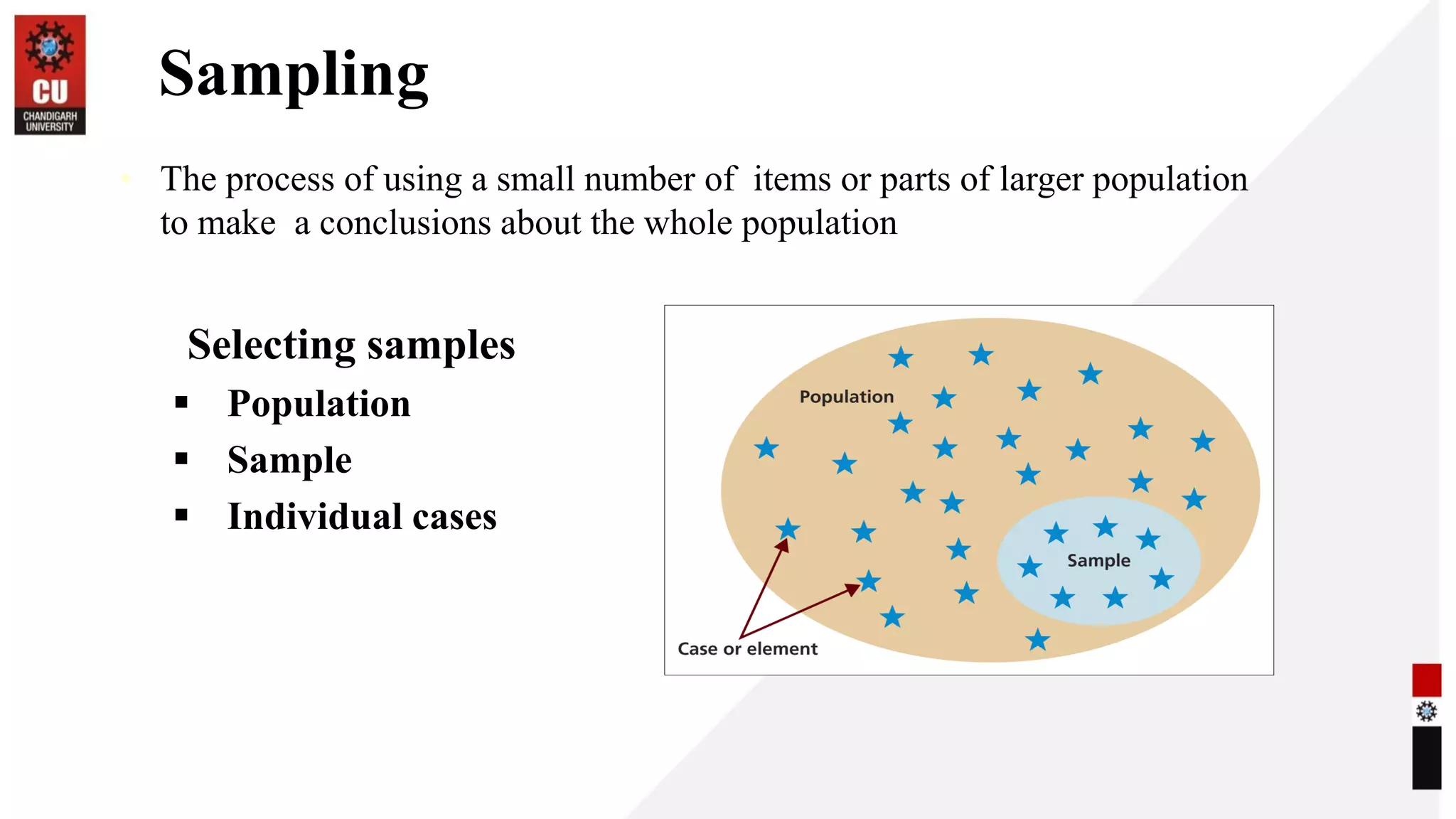
• The process of using a small number of items or parts of larger population
to make a conclusions about the whole population
Sampling
Selecting samples
▪ Population
▪ Sample
▪ Individual cases
Sampling
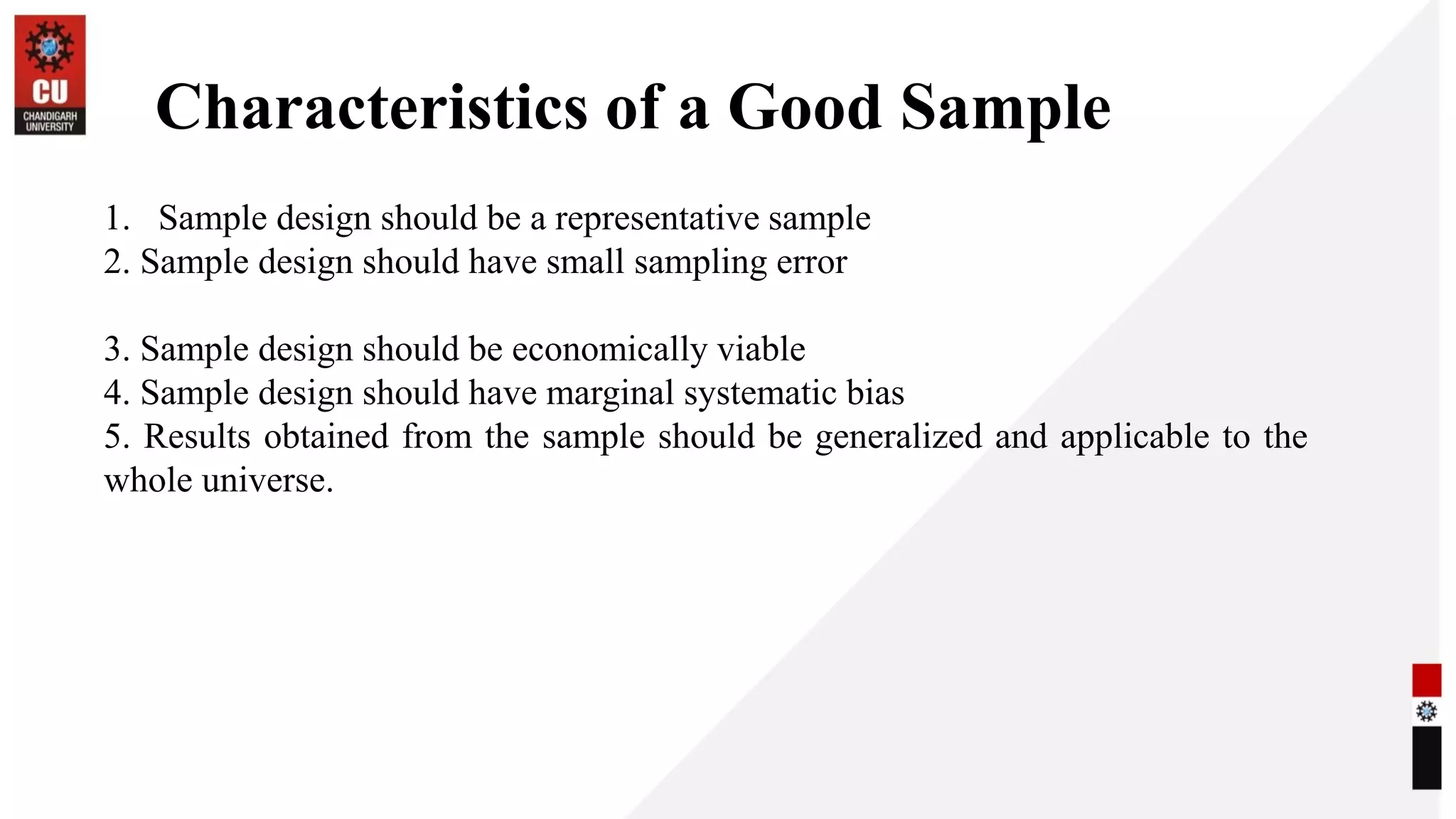
Characteristics of a Good Sample
1. Sample design should be a representative sample
2. Sample design should have small sampling error
3. Sample design should be economically viable
4. Sample design should have marginal systematic bias
5. Results obtained from the sample should be generalized and applicable to the
whole universe.
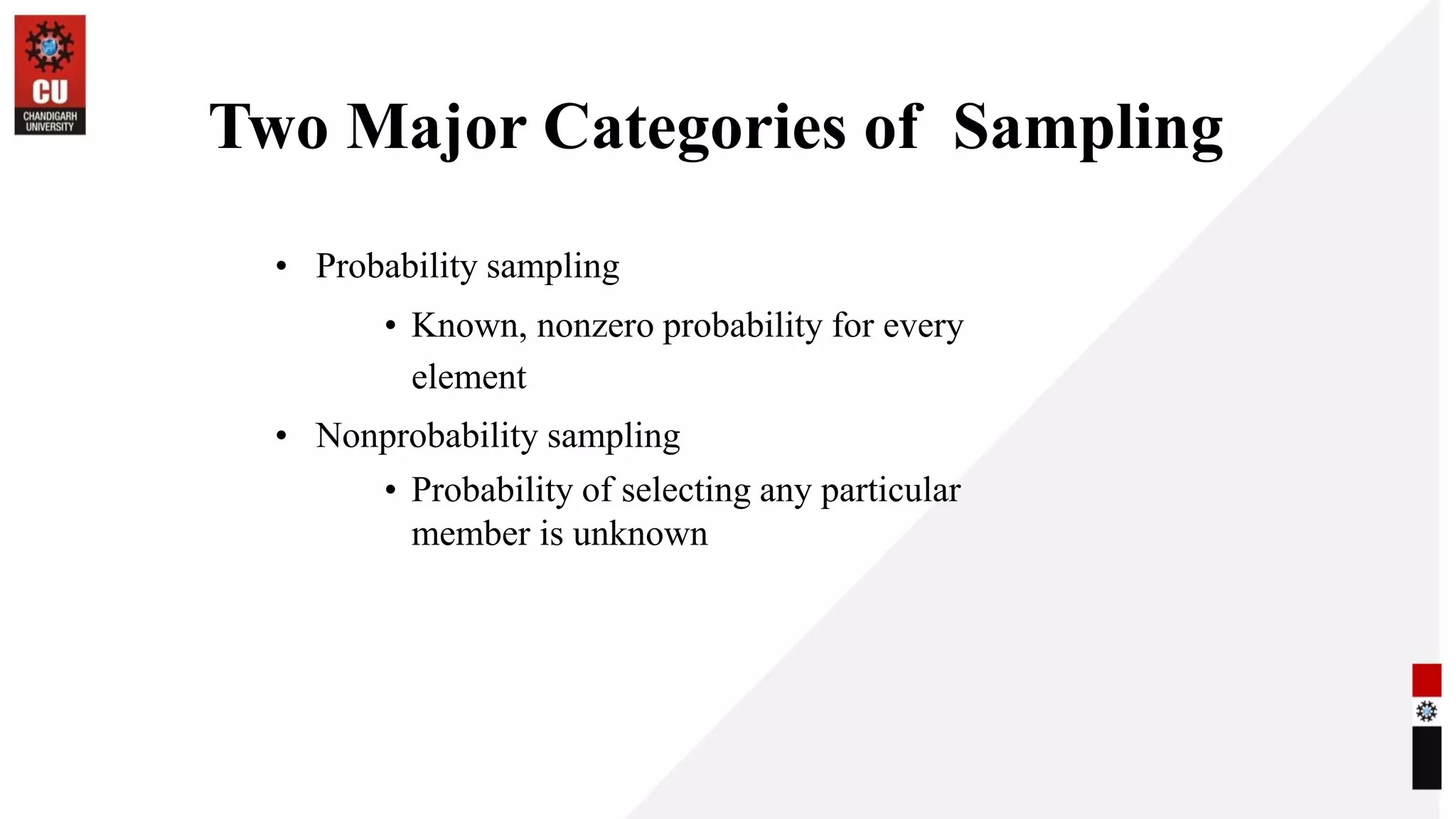
Two Major Categories of Sampling
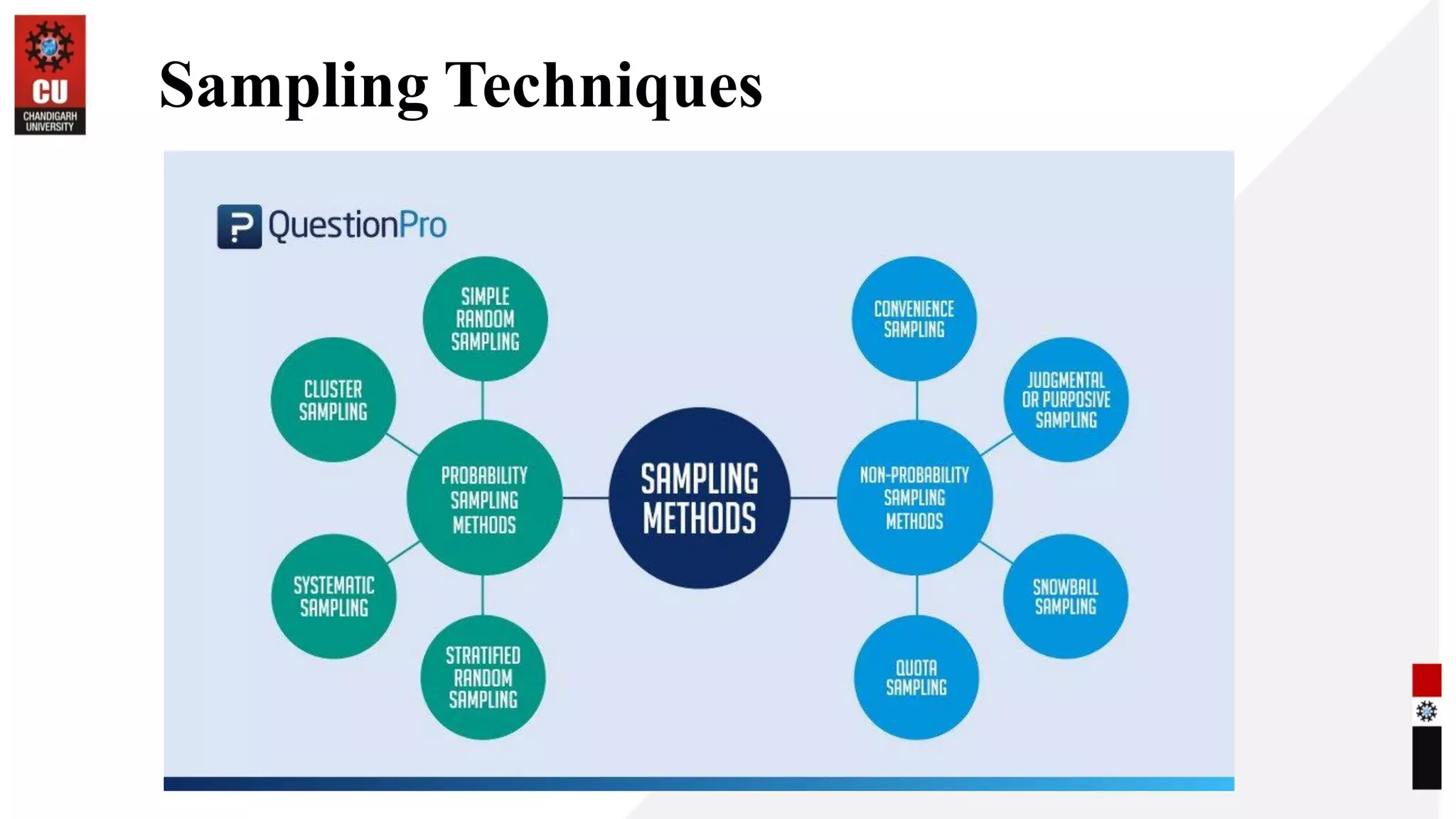
• Probability sampling
• Known, nonzero probability for every
element
• Nonprobability sampling
• Probability of selecting any particular
member is unknown
Source: Saunders et al. (2009)
Sampling Techniques
Probability versus Non-probability Sampling
Techniques
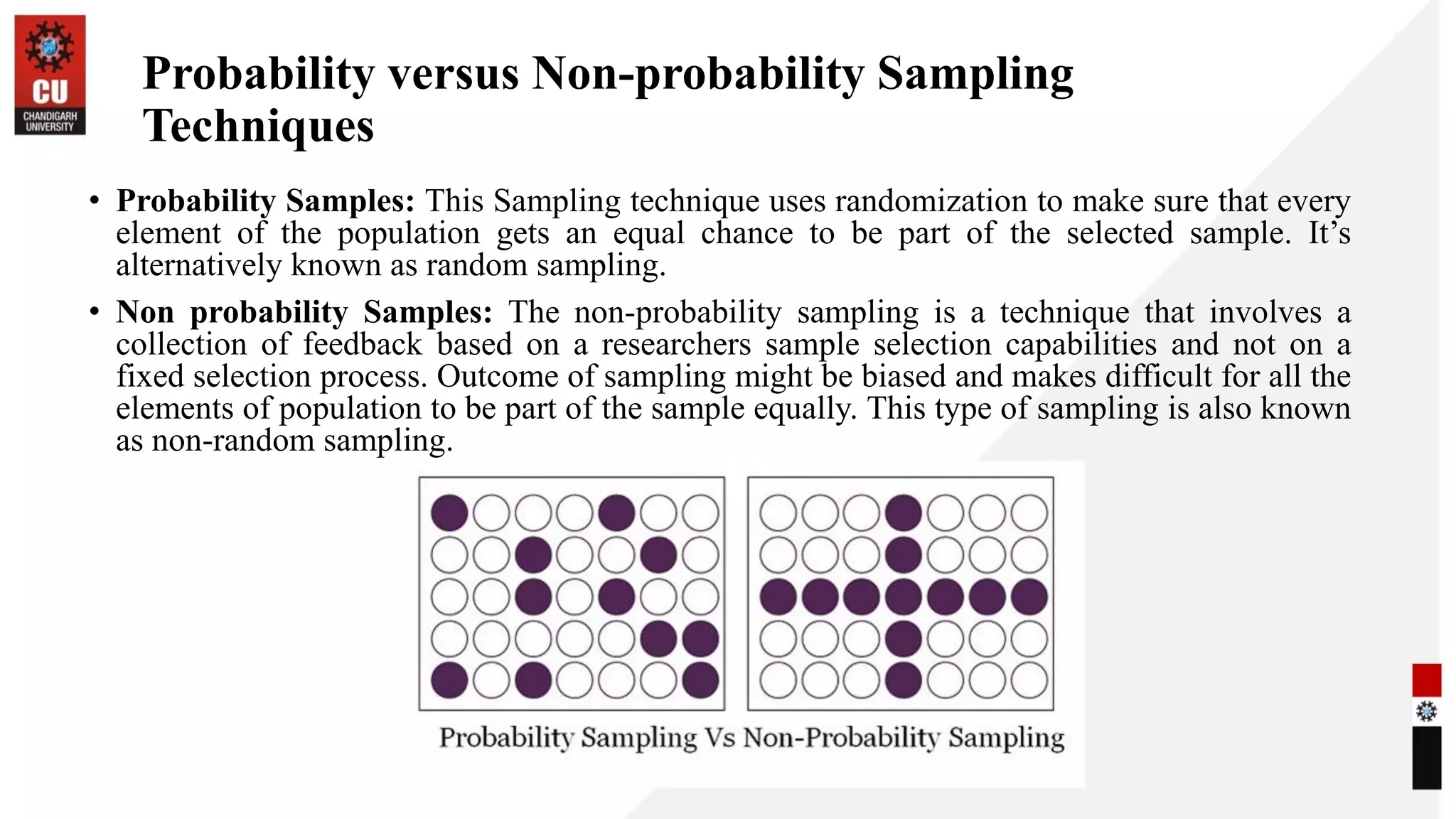
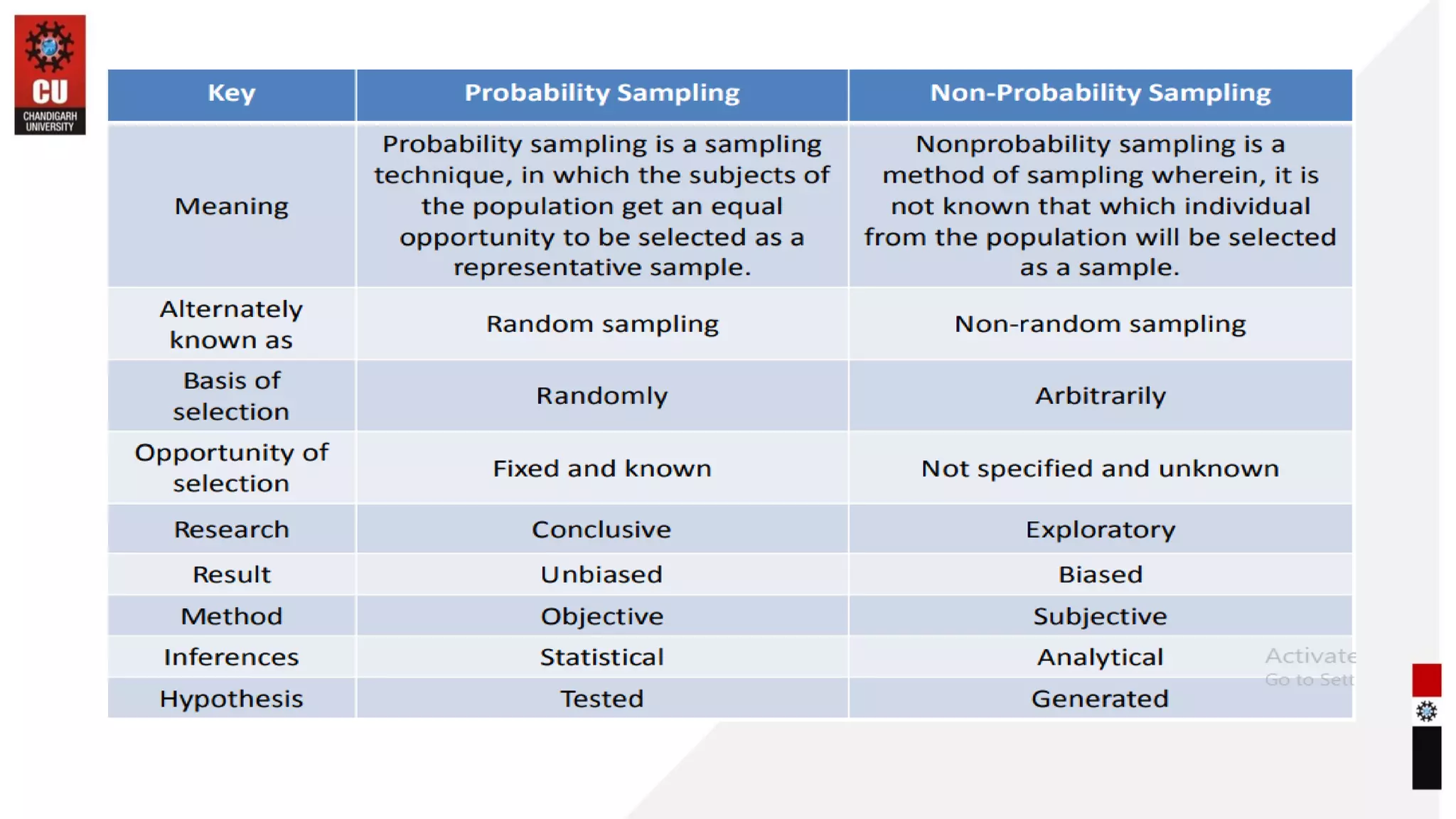
• Probability Samples: This Sampling technique uses randomization to make sure that every
element of the population gets an equal chance to be part of the selected sample. It’s
alternatively known as random sampling.
• Non probability Samples: The non-probability sampling is a technique that involves a
collection of feedback based on a researchers sample selection capabilities and not on a
fixed selection process. Outcome of sampling might be biased and makes difficult for all the
elements of population to be part of the sample equally. This type of sampling is also known
as non-random sampling.
Probability Sampling
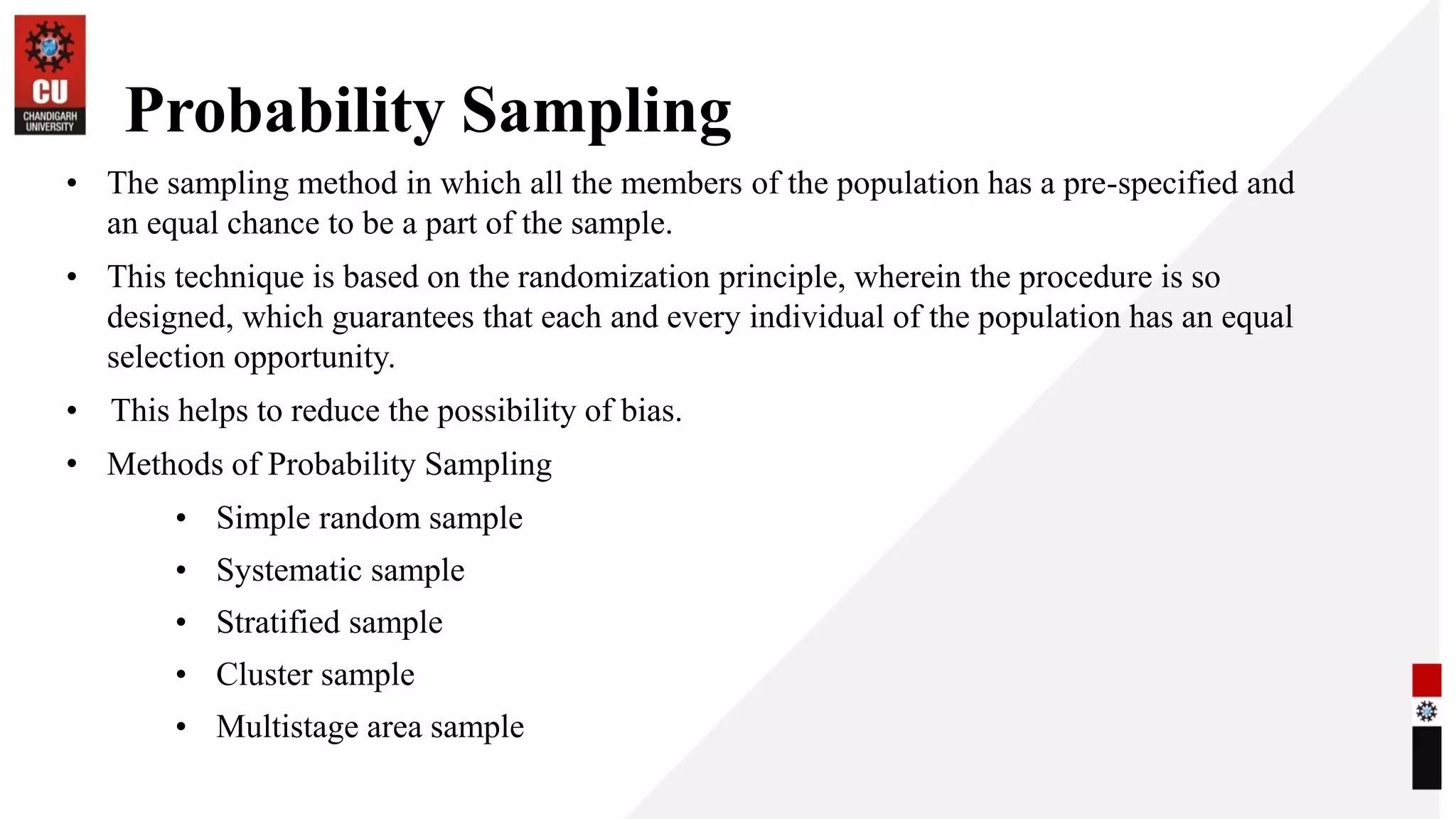
• The sampling method in which all the members of the population has a pre-specified and
an equal chance to be a part of the sample.
• This technique is based on the randomization principle, wherein the procedure is so
designed, which guarantees that each and every individual of the population has an equal
selection opportunity.
• This helps to reduce the possibility of bias.
• Methods of Probability Sampling
• Simple random sample
• Systematic sample
• Stratified sample
• Cluster sample
• Multistage area sample
Nonprobability Sampling
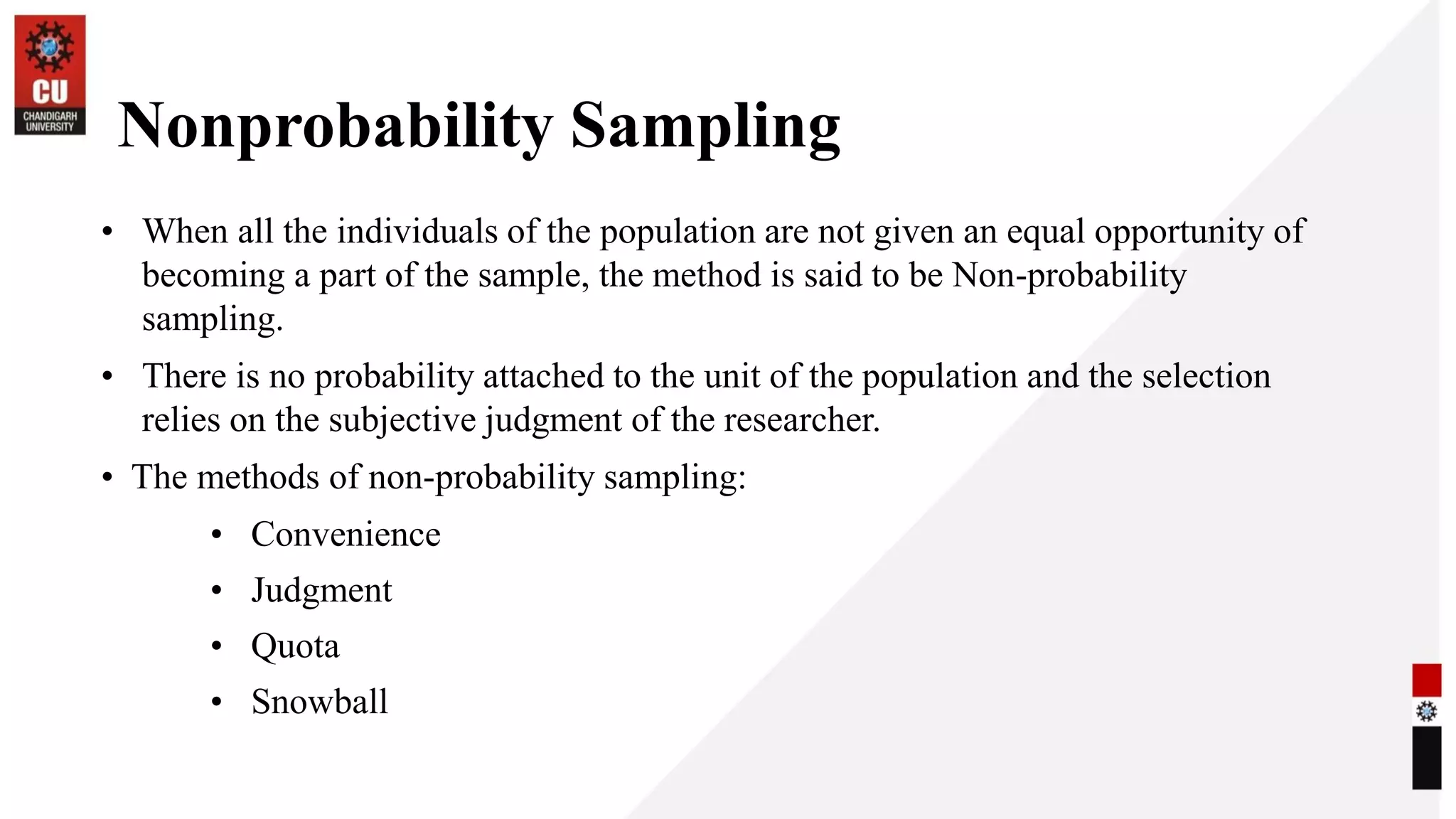
• When all the individuals of the population are not given an equal opportunity of
becoming a part of the sample, the method is said to be Non-probability
sampling.
• There is no probability attached to the unit of the population and the selection
relies on the subjective judgment of the researcher.
• The methods of non-probability sampling:
• Convenience
• Judgment
• Quota
• Snowball
Non-Probability Methods
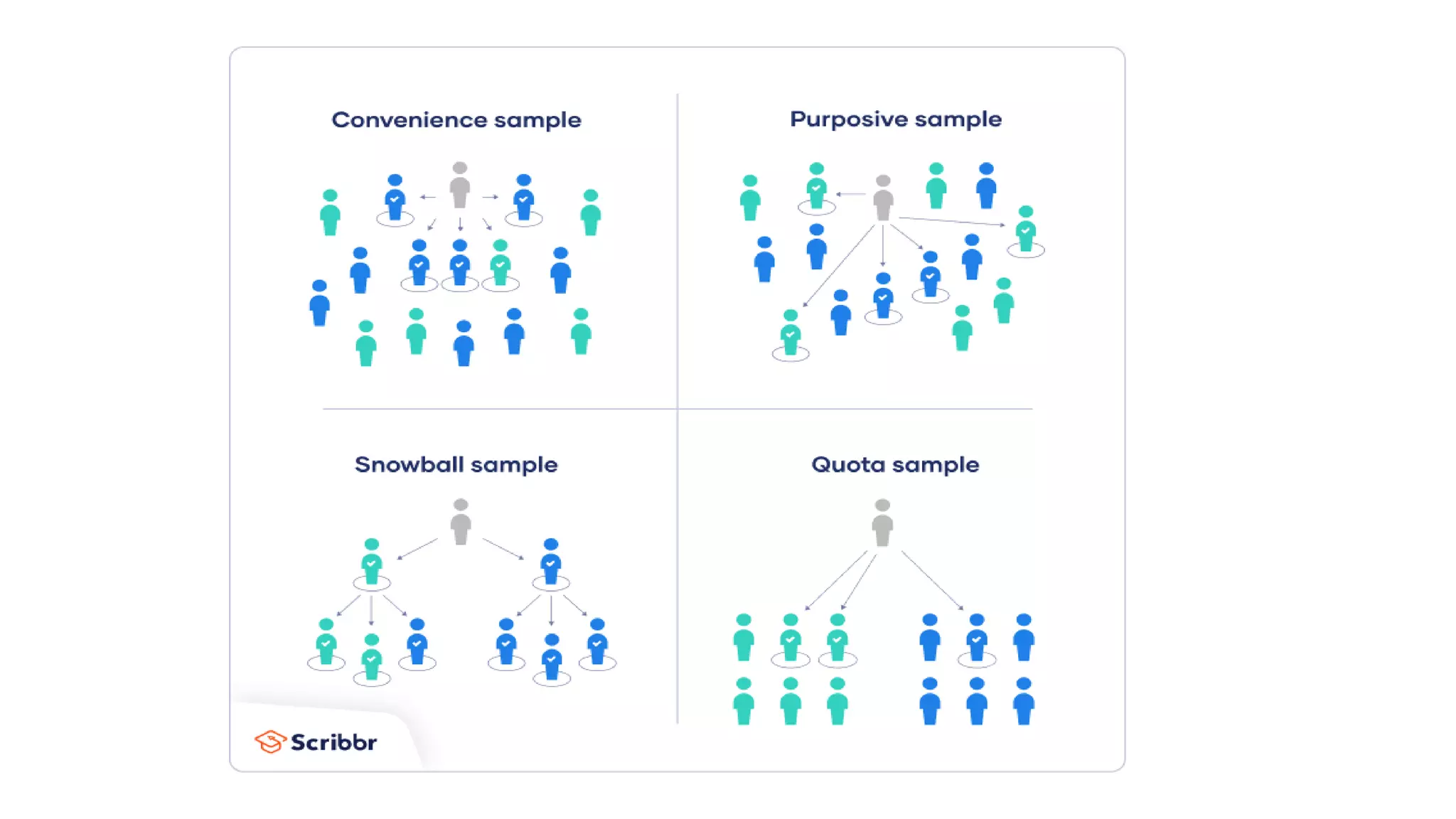
Convenience Sampling
• Convenience samples are nonprobability samples where the element
selection is based on ease of accessibility.
• They are the least reliable but cheapest and easiest to conduct.
• Examples include informal pools of friends and neighbors, people
responding to an advertised invitation, and “on the street” interviews.
Judgment Sampling
• This is based on the intention or the purpose of study.
• Only those elements will be selected from the population which suits the best for
the purpose of our study.
• For Example: If we want to understand the thought process of the people who are
interested in pursuing master’s degree then the selection criteria would be “Are you
interested for Masters in..?” All the people who respond with a “No” will be
excluded from our sample.
POLLING
• Which method of sampling is cheapest ?
• Convenience/Random/judgemental
Quota Sampling
▪ This type of sampling depends of some pre-set standard.
▪ It selects the representative sample from the population.
▪ Proportion of characteristics/ trait in sample should be same as population.
▪ Elements are selected until exact proportions of certain types of data is
obtained or sufficient data in different categories is collected.
▪ For example: If our population has 45% females and 55% males then our
sample should reflect the same percentage of males and females.
Snowball Sampling
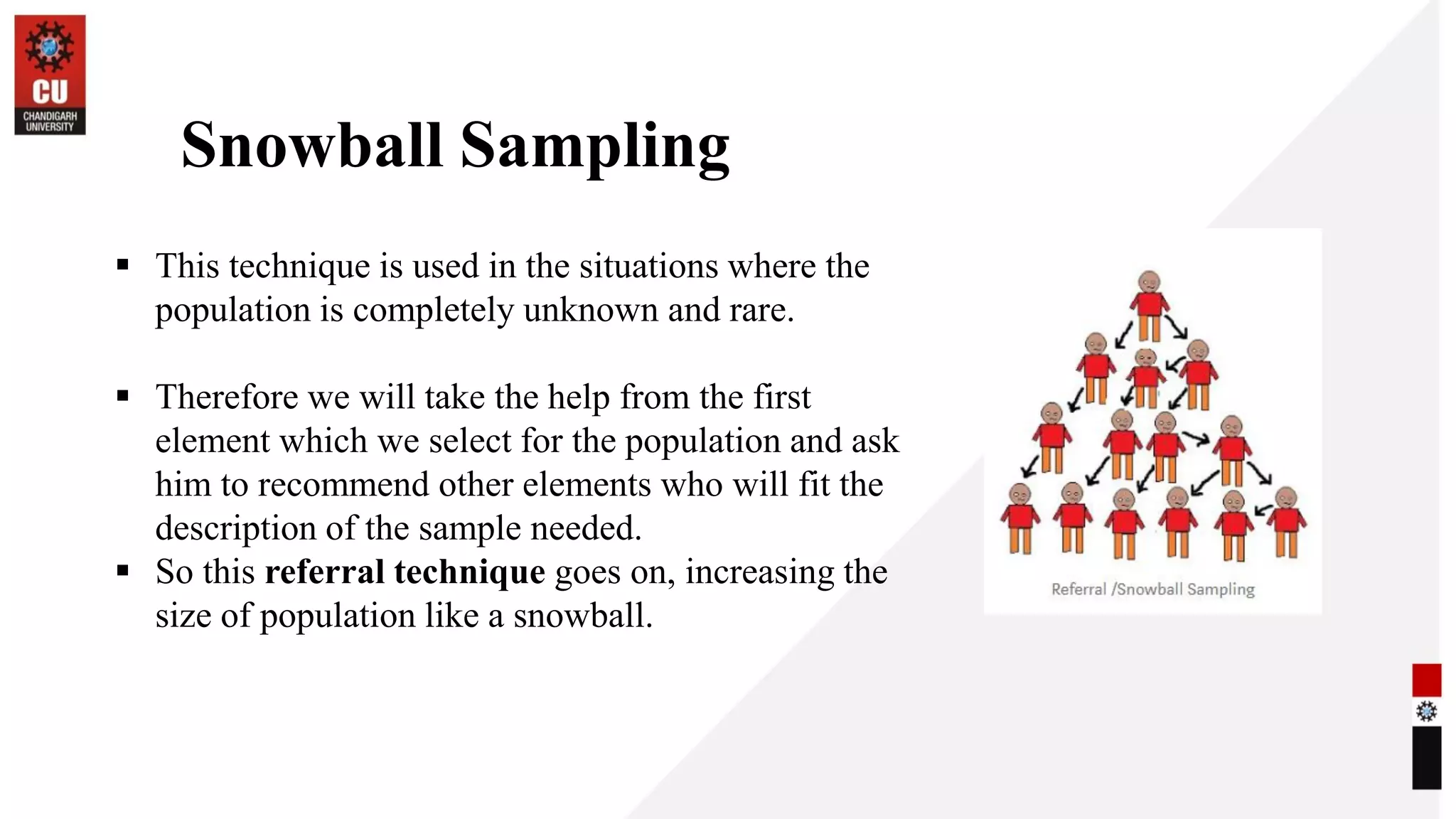
▪ This technique is used in the situations where the
population is completely unknown and rare.
▪ Therefore we will take the help from the first
element which we select for the population and ask
him to recommend other elements who will fit the
description of the sample needed.
▪ So this referral technique goes on, increasing the
size of population like a snowball.
Probability Methods
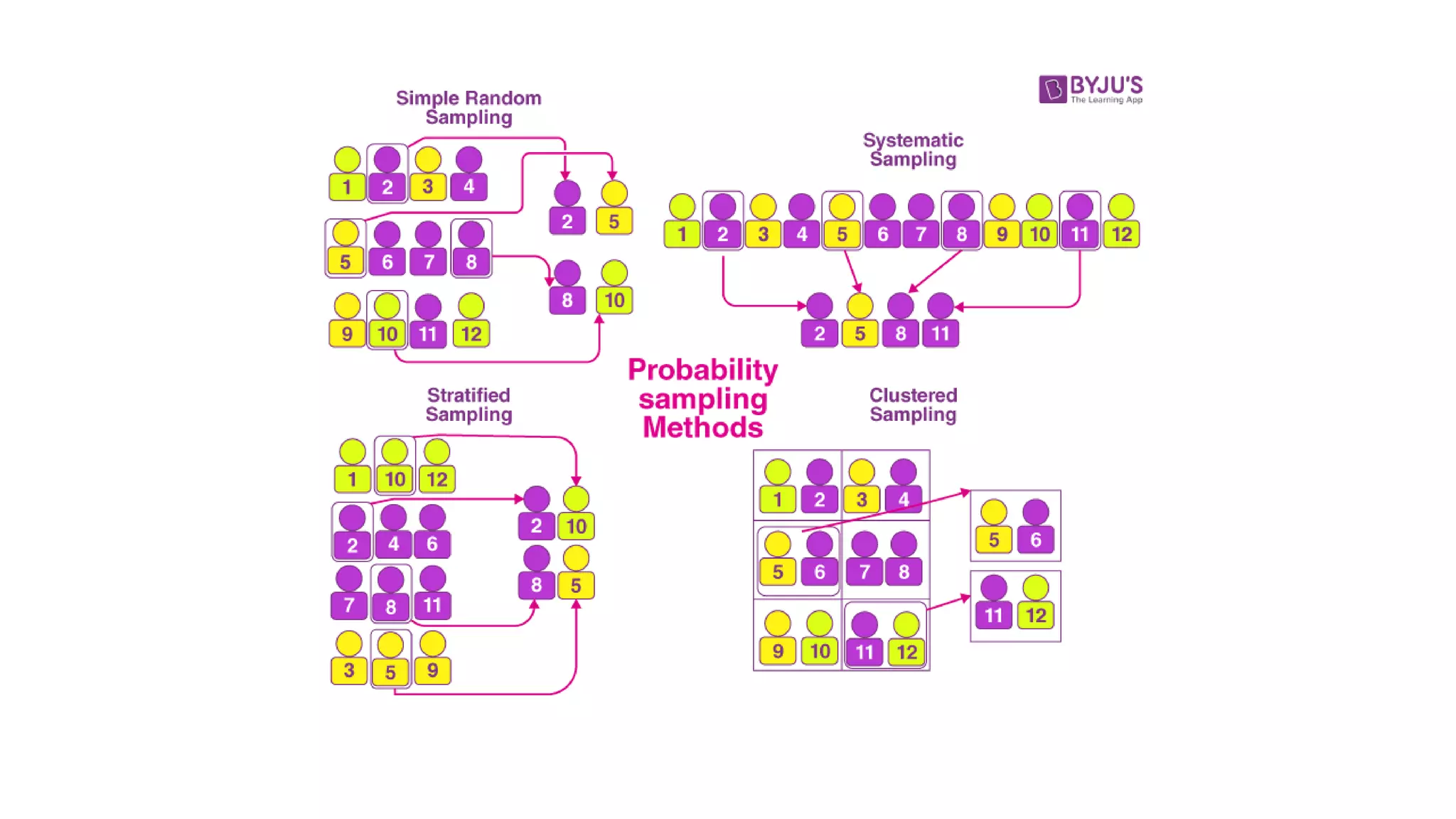
Simple random sampling
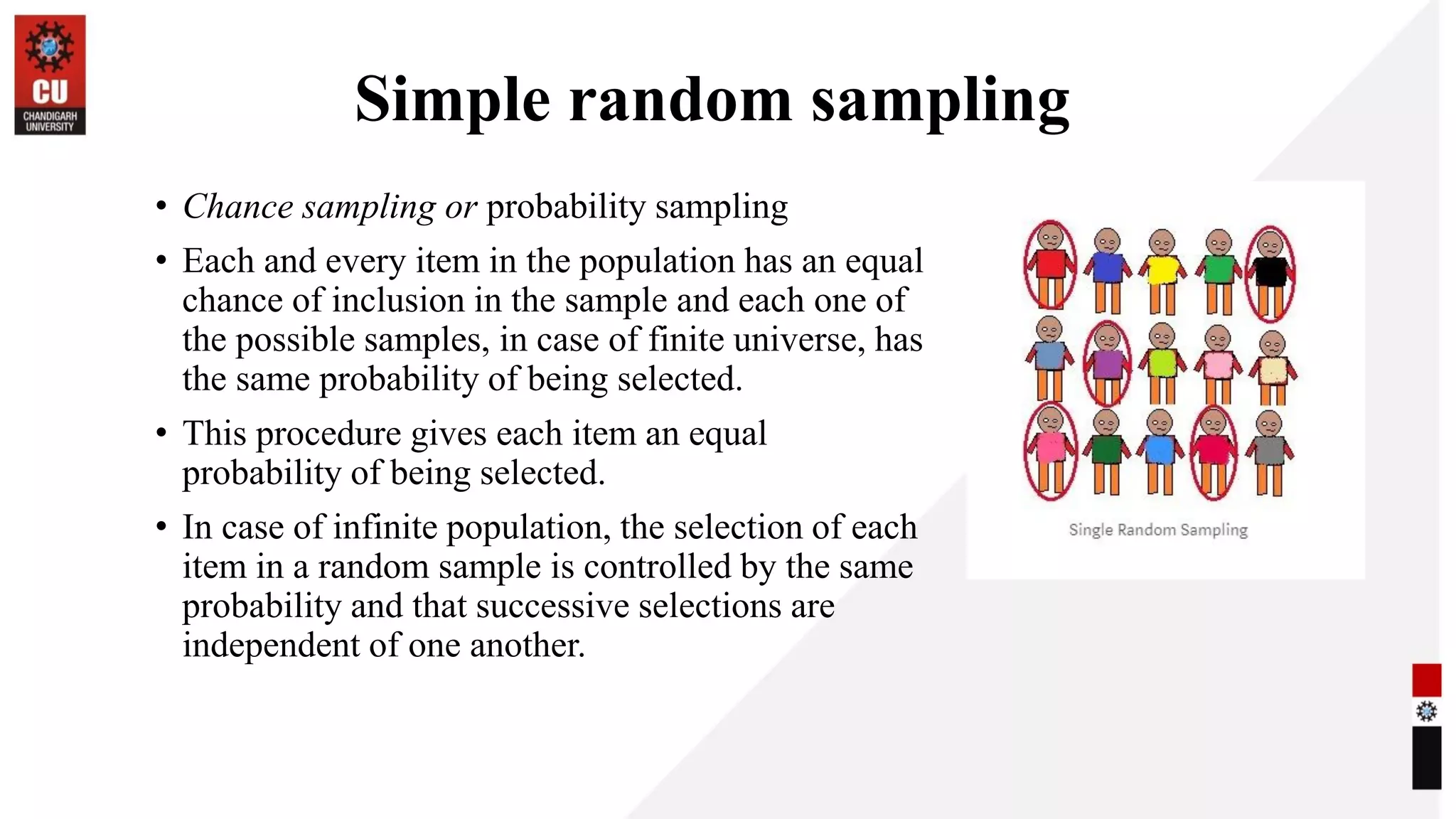
• Chance sampling or probability sampling
• Each and every item in the population has an equal
chance of inclusion in the sample and each one of
the possible samples, in case of finite universe, has
the same probability of being selected.
• This procedure gives each item an equal
probability of being selected.
• In case of infinite population, the selection of each
item in a random sample is controlled by the same
probability and that successive selections are
independent of one another.
Systematic sampling
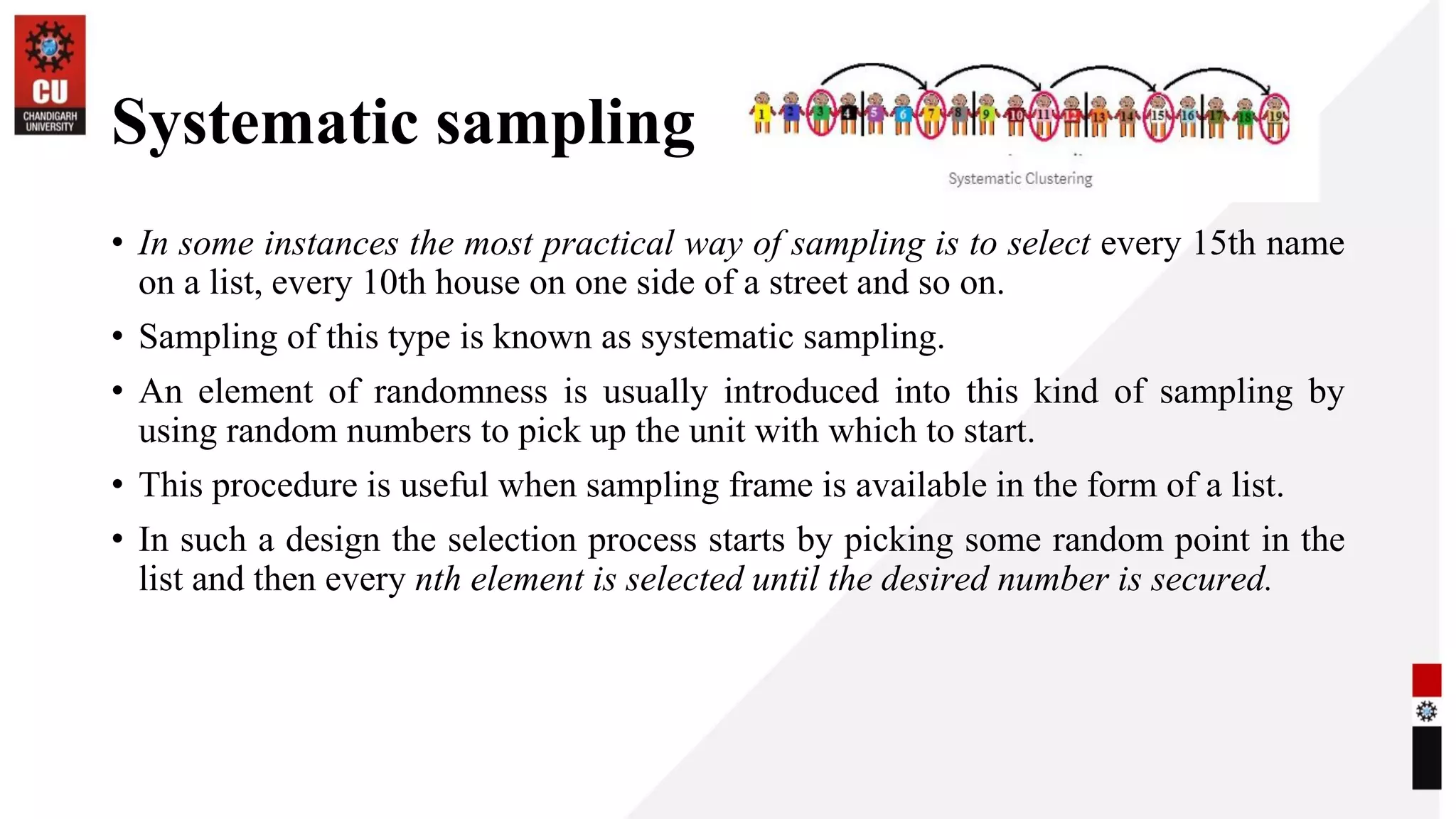
• In some instances the most practical way of sampling is to select every 15th name
on a list, every 10th house on one side of a street and so on.
• Sampling of this type is known as systematic sampling.
• An element of randomness is usually introduced into this kind of sampling by
using random numbers to pick up the unit with which to start.
• This procedure is useful when sampling frame is available in the form of a list.
• In such a design the selection process starts by picking some random point in the
list and then every nth element is selected until the desired number is secured.
Stratified sampling
• If the population does not constitute a
homogeneous group
• The population is stratified into a number of
nonoverlapping subpopulations or strata and
sample items are selected from each stratum.
• If the items selected from each stratum is based
on simple random sampling the entire
procedure, first stratification and then simple
random sampling, is known as stratified random
sampling.
Cluster sampling and Area sampling
• Cluster sampling involves grouping the population and then selecting the
groups or the clusters rather than individual elements for inclusion in the
sample.
• Three clusters might then be selected for the sample randomly.
• All the elements of the cluster are used for sampling.
• Clusters are identified using details such as age, sex, location etc.
• The sample size must often be larger than the simple random sample to
ensure the same level of accuracy because is cluster sampling procedural
potential for order bias and other sources of error is usually accentuated.
• The clustering approach can, however, make the sampling procedure
relatively easier and increase the efficiency of field work, specially in the
case of personal interviews.
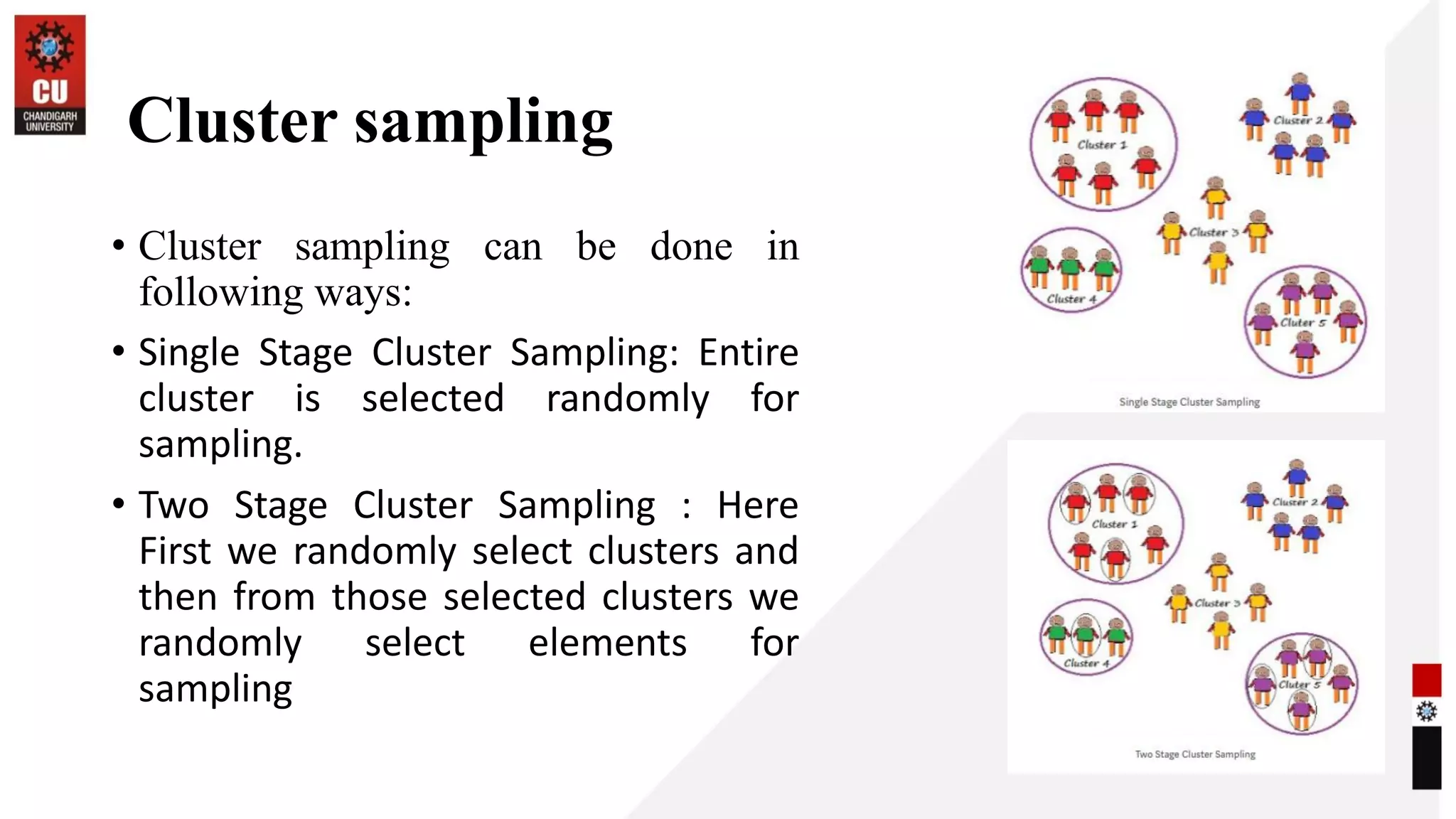
Cluster sampling
• Cluster sampling can be done in
following ways:
• Single Stage Cluster Sampling: Entire
cluster is selected randomly for
sampling.
• Two Stage Cluster Sampling : Here
First we randomly select clusters and
then from those selected clusters we
randomly select elements for
sampling
Cluster sampling and Area sampling
• Area sampling is quite close to cluster sampling and is often talked
about when the total geographical area of interest happens to be big
one.
• Under area sampling we first divide the total area into a number of
smaller non-overlapping areas, generally called geographical clusters,
then a number of these smaller areas are randomly selected, and all
units in these small areas are included in the sample.
• Area sampling is specially helpful where we do not have the list of the
population concerned.
• It also makes the field interviewing more efficient since interviewer
can do many interviews at each location.
Multistage Sampling
• Multi-stage sampling: This is a further
development of the idea of cluster sampling.
This technique is meant for big inquiries
extending to a considerably large
geographical area like an entire country.
• Under multi-stage sampling the first stage
may be to select large primary sampling
units such as states, then districts, then
towns and finally certain families within
towns.
• If the technique of random-sampling is
applied at all stages, the sampling procedure
is described as multi-stage random
sampling.
Sequential Sampling
• Sequential sampling: This is somewhat a complex sample design
where the ultimate size of the sample is not fixed in advance but is
determined according to mathematical decisions on the basis of
information yielded as survey progresses. This design is usually
adopted under acceptance sampling plan in the context of statistical
quality control.
• The sample design to be used must be decided by the researcher taking
into consideration the nature of the inquiry and other related factors.
Qualities of a probability sample
• Representative - allows for generalization from sample to
population
• Inferential statistical tests
• Sample means can be used to estimate population means
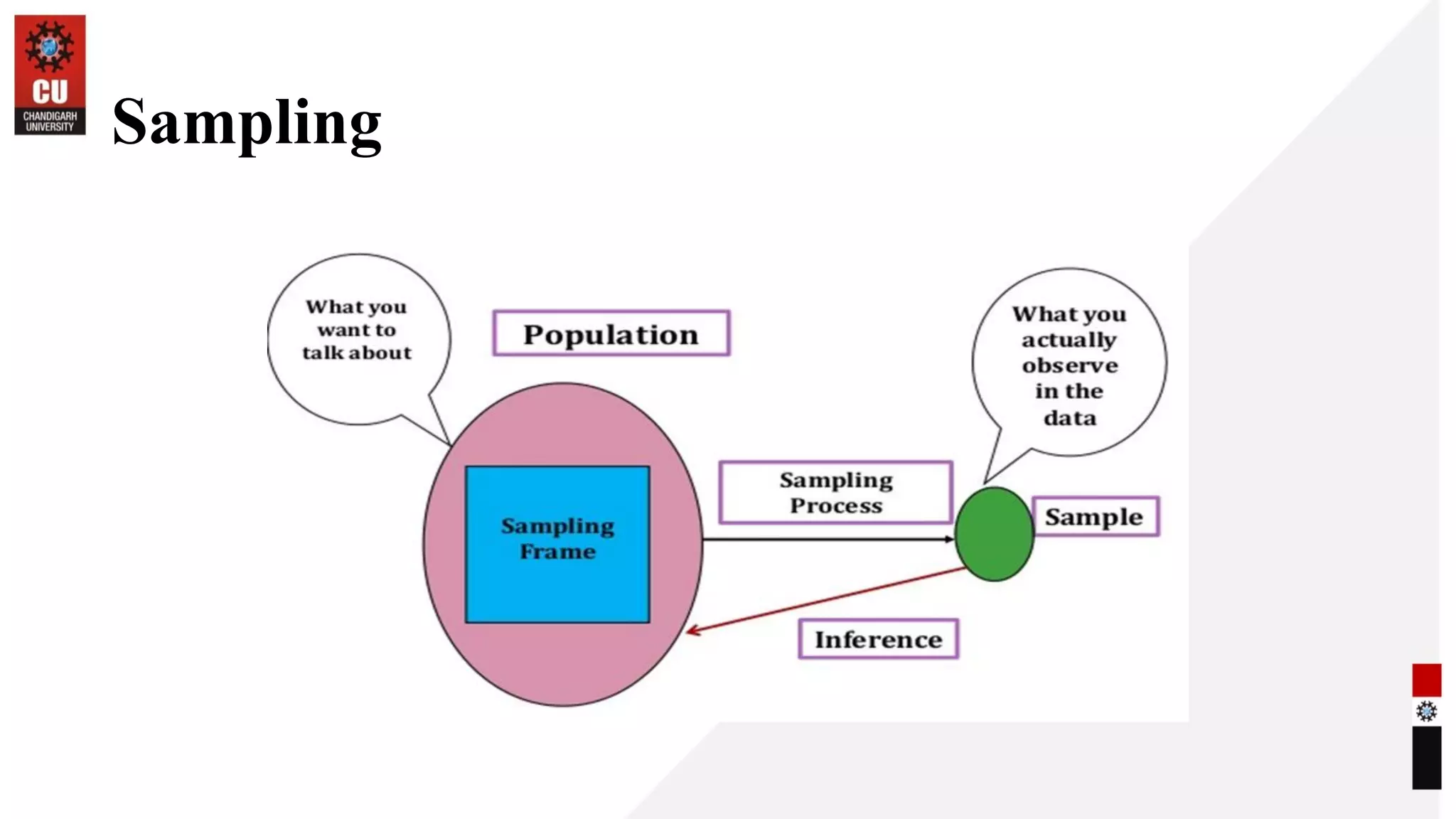
Sampling Frame
A sample frame is the listing of all population elements from which the sample
will be drawn.
An ideal sampling frame will have the following qualities:
• all units have a logical, numerical identifier
• all units can be found – their contact information, map location or other relevant information
is present
• the frame is organized in a logical, systematic fashion
• the frame has additional information about the units that allow the use of more advanced
sampling frames
• every element of the population of interest is present in the frame
• every element of the population is present only once in the frame
• no elements from outside the population of interest are present in the frame
• the data is 'up-to-date
Sampling Units
• Group selected for the sample
• Primary Sampling Units (PSU)
• Secondary Sampling Units
• Tertiary Sampling Units
Error in survey research
• Sampling error
• unavoidable difference between sample and population
• Sampling-related error
• inadequate sampling frame; non-response
• makes it difficult to generalize findings
• Data collection error
• implementation of research instruments
• e.g. poor question wording in surveys
• Data processing error
• faulty management of data, e.g. coding errors
Sampling Error
• Difference between sample and population
• Biased sample does not represent population
• some groups are over-represented; others are under-represented
• Sources of bias
• non-probability sampling, inadequate sample frame, non-
response
• Probability sampling reduces sampling error and allows for
inferential statistics
Random Sampling Error
• The difference between the sample results and the result of a census conducted
using identical procedures
• Statistical fluctuation due to chance variations
Systematic Errors
• Non sampling errors
• Unrepresentative sample results
• Not due to chance
• Due to study design or imperfections in execution
Sample size
• Whether you are using a probability sampling or non-probability sampling technique to help you
create your sample, you will need to decide how large your sample should be (i.e., your sample size).
• Your sample size becomes an ethical issue for two reasons: (a) over-sized samples and (b) under-
sized samples.
• Over sized samples: A sample is over-sized when there are more units (e.g., people, organisations) in
the sample than are needed to achieve you goals (i.e., to answer your research questions robustly).
• An over-sized sample is considered to be an ethical issue because it potentially exposes an excessive
number of people (or other units) to your research.
• Under-sized samples : A sample is under-sized when you are unable to achieve your goals (i.e., to
answer your research questions robustly) because you insufficient units in your sample.
• The important point is that you fail to answer your research questions not because a potential answer
did not exist, but because your sample size was too small for such an answer to be discovered (or
interpreted).
Summary
• Probability Sampling can be more expensive and time consuming
compared to Non-Probability Sampling.
• While probability sampling is based on the principle of randomization
where every entity gets a fair chance to be a part of the sample,
• Non-probability sampling relies on the assumption that the
characteristics are evenly distributed within the population, which
make the sampler believe that any sample so selected would
represent the whole population and the results drawn would be
accurate.
THANK YOU

Sampling PPT By RG.pdf

  • 1.
    Basic Concepts ofSampling Theory By: Dr. Rajni Goel
  • 2.
    Census Survey If westudy each and every unit of a population, it is known as population survey or census survey. In a census investigation, intensive information is obtained from each and every item; thus, many faces of the problem are brought to light. Through, the data collection through census method are more true and reliable, it is appropriate only when units of the population are diverse characteristics or when the population is not too large. Census method of investigation is costly and much time-consuming. It needs a big organization to handle the investigation.
  • 3.
    Need of Sampling •A survey of the entire population is impracticable • Budget constraints restrict data collection • Time constraints restrict data collection • Results from data collection are needed quickly
  • 4.
    Sample Survey • Inour daily life we adopt sampling technique almost every moment of our existence. • Examples: We go to marking and examine a sample of wheat to from an idea about the quality and then decide whether the quality of the whole lot is acceptable or not. We examine a few beads of rice from the bowl on the stove, to check if the rice is cooked or not. • The sampling procedure is based on the assumption that a part of aggregate represent well and whole population. Sampling is the selection of a part of population for the purpose of drawing conclusion about the entire universe. • The basic aim of sampling is to obtain the maximum information about the phenomena under study, with the least use of resources like money, time, and manpower.
  • 5.
    • The processof using a small number of items or parts of larger population to make a conclusions about the whole population Sampling Selecting samples ▪ Population ▪ Sample ▪ Individual cases
  • 6.
  • 7.
    Characteristics of aGood Sample 1. Sample design should be a representative sample 2. Sample design should have small sampling error 3. Sample design should be economically viable 4. Sample design should have marginal systematic bias 5. Results obtained from the sample should be generalized and applicable to the whole universe.
  • 8.
    Two Major Categoriesof Sampling • Probability sampling • Known, nonzero probability for every element • Nonprobability sampling • Probability of selecting any particular member is unknown
  • 9.
    Source: Saunders etal. (2009) Sampling Techniques
  • 10.
    Probability versus Non-probabilitySampling Techniques • Probability Samples: This Sampling technique uses randomization to make sure that every element of the population gets an equal chance to be part of the selected sample. It’s alternatively known as random sampling. • Non probability Samples: The non-probability sampling is a technique that involves a collection of feedback based on a researchers sample selection capabilities and not on a fixed selection process. Outcome of sampling might be biased and makes difficult for all the elements of population to be part of the sample equally. This type of sampling is also known as non-random sampling.
  • 11.
    Probability Sampling • Thesampling method in which all the members of the population has a pre-specified and an equal chance to be a part of the sample. • This technique is based on the randomization principle, wherein the procedure is so designed, which guarantees that each and every individual of the population has an equal selection opportunity. • This helps to reduce the possibility of bias. • Methods of Probability Sampling • Simple random sample • Systematic sample • Stratified sample • Cluster sample • Multistage area sample
  • 12.
    Nonprobability Sampling • Whenall the individuals of the population are not given an equal opportunity of becoming a part of the sample, the method is said to be Non-probability sampling. • There is no probability attached to the unit of the population and the selection relies on the subjective judgment of the researcher. • The methods of non-probability sampling: • Convenience • Judgment • Quota • Snowball
  • 16.
  • 17.
    Convenience Sampling • Conveniencesamples are nonprobability samples where the element selection is based on ease of accessibility. • They are the least reliable but cheapest and easiest to conduct. • Examples include informal pools of friends and neighbors, people responding to an advertised invitation, and “on the street” interviews.
  • 18.
    Judgment Sampling • Thisis based on the intention or the purpose of study. • Only those elements will be selected from the population which suits the best for the purpose of our study. • For Example: If we want to understand the thought process of the people who are interested in pursuing master’s degree then the selection criteria would be “Are you interested for Masters in..?” All the people who respond with a “No” will be excluded from our sample.
  • 19.
    POLLING • Which methodof sampling is cheapest ? • Convenience/Random/judgemental
  • 20.
    Quota Sampling ▪ Thistype of sampling depends of some pre-set standard. ▪ It selects the representative sample from the population. ▪ Proportion of characteristics/ trait in sample should be same as population. ▪ Elements are selected until exact proportions of certain types of data is obtained or sufficient data in different categories is collected. ▪ For example: If our population has 45% females and 55% males then our sample should reflect the same percentage of males and females.
  • 21.
    Snowball Sampling ▪ Thistechnique is used in the situations where the population is completely unknown and rare. ▪ Therefore we will take the help from the first element which we select for the population and ask him to recommend other elements who will fit the description of the sample needed. ▪ So this referral technique goes on, increasing the size of population like a snowball.
  • 22.
  • 23.
    Simple random sampling •Chance sampling or probability sampling • Each and every item in the population has an equal chance of inclusion in the sample and each one of the possible samples, in case of finite universe, has the same probability of being selected. • This procedure gives each item an equal probability of being selected. • In case of infinite population, the selection of each item in a random sample is controlled by the same probability and that successive selections are independent of one another.
  • 24.
    Systematic sampling • Insome instances the most practical way of sampling is to select every 15th name on a list, every 10th house on one side of a street and so on. • Sampling of this type is known as systematic sampling. • An element of randomness is usually introduced into this kind of sampling by using random numbers to pick up the unit with which to start. • This procedure is useful when sampling frame is available in the form of a list. • In such a design the selection process starts by picking some random point in the list and then every nth element is selected until the desired number is secured.
  • 25.
    Stratified sampling • Ifthe population does not constitute a homogeneous group • The population is stratified into a number of nonoverlapping subpopulations or strata and sample items are selected from each stratum. • If the items selected from each stratum is based on simple random sampling the entire procedure, first stratification and then simple random sampling, is known as stratified random sampling.
  • 26.
    Cluster sampling andArea sampling • Cluster sampling involves grouping the population and then selecting the groups or the clusters rather than individual elements for inclusion in the sample. • Three clusters might then be selected for the sample randomly. • All the elements of the cluster are used for sampling. • Clusters are identified using details such as age, sex, location etc. • The sample size must often be larger than the simple random sample to ensure the same level of accuracy because is cluster sampling procedural potential for order bias and other sources of error is usually accentuated. • The clustering approach can, however, make the sampling procedure relatively easier and increase the efficiency of field work, specially in the case of personal interviews.
  • 27.
    Cluster sampling • Clustersampling can be done in following ways: • Single Stage Cluster Sampling: Entire cluster is selected randomly for sampling. • Two Stage Cluster Sampling : Here First we randomly select clusters and then from those selected clusters we randomly select elements for sampling
  • 28.
    Cluster sampling andArea sampling • Area sampling is quite close to cluster sampling and is often talked about when the total geographical area of interest happens to be big one. • Under area sampling we first divide the total area into a number of smaller non-overlapping areas, generally called geographical clusters, then a number of these smaller areas are randomly selected, and all units in these small areas are included in the sample. • Area sampling is specially helpful where we do not have the list of the population concerned. • It also makes the field interviewing more efficient since interviewer can do many interviews at each location.
  • 29.
    Multistage Sampling • Multi-stagesampling: This is a further development of the idea of cluster sampling. This technique is meant for big inquiries extending to a considerably large geographical area like an entire country. • Under multi-stage sampling the first stage may be to select large primary sampling units such as states, then districts, then towns and finally certain families within towns. • If the technique of random-sampling is applied at all stages, the sampling procedure is described as multi-stage random sampling.
  • 30.
    Sequential Sampling • Sequentialsampling: This is somewhat a complex sample design where the ultimate size of the sample is not fixed in advance but is determined according to mathematical decisions on the basis of information yielded as survey progresses. This design is usually adopted under acceptance sampling plan in the context of statistical quality control. • The sample design to be used must be decided by the researcher taking into consideration the nature of the inquiry and other related factors.
  • 32.
    Qualities of aprobability sample • Representative - allows for generalization from sample to population • Inferential statistical tests • Sample means can be used to estimate population means
  • 33.
    Sampling Frame A sampleframe is the listing of all population elements from which the sample will be drawn. An ideal sampling frame will have the following qualities: • all units have a logical, numerical identifier • all units can be found – their contact information, map location or other relevant information is present • the frame is organized in a logical, systematic fashion • the frame has additional information about the units that allow the use of more advanced sampling frames • every element of the population of interest is present in the frame • every element of the population is present only once in the frame • no elements from outside the population of interest are present in the frame • the data is 'up-to-date
  • 34.
    Sampling Units • Groupselected for the sample • Primary Sampling Units (PSU) • Secondary Sampling Units • Tertiary Sampling Units
  • 35.
    Error in surveyresearch • Sampling error • unavoidable difference between sample and population • Sampling-related error • inadequate sampling frame; non-response • makes it difficult to generalize findings • Data collection error • implementation of research instruments • e.g. poor question wording in surveys • Data processing error • faulty management of data, e.g. coding errors
  • 36.
    Sampling Error • Differencebetween sample and population • Biased sample does not represent population • some groups are over-represented; others are under-represented • Sources of bias • non-probability sampling, inadequate sample frame, non- response • Probability sampling reduces sampling error and allows for inferential statistics
  • 37.
    Random Sampling Error •The difference between the sample results and the result of a census conducted using identical procedures • Statistical fluctuation due to chance variations Systematic Errors • Non sampling errors • Unrepresentative sample results • Not due to chance • Due to study design or imperfections in execution
  • 38.
    Sample size • Whetheryou are using a probability sampling or non-probability sampling technique to help you create your sample, you will need to decide how large your sample should be (i.e., your sample size). • Your sample size becomes an ethical issue for two reasons: (a) over-sized samples and (b) under- sized samples. • Over sized samples: A sample is over-sized when there are more units (e.g., people, organisations) in the sample than are needed to achieve you goals (i.e., to answer your research questions robustly). • An over-sized sample is considered to be an ethical issue because it potentially exposes an excessive number of people (or other units) to your research. • Under-sized samples : A sample is under-sized when you are unable to achieve your goals (i.e., to answer your research questions robustly) because you insufficient units in your sample. • The important point is that you fail to answer your research questions not because a potential answer did not exist, but because your sample size was too small for such an answer to be discovered (or interpreted).
  • 39.
    Summary • Probability Samplingcan be more expensive and time consuming compared to Non-Probability Sampling. • While probability sampling is based on the principle of randomization where every entity gets a fair chance to be a part of the sample, • Non-probability sampling relies on the assumption that the characteristics are evenly distributed within the population, which make the sampler believe that any sample so selected would represent the whole population and the results drawn would be accurate.
  • 40.