


SALES FORECASTING
HARSHAL KOTHARI
Sales forecasting is an important
assessment tool that helps to
Regularly take the pulse of your
company get tips on effective
sales forecasting with helps
form a professional speaker
author and business consultant
who has been a real estate
broker , professional insurance
salesperson and financial
planner.
VIDEO
 Jury of Executive opinion Method
 Delphi Method
 The sales force Estimation Method
 Time series Analysis Method
Popular Method of Sales Forecasting
 There are two steps in this method
 High ranking executives estimate probable sales
 An average estimate is calculated
 In the jury of executive opinion method of sales
forecasting, appropriate managers within the
organization assemble to discuss their opinions on
what will happen to sales in the future.
 This method combines managerial experience with
statistical knowledge.
Jury of Executive opinion
 This is a quick and easy way to turn out a forecast.
 This is a way to pool the experience and judgement of
well informed people.
 This may be the only feasible approach if the company
is so young that it has not yet accumulated the
experience to use other forecasting methods.
 This method may be used when adequate sales and
market statistic are missing ,or when these figure
have not yet been put into the form required for more
sophisticated forecasting methods.
Companies using the jury of executive opinion
method do so for one or more of four reason:
 Mainframe computer forecasting is done by
conducting a series of meetings between the two
mainframe analysts at a company, the Service director,
and a Research Operations analyst. Typically, three or
four meetings are required in order to arrive at a
forecast consensus. In between meetings, the forecasts
are examined by colleagues, both domestic and
abroad, for feedback and reaction.
EXAMPLE:
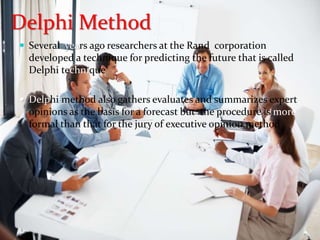
 Several years ago researchers at the Rand corporation
developed a technique for predicting the future that is called
Delphi technique
 Delphi method also gathers evaluates and summarizes expert
opinions as the basis for a forecast but the procedure is more
formal than that for the jury of executive opinion method
Delphi Method
 Decision Makers
 Staff
 Respondents
Steps in the Delphi method
 Steps 1- Various Experts are asked to answer, independently and
in writing, a series of questions about the future of sales or
whatever other area is being forecasted.
 STEP 2 – A summary of all the answers is then prepared. No
expert knows, how any other expert answered the questions.
Three Types of Participants
 STEP 3 – Copies of summary are given to the individual experts
with the request that they modify their original answers if they
think it necessary.
 STEP 4 – Another summary is made of these modifications, and
copies again are distributed to the experts. This time, however,
expert opinions that deviate significantly from the norm must be
justified in writing.
 STEP 5 – A third summary is made of the opinions and
justifications, and copies are once again distributed to the
experts. Justification in writing for all answers is now required.
 STEP 6 – The forecast is generated from all of the opinions and
justifications that arise from step 5.
 The Sales Force Method is a sales forecasting
technique that predicts future sales by analyzing the
opinions of sales people as a group
Sales Force Estimation Method
 A sales forecast is an estimate of sales in dollars or physical
unit in future period under a particular marketing program
and assume set of economic and other factor out side the
unit for which the forecast is made.
 The Sales Force Method is a sales forecasting technique
that predicts future sales by
analyzing the opinions of sales people as
a group.
 Salespeople continually interact with customers,
and from this interaction they usually
develop a knack for predicting
future sales.
Not greatly different in principle from the simple projection of past sales is time
series analysis a statistical procedure for studying historical sales data
This procedure involves isolating and measuring four chief types of sales
variations long term trends cyclical changes seasonal variations and irregular
fluctuations
One drawback of time series analysis is that it is difficult to ‘’ call the turns’’
Time Series analysis Method
The time series analysis method Predicts the future sales by analyzing
The historical relationship between sales And time.
Time Series analysis involves
 Many businesses prepare their sales forecast on the basis of past
sales.
 Time series analysis involves breaking past sales down into four
components
(1)The trend: Are sales growing, flat or in decline.
(2) Seasonal or cyclical factors. Sales are affected by swings in general
economic activity (e.g. increases in the disposable income of
consumers may lead to increase in sales for products in a particular
industry). Seasonal and cyclical factors occur in a regular pattern
(3) Erratic events; these include strikes, fads, war scares and other
disturbances to the market which need to be isolated from past sales
data in order to be able to identify the more normal pattern of sales
(4) Responses: the results of particular measures that have been taken
to increase sales (e.g. a major new advertising campaign).
 For a good of this see R. B. Miller and D .W Wichern,
intermediate Businees Statistics
 P. E. Green and D.S. Tull, Research for marketing
decisions 4th prentice hall Page no 508-10
 S.K. Mullick and D.D. Smith, ‘’how to Choose the
Right Forecasting Technique’’ Harvard Business
Review 49 Page no 55-64
Reference
THANK YOU

sales forecasting

  • 1.
  • 2.
    Sales forecasting isan important assessment tool that helps to Regularly take the pulse of your company get tips on effective sales forecasting with helps form a professional speaker author and business consultant who has been a real estate broker , professional insurance salesperson and financial planner.
  • 3.
  • 4.
     Jury ofExecutive opinion Method  Delphi Method  The sales force Estimation Method  Time series Analysis Method Popular Method of Sales Forecasting
  • 5.
     There aretwo steps in this method  High ranking executives estimate probable sales  An average estimate is calculated  In the jury of executive opinion method of sales forecasting, appropriate managers within the organization assemble to discuss their opinions on what will happen to sales in the future.  This method combines managerial experience with statistical knowledge. Jury of Executive opinion
  • 6.
     This isa quick and easy way to turn out a forecast.  This is a way to pool the experience and judgement of well informed people.  This may be the only feasible approach if the company is so young that it has not yet accumulated the experience to use other forecasting methods.  This method may be used when adequate sales and market statistic are missing ,or when these figure have not yet been put into the form required for more sophisticated forecasting methods. Companies using the jury of executive opinion method do so for one or more of four reason:
  • 7.
     Mainframe computerforecasting is done by conducting a series of meetings between the two mainframe analysts at a company, the Service director, and a Research Operations analyst. Typically, three or four meetings are required in order to arrive at a forecast consensus. In between meetings, the forecasts are examined by colleagues, both domestic and abroad, for feedback and reaction. EXAMPLE:
  • 8.
     Several yearsago researchers at the Rand corporation developed a technique for predicting the future that is called Delphi technique  Delphi method also gathers evaluates and summarizes expert opinions as the basis for a forecast but the procedure is more formal than that for the jury of executive opinion method Delphi Method
  • 9.
     Decision Makers Staff  Respondents Steps in the Delphi method  Steps 1- Various Experts are asked to answer, independently and in writing, a series of questions about the future of sales or whatever other area is being forecasted.  STEP 2 – A summary of all the answers is then prepared. No expert knows, how any other expert answered the questions. Three Types of Participants
  • 10.
     STEP 3– Copies of summary are given to the individual experts with the request that they modify their original answers if they think it necessary.  STEP 4 – Another summary is made of these modifications, and copies again are distributed to the experts. This time, however, expert opinions that deviate significantly from the norm must be justified in writing.  STEP 5 – A third summary is made of the opinions and justifications, and copies are once again distributed to the experts. Justification in writing for all answers is now required.  STEP 6 – The forecast is generated from all of the opinions and justifications that arise from step 5.
  • 11.
     The SalesForce Method is a sales forecasting technique that predicts future sales by analyzing the opinions of sales people as a group Sales Force Estimation Method
  • 12.
     A salesforecast is an estimate of sales in dollars or physical unit in future period under a particular marketing program and assume set of economic and other factor out side the unit for which the forecast is made.  The Sales Force Method is a sales forecasting technique that predicts future sales by analyzing the opinions of sales people as a group.  Salespeople continually interact with customers, and from this interaction they usually develop a knack for predicting future sales.
  • 13.
    Not greatly differentin principle from the simple projection of past sales is time series analysis a statistical procedure for studying historical sales data This procedure involves isolating and measuring four chief types of sales variations long term trends cyclical changes seasonal variations and irregular fluctuations One drawback of time series analysis is that it is difficult to ‘’ call the turns’’ Time Series analysis Method
  • 14.
    The time seriesanalysis method Predicts the future sales by analyzing The historical relationship between sales And time. Time Series analysis involves
  • 15.
     Many businessesprepare their sales forecast on the basis of past sales.  Time series analysis involves breaking past sales down into four components (1)The trend: Are sales growing, flat or in decline. (2) Seasonal or cyclical factors. Sales are affected by swings in general economic activity (e.g. increases in the disposable income of consumers may lead to increase in sales for products in a particular industry). Seasonal and cyclical factors occur in a regular pattern (3) Erratic events; these include strikes, fads, war scares and other disturbances to the market which need to be isolated from past sales data in order to be able to identify the more normal pattern of sales (4) Responses: the results of particular measures that have been taken to increase sales (e.g. a major new advertising campaign).
  • 16.
     For agood of this see R. B. Miller and D .W Wichern, intermediate Businees Statistics  P. E. Green and D.S. Tull, Research for marketing decisions 4th prentice hall Page no 508-10  S.K. Mullick and D.D. Smith, ‘’how to Choose the Right Forecasting Technique’’ Harvard Business Review 49 Page no 55-64 Reference
  • 17.