House Of
Quality
Introduction
 Every successful company has always used data and
information to help in its planning processes. In
planning a new product, engineers have always
examined the manufacturing and performance
history of the current product.
 They look at field test data, comparing their product
to that of their competitor’s product. They examine
any customer satisfaction information that might
happen to be available.
 Quality Function Deployment (QFD) uses a
matrix format to capture a number of issues
that are vital to the planning process.
 The House of Quality Matrix is the most
recognized and widely used form of this
method.
 It translates customer requirements, based
on marketing research and benchmarking
data, into an appropriate number of
engineering targets to be met by a new
product design.
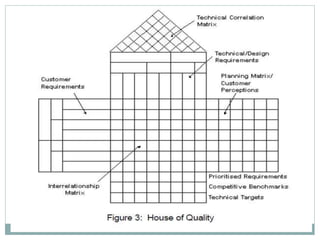
 Its general format is made up of six major
components.
 These include
1. customer requirements
2. technical requirements
3. a planning matrix
4. an interrelationship matrix
5. a technical correlation matrix
6. a technical priorities/benchmarks and targets
section.
The voice of the customer
 The initial steps in forming the house of quality
include determining, clarifying and specifying the
customer ‘s needs.
1. Clarifying customer needs:-
- customers buy benefits and producers offer
features.
- it is most important to translate the wishes of each
and every customer into some tangible values that
can be turned into engineering specification.
2. Specifying the customer needs:-
- After determining what items are the most
important to the customer, organizations must
translate them into particular specifications.
- Nothing can be produced, serviced or maintained
without detailed specification and some set of
standards.
 Each aspects of the desired items must be clearly
defined:
- measurements must be defined, heights specified,
torques stated and weights targeted.
- These values can be derived from several locations.
Organization can use known data from market
research or conduct new studies to gather necessary
information.
- The needs which were clarified and then explicitly
stated, should be satisfied to the best of that
organization’s ability.
Technical requirements
 The next step of the QFD process is identifying what
the customer wants and what must be achieved to
satisfy these wants.
 regulatory standards and requirements dictated by
management must be identified. Once all
requirements are identified it is important to answer
what must be done to the product design to fulfill the
necessary requirements.
Planning Matrix
 Purpose:-
To compare how well the team met the
customer requirements compare to it’s
competitors.
 Customer rating , typically ranging from 1 to 5 are
given to each company under each requirement.
 The customer ratings are combined with the
weighted performance of each demand to produce
over all performance measure for all companies.
Interrelation Matrix
 Function:-
To establish a connection between a
customer’s product requirement and the
performance measures designed to improve
product.
- To obtain the opinions of the consumers as far as
what they need and require from a specific
product.
 With this customer overview, the company can begin to
formulate a strategy to improve their product.
 In doing this, the strengths and weaknesses of the
company are weighted against the customer priorities to
determine
a) what aspects need to be changed to surpass the
competition
b) what aspects need to change to equal the
competition
c) what aspects will be left unchanged.
• The optimal combination is desired.
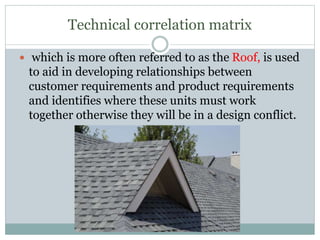
Technical correlation matrix
 which is more often referred to as the Roof, is used
to aid in developing relationships between
customer requirements and product requirements
and identifies where these units must work
together otherwise they will be in a design conflict.
 The following symbols are used to represent what
type of impact each requirement has on the other
hand:-
- strong positive
- positive
- negative
- strong negative
 The objective is to highlight any requirements that
might be in conflict with each other.
Technical Properties and Targets
 Technical properties matrix uses specific items to
record the priorities assigned to technical
requirements.
 It also provides a technical performance achieved
by competitive products and the degree of difficulty
in each requirement.
 The final output of the matrix is a set of the target
values for each technical requirements.
Conclusion
 The House of Quality functions as a living document
and a source of ready reference for related products
and future upgrades.
 the House of Quality helps to identify the critical
technical components that require change.

House of quality matrix

  • 1.
  • 2.
    Introduction  Every successfulcompany has always used data and information to help in its planning processes. In planning a new product, engineers have always examined the manufacturing and performance history of the current product.  They look at field test data, comparing their product to that of their competitor’s product. They examine any customer satisfaction information that might happen to be available.
  • 3.
     Quality FunctionDeployment (QFD) uses a matrix format to capture a number of issues that are vital to the planning process.  The House of Quality Matrix is the most recognized and widely used form of this method.  It translates customer requirements, based on marketing research and benchmarking data, into an appropriate number of engineering targets to be met by a new product design.
  • 4.
     Its generalformat is made up of six major components.  These include 1. customer requirements 2. technical requirements 3. a planning matrix 4. an interrelationship matrix 5. a technical correlation matrix 6. a technical priorities/benchmarks and targets section.
  • 6.
    The voice ofthe customer  The initial steps in forming the house of quality include determining, clarifying and specifying the customer ‘s needs. 1. Clarifying customer needs:- - customers buy benefits and producers offer features. - it is most important to translate the wishes of each and every customer into some tangible values that can be turned into engineering specification.
  • 7.
    2. Specifying thecustomer needs:- - After determining what items are the most important to the customer, organizations must translate them into particular specifications. - Nothing can be produced, serviced or maintained without detailed specification and some set of standards.
  • 8.
     Each aspectsof the desired items must be clearly defined: - measurements must be defined, heights specified, torques stated and weights targeted. - These values can be derived from several locations. Organization can use known data from market research or conduct new studies to gather necessary information. - The needs which were clarified and then explicitly stated, should be satisfied to the best of that organization’s ability.
  • 9.
    Technical requirements  Thenext step of the QFD process is identifying what the customer wants and what must be achieved to satisfy these wants.  regulatory standards and requirements dictated by management must be identified. Once all requirements are identified it is important to answer what must be done to the product design to fulfill the necessary requirements.
  • 10.
    Planning Matrix  Purpose:- Tocompare how well the team met the customer requirements compare to it’s competitors.  Customer rating , typically ranging from 1 to 5 are given to each company under each requirement.  The customer ratings are combined with the weighted performance of each demand to produce over all performance measure for all companies.
  • 11.
    Interrelation Matrix  Function:- Toestablish a connection between a customer’s product requirement and the performance measures designed to improve product. - To obtain the opinions of the consumers as far as what they need and require from a specific product.
  • 12.
     With thiscustomer overview, the company can begin to formulate a strategy to improve their product.  In doing this, the strengths and weaknesses of the company are weighted against the customer priorities to determine a) what aspects need to be changed to surpass the competition b) what aspects need to change to equal the competition c) what aspects will be left unchanged. • The optimal combination is desired.
  • 13.
    Technical correlation matrix which is more often referred to as the Roof, is used to aid in developing relationships between customer requirements and product requirements and identifies where these units must work together otherwise they will be in a design conflict.
  • 14.
     The followingsymbols are used to represent what type of impact each requirement has on the other hand:- - strong positive - positive - negative - strong negative  The objective is to highlight any requirements that might be in conflict with each other.
  • 15.
    Technical Properties andTargets  Technical properties matrix uses specific items to record the priorities assigned to technical requirements.  It also provides a technical performance achieved by competitive products and the degree of difficulty in each requirement.  The final output of the matrix is a set of the target values for each technical requirements.
  • 16.
    Conclusion  The Houseof Quality functions as a living document and a source of ready reference for related products and future upgrades.  the House of Quality helps to identify the critical technical components that require change.