

Presented by :
Ojas Maheshwari
Apoorva Gupta
Himanshu Mishra
Neha shivhare
🎃
Techinques of Sales Forecasting
What is Sales Forecasting?
• A sales forecast is a projection of the expected customer demand for
products or services at a specific company, for a specific time
horizon, and with certain underlying assumptions
• Essential tool used for business planning, marketing, and general
management decision making.
• Sales forecasting can help you achieve sales goals.
• Sales forecasting can help drive sales revenue, improve efficiency,
increase customer retention and reduce costs.
“Why do we do sales
forecasting???
Factors affecting sales forecasting
 Economic factors
 Consumer factors
 Competition factors
 Changes within firm
 Marketing efforts
 Labour problems
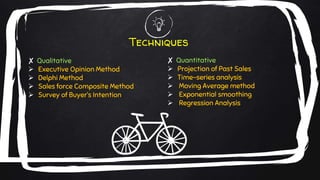
Techniques
✘ Qualitative
 Executive Opinion Method
 Delphi Method
 Sales force Composite Method
 Survey of Buyer’s Intention
✘ Quantitative
 Projection of Past Sales
 Time-series analysis
 Moving Average method
 Exponential smoothing
 Regression Analysis
(1) Jury of executive opinion:
Panel charged with developing a sales forecast. The group has
executives from different departments like marketing, sales, marketing
research, finance, production, operations etc.
Each member is asked to provide an estimate of future sales with
written justification. The opinions are then pooled and analyzed at group
meetings. The advantage is its simplicity, but might take too much time of the
executives involved.
(ii) Delphi Technique
• Group of experts used to make long-range projections.
Issues like future direction of business conditions, business activities,
technology, new product development, and market conditions.
These experts are kept apart from each other so that their opinions are
established independently.
• They prepare individual forecasts, which are then compiled and then
given back to them for a second round of projections.
This process continues until a consensus forecast of the future emerges.
The Delphi technique has the advantage of eliminating the group pressures
of a typical committee meeting.
(iii)Sales Force Composite
• Forecasts arrived at by combining salespersons estimates of expected
sales for their respective territories.
• Field sales people should be motivated to accept sales quotas when they
know that the information they supplied played a major role in
forecasting.
A major disadvantage is that sales people might be a poor judge of future
sales level or market conditions. They can have bias opinions as well.
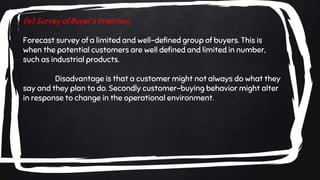
(iv) Survey of Buyer’s Intention
Forecast survey of a limited and well-defined group of buyers. This is
when the potential customers are well defined and limited in number,
such as industrial products.
Disadvantage is that a customer might not always do what they
say and they plan to do. Secondly customer-buying behavior might alter
in response to change in the operational environment.
TOO MUCH THEORETICAL !!!!
Let’s Dive in
Quantitative
Quantitative Techniques
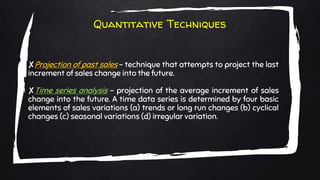
✘Projection of past sales – technique that attempts to project the last
increment of sales change into the future.
✘Time series analysis – projection of the average increment of sales
change into the future. A time data series is determined by four basic
elements of sales variations (a) trends or long run changes (b) cyclical
changes (c) seasonal variations (d) irregular variation.
Quantitative Techniques
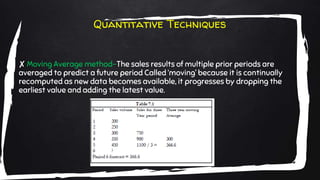
✘ Moving Average method-The sales results of multiple prior periods are
averaged to predict a future period Called ‘moving’ because it is continually
recomputed as new data becomes available, it progresses by dropping the
earliest value and adding the latest value.
Quantitative Techniques
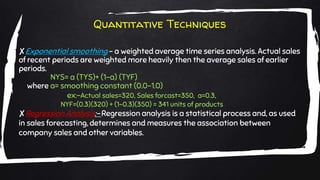
✘Exponential smoothing – a weighted average time series analysis. Actual sales
of recent periods are weighted more heavily then the average sales of earlier
periods.
NYS= a (TYS)+ (1-a) (TYF)
where a= smoothing constant (0.0-1.0)
ex:-Actual sales=320, Sales forcast=350, a=0.3,
NYF=(0.3)(320) + (1-0.3)(350) = 341 units of products
✘Regression Analysis:- Regression analysis is a statistical process and, as used
in sales forecasting, determines and measures the association between
company sales and other variables.
thanks!
Any questions?
😂

Sales Forecasting Techniques

  • 1.
    Presented by : OjasMaheshwari Apoorva Gupta Himanshu Mishra Neha shivhare 🎃 Techinques of Sales Forecasting
  • 2.
    What is SalesForecasting? • A sales forecast is a projection of the expected customer demand for products or services at a specific company, for a specific time horizon, and with certain underlying assumptions • Essential tool used for business planning, marketing, and general management decision making. • Sales forecasting can help you achieve sales goals. • Sales forecasting can help drive sales revenue, improve efficiency, increase customer retention and reduce costs.
  • 3.
    “Why do wedo sales forecasting???
  • 4.
    Factors affecting salesforecasting  Economic factors  Consumer factors  Competition factors  Changes within firm  Marketing efforts  Labour problems
  • 5.
    Techniques ✘ Qualitative  ExecutiveOpinion Method  Delphi Method  Sales force Composite Method  Survey of Buyer’s Intention ✘ Quantitative  Projection of Past Sales  Time-series analysis  Moving Average method  Exponential smoothing  Regression Analysis
  • 6.
    (1) Jury ofexecutive opinion: Panel charged with developing a sales forecast. The group has executives from different departments like marketing, sales, marketing research, finance, production, operations etc. Each member is asked to provide an estimate of future sales with written justification. The opinions are then pooled and analyzed at group meetings. The advantage is its simplicity, but might take too much time of the executives involved.
  • 7.
    (ii) Delphi Technique •Group of experts used to make long-range projections. Issues like future direction of business conditions, business activities, technology, new product development, and market conditions. These experts are kept apart from each other so that their opinions are established independently. • They prepare individual forecasts, which are then compiled and then given back to them for a second round of projections. This process continues until a consensus forecast of the future emerges. The Delphi technique has the advantage of eliminating the group pressures of a typical committee meeting.
  • 8.
    (iii)Sales Force Composite •Forecasts arrived at by combining salespersons estimates of expected sales for their respective territories. • Field sales people should be motivated to accept sales quotas when they know that the information they supplied played a major role in forecasting. A major disadvantage is that sales people might be a poor judge of future sales level or market conditions. They can have bias opinions as well.
  • 9.
    (iv) Survey ofBuyer’s Intention Forecast survey of a limited and well-defined group of buyers. This is when the potential customers are well defined and limited in number, such as industrial products. Disadvantage is that a customer might not always do what they say and they plan to do. Secondly customer-buying behavior might alter in response to change in the operational environment.
  • 10.
    TOO MUCH THEORETICAL!!!! Let’s Dive in Quantitative
  • 11.
    Quantitative Techniques ✘Projection ofpast sales – technique that attempts to project the last increment of sales change into the future. ✘Time series analysis – projection of the average increment of sales change into the future. A time data series is determined by four basic elements of sales variations (a) trends or long run changes (b) cyclical changes (c) seasonal variations (d) irregular variation.
  • 12.
    Quantitative Techniques ✘ MovingAverage method-The sales results of multiple prior periods are averaged to predict a future period Called ‘moving’ because it is continually recomputed as new data becomes available, it progresses by dropping the earliest value and adding the latest value.
  • 13.
    Quantitative Techniques ✘Exponential smoothing– a weighted average time series analysis. Actual sales of recent periods are weighted more heavily then the average sales of earlier periods. NYS= a (TYS)+ (1-a) (TYF) where a= smoothing constant (0.0-1.0) ex:-Actual sales=320, Sales forcast=350, a=0.3, NYF=(0.3)(320) + (1-0.3)(350) = 341 units of products ✘Regression Analysis:- Regression analysis is a statistical process and, as used in sales forecasting, determines and measures the association between company sales and other variables.
  • 14.

Editor's Notes

  • #12 Past sale projection current year sales adding set percentage. cy=300,ly=250 Ny=cy*(cy/ly) Trend-population Seasonal within12 month Cyclical-peak,recession,depression,recovery.
  • #14 A= if sales data changes slowly then a must be small to retain its effect = if sales data changes rapidly then a must be large to retain its effect