
Presented By:
Alay Joshi P 008
Mrinal Patil P 011
Mayuri Chothani Q 001
Rohit Patel Q 003
About the Company
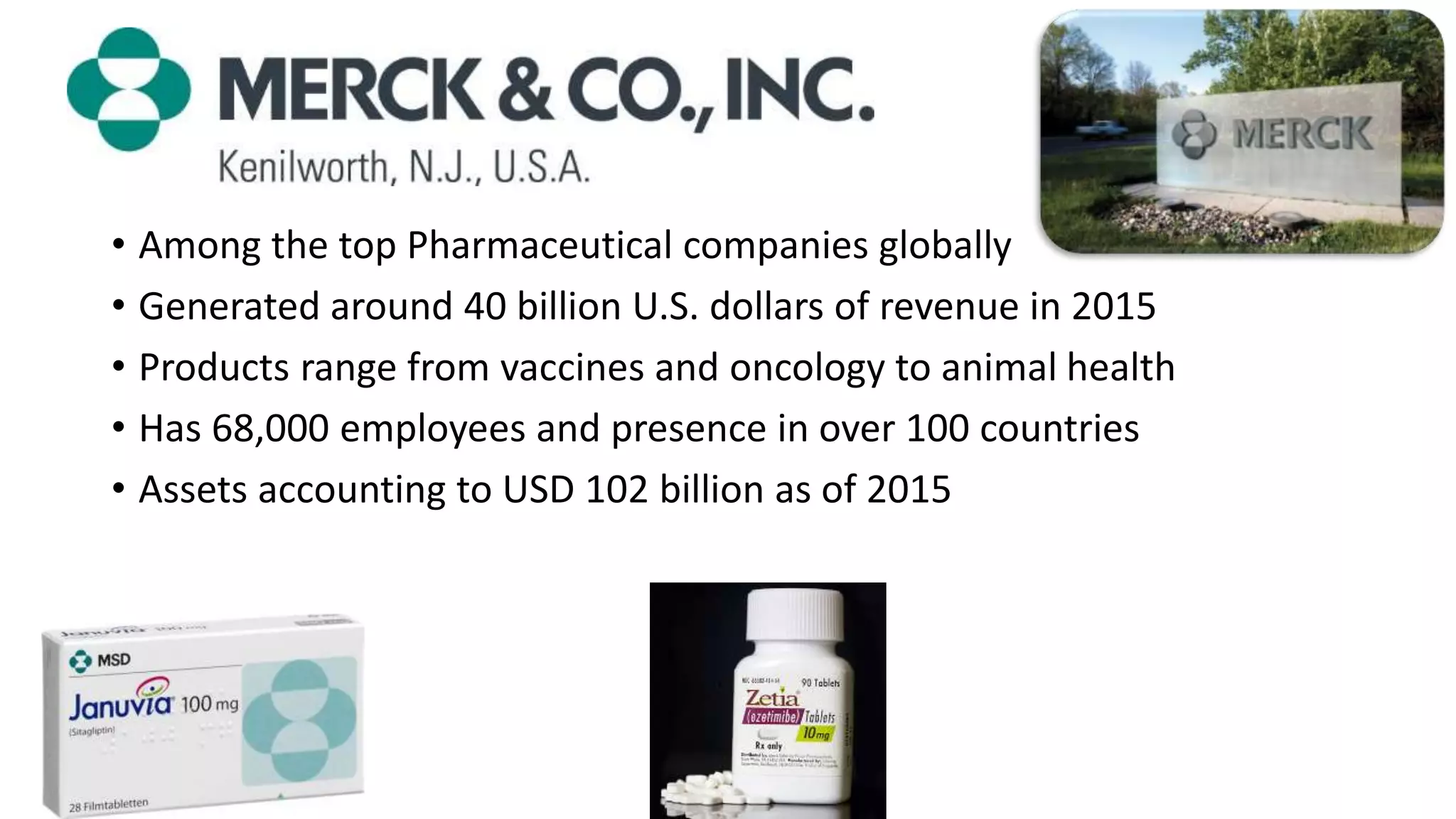
• Among the top Pharmaceutical companies globally
• Generated around 40 billion U.S. dollars of revenue in 2015
• Products range from vaccines and oncology to animal health
• Has 68,000 employees and presence in over 100 countries
• Assets accounting to USD 102 billion as of 2015
CR MATERIALITY ASSESSMENT RESULTS
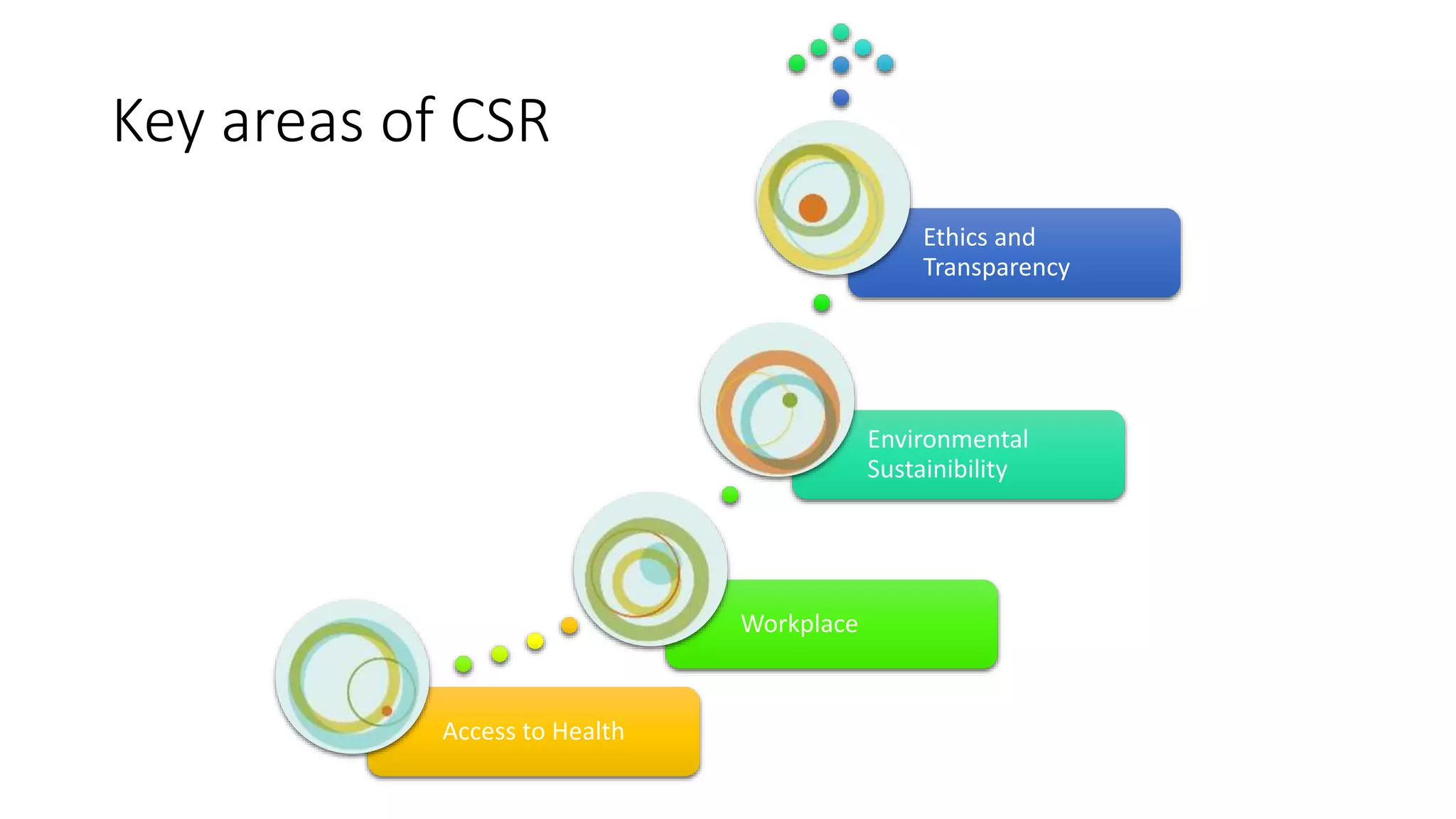
Key areas of CSR
Access to Health
Workplace
Environmental
Sustainibility
Ethics and
Transparency
Access to Health
MSD for Mothers
MECTIZAN® Donation
Program
African
Comprehensive
HIV/AIDS Partnerships
Medical Outreach
Program
MCAN
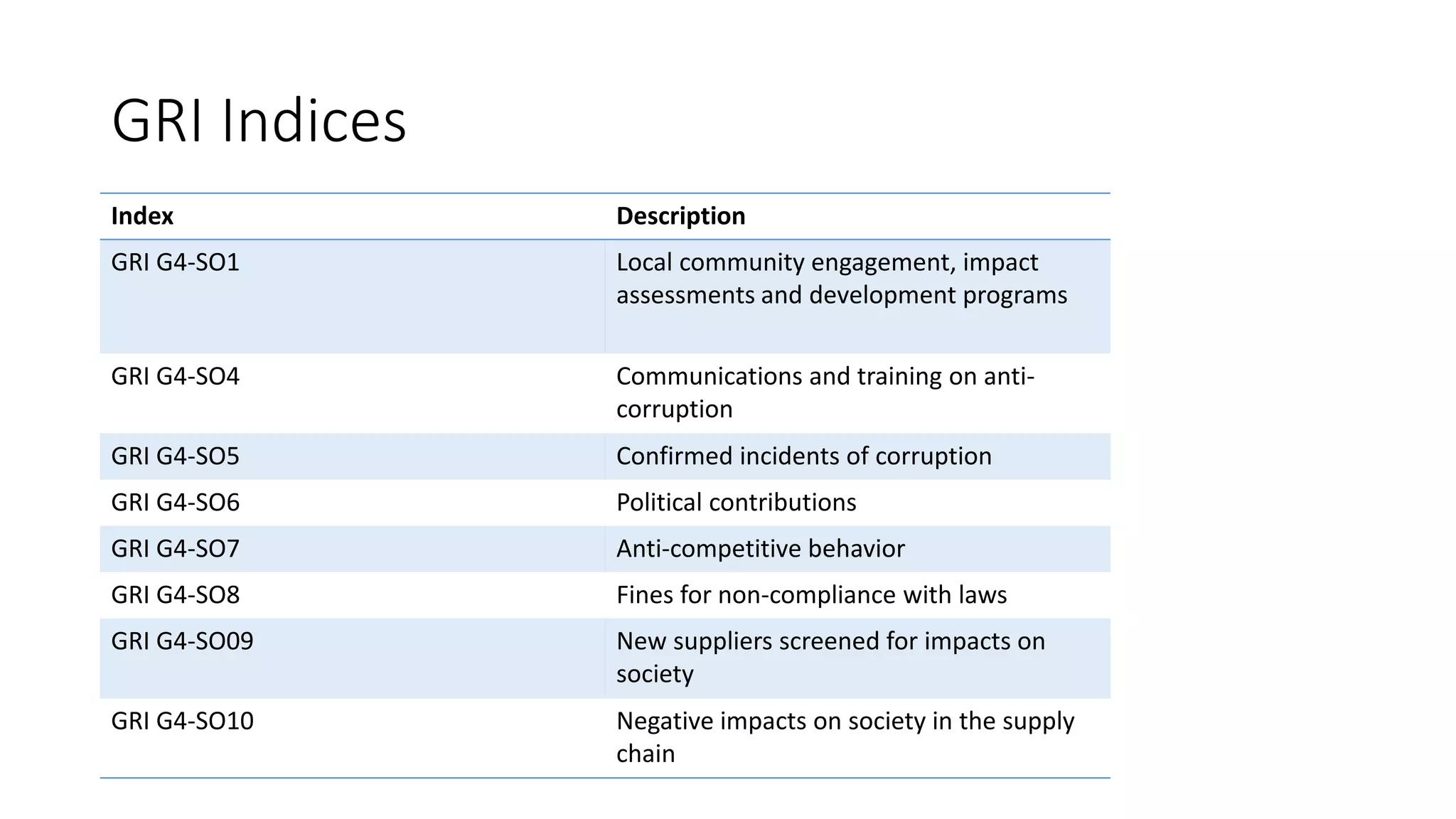
GRI Indices
Index Description
GRI G4-SO1 Local community engagement, impact
assessments and development programs
GRI G4-SO4 Communications and training on anti-
corruption
GRI G4-SO5 Confirmed incidents of corruption
GRI G4-SO6 Political contributions
GRI G4-SO7 Anti-competitive behavior
GRI G4-SO8 Fines for non-compliance with laws
GRI G4-SO09 New suppliers screened for impacts on
society
GRI G4-SO10 Negative impacts on society in the supply
chain
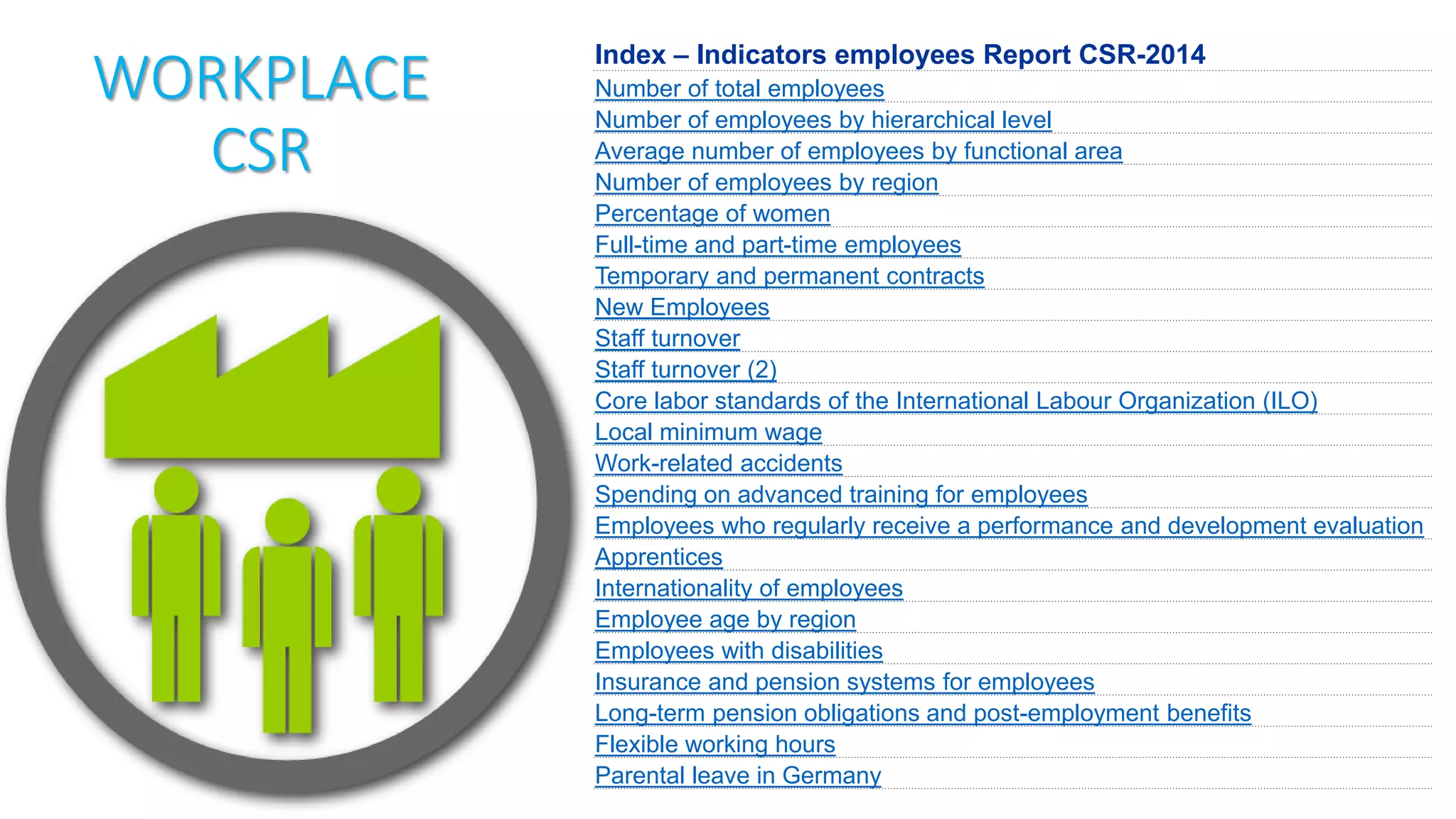
WORKPLACE
CSR
Index – Indicators employees Report CSR-2014
Number of total employees
Number of employees by hierarchical level
Average number of employees by functional area
Number of employees by region
Percentage of women
Full-time and part-time employees
Temporary and permanent contracts
New Employees
Staff turnover
Staff turnover (2)
Core labor standards of the International Labour Organization (ILO)
Local minimum wage
Work-related accidents
Spending on advanced training for employees
Employees who regularly receive a performance and development evaluation
Apprentices
Internationality of employees
Employee age by region
Employees with disabilities
Insurance and pension systems for employees
Long-term pension obligations and post-employment benefits
Flexible working hours
Parental leave in Germany
Indicators
 Good leadership
• Identifying talent
• Training and educating
employees
• Promoting women in
management positions
• Employee networks
• Promoting internationality
• Demographic change
 Attracting young
professionals
• Apprenticeships and vocational
training
• Performance-based pay
• Work-life balance
• Flexible work hour models
• Childcare options
• Entitlement to parental leave
 Occupational health and
safety
• The BeSafe! Program
• Health management
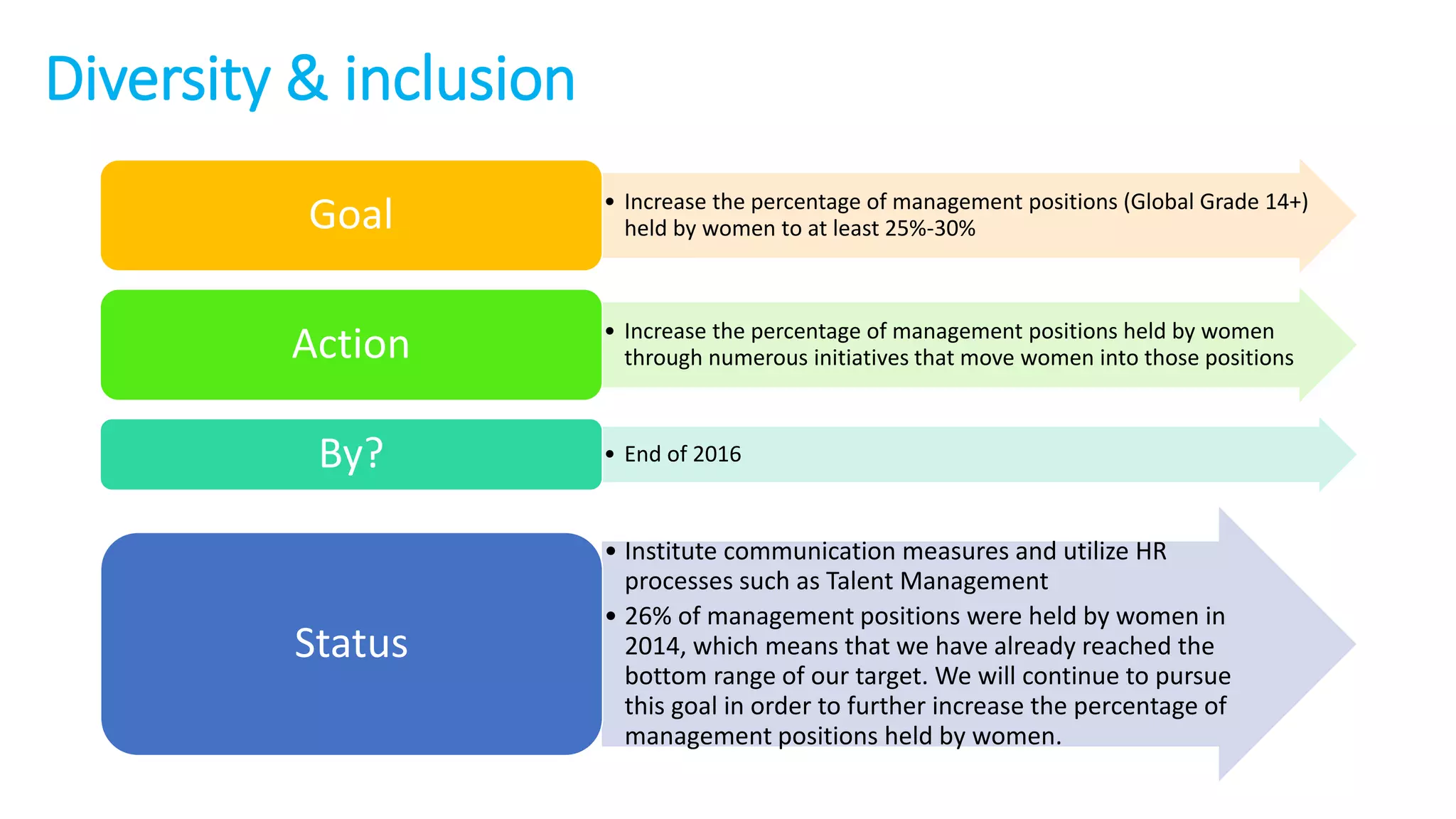
Diversity & inclusion
• Increase the percentage of management positions (Global Grade 14+)
held by women to at least 25%-30%Goal
• Increase the percentage of management positions held by women
through numerous initiatives that move women into those positionsAction
• End of 2016By?
• Institute communication measures and utilize HR
processes such as Talent Management
• 26% of management positions were held by women in
2014, which means that we have already reached the
bottom range of our target. We will continue to pursue
this goal in order to further increase the percentage of
management positions held by women.
Status
Good leadership
Occupational health & safety
Goal
• Reduce occupational accidents throughout the Merck Group (lost time
injury rate = 2.5)
Action
• Implement the BeSafe! program; hold EHS forums on safety behavior
change
By?
• End of 2015
Status
• Through systematic accident prevention measures (such as training and
campaigns to strengthen our corporate safety culture), we attained an
LTIR of 2.2 in 2013 and an LTIR of 1.8 in 2014. We are working to lastingly
stabilize our LTIR.(In progress)
Environmental Sustainability
• EHS Management system
Plan DO Check Act
 Development
of goals
 Objectives and
metrics based
on a review of
company
performance
 EHS programs,
applicable
regulations and
other external
factors.
 Standards,
Guidelines and
Tools, which
are integrated
into the EHS
Management
System
 Detail the
program-
implementatio
n expectations
for sites and
operating
organizations
 Governance
committee
 Executive-
level EHS
Council
through site-
compliance
committees
 Review
performance
 Corrective
actions
 Audits
 Continuous
improvement
initiatives are
taken
Sustainability Strategy
Energy Use & Climate protection
Merck tracks the generation of five GHGs associated with operating our facilities and our fleet:
• Carbon dioxide (CO2)
• Methane
• Nitrous oxide
• Hydrofluorocarbons
• Sulfur hexafluoride
• Initiative
 New facilities to comply with their Energy Design Guide and Energy Conservation Planner
 Built all new laboratories and offices following cost-effective energy-efficient practices. they have
several facilities that are LEED-certified
 In 2014,they conducted energy “treasure hunts” at two facilities in the U.S.
 In 2014,they also began the “Treasure Hunt Online” to help generate energy-savings ideas that
can be shared with all our sites.
 Three U.S. facilities were awarded the 2014 ENERGY STAR label by the U.S. EPA for superior
energy efficiency and environmental performance among U.S. pharmaceutical manufacturing
plants
 Photovoltaic (PV) arrays, wind turbines and other renewable energy installations help them to
reduce energy-demand peaks and to postpone or avoid adding new power plants
Water Use & Recycling of chemicals
• Cooling-system optimization
• Recovery and reuse of steam condensate and water
purification of “reject water”
• Process-water purification-system optimization
• Closed-loop cooling systems are employed at more than half
our facilities worldwide and reduce our freshwater use by
more than 5 billion gallons a year
• Reverse osmosis (RO) reject water is reused for nonpotable
and nonprocess applications such as cooling-tower feed
water, fire water and irrigation, and saves an estimated 50
million gallons of freshwater every
• In the 2013-2014 period, we started recycling heptane, a
chemical that accumulates during the purification of liquid
crystals.
• They collect the heptane, have an external recycling
company treat it, and then reuse the purified solvent in our
processes. Our recycling rate is over 85%, which is enabling
us to lower our heptane consumption by 1,900 metric tons
per year and thus reduce our total waste.
They have a well-established global compliance program that
is consistent with the International Federation of
Pharmaceutical Manufacturers & Associations (IFPMA) Code
of Practice requirements.
Written standards, including a corporate Code of
Conduct, compliance-related policies and
procedures, education, training and
communications, reinforce the importance of
ethical and compliant business practices.
The Corporate Compliance Committee meets at
least four times per year to review the compliance
status across the company’s business divisions
worldwide as part of the committee’s effort to
assess the effectiveness of the company’s
compliance program.
Global Privacy Program
Program is designed to assure that four core privacy values—respect, trust,
prevention and compliance—are embedded into the way they conduct their
business, without regard to how their business, technology or other external
factors may change.
A key component of the approach is focused on facilitating efficient cross-
border data flows.
In 2014, they filed an application with the Belgian Privacy Commission for
approval of our global privacy program under the European Union (EU)
Binding Corporate Rules (BCR) cooperation procedure.
MERCK is the first company in the world to file an application for EU BCR
approval based on an existing APEC CBPR certification.
The aim of our is to promote globally interoperable privacy standards across
the more than 50 countries and economies combined in APEC and the
European Economic Area.
Corporate Responsibility
Merck continuously ensures that corporate responsibility is embedded within the
Company’s business strategy and appropriately evolves as business does.
At the core of their strategy is Merck/MSD’s
corporate responsibility value proposition :“Helping the world be well.” The following four
areas make up prioritized strategy to enhance
global well-being by:
1) improving access to
health
2) demonstrating through their actions an
ethical and transparent approach
3) operating in
an environmentally sustainable fashion
4)starting at home with the well-being of our own
employees.
HUMAN RIGHTS
• Merck has a number of global policies that address how they protect
human rights.
• Company’s Executive Committee is also responsible for ensuring that
governance processes are in place to provide oversight of the
implementation and execution of these corporate policies.
• Labour Standards
• Health and Safety
• Wages and Benefits
• Cuatomers
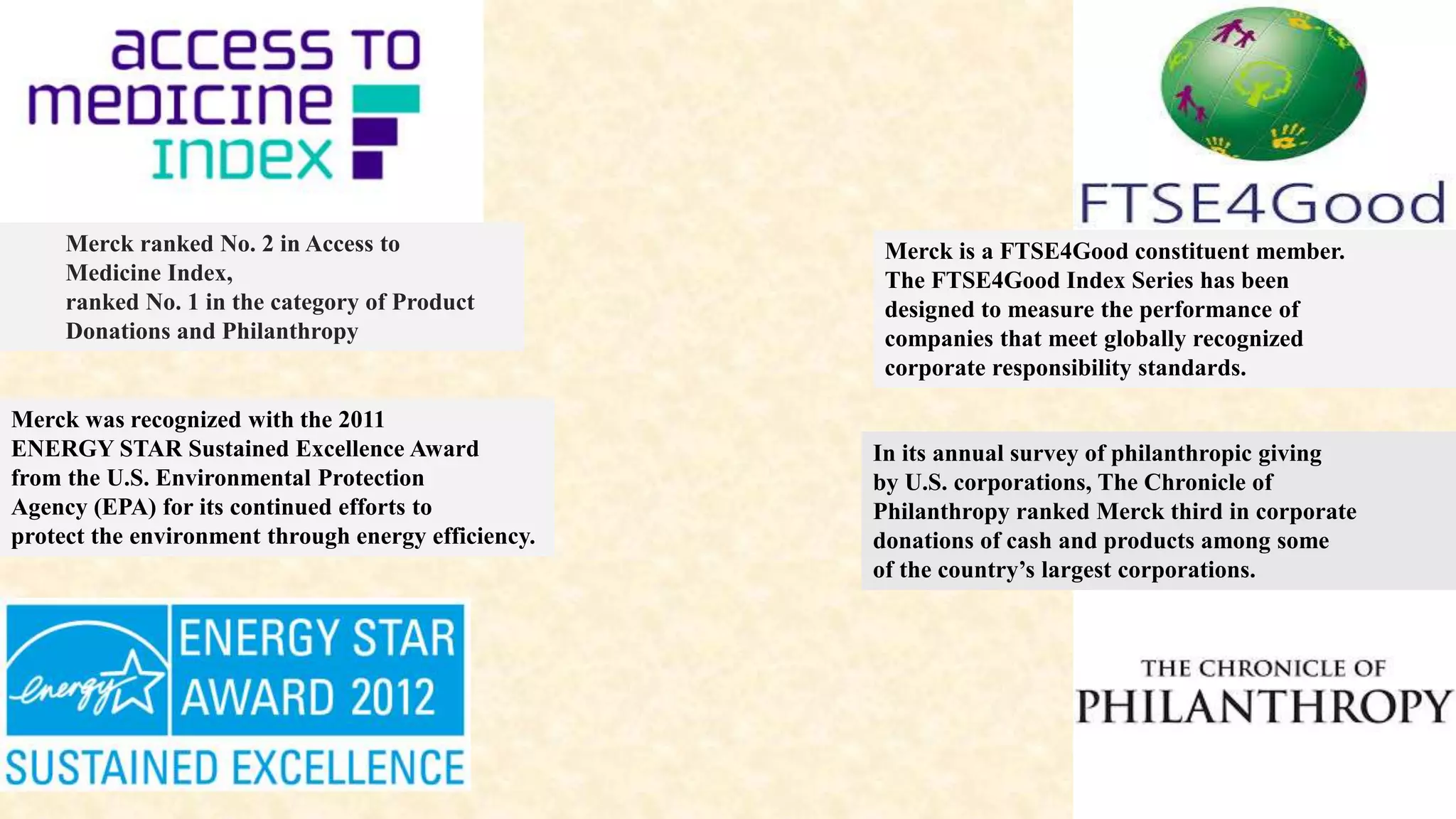
Merck ranked No. 2 in Access to
Medicine Index,
ranked No. 1 in the category of Product
Donations and Philanthropy
In its annual survey of philanthropic giving
by U.S. corporations, The Chronicle of
Philanthropy ranked Merck third in corporate
donations of cash and products among some
of the country’s largest corporations.
Merck was recognized with the 2011
ENERGY STAR Sustained Excellence Award
from the U.S. Environmental Protection
Agency (EPA) for its continued efforts to
protect the environment through energy efficiency.
Merck is a FTSE4Good constituent member.
The FTSE4Good Index Series has been
designed to measure the performance of
companies that meet globally recognized
corporate responsibility standards.
References
• http://www.statista.com/topics/2356/merck-and-co/
• http://www.merck.com/index.html
• www.merckresponsibility.com
• http://www.businesswire.com/news/home/20160406005439/en/Me
rck-Present-Data-KEYTRUDA%C2%AE-pembrolizumab-American-
Association
Merck csr

Merck csr

  • 1.
    Presented By: Alay JoshiP 008 Mrinal Patil P 011 Mayuri Chothani Q 001 Rohit Patel Q 003
  • 2.
    About the Company •Among the top Pharmaceutical companies globally • Generated around 40 billion U.S. dollars of revenue in 2015 • Products range from vaccines and oncology to animal health • Has 68,000 employees and presence in over 100 countries • Assets accounting to USD 102 billion as of 2015
  • 3.
  • 4.
    Key areas ofCSR Access to Health Workplace Environmental Sustainibility Ethics and Transparency
  • 5.
    Access to Health MSDfor Mothers MECTIZAN® Donation Program African Comprehensive HIV/AIDS Partnerships Medical Outreach Program MCAN
  • 7.
    GRI Indices Index Description GRIG4-SO1 Local community engagement, impact assessments and development programs GRI G4-SO4 Communications and training on anti- corruption GRI G4-SO5 Confirmed incidents of corruption GRI G4-SO6 Political contributions GRI G4-SO7 Anti-competitive behavior GRI G4-SO8 Fines for non-compliance with laws GRI G4-SO09 New suppliers screened for impacts on society GRI G4-SO10 Negative impacts on society in the supply chain
  • 9.
    WORKPLACE CSR Index – Indicatorsemployees Report CSR-2014 Number of total employees Number of employees by hierarchical level Average number of employees by functional area Number of employees by region Percentage of women Full-time and part-time employees Temporary and permanent contracts New Employees Staff turnover Staff turnover (2) Core labor standards of the International Labour Organization (ILO) Local minimum wage Work-related accidents Spending on advanced training for employees Employees who regularly receive a performance and development evaluation Apprentices Internationality of employees Employee age by region Employees with disabilities Insurance and pension systems for employees Long-term pension obligations and post-employment benefits Flexible working hours Parental leave in Germany
  • 10.
    Indicators  Good leadership •Identifying talent • Training and educating employees • Promoting women in management positions • Employee networks • Promoting internationality • Demographic change  Attracting young professionals • Apprenticeships and vocational training • Performance-based pay • Work-life balance • Flexible work hour models • Childcare options • Entitlement to parental leave  Occupational health and safety • The BeSafe! Program • Health management
  • 11.
    Diversity & inclusion •Increase the percentage of management positions (Global Grade 14+) held by women to at least 25%-30%Goal • Increase the percentage of management positions held by women through numerous initiatives that move women into those positionsAction • End of 2016By? • Institute communication measures and utilize HR processes such as Talent Management • 26% of management positions were held by women in 2014, which means that we have already reached the bottom range of our target. We will continue to pursue this goal in order to further increase the percentage of management positions held by women. Status
  • 12.
  • 13.
    Occupational health &safety Goal • Reduce occupational accidents throughout the Merck Group (lost time injury rate = 2.5) Action • Implement the BeSafe! program; hold EHS forums on safety behavior change By? • End of 2015 Status • Through systematic accident prevention measures (such as training and campaigns to strengthen our corporate safety culture), we attained an LTIR of 2.2 in 2013 and an LTIR of 1.8 in 2014. We are working to lastingly stabilize our LTIR.(In progress)
  • 14.
    Environmental Sustainability • EHSManagement system Plan DO Check Act  Development of goals  Objectives and metrics based on a review of company performance  EHS programs, applicable regulations and other external factors.  Standards, Guidelines and Tools, which are integrated into the EHS Management System  Detail the program- implementatio n expectations for sites and operating organizations  Governance committee  Executive- level EHS Council through site- compliance committees  Review performance  Corrective actions  Audits  Continuous improvement initiatives are taken
  • 15.
  • 16.
    Energy Use &Climate protection Merck tracks the generation of five GHGs associated with operating our facilities and our fleet: • Carbon dioxide (CO2) • Methane • Nitrous oxide • Hydrofluorocarbons • Sulfur hexafluoride • Initiative  New facilities to comply with their Energy Design Guide and Energy Conservation Planner  Built all new laboratories and offices following cost-effective energy-efficient practices. they have several facilities that are LEED-certified  In 2014,they conducted energy “treasure hunts” at two facilities in the U.S.  In 2014,they also began the “Treasure Hunt Online” to help generate energy-savings ideas that can be shared with all our sites.  Three U.S. facilities were awarded the 2014 ENERGY STAR label by the U.S. EPA for superior energy efficiency and environmental performance among U.S. pharmaceutical manufacturing plants  Photovoltaic (PV) arrays, wind turbines and other renewable energy installations help them to reduce energy-demand peaks and to postpone or avoid adding new power plants
  • 17.
    Water Use &Recycling of chemicals • Cooling-system optimization • Recovery and reuse of steam condensate and water purification of “reject water” • Process-water purification-system optimization • Closed-loop cooling systems are employed at more than half our facilities worldwide and reduce our freshwater use by more than 5 billion gallons a year • Reverse osmosis (RO) reject water is reused for nonpotable and nonprocess applications such as cooling-tower feed water, fire water and irrigation, and saves an estimated 50 million gallons of freshwater every • In the 2013-2014 period, we started recycling heptane, a chemical that accumulates during the purification of liquid crystals. • They collect the heptane, have an external recycling company treat it, and then reuse the purified solvent in our processes. Our recycling rate is over 85%, which is enabling us to lower our heptane consumption by 1,900 metric tons per year and thus reduce our total waste.
  • 19.
    They have awell-established global compliance program that is consistent with the International Federation of Pharmaceutical Manufacturers & Associations (IFPMA) Code of Practice requirements. Written standards, including a corporate Code of Conduct, compliance-related policies and procedures, education, training and communications, reinforce the importance of ethical and compliant business practices. The Corporate Compliance Committee meets at least four times per year to review the compliance status across the company’s business divisions worldwide as part of the committee’s effort to assess the effectiveness of the company’s compliance program.
  • 20.
    Global Privacy Program Programis designed to assure that four core privacy values—respect, trust, prevention and compliance—are embedded into the way they conduct their business, without regard to how their business, technology or other external factors may change. A key component of the approach is focused on facilitating efficient cross- border data flows. In 2014, they filed an application with the Belgian Privacy Commission for approval of our global privacy program under the European Union (EU) Binding Corporate Rules (BCR) cooperation procedure. MERCK is the first company in the world to file an application for EU BCR approval based on an existing APEC CBPR certification. The aim of our is to promote globally interoperable privacy standards across the more than 50 countries and economies combined in APEC and the European Economic Area.
  • 21.
    Corporate Responsibility Merck continuouslyensures that corporate responsibility is embedded within the Company’s business strategy and appropriately evolves as business does. At the core of their strategy is Merck/MSD’s corporate responsibility value proposition :“Helping the world be well.” The following four areas make up prioritized strategy to enhance global well-being by: 1) improving access to health 2) demonstrating through their actions an ethical and transparent approach 3) operating in an environmentally sustainable fashion 4)starting at home with the well-being of our own employees.
  • 22.
    HUMAN RIGHTS • Merckhas a number of global policies that address how they protect human rights. • Company’s Executive Committee is also responsible for ensuring that governance processes are in place to provide oversight of the implementation and execution of these corporate policies. • Labour Standards • Health and Safety • Wages and Benefits • Cuatomers
  • 24.
    Merck ranked No.2 in Access to Medicine Index, ranked No. 1 in the category of Product Donations and Philanthropy In its annual survey of philanthropic giving by U.S. corporations, The Chronicle of Philanthropy ranked Merck third in corporate donations of cash and products among some of the country’s largest corporations. Merck was recognized with the 2011 ENERGY STAR Sustained Excellence Award from the U.S. Environmental Protection Agency (EPA) for its continued efforts to protect the environment through energy efficiency. Merck is a FTSE4Good constituent member. The FTSE4Good Index Series has been designed to measure the performance of companies that meet globally recognized corporate responsibility standards.
  • 25.
    References • http://www.statista.com/topics/2356/merck-and-co/ • http://www.merck.com/index.html •www.merckresponsibility.com • http://www.businesswire.com/news/home/20160406005439/en/Me rck-Present-Data-KEYTRUDA%C2%AE-pembrolizumab-American- Association

Editor's Notes

  • #17 Leadership in Energy and Environmental Design  ENERGY STAR is a U.S. Environmental Protection Agency (EPA) voluntary program that helps businesses and individuals save money and protect our climate through superior energy efficiency.