SALES FORECASTING
Sales Forecasting
is a projection of the expected customer demand for products
or services at a specific company, for a specific time horizon,
and with certain underlying assumptions.
Forecasting can be used for…
• Strategic planning (long range planning)
• Finance and accounting (sales budgets and cost controls)
• Marketing (sales quotas, new products)
• Production and operations
WHY SALES FORECASTING IS IMPORTANT?
Many types of forecasting models that differ in
complexity and amount of data & way they generate
forecasts:
 Forecasts are rarely perfect
 Forecasts are more accurate for grouped data than
for individual items.
 Forecast are more accurate for shorter than longer
time periods.
Principles of Forecasting
1
External Factors
Relative state of the economy
Direct and indirect competition
Styles or fashions
Consumer earnings
Weather
Political Conditions
Factors affecting Sales Forecasting
Internal Factors
Labor problems
Inventory shortages
Working capital shortage
Price changes
Production capability shortage
New product lines
2
TYPES OF
FORESCASTING
Economic forecasts
Predict a variety of economic indicators, like money supply,
inflation rates, interest rates, etc.
Technological forecasts
Predict rates of technological progress and innovation.
Demand forecasts
Predict the future demand for a company’s products or
services.
Types of Forecasting
TYPES OF
FORECASTING
METHODS
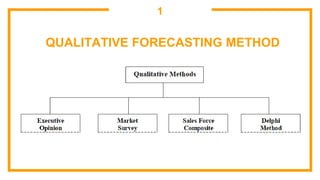
“Qualitative methods: These types of forecasting methods
are based on judgments, opinions, intuition, emotions, or
personal experiences and are subjective in nature. They do
not rely on any rigorous mathematical computations.
Quantitative methods: These types of forecasting methods
are based on mathematical (quantitative) models, and are
objective in nature. They rely heavily on mathematical
computations.
QUALITATIVE FORECASTING METHOD
1
“ Most widely used
 Method of combining and averaging views of several executives
regarding a specific decision or forecast.
 Leads to a quicker (and often more reliable) result without use of
elaborate data manipulation and statistical techniques.
Executive Opinion Method
Merit: This method is simple and quick.
Detailed data are not needed.
Demerit: It is not based on factual data.
More or less, the method rests on guess-work, and may lead to
wrong forecasts.
“ Process includes asking customers about their intentions to buy the
company’s product and services
 Questionnaire may contain other relevant questions
Market Survey
Merit: First hand information is possible.
User’s intention is known.
Demerit: Customer’s expectation cannot be measured exactly.
It is difficult to identify actual buyers.
The method is costly.
Buyers may change their buying decisions.
“ Also known as “Grassroots Approach”
 Individual salespersons forecast sales for their territories
 Individual forecasts are combined & modified by the sales manager to
form the company sales forecast.
 Best used when a highly trained & specialized sales force is used.
Sales Composite Survey
Merit: Specialized knowledge is utilized.
Salesmen are confident and responsible to meet the quota fixed.
Demerit: Success depends upon the competency of salesmen.
The estimation may be unattainable or may to too low for the
forecasts as the salesmen may be optimistic or pessimistic.
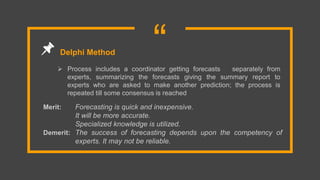
“ Process includes a coordinator getting forecasts separately from
experts, summarizing the forecasts giving the summary report to
experts who are asked to make another prediction; the process is
repeated till some consensus is reached
Delphi Method
Merit: Forecasting is quick and inexpensive.
It will be more accurate.
Specialized knowledge is utilized.
Demerit: The success of forecasting depends upon the competency of
experts. It may not be reliable.
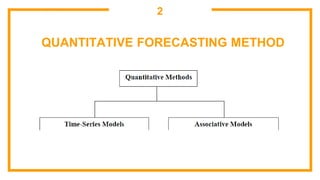
QUANTITATIVE FORECASTING METHOD
2
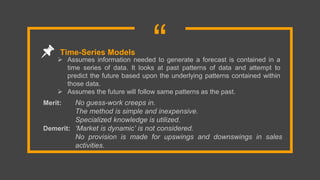
“ Assumes information needed to generate a forecast is contained in a
time series of data. It looks at past patterns of data and attempt to
predict the future based upon the underlying patterns contained within
those data.
 Assumes the future will follow same patterns as the past.
Time-Series Models
Merit: No guess-work creeps in.
The method is simple and inexpensive.
Specialized knowledge is utilized.
Demerit: ‘Market is dynamic’ is not considered.
No provision is made for upswings and downswings in sales
activities.
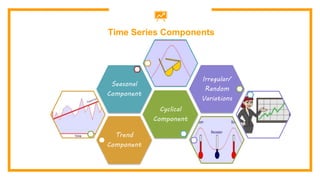
Time Series Components
Trend
Component
Cyclical
Component
Seasonal
Component
Irregular/
Random
Variations
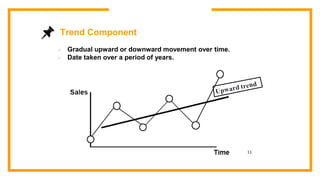
 Gradual upward or downward movement over time.
 Date taken over a period of years.
Trend Component
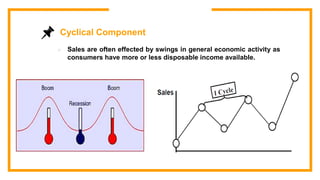
 Sales are often effected by swings in general economic activity as
consumers have more or less disposable income available.
Cyclical Component
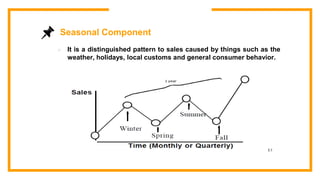
 It is a distinguished pattern to sales caused by things such as the
weather, holidays, local customs and general consumer behavior.
Seasonal Component
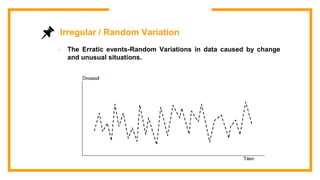
 The Erratic events-Random Variations in data caused by change
and unusual situations.
Irregular / Random Variation
“ (often called causal models) assume that the variable being forecasted
is related to other variables in the environment. They try to project
based upon those associations.
Associative Models
Merit: Can evaluate the impact of changes in other variables.
Demerit: Difficult to identify other variables.
Require historical data on all variables of the model.
Depend on the future values of the other variables.
Sufi Legend:
The Lost Horse
A man who lived on the northern frontier of China was skilled in interpreting
events. One day for no reason, his horse ran away to the nomads across the border.
Everyone tried to console him, but his father said, "What makes you so sure this isn't a
blessing?"
Some months later his horse returned, bringing a splendid nomad stallion. Everyone
congratulated him, but his father said, "What makes you so sure this isn't a disaster?"
Their household was richer by a fine horse, which the son loved to ride. One day he fell
and broke his hip. Everyone tried to console him, but his father said, "What makes you so
sure this isn't a blessing?“
A year later the nomads came in force across the border, and every able-bodied man
took his bow and went into battle. The Chinese frontiersmen lost nine of every ten men.
Only because the son was lame did father and son survive to take care of each other.
Truly, blessing turns to disaster, and disaster to blessing: the changes have no end, nor
can the mystery be fathomed.
Thank You! 
PRESENTED BY: JEHRA MAE SEVILLANO

Sales forecasting

  • 1.
  • 2.
    Sales Forecasting is aprojection of the expected customer demand for products or services at a specific company, for a specific time horizon, and with certain underlying assumptions.
  • 3.
    Forecasting can beused for… • Strategic planning (long range planning) • Finance and accounting (sales budgets and cost controls) • Marketing (sales quotas, new products) • Production and operations WHY SALES FORECASTING IS IMPORTANT?
  • 4.
    Many types offorecasting models that differ in complexity and amount of data & way they generate forecasts:  Forecasts are rarely perfect  Forecasts are more accurate for grouped data than for individual items.  Forecast are more accurate for shorter than longer time periods. Principles of Forecasting 1
  • 5.
    External Factors Relative stateof the economy Direct and indirect competition Styles or fashions Consumer earnings Weather Political Conditions Factors affecting Sales Forecasting Internal Factors Labor problems Inventory shortages Working capital shortage Price changes Production capability shortage New product lines
  • 6.
  • 7.
    Economic forecasts Predict avariety of economic indicators, like money supply, inflation rates, interest rates, etc. Technological forecasts Predict rates of technological progress and innovation. Demand forecasts Predict the future demand for a company’s products or services. Types of Forecasting
  • 8.
  • 9.
    “Qualitative methods: Thesetypes of forecasting methods are based on judgments, opinions, intuition, emotions, or personal experiences and are subjective in nature. They do not rely on any rigorous mathematical computations. Quantitative methods: These types of forecasting methods are based on mathematical (quantitative) models, and are objective in nature. They rely heavily on mathematical computations.
  • 10.
  • 11.
    “ Most widelyused  Method of combining and averaging views of several executives regarding a specific decision or forecast.  Leads to a quicker (and often more reliable) result without use of elaborate data manipulation and statistical techniques. Executive Opinion Method Merit: This method is simple and quick. Detailed data are not needed. Demerit: It is not based on factual data. More or less, the method rests on guess-work, and may lead to wrong forecasts.
  • 12.
    “ Process includesasking customers about their intentions to buy the company’s product and services  Questionnaire may contain other relevant questions Market Survey Merit: First hand information is possible. User’s intention is known. Demerit: Customer’s expectation cannot be measured exactly. It is difficult to identify actual buyers. The method is costly. Buyers may change their buying decisions.
  • 13.
    “ Also knownas “Grassroots Approach”  Individual salespersons forecast sales for their territories  Individual forecasts are combined & modified by the sales manager to form the company sales forecast.  Best used when a highly trained & specialized sales force is used. Sales Composite Survey Merit: Specialized knowledge is utilized. Salesmen are confident and responsible to meet the quota fixed. Demerit: Success depends upon the competency of salesmen. The estimation may be unattainable or may to too low for the forecasts as the salesmen may be optimistic or pessimistic.
  • 14.
    “ Process includesa coordinator getting forecasts separately from experts, summarizing the forecasts giving the summary report to experts who are asked to make another prediction; the process is repeated till some consensus is reached Delphi Method Merit: Forecasting is quick and inexpensive. It will be more accurate. Specialized knowledge is utilized. Demerit: The success of forecasting depends upon the competency of experts. It may not be reliable.
  • 15.
  • 16.
    “ Assumes informationneeded to generate a forecast is contained in a time series of data. It looks at past patterns of data and attempt to predict the future based upon the underlying patterns contained within those data.  Assumes the future will follow same patterns as the past. Time-Series Models Merit: No guess-work creeps in. The method is simple and inexpensive. Specialized knowledge is utilized. Demerit: ‘Market is dynamic’ is not considered. No provision is made for upswings and downswings in sales activities.
  • 17.
  • 18.
     Gradual upwardor downward movement over time.  Date taken over a period of years. Trend Component
  • 19.
     Sales areoften effected by swings in general economic activity as consumers have more or less disposable income available. Cyclical Component
  • 20.
     It isa distinguished pattern to sales caused by things such as the weather, holidays, local customs and general consumer behavior. Seasonal Component
  • 21.
     The Erraticevents-Random Variations in data caused by change and unusual situations. Irregular / Random Variation
  • 22.
    “ (often calledcausal models) assume that the variable being forecasted is related to other variables in the environment. They try to project based upon those associations. Associative Models Merit: Can evaluate the impact of changes in other variables. Demerit: Difficult to identify other variables. Require historical data on all variables of the model. Depend on the future values of the other variables.
  • 23.
  • 24.
    A man wholived on the northern frontier of China was skilled in interpreting events. One day for no reason, his horse ran away to the nomads across the border. Everyone tried to console him, but his father said, "What makes you so sure this isn't a blessing?" Some months later his horse returned, bringing a splendid nomad stallion. Everyone congratulated him, but his father said, "What makes you so sure this isn't a disaster?" Their household was richer by a fine horse, which the son loved to ride. One day he fell and broke his hip. Everyone tried to console him, but his father said, "What makes you so sure this isn't a blessing?“ A year later the nomads came in force across the border, and every able-bodied man took his bow and went into battle. The Chinese frontiersmen lost nine of every ten men. Only because the son was lame did father and son survive to take care of each other. Truly, blessing turns to disaster, and disaster to blessing: the changes have no end, nor can the mystery be fathomed.
  • 25.
    Thank You!  PRESENTEDBY: JEHRA MAE SEVILLANO

Editor's Notes

  • #3  A sales forecast is a projection of what your performance as a sales organization will be at the end of a measurement period (most often either monthly or quarterly).
  • #4 Strategic planning- Sales forecasting enables a business organization to work systematically. Finance and accounting-Sales forecasting is vital for preparing budget. In the absence of sales forecast, a business enterprise may work without any focus and this may result in wastage of its resources. It helps to cut down wasteful band as a result the goods can be offered at a fair price. Marketing-Forecast enables the production manager to set target for his workers. As target is set for each individual and department, it is easy to control performance. Sales forecast helps in product mix decisions as well. It enables the business to decide whether to add a new product to its product line or to drop an unsuccessful one. Production and operations-It enables the sales department to fix responsibilities on every salesman. It helps to determine the production capacity that is actually required.
  • #6 Relative state of the economy- The economic conditions prevailing in every country also do not remain stable. Purchasing power of money, desire to save and invest etc., are some of the important economic factors having a bearing on sales forecast. Direct and indirect competition -The entry of competitors may also affect sales. A firm enjoying monopoly status may lose such a position if the buyers find the competitors’ products more superior. Styles or fashions - The tastes and preferences of the buyers do not remain constant. A sudden change in the preference of the buyers may render the forecasts meaningless. Consumer earnings -Earnings affect the buying preferences of the consumers. Weather -Unexpected climate change may affect the forecasted sales. Political Conditions- The political conditions in a State also influence sales forecast. The policies of the Government regarding business change often. A sudden hike in excise duty or sales tax by the Government may affect sales.   Internal Factors Labor problems, Inventory shortages, Working capital shortage, Price changes, Production capability shortage, New product lines So these are the factors that may affect to your forecasted sales in a certain month or year.
  • #10 Qualitative methods are based on the subjective opinion of the forecaster and quantitative methods are based on mathematical modeling.
  • #12 This method of sales forecasting is the oldest. One or more of the executives, who are experienced and have good knowledge of the market factors make out the expected sales. The executives are responsible while forecasting sales figures through estimates and experiences. All the factors-internal and external—are taken into account. This is a type of committee approach. This method is simple as experiences and judgment are pooled together in taking a sales forecast figure. If there are many executives, their estimates are averaged in drawing the sales forecast.
  • #13 Consumers, as a source of information, are approached to know their likely purchases during the period under a given set of conditions. This type of forecasting is generally adopted for industrial goods. It is suitable for industries, which produce costly goods to a limited number of buyers- wholesalers, retailers, potential consumers etc. A survey is conducted on face to face basis or survey method. It is because changes are constant while buyer behavior and buying decisions change frequently.
  • #14 Under this method, salesmen, or intermediaries are required to make out an estimate sales in their respective territories for a given period. Salesmen are in close touch with the consumers and possess good knowledge about the future demand trend. Thus all the sales force estimates are processed, integrated, modified, and a sales volume estimate formed for the whole market, for the given period.
  • #15 Many types of consultancy agencies have entered into the field of sales. The consultancy agency has specialized experts in the respective field. This includes dealers, trade associations etc. They may conduct market researches and possess ready-made statistical data. Firms may make use of the opinions of such experts. These opinions may be carefully analysed by the company and a sound forecasting is made.
  • #17 The objective of the time series methods is to discover the pattern in the past values of a variable. Assuming that the historical pattern will continue, this method extrapolate it into the future and use it to predict future values of the variable interest. Disadvantage: It cannot evaluate the impact of changes in other variables.
  • #18 A time series analysis is a statistical method of studying historical data. A time data series is determined by four basic elements of sales variations: trends, or long-run changes (T), cyclical changes ©, seasonal variations (S), and irregular or unexpected factors (I). The analysis is based on the assumptions that these elements are combined in the following relationships: Sales = T x C x S x I Past sales figures are taken as a base, analyzed and adjusted to future trends. The past records and reports enable us to interpret the information and forecast future trends and trade cycle too.
  • #19 The trend is the main component of a time series which results from long term effect of socio-economic and political factors. This trend may show the growth or decline in a time series over a long period. This is the type of tendency which continues to persist for a very long period. Prices, export and imports data, for example, reflect obviously increasing tendencies over time.
  • #20 These are long term fluctuation occurring in a time series. These oscillations are mostly observed in economics data and the periods of such oscillations are generally extended from five to twelve years or more. These oscillations are associated to the well known business cycles. These cyclic movements can be studied provided a long series of measurements, free from irregular fluctuations is available.
  • #21 These are short term movements occurring in a data due to seasonal factors. The short term is generally considered as a period in which changes occur in a time series with variations in weather or festivities. For example,  it is commonly observed that the consumption of ice-cream during summer us generally high and hence sales of an ice-cream dealer would be higher in some months of the year while relatively lower during winter months. Employment, output, export etc. are subjected to change due to variation in weather. Similarly sales of garments, umbrella, greeting cards and fire-work are subjected to large variation during festivals like Valentine’s Day, Eid, Christmas, New Year etc. These types of variation in a time series are isolated only when the series is provided biannually, quarterly or monthly.
  • #22 These are sudden changes occurring in a time series which are unlikely to be repeated, it is that component of a time series which cannot be explained by trend, seasonal or cyclic movements .It is because of this fact these variations some-times called residual or random component. These variations though accidental in nature, can cause a continual change in the trend, seasonal and cyclical oscillations during the forthcoming period. Floods, fires, earthquakes, revolutions, epidemics and strikes etc,. are the root cause of such irregularities.
  • #23 Often, leading indicators can help to predict changes in future demand. Causal models assume that the variable being forecast is related to other variables in the environment.
  • #24 the title of this story, is actually a commonly used Chinese idiom or chengyu .  It literally translates as "Old Sai loses a horse". Old Sai is the wise man in the fable.
  • #25 The expression is used to remind others to take life in stride because things aren't really as good (or bad) as they seem. Certainly seems like a wise advice for a society that lives only for the present.