
Author has no financial interests or relationships to disclose.
Based on the Royal College of Ophthalmologists guidelines 2015
Retinal Vein Occlusion
Guidelines
Mohamed A. Awwad MD, FRCS
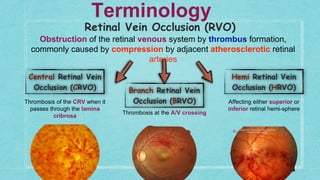
Terminology
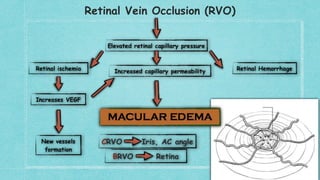
Retinal Vein Occlusion (RVO)
Obstruction of the retinal venous system by thrombus formation,
commonly caused by compression by adjacent atherosclerotic retinal
arteries
Thrombosis of the CRV when it
passes through the lamina
cribrosa
Thrombosis at the A/V crossing
Affecting either superior or
inferior retinal hemi-sphere
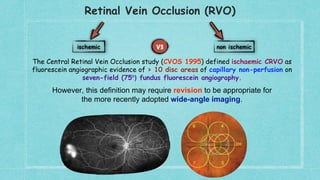
Retinal Vein Occlusion (RVO)
The Central Retinal Vein Occlusion study (CVOS 1995) defined ischaemic CRVO as
fluorescein angiographic evidence of > 10 disc areas of capillary non-perfusion on
seven-field (75º) fundus fluorescein angiography.
However, this definition may require revision to be appropriate for
the more recently adopted wide-angle imaging.
Ischaemic CRVO is associated with one or more of the following characteristics:
6. FA showing > 10 disc areas of retinal capillary non-perfusion on 7-field fluorescein angiography
7. ERG: reduced b wave amplitude, reduced b:a ratio and prolonged b-wave implicit time
Poor VA (44% of
eyes with vision of
<6/60 develop
rubeosis [CVOS]
RAPD
•Presence of multiple dark deep intra-
retinal haemorrhages
•Presence of multiple CWS
•Degree of retinal vein dilatation and
tortuosity
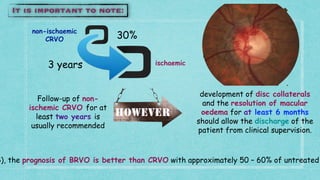
development of disc collaterals
and the resolution of macular
oedema for at least 6 months
should allow the discharge of the
patient from clinical supervision.
S), the prognosis of BRVO is better than CRVO with approximately 50 – 60% of untreated
non-ischaemic
CRVO
ischaemic
30%
3 years
Follow-up of non-
ischemic CRVO for at
least two years is
usually recommended
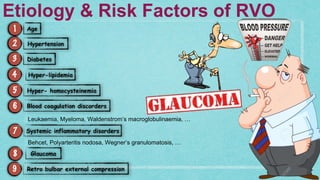
Etiology & Risk Factors of RVO
Leukaemia, Myeloma, Waldenstrom’s macroglobulinaemia, …
Behcet, Polyarteritis nodosa, Wegner’s granulomatosis, …
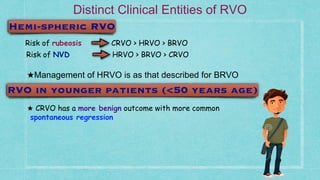
Distinct Clinical Entities of RVO
★ CRVO has a more benign outcome with more common
spontaneous regression
Risk of rubeosis CRVO > HRVO > BRVO
Risk of NVD HRVO > BRVO > CRVO
★Management of HRVO is as that described for BRVO
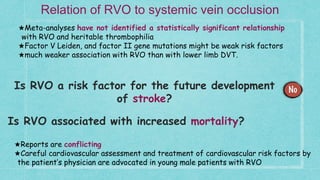
Relation of RVO to systemic vein occlusion
★Meta-analyses have not identified a statistically significant relationship
with RVO and heritable thrombophilia
★Factor V Leiden, and factor II gene mutations might be weak risk factors
★much weaker association with RVO than with lower limb DVT.
Is RVO a risk factor for the future development
of stroke?
Is RVO associated with increased mortality?
★Reports are conflicting
★Careful cardiovascular assessment and treatment of cardiovascular risk factors by
the patient’s physician are advocated in young male patients with RVO
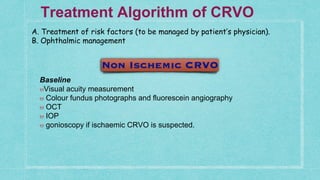
Treatment Algorithm of CRVO
A. Treatment of risk factors (to be managed by patient’s physician).
B. Ophthalmic management
Baseline
Visual acuity measurement
Colour fundus photographs and fluorescein angiography
OCT
IOP
gonioscopy if ischaemic CRVO is suspected.
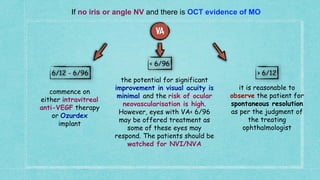
If no iris or angle NV and there is OCT evidence of MO
commence on
either intravitreal
anti-VEGF therapy
or Ozurdex
implant
the potential for significant
improvement in visual acuity is
minimal and the risk of ocular
neovascularisation is high.
However, eyes with VA< 6/96
may be offered treatment as
some of these eyes may
respond. The patients should be
watched for NVI/NVA
it is reasonable to
observe the patient for
spontaneous resolution
as per the judgment of
the treating
ophthalmologist
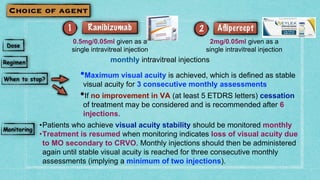
0.5mg/0.05ml given as a
single intravitreal injection
monthly intravitreal injections
•If no improvement in VA (at least 5 ETDRS letters) cessation
of treatment may be considered and is recommended after 6
injections.
•Patients who achieve visual acuity stability should be monitored monthly
•Treatment is resumed when monitoring indicates loss of visual acuity due
to MO secondary to CRVO. Monthly injections should then be administered
again until stable visual acuity is reached for three consecutive monthly
assessments (implying a minimum of two injections).
•Maximum visual acuity is achieved, which is defined as stable
visual acuity for 3 consecutive monthly assessments
2mg/0.05ml given as a
single intravitreal injection
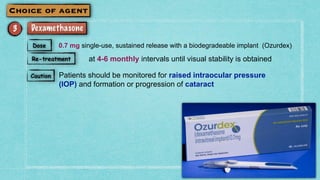
0.7 mg single-use, sustained release with a biodegradeable implant (Ozurdex)
at 4-6 monthly intervals until visual stability is obtained
Patients should be monitored for raised intraocular pressure
(IOP) and formation or progression of cataract
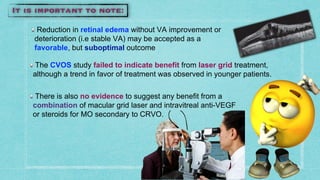
Reduction in retinal edema without VA improvement or
deterioration (i.e stable VA) may be accepted as a
favorable, but suboptimal outcome
The CVOS study failed to indicate benefit from laser grid treatment,
although a trend in favor of treatment was observed in younger patients.
There is also no evidence to suggest any benefit from a
combination of macular grid laser and intravitreal anti-VEGF
or steroids for MO secondary to CRVO.
๏ If an anti-VEGF agent is stopped due to lack of efficacy, there are no
randomised controlled trials that provide evidence that switching to
another anti-VEGF agent may be effective.
๏ However, given our experience with switching anti-VEGF agents in
neovascular ARMD, it may be worthwhile switching to another anti-VEGF
agent and further monthly injections for 3 months may be given to assess the
efficacy of the switch.
๏ There is a good rationale to switch from Ozurdex to an anti-VEGF agent
and vice versa as the different mode of actions of these agents may aid in
resolution of MO.
๏ However, the long term outcomes of sequential or combination treatment of
anti-VEGF agents and steroids remain unclear.
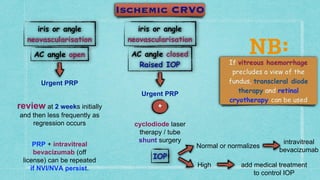
Urgent PRP
review at 2 weeks initially
and then less frequently as
regression occurs
PRP + intravitreal
bevacizumab (off
license) can be repeated
if NVI/NVA persist.
Urgent PRP
cyclodiode laser
therapy / tube
shunt surgery
Normal or normalizes
intravitreal
bevacizumab
High add medical treatment
to control IOP
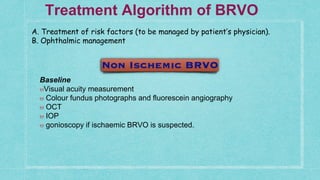
Treatment Algorithm of BRVO
A. Treatment of risk factors (to be managed by patient’s physician).
B. Ophthalmic management
Baseline
Visual acuity measurement
Colour fundus photographs and fluorescein angiography
OCT
IOP
gonioscopy if ischaemic BRVO is suspected.
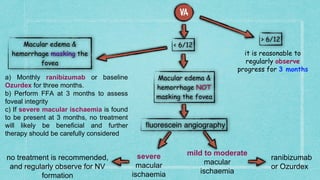
it is reasonable to
regularly observe
progress for 3 months
mild to moderate
macular
ischaemia
ranibizumab
or Ozurdex
severe
macular
ischaemia
no treatment is recommended,
and regularly observe for NV
formation
a) Monthly ranibizumab or baseline
Ozurdex for three months.
b) Perform FFA at 3 months to assess
foveal integrity
c) If severe macular ischaemia is found
to be present at 3 months, no treatment
will likely be beneficial and further
therapy should be carefully considered
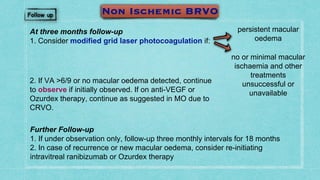
At three months follow-up
1. Consider modified grid laser photocoagulation if:
Further Follow-up
1. If under observation only, follow-up three monthly intervals for 18 months
2. In case of recurrence or new macular oedema, consider re-initiating
intravitreal ranibizumab or Ozurdex therapy
2. If VA >6/9 or no macular oedema detected, continue
to observe if initially observed. If on anti-VEGF or
Ozurdex therapy, continue as suggested in MO due to
CRVO.
persistent macular
oedema
no or minimal macular
ischaemia and other
treatments
unsuccessful or
unavailable
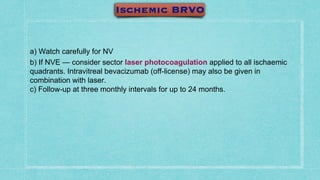
a) Watch carefully for NV
b) If NVE — consider sector laser photocoagulation applied to all ischaemic
quadrants. Intravitreal bevacizumab (off-license) may also be given in
combination with laser.
c) Follow-up at three monthly intervals for up to 24 months.
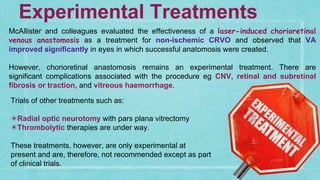
McAllister and colleagues evaluated the effectiveness of a laser-induced chorioretinal
venous anastomosis as a treatment for non-ischemic CRVO and observed that VA
improved significantly in eyes in which successful anatomosis were created.
However, chorioretinal anastomosis remains an experimental treatment. There are
significant complications associated with the procedure eg CNV, retinal and subretinal
fibrosis or traction, and vitreous haemorrhage.
Experimental Treatments
Trials of other treatments such as:
✴Radial optic neurotomy with pars plana vitrectomy
✴Thrombolytic therapies are under way.
These treatments, however, are only experimental at
present and are, therefore, not recommended except as part
of clinical trials.
Rvo guidelines

Rvo guidelines

  • 1.
    Author has nofinancial interests or relationships to disclose. Based on the Royal College of Ophthalmologists guidelines 2015 Retinal Vein Occlusion Guidelines Mohamed A. Awwad MD, FRCS
  • 2.
    Terminology Retinal Vein Occlusion(RVO) Obstruction of the retinal venous system by thrombus formation, commonly caused by compression by adjacent atherosclerotic retinal arteries Thrombosis of the CRV when it passes through the lamina cribrosa Thrombosis at the A/V crossing Affecting either superior or inferior retinal hemi-sphere
  • 3.
  • 4.
    Retinal Vein Occlusion(RVO) The Central Retinal Vein Occlusion study (CVOS 1995) defined ischaemic CRVO as fluorescein angiographic evidence of > 10 disc areas of capillary non-perfusion on seven-field (75º) fundus fluorescein angiography. However, this definition may require revision to be appropriate for the more recently adopted wide-angle imaging.
  • 5.
    Ischaemic CRVO isassociated with one or more of the following characteristics: 6. FA showing > 10 disc areas of retinal capillary non-perfusion on 7-field fluorescein angiography 7. ERG: reduced b wave amplitude, reduced b:a ratio and prolonged b-wave implicit time Poor VA (44% of eyes with vision of <6/60 develop rubeosis [CVOS] RAPD •Presence of multiple dark deep intra- retinal haemorrhages •Presence of multiple CWS •Degree of retinal vein dilatation and tortuosity
  • 6.
    development of disccollaterals and the resolution of macular oedema for at least 6 months should allow the discharge of the patient from clinical supervision. S), the prognosis of BRVO is better than CRVO with approximately 50 – 60% of untreated non-ischaemic CRVO ischaemic 30% 3 years Follow-up of non- ischemic CRVO for at least two years is usually recommended
  • 7.
    Etiology & RiskFactors of RVO Leukaemia, Myeloma, Waldenstrom’s macroglobulinaemia, … Behcet, Polyarteritis nodosa, Wegner’s granulomatosis, …
  • 8.
    Distinct Clinical Entitiesof RVO ★ CRVO has a more benign outcome with more common spontaneous regression Risk of rubeosis CRVO > HRVO > BRVO Risk of NVD HRVO > BRVO > CRVO ★Management of HRVO is as that described for BRVO
  • 9.
    Relation of RVOto systemic vein occlusion ★Meta-analyses have not identified a statistically significant relationship with RVO and heritable thrombophilia ★Factor V Leiden, and factor II gene mutations might be weak risk factors ★much weaker association with RVO than with lower limb DVT. Is RVO a risk factor for the future development of stroke? Is RVO associated with increased mortality? ★Reports are conflicting ★Careful cardiovascular assessment and treatment of cardiovascular risk factors by the patient’s physician are advocated in young male patients with RVO
  • 10.
    Treatment Algorithm ofCRVO A. Treatment of risk factors (to be managed by patient’s physician). B. Ophthalmic management Baseline Visual acuity measurement Colour fundus photographs and fluorescein angiography OCT IOP gonioscopy if ischaemic CRVO is suspected.
  • 11.
    If no irisor angle NV and there is OCT evidence of MO commence on either intravitreal anti-VEGF therapy or Ozurdex implant the potential for significant improvement in visual acuity is minimal and the risk of ocular neovascularisation is high. However, eyes with VA< 6/96 may be offered treatment as some of these eyes may respond. The patients should be watched for NVI/NVA it is reasonable to observe the patient for spontaneous resolution as per the judgment of the treating ophthalmologist
  • 12.
    0.5mg/0.05ml given asa single intravitreal injection monthly intravitreal injections •If no improvement in VA (at least 5 ETDRS letters) cessation of treatment may be considered and is recommended after 6 injections. •Patients who achieve visual acuity stability should be monitored monthly •Treatment is resumed when monitoring indicates loss of visual acuity due to MO secondary to CRVO. Monthly injections should then be administered again until stable visual acuity is reached for three consecutive monthly assessments (implying a minimum of two injections). •Maximum visual acuity is achieved, which is defined as stable visual acuity for 3 consecutive monthly assessments 2mg/0.05ml given as a single intravitreal injection
  • 13.
    0.7 mg single-use,sustained release with a biodegradeable implant (Ozurdex) at 4-6 monthly intervals until visual stability is obtained Patients should be monitored for raised intraocular pressure (IOP) and formation or progression of cataract
  • 14.
    Reduction in retinaledema without VA improvement or deterioration (i.e stable VA) may be accepted as a favorable, but suboptimal outcome The CVOS study failed to indicate benefit from laser grid treatment, although a trend in favor of treatment was observed in younger patients. There is also no evidence to suggest any benefit from a combination of macular grid laser and intravitreal anti-VEGF or steroids for MO secondary to CRVO.
  • 15.
    ๏ If ananti-VEGF agent is stopped due to lack of efficacy, there are no randomised controlled trials that provide evidence that switching to another anti-VEGF agent may be effective. ๏ However, given our experience with switching anti-VEGF agents in neovascular ARMD, it may be worthwhile switching to another anti-VEGF agent and further monthly injections for 3 months may be given to assess the efficacy of the switch. ๏ There is a good rationale to switch from Ozurdex to an anti-VEGF agent and vice versa as the different mode of actions of these agents may aid in resolution of MO. ๏ However, the long term outcomes of sequential or combination treatment of anti-VEGF agents and steroids remain unclear.
  • 16.
    Urgent PRP review at2 weeks initially and then less frequently as regression occurs PRP + intravitreal bevacizumab (off license) can be repeated if NVI/NVA persist. Urgent PRP cyclodiode laser therapy / tube shunt surgery Normal or normalizes intravitreal bevacizumab High add medical treatment to control IOP
  • 17.
    Treatment Algorithm ofBRVO A. Treatment of risk factors (to be managed by patient’s physician). B. Ophthalmic management Baseline Visual acuity measurement Colour fundus photographs and fluorescein angiography OCT IOP gonioscopy if ischaemic BRVO is suspected.
  • 18.
    it is reasonableto regularly observe progress for 3 months mild to moderate macular ischaemia ranibizumab or Ozurdex severe macular ischaemia no treatment is recommended, and regularly observe for NV formation a) Monthly ranibizumab or baseline Ozurdex for three months. b) Perform FFA at 3 months to assess foveal integrity c) If severe macular ischaemia is found to be present at 3 months, no treatment will likely be beneficial and further therapy should be carefully considered
  • 19.
    At three monthsfollow-up 1. Consider modified grid laser photocoagulation if: Further Follow-up 1. If under observation only, follow-up three monthly intervals for 18 months 2. In case of recurrence or new macular oedema, consider re-initiating intravitreal ranibizumab or Ozurdex therapy 2. If VA >6/9 or no macular oedema detected, continue to observe if initially observed. If on anti-VEGF or Ozurdex therapy, continue as suggested in MO due to CRVO. persistent macular oedema no or minimal macular ischaemia and other treatments unsuccessful or unavailable
  • 20.
    a) Watch carefullyfor NV b) If NVE — consider sector laser photocoagulation applied to all ischaemic quadrants. Intravitreal bevacizumab (off-license) may also be given in combination with laser. c) Follow-up at three monthly intervals for up to 24 months.
  • 21.
    McAllister and colleaguesevaluated the effectiveness of a laser-induced chorioretinal venous anastomosis as a treatment for non-ischemic CRVO and observed that VA improved significantly in eyes in which successful anatomosis were created. However, chorioretinal anastomosis remains an experimental treatment. There are significant complications associated with the procedure eg CNV, retinal and subretinal fibrosis or traction, and vitreous haemorrhage. Experimental Treatments Trials of other treatments such as: ✴Radial optic neurotomy with pars plana vitrectomy ✴Thrombolytic therapies are under way. These treatments, however, are only experimental at present and are, therefore, not recommended except as part of clinical trials.