Rubrics for
Performance Assessment
Type of Rubrics
*Analytical rubrics
*Holistic rubrics
Analytical rubrics – are usually preferred when a
fairly focused type of response is required.
Furthermore, analytical rubrics result initially in
several scores, followed by a summative total score-
their use represents assessment on a
multidimensional level.
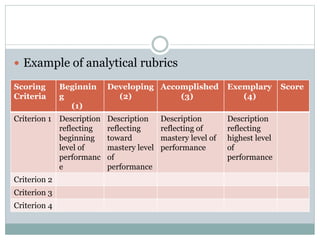
 Example of analytical rubrics
Scoring
Criteria
Beginnin
g
(1)
Developing
(2)
Accomplished
(3)
Exemplary
(4)
Score
Criterion 1 Description
reflecting
beginning
level of
performanc
e
Description
reflecting
toward
mastery level
of
performance
Description
reflecting of
mastery level of
performance
Description
reflecting
highest level
of
performance
Criterion 2
Criterion 3
Criterion 4
When to use analytical rubric?
 several faculty are collectively assessing student
work.
 Outside audiences will be examining rubric scores,
substantially feedback to student or faculty is
desired.
 Profile of specific strengths/weaknesses are desired.
 Advantages of Analytic Rubrics
 Provide useful feedback on areas of strength and
weakness.
 Criterion can be weighted to reflect the relative
importance of each dimension.
 Disadvantages of Analytic Rubrics
 Takes more time to create and use than a holistic
rubric.
 Unless each point for each criterion is well-defined
raters may not arrive at the same score.
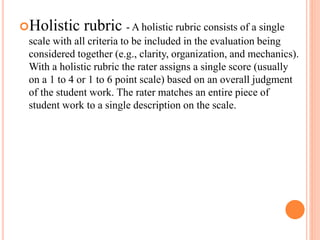
Holistic rubric - A holistic rubric consists of a single
scale with all criteria to be included in the evaluation being
considered together (e.g., clarity, organization, and mechanics).
With a holistic rubric the rater assigns a single score (usually
on a 1 to 4 or 1 to 6 point scale) based on an overall judgment
of the student work. The rater matches an entire piece of
student work to a single description on the scale.
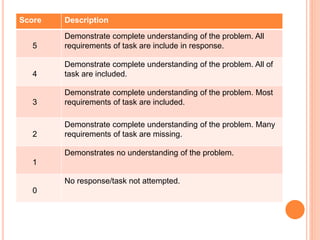
Score Description
5
Demonstrate complete understanding of the problem. All
requirements of task are include in response.
4
Demonstrate complete understanding of the problem. All of
task are included.
3
Demonstrate complete understanding of the problem. Most
requirements of task are included.
2
Demonstrate complete understanding of the problem. Many
requirements of task are missing.
1
Demonstrates no understanding of the problem.
0
No response/task not attempted.
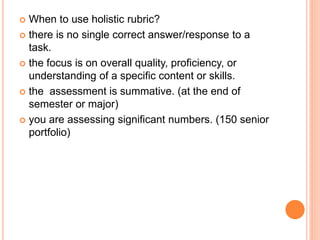
 When to use holistic rubric?
 there is no single correct answer/response to a
task.
 the focus is on overall quality, proficiency, or
understanding of a specific content or skills.
 the assessment is summative. (at the end of
semester or major)
 you are assessing significant numbers. (150 senior
portfolio)
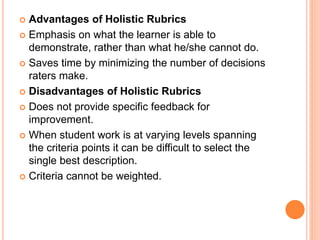
 Advantages of Holistic Rubrics
 Emphasis on what the learner is able to
demonstrate, rather than what he/she cannot do.
 Saves time by minimizing the number of decisions
raters make.
 Disadvantages of Holistic Rubrics
 Does not provide specific feedback for
improvement.
 When student work is at varying levels spanning
the criteria points it can be difficult to select the
single best description.
 Criteria cannot be weighted.

Rubrics for performance assessment

  • 1.
  • 2.
    Type of Rubrics *Analyticalrubrics *Holistic rubrics Analytical rubrics – are usually preferred when a fairly focused type of response is required. Furthermore, analytical rubrics result initially in several scores, followed by a summative total score- their use represents assessment on a multidimensional level.
  • 3.
     Example ofanalytical rubrics Scoring Criteria Beginnin g (1) Developing (2) Accomplished (3) Exemplary (4) Score Criterion 1 Description reflecting beginning level of performanc e Description reflecting toward mastery level of performance Description reflecting of mastery level of performance Description reflecting highest level of performance Criterion 2 Criterion 3 Criterion 4
  • 4.
    When to useanalytical rubric?  several faculty are collectively assessing student work.  Outside audiences will be examining rubric scores, substantially feedback to student or faculty is desired.  Profile of specific strengths/weaknesses are desired.
  • 5.
     Advantages ofAnalytic Rubrics  Provide useful feedback on areas of strength and weakness.  Criterion can be weighted to reflect the relative importance of each dimension.  Disadvantages of Analytic Rubrics  Takes more time to create and use than a holistic rubric.  Unless each point for each criterion is well-defined raters may not arrive at the same score.
  • 6.
    Holistic rubric -A holistic rubric consists of a single scale with all criteria to be included in the evaluation being considered together (e.g., clarity, organization, and mechanics). With a holistic rubric the rater assigns a single score (usually on a 1 to 4 or 1 to 6 point scale) based on an overall judgment of the student work. The rater matches an entire piece of student work to a single description on the scale.
  • 7.
    Score Description 5 Demonstrate completeunderstanding of the problem. All requirements of task are include in response. 4 Demonstrate complete understanding of the problem. All of task are included. 3 Demonstrate complete understanding of the problem. Most requirements of task are included. 2 Demonstrate complete understanding of the problem. Many requirements of task are missing. 1 Demonstrates no understanding of the problem. 0 No response/task not attempted.
  • 8.
     When touse holistic rubric?  there is no single correct answer/response to a task.  the focus is on overall quality, proficiency, or understanding of a specific content or skills.  the assessment is summative. (at the end of semester or major)  you are assessing significant numbers. (150 senior portfolio)
  • 9.
     Advantages ofHolistic Rubrics  Emphasis on what the learner is able to demonstrate, rather than what he/she cannot do.  Saves time by minimizing the number of decisions raters make.  Disadvantages of Holistic Rubrics  Does not provide specific feedback for improvement.  When student work is at varying levels spanning the criteria points it can be difficult to select the single best description.  Criteria cannot be weighted.