CHAPTER 2:
AUTHENTIC ASSESSMENT:
MEANING,
CHARACTERISTICS AND
PRACTICES
Topics:
AUTHENTIC ASSESSMENT:
MEANING, CHARACTERISTICS
AND PRACTICES
Why Authentic assessment?
CHARACTERISTICS OF
AUTHENTIC ASSESSMENT (AA)
WHAT IS AUTHENTIC
ASSESSMENT?
LEARNING OBJECTIVES:
1. identify the relationship of assessment,
evaluation and marks to determine the
attainment of student learning outcomes.
2. discuss the authentic assessment
meaning, characteristics and practices.
3. illustrate the phases of authentic
assessment.
Inroduction:
In 1935, the distinguished educator Ralph Tyler
proposed an "enlarged concept of student
evaluation," encompassing other approaches
besides tests and quizzes. He urged teachers to
sample learning by collecting products of their
efforts throughout the year. That practice has
evolved into what is today termed "authentic
assessment," which encompasses a range of
approaches including portfolio assessment,
journals and logs, products, videotapes of
performances, and projects.
Both assessment and evaluation are
based on the judgmental of an
experienced, thoughtful human being
– an expert. Machines don’t assess,
papers don’t assess, test don’t
assess. Humans assess. And what
better person is there to assess the
progress and development of his or
her students than the classrooms
teacher.
LARRY MALONE
Lawrence Hall of Science,
The term assessment, evaluation,
testing and marks are term often used
in determining the degree of
attainment of students learning
outcomes. At times they are used
interchangeably, it will be useful to
clarify their meaning to distinguish
them from one another.
Assessment- refers to the process
of gathering data and information
about what students know and can
do. Through assessment, the
teacher can find out what students
are learning.
Evaluation – involves the task of
interpreting, forming conclusions and
making judgment about the
information which was gathered in
the process of assessment.
Testing- is an instrument of
Marks- are reports of the result of evaluating information
obtained in assessment process. Marks have certain
components related to the learning activities undertaken by
the students.
Example of such components are:
20% for class participation
10% for completed assignments
20% for quizzes
30% for submitted reports
20% for oral presentation of completed project
______________________________________
100% TOTAL
Assessment involves review of evidence of
learning such as journal entries, written
work, portfolios, skill demonstrations, and
performance in learning activities, test
result and rubrics ratings which cover a
period time and should reveal the progress
of students in competencies. Evaluation in
the other hand occurs when a mark or grade
is assigned after a quiz, a presentation or a
completed task.
Why Authentic assessment?
“The common practices of using recall and
recognition objective the skills and knowledge
they have mastered”. --- Richard Stiggins (1987)
“Authentic assessment is products and/or
performances correlated with real experiences”. --
- Newton Public Schools
Other names of authentic assessment are
performance assessment, alternative
assessment, and direct assessment.
CHARACTERISTICS
OF AUTHENTIC
ASSESSMENT (AA)
1. Authentic Assessment starts with clear definite
criteria of performance made known to the
students.
2. Authentic Assessment is a criterion- referenced
rather than norm- referenced and so it identifies
strengths and weaknesses, but does not compare
students nor rank their levels of performance.
3. Authentic Assessment requires students to make
their own answer to questions rather than select
from given options as in multiple choice items, and
requires them to use a range of higher order
thinking skills (HOTS).
4. Authentic Assessment often emphasizes
performance and therefore students are required
to demonstrate their knowledge, skills or
competencies in appropriate situations.
Authentic assessment does not rely on ability to
recall facts or memorize details, instead
students are asked to demonstrate skills and
concepts they have learned.
5. Authentic Assessment encourages both
teacher and students to determine their rate of
progress in cooperatively attaining the desired
student learning outcomes.
6. Authentic Assessment does not encourage rote
learning and passive taking of test; instead, students are
required to demonstrate analytical skills, ability to
integrate what they learn, creativity, and ability to work
in group, skills in oral and written communications. In
brief, authentic assessment values not only the finished
products which are the learning outcomes, but also the
process of learning.
7. Authentic Assessment changes the role of students as
passive test takers into become active and involve
participants in assessment activities that emphasize
what they are capable of doing instead test to measure
students’ skills or retained facts has come under
scrutiny because of the limitation encountered in
determining the students’ capability to utilized their
WHAT IS AUTHENTIC ASSESSMENT?
Here are some definitions:
“A form of assessment in which students are asked to
perform real-world task that demonstrate meaningful
application of essential knowledge and skills..” –Jon Mueller
(2011)
“Engaging and worthy problems or questions of
importance, in which students must use knowledge to fashion
performances effectively and creatively. The tasks are either
replicas of or analogous to the kind of problems faced by adult
citizens and consumers or professionals in field.” – Grant
Wiggins (1987)
“Performance (authentic) assessments call upon
the examinee to demonstrate specific skills and
competencies; that is, to apply of their
weaknesses. This results is diminished fear of
tests and improvement of self-esteem.
From teacher- centered activities, authentic
assessment encourages a learner-centered class
where the teacher’s major role is to help students
accept responsibility for their learning and
become self-evaluators.
Phases of
Authentic
Assessment
The purpose of assessment is to improve
student learning. Assessment achieves this
purpose by gathering pieces of evidence of
student performance over a period of time.
Such evidence may be in the form of
written works, journal entries, oral
presentations, research paper results, essay,
story writing, and examination results.
“Closing the loop” encourages the use of
assessment results for further improvement.
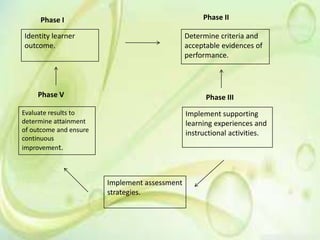
In general, Outcome assessment goes
through five (5) phases
Identifying the most
important knowledge and
skills that students should
be able to demonstrate as
a result of their learning
activities.
Determining the criteria
and standards of outcomes
performance and the
acceptable evidence that
may be presented as proof
of outcomes’ attainment.
Implementation of the
supporting activities that will
facilitate the attainment of
the desired student learning
outcomes.
Measuring the extent at
which the student is
attaining the desired
learning outcomes.
Interpreting the
assessment results and
evaluating whether they
indicate attainment of the
desired outcomes and
utilizing them for continuous
improvement
Phase I
Identity learner
outcome.
Determine criteria and
acceptable evidences of
performance.
Phase II
Evaluate results to
determine attainment
of outcome and ensure
continuous
improvement.
Phase V Phase III
Implement supporting
learning experiences and
instructional activities.
Implement assessment
strategies.
Examples of Authentic Assessment
Activities:
1. Doing science experiments.
2. Conducting social science field research.
3. Writing stories and reports.
4. Reading and interpreting literary pieces.
5. Solving mathematical problems that have
real-world implications.
6. Performing particular
skills/competencies
7. Simulation or role playing.
8. Exhibiting and displaying
completed works.
9. Submitting portfolios
10. Submitting original creative
projects.
Traditional Assessment- Is commonly
associated with pre- determined
choice measure of assessment such as
multiple choices tasks, fill-in-the
blanks, true – false, matching type and
others. Students typically recall or
select the answers. Essentially, TA
springs from the educational which
involves the following principles and
practices.
1.A School’s mission is to develop useful
citizens.
2.To be a useful citizen, one must process a
certain body of knowledge and skills;
3.The school is entrusted to teach this body of
knowledge and skills;
4.To determine if the student have acquired
these knowledge and skills, the school must
test the student on these knowledge and
skills.
Authentic Assessment- on the other hand is
grounded on the following principles and
practices:
1. A school’s mission is to develop useful citizen;
2. To be a useful citizen, one has to be capable of
performing useful tasks in the real-world;
3. The school’s duty is to help students develop
proficiency in performing the tasks that 4. they
will be required tom perform after graduation in
the work place;
4. The school must then require students to
perform tasks that duplicate or imitate real-
world situations.
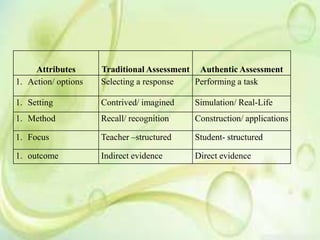
Attributes Traditional Assessment Authentic Assessment
1. Action/ options Selecting a response Performing a task
1. Setting Contrived/ imagined Simulation/ Real-Life
1. Method Recall/ recognition Construction/ applications
1. Focus Teacher –structured Student- structured
1. outcome Indirect evidence Direct evidence

Chapter 2- Authentic assessment

  • 1.
  • 2.
    Topics: AUTHENTIC ASSESSMENT: MEANING, CHARACTERISTICS ANDPRACTICES Why Authentic assessment? CHARACTERISTICS OF AUTHENTIC ASSESSMENT (AA) WHAT IS AUTHENTIC ASSESSMENT?
  • 3.
    LEARNING OBJECTIVES: 1. identifythe relationship of assessment, evaluation and marks to determine the attainment of student learning outcomes. 2. discuss the authentic assessment meaning, characteristics and practices. 3. illustrate the phases of authentic assessment.
  • 4.
    Inroduction: In 1935, thedistinguished educator Ralph Tyler proposed an "enlarged concept of student evaluation," encompassing other approaches besides tests and quizzes. He urged teachers to sample learning by collecting products of their efforts throughout the year. That practice has evolved into what is today termed "authentic assessment," which encompasses a range of approaches including portfolio assessment, journals and logs, products, videotapes of performances, and projects.
  • 5.
    Both assessment andevaluation are based on the judgmental of an experienced, thoughtful human being – an expert. Machines don’t assess, papers don’t assess, test don’t assess. Humans assess. And what better person is there to assess the progress and development of his or her students than the classrooms teacher. LARRY MALONE Lawrence Hall of Science,
  • 6.
    The term assessment,evaluation, testing and marks are term often used in determining the degree of attainment of students learning outcomes. At times they are used interchangeably, it will be useful to clarify their meaning to distinguish them from one another.
  • 7.
    Assessment- refers tothe process of gathering data and information about what students know and can do. Through assessment, the teacher can find out what students are learning. Evaluation – involves the task of interpreting, forming conclusions and making judgment about the information which was gathered in the process of assessment. Testing- is an instrument of
  • 8.
    Marks- are reportsof the result of evaluating information obtained in assessment process. Marks have certain components related to the learning activities undertaken by the students. Example of such components are: 20% for class participation 10% for completed assignments 20% for quizzes 30% for submitted reports 20% for oral presentation of completed project ______________________________________ 100% TOTAL
  • 9.
    Assessment involves reviewof evidence of learning such as journal entries, written work, portfolios, skill demonstrations, and performance in learning activities, test result and rubrics ratings which cover a period time and should reveal the progress of students in competencies. Evaluation in the other hand occurs when a mark or grade is assigned after a quiz, a presentation or a completed task.
  • 10.
    Why Authentic assessment? “Thecommon practices of using recall and recognition objective the skills and knowledge they have mastered”. --- Richard Stiggins (1987) “Authentic assessment is products and/or performances correlated with real experiences”. -- - Newton Public Schools Other names of authentic assessment are performance assessment, alternative assessment, and direct assessment.
  • 11.
  • 12.
    1. Authentic Assessmentstarts with clear definite criteria of performance made known to the students. 2. Authentic Assessment is a criterion- referenced rather than norm- referenced and so it identifies strengths and weaknesses, but does not compare students nor rank their levels of performance. 3. Authentic Assessment requires students to make their own answer to questions rather than select from given options as in multiple choice items, and requires them to use a range of higher order thinking skills (HOTS).
  • 13.
    4. Authentic Assessmentoften emphasizes performance and therefore students are required to demonstrate their knowledge, skills or competencies in appropriate situations. Authentic assessment does not rely on ability to recall facts or memorize details, instead students are asked to demonstrate skills and concepts they have learned. 5. Authentic Assessment encourages both teacher and students to determine their rate of progress in cooperatively attaining the desired student learning outcomes.
  • 14.
    6. Authentic Assessmentdoes not encourage rote learning and passive taking of test; instead, students are required to demonstrate analytical skills, ability to integrate what they learn, creativity, and ability to work in group, skills in oral and written communications. In brief, authentic assessment values not only the finished products which are the learning outcomes, but also the process of learning. 7. Authentic Assessment changes the role of students as passive test takers into become active and involve participants in assessment activities that emphasize what they are capable of doing instead test to measure students’ skills or retained facts has come under scrutiny because of the limitation encountered in determining the students’ capability to utilized their
  • 15.
    WHAT IS AUTHENTICASSESSMENT? Here are some definitions: “A form of assessment in which students are asked to perform real-world task that demonstrate meaningful application of essential knowledge and skills..” –Jon Mueller (2011) “Engaging and worthy problems or questions of importance, in which students must use knowledge to fashion performances effectively and creatively. The tasks are either replicas of or analogous to the kind of problems faced by adult citizens and consumers or professionals in field.” – Grant Wiggins (1987)
  • 16.
    “Performance (authentic) assessmentscall upon the examinee to demonstrate specific skills and competencies; that is, to apply of their weaknesses. This results is diminished fear of tests and improvement of self-esteem. From teacher- centered activities, authentic assessment encourages a learner-centered class where the teacher’s major role is to help students accept responsibility for their learning and become self-evaluators.
  • 17.
  • 18.
    The purpose ofassessment is to improve student learning. Assessment achieves this purpose by gathering pieces of evidence of student performance over a period of time. Such evidence may be in the form of written works, journal entries, oral presentations, research paper results, essay, story writing, and examination results. “Closing the loop” encourages the use of assessment results for further improvement. In general, Outcome assessment goes through five (5) phases
  • 19.
    Identifying the most importantknowledge and skills that students should be able to demonstrate as a result of their learning activities.
  • 20.
    Determining the criteria andstandards of outcomes performance and the acceptable evidence that may be presented as proof of outcomes’ attainment.
  • 21.
    Implementation of the supportingactivities that will facilitate the attainment of the desired student learning outcomes.
  • 22.
    Measuring the extentat which the student is attaining the desired learning outcomes.
  • 23.
    Interpreting the assessment resultsand evaluating whether they indicate attainment of the desired outcomes and utilizing them for continuous improvement
  • 24.
    Phase I Identity learner outcome. Determinecriteria and acceptable evidences of performance. Phase II Evaluate results to determine attainment of outcome and ensure continuous improvement. Phase V Phase III Implement supporting learning experiences and instructional activities. Implement assessment strategies.
  • 25.
    Examples of AuthenticAssessment Activities: 1. Doing science experiments. 2. Conducting social science field research. 3. Writing stories and reports. 4. Reading and interpreting literary pieces. 5. Solving mathematical problems that have real-world implications.
  • 26.
    6. Performing particular skills/competencies 7.Simulation or role playing. 8. Exhibiting and displaying completed works. 9. Submitting portfolios 10. Submitting original creative projects.
  • 27.
    Traditional Assessment- Iscommonly associated with pre- determined choice measure of assessment such as multiple choices tasks, fill-in-the blanks, true – false, matching type and others. Students typically recall or select the answers. Essentially, TA springs from the educational which involves the following principles and practices.
  • 28.
    1.A School’s missionis to develop useful citizens. 2.To be a useful citizen, one must process a certain body of knowledge and skills; 3.The school is entrusted to teach this body of knowledge and skills; 4.To determine if the student have acquired these knowledge and skills, the school must test the student on these knowledge and skills.
  • 29.
    Authentic Assessment- onthe other hand is grounded on the following principles and practices: 1. A school’s mission is to develop useful citizen; 2. To be a useful citizen, one has to be capable of performing useful tasks in the real-world; 3. The school’s duty is to help students develop proficiency in performing the tasks that 4. they will be required tom perform after graduation in the work place; 4. The school must then require students to perform tasks that duplicate or imitate real- world situations.
  • 30.
    Attributes Traditional AssessmentAuthentic Assessment 1. Action/ options Selecting a response Performing a task 1. Setting Contrived/ imagined Simulation/ Real-Life 1. Method Recall/ recognition Construction/ applications 1. Focus Teacher –structured Student- structured 1. outcome Indirect evidence Direct evidence