Revised by:EltonJohn B. Embodo
Revision #2
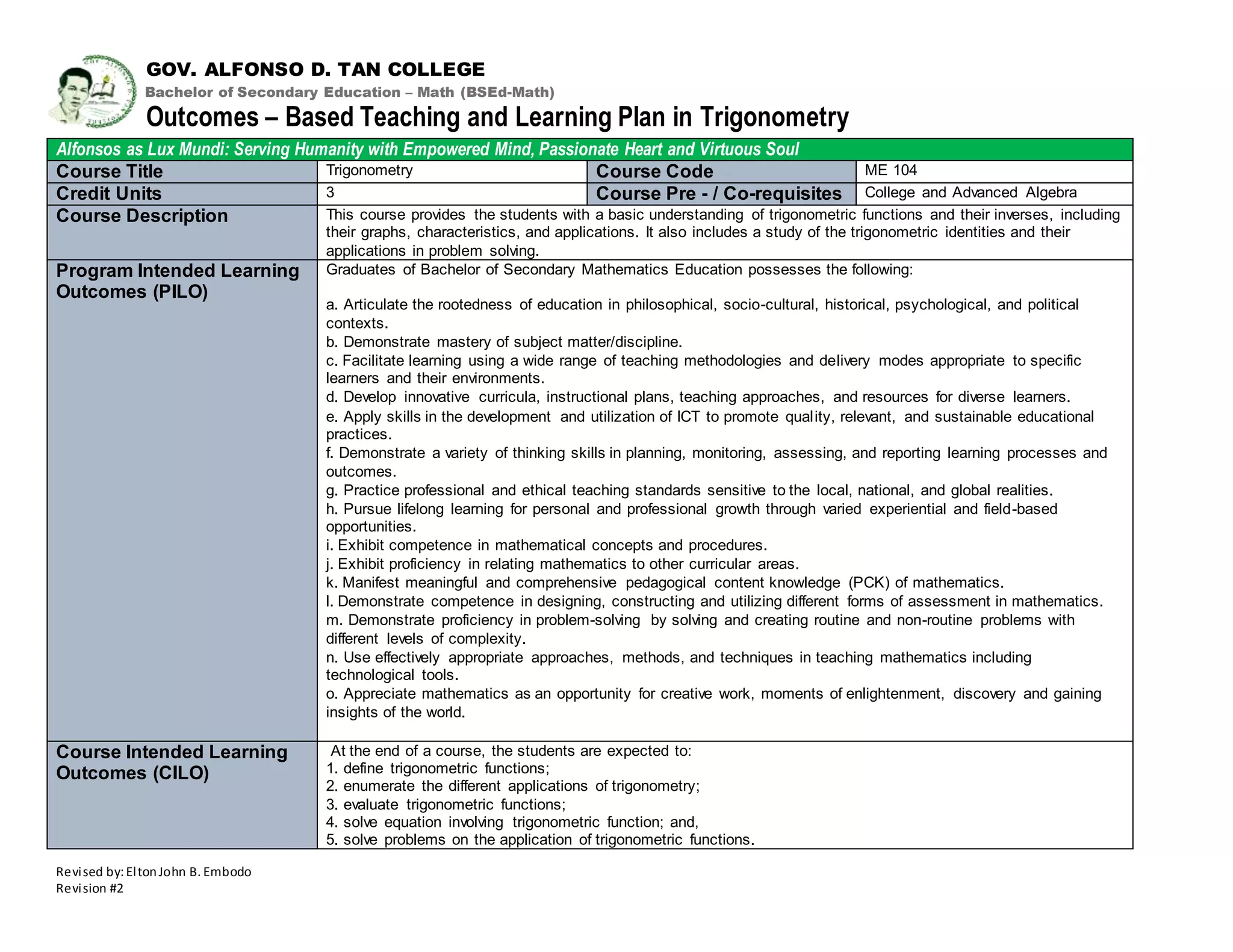
GOV. ALFONSO D. TAN COLLEGE
Bachelor of Secondary Education – Math (BSEd-Math)
Outcomes – Based Teaching and Learning Plan in Trigonometry
Alfonsos as Lux Mundi: Serving Humanity with Empowered Mind, Passionate Heart and Virtuous Soul
Course Title Trigonometry Course Code ME 104
Credit Units 3 Course Pre - / Co-requisites College and Advanced Algebra
Course Description This course provides the students with a basic understanding of trigonometric functions and their inverses, including
their graphs, characteristics, and applications. It also includes a study of the trigonometric identities and their
applications in problem solving.
Program Intended Learning
Outcomes (PILO)
Graduates of Bachelor of Secondary Mathematics Education possesses the following:
a. Articulate the rootedness of education in philosophical, socio-cultural, historical, psychological, and political
contexts.
b. Demonstrate mastery of subject matter/discipline.
c. Facilitate learning using a wide range of teaching methodologies and delivery modes appropriate to specific
learners and their environments.
d. Develop innovative curricula, instructional plans, teaching approaches, and resources for diverse learners.
e. Apply skills in the development and utilization of ICT to promote quality, relevant, and sustainable educational
practices.
f. Demonstrate a variety of thinking skills in planning, monitoring, assessing, and reporting learning processes and
outcomes.
g. Practice professional and ethical teaching standards sensitive to the local, national, and global realities.
h. Pursue lifelong learning for personal and professional growth through varied experiential and field-based
opportunities.
i. Exhibit competence in mathematical concepts and procedures.
j. Exhibit proficiency in relating mathematics to other curricular areas.
k. Manifest meaningful and comprehensive pedagogical content knowledge (PCK) of mathematics.
l. Demonstrate competence in designing, constructing and utilizing different forms of assessment in mathematics.
m. Demonstrate proficiency in problem-solving by solving and creating routine and non-routine problems with
different levels of complexity.
n. Use effectively appropriate approaches, methods, and techniques in teaching mathematics including
technological tools.
o. Appreciate mathematics as an opportunity for creative work, moments of enlightenment, discovery and gaining
insights of the world.
Course Intended Learning
Outcomes (CILO)
At the end of a course, the students are expected to:
1. define trigonometric functions;
2. enumerate the different applications of trigonometry;
3. evaluate trigonometric functions;
4. solve equation involving trigonometric function; and,
5. solve problems on the application of trigonometric functions.
Revised by:EltonJohn B. Embodo
Revision #2
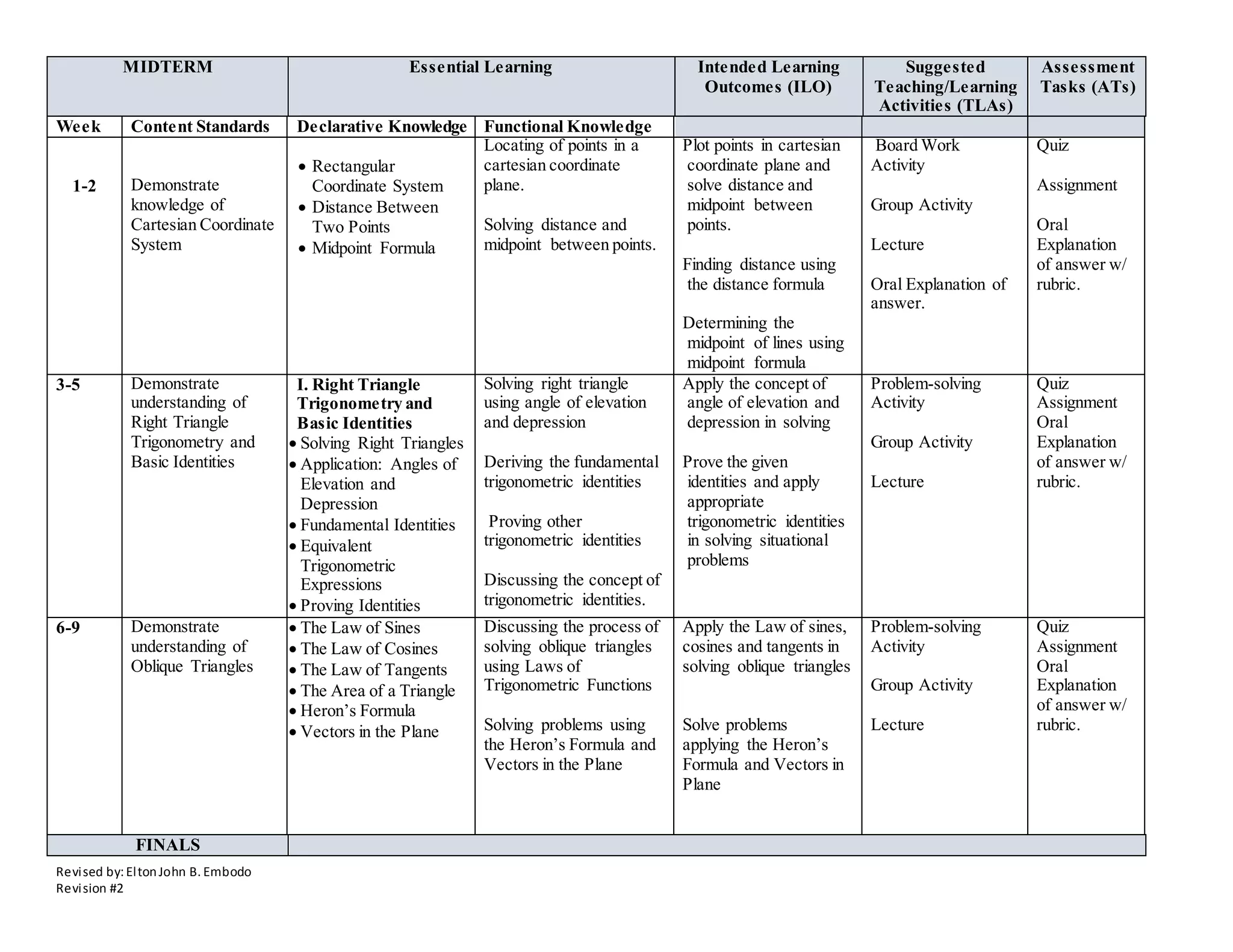
MIDTERM Essential Learning Intended Learning
Outcomes (ILO)
Suggested
Teaching/Learning
Activities (TLAs)
Assessment
Tasks (ATs)
Week Content Standards Declarative Knowledge Functional Knowledge
1-2 Demonstrate
knowledge of
Cartesian Coordinate
System
 Rectangular
Coordinate System
 Distance Between
Two Points
 Midpoint Formula
Locating of points in a
cartesian coordinate
plane.
Solving distance and
midpoint between points.
Plot points in cartesian
coordinate plane and
solve distance and
midpoint between
points.
Finding distance using
the distance formula
Determining the
midpoint of lines using
midpoint formula
Board Work
Activity
Group Activity
Lecture
Oral Explanation of
answer.
Quiz
Assignment
Oral
Explanation
of answer w/
rubric.
3-5 Demonstrate
understanding of
Right Triangle
Trigonometry and
Basic Identities
I. Right Triangle
Trigonometry and
Basic Identities
 Solving Right Triangles
 Application: Angles of
Elevation and
Depression
 Fundamental Identities
 Equivalent
Trigonometric
Expressions
 Proving Identities
Solving right triangle
using angle of elevation
and depression
Deriving the fundamental
trigonometric identities
Proving other
trigonometric identities
Discussing the concept of
trigonometric identities.
Apply the concept of
angle of elevation and
depression in solving
Prove the given
identities and apply
appropriate
trigonometric identities
in solving situational
problems
Problem-solving
Activity
Group Activity
Lecture
Quiz
Assignment
Oral
Explanation
of answer w/
rubric.
6-9 Demonstrate
understanding of
Oblique Triangles
 The Law of Sines
 The Law of Cosines
 The Law of Tangents
 The Area of a Triangle
 Heron’s Formula
 Vectors in the Plane
Discussing the process of
solving oblique triangles
using Laws of
Trigonometric Functions
Solving problems using
the Heron’s Formula and
Vectors in the Plane
Apply the Law of sines,
cosines and tangents in
solving oblique triangles
Solve problems
applying the Heron’s
Formula and Vectors in
Plane
Problem-solving
Activity
Group Activity
Lecture
Quiz
Assignment
Oral
Explanation
of answer w/
rubric.
FINALS
Revised by:EltonJohn B. Embodo
Revision #2
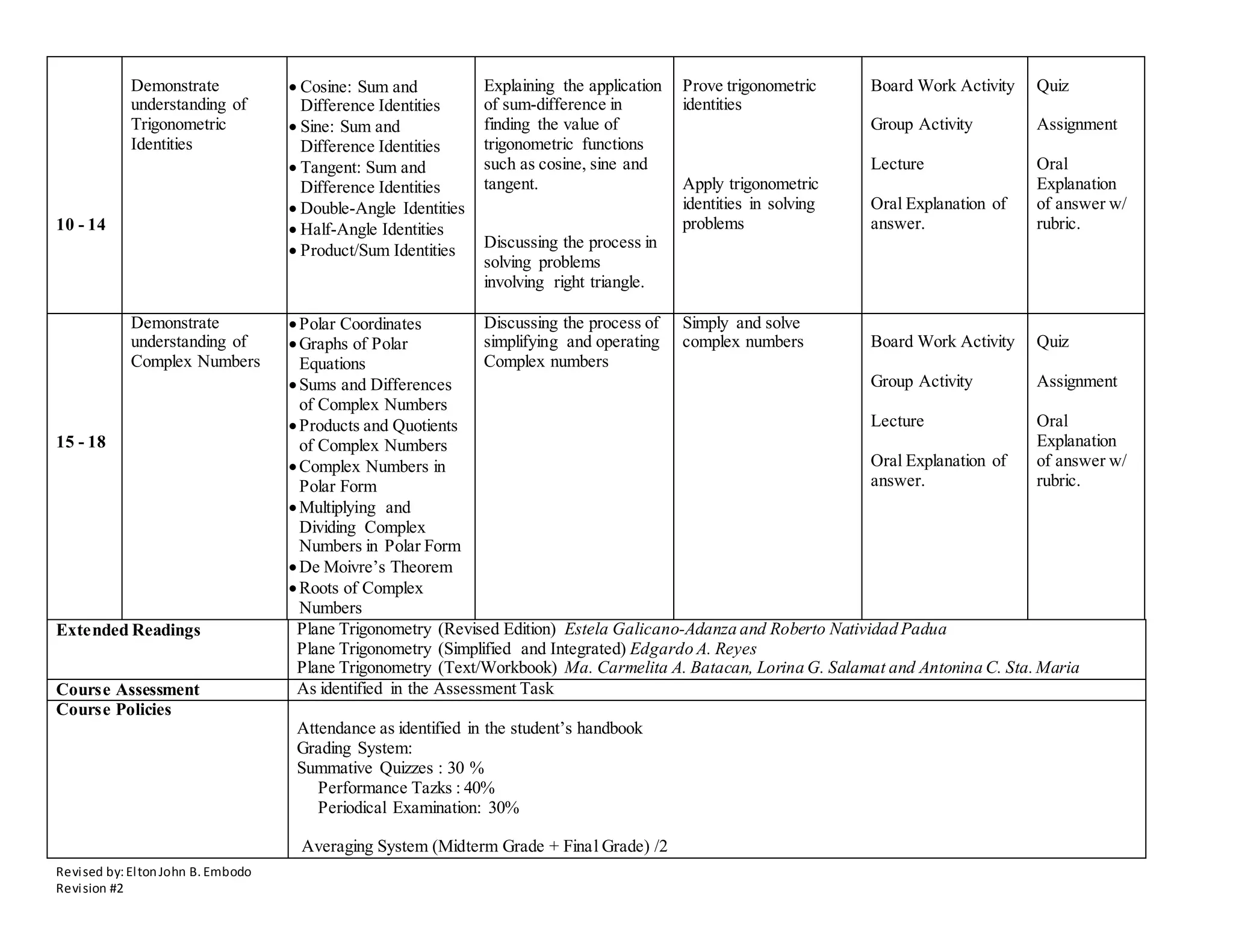
10 - 14
Demonstrate
understanding of
Trigonometric
Identities
 Cosine: Sum and
Difference Identities
 Sine: Sum and
Difference Identities
 Tangent: Sum and
Difference Identities
 Double-Angle Identities
 Half-Angle Identities
 Product/Sum Identities
Explaining the application
of sum-difference in
finding the value of
trigonometric functions
such as cosine, sine and
tangent.
Discussing the process in
solving problems
involving right triangle.
Prove trigonometric
identities
Apply trigonometric
identities in solving
problems
Board Work Activity
Group Activity
Lecture
Oral Explanation of
answer.
Quiz
Assignment
Oral
Explanation
of answer w/
rubric.
15 - 18
Demonstrate
understanding of
Complex Numbers
Polar Coordinates
Graphs of Polar
Equations
Sums and Differences
of Complex Numbers
Products and Quotients
of Complex Numbers
Complex Numbers in
Polar Form
Multiplying and
Dividing Complex
Numbers in Polar Form
De Moivre’s Theorem
Roots of Complex
Numbers
Discussing the process of
simplifying and operating
Complex numbers
Simply and solve
complex numbers Board Work Activity
Group Activity
Lecture
Oral Explanation of
answer.
Quiz
Assignment
Oral
Explanation
of answer w/
rubric.
Extended Readings Plane Trigonometry (Revised Edition) Estela Galicano-Adanza and Roberto Natividad Padua
Plane Trigonometry (Simplified and Integrated) Edgardo A. Reyes
Plane Trigonometry (Text/Workbook) Ma. Carmelita A. Batacan, Lorina G. Salamat and Antonina C. Sta.Maria
Course Assessment As identified in the Assessment Task
Course Policies
Attendance as identified in the student’s handbook
Grading System:
Summative Quizzes : 30 %
Performance Tazks : 40%
Periodical Examination: 30%
Averaging System (Midterm Grade + Final Grade) /2
Revised by:EltonJohn B. Embodo
Revision #2
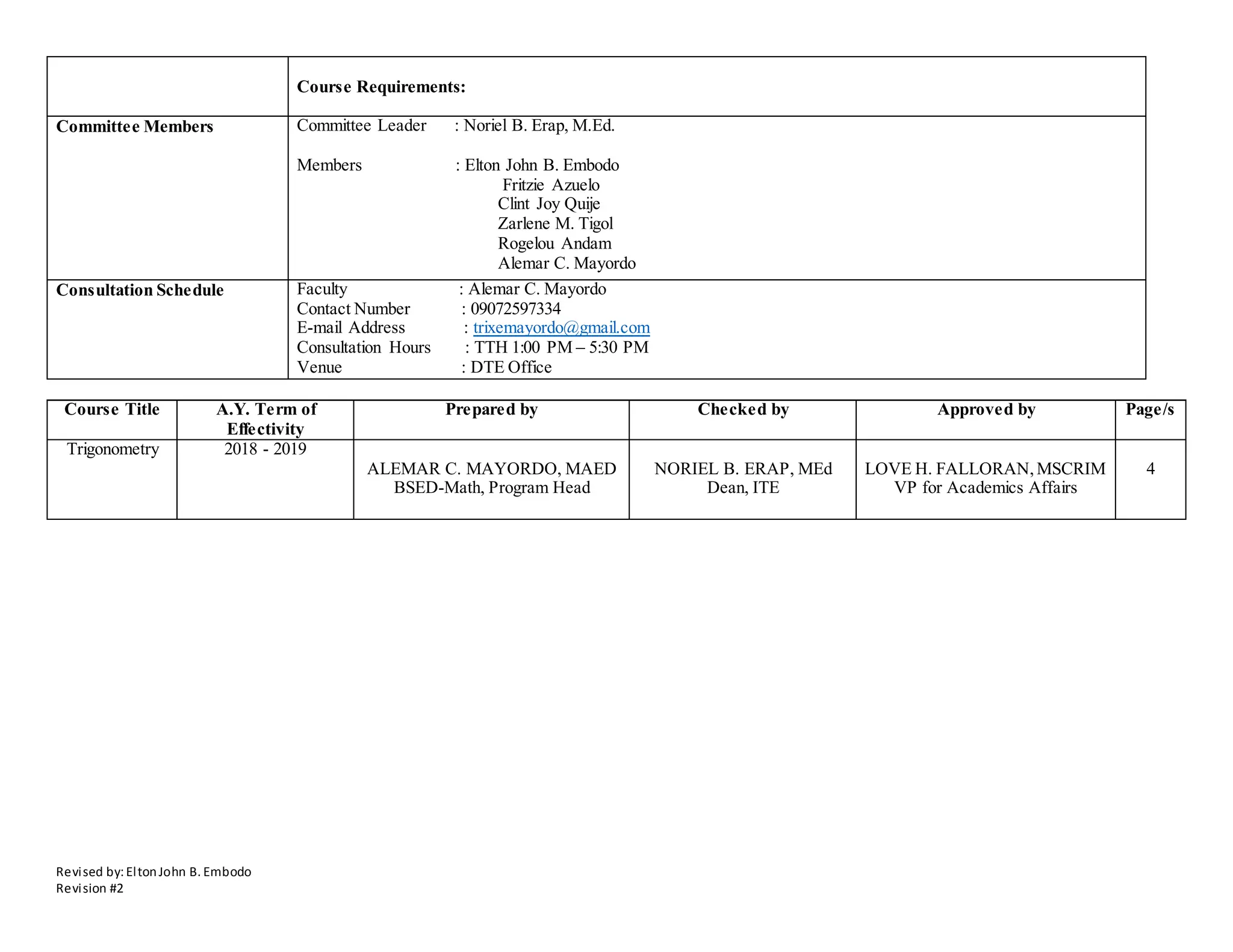
Course Requirements:
Committee Members Committee Leader : Noriel B. Erap, M.Ed.
Members : Elton John B. Embodo
Fritzie Azuelo
Clint Joy Quije
Zarlene M. Tigol
Rogelou Andam
Alemar C. Mayordo
Consultation Schedule Faculty : Alemar C. Mayordo
Contact Number : 09072597334
E-mail Address : trixemayordo@gmail.com
Consultation Hours : TTH 1:00 PM – 5:30 PM
Venue : DTE Office
Course Title A.Y. Term of
Effectivity
Prepared by Checked by Approved by Page/s
Trigonometry 2018 - 2019
ALEMAR C. MAYORDO, MAED
BSED-Math, Program Head
NORIEL B. ERAP, MEd
Dean, ITE
LOVE H. FALLORAN,MSCRIM
VP for Academics Affairs
4

Outcomes based teaching learning plan (obtlp) trigonometry

  • 1.
    Revised by:EltonJohn B.Embodo Revision #2 GOV. ALFONSO D. TAN COLLEGE Bachelor of Secondary Education – Math (BSEd-Math) Outcomes – Based Teaching and Learning Plan in Trigonometry Alfonsos as Lux Mundi: Serving Humanity with Empowered Mind, Passionate Heart and Virtuous Soul Course Title Trigonometry Course Code ME 104 Credit Units 3 Course Pre - / Co-requisites College and Advanced Algebra Course Description This course provides the students with a basic understanding of trigonometric functions and their inverses, including their graphs, characteristics, and applications. It also includes a study of the trigonometric identities and their applications in problem solving. Program Intended Learning Outcomes (PILO) Graduates of Bachelor of Secondary Mathematics Education possesses the following: a. Articulate the rootedness of education in philosophical, socio-cultural, historical, psychological, and political contexts. b. Demonstrate mastery of subject matter/discipline. c. Facilitate learning using a wide range of teaching methodologies and delivery modes appropriate to specific learners and their environments. d. Develop innovative curricula, instructional plans, teaching approaches, and resources for diverse learners. e. Apply skills in the development and utilization of ICT to promote quality, relevant, and sustainable educational practices. f. Demonstrate a variety of thinking skills in planning, monitoring, assessing, and reporting learning processes and outcomes. g. Practice professional and ethical teaching standards sensitive to the local, national, and global realities. h. Pursue lifelong learning for personal and professional growth through varied experiential and field-based opportunities. i. Exhibit competence in mathematical concepts and procedures. j. Exhibit proficiency in relating mathematics to other curricular areas. k. Manifest meaningful and comprehensive pedagogical content knowledge (PCK) of mathematics. l. Demonstrate competence in designing, constructing and utilizing different forms of assessment in mathematics. m. Demonstrate proficiency in problem-solving by solving and creating routine and non-routine problems with different levels of complexity. n. Use effectively appropriate approaches, methods, and techniques in teaching mathematics including technological tools. o. Appreciate mathematics as an opportunity for creative work, moments of enlightenment, discovery and gaining insights of the world. Course Intended Learning Outcomes (CILO) At the end of a course, the students are expected to: 1. define trigonometric functions; 2. enumerate the different applications of trigonometry; 3. evaluate trigonometric functions; 4. solve equation involving trigonometric function; and, 5. solve problems on the application of trigonometric functions.
  • 2.
    Revised by:EltonJohn B.Embodo Revision #2 MIDTERM Essential Learning Intended Learning Outcomes (ILO) Suggested Teaching/Learning Activities (TLAs) Assessment Tasks (ATs) Week Content Standards Declarative Knowledge Functional Knowledge 1-2 Demonstrate knowledge of Cartesian Coordinate System  Rectangular Coordinate System  Distance Between Two Points  Midpoint Formula Locating of points in a cartesian coordinate plane. Solving distance and midpoint between points. Plot points in cartesian coordinate plane and solve distance and midpoint between points. Finding distance using the distance formula Determining the midpoint of lines using midpoint formula Board Work Activity Group Activity Lecture Oral Explanation of answer. Quiz Assignment Oral Explanation of answer w/ rubric. 3-5 Demonstrate understanding of Right Triangle Trigonometry and Basic Identities I. Right Triangle Trigonometry and Basic Identities  Solving Right Triangles  Application: Angles of Elevation and Depression  Fundamental Identities  Equivalent Trigonometric Expressions  Proving Identities Solving right triangle using angle of elevation and depression Deriving the fundamental trigonometric identities Proving other trigonometric identities Discussing the concept of trigonometric identities. Apply the concept of angle of elevation and depression in solving Prove the given identities and apply appropriate trigonometric identities in solving situational problems Problem-solving Activity Group Activity Lecture Quiz Assignment Oral Explanation of answer w/ rubric. 6-9 Demonstrate understanding of Oblique Triangles  The Law of Sines  The Law of Cosines  The Law of Tangents  The Area of a Triangle  Heron’s Formula  Vectors in the Plane Discussing the process of solving oblique triangles using Laws of Trigonometric Functions Solving problems using the Heron’s Formula and Vectors in the Plane Apply the Law of sines, cosines and tangents in solving oblique triangles Solve problems applying the Heron’s Formula and Vectors in Plane Problem-solving Activity Group Activity Lecture Quiz Assignment Oral Explanation of answer w/ rubric. FINALS
  • 3.
    Revised by:EltonJohn B.Embodo Revision #2 10 - 14 Demonstrate understanding of Trigonometric Identities  Cosine: Sum and Difference Identities  Sine: Sum and Difference Identities  Tangent: Sum and Difference Identities  Double-Angle Identities  Half-Angle Identities  Product/Sum Identities Explaining the application of sum-difference in finding the value of trigonometric functions such as cosine, sine and tangent. Discussing the process in solving problems involving right triangle. Prove trigonometric identities Apply trigonometric identities in solving problems Board Work Activity Group Activity Lecture Oral Explanation of answer. Quiz Assignment Oral Explanation of answer w/ rubric. 15 - 18 Demonstrate understanding of Complex Numbers Polar Coordinates Graphs of Polar Equations Sums and Differences of Complex Numbers Products and Quotients of Complex Numbers Complex Numbers in Polar Form Multiplying and Dividing Complex Numbers in Polar Form De Moivre’s Theorem Roots of Complex Numbers Discussing the process of simplifying and operating Complex numbers Simply and solve complex numbers Board Work Activity Group Activity Lecture Oral Explanation of answer. Quiz Assignment Oral Explanation of answer w/ rubric. Extended Readings Plane Trigonometry (Revised Edition) Estela Galicano-Adanza and Roberto Natividad Padua Plane Trigonometry (Simplified and Integrated) Edgardo A. Reyes Plane Trigonometry (Text/Workbook) Ma. Carmelita A. Batacan, Lorina G. Salamat and Antonina C. Sta.Maria Course Assessment As identified in the Assessment Task Course Policies Attendance as identified in the student’s handbook Grading System: Summative Quizzes : 30 % Performance Tazks : 40% Periodical Examination: 30% Averaging System (Midterm Grade + Final Grade) /2
  • 4.
    Revised by:EltonJohn B.Embodo Revision #2 Course Requirements: Committee Members Committee Leader : Noriel B. Erap, M.Ed. Members : Elton John B. Embodo Fritzie Azuelo Clint Joy Quije Zarlene M. Tigol Rogelou Andam Alemar C. Mayordo Consultation Schedule Faculty : Alemar C. Mayordo Contact Number : 09072597334 E-mail Address : trixemayordo@gmail.com Consultation Hours : TTH 1:00 PM – 5:30 PM Venue : DTE Office Course Title A.Y. Term of Effectivity Prepared by Checked by Approved by Page/s Trigonometry 2018 - 2019 ALEMAR C. MAYORDO, MAED BSED-Math, Program Head NORIEL B. ERAP, MEd Dean, ITE LOVE H. FALLORAN,MSCRIM VP for Academics Affairs 4