American Journal of Multidisciplinary Research & Development (AJMRD)
Volume 06, Issue 09 (September - 2024), PP 63-75
ISSN: 2360-821X
www.ajmrd.com
Multidisciplinary Journal www.ajmrd.com Page | 63
ABSTRACT: Teaching while managing instructional workload is causal to the teaching-learning process. The
study determined the teachers' instructional workload management to the teachers’ teaching efficacy. It was
conducted in a community college in Tangub City, Misamis Occidental. The descriptive-correlational design was
used in the study. There were 15 program heads and 361 students who served as the respondents selected
through a stratified random sampling technique. The researcher-made Teachers’ Instructional Workload
Management and Teachers’ Teaching Efficacy Questionnaires were used as research instruments. Mean,
Standard Deviation, and Pearson Product-Moment Correlation Coefficient were used as statistical tools to
analyze the data gathered. Results revealed that the teachers were very good in their instructional workload
management. The teachers’ teaching efficacy was very high. Some aspects of the teachers’ instructional
workload management like the preparation of instructional materials influenced the teachers’ administration of
assessment tasks and classroom management. Their conduct of consultation also influenced the administration of
assessment tasks. Moreover, their submission of academic reports influenced the administration of assessment
tasks and school resource utilization. The workload management of teachers play a crucial role in shaping
teachers’ teaching efficacy. It is recommended for teachers to manage their workload proactively since it can
impact their teaching efficacy.
Keywords: efficacy, instruction, management, teaching, workload
Research Paper Open Access
TEACHERS' INSTRUCTIONAL WORKLOAD MANAGEMENT
AND ITS IMPACT ON TEACHING EFFICACY
Elton John B. Embodo1
, Haydee D. Villanueva2
1
Pangabuan Integrated School, Department of Education, Tangub City, Misamis Occidental, Philippines
2
Misamis University, Ozamis City, Misamis Occidental, Philippines
I. INTRODUCTION
The instructional workload includes curriculum design; lesson notes drafting, learners' interest
development in the curriculum, learner performance class management, and continuous assessments. Delegation of
administrative duties and periods on curriculum planning, implementation, and revision forms part of workload
management in instruction. The perception of quality in performing instructional tasks depends on the teachers'
professional knowledge, skills, specialization areas, and experiences (Ayeni & Amanekwe, 2018). Some teachers in
some schools are overloaded with their workload, which thus affects their performance in teaching (Clarin et al.,
2021).
Also, managing additional workload would affect the teachers' performance while teaching. Most of the
time, teachers had work stressors that affected workload management. When teachers manage their workload, they
also achieve better performance regarding teaching. Thus, the ability of teachers to manage their workload is a
contributory factor to their performance (Pagocag & Lumapenet, 2022). In contrast, the excessive workload placed
on teachers contributes to burnout, besides the poor performance of their teaching ability. Teacher burnout is due to
their demands, especially in workload, administration, and task confusion (Chan et al., 2021).
Further, the work of teachers would be compromised by administrative requirements, many school tasks,
and requests (Quirap, 2022). Therefore, the workload of teachers should be managed appropriately. First, they are
human beings who can feel anxious, unhappy, irritated, and bored when overworked, affecting their teaching
performance (Ayeni & Amanekwe, 2018). However, teachers can be organized and encouraged through appropriate
supervision and encouraging remarks, enhancing work performance (Andriani et al., 2018).
Teachers' workload is associated with teaching efficacy since it is difficult to incorporate effective
classroom teaching and learning. The overworked teachers negatively affect their teaching efficacy since this
condition gives them no time for lesson planning and task assessment. This, in turn, may negatively affect the
quality of teaching and learning (Dorji & Wangchuk, 2022).
TEACHERS' INSTRUCTIONAL WORKLOAD MANAGEMENT AND ITS IMPACT ON…
Multidisciplinary Journal www.ajmrd.com Page | 64
The second assurance of quality education is the efficacy of a teacher. Self-efficacy is the ability of an
individual to conduct a job or an act expected of them to accomplish a specific aim (Lauermann & Hagen, 2021).
For teachers, it means their belief in the confidence that they can change students' behaviors and performances in
their classrooms. The self-efficacy of teachers is a significant phenomenon and can be regarded as one factor
contributing to learning and effective teaching. Self-efficacy has significantly improved teaching effectiveness
(Nurindah et al., 2019). Lastly, teachers' sense of teaching efficacy significantly affects teaching methodologies,
passion, dedication, and performance, hence bringing about success amongst students (Barni et al., 2019).
However, low student performance may further be influenced by low teacher efficacy. In that regard,
teachers may feel more secure and satisfied in their jobs. They may even find an enhancement in general well-being
through increased self-efficacy in classroom management development (Shao, 2023). Conversely, sufficient
supervision may better inform the teachers with relatively low self-efficacy. Such supervision of teaching and
learning processes may make the teachers feel more effective. Therefore, low teaching efficacy is found to relate to
both teaching quality and student learning. Hence, such factors should not be excluded while evaluating a school's
performance Khun-Inkeeree et al. (2020).
Although there is substantial evidence that teachers play a core role in the provision of quality education
(Ampofo et al., 2019), there is limited understanding of how instructional management of teachers relates to
teaching efficacy. Therefore, a theoretical gap exists between instructional workload management and teaching
efficacy. This theoretical gap is important because quite often, overwhelming workloads are assigned to teachers
and may affect teaching performance (Chan et al., 2021). Addressing this theoretical gap could provide valuable
insights into the complex dynamics among workload management and teaching-efficacy, ultimately improving the
quality of education in schools and the well-being of educators.
A report showed that over 40 percent of the students surveyed reported that their teachers are sometimes or
often absent (Chi, 2023). One of the reasons why teachers sometimes may not be able to go to classes is due to the
workload assigned to them (Manuel et al., 2018). It was also mentioned among some education institutions in the
Philippines that teachers face workload pressures which affect teaching performance (Clarin et al., 2021). Other
teachers also delayed their submission of academic reports due to the existence of some other workloads that must
be finished first and because of the students' delayed submission of outputs (Agayon et al., 2022).
A community college in Tangub City, Misamis Occidental, submitted for accreditation. Apart from
accomplishing the deliverables for accreditation, they also had to perform their instructional workloads and
classroom instruction. The researcher deemed it crucial to investigate teachers' instructional workload in
determining teachers' teaching efficacy, as vital for ensuring the delivery of quality education to students.
II. THE THEORY OF CONCEPTUAL FIELDS (TCF)
Taylor’s (1911) Scientific Management Theory for Classical Management. This classic management
theory lies behind the management of teachers on the Instructional Workload. The fundamental aim behind this
theory's presentation of ideas is to make influential working people. This theory has looked at and integrated the
work practices of management and the workforce to achieve this aim (Nordin et al., 2019). This theory relies upon
three fundamental tenets: employee motivation, scientific management, and rewards (Nurhasanah, 2021).
Administrators will, therefore, understand this theory in relation to teachers' work through the stated principles of
time and movement to lower the teachers' workload and make them satisfied with their work. This theory can help
teachers become more productive in their tasks (Mosbiran et al., 2020).
In the quest for production or output, burdens can be circumvented, and job satisfaction can be realized if
management subscribes to the scientific management ways suggested under this theory (Mohamed et al., 2021).
Program heads must provide proportional rewards for teachers to be content in discharging their duties and with a
minimum workload to deliver (Aziz et al., 2021). Employees are sometimes unsatisfied with their jobs because
management is so absorbed with quality that it results in a pile of work (Mustafa et al., 2020). As shown in a study,
there is a need for supervision to exercise prudence in determining where an employee should be stationed, what
tasks are appropriate to be given to them, and how to best satisfy their demands (Norbin et al., 2021).
Although Taylor's Scientific Management Theory has been molded in the industrial context, some aspects
of these theories can be applied to the management tasks of teachers. Teachers, as agents of total development, can
take the lessons from scientific management to enhance efficiency, effectiveness, and the overall learning
experience for the students. Concerning time and motion studies, teachers must wisely manage time to cover the
curriculum and analyze the most effective methods for conveying information to the students (Stronge, 2018). For
process standardization, teachers need to standardize certain aspects of the teaching process, such as the criteria for
grading, assessing, and setting the classroom's routines (Shepard, 2019). For training and development, teachers also
TEACHERS' INSTRUCTIONAL WORKLOAD MANAGEMENT AND ITS IMPACT ON…
Multidisciplinary Journal www.ajmrd.com Page | 65
need continuous professional development to be updated on educational theories, technologies, and teaching
methods (Batanero et al., 2020). Incentives and motivation teachers play a motivational role in this very sense of
motivating students toward excellence in their academic and life skills (Barkley & Major, 2020). For efficiency and
productivity, teachers aim to maximize learning outcomes for their students. It includes the optimization of teaching
methods, adaptation to different learning styles, and effective using resources to enhance the educational experience
(Dwijayani, 2019).
Taylor's Scientific Management Theory is highly relevant to the study's instructional workload
management variable. Taylor's theory, premised on employee motivation, scientific management, and rewards
principles, provides a powerful construct for administrators, especially program heads, to maximize teachers'
productivity and job satisfaction. By focusing on the principles of time and motion, program heads could
strategically alleviate the teachers' workload, ensuring satisfaction with the assigned task. However, Taylor's insight
has been applied cautiously in the study on the part of program heads, who have been reminded to exercise
prudence and adopt a more nuanced supervisory strategy in consideration of the peculiar demands and
circumstances of individual teachers, thus making her theory relevant in effective instructional workload
management.
Social Cognitive Theory. The teaching efficacy of the teachers is also anchored in this Social Cognitive
Theory of Albert Bandura. It developed into the SCT in the year 1986 and purports that learning occurs in a social
environment with a dynamic relationship between the individual, environment, and behavior. Given more emphasis
are the social influence and external and internal social reinforcement of the SCT which sets it apart. SCT describes
how people learn and acquire behaviors as well as the social circumstances in which those behaviors are performed.
He defined self-efficacy as "the ability to perform specific tasks." Self-efficacy perception has a central role in the
causal structure of a cognitive social theory; self-efficacy perceptions affect people's capability either to cope with
change individually or collectively (Abdullah, 2019). Self-efficacy theory, and the broader social cognitive theory
within which self-efficacy is contained, thereby clearly supports a democratic ideal that posits all people to be
competent and capable of success, provided they have the opportunities and self-efficacy to fulfill their goals (Naz
et al., 2020).
Productivity in teaching by the teachers will be evidenced where the teacher has high beliefs in their ability
to teach since they will not be haunted by fear because failing will mean failure of the teacher's actions; therefore,
they work out of fear (Green, 2018). Among the most critical practical elements, researchers have pointed out as far
as teaching and learning is concerned are teachers' idea about their efficacy. Having self-efficacy is important for
teachers to know how to realize their purposes and tasks and how they solve educational problems (Barni et al.,
2019). Those teachers who have low self-efficacy avoid trying hard with complex tasks, perceive creative tasks and
situations as challenging, interpret everything negatively, and give up hope in their abilities. In contrast, high self-
efficacy teachers welcome complex tasks to be mastered, foster a more profound sense of interest in their work,
develop a strong commitment, and recover quickly from setbacks (Hussain, 2022).
III. METHODOLOGY
The used the descriptive-correlational design. Descriptive research seeks to collect data to test hypotheses
or to answer questions concerning the status of the subject of the study (Gay, 1992). The correlational research
design sought to ascertain relationships between two or more variables (Cherry, 2023). The design was considered
appropriate in determining the relationship of the teachers' instructional workload management to the teachers'
teaching efficacy.
The study was conducted in a local college in Tangub City, Misamis Occidental, Philippines. This
institution offers 16 programs, and each program head supervises faculty members who handle 24 units each. It has
233 faculty members, 99 of whom are part-time teachers from six institutes.
The first group of respondents consisted of 15 program heads of the institution as they rated the teachers’
instructional workload management. The program heads were selected based on the following criteria: 1) current
program heads serving the program for a complete semester in the institution, and 2) gave the consent to participate
in the study. Moreover, program heads who had just been installed in the Second Semester of 2023-2024 were not
included as study respondents. The last group of respondents were the students from each of the 16 programs. They
rated the teachers' teaching efficacy. To represent the sample size in this research study, 361 students were
determined based on the Raosoft online application used. Stratified random sampling was chosen to assure the
number of representations is to be proportionate to every program. It includes those students who enrolled in at least
18 units are considered as the respondents of the study.
A researcher-made questionnaire was used to determine the teachers’ instructional workload management.
TEACHERS' INSTRUCTIONAL WORKLOAD MANAGEMENT AND ITS IMPACT ON…
Multidisciplinary Journal www.ajmrd.com Page | 66
This questionnaire had four constructs: preparation of instructional materials, handling classes and monitoring of
students, conducting consultation, checking outputs and computing grades, and submission of academic reports,
with ten statements for each construct. The instrument had a total of forty statements. This underwent validation
from the experts in the field. A pilot test was also conducted to establish its reliability, with the program heads
rating the teachers who were not included as the study's respondents. The Cronbach's Alpha for the constructs:
preparation of instructional materials was 0.8463, handling classes and monitoring of students was 0.8612, the
conduct of consultation was 0.8511, checking of outputs and computing grades was 0.8688, submission of academic
reports was 0.8753. The questionnaire had excellent internal consistency and was considered reliable for use as a
research instrument.
This questionnaire for teaching efficacy was a researcher-made instrument. It was composed of four
constructs: attending classes and monitoring students, delivery of instruction, administration of assessment tasks,
school resource utilization, and classroom management. Each construct consisted of ten statements. This underwent
validation from experts in the field, as well as pilot testing to establish its reliability. It was administered to students
who were not included as the study's respondents. The Cronbach's Alpha for the constructs: delivery of instruction
was 0.9348, administration of assessment tasks was 0.9565, school resource utilization was 0.9316, and classroom
management was 0.9535. The questionnaire had excellent internal consistency and was considered reliable for use
as the research instrument.
IV. OBJECTIVES OF THE STUDY
The study determined the relationship of the teachers' instructional workload management to the teachers’
teaching efficacy. It was conducted in a local college in Tangub City, Misamis Occidental. The study sought to
answer the following research questions:
1. What is the level of teachers’ instructional workload management in terms preparing instructional
materials, handling classes and monitoring students, conducting consultation, checking outputs and
computing grades, and submitting academic reports?
2. What is the level of teachers’ teaching efficacy in terms of delivery of instruction, administration of
assessment tasks, school resource utilization, and classroom management?
3. Is there a significant relationship between the teachers’ instructional workload management and their
teaching efficacy?
V. RESULTS AND DISCUSSIONS
Level of the Teachers’ Instructional Workload Management
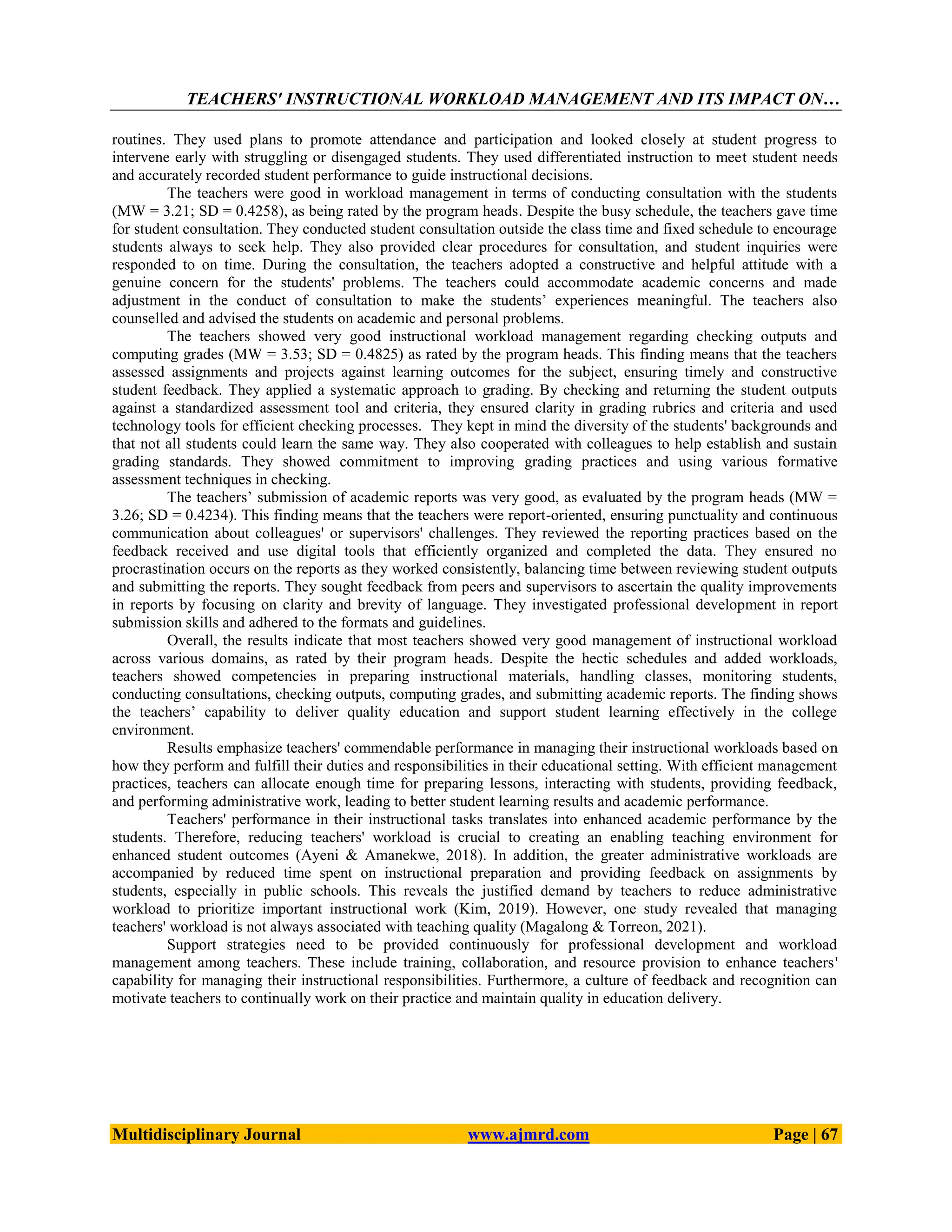
Table 1 shows the level of the teachers’ instructional workload management. It shows the very good level
of the teachers’ workload management as assessed by their respective program heads (WM = 3.32; SD = 0.1343). In
all the constructs of instructional workload, the teachers showed very good workload management except for one,
which was the conduct of consultations with the students. The result implies that teachers, as assessed by their
program heads, could prepare instructional materials for the lessons, handle classes, monitor students, conduct
consultations, check outputs, compute grades, and submit academic reports despite the hectic schedules in the
college. Furthermore, they could perform their routine tasks despite sudden additional workloads.
Besides delivering lessons to the students, teachers also manage instructional workload. If teachers
efficiently manage their instructional workloads, they may have enough time to study and prepare for daily lessons.
This way, they can provide quality learning among the students. Their very good management of instructional
workload can help them teach the students more effectively and help improve their academic performance.
The level of the teachers’ instructional workload management in terms of the preparation of instructional
materials was very good (WM = 3.32; SD = 0.3558), as assessed by their program heads. This finding suggests that
teachers crafted the syllabi according to course descriptions, learning outcomes, and other requirements, using
modern print and non-print materials to supplement the instructional content. They organized materials logically,
met deadlines, followed institutional policies, and created supplementary materials such as handouts to aid student
learning. They also prepared the materials to suit diverse learning styles, updated instruction content with the latest
research and real-life examples, included multimedia elements, and ensured accessibility in a digital and printable
format.
The teachers exhibited very good management regarding handling classes and monitoring students (MW =
3.36; SD = 0.4343), as perceived by their program heads perceived. This finding shows that the teachers maintained
very good attendance and punctuality and notified students in advance regarding their absence. They effectively
handled classroom activities to meet course requirements and promote engagement with clear expectations and
TEACHERS' INSTRUCTIONAL WORKLOAD MANAGEMENT AND ITS IMPACT ON…
Multidisciplinary Journal www.ajmrd.com Page | 67
routines. They used plans to promote attendance and participation and looked closely at student progress to
intervene early with struggling or disengaged students. They used differentiated instruction to meet student needs
and accurately recorded student performance to guide instructional decisions.
The teachers were good in workload management in terms of conducting consultation with the students
(MW = 3.21; SD = 0.4258), as being rated by the program heads. Despite the busy schedule, the teachers gave time
for student consultation. They conducted student consultation outside the class time and fixed schedule to encourage
students always to seek help. They also provided clear procedures for consultation, and student inquiries were
responded to on time. During the consultation, the teachers adopted a constructive and helpful attitude with a
genuine concern for the students' problems. The teachers could accommodate academic concerns and made
adjustment in the conduct of consultation to make the students’ experiences meaningful. The teachers also
counselled and advised the students on academic and personal problems.
The teachers showed very good instructional workload management regarding checking outputs and
computing grades (MW = 3.53; SD = 0.4825) as rated by the program heads. This finding means that the teachers
assessed assignments and projects against learning outcomes for the subject, ensuring timely and constructive
student feedback. They applied a systematic approach to grading. By checking and returning the student outputs
against a standardized assessment tool and criteria, they ensured clarity in grading rubrics and criteria and used
technology tools for efficient checking processes. They kept in mind the diversity of the students' backgrounds and
that not all students could learn the same way. They also cooperated with colleagues to help establish and sustain
grading standards. They showed commitment to improving grading practices and using various formative
assessment techniques in checking.
The teachers’ submission of academic reports was very good, as evaluated by the program heads (MW =
3.26; SD = 0.4234). This finding means that the teachers were report-oriented, ensuring punctuality and continuous
communication about colleagues' or supervisors' challenges. They reviewed the reporting practices based on the
feedback received and use digital tools that efficiently organized and completed the data. They ensured no
procrastination occurs on the reports as they worked consistently, balancing time between reviewing student outputs
and submitting the reports. They sought feedback from peers and supervisors to ascertain the quality improvements
in reports by focusing on clarity and brevity of language. They investigated professional development in report
submission skills and adhered to the formats and guidelines.
Overall, the results indicate that most teachers showed very good management of instructional workload
across various domains, as rated by their program heads. Despite the hectic schedules and added workloads,
teachers showed competencies in preparing instructional materials, handling classes, monitoring students,
conducting consultations, checking outputs, computing grades, and submitting academic reports. The finding shows
the teachers’ capability to deliver quality education and support student learning effectively in the college
environment.
Results emphasize teachers' commendable performance in managing their instructional workloads based on
how they perform and fulfill their duties and responsibilities in their educational setting. With efficient management
practices, teachers can allocate enough time for preparing lessons, interacting with students, providing feedback,
and performing administrative work, leading to better student learning results and academic performance.
Teachers' performance in their instructional tasks translates into enhanced academic performance by the
students. Therefore, reducing teachers' workload is crucial to creating an enabling teaching environment for
enhanced student outcomes (Ayeni & Amanekwe, 2018). In addition, the greater administrative workloads are
accompanied by reduced time spent on instructional preparation and providing feedback on assignments by
students, especially in public schools. This reveals the justified demand by teachers to reduce administrative
workload to prioritize important instructional work (Kim, 2019). However, one study revealed that managing
teachers' workload is not always associated with teaching quality (Magalong & Torreon, 2021).
Support strategies need to be provided continuously for professional development and workload
management among teachers. These include training, collaboration, and resource provision to enhance teachers'
capability for managing their instructional responsibilities. Furthermore, a culture of feedback and recognition can
motivate teachers to continually work on their practice and maintain quality in education delivery.
TEACHERS' INSTRUCTIONAL WORKLOAD MANAGEMENT AND ITS IMPACT ON…
Multidisciplinary Journal www.ajmrd.com Page | 68
Table 1
Level of the Teachers’ Instructional Workload Management
Instructional Workloads WM StDev Interpretation
Preparation of Instructional Materials
Handling Classes and Monitoring of Students
Conduct of Consultation
Checking Outputs and Computing Grades
Submission of Academic Reports
3.32
3.36
3.21
3.53
3.26
0.3558
0.4343
0.4258
0.4825
0.4234
Very Good
Very Good
Good
Very Good
Very Good
Overall Weighted Mean 3.32 0.1343 Very Good
Legend: 3.26-4.00 – Very Good (VG); 2.51-3.25 – Good (G);1.76-2.50 – Poor (P);1.00-1.75 – Very Poor (VP)
Level of the Teachers’ Teaching Efficacy
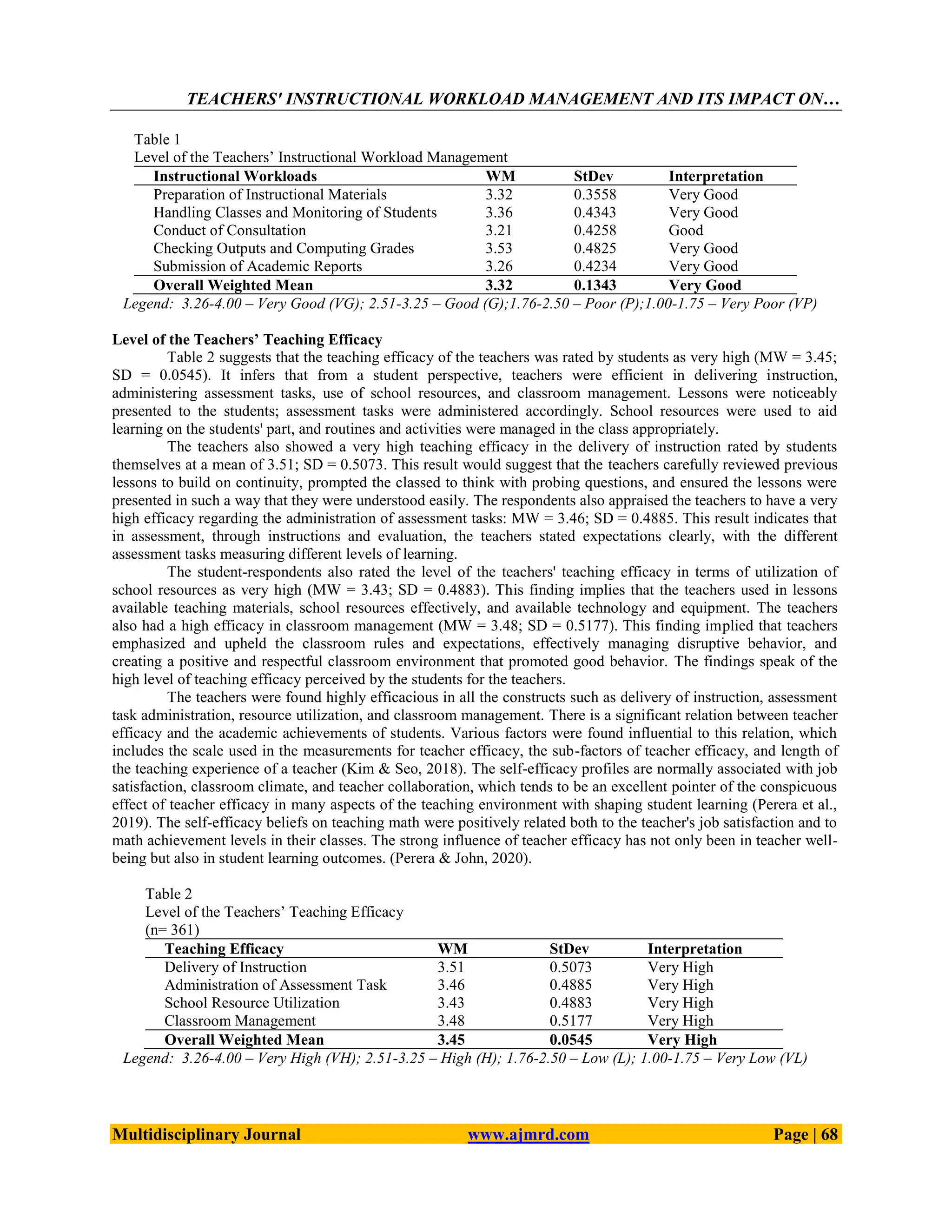
Table 2 suggests that the teaching efficacy of the teachers was rated by students as very high (MW = 3.45;
SD = 0.0545). It infers that from a student perspective, teachers were efficient in delivering instruction,
administering assessment tasks, use of school resources, and classroom management. Lessons were noticeably
presented to the students; assessment tasks were administered accordingly. School resources were used to aid
learning on the students' part, and routines and activities were managed in the class appropriately.
The teachers also showed a very high teaching efficacy in the delivery of instruction rated by students
themselves at a mean of 3.51; SD = 0.5073. This result would suggest that the teachers carefully reviewed previous
lessons to build on continuity, prompted the classed to think with probing questions, and ensured the lessons were
presented in such a way that they were understood easily. The respondents also appraised the teachers to have a very
high efficacy regarding the administration of assessment tasks: MW = 3.46; SD = 0.4885. This result indicates that
in assessment, through instructions and evaluation, the teachers stated expectations clearly, with the different
assessment tasks measuring different levels of learning.
The student-respondents also rated the level of the teachers' teaching efficacy in terms of utilization of
school resources as very high (MW = 3.43; SD = 0.4883). This finding implies that the teachers used in lessons
available teaching materials, school resources effectively, and available technology and equipment. The teachers
also had a high efficacy in classroom management (MW = 3.48; SD = 0.5177). This finding implied that teachers
emphasized and upheld the classroom rules and expectations, effectively managing disruptive behavior, and
creating a positive and respectful classroom environment that promoted good behavior. The findings speak of the
high level of teaching efficacy perceived by the students for the teachers.
The teachers were found highly efficacious in all the constructs such as delivery of instruction, assessment
task administration, resource utilization, and classroom management. There is a significant relation between teacher
efficacy and the academic achievements of students. Various factors were found influential to this relation, which
includes the scale used in the measurements for teacher efficacy, the sub-factors of teacher efficacy, and length of
the teaching experience of a teacher (Kim & Seo, 2018). The self-efficacy profiles are normally associated with job
satisfaction, classroom climate, and teacher collaboration, which tends to be an excellent pointer of the conspicuous
effect of teacher efficacy in many aspects of the teaching environment with shaping student learning (Perera et al.,
2019). The self-efficacy beliefs on teaching math were positively related both to the teacher's job satisfaction and to
math achievement levels in their classes. The strong influence of teacher efficacy has not only been in teacher well-
being but also in student learning outcomes. (Perera & John, 2020).
Table 2
Level of the Teachers’ Teaching Efficacy
(n= 361)
Teaching Efficacy WM StDev Interpretation
Delivery of Instruction
Administration of Assessment Task
School Resource Utilization
Classroom Management
3.51
3.46
3.43
3.48
0.5073
0.4885
0.4883
0.5177
Very High
Very High
Very High
Very High
Overall Weighted Mean 3.45 0.0545 Very High
Legend: 3.26-4.00 – Very High (VH); 2.51-3.25 – High (H); 1.76-2.50 – Low (L); 1.00-1.75 – Very Low (VL)
TEACHERS' INSTRUCTIONAL WORKLOAD MANAGEMENT AND ITS IMPACT ON…
Multidisciplinary Journal www.ajmrd.com Page | 69
Significant Relationship between the Teachers’ Instructional Workload Management and the Teachers’
Teaching Efficacy
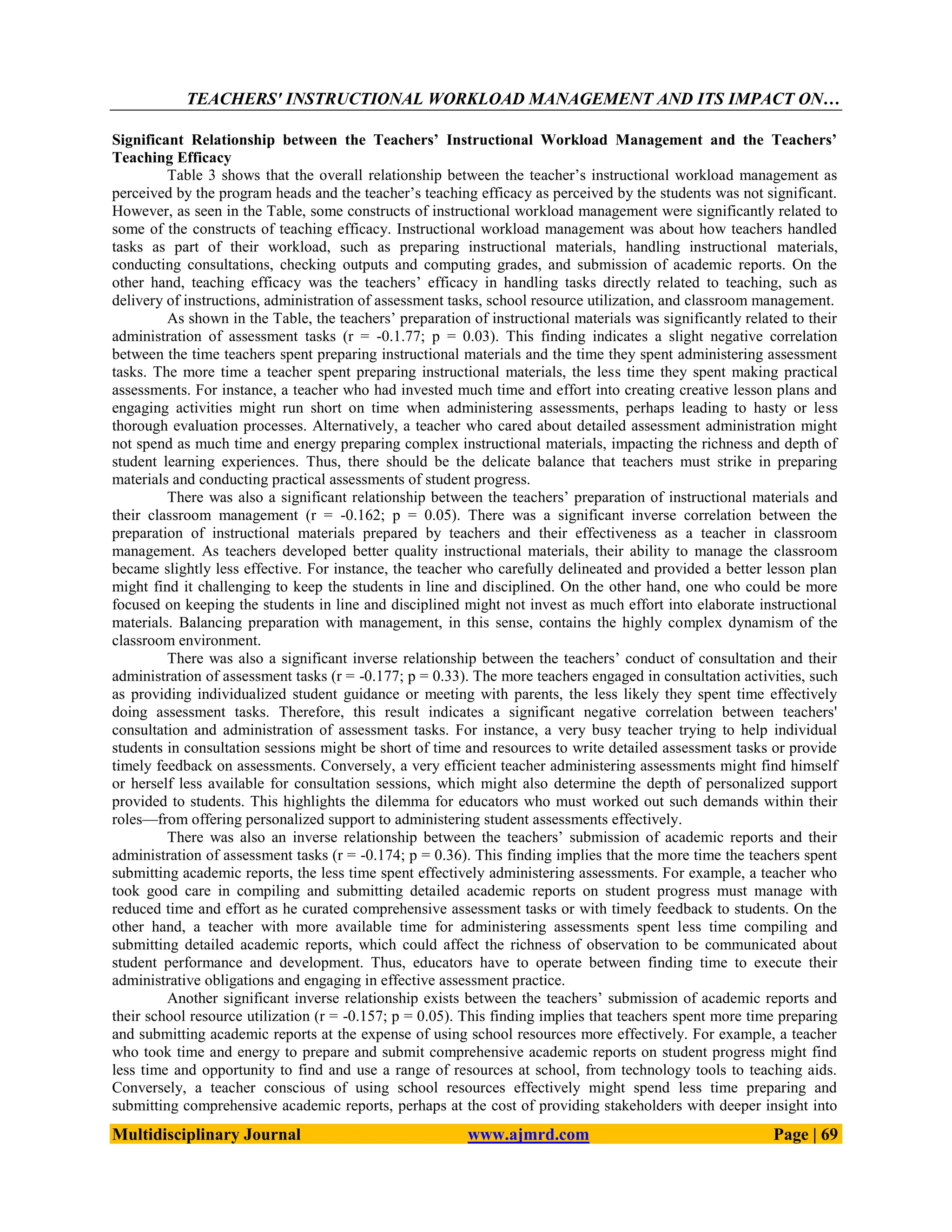
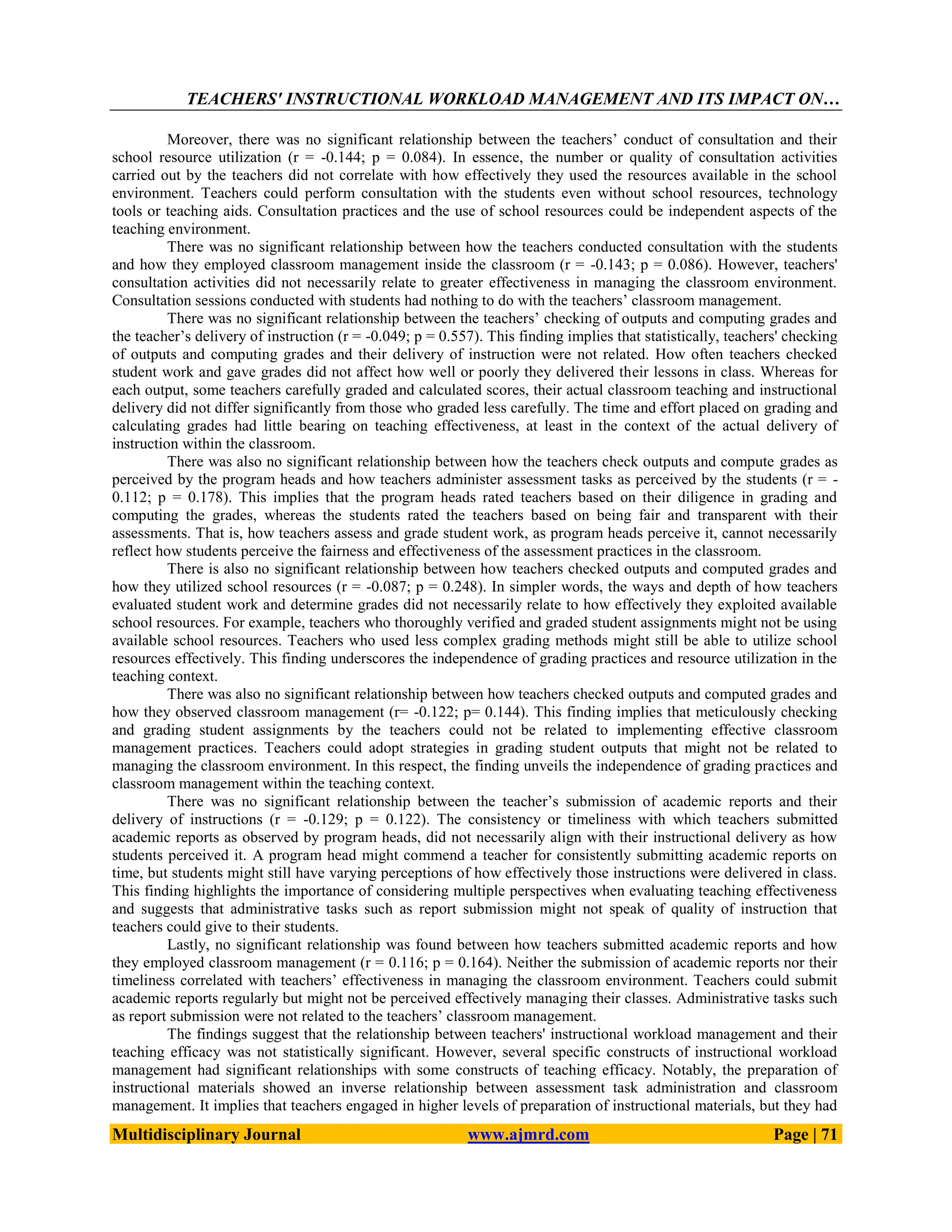
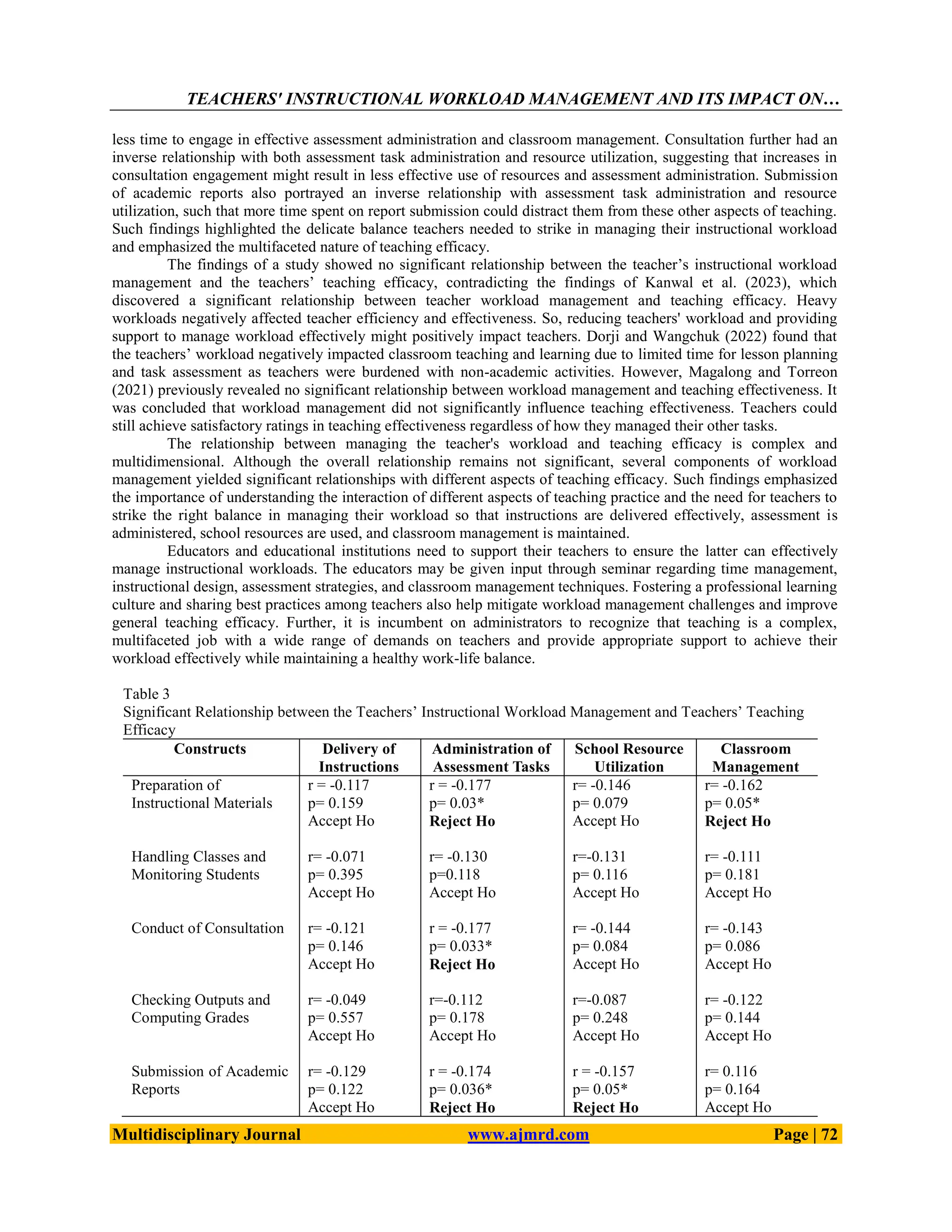
Table 3 shows that the overall relationship between the teacher’s instructional workload management as
perceived by the program heads and the teacher’s teaching efficacy as perceived by the students was not significant.
However, as seen in the Table, some constructs of instructional workload management were significantly related to
some of the constructs of teaching efficacy. Instructional workload management was about how teachers handled
tasks as part of their workload, such as preparing instructional materials, handling instructional materials,
conducting consultations, checking outputs and computing grades, and submission of academic reports. On the
other hand, teaching efficacy was the teachers’ efficacy in handling tasks directly related to teaching, such as
delivery of instructions, administration of assessment tasks, school resource utilization, and classroom management.
As shown in the Table, the teachers’ preparation of instructional materials was significantly related to their
administration of assessment tasks (r = -0.1.77; p = 0.03). This finding indicates a slight negative correlation
between the time teachers spent preparing instructional materials and the time they spent administering assessment
tasks. The more time a teacher spent preparing instructional materials, the less time they spent making practical
assessments. For instance, a teacher who had invested much time and effort into creating creative lesson plans and
engaging activities might run short on time when administering assessments, perhaps leading to hasty or less
thorough evaluation processes. Alternatively, a teacher who cared about detailed assessment administration might
not spend as much time and energy preparing complex instructional materials, impacting the richness and depth of
student learning experiences. Thus, there should be the delicate balance that teachers must strike in preparing
materials and conducting practical assessments of student progress.
There was also a significant relationship between the teachers’ preparation of instructional materials and
their classroom management (r = -0.162; p = 0.05). There was a significant inverse correlation between the
preparation of instructional materials prepared by teachers and their effectiveness as a teacher in classroom
management. As teachers developed better quality instructional materials, their ability to manage the classroom
became slightly less effective. For instance, the teacher who carefully delineated and provided a better lesson plan
might find it challenging to keep the students in line and disciplined. On the other hand, one who could be more
focused on keeping the students in line and disciplined might not invest as much effort into elaborate instructional
materials. Balancing preparation with management, in this sense, contains the highly complex dynamism of the
classroom environment.
There was also a significant inverse relationship between the teachers’ conduct of consultation and their
administration of assessment tasks (r = -0.177; p = 0.33). The more teachers engaged in consultation activities, such
as providing individualized student guidance or meeting with parents, the less likely they spent time effectively
doing assessment tasks. Therefore, this result indicates a significant negative correlation between teachers'
consultation and administration of assessment tasks. For instance, a very busy teacher trying to help individual
students in consultation sessions might be short of time and resources to write detailed assessment tasks or provide
timely feedback on assessments. Conversely, a very efficient teacher administering assessments might find himself
or herself less available for consultation sessions, which might also determine the depth of personalized support
provided to students. This highlights the dilemma for educators who must worked out such demands within their
roles—from offering personalized support to administering student assessments effectively.
There was also an inverse relationship between the teachers’ submission of academic reports and their
administration of assessment tasks (r = -0.174; p = 0.36). This finding implies that the more time the teachers spent
submitting academic reports, the less time spent effectively administering assessments. For example, a teacher who
took good care in compiling and submitting detailed academic reports on student progress must manage with
reduced time and effort as he curated comprehensive assessment tasks or with timely feedback to students. On the
other hand, a teacher with more available time for administering assessments spent less time compiling and
submitting detailed academic reports, which could affect the richness of observation to be communicated about
student performance and development. Thus, educators have to operate between finding time to execute their
administrative obligations and engaging in effective assessment practice.
Another significant inverse relationship exists between the teachers’ submission of academic reports and
their school resource utilization (r = -0.157; p = 0.05). This finding implies that teachers spent more time preparing
and submitting academic reports at the expense of using school resources more effectively. For example, a teacher
who took time and energy to prepare and submit comprehensive academic reports on student progress might find
less time and opportunity to find and use a range of resources at school, from technology tools to teaching aids.
Conversely, a teacher conscious of using school resources effectively might spend less time preparing and
submitting comprehensive academic reports, perhaps at the cost of providing stakeholders with deeper insight into
TEACHERS' INSTRUCTIONAL WORKLOAD MANAGEMENT AND ITS IMPACT ON…
Multidisciplinary Journal www.ajmrd.com Page | 70
student performance. Educators face then the challenge of balancing administrative demands against effectively
using available resources to improve teaching and learning.
Meanwhile, there was no significant relationship between the teachers’ preparation of instructional
materials and the teachers’ delivery of instruction (r = -0.117; p = 0.159). This finding means that the quality and
detail of instructional material could not necessarily translate into effective delivery of instructions in classrooms. A
teacher might have elaborated lesson plans and materials but might not deliver classroom instructions that could be
engaging to the students. In contrast, a teacher might have less elaborate instructional material but good presentation
skills, the delivery of instructions could still be effective. This finding underlines the complexity of teaching and the
many factors that make instruction effective beyond the preparation.
There was no significant relationship between the teachers’ preparation of instructional materials and the
teacher’s school resource utilization (r = -0.146; p = 0.079). This finding implies that program heads might admire
how well-prepared and well-structured a teacher's instructional material could be. However, the students might still
perceive the delivery of such instructions as boring or difficult. Conversely, a teacher who received lower ratings
from the program heads on the quality of instructional material might still be able to inspire and communicate
instructions to them in ways that align well with the students. This result points to the need to consider various
perspectives when evaluating teaching effectiveness and the fact that perceptions of preparation might not
necessarily correspond to perceptions of instructional delivery.
There was no significant relationship between the teachers’ handling of classes and monitoring of students
and the teachers’ delivery of instructions (r = -0.071; p = 0.395). Generally, how the teacher handled the class and
monitors students did not necessarily mean effective instruction in the classroom. For instance, the teachers could be
strict in handling classes and monitoring students, yet he might still struggle to teach the students in ensuring they
understood well the lessons. On the other hand, a teacher could have a calm approach to how he handled the
students but still could deliver instruction effectively to the students. These results might be influenced by the
teachers’ classroom management style, lesson mastery, and practical teaching strategy mastery.
There was no significant relationship between how teachers handled classes and monitored students and
how they administered assessment tasks (r = -0.130; p = 0.118). This finding implies that a program head might
take not of the teacher managing the classroom well and monitored the students’ behavior. However, the students
might not find the assessment task as transparent or fair. In contrast, a teacher might not be good concerning
classroom management, but the students might the teacher noteworthy in administering the assessments. Thus,
assessment in terms of practice should encompass the multiple perspectives stakeholders may give when evaluating
the teachers’ teaching practice. In this study, there was the seeming disparity of how the program heads perceived
the teachers regarding classroom management and how the students perceived the latter.
There was no significant relationship between how the teachers handled classes or monitored students and
how they utilized school resources (r = -0.131; p = 116). This finding means that classroom management and
student supervision did not necessarily translate to resource utilization, as observed within the school environment.
For instance, a teacher who could be strict in managing the classroom and closely monitoring the students' behavior
might or might not be more likely to utilize school resources like technology tools or teaching aids. Likewise, a
teacher who could be relatively lax in classroom management might be different in terms of resource utilization.
This result shows that resource utilization and classroom management were independent, and that resource
utilization was subject to other influences besides classroom management.
There was also no significant relationship between how the teachers handled classes and monitored
students and how the teachers employed classroom management (r = -0.111; p = 0.181). This finding implies that
the program head believed the teachers handling the classes and monitoring students very well based on the ratings
given to the teachers during classroom observations. However, the students perceived the teachers’ classroom
management as poorly carried out or ineffective during daily or usual class discussions. This finding underscores
the importance of considering multiple viewpoints when evaluating teaching practices and suggests that perceptions
of classroom management might differ between administrators and students.
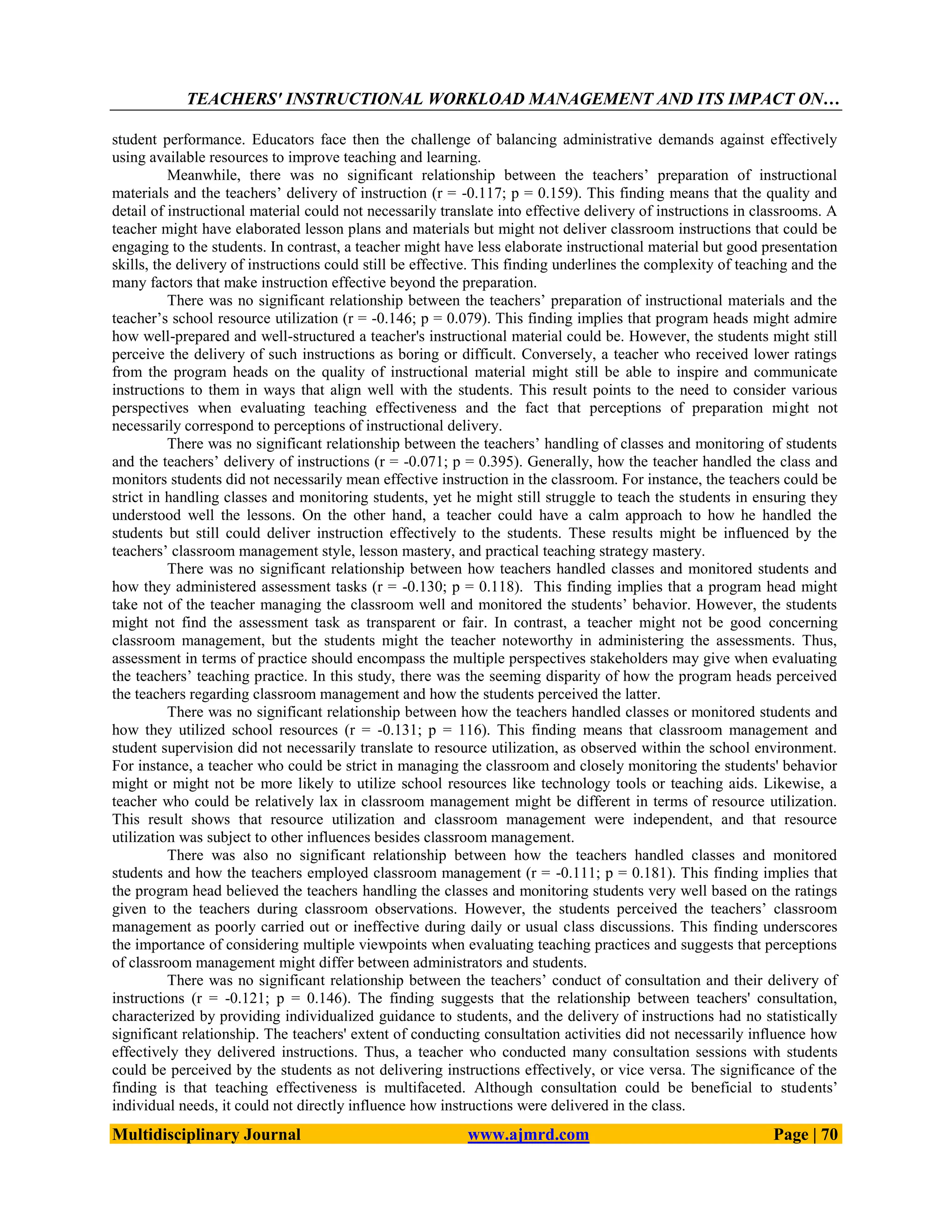
There was no significant relationship between the teachers’ conduct of consultation and their delivery of
instructions (r = -0.121; p = 0.146). The finding suggests that the relationship between teachers' consultation,
characterized by providing individualized guidance to students, and the delivery of instructions had no statistically
significant relationship. The teachers' extent of conducting consultation activities did not necessarily influence how
effectively they delivered instructions. Thus, a teacher who conducted many consultation sessions with students
could be perceived by the students as not delivering instructions effectively, or vice versa. The significance of the
finding is that teaching effectiveness is multifaceted. Although consultation could be beneficial to students’
individual needs, it could not directly influence how instructions were delivered in the class.
TEACHERS' INSTRUCTIONAL WORKLOAD MANAGEMENT AND ITS IMPACT ON…
Multidisciplinary Journal www.ajmrd.com Page | 71
Moreover, there was no significant relationship between the teachers’ conduct of consultation and their
school resource utilization (r = -0.144; p = 0.084). In essence, the number or quality of consultation activities
carried out by the teachers did not correlate with how effectively they used the resources available in the school
environment. Teachers could perform consultation with the students even without school resources, technology
tools or teaching aids. Consultation practices and the use of school resources could be independent aspects of the
teaching environment.
There was no significant relationship between how the teachers conducted consultation with the students
and how they employed classroom management inside the classroom (r = -0.143; p = 0.086). However, teachers'
consultation activities did not necessarily relate to greater effectiveness in managing the classroom environment.
Consultation sessions conducted with students had nothing to do with the teachers’ classroom management.
There was no significant relationship between the teachers’ checking of outputs and computing grades and
the teacher’s delivery of instruction (r = -0.049; p = 0.557). This finding implies that statistically, teachers' checking
of outputs and computing grades and their delivery of instruction were not related. How often teachers checked
student work and gave grades did not affect how well or poorly they delivered their lessons in class. Whereas for
each output, some teachers carefully graded and calculated scores, their actual classroom teaching and instructional
delivery did not differ significantly from those who graded less carefully. The time and effort placed on grading and
calculating grades had little bearing on teaching effectiveness, at least in the context of the actual delivery of
instruction within the classroom.
There was also no significant relationship between how the teachers check outputs and compute grades as
perceived by the program heads and how teachers administer assessment tasks as perceived by the students (r = -
0.112; p = 0.178). This implies that the program heads rated teachers based on their diligence in grading and
computing the grades, whereas the students rated the teachers based on being fair and transparent with their
assessments. That is, how teachers assess and grade student work, as program heads perceive it, cannot necessarily
reflect how students perceive the fairness and effectiveness of the assessment practices in the classroom.
There is also no significant relationship between how teachers checked outputs and computed grades and
how they utilized school resources (r = -0.087; p = 0.248). In simpler words, the ways and depth of how teachers
evaluated student work and determine grades did not necessarily relate to how effectively they exploited available
school resources. For example, teachers who thoroughly verified and graded student assignments might not be using
available school resources. Teachers who used less complex grading methods might still be able to utilize school
resources effectively. This finding underscores the independence of grading practices and resource utilization in the
teaching context.
There was also no significant relationship between how teachers checked outputs and computed grades and
how they observed classroom management (r= -0.122; p= 0.144). This finding implies that meticulously checking
and grading student assignments by the teachers could not be related to implementing effective classroom
management practices. Teachers could adopt strategies in grading student outputs that might not be related to
managing the classroom environment. In this respect, the finding unveils the independence of grading practices and
classroom management within the teaching context.
There was no significant relationship between the teacher’s submission of academic reports and their
delivery of instructions (r = -0.129; p = 0.122). The consistency or timeliness with which teachers submitted
academic reports as observed by program heads, did not necessarily align with their instructional delivery as how
students perceived it. A program head might commend a teacher for consistently submitting academic reports on
time, but students might still have varying perceptions of how effectively those instructions were delivered in class.
This finding highlights the importance of considering multiple perspectives when evaluating teaching effectiveness
and suggests that administrative tasks such as report submission might not speak of quality of instruction that
teachers could give to their students.
Lastly, no significant relationship was found between how teachers submitted academic reports and how
they employed classroom management (r = 0.116; p = 0.164). Neither the submission of academic reports nor their
timeliness correlated with teachers’ effectiveness in managing the classroom environment. Teachers could submit
academic reports regularly but might not be perceived effectively managing their classes. Administrative tasks such
as report submission were not related to the teachers’ classroom management.
The findings suggest that the relationship between teachers' instructional workload management and their
teaching efficacy was not statistically significant. However, several specific constructs of instructional workload
management had significant relationships with some constructs of teaching efficacy. Notably, the preparation of
instructional materials showed an inverse relationship between assessment task administration and classroom
management. It implies that teachers engaged in higher levels of preparation of instructional materials, but they had
TEACHERS' INSTRUCTIONAL WORKLOAD MANAGEMENT AND ITS IMPACT ON…
Multidisciplinary Journal www.ajmrd.com Page | 72
less time to engage in effective assessment administration and classroom management. Consultation further had an
inverse relationship with both assessment task administration and resource utilization, suggesting that increases in
consultation engagement might result in less effective use of resources and assessment administration. Submission
of academic reports also portrayed an inverse relationship with assessment task administration and resource
utilization, such that more time spent on report submission could distract them from these other aspects of teaching.
Such findings highlighted the delicate balance teachers needed to strike in managing their instructional workload
and emphasized the multifaceted nature of teaching efficacy.
The findings of a study showed no significant relationship between the teacher’s instructional workload
management and the teachers’ teaching efficacy, contradicting the findings of Kanwal et al. (2023), which
discovered a significant relationship between teacher workload management and teaching efficacy. Heavy
workloads negatively affected teacher efficiency and effectiveness. So, reducing teachers' workload and providing
support to manage workload effectively might positively impact teachers. Dorji and Wangchuk (2022) found that
the teachers’ workload negatively impacted classroom teaching and learning due to limited time for lesson planning
and task assessment as teachers were burdened with non-academic activities. However, Magalong and Torreon
(2021) previously revealed no significant relationship between workload management and teaching effectiveness. It
was concluded that workload management did not significantly influence teaching effectiveness. Teachers could
still achieve satisfactory ratings in teaching effectiveness regardless of how they managed their other tasks.
The relationship between managing the teacher's workload and teaching efficacy is complex and
multidimensional. Although the overall relationship remains not significant, several components of workload
management yielded significant relationships with different aspects of teaching efficacy. Such findings emphasized
the importance of understanding the interaction of different aspects of teaching practice and the need for teachers to
strike the right balance in managing their workload so that instructions are delivered effectively, assessment is
administered, school resources are used, and classroom management is maintained.
Educators and educational institutions need to support their teachers to ensure the latter can effectively
manage instructional workloads. The educators may be given input through seminar regarding time management,
instructional design, assessment strategies, and classroom management techniques. Fostering a professional learning
culture and sharing best practices among teachers also help mitigate workload management challenges and improve
general teaching efficacy. Further, it is incumbent on administrators to recognize that teaching is a complex,
multifaceted job with a wide range of demands on teachers and provide appropriate support to achieve their
workload effectively while maintaining a healthy work-life balance.
Table 3
Significant Relationship between the Teachers’ Instructional Workload Management and Teachers’ Teaching
Efficacy
Constructs Delivery of
Instructions
Administration of
Assessment Tasks
School Resource
Utilization
Classroom
Management
Preparation of
Instructional Materials
Handling Classes and
Monitoring Students
Conduct of Consultation
Checking Outputs and
Computing Grades
Submission of Academic
Reports
r = -0.117
p= 0.159
Accept Ho
r= -0.071
p= 0.395
Accept Ho
r= -0.121
p= 0.146
Accept Ho
r= -0.049
p= 0.557
Accept Ho
r= -0.129
p= 0.122
Accept Ho
r = -0.177
p= 0.03*
Reject Ho
r= -0.130
p=0.118
Accept Ho
r = -0.177
p= 0.033*
Reject Ho
r=-0.112
p= 0.178
Accept Ho
r = -0.174
p= 0.036*
Reject Ho
r= -0.146
p= 0.079
Accept Ho
r=-0.131
p= 0.116
Accept Ho
r= -0.144
p= 0.084
Accept Ho
r=-0.087
p= 0.248
Accept Ho
r = -0.157
p= 0.05*
Reject Ho
r= -0.162
p= 0.05*
Reject Ho
r= -0.111
p= 0.181
Accept Ho
r= -0.143
p= 0.086
Accept Ho
r= -0.122
p= 0.144
Accept Ho
r= 0.116
p= 0.164
Accept Ho
TEACHERS' INSTRUCTIONAL WORKLOAD MANAGEMENT AND ITS IMPACT ON…
Multidisciplinary Journal www.ajmrd.com Page | 73
Ho2: There is no significant relationship between the teachers’ instructional workload management and the
teachers’ teaching efficacy.
Legend: 0.00-0.01** Highly Significant; 0.02-0.05* Significant; above 0.05 Not Significant
VI. CONCLUSIONS
Although there is no significant overall relationship between the instructional workload management of
teachers and their teaching efficacy, research findings indicate that some dimensions of workload management are
inversely correlated with those dimensions of teaching efficacy. For instance, the more time teachers spent in
preparing instructional materials, conducting consultations, or submitting academic reports, the less effective they
became in terms of administering assessment tasks, classroom management, and resource utilization. These findings
continue to support the complex and multifaceted aspects of teaching, where educators must successfully navigate a
series of responsibilities in a delicate balance to sustain effective teaching. It thus follows that institutions of
learning can start providing additional supportive services and training programs to help teachers manage their
workloads better, in such a way as to benefit from positive impacts on teaching efficiency while sustaining
successful learning among students.
REFERENCES
1. Abdullah, S. M. (2019). Social Cognitive Theory: A Bandura Thought Review published in 1982-
2012. Psikodimensia: Kajian Ilmiah Psikologi, 18(1), 85. Retrieved on October 17, 2023
from https://doi.org/10.24167/psidim.v18i1.1708
2. Agayon, A. J. D., Agayon, A. K. R., & Pentang, J. (2022). Teachers in The New Normal: Challenges and
Coping Mechanisms in Secondary Schools. Journal of Humanities and Education Development, 4(1), 67–
75. Retrieved on December 12, 2023 from https://doi.org/10.22161/jhed.4.1.8.
3. Ampofo, S. Y., Onyango, G., & Ogola, M. (2019). Influence of school heads’ direct supervision on teacher
role performance in public senior high Schools, Central Region, Ghana. IAFOR Journal of Education.
Retrieved on October 15, 2023 from https://doi.org/10.22492/ije.7.2.01
4. Andriani, S., Kesumawati, N., & Kristiawan, M. (2018). The influence of transformational leadership and
work motivation on teachers’ performance. International Journal of Scientific & Technology
Research, 7(7), 19–29. Retrieved on October 20, 2023 from https://rb.gy/6ljlt6.
5. Ayeni, A. J., & Amanekwe, A. P. (2018). Teachers’ instructional workload management and students’
academic performance in public and private secondary schools in Akoko North-East Local Government,
Ondo State, Nigeria. American International Journal of Education and Linguistics Research, 1(1), 9–23.
Retrieved on October 15, 2023 from https://doi.org/10.46545/aijelr.v1i1.24
6. Aziz, A., Mamat, M., Salleh, D., Abdullah, S., & Nordin, M. (2021). An Analysis of Systematic Literature
Review on the Development Of Islamic Oriented Instruments. Journal of Contemporary Issues in Business
and Government, 7(1). Retrieved on October 21, 2023 from https://rb.gy/qlacpx.
7. Barkley, E. F., & Major, C. H. (2020). Student engagement techniques: A handbook for college faculty.
John Wiley & Sons.
8. Barni, D., Danioni, F., & Benevene, P. (2019). Teachers’ teaching efficacy: The role of personal values
and motivations for teaching. Frontiers in Psychology, 10. Retrieved on October 15,
2023 https://doi.org/10.3389/fpsyg.2019.01645
9. Batanero, J. M. F., Rueda, M. M., Fernández‐Cerero, J., & García‐Martínez, I. (2020). Digital
competencies for teacher professional development. Systematic review. European Journal of Teacher
Education, 45(4), 513–531. Retrieved on November 12, 2023 from
https://doi.org/10.1080/02619768.2020.1827389
10. Chan, M., Sharkey, J. D., Lawrie, S. I., Arch, D. A. N., & Nylund‐Gibson, K. (2021). Elementary school
teacher well-being and supportive measures amid COVID-19: An exploratory study. School
Psychology, 36(6), 533–545. Retrieved on October 20, 2023 from https://doi.org/10.1037/spq0000441
11. Cherry, K., (2023, May 4). Correlation Studies in Psychology Research. Verywell Mind. Retrieved
January 24, 2024 from https://rb.gy/l2slax
12. Chi, C. (2023, September 24). Learning poverty in the Philippines linked to poor teaching quality – World
Bank study. Philstar.com. Retrieved on October 18, 2023
from https://www.philstar.com/headlines/2023/09/22/2298233/learning-poverty-philippines-linked-poor-
teaching-quality-world-bank-study
TEACHERS' INSTRUCTIONAL WORKLOAD MANAGEMENT AND ITS IMPACT ON…
Multidisciplinary Journal www.ajmrd.com Page | 74
13. Clarin, A., Jomuad, P., Antiquina, L., Cericos, E., Bacus, J., Vallejo, J., Dionio, J., Bazar, J., & Cocolan1,
J. (2021). Teachers' workload about burnout and work performance. International Journal of Educational
Policy Research and Review, 8(2). Retrieved on October 19, 2023
from https://doi.org/10.15739/ijeprr.21.007
14. Dorji, S., & Wangchuk, S. (2022). Teacher’s Workload and its Efficacy in Classroom Teaching in Primary
Schools Under Punakha Dzongkhag. Acta Scientific Paediatrics, 03–14. Retrieved on December 19, 2023
from https://doi.org/10.31080/aspe.2022.05.0510
15. Dwijayani, N. M. (2019). Development of circle learning media to improve student learning outcomes.
Journal of Physics, 1321(2), 022099. Retrieved on November 5, 2023 from https://doi.org/10.1088/1742-
6596/1321/2/022099
16. Gay, L. R. (1992). Educational Research: Competencies for Analysis and Application (4th ed.). New York,
NY: Merrill/Macmillan.
17. Green, D. (2018, June 11). Fostering teacher innovative behavior through design thinking. Retrieved on
October 15, 2023 from https://jscholarship.library.jhu.edu/items/e26169ad-8c5c-463d-b8a3-c1333153f824
18. Hussain, M., & Khan, S. (2022). Self-Efficacy of Teachers: A Review of the Literature. Jamshedpur
Research Review-Govt Registered, Refereed, Peer-Reviewed, Multi-Disciplinary Research Journal, 1(50),
110–116. Retrieved on December 14, 2023 from
https://www.researchgate.net/publication/358368223_self-
efficacy_of_teachers_a_review_of_the_literature.
19. Kanwal, A., Rafiq, S., & Afzal, A. (2023). Impact Of Workload on Teachers’ Efficiency and Their
Students’ Academic Achievement At The University Level. Gomal University Journal of Research,
39(02), 131–146. Retrieved on May 5, 2024 from https://doi.org/10.51380/gujr-39-02-02
20. Kim, K. R., & Seo, E. H. (2018). The relationship between teacher efficacy and students’ academic
achievement: A meta-analysis. Social Behavior and Personality, 46(4), 529–540. Retrieved on April 30,
2024 from https://doi.org/10.2224/sbp.6554
21. Kim, K. N. (2019). Teachers’ administrative workload is crowding out instructional activities. Asia Pacific
Journal of Education, 39(1), 31–49. Retrieved on April 28, 2024 from
https://doi.org/10.1080/02188791.2019.1572592
22. Khun-Inkeeree, H., Mahmood, M. H. H., Haji-Mohd-Noor, S. S., Kasa, M. D., Aslamiah, A., Fauzee, M. S.
O., & Sofian, F. N. R. M. (2020). Increasing Teachers’ Teaching Efficacy through Regular Teaching and
Learning Supervision. Universal Journal of Educational Research, 8(7), 3002–3013. Retrieved on October
19, 2023 from https://doi.org/10.13189/ujer.2020.080729
23. Lauermann, F., & Hagen, I. T. (2021). Do teachers’ perceived teaching competence and self-efficacy affect
students’ academic outcomes? A closer look at student-reported classroom processes and
outcomes. Educational Psychologist, 56(4), 265–282. Retrieved on October 17, 2023
from https://doi.org/10.1080/00461520.2021.1991355
24. Magalong, A. A., & Torreon, L. C. (2021). Teaching workload management: its impact on teachers’ well-
being and effectiveness. American Journal of Multidisciplinary Research & Development (AJMRD), 3(02),
31-36.
25. Manuel, J., Carter, D., & Dutton, J. (2018). ―As much as I love being in the classroom‖: Understanding
secondary English teachers’ workload. English in Australia, 53(3), 5–22. Retrieved on October 15, 2023
from https://eric.ed.gov/?id=EJ1207897
26. Mustafa, M., Nordin, M., Razzaq, A., & Ibrahim, B. (2020). Vocational College Teachers in Malaysia:
Confirmatory Factor Analysis for Job Attitude. PalArch’s Journal of Archaeology of Egypt /
Egyptology, 19(9), 5091–5098. Retrieved on October 15, 2023 from
https://archives.palarch.nl/index.php/jae/article/view/4745
27. Mosbiran, N., Mostafa, M., Razzaq, A., Ahad, R., & Nordin, M. (2020). Meta-Analysis for Special
Education Leadership in Malaysia. PalArch’s Journal of Archaeology of Egypt/Egyptology, 17(7).
Retrieved on October 20, 2023 from https://archives.palarch.nl/index.php/jae/article/view/5251
28. Naz, S., Li, C., Zaman, U., & Rafiq, M. (2020). Linking proactive personality and entrepreneurial
intentions: a serial mediation model involving broader and specific Self-Efficacy. Journal of Open
Innovation: Technology, Market, and Complexity, 6(4), 166. Retrieved on October 16, 2023
from https://doi.org/10.3390/joitmc6040166
29. Norbin, M., Iqbal, F., & Bajwa, R. (2021). Challenges Of Parents In The Implementation Of Teaching
TEACHERS' INSTRUCTIONAL WORKLOAD MANAGEMENT AND ITS IMPACT ON…
Multidisciplinary Journal www.ajmrd.com Page | 75
Process And Facilitation At Home During Movement Control Orders for Students With Special Needs
With Hearing Impairment In Malaysia. Psychology and Education, 58(2), 9188–9193. Retrieved on
October 17, 2023 from http://psychologyandeducation.net/pae/index.php/pae/article/view/3633
30. Nordin, M. N., Mustafa, M. Z., & Razzaq, A. (2019). The practice of principals’ leadership and its effect
on job satisfaction of Special Education Integration Program (PPKI) teachers in Johor, Malaysia. Universal
Journal of Educational Research, 7(9), 2008–2014. Retrieved on October 18, 2023
from https://doi.org/10.13189/ujer.2019.070923
31. Nurhasanah, U. M. E. (2021). Socio-Economic Study: Middle-Class Society Portraits in Drama "Sayang
Ada Orang Lain" By Utuy Tatang Sontani. Zenodo (CERN European Organization for Nuclear Research).
Retrieved on October 17, 2023 from https://doi.org/10.5281/zenodo.4630797
32. Nurindah, N., Akil, M., & Jafar, B. (2019). Teachers’ teaching efficacy and Performance in Teaching
Literature in the Interest-based Classes at Senior High School. Journal of Language Teaching and
Research, 10(6), 1271. Retrieved on October 17, 2023 from https://doi.org/10.17507/jltr.1006.16
33. Pagocag, H., & Lumapenet, H. (2022). Teachers’ Work Stressors Towards Achievement and Learners’
Performance. International Journal of Advance Research and Innovative Ideas in Education, 8(3), 5526–
5530. Retrieved on October 20, 2023 from https://tinyurl.com/2uaf7ac9
34. Perera, H. N., Calkins, C. M., & Part, R. (2019). Teacher self-efficacy profiles: Determinants, outcomes,
and generalizability across teaching level. Contemporary Educational Psychology, 58, 186–203.
https://doi.org/10.1016/j.cedpsych.2019.02.006
35. Perera, H. N., & John, J. E. (2020). Teachers’ self-efficacy beliefs for teaching math: Relations with
teacher and student outcomes. Contemporary Educational Psychology, 61, 101842.
https://doi.org/10.1016/j.cedpsych.2020.101842
36. Quirap, E. A. (2022). ―Teachers Burnout Revisited: An Analytical Evidence.‖ International Journal of
Research Publications, 97(1). October 15, 2023 from https://doi.org/10.47119/ijrp100971320222972
37. Shao, G. (2023). A model of teacher enthusiasm, teachers’ teaching efficacy, grit, and teacher well-being
among English as a foreign language teacher. Frontiers in Psychology, p. 14. October 18, 2023
from https://doi.org/10.3389/fpsyg.2023.1169824
38. Shepard, L. A. (2019). Classroom Assessment to Support Teaching and Learning. The ANNALS of the
American Academy of Political and Social Science. Retrieved on November 11, 2023 from
https://doi.org/10.1177/0002716219843818
39. Stronge, J. H. (2018). Qualities of Effective Teachers, 3rd Edition. October 16, 2023
from https://eric.ed.gov/?id=ED509061

Teachers' Instructional Workload Management and Its Impact on Teaching Efficacy

  • 1.
    American Journal ofMultidisciplinary Research & Development (AJMRD) Volume 06, Issue 09 (September - 2024), PP 63-75 ISSN: 2360-821X www.ajmrd.com Multidisciplinary Journal www.ajmrd.com Page | 63 ABSTRACT: Teaching while managing instructional workload is causal to the teaching-learning process. The study determined the teachers' instructional workload management to the teachers’ teaching efficacy. It was conducted in a community college in Tangub City, Misamis Occidental. The descriptive-correlational design was used in the study. There were 15 program heads and 361 students who served as the respondents selected through a stratified random sampling technique. The researcher-made Teachers’ Instructional Workload Management and Teachers’ Teaching Efficacy Questionnaires were used as research instruments. Mean, Standard Deviation, and Pearson Product-Moment Correlation Coefficient were used as statistical tools to analyze the data gathered. Results revealed that the teachers were very good in their instructional workload management. The teachers’ teaching efficacy was very high. Some aspects of the teachers’ instructional workload management like the preparation of instructional materials influenced the teachers’ administration of assessment tasks and classroom management. Their conduct of consultation also influenced the administration of assessment tasks. Moreover, their submission of academic reports influenced the administration of assessment tasks and school resource utilization. The workload management of teachers play a crucial role in shaping teachers’ teaching efficacy. It is recommended for teachers to manage their workload proactively since it can impact their teaching efficacy. Keywords: efficacy, instruction, management, teaching, workload Research Paper Open Access TEACHERS' INSTRUCTIONAL WORKLOAD MANAGEMENT AND ITS IMPACT ON TEACHING EFFICACY Elton John B. Embodo1 , Haydee D. Villanueva2 1 Pangabuan Integrated School, Department of Education, Tangub City, Misamis Occidental, Philippines 2 Misamis University, Ozamis City, Misamis Occidental, Philippines I. INTRODUCTION The instructional workload includes curriculum design; lesson notes drafting, learners' interest development in the curriculum, learner performance class management, and continuous assessments. Delegation of administrative duties and periods on curriculum planning, implementation, and revision forms part of workload management in instruction. The perception of quality in performing instructional tasks depends on the teachers' professional knowledge, skills, specialization areas, and experiences (Ayeni & Amanekwe, 2018). Some teachers in some schools are overloaded with their workload, which thus affects their performance in teaching (Clarin et al., 2021). Also, managing additional workload would affect the teachers' performance while teaching. Most of the time, teachers had work stressors that affected workload management. When teachers manage their workload, they also achieve better performance regarding teaching. Thus, the ability of teachers to manage their workload is a contributory factor to their performance (Pagocag & Lumapenet, 2022). In contrast, the excessive workload placed on teachers contributes to burnout, besides the poor performance of their teaching ability. Teacher burnout is due to their demands, especially in workload, administration, and task confusion (Chan et al., 2021). Further, the work of teachers would be compromised by administrative requirements, many school tasks, and requests (Quirap, 2022). Therefore, the workload of teachers should be managed appropriately. First, they are human beings who can feel anxious, unhappy, irritated, and bored when overworked, affecting their teaching performance (Ayeni & Amanekwe, 2018). However, teachers can be organized and encouraged through appropriate supervision and encouraging remarks, enhancing work performance (Andriani et al., 2018). Teachers' workload is associated with teaching efficacy since it is difficult to incorporate effective classroom teaching and learning. The overworked teachers negatively affect their teaching efficacy since this condition gives them no time for lesson planning and task assessment. This, in turn, may negatively affect the quality of teaching and learning (Dorji & Wangchuk, 2022).
  • 2.
    TEACHERS' INSTRUCTIONAL WORKLOADMANAGEMENT AND ITS IMPACT ON… Multidisciplinary Journal www.ajmrd.com Page | 64 The second assurance of quality education is the efficacy of a teacher. Self-efficacy is the ability of an individual to conduct a job or an act expected of them to accomplish a specific aim (Lauermann & Hagen, 2021). For teachers, it means their belief in the confidence that they can change students' behaviors and performances in their classrooms. The self-efficacy of teachers is a significant phenomenon and can be regarded as one factor contributing to learning and effective teaching. Self-efficacy has significantly improved teaching effectiveness (Nurindah et al., 2019). Lastly, teachers' sense of teaching efficacy significantly affects teaching methodologies, passion, dedication, and performance, hence bringing about success amongst students (Barni et al., 2019). However, low student performance may further be influenced by low teacher efficacy. In that regard, teachers may feel more secure and satisfied in their jobs. They may even find an enhancement in general well-being through increased self-efficacy in classroom management development (Shao, 2023). Conversely, sufficient supervision may better inform the teachers with relatively low self-efficacy. Such supervision of teaching and learning processes may make the teachers feel more effective. Therefore, low teaching efficacy is found to relate to both teaching quality and student learning. Hence, such factors should not be excluded while evaluating a school's performance Khun-Inkeeree et al. (2020). Although there is substantial evidence that teachers play a core role in the provision of quality education (Ampofo et al., 2019), there is limited understanding of how instructional management of teachers relates to teaching efficacy. Therefore, a theoretical gap exists between instructional workload management and teaching efficacy. This theoretical gap is important because quite often, overwhelming workloads are assigned to teachers and may affect teaching performance (Chan et al., 2021). Addressing this theoretical gap could provide valuable insights into the complex dynamics among workload management and teaching-efficacy, ultimately improving the quality of education in schools and the well-being of educators. A report showed that over 40 percent of the students surveyed reported that their teachers are sometimes or often absent (Chi, 2023). One of the reasons why teachers sometimes may not be able to go to classes is due to the workload assigned to them (Manuel et al., 2018). It was also mentioned among some education institutions in the Philippines that teachers face workload pressures which affect teaching performance (Clarin et al., 2021). Other teachers also delayed their submission of academic reports due to the existence of some other workloads that must be finished first and because of the students' delayed submission of outputs (Agayon et al., 2022). A community college in Tangub City, Misamis Occidental, submitted for accreditation. Apart from accomplishing the deliverables for accreditation, they also had to perform their instructional workloads and classroom instruction. The researcher deemed it crucial to investigate teachers' instructional workload in determining teachers' teaching efficacy, as vital for ensuring the delivery of quality education to students. II. THE THEORY OF CONCEPTUAL FIELDS (TCF) Taylor’s (1911) Scientific Management Theory for Classical Management. This classic management theory lies behind the management of teachers on the Instructional Workload. The fundamental aim behind this theory's presentation of ideas is to make influential working people. This theory has looked at and integrated the work practices of management and the workforce to achieve this aim (Nordin et al., 2019). This theory relies upon three fundamental tenets: employee motivation, scientific management, and rewards (Nurhasanah, 2021). Administrators will, therefore, understand this theory in relation to teachers' work through the stated principles of time and movement to lower the teachers' workload and make them satisfied with their work. This theory can help teachers become more productive in their tasks (Mosbiran et al., 2020). In the quest for production or output, burdens can be circumvented, and job satisfaction can be realized if management subscribes to the scientific management ways suggested under this theory (Mohamed et al., 2021). Program heads must provide proportional rewards for teachers to be content in discharging their duties and with a minimum workload to deliver (Aziz et al., 2021). Employees are sometimes unsatisfied with their jobs because management is so absorbed with quality that it results in a pile of work (Mustafa et al., 2020). As shown in a study, there is a need for supervision to exercise prudence in determining where an employee should be stationed, what tasks are appropriate to be given to them, and how to best satisfy their demands (Norbin et al., 2021). Although Taylor's Scientific Management Theory has been molded in the industrial context, some aspects of these theories can be applied to the management tasks of teachers. Teachers, as agents of total development, can take the lessons from scientific management to enhance efficiency, effectiveness, and the overall learning experience for the students. Concerning time and motion studies, teachers must wisely manage time to cover the curriculum and analyze the most effective methods for conveying information to the students (Stronge, 2018). For process standardization, teachers need to standardize certain aspects of the teaching process, such as the criteria for grading, assessing, and setting the classroom's routines (Shepard, 2019). For training and development, teachers also
  • 3.
    TEACHERS' INSTRUCTIONAL WORKLOADMANAGEMENT AND ITS IMPACT ON… Multidisciplinary Journal www.ajmrd.com Page | 65 need continuous professional development to be updated on educational theories, technologies, and teaching methods (Batanero et al., 2020). Incentives and motivation teachers play a motivational role in this very sense of motivating students toward excellence in their academic and life skills (Barkley & Major, 2020). For efficiency and productivity, teachers aim to maximize learning outcomes for their students. It includes the optimization of teaching methods, adaptation to different learning styles, and effective using resources to enhance the educational experience (Dwijayani, 2019). Taylor's Scientific Management Theory is highly relevant to the study's instructional workload management variable. Taylor's theory, premised on employee motivation, scientific management, and rewards principles, provides a powerful construct for administrators, especially program heads, to maximize teachers' productivity and job satisfaction. By focusing on the principles of time and motion, program heads could strategically alleviate the teachers' workload, ensuring satisfaction with the assigned task. However, Taylor's insight has been applied cautiously in the study on the part of program heads, who have been reminded to exercise prudence and adopt a more nuanced supervisory strategy in consideration of the peculiar demands and circumstances of individual teachers, thus making her theory relevant in effective instructional workload management. Social Cognitive Theory. The teaching efficacy of the teachers is also anchored in this Social Cognitive Theory of Albert Bandura. It developed into the SCT in the year 1986 and purports that learning occurs in a social environment with a dynamic relationship between the individual, environment, and behavior. Given more emphasis are the social influence and external and internal social reinforcement of the SCT which sets it apart. SCT describes how people learn and acquire behaviors as well as the social circumstances in which those behaviors are performed. He defined self-efficacy as "the ability to perform specific tasks." Self-efficacy perception has a central role in the causal structure of a cognitive social theory; self-efficacy perceptions affect people's capability either to cope with change individually or collectively (Abdullah, 2019). Self-efficacy theory, and the broader social cognitive theory within which self-efficacy is contained, thereby clearly supports a democratic ideal that posits all people to be competent and capable of success, provided they have the opportunities and self-efficacy to fulfill their goals (Naz et al., 2020). Productivity in teaching by the teachers will be evidenced where the teacher has high beliefs in their ability to teach since they will not be haunted by fear because failing will mean failure of the teacher's actions; therefore, they work out of fear (Green, 2018). Among the most critical practical elements, researchers have pointed out as far as teaching and learning is concerned are teachers' idea about their efficacy. Having self-efficacy is important for teachers to know how to realize their purposes and tasks and how they solve educational problems (Barni et al., 2019). Those teachers who have low self-efficacy avoid trying hard with complex tasks, perceive creative tasks and situations as challenging, interpret everything negatively, and give up hope in their abilities. In contrast, high self- efficacy teachers welcome complex tasks to be mastered, foster a more profound sense of interest in their work, develop a strong commitment, and recover quickly from setbacks (Hussain, 2022). III. METHODOLOGY The used the descriptive-correlational design. Descriptive research seeks to collect data to test hypotheses or to answer questions concerning the status of the subject of the study (Gay, 1992). The correlational research design sought to ascertain relationships between two or more variables (Cherry, 2023). The design was considered appropriate in determining the relationship of the teachers' instructional workload management to the teachers' teaching efficacy. The study was conducted in a local college in Tangub City, Misamis Occidental, Philippines. This institution offers 16 programs, and each program head supervises faculty members who handle 24 units each. It has 233 faculty members, 99 of whom are part-time teachers from six institutes. The first group of respondents consisted of 15 program heads of the institution as they rated the teachers’ instructional workload management. The program heads were selected based on the following criteria: 1) current program heads serving the program for a complete semester in the institution, and 2) gave the consent to participate in the study. Moreover, program heads who had just been installed in the Second Semester of 2023-2024 were not included as study respondents. The last group of respondents were the students from each of the 16 programs. They rated the teachers' teaching efficacy. To represent the sample size in this research study, 361 students were determined based on the Raosoft online application used. Stratified random sampling was chosen to assure the number of representations is to be proportionate to every program. It includes those students who enrolled in at least 18 units are considered as the respondents of the study. A researcher-made questionnaire was used to determine the teachers’ instructional workload management.
  • 4.
    TEACHERS' INSTRUCTIONAL WORKLOADMANAGEMENT AND ITS IMPACT ON… Multidisciplinary Journal www.ajmrd.com Page | 66 This questionnaire had four constructs: preparation of instructional materials, handling classes and monitoring of students, conducting consultation, checking outputs and computing grades, and submission of academic reports, with ten statements for each construct. The instrument had a total of forty statements. This underwent validation from the experts in the field. A pilot test was also conducted to establish its reliability, with the program heads rating the teachers who were not included as the study's respondents. The Cronbach's Alpha for the constructs: preparation of instructional materials was 0.8463, handling classes and monitoring of students was 0.8612, the conduct of consultation was 0.8511, checking of outputs and computing grades was 0.8688, submission of academic reports was 0.8753. The questionnaire had excellent internal consistency and was considered reliable for use as a research instrument. This questionnaire for teaching efficacy was a researcher-made instrument. It was composed of four constructs: attending classes and monitoring students, delivery of instruction, administration of assessment tasks, school resource utilization, and classroom management. Each construct consisted of ten statements. This underwent validation from experts in the field, as well as pilot testing to establish its reliability. It was administered to students who were not included as the study's respondents. The Cronbach's Alpha for the constructs: delivery of instruction was 0.9348, administration of assessment tasks was 0.9565, school resource utilization was 0.9316, and classroom management was 0.9535. The questionnaire had excellent internal consistency and was considered reliable for use as the research instrument. IV. OBJECTIVES OF THE STUDY The study determined the relationship of the teachers' instructional workload management to the teachers’ teaching efficacy. It was conducted in a local college in Tangub City, Misamis Occidental. The study sought to answer the following research questions: 1. What is the level of teachers’ instructional workload management in terms preparing instructional materials, handling classes and monitoring students, conducting consultation, checking outputs and computing grades, and submitting academic reports? 2. What is the level of teachers’ teaching efficacy in terms of delivery of instruction, administration of assessment tasks, school resource utilization, and classroom management? 3. Is there a significant relationship between the teachers’ instructional workload management and their teaching efficacy? V. RESULTS AND DISCUSSIONS Level of the Teachers’ Instructional Workload Management Table 1 shows the level of the teachers’ instructional workload management. It shows the very good level of the teachers’ workload management as assessed by their respective program heads (WM = 3.32; SD = 0.1343). In all the constructs of instructional workload, the teachers showed very good workload management except for one, which was the conduct of consultations with the students. The result implies that teachers, as assessed by their program heads, could prepare instructional materials for the lessons, handle classes, monitor students, conduct consultations, check outputs, compute grades, and submit academic reports despite the hectic schedules in the college. Furthermore, they could perform their routine tasks despite sudden additional workloads. Besides delivering lessons to the students, teachers also manage instructional workload. If teachers efficiently manage their instructional workloads, they may have enough time to study and prepare for daily lessons. This way, they can provide quality learning among the students. Their very good management of instructional workload can help them teach the students more effectively and help improve their academic performance. The level of the teachers’ instructional workload management in terms of the preparation of instructional materials was very good (WM = 3.32; SD = 0.3558), as assessed by their program heads. This finding suggests that teachers crafted the syllabi according to course descriptions, learning outcomes, and other requirements, using modern print and non-print materials to supplement the instructional content. They organized materials logically, met deadlines, followed institutional policies, and created supplementary materials such as handouts to aid student learning. They also prepared the materials to suit diverse learning styles, updated instruction content with the latest research and real-life examples, included multimedia elements, and ensured accessibility in a digital and printable format. The teachers exhibited very good management regarding handling classes and monitoring students (MW = 3.36; SD = 0.4343), as perceived by their program heads perceived. This finding shows that the teachers maintained very good attendance and punctuality and notified students in advance regarding their absence. They effectively handled classroom activities to meet course requirements and promote engagement with clear expectations and
  • 5.
    TEACHERS' INSTRUCTIONAL WORKLOADMANAGEMENT AND ITS IMPACT ON… Multidisciplinary Journal www.ajmrd.com Page | 67 routines. They used plans to promote attendance and participation and looked closely at student progress to intervene early with struggling or disengaged students. They used differentiated instruction to meet student needs and accurately recorded student performance to guide instructional decisions. The teachers were good in workload management in terms of conducting consultation with the students (MW = 3.21; SD = 0.4258), as being rated by the program heads. Despite the busy schedule, the teachers gave time for student consultation. They conducted student consultation outside the class time and fixed schedule to encourage students always to seek help. They also provided clear procedures for consultation, and student inquiries were responded to on time. During the consultation, the teachers adopted a constructive and helpful attitude with a genuine concern for the students' problems. The teachers could accommodate academic concerns and made adjustment in the conduct of consultation to make the students’ experiences meaningful. The teachers also counselled and advised the students on academic and personal problems. The teachers showed very good instructional workload management regarding checking outputs and computing grades (MW = 3.53; SD = 0.4825) as rated by the program heads. This finding means that the teachers assessed assignments and projects against learning outcomes for the subject, ensuring timely and constructive student feedback. They applied a systematic approach to grading. By checking and returning the student outputs against a standardized assessment tool and criteria, they ensured clarity in grading rubrics and criteria and used technology tools for efficient checking processes. They kept in mind the diversity of the students' backgrounds and that not all students could learn the same way. They also cooperated with colleagues to help establish and sustain grading standards. They showed commitment to improving grading practices and using various formative assessment techniques in checking. The teachers’ submission of academic reports was very good, as evaluated by the program heads (MW = 3.26; SD = 0.4234). This finding means that the teachers were report-oriented, ensuring punctuality and continuous communication about colleagues' or supervisors' challenges. They reviewed the reporting practices based on the feedback received and use digital tools that efficiently organized and completed the data. They ensured no procrastination occurs on the reports as they worked consistently, balancing time between reviewing student outputs and submitting the reports. They sought feedback from peers and supervisors to ascertain the quality improvements in reports by focusing on clarity and brevity of language. They investigated professional development in report submission skills and adhered to the formats and guidelines. Overall, the results indicate that most teachers showed very good management of instructional workload across various domains, as rated by their program heads. Despite the hectic schedules and added workloads, teachers showed competencies in preparing instructional materials, handling classes, monitoring students, conducting consultations, checking outputs, computing grades, and submitting academic reports. The finding shows the teachers’ capability to deliver quality education and support student learning effectively in the college environment. Results emphasize teachers' commendable performance in managing their instructional workloads based on how they perform and fulfill their duties and responsibilities in their educational setting. With efficient management practices, teachers can allocate enough time for preparing lessons, interacting with students, providing feedback, and performing administrative work, leading to better student learning results and academic performance. Teachers' performance in their instructional tasks translates into enhanced academic performance by the students. Therefore, reducing teachers' workload is crucial to creating an enabling teaching environment for enhanced student outcomes (Ayeni & Amanekwe, 2018). In addition, the greater administrative workloads are accompanied by reduced time spent on instructional preparation and providing feedback on assignments by students, especially in public schools. This reveals the justified demand by teachers to reduce administrative workload to prioritize important instructional work (Kim, 2019). However, one study revealed that managing teachers' workload is not always associated with teaching quality (Magalong & Torreon, 2021). Support strategies need to be provided continuously for professional development and workload management among teachers. These include training, collaboration, and resource provision to enhance teachers' capability for managing their instructional responsibilities. Furthermore, a culture of feedback and recognition can motivate teachers to continually work on their practice and maintain quality in education delivery.
  • 6.
    TEACHERS' INSTRUCTIONAL WORKLOADMANAGEMENT AND ITS IMPACT ON… Multidisciplinary Journal www.ajmrd.com Page | 68 Table 1 Level of the Teachers’ Instructional Workload Management Instructional Workloads WM StDev Interpretation Preparation of Instructional Materials Handling Classes and Monitoring of Students Conduct of Consultation Checking Outputs and Computing Grades Submission of Academic Reports 3.32 3.36 3.21 3.53 3.26 0.3558 0.4343 0.4258 0.4825 0.4234 Very Good Very Good Good Very Good Very Good Overall Weighted Mean 3.32 0.1343 Very Good Legend: 3.26-4.00 – Very Good (VG); 2.51-3.25 – Good (G);1.76-2.50 – Poor (P);1.00-1.75 – Very Poor (VP) Level of the Teachers’ Teaching Efficacy Table 2 suggests that the teaching efficacy of the teachers was rated by students as very high (MW = 3.45; SD = 0.0545). It infers that from a student perspective, teachers were efficient in delivering instruction, administering assessment tasks, use of school resources, and classroom management. Lessons were noticeably presented to the students; assessment tasks were administered accordingly. School resources were used to aid learning on the students' part, and routines and activities were managed in the class appropriately. The teachers also showed a very high teaching efficacy in the delivery of instruction rated by students themselves at a mean of 3.51; SD = 0.5073. This result would suggest that the teachers carefully reviewed previous lessons to build on continuity, prompted the classed to think with probing questions, and ensured the lessons were presented in such a way that they were understood easily. The respondents also appraised the teachers to have a very high efficacy regarding the administration of assessment tasks: MW = 3.46; SD = 0.4885. This result indicates that in assessment, through instructions and evaluation, the teachers stated expectations clearly, with the different assessment tasks measuring different levels of learning. The student-respondents also rated the level of the teachers' teaching efficacy in terms of utilization of school resources as very high (MW = 3.43; SD = 0.4883). This finding implies that the teachers used in lessons available teaching materials, school resources effectively, and available technology and equipment. The teachers also had a high efficacy in classroom management (MW = 3.48; SD = 0.5177). This finding implied that teachers emphasized and upheld the classroom rules and expectations, effectively managing disruptive behavior, and creating a positive and respectful classroom environment that promoted good behavior. The findings speak of the high level of teaching efficacy perceived by the students for the teachers. The teachers were found highly efficacious in all the constructs such as delivery of instruction, assessment task administration, resource utilization, and classroom management. There is a significant relation between teacher efficacy and the academic achievements of students. Various factors were found influential to this relation, which includes the scale used in the measurements for teacher efficacy, the sub-factors of teacher efficacy, and length of the teaching experience of a teacher (Kim & Seo, 2018). The self-efficacy profiles are normally associated with job satisfaction, classroom climate, and teacher collaboration, which tends to be an excellent pointer of the conspicuous effect of teacher efficacy in many aspects of the teaching environment with shaping student learning (Perera et al., 2019). The self-efficacy beliefs on teaching math were positively related both to the teacher's job satisfaction and to math achievement levels in their classes. The strong influence of teacher efficacy has not only been in teacher well- being but also in student learning outcomes. (Perera & John, 2020). Table 2 Level of the Teachers’ Teaching Efficacy (n= 361) Teaching Efficacy WM StDev Interpretation Delivery of Instruction Administration of Assessment Task School Resource Utilization Classroom Management 3.51 3.46 3.43 3.48 0.5073 0.4885 0.4883 0.5177 Very High Very High Very High Very High Overall Weighted Mean 3.45 0.0545 Very High Legend: 3.26-4.00 – Very High (VH); 2.51-3.25 – High (H); 1.76-2.50 – Low (L); 1.00-1.75 – Very Low (VL)
  • 7.
    TEACHERS' INSTRUCTIONAL WORKLOADMANAGEMENT AND ITS IMPACT ON… Multidisciplinary Journal www.ajmrd.com Page | 69 Significant Relationship between the Teachers’ Instructional Workload Management and the Teachers’ Teaching Efficacy Table 3 shows that the overall relationship between the teacher’s instructional workload management as perceived by the program heads and the teacher’s teaching efficacy as perceived by the students was not significant. However, as seen in the Table, some constructs of instructional workload management were significantly related to some of the constructs of teaching efficacy. Instructional workload management was about how teachers handled tasks as part of their workload, such as preparing instructional materials, handling instructional materials, conducting consultations, checking outputs and computing grades, and submission of academic reports. On the other hand, teaching efficacy was the teachers’ efficacy in handling tasks directly related to teaching, such as delivery of instructions, administration of assessment tasks, school resource utilization, and classroom management. As shown in the Table, the teachers’ preparation of instructional materials was significantly related to their administration of assessment tasks (r = -0.1.77; p = 0.03). This finding indicates a slight negative correlation between the time teachers spent preparing instructional materials and the time they spent administering assessment tasks. The more time a teacher spent preparing instructional materials, the less time they spent making practical assessments. For instance, a teacher who had invested much time and effort into creating creative lesson plans and engaging activities might run short on time when administering assessments, perhaps leading to hasty or less thorough evaluation processes. Alternatively, a teacher who cared about detailed assessment administration might not spend as much time and energy preparing complex instructional materials, impacting the richness and depth of student learning experiences. Thus, there should be the delicate balance that teachers must strike in preparing materials and conducting practical assessments of student progress. There was also a significant relationship between the teachers’ preparation of instructional materials and their classroom management (r = -0.162; p = 0.05). There was a significant inverse correlation between the preparation of instructional materials prepared by teachers and their effectiveness as a teacher in classroom management. As teachers developed better quality instructional materials, their ability to manage the classroom became slightly less effective. For instance, the teacher who carefully delineated and provided a better lesson plan might find it challenging to keep the students in line and disciplined. On the other hand, one who could be more focused on keeping the students in line and disciplined might not invest as much effort into elaborate instructional materials. Balancing preparation with management, in this sense, contains the highly complex dynamism of the classroom environment. There was also a significant inverse relationship between the teachers’ conduct of consultation and their administration of assessment tasks (r = -0.177; p = 0.33). The more teachers engaged in consultation activities, such as providing individualized student guidance or meeting with parents, the less likely they spent time effectively doing assessment tasks. Therefore, this result indicates a significant negative correlation between teachers' consultation and administration of assessment tasks. For instance, a very busy teacher trying to help individual students in consultation sessions might be short of time and resources to write detailed assessment tasks or provide timely feedback on assessments. Conversely, a very efficient teacher administering assessments might find himself or herself less available for consultation sessions, which might also determine the depth of personalized support provided to students. This highlights the dilemma for educators who must worked out such demands within their roles—from offering personalized support to administering student assessments effectively. There was also an inverse relationship between the teachers’ submission of academic reports and their administration of assessment tasks (r = -0.174; p = 0.36). This finding implies that the more time the teachers spent submitting academic reports, the less time spent effectively administering assessments. For example, a teacher who took good care in compiling and submitting detailed academic reports on student progress must manage with reduced time and effort as he curated comprehensive assessment tasks or with timely feedback to students. On the other hand, a teacher with more available time for administering assessments spent less time compiling and submitting detailed academic reports, which could affect the richness of observation to be communicated about student performance and development. Thus, educators have to operate between finding time to execute their administrative obligations and engaging in effective assessment practice. Another significant inverse relationship exists between the teachers’ submission of academic reports and their school resource utilization (r = -0.157; p = 0.05). This finding implies that teachers spent more time preparing and submitting academic reports at the expense of using school resources more effectively. For example, a teacher who took time and energy to prepare and submit comprehensive academic reports on student progress might find less time and opportunity to find and use a range of resources at school, from technology tools to teaching aids. Conversely, a teacher conscious of using school resources effectively might spend less time preparing and submitting comprehensive academic reports, perhaps at the cost of providing stakeholders with deeper insight into
  • 8.
    TEACHERS' INSTRUCTIONAL WORKLOADMANAGEMENT AND ITS IMPACT ON… Multidisciplinary Journal www.ajmrd.com Page | 70 student performance. Educators face then the challenge of balancing administrative demands against effectively using available resources to improve teaching and learning. Meanwhile, there was no significant relationship between the teachers’ preparation of instructional materials and the teachers’ delivery of instruction (r = -0.117; p = 0.159). This finding means that the quality and detail of instructional material could not necessarily translate into effective delivery of instructions in classrooms. A teacher might have elaborated lesson plans and materials but might not deliver classroom instructions that could be engaging to the students. In contrast, a teacher might have less elaborate instructional material but good presentation skills, the delivery of instructions could still be effective. This finding underlines the complexity of teaching and the many factors that make instruction effective beyond the preparation. There was no significant relationship between the teachers’ preparation of instructional materials and the teacher’s school resource utilization (r = -0.146; p = 0.079). This finding implies that program heads might admire how well-prepared and well-structured a teacher's instructional material could be. However, the students might still perceive the delivery of such instructions as boring or difficult. Conversely, a teacher who received lower ratings from the program heads on the quality of instructional material might still be able to inspire and communicate instructions to them in ways that align well with the students. This result points to the need to consider various perspectives when evaluating teaching effectiveness and the fact that perceptions of preparation might not necessarily correspond to perceptions of instructional delivery. There was no significant relationship between the teachers’ handling of classes and monitoring of students and the teachers’ delivery of instructions (r = -0.071; p = 0.395). Generally, how the teacher handled the class and monitors students did not necessarily mean effective instruction in the classroom. For instance, the teachers could be strict in handling classes and monitoring students, yet he might still struggle to teach the students in ensuring they understood well the lessons. On the other hand, a teacher could have a calm approach to how he handled the students but still could deliver instruction effectively to the students. These results might be influenced by the teachers’ classroom management style, lesson mastery, and practical teaching strategy mastery. There was no significant relationship between how teachers handled classes and monitored students and how they administered assessment tasks (r = -0.130; p = 0.118). This finding implies that a program head might take not of the teacher managing the classroom well and monitored the students’ behavior. However, the students might not find the assessment task as transparent or fair. In contrast, a teacher might not be good concerning classroom management, but the students might the teacher noteworthy in administering the assessments. Thus, assessment in terms of practice should encompass the multiple perspectives stakeholders may give when evaluating the teachers’ teaching practice. In this study, there was the seeming disparity of how the program heads perceived the teachers regarding classroom management and how the students perceived the latter. There was no significant relationship between how the teachers handled classes or monitored students and how they utilized school resources (r = -0.131; p = 116). This finding means that classroom management and student supervision did not necessarily translate to resource utilization, as observed within the school environment. For instance, a teacher who could be strict in managing the classroom and closely monitoring the students' behavior might or might not be more likely to utilize school resources like technology tools or teaching aids. Likewise, a teacher who could be relatively lax in classroom management might be different in terms of resource utilization. This result shows that resource utilization and classroom management were independent, and that resource utilization was subject to other influences besides classroom management. There was also no significant relationship between how the teachers handled classes and monitored students and how the teachers employed classroom management (r = -0.111; p = 0.181). This finding implies that the program head believed the teachers handling the classes and monitoring students very well based on the ratings given to the teachers during classroom observations. However, the students perceived the teachers’ classroom management as poorly carried out or ineffective during daily or usual class discussions. This finding underscores the importance of considering multiple viewpoints when evaluating teaching practices and suggests that perceptions of classroom management might differ between administrators and students. There was no significant relationship between the teachers’ conduct of consultation and their delivery of instructions (r = -0.121; p = 0.146). The finding suggests that the relationship between teachers' consultation, characterized by providing individualized guidance to students, and the delivery of instructions had no statistically significant relationship. The teachers' extent of conducting consultation activities did not necessarily influence how effectively they delivered instructions. Thus, a teacher who conducted many consultation sessions with students could be perceived by the students as not delivering instructions effectively, or vice versa. The significance of the finding is that teaching effectiveness is multifaceted. Although consultation could be beneficial to students’ individual needs, it could not directly influence how instructions were delivered in the class.
  • 9.
    TEACHERS' INSTRUCTIONAL WORKLOADMANAGEMENT AND ITS IMPACT ON… Multidisciplinary Journal www.ajmrd.com Page | 71 Moreover, there was no significant relationship between the teachers’ conduct of consultation and their school resource utilization (r = -0.144; p = 0.084). In essence, the number or quality of consultation activities carried out by the teachers did not correlate with how effectively they used the resources available in the school environment. Teachers could perform consultation with the students even without school resources, technology tools or teaching aids. Consultation practices and the use of school resources could be independent aspects of the teaching environment. There was no significant relationship between how the teachers conducted consultation with the students and how they employed classroom management inside the classroom (r = -0.143; p = 0.086). However, teachers' consultation activities did not necessarily relate to greater effectiveness in managing the classroom environment. Consultation sessions conducted with students had nothing to do with the teachers’ classroom management. There was no significant relationship between the teachers’ checking of outputs and computing grades and the teacher’s delivery of instruction (r = -0.049; p = 0.557). This finding implies that statistically, teachers' checking of outputs and computing grades and their delivery of instruction were not related. How often teachers checked student work and gave grades did not affect how well or poorly they delivered their lessons in class. Whereas for each output, some teachers carefully graded and calculated scores, their actual classroom teaching and instructional delivery did not differ significantly from those who graded less carefully. The time and effort placed on grading and calculating grades had little bearing on teaching effectiveness, at least in the context of the actual delivery of instruction within the classroom. There was also no significant relationship between how the teachers check outputs and compute grades as perceived by the program heads and how teachers administer assessment tasks as perceived by the students (r = - 0.112; p = 0.178). This implies that the program heads rated teachers based on their diligence in grading and computing the grades, whereas the students rated the teachers based on being fair and transparent with their assessments. That is, how teachers assess and grade student work, as program heads perceive it, cannot necessarily reflect how students perceive the fairness and effectiveness of the assessment practices in the classroom. There is also no significant relationship between how teachers checked outputs and computed grades and how they utilized school resources (r = -0.087; p = 0.248). In simpler words, the ways and depth of how teachers evaluated student work and determine grades did not necessarily relate to how effectively they exploited available school resources. For example, teachers who thoroughly verified and graded student assignments might not be using available school resources. Teachers who used less complex grading methods might still be able to utilize school resources effectively. This finding underscores the independence of grading practices and resource utilization in the teaching context. There was also no significant relationship between how teachers checked outputs and computed grades and how they observed classroom management (r= -0.122; p= 0.144). This finding implies that meticulously checking and grading student assignments by the teachers could not be related to implementing effective classroom management practices. Teachers could adopt strategies in grading student outputs that might not be related to managing the classroom environment. In this respect, the finding unveils the independence of grading practices and classroom management within the teaching context. There was no significant relationship between the teacher’s submission of academic reports and their delivery of instructions (r = -0.129; p = 0.122). The consistency or timeliness with which teachers submitted academic reports as observed by program heads, did not necessarily align with their instructional delivery as how students perceived it. A program head might commend a teacher for consistently submitting academic reports on time, but students might still have varying perceptions of how effectively those instructions were delivered in class. This finding highlights the importance of considering multiple perspectives when evaluating teaching effectiveness and suggests that administrative tasks such as report submission might not speak of quality of instruction that teachers could give to their students. Lastly, no significant relationship was found between how teachers submitted academic reports and how they employed classroom management (r = 0.116; p = 0.164). Neither the submission of academic reports nor their timeliness correlated with teachers’ effectiveness in managing the classroom environment. Teachers could submit academic reports regularly but might not be perceived effectively managing their classes. Administrative tasks such as report submission were not related to the teachers’ classroom management. The findings suggest that the relationship between teachers' instructional workload management and their teaching efficacy was not statistically significant. However, several specific constructs of instructional workload management had significant relationships with some constructs of teaching efficacy. Notably, the preparation of instructional materials showed an inverse relationship between assessment task administration and classroom management. It implies that teachers engaged in higher levels of preparation of instructional materials, but they had
  • 10.
    TEACHERS' INSTRUCTIONAL WORKLOADMANAGEMENT AND ITS IMPACT ON… Multidisciplinary Journal www.ajmrd.com Page | 72 less time to engage in effective assessment administration and classroom management. Consultation further had an inverse relationship with both assessment task administration and resource utilization, suggesting that increases in consultation engagement might result in less effective use of resources and assessment administration. Submission of academic reports also portrayed an inverse relationship with assessment task administration and resource utilization, such that more time spent on report submission could distract them from these other aspects of teaching. Such findings highlighted the delicate balance teachers needed to strike in managing their instructional workload and emphasized the multifaceted nature of teaching efficacy. The findings of a study showed no significant relationship between the teacher’s instructional workload management and the teachers’ teaching efficacy, contradicting the findings of Kanwal et al. (2023), which discovered a significant relationship between teacher workload management and teaching efficacy. Heavy workloads negatively affected teacher efficiency and effectiveness. So, reducing teachers' workload and providing support to manage workload effectively might positively impact teachers. Dorji and Wangchuk (2022) found that the teachers’ workload negatively impacted classroom teaching and learning due to limited time for lesson planning and task assessment as teachers were burdened with non-academic activities. However, Magalong and Torreon (2021) previously revealed no significant relationship between workload management and teaching effectiveness. It was concluded that workload management did not significantly influence teaching effectiveness. Teachers could still achieve satisfactory ratings in teaching effectiveness regardless of how they managed their other tasks. The relationship between managing the teacher's workload and teaching efficacy is complex and multidimensional. Although the overall relationship remains not significant, several components of workload management yielded significant relationships with different aspects of teaching efficacy. Such findings emphasized the importance of understanding the interaction of different aspects of teaching practice and the need for teachers to strike the right balance in managing their workload so that instructions are delivered effectively, assessment is administered, school resources are used, and classroom management is maintained. Educators and educational institutions need to support their teachers to ensure the latter can effectively manage instructional workloads. The educators may be given input through seminar regarding time management, instructional design, assessment strategies, and classroom management techniques. Fostering a professional learning culture and sharing best practices among teachers also help mitigate workload management challenges and improve general teaching efficacy. Further, it is incumbent on administrators to recognize that teaching is a complex, multifaceted job with a wide range of demands on teachers and provide appropriate support to achieve their workload effectively while maintaining a healthy work-life balance. Table 3 Significant Relationship between the Teachers’ Instructional Workload Management and Teachers’ Teaching Efficacy Constructs Delivery of Instructions Administration of Assessment Tasks School Resource Utilization Classroom Management Preparation of Instructional Materials Handling Classes and Monitoring Students Conduct of Consultation Checking Outputs and Computing Grades Submission of Academic Reports r = -0.117 p= 0.159 Accept Ho r= -0.071 p= 0.395 Accept Ho r= -0.121 p= 0.146 Accept Ho r= -0.049 p= 0.557 Accept Ho r= -0.129 p= 0.122 Accept Ho r = -0.177 p= 0.03* Reject Ho r= -0.130 p=0.118 Accept Ho r = -0.177 p= 0.033* Reject Ho r=-0.112 p= 0.178 Accept Ho r = -0.174 p= 0.036* Reject Ho r= -0.146 p= 0.079 Accept Ho r=-0.131 p= 0.116 Accept Ho r= -0.144 p= 0.084 Accept Ho r=-0.087 p= 0.248 Accept Ho r = -0.157 p= 0.05* Reject Ho r= -0.162 p= 0.05* Reject Ho r= -0.111 p= 0.181 Accept Ho r= -0.143 p= 0.086 Accept Ho r= -0.122 p= 0.144 Accept Ho r= 0.116 p= 0.164 Accept Ho
  • 11.
    TEACHERS' INSTRUCTIONAL WORKLOADMANAGEMENT AND ITS IMPACT ON… Multidisciplinary Journal www.ajmrd.com Page | 73 Ho2: There is no significant relationship between the teachers’ instructional workload management and the teachers’ teaching efficacy. Legend: 0.00-0.01** Highly Significant; 0.02-0.05* Significant; above 0.05 Not Significant VI. CONCLUSIONS Although there is no significant overall relationship between the instructional workload management of teachers and their teaching efficacy, research findings indicate that some dimensions of workload management are inversely correlated with those dimensions of teaching efficacy. For instance, the more time teachers spent in preparing instructional materials, conducting consultations, or submitting academic reports, the less effective they became in terms of administering assessment tasks, classroom management, and resource utilization. These findings continue to support the complex and multifaceted aspects of teaching, where educators must successfully navigate a series of responsibilities in a delicate balance to sustain effective teaching. It thus follows that institutions of learning can start providing additional supportive services and training programs to help teachers manage their workloads better, in such a way as to benefit from positive impacts on teaching efficiency while sustaining successful learning among students. REFERENCES 1. Abdullah, S. M. (2019). Social Cognitive Theory: A Bandura Thought Review published in 1982- 2012. Psikodimensia: Kajian Ilmiah Psikologi, 18(1), 85. Retrieved on October 17, 2023 from https://doi.org/10.24167/psidim.v18i1.1708 2. Agayon, A. J. D., Agayon, A. K. R., & Pentang, J. (2022). Teachers in The New Normal: Challenges and Coping Mechanisms in Secondary Schools. Journal of Humanities and Education Development, 4(1), 67– 75. Retrieved on December 12, 2023 from https://doi.org/10.22161/jhed.4.1.8. 3. Ampofo, S. Y., Onyango, G., & Ogola, M. (2019). Influence of school heads’ direct supervision on teacher role performance in public senior high Schools, Central Region, Ghana. IAFOR Journal of Education. Retrieved on October 15, 2023 from https://doi.org/10.22492/ije.7.2.01 4. Andriani, S., Kesumawati, N., & Kristiawan, M. (2018). The influence of transformational leadership and work motivation on teachers’ performance. International Journal of Scientific & Technology Research, 7(7), 19–29. Retrieved on October 20, 2023 from https://rb.gy/6ljlt6. 5. Ayeni, A. J., & Amanekwe, A. P. (2018). Teachers’ instructional workload management and students’ academic performance in public and private secondary schools in Akoko North-East Local Government, Ondo State, Nigeria. American International Journal of Education and Linguistics Research, 1(1), 9–23. Retrieved on October 15, 2023 from https://doi.org/10.46545/aijelr.v1i1.24 6. Aziz, A., Mamat, M., Salleh, D., Abdullah, S., & Nordin, M. (2021). An Analysis of Systematic Literature Review on the Development Of Islamic Oriented Instruments. Journal of Contemporary Issues in Business and Government, 7(1). Retrieved on October 21, 2023 from https://rb.gy/qlacpx. 7. Barkley, E. F., & Major, C. H. (2020). Student engagement techniques: A handbook for college faculty. John Wiley & Sons. 8. Barni, D., Danioni, F., & Benevene, P. (2019). Teachers’ teaching efficacy: The role of personal values and motivations for teaching. Frontiers in Psychology, 10. Retrieved on October 15, 2023 https://doi.org/10.3389/fpsyg.2019.01645 9. Batanero, J. M. F., Rueda, M. M., Fernández‐Cerero, J., & García‐Martínez, I. (2020). Digital competencies for teacher professional development. Systematic review. European Journal of Teacher Education, 45(4), 513–531. Retrieved on November 12, 2023 from https://doi.org/10.1080/02619768.2020.1827389 10. Chan, M., Sharkey, J. D., Lawrie, S. I., Arch, D. A. N., & Nylund‐Gibson, K. (2021). Elementary school teacher well-being and supportive measures amid COVID-19: An exploratory study. School Psychology, 36(6), 533–545. Retrieved on October 20, 2023 from https://doi.org/10.1037/spq0000441 11. Cherry, K., (2023, May 4). Correlation Studies in Psychology Research. Verywell Mind. Retrieved January 24, 2024 from https://rb.gy/l2slax 12. Chi, C. (2023, September 24). Learning poverty in the Philippines linked to poor teaching quality – World Bank study. Philstar.com. Retrieved on October 18, 2023 from https://www.philstar.com/headlines/2023/09/22/2298233/learning-poverty-philippines-linked-poor- teaching-quality-world-bank-study
  • 12.
    TEACHERS' INSTRUCTIONAL WORKLOADMANAGEMENT AND ITS IMPACT ON… Multidisciplinary Journal www.ajmrd.com Page | 74 13. Clarin, A., Jomuad, P., Antiquina, L., Cericos, E., Bacus, J., Vallejo, J., Dionio, J., Bazar, J., & Cocolan1, J. (2021). Teachers' workload about burnout and work performance. International Journal of Educational Policy Research and Review, 8(2). Retrieved on October 19, 2023 from https://doi.org/10.15739/ijeprr.21.007 14. Dorji, S., & Wangchuk, S. (2022). Teacher’s Workload and its Efficacy in Classroom Teaching in Primary Schools Under Punakha Dzongkhag. Acta Scientific Paediatrics, 03–14. Retrieved on December 19, 2023 from https://doi.org/10.31080/aspe.2022.05.0510 15. Dwijayani, N. M. (2019). Development of circle learning media to improve student learning outcomes. Journal of Physics, 1321(2), 022099. Retrieved on November 5, 2023 from https://doi.org/10.1088/1742- 6596/1321/2/022099 16. Gay, L. R. (1992). Educational Research: Competencies for Analysis and Application (4th ed.). New York, NY: Merrill/Macmillan. 17. Green, D. (2018, June 11). Fostering teacher innovative behavior through design thinking. Retrieved on October 15, 2023 from https://jscholarship.library.jhu.edu/items/e26169ad-8c5c-463d-b8a3-c1333153f824 18. Hussain, M., & Khan, S. (2022). Self-Efficacy of Teachers: A Review of the Literature. Jamshedpur Research Review-Govt Registered, Refereed, Peer-Reviewed, Multi-Disciplinary Research Journal, 1(50), 110–116. Retrieved on December 14, 2023 from https://www.researchgate.net/publication/358368223_self- efficacy_of_teachers_a_review_of_the_literature. 19. Kanwal, A., Rafiq, S., & Afzal, A. (2023). Impact Of Workload on Teachers’ Efficiency and Their Students’ Academic Achievement At The University Level. Gomal University Journal of Research, 39(02), 131–146. Retrieved on May 5, 2024 from https://doi.org/10.51380/gujr-39-02-02 20. Kim, K. R., & Seo, E. H. (2018). The relationship between teacher efficacy and students’ academic achievement: A meta-analysis. Social Behavior and Personality, 46(4), 529–540. Retrieved on April 30, 2024 from https://doi.org/10.2224/sbp.6554 21. Kim, K. N. (2019). Teachers’ administrative workload is crowding out instructional activities. Asia Pacific Journal of Education, 39(1), 31–49. Retrieved on April 28, 2024 from https://doi.org/10.1080/02188791.2019.1572592 22. Khun-Inkeeree, H., Mahmood, M. H. H., Haji-Mohd-Noor, S. S., Kasa, M. D., Aslamiah, A., Fauzee, M. S. O., & Sofian, F. N. R. M. (2020). Increasing Teachers’ Teaching Efficacy through Regular Teaching and Learning Supervision. Universal Journal of Educational Research, 8(7), 3002–3013. Retrieved on October 19, 2023 from https://doi.org/10.13189/ujer.2020.080729 23. Lauermann, F., & Hagen, I. T. (2021). Do teachers’ perceived teaching competence and self-efficacy affect students’ academic outcomes? A closer look at student-reported classroom processes and outcomes. Educational Psychologist, 56(4), 265–282. Retrieved on October 17, 2023 from https://doi.org/10.1080/00461520.2021.1991355 24. Magalong, A. A., & Torreon, L. C. (2021). Teaching workload management: its impact on teachers’ well- being and effectiveness. American Journal of Multidisciplinary Research & Development (AJMRD), 3(02), 31-36. 25. Manuel, J., Carter, D., & Dutton, J. (2018). ―As much as I love being in the classroom‖: Understanding secondary English teachers’ workload. English in Australia, 53(3), 5–22. Retrieved on October 15, 2023 from https://eric.ed.gov/?id=EJ1207897 26. Mustafa, M., Nordin, M., Razzaq, A., & Ibrahim, B. (2020). Vocational College Teachers in Malaysia: Confirmatory Factor Analysis for Job Attitude. PalArch’s Journal of Archaeology of Egypt / Egyptology, 19(9), 5091–5098. Retrieved on October 15, 2023 from https://archives.palarch.nl/index.php/jae/article/view/4745 27. Mosbiran, N., Mostafa, M., Razzaq, A., Ahad, R., & Nordin, M. (2020). Meta-Analysis for Special Education Leadership in Malaysia. PalArch’s Journal of Archaeology of Egypt/Egyptology, 17(7). Retrieved on October 20, 2023 from https://archives.palarch.nl/index.php/jae/article/view/5251 28. Naz, S., Li, C., Zaman, U., & Rafiq, M. (2020). Linking proactive personality and entrepreneurial intentions: a serial mediation model involving broader and specific Self-Efficacy. Journal of Open Innovation: Technology, Market, and Complexity, 6(4), 166. Retrieved on October 16, 2023 from https://doi.org/10.3390/joitmc6040166 29. Norbin, M., Iqbal, F., & Bajwa, R. (2021). Challenges Of Parents In The Implementation Of Teaching
  • 13.
    TEACHERS' INSTRUCTIONAL WORKLOADMANAGEMENT AND ITS IMPACT ON… Multidisciplinary Journal www.ajmrd.com Page | 75 Process And Facilitation At Home During Movement Control Orders for Students With Special Needs With Hearing Impairment In Malaysia. Psychology and Education, 58(2), 9188–9193. Retrieved on October 17, 2023 from http://psychologyandeducation.net/pae/index.php/pae/article/view/3633 30. Nordin, M. N., Mustafa, M. Z., & Razzaq, A. (2019). The practice of principals’ leadership and its effect on job satisfaction of Special Education Integration Program (PPKI) teachers in Johor, Malaysia. Universal Journal of Educational Research, 7(9), 2008–2014. Retrieved on October 18, 2023 from https://doi.org/10.13189/ujer.2019.070923 31. Nurhasanah, U. M. E. (2021). Socio-Economic Study: Middle-Class Society Portraits in Drama "Sayang Ada Orang Lain" By Utuy Tatang Sontani. Zenodo (CERN European Organization for Nuclear Research). Retrieved on October 17, 2023 from https://doi.org/10.5281/zenodo.4630797 32. Nurindah, N., Akil, M., & Jafar, B. (2019). Teachers’ teaching efficacy and Performance in Teaching Literature in the Interest-based Classes at Senior High School. Journal of Language Teaching and Research, 10(6), 1271. Retrieved on October 17, 2023 from https://doi.org/10.17507/jltr.1006.16 33. Pagocag, H., & Lumapenet, H. (2022). Teachers’ Work Stressors Towards Achievement and Learners’ Performance. International Journal of Advance Research and Innovative Ideas in Education, 8(3), 5526– 5530. Retrieved on October 20, 2023 from https://tinyurl.com/2uaf7ac9 34. Perera, H. N., Calkins, C. M., & Part, R. (2019). Teacher self-efficacy profiles: Determinants, outcomes, and generalizability across teaching level. Contemporary Educational Psychology, 58, 186–203. https://doi.org/10.1016/j.cedpsych.2019.02.006 35. Perera, H. N., & John, J. E. (2020). Teachers’ self-efficacy beliefs for teaching math: Relations with teacher and student outcomes. Contemporary Educational Psychology, 61, 101842. https://doi.org/10.1016/j.cedpsych.2020.101842 36. Quirap, E. A. (2022). ―Teachers Burnout Revisited: An Analytical Evidence.‖ International Journal of Research Publications, 97(1). October 15, 2023 from https://doi.org/10.47119/ijrp100971320222972 37. Shao, G. (2023). A model of teacher enthusiasm, teachers’ teaching efficacy, grit, and teacher well-being among English as a foreign language teacher. Frontiers in Psychology, p. 14. October 18, 2023 from https://doi.org/10.3389/fpsyg.2023.1169824 38. Shepard, L. A. (2019). Classroom Assessment to Support Teaching and Learning. The ANNALS of the American Academy of Political and Social Science. Retrieved on November 11, 2023 from https://doi.org/10.1177/0002716219843818 39. Stronge, J. H. (2018). Qualities of Effective Teachers, 3rd Edition. October 16, 2023 from https://eric.ed.gov/?id=ED509061