1st
Revision
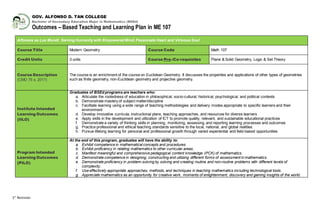
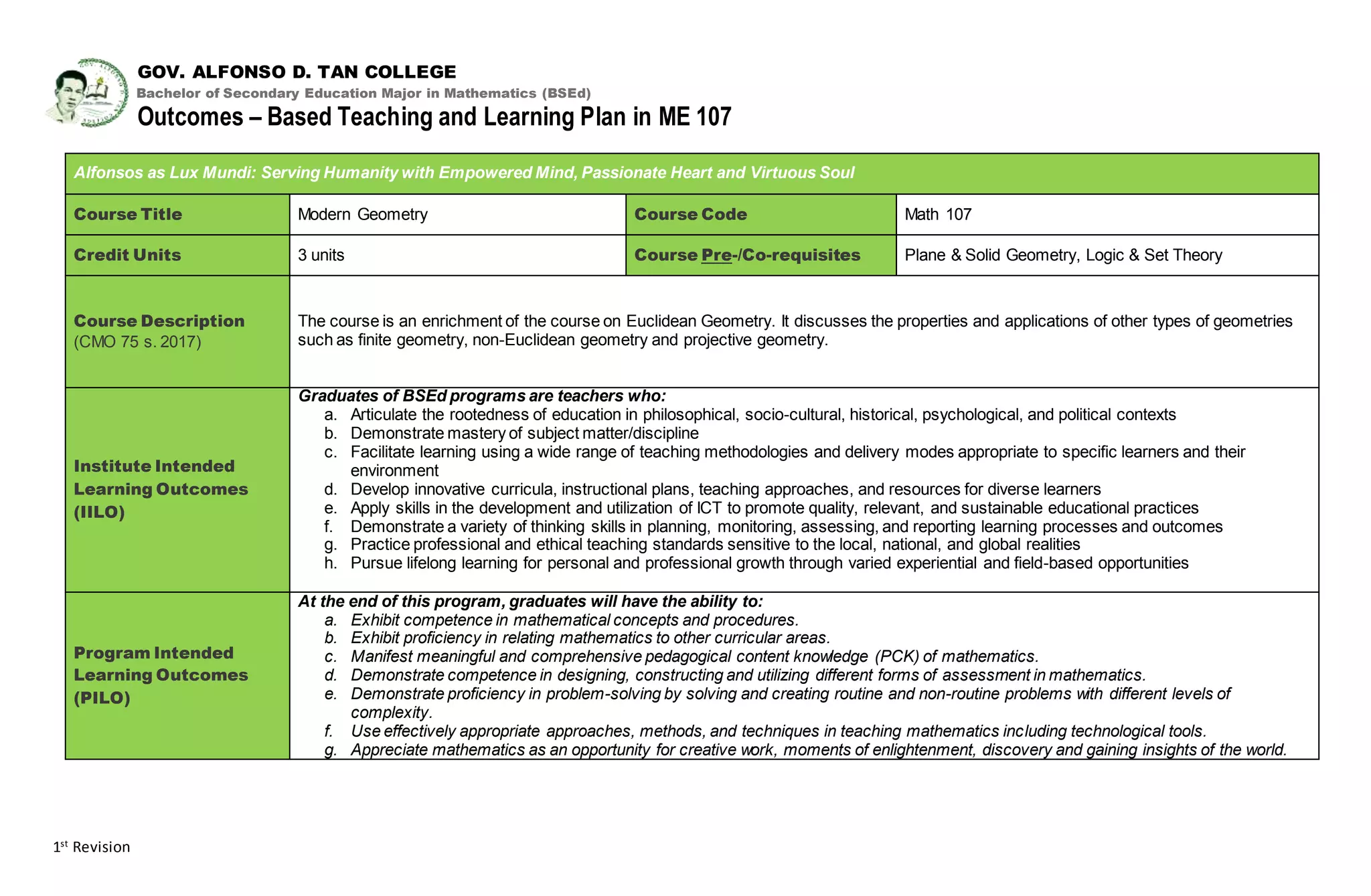
GOV. ALFONSO D. TAN COLLEGE
Bachelor of Secondary Education Major in Mathematics (BSEd)
Outcomes – Based Teaching and Learning Plan in ME 107
Alfonsos as Lux Mundi: Serving Humanity with Empowered Mind, Passionate Heart and Virtuous Soul
Course Title Modern Geometry Course Code Math 107
Credit Units 3 units Course Pre-/Co-requisites Plane & Solid Geometry, Logic & Set Theory
Course Description
(CMO 75 s. 2017)
The course is an enrichment of the course on Euclidean Geometry. It discusses the properties and applications of other types of geometries
such as finite geometry, non-Euclidean geometry and projective geometry.
Institute Intended
Learning Outcomes
(IILO)
Graduates of BSEd programs are teachers who:
a. Articulate the rootedness of education in philosophical, socio-cultural, historical, psychological, and political contexts
b. Demonstrate mastery of subject matter/discipline
c. Facilitate learning using a wide range of teaching methodologies and delivery modes appropriate to specific learners and their
environment
d. Develop innovative curricula, instructional plans, teaching approaches, and resources for diverse learners
e. Apply skills in the development and utilization of ICT to promote quality, relevant, and sustainable educational practices
f. Demonstrate a variety of thinking skills in planning, monitoring, assessing, and reporting learning processes and outcomes
g. Practice professional and ethical teaching standards sensitive to the local, national, and global realities
h. Pursue lifelong learning for personal and professional growth through varied experiential and field-based opportunities
Program Intended
Learning Outcomes
(PILO)
At the end of this program, graduates will have the ability to:
a. Exhibit competence in mathematical concepts and procedures.
b. Exhibit proficiency in relating mathematics to other curricular areas.
c. Manifest meaningful and comprehensive pedagogical content knowledge (PCK) of mathematics.
d. Demonstrate competence in designing, constructing and utilizing different forms of assessment in mathematics.
e. Demonstrate proficiency in problem-solving by solving and creating routine and non-routine problems with different levels of
complexity.
f. Use effectively appropriate approaches, methods, and techniques in teaching mathematics including technological tools.
g. Appreciate mathematics as an opportunity for creative work, moments of enlightenment, discovery and gaining insights of the world.
1st
Revision
Course Intended
Learning Outcomes
(CILO)
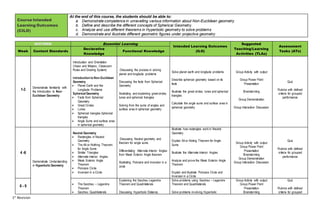
At the end of this course, the students should be able to:
a. Demonstrate competence in unravelling various information about Non-Euclidean geometry
b. Define and describe the different concepts of Spherical Geometry.
c. Analyze and use different theorems in Hyperbolic geometry to solve problems
d. Demonstrate and illustrate different geometric figures under projective geometry
MIDTERM Essential Learning
Intended Learning Outcomes
(ILO)
Suggested
Teaching/Learning
Activities (TLAs)
Assessment
Tasks (ATs)Week Content Standards
Declarative
Knowledge
Functional Knowledge
1-3 Demonstrate familiarity with
the Introduction to Non-
Euclidean Geometry
Introduction and Orientation
(Vision and Mission, Classroom
Rules and Grading System)
Introduction to Non-Euclidean
Geometry
 Planet Earth and the
Longitude Problems
Spherical Geometry
 Facts from Spherical
Geometry
 Great Circles
 Lunes
 Spherical biangles Spherical
triangles
 Angle Sums and surface area
in spherical geometry
-Discussing the process in solving
planet and longitude problems
Discussing the facts from Spherical
Geometry
Illustrating and explaining great circles,
lunes and spherical triangles
Solving from the sums of angles and
surface area in spherical geometry
Solve planet earth and longitude problems
Describe spherical geometry based on its
facts
Illustrate the great circles, lunes and spherical
triangles
Calculate the angle sums and surface area in
spherical geometry
Group Activity with output
Group Power Point
Presentation
Brainstorming
Group Demonstration
Group Interactive Discussion
Quiz
Rubrics with defined
criteria for grouped
performance
4 -6
Demonstrate Understanding
in Hyperbolic Geometry
Neutral Geometry
 Rectangles in Neutral
Geometry
 The All-or-Nothing Theorem
for Angle Sums
 Similar Triangles
 Alternate-Interior Angles
 Weak Exterior Angle
Theorem
 Poincare Circle
 Inversion in a Circle
Discussing Neutral geometry and
theorem for angle sums
Differentiating Alternate-Interior Angles
from Weak Exterior Angle theorem
Illustrating Poincare and inversion in a
circle
Illustrate how rectangles work in Neutral
Geometry
Explain All-or-Noting Theorem for Angle
Sums
Illustrate the Alternate-Interior Angles
Analyze and prove the Weak Exterior Angle
Theorem
Explain and illustrate Poincare Circle and
Inversion in a Circle
Group Activity with output
Group Power Point
Presentation
Brainstorming
Group Demonstration
Group Interactive Discussion
Quiz
Rubrics with defined
criteria for grouped
performance
6 - 9
 The Saccheu – Legendre
Theorem
 Saccheu Quadrilaterals
Explaining the Saccheu Legendre
Theorem and Quadrilaterals
Discussing Hyperbolic Distance,
Solve problems using Saccheu – Legendre
Theorem and Quadrilaterals
Solve problems involving Hyperbolic
Group Activity with output
Group Power Point
Presentation
Brainstorming
Quiz
Rubrics with defined
criteria for grouped
1st
Revision
 Hyperbolic Distance
 Hyperbolic Laws of Cosines
 Hyperbolic Axioms
Hyperbolic Laws of Consines and
hyperbolic axioms
Distance, hyperbolic laws of cosines and
Hyperbolic axioms
Group Demonstration
Group Interactive Discussion
performance
FINAL
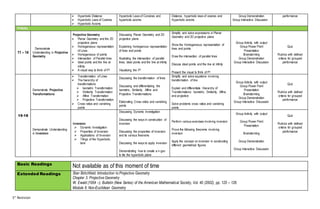
11 – 14
Demonstrate
Understanding in Projective
Geometry
Projective Geometry
 Planar Geometry and the 2D
projective plane
 Homogeneous representation
of Lines
 Homogeneous of points
 Intersection of Parallel lines
 Ideal points and the line at
infinity
 A visual way to think of P2
Discussing Planar Geometry and 2D
projective plane
Explaining homogenous representation
of lines and points
Illustrating the intersection of parallel
lines, ideal points and the line at infinity
Visualizing the P2
Simplify and solve expressions in Planar
Geometry and 2D projective plane
Show the Homogeneous representation of
lines and points
Draw the intersection of parallel lines
Discuss ideal points and the line at infinity
Present the visual to think of P2
Group Activity with output
Group Power Point
Presentation
Brainstorming
Group Demonstration
Group Interactive Discussion
Quiz
Rubrics with defined
criteria for grouped
performance
15-18
Demonstrate Projective
Transformations
 Transformation of Lines
 The hierarchy of
transformations
 Isometric Transformation
 Similarity Transformation
 Affine Transformation
 Projective Transformation
 Cross ratios and vanishing
points
Discussing the transformation of lines
Discussing and differentiating the
Isometric, Similarity, Affine and
Projective Transformations
Elaborating Cross ratios and vanishing
points
Simplify and solve equations involving
transformation of line
Explain and differentiate Hierarchy of
Transformations: Isometric, Similarity, Affine,
and projective
Solve problems cross ratios and vanishing
points
Group Activity with output
Group Power Point
Presentation
Brainstorming
Group Demonstration
Group Interactive Discussion
Quiz
Rubrics with defined
criteria for grouped
performance
Demonstrate Understanding
in Inversion
Inversion
 Dynamic Investigation
 Properties of Inversion
 Applications of Inversion
 Tilings of the Hyperbolic
lane
Discussing Dynamic investigation
Discussing the ways in construction of
inversion
Discussing the properties of inversion
and its various theorems
Discussing the ways to apply inversion
Demonstrating how to create a n-gon
to tile the hyperbolic plane
Perform various exercises involving inversion
Prove the following theorems involving
inversion
Apply the concept on inversion in constructing
different geometrical figures
Group Activity with output
Group Power Point
Presentation
Brainstorming
Group Demonstration
Group Interactive Discussion
Quiz
Rubrics with defined
criteria for grouped
performance
Basic Readings
Not available as of this moment of time
Extended Readings Stan Birtchfield. Introduction to Projective Geometry
Chapter 3. Projective Geometry
W. Ewald (1954 –), Bulletin (New Series) of the American Mathematical Society, Vol. 40 (2002), pp. 125 – 126.
Module 6. Non-Euclidean Geometry
1st
Revision
Simeon Ball and Zsuzsa Weiner. (2011). An Introduction to Finite Geometry
Chapter 4. Introduction to Hyperbolic Geometry
Course Assessment As identifiedin the Assessment Task
Course Policies LanguageofInstructions
English
Attendance
As identifiedin the student handbook
Homework,Quizzes,Written Reports,ReactionPapersand Portfolio
Special Requirement
GradingSystem
SummativeQuiz 30%
SummativePerformance 40%
PeriodicalExam 30%
100%
Classroom RulesandRegulations
Respect
Committee Members CommitteeLeader : Alemar C. Mayordo
Members : Elton John B. Embodo
RogielouP. Andam
Clint Joy Quije
ZarleneM.Tigol
Consultation Schedule FacultyMember : EltonJohn B. Embodo
ContactNumber : 09107619989
E-mailaddress : eltonjohn439@yahoo.com
ConsultationHours:
TimeandVenue :
Course
Title
A.Y. Term of
Effectivity
Prepared by Checked by Noted by Approved by Pages
Modern
Geometry
2019– 2020 ELTONJOHNB.EMBODO,MAEd
Instructor
ELTON JOHN B. EMBODO, MAEd
Program Coordinator, Math
ALEMAR C. MAYORDO, MAED
ITE, OIC-Dean
LOVE H. FALLORAN, Ph.D
VP for Academics
4

Outcomes based teaching learning plan (obtlp)- modern geometry 1st rev

  • 1.
    1st Revision GOV. ALFONSO D.TAN COLLEGE Bachelor of Secondary Education Major in Mathematics (BSEd) Outcomes – Based Teaching and Learning Plan in ME 107 Alfonsos as Lux Mundi: Serving Humanity with Empowered Mind, Passionate Heart and Virtuous Soul Course Title Modern Geometry Course Code Math 107 Credit Units 3 units Course Pre-/Co-requisites Plane & Solid Geometry, Logic & Set Theory Course Description (CMO 75 s. 2017) The course is an enrichment of the course on Euclidean Geometry. It discusses the properties and applications of other types of geometries such as finite geometry, non-Euclidean geometry and projective geometry. Institute Intended Learning Outcomes (IILO) Graduates of BSEd programs are teachers who: a. Articulate the rootedness of education in philosophical, socio-cultural, historical, psychological, and political contexts b. Demonstrate mastery of subject matter/discipline c. Facilitate learning using a wide range of teaching methodologies and delivery modes appropriate to specific learners and their environment d. Develop innovative curricula, instructional plans, teaching approaches, and resources for diverse learners e. Apply skills in the development and utilization of ICT to promote quality, relevant, and sustainable educational practices f. Demonstrate a variety of thinking skills in planning, monitoring, assessing, and reporting learning processes and outcomes g. Practice professional and ethical teaching standards sensitive to the local, national, and global realities h. Pursue lifelong learning for personal and professional growth through varied experiential and field-based opportunities Program Intended Learning Outcomes (PILO) At the end of this program, graduates will have the ability to: a. Exhibit competence in mathematical concepts and procedures. b. Exhibit proficiency in relating mathematics to other curricular areas. c. Manifest meaningful and comprehensive pedagogical content knowledge (PCK) of mathematics. d. Demonstrate competence in designing, constructing and utilizing different forms of assessment in mathematics. e. Demonstrate proficiency in problem-solving by solving and creating routine and non-routine problems with different levels of complexity. f. Use effectively appropriate approaches, methods, and techniques in teaching mathematics including technological tools. g. Appreciate mathematics as an opportunity for creative work, moments of enlightenment, discovery and gaining insights of the world.
  • 2.
    1st Revision Course Intended Learning Outcomes (CILO) Atthe end of this course, the students should be able to: a. Demonstrate competence in unravelling various information about Non-Euclidean geometry b. Define and describe the different concepts of Spherical Geometry. c. Analyze and use different theorems in Hyperbolic geometry to solve problems d. Demonstrate and illustrate different geometric figures under projective geometry MIDTERM Essential Learning Intended Learning Outcomes (ILO) Suggested Teaching/Learning Activities (TLAs) Assessment Tasks (ATs)Week Content Standards Declarative Knowledge Functional Knowledge 1-3 Demonstrate familiarity with the Introduction to Non- Euclidean Geometry Introduction and Orientation (Vision and Mission, Classroom Rules and Grading System) Introduction to Non-Euclidean Geometry  Planet Earth and the Longitude Problems Spherical Geometry  Facts from Spherical Geometry  Great Circles  Lunes  Spherical biangles Spherical triangles  Angle Sums and surface area in spherical geometry -Discussing the process in solving planet and longitude problems Discussing the facts from Spherical Geometry Illustrating and explaining great circles, lunes and spherical triangles Solving from the sums of angles and surface area in spherical geometry Solve planet earth and longitude problems Describe spherical geometry based on its facts Illustrate the great circles, lunes and spherical triangles Calculate the angle sums and surface area in spherical geometry Group Activity with output Group Power Point Presentation Brainstorming Group Demonstration Group Interactive Discussion Quiz Rubrics with defined criteria for grouped performance 4 -6 Demonstrate Understanding in Hyperbolic Geometry Neutral Geometry  Rectangles in Neutral Geometry  The All-or-Nothing Theorem for Angle Sums  Similar Triangles  Alternate-Interior Angles  Weak Exterior Angle Theorem  Poincare Circle  Inversion in a Circle Discussing Neutral geometry and theorem for angle sums Differentiating Alternate-Interior Angles from Weak Exterior Angle theorem Illustrating Poincare and inversion in a circle Illustrate how rectangles work in Neutral Geometry Explain All-or-Noting Theorem for Angle Sums Illustrate the Alternate-Interior Angles Analyze and prove the Weak Exterior Angle Theorem Explain and illustrate Poincare Circle and Inversion in a Circle Group Activity with output Group Power Point Presentation Brainstorming Group Demonstration Group Interactive Discussion Quiz Rubrics with defined criteria for grouped performance 6 - 9  The Saccheu – Legendre Theorem  Saccheu Quadrilaterals Explaining the Saccheu Legendre Theorem and Quadrilaterals Discussing Hyperbolic Distance, Solve problems using Saccheu – Legendre Theorem and Quadrilaterals Solve problems involving Hyperbolic Group Activity with output Group Power Point Presentation Brainstorming Quiz Rubrics with defined criteria for grouped
  • 3.
    1st Revision  Hyperbolic Distance Hyperbolic Laws of Cosines  Hyperbolic Axioms Hyperbolic Laws of Consines and hyperbolic axioms Distance, hyperbolic laws of cosines and Hyperbolic axioms Group Demonstration Group Interactive Discussion performance FINAL 11 – 14 Demonstrate Understanding in Projective Geometry Projective Geometry  Planar Geometry and the 2D projective plane  Homogeneous representation of Lines  Homogeneous of points  Intersection of Parallel lines  Ideal points and the line at infinity  A visual way to think of P2 Discussing Planar Geometry and 2D projective plane Explaining homogenous representation of lines and points Illustrating the intersection of parallel lines, ideal points and the line at infinity Visualizing the P2 Simplify and solve expressions in Planar Geometry and 2D projective plane Show the Homogeneous representation of lines and points Draw the intersection of parallel lines Discuss ideal points and the line at infinity Present the visual to think of P2 Group Activity with output Group Power Point Presentation Brainstorming Group Demonstration Group Interactive Discussion Quiz Rubrics with defined criteria for grouped performance 15-18 Demonstrate Projective Transformations  Transformation of Lines  The hierarchy of transformations  Isometric Transformation  Similarity Transformation  Affine Transformation  Projective Transformation  Cross ratios and vanishing points Discussing the transformation of lines Discussing and differentiating the Isometric, Similarity, Affine and Projective Transformations Elaborating Cross ratios and vanishing points Simplify and solve equations involving transformation of line Explain and differentiate Hierarchy of Transformations: Isometric, Similarity, Affine, and projective Solve problems cross ratios and vanishing points Group Activity with output Group Power Point Presentation Brainstorming Group Demonstration Group Interactive Discussion Quiz Rubrics with defined criteria for grouped performance Demonstrate Understanding in Inversion Inversion  Dynamic Investigation  Properties of Inversion  Applications of Inversion  Tilings of the Hyperbolic lane Discussing Dynamic investigation Discussing the ways in construction of inversion Discussing the properties of inversion and its various theorems Discussing the ways to apply inversion Demonstrating how to create a n-gon to tile the hyperbolic plane Perform various exercises involving inversion Prove the following theorems involving inversion Apply the concept on inversion in constructing different geometrical figures Group Activity with output Group Power Point Presentation Brainstorming Group Demonstration Group Interactive Discussion Quiz Rubrics with defined criteria for grouped performance Basic Readings Not available as of this moment of time Extended Readings Stan Birtchfield. Introduction to Projective Geometry Chapter 3. Projective Geometry W. Ewald (1954 –), Bulletin (New Series) of the American Mathematical Society, Vol. 40 (2002), pp. 125 – 126. Module 6. Non-Euclidean Geometry
  • 4.
    1st Revision Simeon Ball andZsuzsa Weiner. (2011). An Introduction to Finite Geometry Chapter 4. Introduction to Hyperbolic Geometry Course Assessment As identifiedin the Assessment Task Course Policies LanguageofInstructions English Attendance As identifiedin the student handbook Homework,Quizzes,Written Reports,ReactionPapersand Portfolio Special Requirement GradingSystem SummativeQuiz 30% SummativePerformance 40% PeriodicalExam 30% 100% Classroom RulesandRegulations Respect Committee Members CommitteeLeader : Alemar C. Mayordo Members : Elton John B. Embodo RogielouP. Andam Clint Joy Quije ZarleneM.Tigol Consultation Schedule FacultyMember : EltonJohn B. Embodo ContactNumber : 09107619989 E-mailaddress : eltonjohn439@yahoo.com ConsultationHours: TimeandVenue : Course Title A.Y. Term of Effectivity Prepared by Checked by Noted by Approved by Pages Modern Geometry 2019– 2020 ELTONJOHNB.EMBODO,MAEd Instructor ELTON JOHN B. EMBODO, MAEd Program Coordinator, Math ALEMAR C. MAYORDO, MAED ITE, OIC-Dean LOVE H. FALLORAN, Ph.D VP for Academics 4