Revised by:EltonJohn B. Embodo
2nd Revision
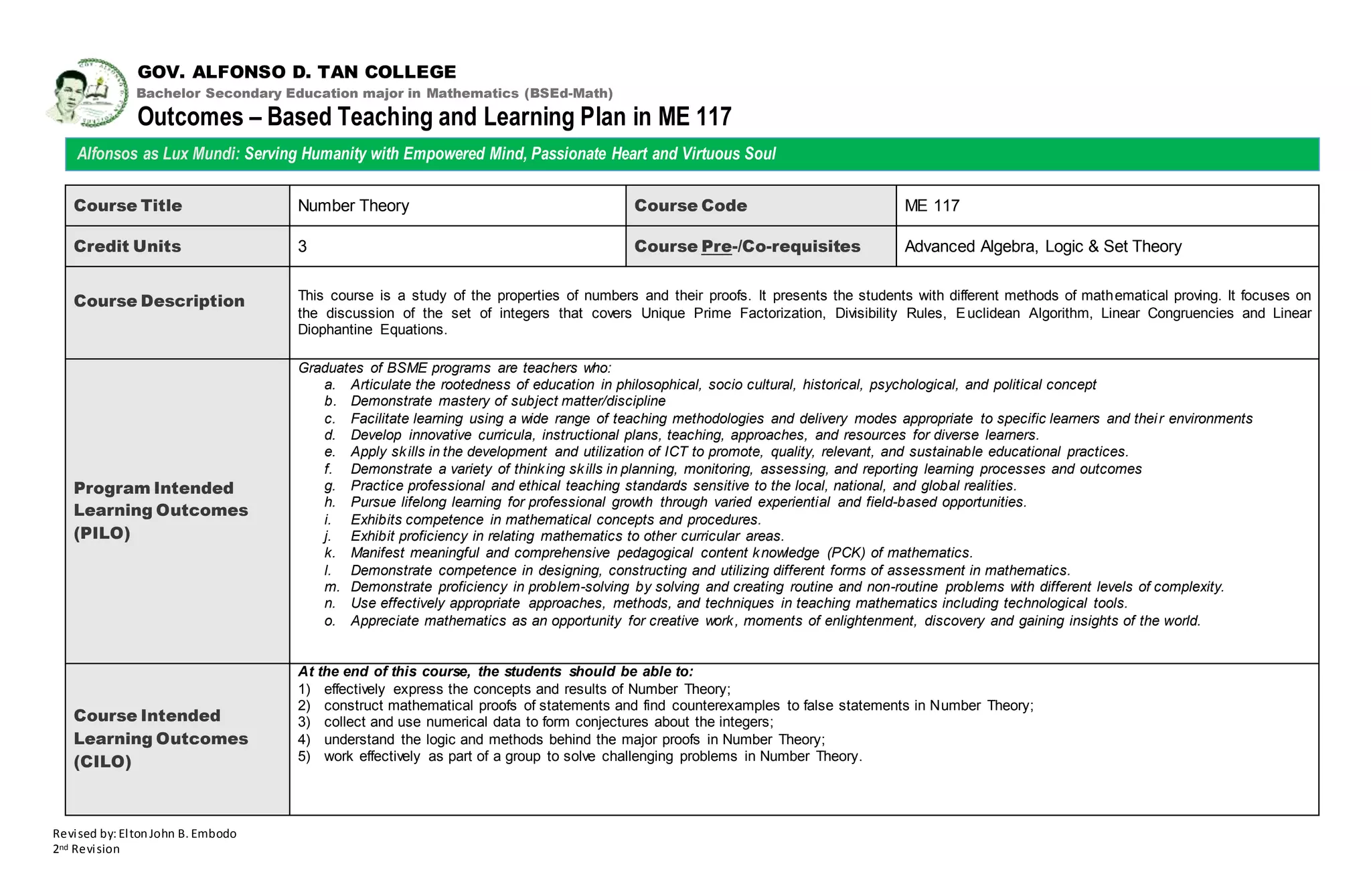
GOV. ALFONSO D. TAN COLLEGE
Bachelor Secondary Education major in Mathematics (BSEd-Math)
Outcomes – Based Teaching and Learning Plan in ME 117
Course Title Number Theory Course Code ME 117
Credit Units 3 Course Pre-/Co-requisites Advanced Algebra, Logic & Set Theory
Course Description This course is a study of the properties of numbers and their proofs. It presents the students with different methods of mathematical proving. It focuses on
the discussion of the set of integers that covers Unique Prime Factorization, Divisibility Rules, Euclidean Algorithm, Linear Congruencies and Linear
Diophantine Equations.
Program Intended
Learning Outcomes
(PILO)
Graduates of BSME programs are teachers who:
a. Articulate the rootedness of education in philosophical, socio cultural, historical, psychological, and political concept
b. Demonstrate mastery of subject matter/discipline
c. Facilitate learning using a wide range of teaching methodologies and delivery modes appropriate to specific learners and their environments
d. Develop innovative curricula, instructional plans, teaching, approaches, and resources for diverse learners.
e. Apply skills in the development and utilization of ICT to promote, quality, relevant, and sustainable educational practices.
f. Demonstrate a variety of thinking skills in planning, monitoring, assessing, and reporting learning processes and outcomes
g. Practice professional and ethical teaching standards sensitive to the local, national, and global realities.
h. Pursue lifelong learning for professional growth through varied experiential and field-based opportunities.
i. Exhibits competence in mathematical concepts and procedures.
j. Exhibit proficiency in relating mathematics to other curricular areas.
k. Manifest meaningful and comprehensive pedagogical content knowledge (PCK) of mathematics.
l. Demonstrate competence in designing, constructing and utilizing different forms of assessment in mathematics.
m. Demonstrate proficiency in problem-solving by solving and creating routine and non-routine problems with different levels of complexity.
n. Use effectively appropriate approaches, methods, and techniques in teaching mathematics including technological tools.
o. Appreciate mathematics as an opportunity for creative work, moments of enlightenment, discovery and gaining insights of the world.
Course Intended
Learning Outcomes
(CILO)
At the end of this course, the students should be able to:
1) effectively express the concepts and results of Number Theory;
2) construct mathematical proofs of statements and find counterexamples to false statements in Number Theory;
3) collect and use numerical data to form conjectures about the integers;
4) understand the logic and methods behind the major proofs in Number Theory;
5) work effectively as part of a group to solve challenging problems in Number Theory.
Alfonsos as Lux Mundi: Serving Humanity with Empowered Mind, Passionate Heart and Virtuous Soul
Revised by:EltonJohn B. Embodo
2nd Revision
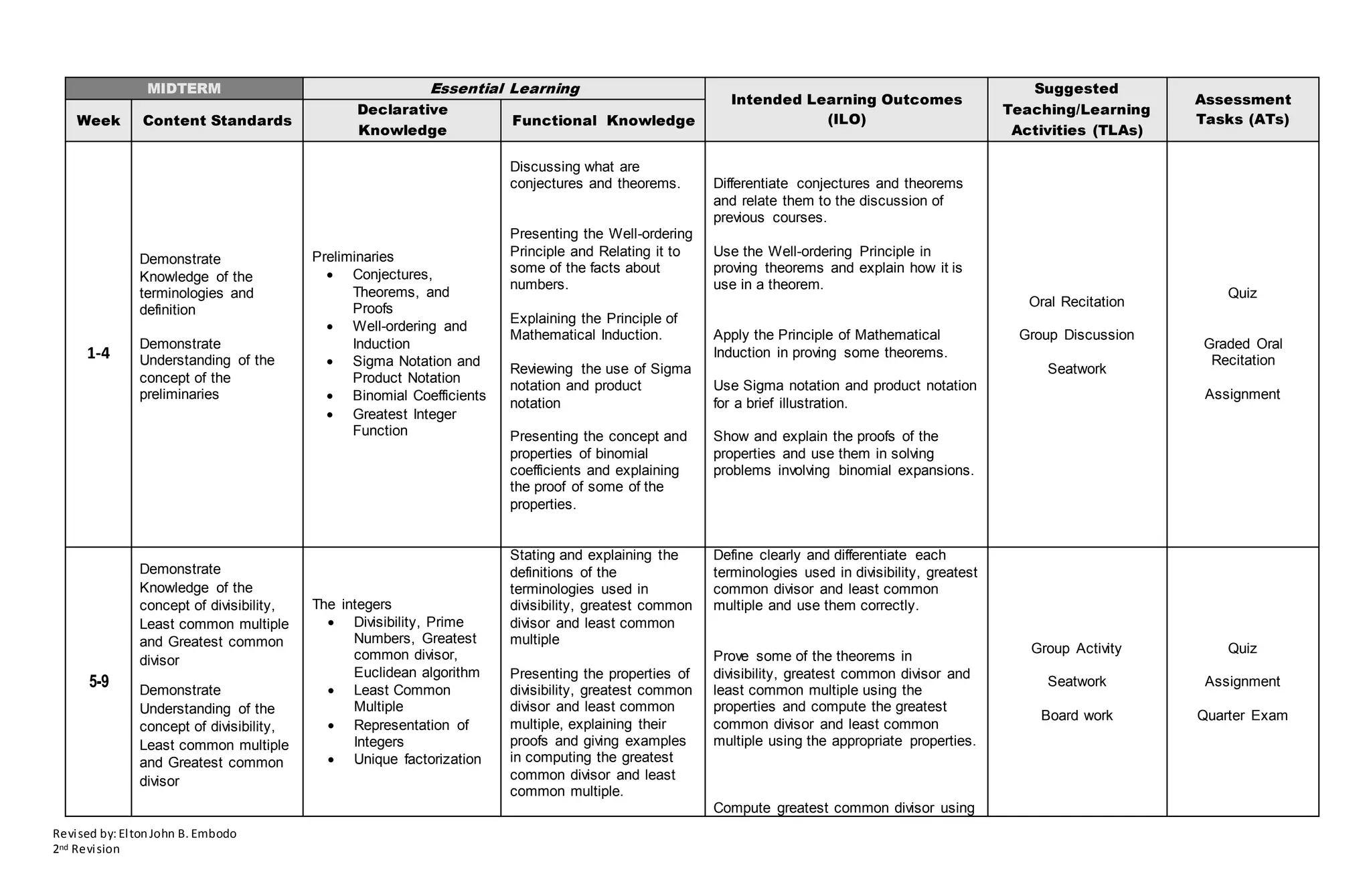
MIDTERM Essential Learning
Intended Learning Outcomes
(ILO)
Suggested
Teaching/Learning
Activities (TLAs)
Assessment
Tasks (ATs)Week Content Standards
Declarative
Knowledge
Functional Knowledge
1-4
Demonstrate
Knowledge of the
terminologies and
definition
Demonstrate
Understanding of the
concept of the
preliminaries
Preliminaries
 Conjectures,
Theorems, and
Proofs
 Well-ordering and
Induction
 Sigma Notation and
Product Notation
 Binomial Coefficients
 Greatest Integer
Function
Discussing what are
conjectures and theorems.
Presenting the Well-ordering
Principle and Relating it to
some of the facts about
numbers.
Explaining the Principle of
Mathematical Induction.
Reviewing the use of Sigma
notation and product
notation
Presenting the concept and
properties of binomial
coefficients and explaining
the proof of some of the
properties.
Differentiate conjectures and theorems
and relate them to the discussion of
previous courses.
Use the Well-ordering Principle in
proving theorems and explain how it is
use in a theorem.
Apply the Principle of Mathematical
Induction in proving some theorems.
Use Sigma notation and product notation
for a brief illustration.
Show and explain the proofs of the
properties and use them in solving
problems involving binomial expansions.
Oral Recitation
Group Discussion
Seatwork
Quiz
Graded Oral
Recitation
Assignment
5-9
Demonstrate
Knowledge of the
concept of divisibility,
Least common multiple
and Greatest common
divisor
Demonstrate
Understanding of the
concept of divisibility,
Least common multiple
and Greatest common
divisor
The integers
 Divisibility, Prime
Numbers, Greatest
common divisor,
Euclidean algorithm
 Least Common
Multiple
 Representation of
Integers
 Unique factorization
Stating and explaining the
definitions of the
terminologies used in
divisibility, greatest common
divisor and least common
multiple
Presenting the properties of
divisibility, greatest common
divisor and least common
multiple, explaining their
proofs and giving examples
in computing the greatest
common divisor and least
common multiple.
Define clearly and differentiate each
terminologies used in divisibility, greatest
common divisor and least common
multiple and use them correctly.
Prove some of the theorems in
divisibility, greatest common divisor and
least common multiple using the
properties and compute the greatest
common divisor and least common
multiple using the appropriate properties.
Compute greatest common divisor using
Group Activity
Seatwork
Board work
Quiz
Assignment
Quarter Exam
Revised by:EltonJohn B. Embodo
2nd Revision
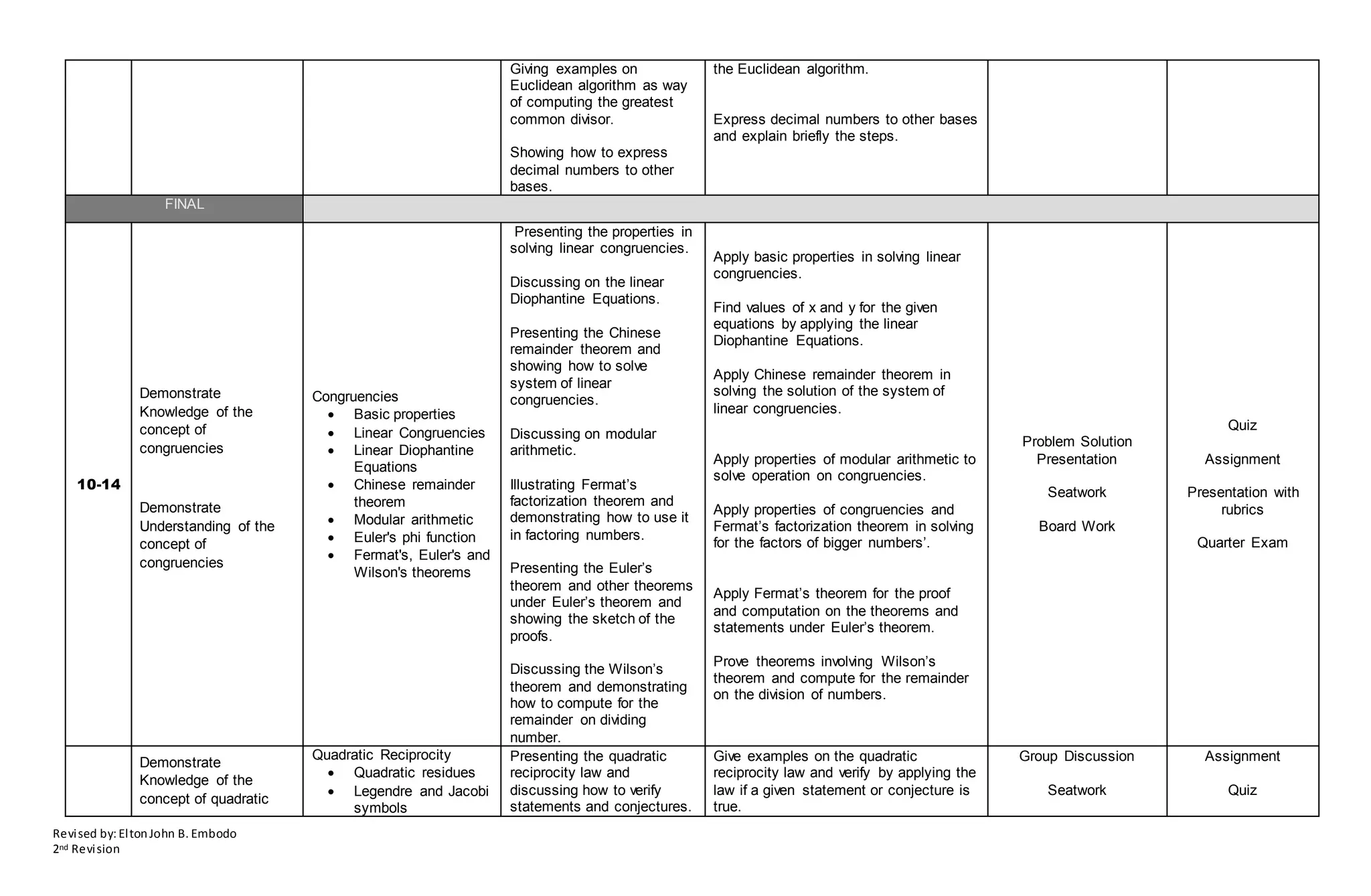
Giving examples on
Euclidean algorithm as way
of computing the greatest
common divisor.
Showing how to express
decimal numbers to other
bases.
the Euclidean algorithm.
Express decimal numbers to other bases
and explain briefly the steps.
FINAL
10-14
Demonstrate
Knowledge of the
concept of
congruencies
Demonstrate
Understanding of the
concept of
congruencies
Congruencies
 Basic properties
 Linear Congruencies
 Linear Diophantine
Equations
 Chinese remainder
theorem
 Modular arithmetic
 Euler's phi function
 Fermat's, Euler's and
Wilson's theorems
Presenting the properties in
solving linear congruencies.
Discussing on the linear
Diophantine Equations.
Presenting the Chinese
remainder theorem and
showing how to solve
system of linear
congruencies.
Discussing on modular
arithmetic.
Illustrating Fermat’s
factorization theorem and
demonstrating how to use it
in factoring numbers.
Presenting the Euler’s
theorem and other theorems
under Euler’s theorem and
showing the sketch of the
proofs.
Discussing the Wilson’s
theorem and demonstrating
how to compute for the
remainder on dividing
number.
Apply basic properties in solving linear
congruencies.
Find values of x and y for the given
equations by applying the linear
Diophantine Equations.
Apply Chinese remainder theorem in
solving the solution of the system of
linear congruencies.
Apply properties of modular arithmetic to
solve operation on congruencies.
Apply properties of congruencies and
Fermat’s factorization theorem in solving
for the factors of bigger numbers’.
Apply Fermat’s theorem for the proof
and computation on the theorems and
statements under Euler’s theorem.
Prove theorems involving Wilson’s
theorem and compute for the remainder
on the division of numbers.
Problem Solution
Presentation
Seatwork
Board Work
Quiz
Assignment
Presentation with
rubrics
Quarter Exam
Demonstrate
Knowledge of the
concept of quadratic
Quadratic Reciprocity
 Quadratic residues
 Legendre and Jacobi
symbols
Presenting the quadratic
reciprocity law and
discussing how to verify
statements and conjectures.
Give examples on the quadratic
reciprocity law and verify by applying the
law if a given statement or conjecture is
true.
Group Discussion
Seatwork
Assignment
Quiz
Revised by:EltonJohn B. Embodo
2nd Revision
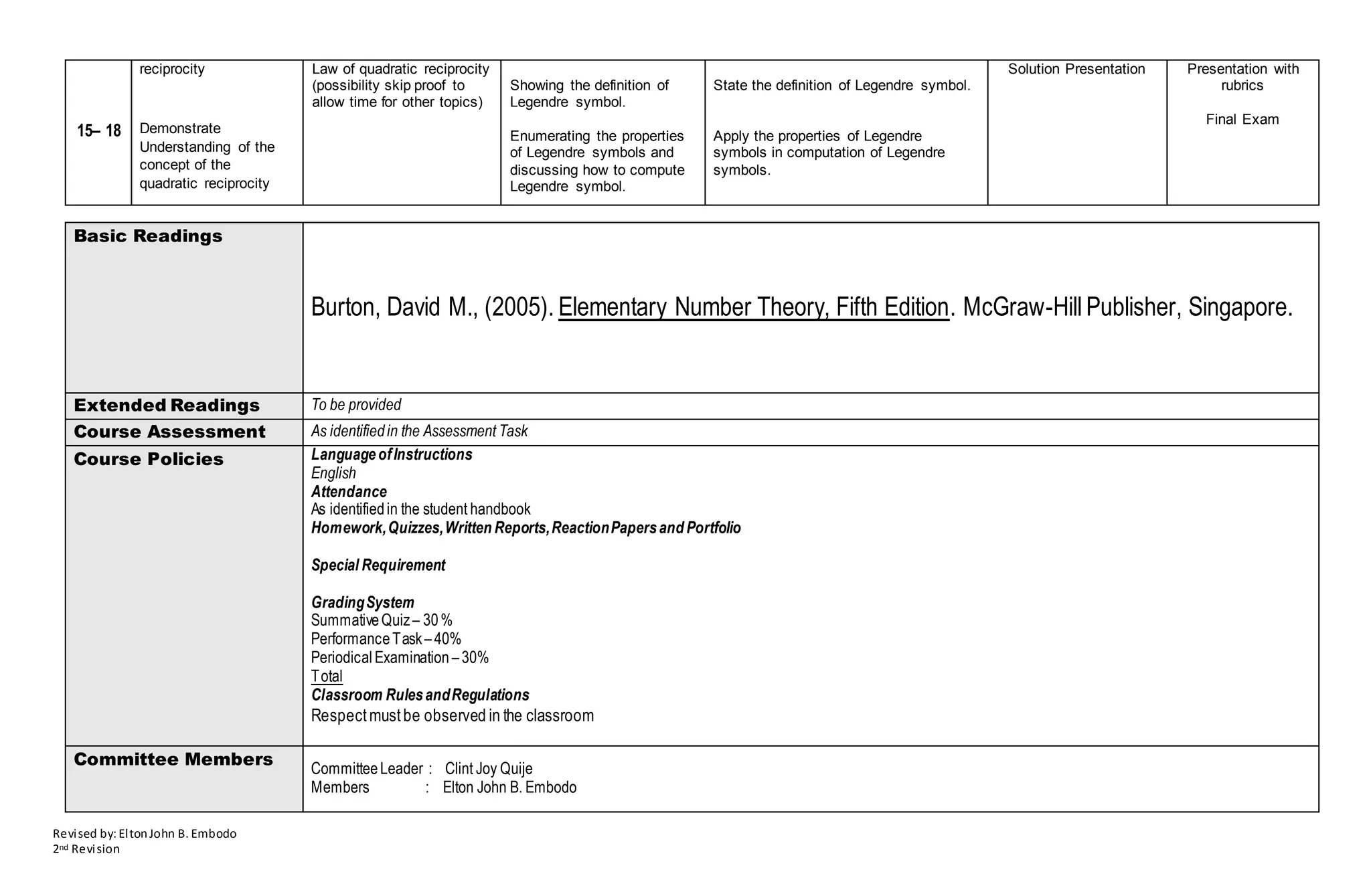
15– 18
reciprocity
Demonstrate
Understanding of the
concept of the
quadratic reciprocity
Law of quadratic reciprocity
(possibility skip proof to
allow time for other topics)
Showing the definition of
Legendre symbol.
Enumerating the properties
of Legendre symbols and
discussing how to compute
Legendre symbol.
State the definition of Legendre symbol.
Apply the properties of Legendre
symbols in computation of Legendre
symbols.
Solution Presentation Presentation with
rubrics
Final Exam
Basic Readings
Burton, David M., (2005). Elementary Number Theory, Fifth Edition. McGraw-HillPublisher, Singapore.
Extended Readings To be provided
Course Assessment As identifiedin the Assessment Task
Course Policies LanguageofInstructions
English
Attendance
As identifiedin the student handbook
Homework,Quizzes,Written Reports,ReactionPapersand Portfolio
Special Requirement
GradingSystem
SummativeQuiz– 30%
PerformanceTask–40%
PeriodicalExamination –30%
Total
Classroom RulesandRegulations
Respectmustbe observed in the classroom
Committee Members
CommitteeLeader : Clint Joy Quije
Members : Elton John B. Embodo
Revised by:EltonJohn B. Embodo
2nd Revision
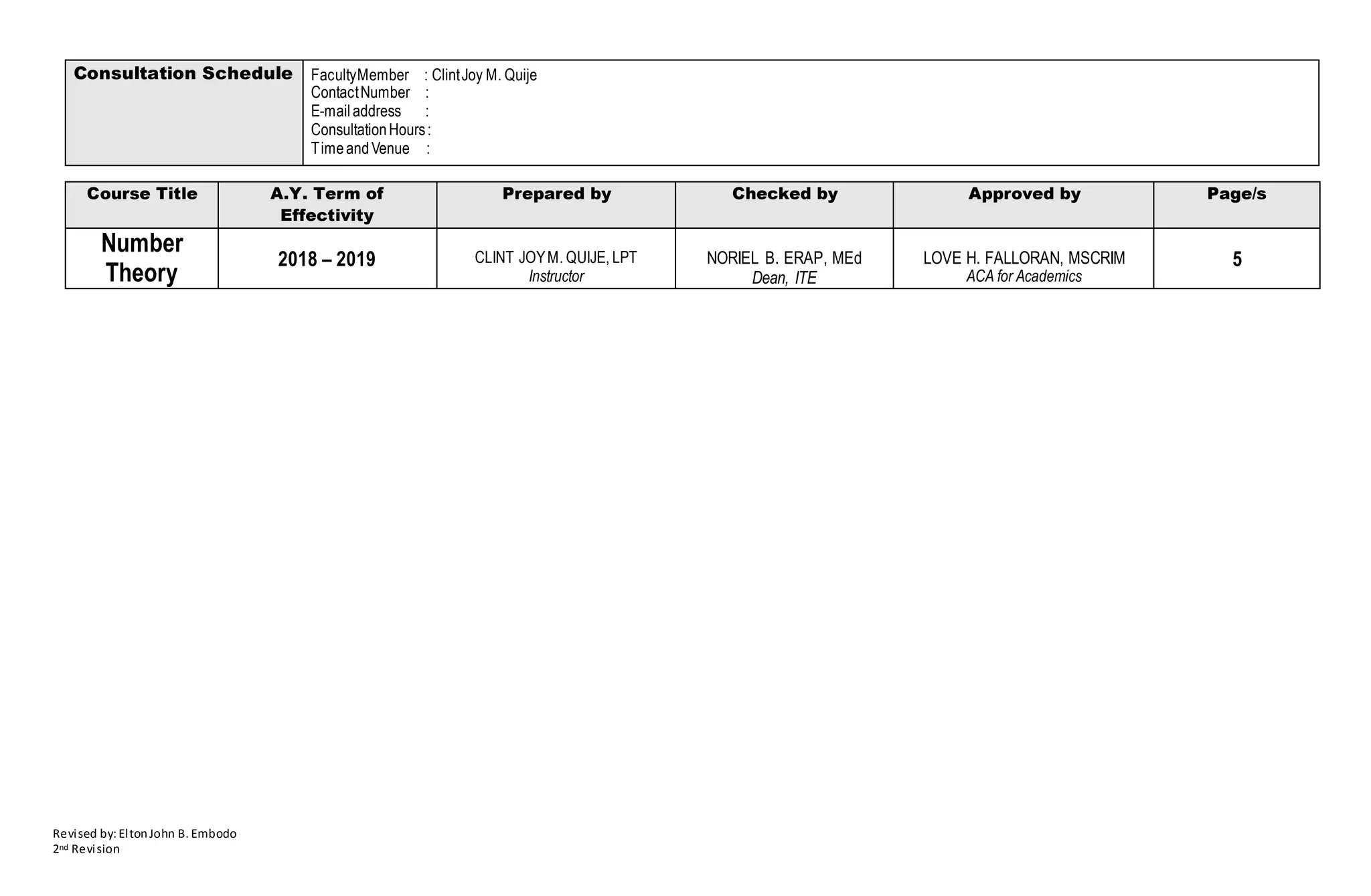
Consultation Schedule FacultyMember : ClintJoy M. Quije
ContactNumber :
E-mailaddress :
ConsultationHours:
TimeandVenue :
Course Title A.Y. Term of
Effectivity
Prepared by Checked by Approved by Page/s
Number
Theory
2018 – 2019 CLINT JOYM. QUIJE, LPT
Instructor
NORIEL B. ERAP, MEd
Dean, ITE
LOVE H. FALLORAN, MSCRIM
ACA for Academics
5

Outcomes based teaching learning plan (obtlp) number theory 2

  • 1.
    Revised by:EltonJohn B.Embodo 2nd Revision GOV. ALFONSO D. TAN COLLEGE Bachelor Secondary Education major in Mathematics (BSEd-Math) Outcomes – Based Teaching and Learning Plan in ME 117 Course Title Number Theory Course Code ME 117 Credit Units 3 Course Pre-/Co-requisites Advanced Algebra, Logic & Set Theory Course Description This course is a study of the properties of numbers and their proofs. It presents the students with different methods of mathematical proving. It focuses on the discussion of the set of integers that covers Unique Prime Factorization, Divisibility Rules, Euclidean Algorithm, Linear Congruencies and Linear Diophantine Equations. Program Intended Learning Outcomes (PILO) Graduates of BSME programs are teachers who: a. Articulate the rootedness of education in philosophical, socio cultural, historical, psychological, and political concept b. Demonstrate mastery of subject matter/discipline c. Facilitate learning using a wide range of teaching methodologies and delivery modes appropriate to specific learners and their environments d. Develop innovative curricula, instructional plans, teaching, approaches, and resources for diverse learners. e. Apply skills in the development and utilization of ICT to promote, quality, relevant, and sustainable educational practices. f. Demonstrate a variety of thinking skills in planning, monitoring, assessing, and reporting learning processes and outcomes g. Practice professional and ethical teaching standards sensitive to the local, national, and global realities. h. Pursue lifelong learning for professional growth through varied experiential and field-based opportunities. i. Exhibits competence in mathematical concepts and procedures. j. Exhibit proficiency in relating mathematics to other curricular areas. k. Manifest meaningful and comprehensive pedagogical content knowledge (PCK) of mathematics. l. Demonstrate competence in designing, constructing and utilizing different forms of assessment in mathematics. m. Demonstrate proficiency in problem-solving by solving and creating routine and non-routine problems with different levels of complexity. n. Use effectively appropriate approaches, methods, and techniques in teaching mathematics including technological tools. o. Appreciate mathematics as an opportunity for creative work, moments of enlightenment, discovery and gaining insights of the world. Course Intended Learning Outcomes (CILO) At the end of this course, the students should be able to: 1) effectively express the concepts and results of Number Theory; 2) construct mathematical proofs of statements and find counterexamples to false statements in Number Theory; 3) collect and use numerical data to form conjectures about the integers; 4) understand the logic and methods behind the major proofs in Number Theory; 5) work effectively as part of a group to solve challenging problems in Number Theory. Alfonsos as Lux Mundi: Serving Humanity with Empowered Mind, Passionate Heart and Virtuous Soul
  • 2.
    Revised by:EltonJohn B.Embodo 2nd Revision MIDTERM Essential Learning Intended Learning Outcomes (ILO) Suggested Teaching/Learning Activities (TLAs) Assessment Tasks (ATs)Week Content Standards Declarative Knowledge Functional Knowledge 1-4 Demonstrate Knowledge of the terminologies and definition Demonstrate Understanding of the concept of the preliminaries Preliminaries  Conjectures, Theorems, and Proofs  Well-ordering and Induction  Sigma Notation and Product Notation  Binomial Coefficients  Greatest Integer Function Discussing what are conjectures and theorems. Presenting the Well-ordering Principle and Relating it to some of the facts about numbers. Explaining the Principle of Mathematical Induction. Reviewing the use of Sigma notation and product notation Presenting the concept and properties of binomial coefficients and explaining the proof of some of the properties. Differentiate conjectures and theorems and relate them to the discussion of previous courses. Use the Well-ordering Principle in proving theorems and explain how it is use in a theorem. Apply the Principle of Mathematical Induction in proving some theorems. Use Sigma notation and product notation for a brief illustration. Show and explain the proofs of the properties and use them in solving problems involving binomial expansions. Oral Recitation Group Discussion Seatwork Quiz Graded Oral Recitation Assignment 5-9 Demonstrate Knowledge of the concept of divisibility, Least common multiple and Greatest common divisor Demonstrate Understanding of the concept of divisibility, Least common multiple and Greatest common divisor The integers  Divisibility, Prime Numbers, Greatest common divisor, Euclidean algorithm  Least Common Multiple  Representation of Integers  Unique factorization Stating and explaining the definitions of the terminologies used in divisibility, greatest common divisor and least common multiple Presenting the properties of divisibility, greatest common divisor and least common multiple, explaining their proofs and giving examples in computing the greatest common divisor and least common multiple. Define clearly and differentiate each terminologies used in divisibility, greatest common divisor and least common multiple and use them correctly. Prove some of the theorems in divisibility, greatest common divisor and least common multiple using the properties and compute the greatest common divisor and least common multiple using the appropriate properties. Compute greatest common divisor using Group Activity Seatwork Board work Quiz Assignment Quarter Exam
  • 3.
    Revised by:EltonJohn B.Embodo 2nd Revision Giving examples on Euclidean algorithm as way of computing the greatest common divisor. Showing how to express decimal numbers to other bases. the Euclidean algorithm. Express decimal numbers to other bases and explain briefly the steps. FINAL 10-14 Demonstrate Knowledge of the concept of congruencies Demonstrate Understanding of the concept of congruencies Congruencies  Basic properties  Linear Congruencies  Linear Diophantine Equations  Chinese remainder theorem  Modular arithmetic  Euler's phi function  Fermat's, Euler's and Wilson's theorems Presenting the properties in solving linear congruencies. Discussing on the linear Diophantine Equations. Presenting the Chinese remainder theorem and showing how to solve system of linear congruencies. Discussing on modular arithmetic. Illustrating Fermat’s factorization theorem and demonstrating how to use it in factoring numbers. Presenting the Euler’s theorem and other theorems under Euler’s theorem and showing the sketch of the proofs. Discussing the Wilson’s theorem and demonstrating how to compute for the remainder on dividing number. Apply basic properties in solving linear congruencies. Find values of x and y for the given equations by applying the linear Diophantine Equations. Apply Chinese remainder theorem in solving the solution of the system of linear congruencies. Apply properties of modular arithmetic to solve operation on congruencies. Apply properties of congruencies and Fermat’s factorization theorem in solving for the factors of bigger numbers’. Apply Fermat’s theorem for the proof and computation on the theorems and statements under Euler’s theorem. Prove theorems involving Wilson’s theorem and compute for the remainder on the division of numbers. Problem Solution Presentation Seatwork Board Work Quiz Assignment Presentation with rubrics Quarter Exam Demonstrate Knowledge of the concept of quadratic Quadratic Reciprocity  Quadratic residues  Legendre and Jacobi symbols Presenting the quadratic reciprocity law and discussing how to verify statements and conjectures. Give examples on the quadratic reciprocity law and verify by applying the law if a given statement or conjecture is true. Group Discussion Seatwork Assignment Quiz
  • 4.
    Revised by:EltonJohn B.Embodo 2nd Revision 15– 18 reciprocity Demonstrate Understanding of the concept of the quadratic reciprocity Law of quadratic reciprocity (possibility skip proof to allow time for other topics) Showing the definition of Legendre symbol. Enumerating the properties of Legendre symbols and discussing how to compute Legendre symbol. State the definition of Legendre symbol. Apply the properties of Legendre symbols in computation of Legendre symbols. Solution Presentation Presentation with rubrics Final Exam Basic Readings Burton, David M., (2005). Elementary Number Theory, Fifth Edition. McGraw-HillPublisher, Singapore. Extended Readings To be provided Course Assessment As identifiedin the Assessment Task Course Policies LanguageofInstructions English Attendance As identifiedin the student handbook Homework,Quizzes,Written Reports,ReactionPapersand Portfolio Special Requirement GradingSystem SummativeQuiz– 30% PerformanceTask–40% PeriodicalExamination –30% Total Classroom RulesandRegulations Respectmustbe observed in the classroom Committee Members CommitteeLeader : Clint Joy Quije Members : Elton John B. Embodo
  • 5.
    Revised by:EltonJohn B.Embodo 2nd Revision Consultation Schedule FacultyMember : ClintJoy M. Quije ContactNumber : E-mailaddress : ConsultationHours: TimeandVenue : Course Title A.Y. Term of Effectivity Prepared by Checked by Approved by Page/s Number Theory 2018 – 2019 CLINT JOYM. QUIJE, LPT Instructor NORIEL B. ERAP, MEd Dean, ITE LOVE H. FALLORAN, MSCRIM ACA for Academics 5