International Journal for Multidisciplinary Research (IJFMR)
E-ISSN: 2582-2160 ● Website: www.ijfmr.com ● Email: editor@ijfmr.com
IJFMR240527626 Volume 6, Issue 5, September-October 2024 1
Experiences of Program Heads in Supervising
Teachers: A Phenomenological Study
Elton John B. Embodo1
, Haydee D. Villanueva2
1
EdD, Teacher, Pangabuan Integrated School, Department of Education
2
PhD, Professor, College of Arts and Sciences, Misamis University
Abstract
The supervision of teachers is essential for ensuring effective teaching methods, ongoing professional
growth, and student success. This study explored the experiences of program heads in supervising
teachers. It was conducted in a local college in Tangub City, Misamis Occidental. The
phenomenological design was used in the study. Eleven program heads served as the participants
selected through the purposive sampling technique. The Interview Guide was used as the research
instrument. Moustakas’ transcendental phenomenology of data analysis was utilized to analyze the data
gathered. Results revealed the following main themes: the critical role of supervision in advancing
teacher development and educational excellence, mutual learning and growth, the role of program heads
in teacher supervision, overcoming challenges in teacher supervision, and effective communication
strategies. Supervision improves teaching and learning quality, which supports professional
development. The complex nature of supervisory roles requires adaptive strategies and strong support
networks. It is recommended for program heads and teachers to establish open communication to help
address the challenges encountered during supervision.
Keywords: challenges, coping strategies, experiences, supervision, teachers
1. Introduction
Supervision is using expert knowledge and experience to monitor, appraise, and direct instruction
improvement in schools (Amough & Odeh, 2018). One aspect of general supervision that a program
head within a school expects is the supervision of instruction. Good supervision has been recognized
worldwide as helping improve the educational process, and in this regard, supervision in schools is
essential (Wahyu, 2020). Since quality education remains the top priority of the education process,
teachers are deemed to have a crucial role in it. They are often seen as one of the most trusted sources to
indicate the effectiveness of the education process in schools (Stronge, 2018).
Adequate supervision, especially for prime instruction providers, should be implemented to ensure the
proper education quality by the school (Wakutile, 2019). Teachers should provide well-educated
learners, and in a bid to achieve that, they actively take each opportunity for professional development to
enhance their teaching techniques and advance the quality of education they provide (Schachter et al.,
2019). They sometimes fail to achieve that because of an overwhelming workload to complete daily and
low self-efficacy. Hence, the teachers must be closely supervised by their immediate heads to ensure
effective management of daily workloads and adequate instruction quality to the learners. Teachers must
be closely supervised by their immediate heads to ensure effective management of daily workloads and
International Journal for Multidisciplinary Research (IJFMR)
E-ISSN: 2582-2160 ● Website: www.ijfmr.com ● Email: editor@ijfmr.com
IJFMR240527626 Volume 6, Issue 5, September-October 2024 2
that the quality of instruction provided to the learners meets quality standards (Owan & Agunwa, 2019).
In USA, instructional supervisors have developed numerous experiences in instructional leadership and
supervision. These include pressure and visibility within the rural community, developing relationships
and rapport, resource and financial constraints, and the different roles they play (Wieczorek & Manard,
2018). To meet the specific needs of educational leaders, training in leadership, mentoring, and
professional development, programs should be complemented, and they should be able to understand the
expectations of public-school systems. In Canada, educational leaders have shared different experiences
in teacher supervision and evaluation. Sound teacher supervision and evaluation constitute an essential
part of a career-long practice continuum that helps develop the teacher while ensuring quality
instruction. Contextualization with the policy that situates these practices within a more extensive
understanding of overall instructional leadership is desirable (Brandon et al., 2018).
The teachers reported that program heads in South Africa had a variety of experiences in providing
supervision and curriculum support. These experiences included a lack of operating resources, heavy
workloads, lack of knowledge and skills, and lack of time (Rammbuda, 2023). Due to the above reasons,
a framework for school leadership had to be developed to address the issues since they are aspects
related to teaching and learning in the classroom (Mthembu & Chummun, 2022). They also have
experienced poor performance, parental involvement, negative attitudes, poor discipline, and poor-
quality learning (Ndebele, 2018).
In Nigeria, it was recommended that for effective use of supervisory practices, educational leaders
should be specially trained in practices of supervision, have built-in lifelong learning within school-
based instructional supervision, should have regular on-job training sessions, good supply of teaching
and learning facilities in schools, good supply and motivation of teachers, and complete transition from
traditional supervision procedures to modern, democratic supervision (Bwoi, 2022). Teachers'
perception of formal observation conferences comprises factors such as the value of time, structure, and
procedure, the influence and significance of feedback conferences, and the lack of experience with
formal observation procedures. These results imply a change in teacher observation and supervision
protocols educational leaders use (Jefferis, 2022). They need various skills to supervise teachers in terms
of instruction and professional development efficiently. These skills include accountability, effective
communication, good interpersonal skills, subject-matter expertise, administrative expertise, digital
proficiency, and listening skills (So-Oabeb & Du Plessis, 2023).
A study conducted in higher education institutions in Nueva Ecija, Philippines, disclosed that
instructional leaders’ interpersonal, leadership, and supervisory skills were evident as observed by both
the school administrators and their teachers. The interrelation of supervisory capacities, interpersonal
skills, and leadership qualities demonstrated massive correlations between the decision-making of
educational administrators and their managerial skills in planning and organizing, which leads to the
conclusion that their leadership was evident (Villanueva et al., 2021). When performed by educational
leaders, instructional supervision generally seeks to support teachers' reflective thinking and leads school
improvement by fostering professional development (Chen, 2018).
The limited research on the experiences of program heads in higher education institutions, especially in
Misamis Occidental, also exposed a need to explore these issues to ensure quality teaching and learning
through supervision. Through the exploration of the experiences of program heads in their supervisory
roles, educational excellence may be ensured. The research might lead to the creation of targeted
training programs, policy reforms, and best practices to help program heads effectively supervise
International Journal for Multidisciplinary Research (IJFMR)
E-ISSN: 2582-2160 ● Website: www.ijfmr.com ● Email: editor@ijfmr.com
IJFMR240527626 Volume 6, Issue 5, September-October 2024 3
teachers and promote professional development, enhancing educational quality in higher institutions. It
could also contribute to the broader discourse on educational leadership and teacher supervision, with
insights applicable internationally.
Conceptual Framework
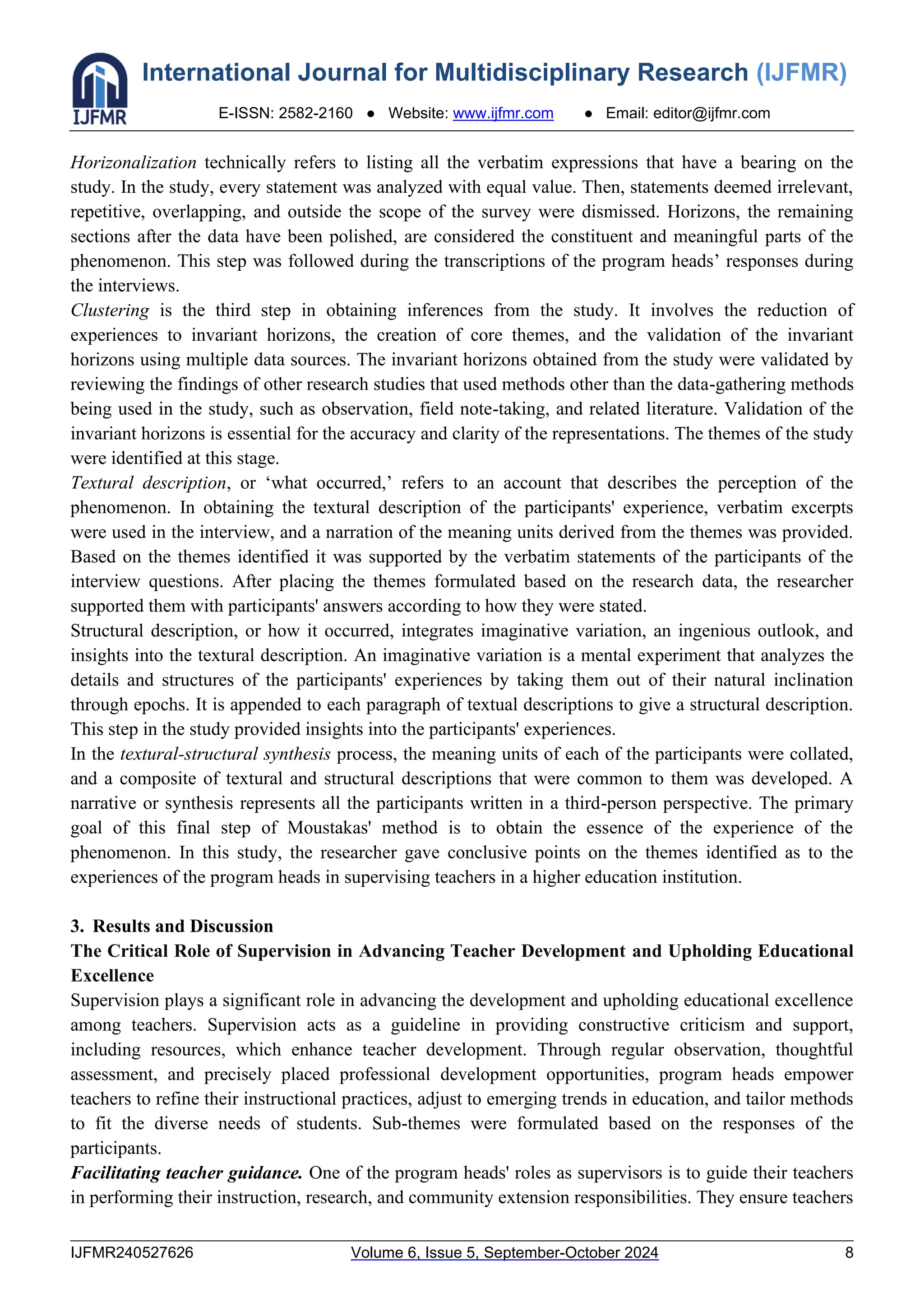
This phenomenological study was able to identify the following themes: facilitating teacher guidance,
maintaining academic standards, optimizing student learning outcomes, learning through teacher
supervision, feeling a sense of fulfillment, managing time constraints, navigating hurdles in evaluating
teachers’ performance, seizing hesitations in supervising experienced teachers, managing challenges
with teachers' report submissions, nurturing open communication, providing objective and constructive
feedback, embracing flexibility, and seeking support.
Facilitating teacher guidance. Good teacher supervision often includes mentorship and support.
Seasoned teachers or instructional coaches can mentor new educators, offering insights, strategies, and
emotional support in dealing with the rigors of teaching (Leng, 2023). The supervisor ensures that new
faculty members receive enough orientation and support to enable them to perform their duties
effectively and confidently and carry on the school's educational mission, policies, and procedures
(NAIS, 2024). Supervision tremendously influences the improvement of teachers' instructional skills and
fosters their motivation, contributing significantly to their continuous professional development
(Antonio, 2019).
Maintaining academic standards. The primary purpose of teacher supervision is to help improve the
quality of instruction. Supervisors observe teachers' performance and provide valuable feedback
regarding teaching techniques, content delivery, and classroom management (Leng, 2023). The
supervisor assesses and works to improve teaching through classroom visits, discussions with teachers,
and other methods that are fair and consistent with the practice of the individual school (NAIS, 2024).
Supervision encourages teachers to motivate them to work hard with high expectations, which can be a
basis for success. When supervision is weak, it hampers the teacher's effectiveness, and the quality of
teaching and learning is compromised, which affects students' academic attainment (Antonio, 2019).
Optimizing students’ learning outcomes. Teacher supervision is essential in ensuring students' holistic
development, a positive learning environment, and furthering the professional improvement of
educators. Supervision could allow teachers to note their students' needs and learning styles. Teachers
are then able to develop a tailored way of instruction to meet the different needs of each one of the
learners (Leng, 2023). Supervision is essential in fine-tuning teaching methodologies to encompass the
emerging educational landscape, further ensuring improved student learning experiences and outcomes
(Mulyanti, 2023). Supervision forms the keystone for creating an atmosphere that is both collaborative
and supportive, where teaching thrives for the eventual purpose of propelling student-driven learning
experiences (Gordon, 2023).
Learning through teacher supervision. Program heads are developing themselves as they lead and
support educators and educational supervisors during professional growth. In their manifold role,
curriculum development, instructional leadership, and teacher evaluation make the supervisor the main
driving force to actively engage teachers toward better instructional techniques, innovations, and
adaptation to changing educational trends (Vezy, 2023). Supervisors involved in educational supervision
also get the opportunity to improve their professionalism and competence from their role in guiding and
supporting teachers. In facilitating better teaching quality and professionalism, educational supervisors
International Journal for Multidisciplinary Research (IJFMR)
E-ISSN: 2582-2160 ● Website: www.ijfmr.com ● Email: editor@ijfmr.com
IJFMR240527626 Volume 6, Issue 5, September-October 2024 4
contribute to enhancing the learning results and standards in educational institutions (Nurulita et al.,
2021). Supervisors, therefore, increase their knowledge and expertise through their involvement in
instructional supervision while offering professional support necessary to teachers. However, findings
have shown that some problems need more support from educational authorities regarding resources and
supervisor training (Ashun & Acquah, 2021).
Feeling a sense of fulfillment. Supervisors immersed in their jobs are satisfied with leading teachers to
improve instructional performance that aligns with professional standards. They detect instructional
challenges quickly through careful observation and appraisal, enabling timely interventions that cultivate
teacher competencies and foster professional growth (Abubakr, 2018). Supervisors who find fulfillment
in their role know that directive supervision pays off both in enhancing teacher performance and attitude.
Recognizing the effectiveness of directive supervision is vital in improving teaching performance and
positive attitudes among teachers (Hoque et al., 2020). Supervisors who find fulfillment in their work
emphasize direct supervision of teachers' lesson planning and delivery since this dramatically influences
teacher role performance. This underscores the importance of allocating adequate time and resources for
effective instructional supervision, contributing to better teaching outcomes in public senior high schools
(Ampofo et al., 2019).
Managing time constraints. Some challenges supervisors may encounter in managing time include
employee procrastination, minimizing distractions in the workplace, prioritizing tasks by employees,
taking breaks for optimal performance, maintaining high levels of employee motivation, and applying
appropriate technology to leverage processes to gain efficiency (Symonds, 2024). Time management
challenges that a program head faces include how to handle procrastination among the faculty, how to
reduce the adverse effects of multitasking, how to minimize work environment distractions, how to
enhance prioritizing skills, and how to ensure that the most important work gets done (Connolly, 2023).
Navigating hurdles in evaluating teachers’ performance. Program heads face challenges in effectively
assessing teachers' performance based on poor execution, poor approaches, delayed feedback, and
disparities in evaluation processes, impacting the evaluation of teachers' performances (Rafiq et al.,
2022). Among the severe difficulties program heads face regarding teachers' performance evaluation are
questions on the validity of observation-based assessment, lack of meaningful feedback, privacy
problems over evaluation data, equity in differences among subjects and levels, and the time-consuming
nature of evaluation amidst competing demands. Difficulties in accurately assessing teachers'
capabilities and practical support for professional development are but a few of the challenges in
evaluating teachers' performance (Robinson, 2022). The program heads find it hard to assess the
teachers' performance in digital settings since very few teachers can master all tasks related to digital
teaching (Claro et al., 2018).
Seizing hesitations in supervising experienced teachers. The study has also shown that sometimes
supervisors are reluctant to provide negative but honest feedback to teachers. Teachers viewed
supervision as a fault-finding process, which made them feel anxious and bitter about the observation
process, contributing to a negative attitude toward supervision (Hoque et al., 2020). Some of them are
also reluctant to give objective yet somewhat negative feedback to the teachers for fear that it may be
perceived as something negative and not applicable or for fear that the one receiving it will not take it
well, which can create a culture of avoidance rather than constructive growth (Vollebregt, 2021). One of
the reasons why supervisors might be hesitant to provide negative yet honest feedback to teachers is the
International Journal for Multidisciplinary Research (IJFMR)
E-ISSN: 2582-2160 ● Website: www.ijfmr.com ● Email: editor@ijfmr.com
IJFMR240527626 Volume 6, Issue 5, September-October 2024 5
concern about teachers' receptivity to the input and their ability to discern the truth within it (Fulham et
al., 2022).
Managing challenges with teachers' report submissions. The problems supervisors face in submitting
academic reports are complex, involving quality, efficiency, and timeliness. Some of the implications
emanating from the findings are improved communication, strong partnerships, smooth processes,
building a committed culture, quality service, and empowering the supervisors (Bargo, 2022). One of the
problems and challenges of the 21st-century meaning of supervision is that the valued time of the
supervisors is tired of bookkeeping and form-filling. This leaves the supervisors with insufficient time to
do the real supervisory work (Suleiman et al., 2020). The challenges that instructional leaders
encountered in supervising in the news every day included issues in monitoring teachers' submission of
reports and utilizing creative methods of instruction (Magno, 2023).
Nurturing open communication. Communication between supervisors and teachers is effective since this
will ensure that reports are clearly articulated about areas of accomplishments and areas needing
improvement, thus minimizing inaccuracies and incompleteness of data (Bargo, 2022). Opening
communication between teachers and supervisors may help improve teacher performance and enhance
work motivation. Good academic supervision with interpersonal communication positively affects
teacher performance, indicating that detailed attention paid to teachers' needs with regular coaching will
improve skills in teaching and eventually enhance educational quality (Wardani et al., 2021). It is
underscored that the supervisors' communication skills are essential for open communication with
teachers, constructive feedback, solving problems, and establishing positive relationships (Chron, 2021).
Providing objective and constructive feedback. For heads of programs, giving objective feedback to
teachers is a challenge since they must navigate a delicate balance between constructive criticism and
personal feelings filled with uncertainty and apprehension (Vollebregt, 2021). However, teachers who
receive constructive feedback through supervision are better equipped to engage their students (Leng,
2023). Program heads often face the problem of providing objective feedback to their teachers since
concerns related to probable emotional reactions, ambiguity, time constraints, and personal stress can
hinder effective communication and behavior change (Grossman, 2022).
Embracing flexibility. The coping mechanisms employed by the instructional leaders included versatility
and flexibility in leadership. This indicates adapting their style and leadership approach to suit the new
regular's demands (Magno, 2023). Employing flexibility as a coping strategy, program heads can change
their behavior sensitively to the environmental cues when supervising teachers, which ensures adaptive
functioning in challenging circumstances. (Basińska et al., 2021). Flexibility is an essential coping
strategy for program heads supervising teachers, influencing the coping methods used amidst increased
psychological distress (Tindle et al., 2022).
Seeking support. Program heads can also solicit support from colleagues and supervisors to cope with
issues related to dealing with teachers and improving productivity, problem-solving skills, and teamwork
relationships in the workplace (Lodwick, 2024). An excellent way for supervisors to cope with behavior
management problems is to seek help from experienced colleagues called positive deviants (Rogers,
2019).
International Journal for Multidisciplinary Research (IJFMR)
E-ISSN: 2582-2160 ● Website: www.ijfmr.com ● Email: editor@ijfmr.com
IJFMR240527626 Volume 6, Issue 5, September-October 2024 6
Objectives of the Study
This study explored the experiences of program heads in supervising teachers in a local community
college in Tangub City, Misamis Occidental. Specifically, this sought to answer the following questions:
1. What are the program heads’ perceptions of the importance of supervising
teachers?
2. What are the participants’ experiences in supervising teachers?
3. What challenges have the participants encountered in supervising teachers?
4. How do program heads cope with the challenges of supervising
teachers?
2. Methodology
Research Design
This study employed a phenomenological design. Phenomenology is a qualitative non-dualistic research
approach. It identifies and retains the discourse of research participants (Barnard et al., 1999).
Phenomenological research focuses on exploring and understanding human experiences as they are lived
and perceived by people (Larsen & Adu, 2021). This design was considered appropriate in studying the
lived experiences of program heads in supervising teachers.
Research Setting
The research was conducted in a community college in Tangub City, Misamis Occidental, Philippines.
This institution offers fifteen programs, and each program head supervises faculty members. There were
233 faculty members, 99 of whom were part-timers from six institutes. As of the First Semester of
School Year 2023-2034, there were 5, 959 students enrolled. The institution has undergone a Level 2
accreditation for BSED-Math, BEED, BSED Social Studies, BSED English, and AB Political Science in
December 2022. A year later, other programs that undertook a level 2 accreditation are BSOA, BSED
Filipino, BSBA HRM, AB Communication, AB English, BS Criminology, BS Computer Science, and
Diploma in Midwifery in December 2023.
The Critical
Role of
Supervision
Challenges
in Teacher
Supervision
Mutual
Learning
and Growth
in Teacher
Supervision
Effective
Communication
Strategies in
Teacher
Supervision
Experiences of
Program
Heads in
Supervising
Teachers
International Journal for Multidisciplinary Research (IJFMR)
E-ISSN: 2582-2160 ● Website: www.ijfmr.com ● Email: editor@ijfmr.com
IJFMR240527626 Volume 6, Issue 5, September-October 2024 7
Research Participants
The participants of this study were the program heads from the different institutes in the college. The 11
participants were identified through purposive sampling. The actual number of participants was based on
data saturation. The program heads were selected based on the following criteria: 1) current program
heads who have served the program for one complete semester in the institution, and 2) gave consent to
participate in the study. Moreover, program heads who were just installed during the Second Semester of
2023-2024 were not included as participants of the study.
Data-Gathering Procedure
Before conducting the study, the researcher sought permission from the Dean of the Graduate School of
Misamis University in Ozamiz City. Permission was also obtained from the Office of the Vice President
for Academic Affairs of the institution where the study was conducted. Upon the approval of the letter
request, a researcher-made structured Interview Guide was used to obtain data from the participants'
experiences in supervising teachers. In addition, the researcher interviewed the participants based on
schedules identified and agreed upon.
The participants were informed that the information collected would be kept confidential. The
participants were told they could withdraw from the study at any time. They were required to fill in an
Informed Consent form. After identifying the final set of participants, the interviews were scheduled and
recorded digitally, followed by transcriptions. The interviews were conducted face-to-face to ask further
questions. The interviews took from forty-five minutes to one hour each. The interviews began by
identifying the participants and reviewing the purpose of the research. Then, the participants were
required to review the drafts of the study's written report to obtain additional feedback and establish
accuracy.
Research Instrument
The Interview Guide was used to conduct in-depth interviews. The participants were interviewed about
their experiences in supervising teachers or instructors. They were also asked about their challenges,
coping strategies, learning, and suggestions for the supervision of teachers. In this study, the researcher
developed the Interview Guide. Experts in qualitative research were asked to do the content validity test
to validate the interview guide questions. Interview questions underwent pilot interviews before
conducting the study to check for clarity and ensure they solicited information in response to the
research questions.
Data Analysis
This study utilized the Moustakas’ transcendental phenomenology of data analysis using NViVO
software, where codes and categories were extracted. The following are the steps in the
phenomenological reduction which served as a guide in analyzing the data gathered: (1) Bracketing, (2)
Horizonalization, (3) Clustering into Themes, (4) Textural Description, (5) Structural Description, and
(6) Textural-Structural Synthesis.
Bracketing is an approach used to mitigate the effects of preconceived notions and perceptions to be held
before the study starts. It is a process of suspending judgments and biases, or 'epoche.' The step helps
reach a deep level of inquiry from topic and population selection, interview design, collection and
interpretation, and dissemination of research findings. This step was followed during the selection of the
participants, as to how the data were collected and interpreted in identifying the experiences of the
program heads in supervising teachers as the study participants.
International Journal for Multidisciplinary Research (IJFMR)
E-ISSN: 2582-2160 ● Website: www.ijfmr.com ● Email: editor@ijfmr.com
IJFMR240527626 Volume 6, Issue 5, September-October 2024 8
Horizonalization technically refers to listing all the verbatim expressions that have a bearing on the
study. In the study, every statement was analyzed with equal value. Then, statements deemed irrelevant,
repetitive, overlapping, and outside the scope of the survey were dismissed. Horizons, the remaining
sections after the data have been polished, are considered the constituent and meaningful parts of the
phenomenon. This step was followed during the transcriptions of the program heads’ responses during
the interviews.
Clustering is the third step in obtaining inferences from the study. It involves the reduction of
experiences to invariant horizons, the creation of core themes, and the validation of the invariant
horizons using multiple data sources. The invariant horizons obtained from the study were validated by
reviewing the findings of other research studies that used methods other than the data-gathering methods
being used in the study, such as observation, field note-taking, and related literature. Validation of the
invariant horizons is essential for the accuracy and clarity of the representations. The themes of the study
were identified at this stage.
Textural description, or ‘what occurred,’ refers to an account that describes the perception of the
phenomenon. In obtaining the textural description of the participants' experience, verbatim excerpts
were used in the interview, and a narration of the meaning units derived from the themes was provided.
Based on the themes identified it was supported by the verbatim statements of the participants of the
interview questions. After placing the themes formulated based on the research data, the researcher
supported them with participants' answers according to how they were stated.
Structural description, or how it occurred, integrates imaginative variation, an ingenious outlook, and
insights into the textural description. An imaginative variation is a mental experiment that analyzes the
details and structures of the participants' experiences by taking them out of their natural inclination
through epochs. It is appended to each paragraph of textual descriptions to give a structural description.
This step in the study provided insights into the participants' experiences.
In the textural-structural synthesis process, the meaning units of each of the participants were collated,
and a composite of textural and structural descriptions that were common to them was developed. A
narrative or synthesis represents all the participants written in a third-person perspective. The primary
goal of this final step of Moustakas' method is to obtain the essence of the experience of the
phenomenon. In this study, the researcher gave conclusive points on the themes identified as to the
experiences of the program heads in supervising teachers in a higher education institution.
3. Results and Discussion
The Critical Role of Supervision in Advancing Teacher Development and Upholding Educational
Excellence
Supervision plays a significant role in advancing the development and upholding educational excellence
among teachers. Supervision acts as a guideline in providing constructive criticism and support,
including resources, which enhance teacher development. Through regular observation, thoughtful
assessment, and precisely placed professional development opportunities, program heads empower
teachers to refine their instructional practices, adjust to emerging trends in education, and tailor methods
to fit the diverse needs of students. Sub-themes were formulated based on the responses of the
participants.
Facilitating teacher guidance. One of the program heads' roles as supervisors is to guide their teachers
in performing their instruction, research, and community extension responsibilities. They ensure teachers
International Journal for Multidisciplinary Research (IJFMR)
E-ISSN: 2582-2160 ● Website: www.ijfmr.com ● Email: editor@ijfmr.com
IJFMR240527626 Volume 6, Issue 5, September-October 2024 9
receive personalized support and mentorship to accomplish their tasks efficiently. Two of the
participants gave the following statements:
"As a program head, it is important to provide guidance/supervision to the teachers of the
program." (P1)
"As a program head, I believe that providing supervision to teachers within the
community college context is very important. For instance, we have new faculty members
each year in need guidance on what and how to do things related to instruction, research,
and extension.” (P9)
Participant 1 highlighted the importance of this role by pointing out that a program head needs to guide
and supervise the teachers. The program heads' responsibilities include leading and developing the
faculty members in their program. Through guidance and supervision, program heads help ensure that
instructions are of good quality and in line with educational standards.
Participant 9 emphasized that every year comes with its problems and opportunities since new faculty
can be on board. Supervision can be instrumental since new faculty must be guided in various
instruction, research, and extension aspects. Program heads serve as mentors and facilitators through
whom new faculty can be given support, resources, and expertise to settle into their roles and
responsibilities effectively.
Program heads guide and mentor teachers in their instructional practices to ensure that they align with
the educational standards and enable quality learning. Also, the number of new faculty members who
join the program each year is quite dynamic. The program head must innovate guidance and support
depending on the incoming faculty to offer them the necessary resources and expertise for better
induction. Therefore, this suggests that the head of the program plays a critical role in mentorship and
facilitation to provide an enabling and nurturing environment that enable faculty members to effectively
perform their instructional, research, and community engagement duties. After all, the effective
leadership and mentorship of program heads significantly contribute to the success and development of
the faculty members in the program for the general enhancement of quality education and improved
student learning outcomes.
Maintaining academic standards. Ensuring excellence in education and fostering a culture of
continuous improvement in teaching effectiveness are the most critical objectives in the college’s
educational framework. Teacher supervision is an indispensable means of doing so, as it carries a
multifaceted role in maintaining standards, fostering professional development, and nurturing a culture
of excellence. Through constant supervision, educators receive valuable feedback on teaching
techniques, which they need to refine their practices to enhance student learning outcomes. The
following were the responses of the participants:
"Supervising teachers is vital for maintaining educational standards, fostering teacher
development, and creating a culture of excellence.” (P2)
"The importance of providing supervision to teachers within the context of the community
college in Tangub City is to enhance teaching effectiveness as supervision offers valuable
feedback on teaching techniques." (P3)
“Teacher supervision helps improve the teaching and learning environment since faculty
performance is constantly monitored. I constantly assess the teachers’ performance under
the program I am handling. This helped the teachers to monitor and improve our technology,
pedagogy, and content knowledge.” (P4)
International Journal for Multidisciplinary Research (IJFMR)
E-ISSN: 2582-2160 ● Website: www.ijfmr.com ● Email: editor@ijfmr.com
IJFMR240527626 Volume 6, Issue 5, September-October 2024 10
"Supervision is essential to investigate faculty who are not giving what is due to students. It
ensures that quality education is given and at the same time promotes academic freedom."
(P5)
“I consider providing supervision to teachers as crucial in my role as a program head
because I am the person who shall provide them with necessary actions and feedback to
improve their overall teaching.” (P7)
“Supervision of teachers is vital for fostering a supportive learning environment and the
overall quality of instruction and academic services for the students.” (P8)
“Providing supervision . . . enhances the teaching and learning environment by fostering a
supportive and collaborative atmosphere.” (P10)
Participants 1 and 5 described supervision as vital in sustaining educational standards through promoting
the development of teachers. By promoting the professional development of teachers through
supervision, they can improve the quality of education they provide to the students, thus creating a
culture of excellence among them. Participants 3 and 7 added that the teachers can enhance their
teaching quality through supervision, wherein they can be informed about their strengths and
weaknesses. These teachers may be given honest and objective feedback regarding how they deliver the
lessons and perform other instructional workloads. They empower their strengths and work on their
weaknesses to provide quality learning to their students.
In addition, Participants 4, 8, and 10 mentioned that supervision enhances the teaching and learning
environment, which is crucial to improving the overall teaching quality. The claim emphasizes how
necessary teacher supervision is for strengthening the teaching and learning environment in the college.
Participant 4 showed that when one is being continually monitored over faculty performance, it leads to
improving TPACK. Teachers must be assessed for their performance regularly, and feedback is given to
them to enhance professional growth and development, significantly improving instruction quality. In
this way, it fosters continuous improvement and keeps educators updated on the most appropriate
practices in teaching.
Participant 8 emphasized the importance of teacher supervision for a good and supportive learning
environment. By guiding, giving feedback, and providing teachers with resources, the supervisors give
quality instructions and other academic services to the students. It includes a supportive learning
environment, which enriches student engagement and motivation, facilitates good teacher-student
relationships, and yields better learning outcomes. Participant 10 reiterated the same idea, emphasizing
how supervision facilitates a supportive and collaborative atmosphere. A culture whereby teachers feel
supported in their professional growth and development is created through fostering open
communication, collaboration, and teamwork among teachers. This is, in turn, beneficial not only to the
teachers but to the students.
The teacher supervision plays a critical role in sustaining and improving educational standards and the
professional growth of educators in the college. In this respect, promoting teachers' professional growth
through supervision by program heads contributes to the enhancement of quality education given to the
students and the development of a culture of excellence in the institution. Through supervision, teachers
can upgrade the quality of teaching since honest and objective feedback about their instruction practices
enables them to address their weaknesses and capitalize on their strengths to produce quality learning
experiences for their students. Furthermore, supervision enhances the teaching and learning environment
by fostering a supportive atmosphere, enriching student engagement and motivation, and facilitating
International Journal for Multidisciplinary Research (IJFMR)
E-ISSN: 2582-2160 ● Website: www.ijfmr.com ● Email: editor@ijfmr.com
IJFMR240527626 Volume 6, Issue 5, September-October 2024 11
solid teacher-student relationships. Therefore, the implication is that adequate teacher supervision is
indispensable for sustaining high educational standards and promoting a culture of excellence in the
college.
Optimizing student learning outcomes. Supervision entails ensuring that the best practices of
instruction, curriculum, and learning strategies are aligned to maximize student achievement and growth.
Therefore, through identifying the needs for improvement, availing professional development
opportunities, and providing a culture of continuous improvement, supervision helps create an enabling
environment in which students can have the best chance to develop academically and socially.
Supervision ensures that every student receives a quality education and can achieve the desired learning
outcomes. The following statements were given by the participants:
“But I also guide and provide suggestions whenever it is necessary to help meet the
objectives and help the students learn the best.” (P5)
“I can identify areas of improvement, ensure that they meet necessary standards, and
guarantee students receive quality education.” (P7)
“If I supervise my teachers very well, I believe that they will be able to give the best
quality of learning to the students.” (P8)
"For me, providing supervision to the teachers is crucial to maintaining the best quality
of learning the students deserve. As a program head, I must oversee how my teachers
teach their students. It can be done when I regularly conduct informed and pop-in
classroom observations." (P11)
Participants 5 and 7 recognized the importance of support for teachers to ensure that students receive the
best learning experience. Program heads can identify the weak areas among the teachers and the former
can give feedback to ensure that the latter demonstrate the standards in teaching, leading to quality
education for students. This is a dedication to the objective of developing and sustaining excellent
standards of teaching and learning. Moreover, Participants 8 and 11 felt claimed that proper supervision
of teachers may result in the best quality learning experience for students. By supporting and mentoring
teachers, they want to ensure that students receive high-quality education relevant to their needs and
promote academic excellence. They believed that the quality of education that students deserve is
through supervision. They said that as program heads, they emphasized regular classroom observation to
monitor the teaching practices and ensured that these practices aligned with the educational goals. Thus,
the program heads needed to be proactive to creating a conducive learning environment to benefit the
students.
The commitment of the program heads to securing the best education for the students is through
adequate teacher supervision. Through the collective emphasis on the need for support, guidance, and
mentorship for teachers to advance the learning experience for students, the participants underscored
their critical role in ensuring excellent standards in the teaching-learning process. They identified areas
of concern in education delivery and ensured that teachers upheld the required standards. Thus, the
dedication to quality education is indicated by proactive classroom observation to monitor teaching
practices and see whether they align with education goals. Proper supervision and support of teachers by
the program heads are crucial to developing a learning environment that promotes academic excellence
and secures successful outcomes for students in the college.
Supervisory skills are essential in increasing teacher capacity using instructional supervision. There is a
positive relationship between supervisory skills and teacher capacity, which means much for improving
International Journal for Multidisciplinary Research (IJFMR)
E-ISSN: 2582-2160 ● Website: www.ijfmr.com ● Email: editor@ijfmr.com
IJFMR240527626 Volume 6, Issue 5, September-October 2024 12
supervision practices toward strengthening instructional practice and learning outcomes (Makin et al.,
2018). Adequate academic supervision plays a critical role in improving the quality of education. Such
challenges like low support, inspection-focused supervision, and lack of dedication hamper the
improvement of teaching-learning processes; hence, addressing these issues can ensure that educational
leaders play their supervisory roles effectively to advance quality education (Alam et al., 2021). Lastly,
educational leaders’ supervision significantly affects teachers' high-quality performance and academic
work environment. It shows that a positive relationship with school leaders and workgroup
encouragement would help develop a learning environment and overcome teaching challenges in dealing
with unruly and aggressive student behavior (Kilag et al., 2023).
Teachers in the field are responsible for educating individuals who will later take mature roles as
members of society. Thus, these educators must ensure they can deliver quality instruction so that the
students become well-equipped with the needed knowledge and skills to discharge their responsibilities
later in life. In this regard, program heads must ensure that they give supervision to teachers under their
department so that the latter can consistently provide the students with meaningful and adequate learning
experiences toward the achievement of excellence in their studies and embody the quality of education
that schools are mandated to uphold.
Mutual Learning and Growth: The Role of Program Heads in Teacher Supervision
The theme that emerged from the participants' positive experiences in supervising teachers is mutual
learning and growth, emphasizing the role of the program heads in teacher supervision. It reveals the
dynamic exchange of knowledge, support, and guidance between program heads and teachers, leading to
collective professional development and improvement of teaching effectiveness. With combined efforts
and proactive contributions, program heads help make the environment conducive to continuous
learning, entrenching a culture of excellence and innovation within educational settings. Participants'
experiences revealed the valuable insight on adequate teacher supervision has on educators and students.
The subthemes are learning through teacher supervision and feeling a sense of fulfillment.
Learning through teacher supervision. There is a dynamic sharing of ideas, best practices, and
innovative strategies by teachers with program heads, which contributes to the latter's professional
growth. Working with teachers, the head of the program can learn what is effective in delivering
instruction, how to manage students inside the classrooms, and new trends in education. In this way,
there can be continuous improvement and a spirit of mutual support, enhancing teacher supervision
effectiveness and the quality of education given to the students. The following were the participants’
statements:
“I was able to enhance my learning and improve myself in the supervision of instruction.
Through constructive feedback to teachers and monitoring their professional development
fostered their growth as educators, I also found myself developing professionally.” (P3)
“Supervising teachers helps me reflect on my performance as well. It reminds me of what I
must and must not do in teaching-learning process. I also get to have a chance to learn
new strategies used by the teachers I supervised.” (P4)
These participants collectively conveyed the relationship between learning and growth that teacher
supervision offers. They claimed that supervising teachers enhances the teachers’ professional
development and improves the program heads. Participants 3 and 4 emphasized that providing
constructive feedback and monitoring teachers' progress lead the program heads’ personal and
International Journal for Multidisciplinary Research (IJFMR)
E-ISSN: 2582-2160 ● Website: www.ijfmr.com ● Email: editor@ijfmr.com
IJFMR240527626 Volume 6, Issue 5, September-October 2024 13
professional growth. Supervising makes one reflect within and learns new strategies from the teachers
being supervised.
“Majority of our faculty have been in the academe longer than I have, so by sitting in or
observing their classes and occasions where they share their thoughts, I learn from them. I
also grow through interaction with my faculty and observing them.” (P5)
“Through supervising teachers, like sitting in their classes and doing one-on-one
conferences, I also learn many things from them. It is like a win-win situation since I help
them perform better in teaching the students, and they also help me perform better in
supervising them.” (P6)
“For me, supervision is not one-way since both the program head and the teachers get to
learn from each other during formal observations and feedbacking. I have learned from the
teachers as well." (P10)
Likewise, Participants 5, 6 and 10 described supervision as a mutual learning opportunity where
both parties could benefit. As supervisors, program heads learned from the teachers' experiences
and insights through the guidance they gave to improve the teaching practices. They emphasized
that during supervision, the program heads and teachers learned from each other during formal
observations and feedback.
“I have learned from the teachers’ ideas during conferences, which help me improve my
supervision practice.” (P8)
“… becoming the program head has widened my horizons and added to my professional
experience. I have learned how to deal with people effectively, monitor programs, and
resolve conflicts, which greatly help me grow.” (P11)
Finally, Participants 8 and 11 said that through interactions with teachers during conferences, they
learned and thus developed professionally, showing the two-way direction of learning in supervision.
They emphasized that the role of program head broadened their horizons because they had precious
experiences in dealing with people, monitoring programs, and resolving conflicts, contributing to the
program heads’ development.
Collectively, the participants highlighted that supervision contributes to professional development in
teaching and the program heads themselves. The latter facilitate the teachers grow through constructive
feedback, monitoring, and reflection, which also help the latter develop professionally. This dynamic of
mutual learning is further underscored by the recognition that supervision offers a platform where
program heads and teachers share insights, experiences, and innovative strategies. The role played by
program heads in gaining broader horizons through diverse experiences in handling teachers, monitoring
programs, and conflict resolution generally shows the multifaceted nature of growth opportunities within
the supervision process. This implies that teacher supervision acts as a spur for educators and
supervisors in continuous learning and development toward better teaching practices and improved
quality of education.
Feeling a sense of fulfillment. This theme epitomizes the intense satisfaction and fulfillment of the
program heads as they monitor teachers. It shows a robust and rewarding emotion brought about by
seeing the improvement, growth, and success of the educators they mentor. The programs instituted by
these heads reflect a delicate interaction between personal values and professional undertakings in which
these program heads derive happiness and fulfillment by empowering and supporting their teachers to
realize their goals and contribute effectively to the educational field. This feeling reflects the concrete
International Journal for Multidisciplinary Research (IJFMR)
E-ISSN: 2582-2160 ● Website: www.ijfmr.com ● Email: editor@ijfmr.com
IJFMR240527626 Volume 6, Issue 5, September-October 2024 14
results of adequate supervision and the intrinsic rewards of creating a supportive and enriching
environment that promotes professional growth and excellence. The participants cited that:
“I am just thankful that my faculty members are receptive to feedback and comments. . .. I
remain motivated and resilient despite the struggles since the teachers are willing to work
cooperatively.” (P1)
“I have had positive experiences like seeing teachers grow, students succeed, fostering
collaboration, encouraging innovation, and building strong relationships with teachers.”
(P2)
“I find it most rewarding for me, as their program head, when my teachers willingly accept
my suggestions and feedback for improving their teaching or engagements such as
community extension and research. Moreover, when I see them applying my comments and
suggestions by making noticeable changes to their teaching strategies and methods, I could
say that I can supervise them well.” (P7)
“The sense of fulfillment knowing that I was able to extend help to my colleagues is very
special to me, something that I will forever treasure.” (P9)
The participants all underscored the rewarding sides of supervising teachers and fostering a
collaborative, supportive environment in the educational setting. Participant 1 was grateful that the
faculty members' receptive attitude toward feedback and comments made him stay resilient during
difficult times. Similarly, Participant 2 pointed out the positive experiences of watching teachers grow,
student success, and building collaboration and innovation, indicating the supportive and enriching
environment. For Participants 7 and 9, they stressed that the willingness of teachers to accept
suggestions and ideas and record improvements in teaching strategies and methods encouraged them
toward their supervisory role. These responses, therefore, raise the importance of mutual respect,
cooperation, and supportive relationships in the supervision process, fostering a setting that is supportive
and conducive to continuous improvement and success for both teachers and students.
The participants expressed fulfillment and satisfaction in observing teacher and student growth and
success, building cooperation, stimulating innovation, and building solid and cordial relationships within
the educational community. The responses highlight the positive impacts of adequate teacher
supervision in collaboration, growth, and success within the educational setting. Moreover, the
rewarding nature of observing teachers apply feedback and seeing noticeable changes in the strategy
they adopt for teaching underlines the changing power of good supervision for the practices of teaching
and student outcomes. Generally, positive experiences from adequate teacher supervision contribute to a
supportive, thriving educational environment that benefits the educators and the students.
Education leaders also gain positive experiences from supervising teachers. It helps them identify and
deal with gaps in their leadership by empowering teachers with the necessary skills and knowledge to
contribute meaningfully toward school improvement efforts (Barnett, 2024). Systematic teacher
supervision allows educational leaders to gain insight into teaching practices and student learning
outcomes (DiPaola & Wagner, 2018). Supervision by teachers helps school leaders in performance,
competencies, and professional development for making informed decisions and targeting support
strategies (Reambonanza & Tan, 2022).
Supervisors are given the tasks of monitoring and supervising the teachers in their department to ensure
that the quality of education is upheld. Nevertheless, while giving supervision, the heads of the program
are provided with venues to reflect on their teaching practices, wherein there can also be room for
International Journal for Multidisciplinary Research (IJFMR)
E-ISSN: 2582-2160 ● Website: www.ijfmr.com ● Email: editor@ijfmr.com
IJFMR240527626 Volume 6, Issue 5, September-October 2024 15
improvement. Though the program heads take more responsibility for the quality of work that other
teachers render, the supervisory work allows them to widen their perspectives on teaching. It enables
them to identify the areas they need to upgrade to become more effective educators.
Overcoming Challenges in Teacher Supervision: Time Management, Consistency, and Profession-
al Dynamics
Supervising teachers is a multifaceted task that requires keen attention and skillful handling from the
program heads. Within this critical role, program heads face a few problems that may challenge their
commitment and competence. From time management to harmonious relationships with educators and
detailed submission of reports to the protection of quality teaching, each aspect carries a problem. In ad-
dition, program heads take the arduous task of guiding the initiatives and activities toward realizing pro-
grams, ensuring they are implemented and thrive in the long run. Thus, supervising teachers emerges as
a duty and a dynamic enterprise full of challenges that need proactive navigation and commitment. The
sub-themes include managing time constraints, navigating hurdles in evaluating teachers’ performance,
seizing hesitations in supervising experienced teachers, and managing challenges with teachers' report
submissions.
Managing Time Constraints. For a program head, time constraints management means the proper use of
available time for various activities and duties to be carried out within a given time limit. The concern
involves synchronizing schedules, prioritizing activities, and ensuring all necessary activities are han-
dled effectively despite the time constraints. It requires strategic planning, delegation, and adapting to
unforeseen circumstances without losing productivity and meeting deadlines. Below are the statements
from the participants.
“The challenges I face in supervising teachers involve difficulty in managing time effective-
ly, balancing administrative tasks while providing effective support and feedback to teach-
ers within limited time frames.” (P3)
“Some of my challenges include limited time to conduct thorough observation and confer-
ences. I have to remind them from time to time. Another thing is that sudden reports must
be submitted, which are difficult to accomplish due to the limited time given.” (P8)
The responses by the participants suggest the multifaceted nature of time management issues for pro-
gram heads in their supervision of teachers. Participant 3 pointed out how difficult it was to balance ad-
ministrative duties with providing support and feedback to teachers, given the time constraints. It sug-
gests that program heads must balance managerial responsibilities and professional development in their
teaching force.
Participant 8 expressed his difficulty conducting comprehensive observations and conferences because
of a lack of time, compounded by the sudden call for report submissions. Time concerns hindered him
from giving effective feedback and disrupted the continuity of support and development endeavors for
teachers. Therefore, there is a need for streamlined processes and better communication so that time is
optimized, and administrative duties and teacher support initiatives are provided effectively.
"One of the difficulties/challenges that I have encountered is doing administrative tasks
which are sometimes hard to accomplish because of the short period given.” (P9)
“Especially, time constraints and sudden accomplishments and submission of reports. They
somehow consume much of my time, and I only have limited time spent attending to the
concerns of my teachers.” (P10)
International Journal for Multidisciplinary Research (IJFMR)
E-ISSN: 2582-2160 ● Website: www.ijfmr.com ● Email: editor@ijfmr.com
IJFMR240527626 Volume 6, Issue 5, September-October 2024 16
Besides, Participants 9 and 10 highlighted the all-prevalent time constraints on administrative functions
and responsiveness to teacher concerns. P9's difficulty executing administrative functions within com-
pressed timelines conveys the need to prioritize and even delegate some of those responsibilities to ease
the burden. The time-consuming report submissions and their subsequent implication on how teacher
concerns are dealt with bring to the fore the need for optimized workflow efficiencies and strategies for
coping with sudden demands. In short, these responses collectively underscore the need for proactive
time management strategies, streamlined processes, and effective lines of communication to navigate the
intricate landscape of supervising teachers within limited time frames.
Navigating hurdles in evaluating teachers’ performance. Evaluation of teachers' performance is one of
the biggest challenges a program head faces when they are tasked with supervising teachers. This theme
embodies the difficulties and challenges that come with effectively and accurately appraising and giving
feedback on the effectiveness of teaching by teachers in the classroom. It includes making fair and com-
prehensive judgments, eliminating biases, dealing with different teaching styles and contexts, and ensur-
ing that goals and institutional standards are met. The statements below were the responses given by the
participants:
“I supervised a teacher who was too proud of herself. In other words, her actions were not
aligned with her talk. After my class observation, she was disappointed with her score, so I
gave her a second chance to be observed.” (P1)
“Another one is difficulty in addressing the varied levels of teachers’ performance and in-
structional approaches while maintaining fairness and equity in providing feedback and
support.” (P3)
"One of the challenges I had in supervising teachers is that I find it hard to evaluate their
actual performance in classes according to how I see it during observation and how their
students describe it during their regular classes. Teachers tend to perform better during
class observations than the regular classes." (P4)
These participants' responses speak of the various challenges that program heads experience in assessing
teachers' performances. Participants 1 and 3 dealt with differences in performance levels and teaching
styles and made judgments based on fairness and equity in giving feedback. The evaluation processes
need to consider individual styles and contexts, while maintaining consistency and equity in the delivery
of feedback. Hence, flexible frameworks of assessment need to be considered to accommodate a variety
of teaching practices and answer to the specific needs of every teacher.
According to Participant 4, teachers performed differently during formal observations compared to their
performance during regular class sessions. In this regard, program heads found it difficult to assess the
actual effectiveness of teachers, as observed behaviors might not be consistently demonstrated in usual
teaching-learning process. To overcome this difficulty, program heads must consider multiple assessment
methods, including peer observations, student feedback mechanisms, and ongoing professional devel-
opment opportunities, to understand teachers' performance comprehensively and foster continual im-
provement. Overall, these participants’ responses could shed light on the complexity of assessing teacher
performance and the need for tailored approaches to cope with the varied problems that arise in doing so.
Seizing hesitations in supervising experienced teachers. This theme focuses on how a program head
might feel some form of reluctance or uneasiness because of factors such as differences in age, perceived
authority, academic achievements, and feelings of inferiority. The hesitations of program heads could be
caused by the teachers resenting them, questioning their authority or competence, giving offense, and
International Journal for Multidisciplinary Research (IJFMR)
E-ISSN: 2582-2160 ● Website: www.ijfmr.com ● Email: editor@ijfmr.com
IJFMR240527626 Volume 6, Issue 5, September-October 2024 17
considering them co-equals or even lesser in educational attainment and status. The following statements
were given by the participants:
“The challenges I faced in supervising teachers initially included hesitancy in addressing
issues due to fear that they might resent me for correcting them. Additionally, being young-
er than some of the teachers added to my concerns. I am hesitant when I supervise and
provide feedback because they are much older and more experienced than I am.” (P2)
“First, it would be that I am merely a job order employee; my workload should not have
included administrative work such as being program head. Program heads' authority level
in such a case could be diminished, further causing hesitation to discipline any already
tenured faculty.” (P5)
The participants' responses collectively highlight program heads' complex challenges in supervis-
ing experienced teachers. Participants 2 and 5 articulated hesitations based on age-related concerns and
the fear of gaining resentment from more experienced, older teachers when giving corrective feedback.
The claims of the participants bring to the fore the sensitive balance that a program head must achieve in
developing authority and credibility, mainly where there is an age difference with the teachers they su-
pervise.
“Though I have been designated as a program head for years, I still feel like more of a
subordinate. So, I struggle supervising teachers in their workload management and teach-
ing practice since I feel uneasy. I hesitate that during the conferences with them, I might
say something that upset them or hurt their ego.” (P6)
“First, is because of inhibition, and second, because of stagnation. Sometimes, I was reluc-
tant to provide suggestions to my teachers because I perceived myself as on equal footing
with them as we all have master’s degrees and receive the same salary.” (P7)
Participants 6 and 7 simultaneously discussed their feelings of subordination despite being program
heads for several years. They revealed inhibition and stagnation in providing suggestions to teachers be-
cause program heads and teachers have equal educational backgrounds and salaries, suppressing their
ability to enact their leadership roles effectively.
“One personal challenge I had is that I feel a sense of uneasiness evaluating teachers who
have higher academic achievement and experiences than I have.” (P4)
“And during the supervision session, sometimes I hesitated to be objective in evaluating
their performance during the feedback because some of my faculty have higher educational
attainment than I have.” (P10)
Moreover, Participants 4 and 10 said they were hesitant to evaluate teachers with higher academic
achievements and experiences, indicating issues in perceived competence and confidence in assessment
judgments. This stresses the importance of professional development opportunities for program heads to
better equip them with the skills needed to objectively evaluate teacher performance and provide con-
structive feedback independent of the academic credentials of the teachers they supervise.
Managing challenges with teachers' report submissions. The program heads face one of the biggest
challenges in supervising teachers—managing problems with teachers' report submissions. This theme
describes frustration and disappointment when teachers failed to submit needed reports on time after
many reminders and proactive communication from the program head. The result of all these incomplete
submissions hampered the administrative processes' efficiency that could impede the institution's deci-
sion-making and evaluation efforts. The statements below were given by the participants:
International Journal for Multidisciplinary Research (IJFMR)
E-ISSN: 2582-2160 ● Website: www.ijfmr.com ● Email: editor@ijfmr.com
IJFMR240527626 Volume 6, Issue 5, September-October 2024 18
“Some of the teachers did not submit reports on time, which was frustrating for me since I
had to remind them from time to time.” (P8)
“Also, some faculty, especially part-time, sometimes reported to their classes and did not
submit necessary reports on time. It made me feel tired because I had to mitigate this con-
cern through consistent updates."(P9)
"One thing that makes supervising teachers challenging is when teachers do not submit the
necessary documents or reports. I always remind them in advance about what they must
comply with and submit to me, but it turns out that they are so preoccupied that they take
the submission of documents for granted. I cannot finalize my consolidated reports unless
they all submit their reports to me." (P11)
The statements of Participants 8, 9, and 11 convey the high level of frustration and exhaustion they expe-
rienced when teachers did not submit the required reports in time. They felt unhappy about constantly
needing to be reminded to get their submissions in due time. They were worried that it might be a recur-
ring issue, disrupting workflow and administrative efficiency. They also mentioned the additional chal-
lenge of part-time faculty members whose report submissions were inconsistent and led to fatigue due to
constant follow-up and updates. From these responses, the program heads needed to develop the value of
clear expectations and communication channels for addressing report submission issues.
Moreover, the participants also gave more emphasis on how report submissions could hinder the pro-
gram head's ability to complete consolidated reports. The participants claimed that managing preoccu-
pied teachers who failed to remember the importance of timely document submissions. In this vein, ac-
countability is essential for smooth administrative processes. Overall, the participants’ responses demon-
strate the need for proactive measures, such as constant reminders and clear communication, which pro-
mote responsibility and respect for deadlines by teachers to make an institution function efficiently.
Teacher supervision imposed various challenges on educational leaders, including program heads and
principals. There were challenges in managing overlapping responsibilities in strained budgetary condi-
tions, illustrating the complexity of their role and the need for increased support and preparation pro-
grams (Wieczorek & Manard, 2018). School leaders face difficulties in supervising teachers, including
poor road networks that hinder planned supervision, delayed responses to reports from supervision activ-
ities, and a lack of logistical support (Ashun, 2022). School leaders' instructional and supervisory chal-
lenges include centralizing school supervision activities, limited involvement of external supervisors,
insufficient instructional resources, and excessive administrative workload (William & Ligembe, 2022).
Giving supervision to other teachers may not be an easy task because it entails additional work responsi-
bilities. With the classes handled as faculty and other tasks also delegated to them, program heads may
also find it difficult to give priority, wherein the skills of time management can be tested. With the vari-
ous teaching responsibilities and supervisory functions needed, program heads can grapple with the chal-
lenges of staying effective in the expected work.
Effective Communication Strategies in Teacher Supervision and Professional Development
Effective communication is essential to successful teacher supervision and professional development. It
is the foundation on which collaboration thrives and is the ordeal in which teachers grow and students
flourish. For communication strategies in teacher supervision and professional development, the sub-
themes include nurturing open communication, providing objective and constructive feedback,
embracing flexibility, and seeking support systems. These coping mechanisms of the program heads’
challenges pave the way for a culture of growth and continuous improvement for teachers. This
International Journal for Multidisciplinary Research (IJFMR)
E-ISSN: 2582-2160 ● Website: www.ijfmr.com ● Email: editor@ijfmr.com
IJFMR240527626 Volume 6, Issue 5, September-October 2024 19
discussion intends to expound on communication to improve teaching practices and increase
professional growth through supervision.
Nurturing open communication. Among the coping strategies used to deal with these challenges is
nurturing open communication, which helps establish collaborative relationships and face challenges
head-on within the teaching environment. It shows how open communication becomes the basis for the
empowerment of the program heads to effectively navigate these challenges, build trust, and create an
atmosphere of transparency and mutual understanding within the educational community. Nurturing
open communication empowers the head of the program to build an environment that supports
professional development, constructive criticism, and, ultimately, improvement in teaching approaches
for the betterment of teachers and students. The following were the participants’ statements:
"For me, it is open communication channels. Whenever I hear concerns about or complaints
regarding my teachers from the students, I talk to them privately and share my concerns. I
also provide suggestions on how they solve the issue. I keep my communication open even to
those teachers who are not so willing for constructive feedback." (P1)
“I must maintain open and honest communication channels with teachers to address concerns
promptly and foster a supportive environment. Whenever there are miscommunications
among my teachers, I call their attention and sit down to discuss the issue. With this, I could
address my challenge in supervising teachers.” (P3)
The earlier statements underscore the importance of open communication as a coping strategy program
heads use in effectively supervising teachers. Participants 1 and 3 showed that student concerns were
proactively addressed and that private discussions with teachers involved sharing feedback and
suggestions on how the teachers could improve. This approach emphasizes the importance of open
communication in promoting a culture of accountability and continuous improvement within the
educational setting. Similarly, the participants noted the need to uphold honest communication channels
for addressing miscommunications at the earliest opportunity among teachers and, in so doing, help
create an environment supportive of professional development.
"To cope with challenges while supervising teachers, I focus on open communication, seek
support when needed, continuously develop my skills, stay flexible in my approach, and
reflect on experiences for personal growth." (P2)
"For the first challenge I faced, what I did was as the next grading started, I reminded or kept
them informed that I would sit in their classes unannounced occasionally. In this way, I may
obtain a more accurate and realistic evaluation of their performance in teaching. Having
constant communication with them through the announcement, I will be able to challenge
them to be at their best all the time.” (P4)
Furthermore, Participants 2 and 4 employed a holistic coping strategy that included open
communication, seeking help, continuous skill improvement, flexibility, and personal reflection. They
further emphasized the proactive nature of open communication by using surprise classroom
observations to get a realistic assessment of teacher performance. It depicts a desire for accountability
and improvement.
"I think the strategies I find the most effective is having constant communication with my
teachers." (P6)
"As the program head, I cope with the challenge of doing administrative tasks by asking for
guidance and having good or open communication so I will be guided properly with new and
International Journal for Multidisciplinary Research (IJFMR)
E-ISSN: 2582-2160 ● Website: www.ijfmr.com ● Email: editor@ijfmr.com
IJFMR240527626 Volume 6, Issue 5, September-October 2024 20
old tasks. I can avoid having disagreements with my teachers by employing open
communication. Whenever an issue arises, especially on how they instruct students, comply,
or submit reports, I immediately address it by calling their attention." (P9)
“Next is to have open communication – so that only I will be able to relay reliable
information regarding their performance and with that I will be able to guide them toward
improvement.” (10)
“I remind them all the time until they all submit the required reports. Constant
communication and updates are strategies I find effective in supervising my teachers.” (P11)
Participants 6, 9, 10, and 11 emphasized open communication as a coping mechanism to address their
challenges in supervising teachers. The participants highlighted the essential role of open
communication in advancing transparency, trust, and cooperation in educational institutions. Open
dialogue allows program heads to respond to concerns, remedy conflicts, and nurture a spirit of
continuous improvement among teachers. Also, the constant emergence of communication as a strategy
for coping emphasizes its role in mitigating challenges and improving administrative efficiency and
professional development. In conclusion, these qualitative insights reveal the transformative power of
open communication in driving adequate teacher supervision and fostering a supportive environment for
educational excellence.
Providing objective and constructive feedback. Providing objective and constructive feedback is a
coping strategy that the program heads employ to overcome the challenges of supervising teachers.
Since it is the purpose of program heads to perform their supervisory functions effectively, providing
feedback offers an effective way of facilitating conversation and addressing concerns in the pursuit of
teacher excellence. Program heads empower the teachers to reflect on their practices by providing
objective and constructive feedback, identifying areas that need development, and eventually improving
students' learning experiences. The following statements were given by the participants:
“I continue giving objective rating and constructive feedback and monitor if there are
significant improvements happening to them.” (P1)
“I opt to be objective and more constructive as possible so that, in a way, I can still provide
valuable information on how to improve myself even though some of them have higher
educational attainment and are more experienced than I am.” (P4)
“… and I always try to be honest and objective in supervising them so that they will know
what and how they can improve their teaching performance (P6)
“While I was evaluating one of the faculty who has higher education attainment than I do, I
did try to be objective and told him my comments and suggestions in the most respectful way
possible.” (10)
Participant 1 emphasized continuous giving of objective ratings and constructive feedback and ensured
constant monitoring to achieve improvements in teaching practices. It shows concern for improving
educators' professional growth and development with targeted feedback that encourages them to reflect
on improving. Moreover, Participants 4 and 6 claimed that objectivity and honesty in giving feedback
are essential regardless of the teachers' educational background or level of experience. Focusing on
objectivity, program heads ensure that feedback addresses clear, observable criteria rather than mere
subjective judgment. In so doing, a culture of fairness and accountability is fostered, wherein all teachers
have equal opportunities to improve and develop professionally.
International Journal for Multidisciplinary Research (IJFMR)
E-ISSN: 2582-2160 ● Website: www.ijfmr.com ● Email: editor@ijfmr.com
IJFMR240527626 Volume 6, Issue 5, September-October 2024 21
Participant 10 showed respect for how teachers with high educational attainment were given objective
but constructive ratings. This approach values the teachers' expertise and experience but offers valuable
ideas for enhancement. With objective and constructive feedback, program heads foster individual
teacher growth and general improvement in teaching practices that lead to better student learning
outcomes within the institution.
Embracing flexibility. As program heads perform their supervisory roles within dynamic circumstances,
adopting flexibility allows them to respond innovatively to changing demands, take advantage of
emerging opportunities, and build a resilient culture among teachers. This theme shows the impact of
flexibility as a coping mechanism that would allow program heads to effectively lead and support their
educational communities in times of uncertainty and change. The participants stated the following:
“… stay flexible in my approach and reflect on experiences for personal growth.” (P2)
“I also employ flexibility and adaptability to adjust my supervision approaches. In addition, I
utilize problem-solving skills, critical thinking, and creativity to address the concerns among
the teachers.” (P3)
“I had to be flexible when necessary but firm on my decision at the same time.” (P11)
Participant 2 stressed flexibility as it brings along personal growth through reflection. One had to stay
open to different insights. Program heads can develop methods, find ways to improve, and develop
dynamic leadership. Similarly, Participant 3 emphasized flexibility in response to the teachers' concerns,
which entails problem-solving, critical thinking, and creativity to manage difficulties and build
teamwork and constant improvement. Participant 11 added that flexibility must be balanced with
firmness—flexible decision-making that upholds standards. This nuanced approach helps program heads
negotiate uncertainties, maintains accountability, and supports teacher development.
Seeking Support. Seeking support from colleagues and experts becomes a critical coping strategy
program heads use to successfully face the challenges inherent in supervising teachers. As program
heads work hard to perform their supervisory roles in complex and ever-emerging demands, the art of
seeking support enables them to harness the knowledge and experiences of colleagues and experts to
create cooperation, innovation, and lifelong learning. Seeking support as a coping strategy allows
program heads to negotiate uncertainties, deal with challenges, and nurture a culture of support and
collaboration within educational institutions. The following responses were given by the participants:
“… but with the help of my dean who trained, guided, and empowered me, I gained the skills
necessary for the position.” (P2)
“It is basically through the help from other program heads in our institute that I was able to
perform my tasks.” (P4)
“I also ask questions whenever there is something I do not understand. It was a struggle at
first, but later I got used to the responsibilities a program head has.” (P6)
“Another is that I always ask our dean whenever I need to know more about something.” (P7)
The participants’ responses indicate the importance of seeking support from colleagues and experts as a
coping strategy program heads use to supervise teachers. Participants 2, 4, 6, and 7 all underscored the
precious role of mentorship and guidance in getting equipped with the necessary competencies for the
position they assume. Program heads can lead with more confidence and skill if needed by seeking
advice and support from more experienced colleagues or experts. This collaborative approach
encourages professional growth and establishes good working relations within the educational
community for adequate supervision.
International Journal for Multidisciplinary Research (IJFMR)
E-ISSN: 2582-2160 ● Website: www.ijfmr.com ● Email: editor@ijfmr.com
IJFMR240527626 Volume 6, Issue 5, September-October 2024 22
“Last is support networks – seek support from colleagues.” (P3)
“I cope with these challenges by consultation and connecting with other higher education
institutions, trying to benchmark their methods and consult higher-ups as to possible
application in my program.” (P5)
Participants 3 and 5 commented on the creation of support networks and the active consultation with
peers and external institutions. By tapping into people's collective knowledge and experiences, program
heads can realize diverse perspectives, share best practices, and be informed of novel educational
tendencies. Actively pursuing support enables program heads to address challenges, innovate in teaching
practices, and improve the quality of education within the institution. Consulting with higher education
institutions through higher authority and experts can help benchmark their methods, seek insights, and
explore opportunities for collaboration and improvement in service to the betterment of educational
excellence.
Indeed, program heads employ various coping strategies for their challenges. One is having open
communication. Good, clear, and consistent communication by the principals with their teachers
establishes trust, makes them understand each other better, and strengthens their relationship, all of
which contribute to the effectiveness of the school and its success (Dalton, 2024). Effective
communication between supervisors, program heads, and teachers enhances teachers' professionalism
and creates a strong sense of togetherness and kinship within the school community (Wijaya et al.,
2020). Other coping mechanisms that instructional leaders use in the new normal include versatility and
flexibility in leadership, overcoming such challenges as the lack of resources, communication barriers,
and age-related issues. Their supervisory competencies emphasize interpersonal skills essential to sail
through the complexity of supervising in the ever-changing educational landscape (Magno, 2023).
Amid the many challenges that program heads may be dealing with, the most crucial way that can be
used to resolve concerns or issues related to the delivery of instruction and other academic-related
matters is to communicate well with the people under their supervisory function. There can be lapses in
the discharge of work responsibilities that can be addressed through proper and timely feedback, one that
can lead other educators to become more determined and committed to the teaching profession.
Educators may vary in their perspectives, but they can meet halfway toward the common goal of
ensuring that students' interests and welfare are given importance and that the mandate of the
educational institution is served.
4. Conclusions and Recommendations
Effective supervision by program heads is essential for advancing teacher development, maintaining
educational standards, and enhancing student learning outcomes. It is through guidance, feedback, and
support that program heads allow teachers to continue refining their pedagogical practices toward
constant changes in the educational trend and meeting diversifying student needs. This supervision
offers a culture of excellence, continuous professional growth, and delivery of quality education to all
learners.
Supervision provided by program heads nurtures mutual growth and learning for both the teacher and
supervisor. It is an interactive process wherein program heads learn from the ideas and experiences of
teachers, and where teachers learn from the feedback and advice given to them. This satisfying feeling
from this cycle of events grows professional bonds, builds excellence in culture, and fosters continued
improvement in teaching skills that can only be passed to the learning students.
International Journal for Multidisciplinary Research (IJFMR)
E-ISSN: 2582-2160 ● Website: www.ijfmr.com ● Email: editor@ijfmr.com
IJFMR240527626 Volume 6, Issue 5, September-October 2024 23
For program heads, supervising teachers is a multi-faceted challenge entailing time management, fair
evaluation, overcoming hesitations with experienced educators, and managing report submissions on
time. Since the activities involved in the supervision are complex in themselves, the need for strategic
planning, effective communication, and flexible approaches to evaluation is mandatory. Addressing
these challenges is considered crucial for promoting supportive teaching and continuous pursuit of
improvement in relation to educational practices.
Effective communication is the key to overcoming such challenges in teacher supervision and
professional development. Various strategies that ensure the promotion of open dialogue, giving and
receiving objective feedback, flexibility, and support from colleagues will be paramount in furthering a
collaborative educational environment that supports growth. Such clear and constructive communication
allows program heads to lead the way in teacher performance through effectively overcoming challenges
and further promoting a culture of continuous improvement within their institutions.
Recommendations
Educational institutions may create a structured supervisory framework that continuously trains and
develops the capacity of program heads. These institutions may prioritize professional development for
supervisors to develop further their skills in guiding teachers, maintaining high academic standards, and
ensuring continuous improvement in student learning outcomes. Educational institutions may help foster
mutual learning and professional growth by creating mentorship programs where experienced
supervisors can share their insights to improve the complete supervisory process for new supervisors.
Educational institutions may streamline administrative procedures to reduce the administrative burden
on program heads, giving them more time to devote to academic supervision. Training in comprehensive
performance evaluation techniques can help supervisors evaluate teachers' performance effectively,
including those with higher educational attainments. Educational institutions encourage the development
of strong support networks, adaptive strategies, and open communication channels to help program
heads work through supervisory challenges. Future researchers may explore concepts related to program
heads' job satisfaction, motivation, and overall performance.
5. Acknowledgement
The researcher wishes to express his heartfelt gratitude and appreciation to the following who, in
different ways, helped in making this research undertaking successful: Dr. Cynthia S. Superable, the
Dean of the Graduate School of Misamis University, for the valuable insights and inputs given leading
to the accomplishment of this paper; Dr. Mildred M. Garcia, Dr. Analyn S. Clarin, Dr. Perlito D.
Jomuad, and Dr. Lloyd B. Ranises, the members of the Dissertation Committee, for their insightful
comments, suggestions, and recommendations for the betterment of this study; Dr. Haydee D.
Villanueva, his dissertation adviser, for the constant guidance, unselfish patience, motivation, and inputs
given for the improvement of the research output; Dr. Maricelle M. Nueva, the College President of
Tangub City Global College for the permission given for the conduct of the study; The respondents, for
their willingness and cooperation in answering the research instruments; His family, for the untiring
moral and financial support extended, leading to the accomplishment of this paper; and Above all, the
God Almighty, for His divine inspiration, blessings, knowledge, and opportunity given to the researcher
to succeed in this research endeavor.
International Journal for Multidisciplinary Research (IJFMR)
E-ISSN: 2582-2160 ● Website: www.ijfmr.com ● Email: editor@ijfmr.com
IJFMR240527626 Volume 6, Issue 5, September-October 2024 24
6. References
1. Abubakr, A. (2018). The Role of Educational Supervisors Towards Improving Teachers
Performance.
2. Alam, M. J., Haque, A. K. M. M., & Banu, A. S. S. (2021). Academic Supervision for Improving
Quality Education in Primary Schools of Bangladesh: Concept, Issues, and Implications. Asian
Journal of Education and Social Studies, 1–12. Retrieved on May 12, 2024 from
https://doi.org/10.9734/ajess/2021/v14i330359
3. Amough, C., & Odeh, I. (2018). Adequate Supervision and Quality Education In Secondary Schools
In Nigeria. Multidisciplinary Journal of Academic Excellence, 18(1). Retrieved on October 22, 2023
from https://tinyurl.com/3ht5wcxt
4. Ampofo, S. Y., Onyango, G., & Ogola, M. (2019). Influence of school heads’ direct supervision on
teacher role performance in public senior high Schools, Central Region, Ghana. IAFOR Journal of
Education. Retrieved on May 13, 2024 from https://doi.org/10.22492/ije.7.2.01
5. Antonio, P. (2019). Teacher Supervision Support and Its Impact on Professional Development of
Teachers in Primary Schools. International Journal of Innovative Science and Research Technology,
4(7). ISSN No:-2456-2165
6. Ashun, E. A. (2022). Challenges of instructional supervision of social studies lessons in Ghana's
public primary and junior high schools. Universal Journal of Social Sciences and Humanities, 2(1),
6–15. Retrieved on May 12, 2024 from https://doi.org/10.31586/ujssh.2022.269
7. Ashun, E., & Acquah, A. (2021). Instructional Supervision and Its Benefits: A Study of Junior High
Schools Social Studies Teachers in the Aowin Municipality. Journal of Education & Social Policy,
8(4). Retrieved on May 14, 2024 https://doi.org/10.30845/jesp.v8n4p9
8. Bargo, D. D. (2022). Challenges Experienced by the District and Division Supervisors on Reports
and Accomplishments from the Schools. British Journal of Teacher Education and Pedagogy, 1(1),
54–66. Retrieved on May 15, 2024 https://doi.org/10.32996/bjtep.2022.1.1.6
9. Barnard, A., McCosker, H., & Gerber, R. (1999). Phenomenography: a qualitative research approach
for exploring understanding in health care. Qualitative Health Research, 9(2), 212–226. Retrieved on
January 24, 2024 from https://doi.org/10.1177/104973299129121794
10. Barnett, J. H. (2024). Unleashing Teacher Leadership: A Toolkit for Ensuring Effective Instruction
in Every Classroom. ASCD.
11. Basińska, M. A., Kruczek, A., Borzyszkowska, A., Góralska, K., Grzankowska, I., & Sołtys, M.
(2021). Flexibility in Coping with Stress Questionnaire: Structure and psychometric properties.
Current Issues in Personality Psychology, 9(2), 179–194. Retrieved on May 15, 2024 from
https://doi.org/10.5114/cipp.2021.106412
12. Bouchamma, Y., & Michaud, C. (2013). Professional development of supervisors through
professional learning communities. International Journal of Leadership in Education, 17(1), 62–82.
Retrieved on May 14, 2024 https://doi.org/10.1080/13603124.2013.778332
13. Brandon, J., Hollweck, T., Donlevy, J. K., & Whalen, C. (2018). Teacher supervision and evaluation
challenges: Canadian perspectives on overall instructional leadership. Teachers and Teaching, 24(3),
263–280. Retrieved on October 21, 2023 from https://doi.org/10.1080/13540602.2018.1425678
14. Bryman, A. & Bell, E. (2007) “Business Research Methods”, 2nd edition. Oxford University Press.
15. Bwoi, G. (2022). Role-Players’ Perceptions Regarding Principals’ Role in School-Based
Instructional Supervision in Public Secondary Schools in Plateau State, Nigeria [PhD Dissertation].
International Journal for Multidisciplinary Research (IJFMR)
E-ISSN: 2582-2160 ● Website: www.ijfmr.com ● Email: editor@ijfmr.com
IJFMR240527626 Volume 6, Issue 5, September-October 2024 25
University of Johannesburg (South Africa). Retrieved on October 23, 2023 from
https://tinyurl.com/35645hp2
16. Chen, C. L. (2018). Facilitation of Teachers’ Professional Development through Principals’
Instructional Supervision and Teachers’ Knowledge- Management Behaviors. In InTech eBooks.
Retrieved on October 23, 2023 from https://doi.org/10.5772/intechopen.77978.
17. Chron, C. (2021, March 4). Importance of communication skills for supervisors. Small Business -
Chron.com. Retrieved May 14, 2024, from https://smallbusiness.chron.com/importance-
communication-skills-supervisors-10255.html
18. Claro, M., Salinas, Á., Cabello-Hutt, T., Martı́N, E. S., Preiss, D., Valenzuela, S., & Jara, I. (2018).
Teaching in a Digital Environment (TIDE): Defining and measuring teachers’ capacity to develop
students’ digital information and communication skills. Computers and Education/Computers &
Education, 121, 162–174. https://doi.org/10.1016/j.compedu.2018.03.001
19. Connolly, A. (2023, August 9). Top 10 Time Management Challenges. Hubstaff Blog. Retrieved on
May 14, 2024 from https://hubstaff.com/blog/time-management-challenges/
20. Dalton, J. (2024). Effective communications / Guides for managing your school / Managing your
school / Home - Educational Leaders. Educational Leaders. Retrieved May 12, 2024, from
https://tinyurl.com/mr3hkd2d
21. DiPaola, M., & Wagner, C. A. (2018). Improving Instruction Through Supervision, Evaluation, and
Professional Development: Second Edition. IAP.
22. Fulham, N. M., Krueger, K., & Cohen, T. R. (2022). Honest feedback: Barriers to receptivity and
discerning the truth in feedback. Current Opinion in Psychology, p. 46, 101405.
https://doi.org/10.1016/j.copsyc.2022.101405
23. Gordon, S. P. (2023). Supervision, teaching, and learning in Successful Schools: A hall of mirrors.
Journal of Educational Supervision, 6(3), 1–24. Retrieved on May 13, 2024 from
https://doi.org/10.31045/jes.6.3.1
24. Grossman, D. (2022, November 28). 4 key issues that can get in the way of giving effective
feedback. The Grossman Group. Retrieved May 15, 2024, from
https://www.yourthoughtpartner.com/blog/4-key-issues-that-can-get-in-the-way-of-giving-effective-
feedback
25. Hoque, K. E., Kenayathulla, H. B., D, M. V., Subramaniam, O., & Islam, R. (2020). Relationships
between supervision and teachers’ performance and attitude in secondary schools in Malaysia.
SAGE Open, 10(2), Retrieved on May 13, 2024 from https://doi.org/10.1177/2158244020925501
26. Indeed Editorial Team. (2023, March 17). 12 Time-Management Problems (and How To Fix Them).
Indeed. Retrieved May 14, 2024, from https://www.indeed.com/career-advice/career-
development/time-management-problems
27. Jefferis, A. (2022). A Phenomenological Study of Formal Observation Feedback Conferences in
Archdiocese of Portland in Oregon Catholic Schools [PhD Dissertation]. Creighton University.
Retrieved on October 23, 2023 from https://tinyurl.com/438y8atb
28. Kilag, O. K. T., Calledo, M. F. S., Uy, F. T., Cerna, Y. T. D., Angtud, N. a. A., & Villanueva, K.
(2023). Teacher quality performance: work environment, attitude, and principal supervision:
qualitative investigation. Basic and Applied Education Research Journal, 4(1), 1–11. Retrieved on
May 12, 2024 from https://doi.org/10.11594/baerj.04.01.01
International Journal for Multidisciplinary Research (IJFMR)
E-ISSN: 2582-2160 ● Website: www.ijfmr.com ● Email: editor@ijfmr.com
IJFMR240527626 Volume 6, Issue 5, September-October 2024 26
29. Larsen, H. G., & Adu, P. (2021). The theoretical framework in phenomenological research:
Development and Application. Routledge.
30. Leng, H. (2023). The crucial role of teacher supervision in education. www.eduscires.com. Retrieved
on May 13, 2024 from https://doi.org/10.22521/JESR.2023.13.3.27
31. Lodwick, A. (2024, March 14). Asking for help from colleagues correctly (and why you should).
ReviewStudio. Retrieved on May 15, 2024 from https://tinyurl.com/35n7ksmd
32. Magno, G. C. (2023). Challenges and coping mechanisms in the supervision of the instructional
leaders in the new normal. IOER International Multidisciplinary Research Journal (Online)/IOER
International Multidisciplinary Research Journal (Print), 5(2). Retrieve on May 12, 2024 from
https://doi.org/10.54476/ioer-imrj/280386
33. Makin, M., Abdullah, Z., & Shafee, S. (2018). The art of supervision: Role of supervisory skills in
developing teacher capacity. Malaysian Online Journal of Educational Management, 6(4), 37–55.
Retrieved on May 12, 2024 from https://doi.org/10.22452/mojem.vol6no4.3
34. Mthembu, M., & Chummun, B. (2022). Exploring school leadership challenges of “presencing” to
the creation of societal value and nation building in South Africa. IFE Centre for Psychological
Studies, 20(3), 19620–19637. Retrieved on October 24, 2023 from
https://journals.co.za/doi/abs/10.10520/ejc-genbeh_v20_n3_a4.
35. Mulyanti, D. (2023). Educational supervision to improve teachers’ learning quality and performance
in the new normal era. Al-Ishlah : Jurnal Pendidikan, 15(3). Retrieved on May 13, 2024 from
https://doi.org/10.35445/alishlah.v15i3.3780
36. NAIS. (2024). Principles of good practice: Teachers and supervisors of teachers. National
Association of Independent Schools. Retrieved May 13, 2024, from
https://www.nais.org/learn/principles-of-good-practice/teachers-and-supervisors-of-teachers/
37. Ndebele, M. (2018). Homework in the Foundation Phase: Perceptions of principals of eight public
primary schools in Johannesburg. South African Journal of Education. Retrieved on October 22,
2023 from https://doi.org/10.15700/saje.v38n2a1461
38. Nurulita, N. D., Prestiadi, D., & Imron, A. (2021). Education Supervision as A Teacher
Professionalism Improvement. Advances in Social Science, Education, and Humanities Research,
589, 129–131. Retrieved on May 14, 2024 from https://doi.org/10.2991/assehr.k.211101.025
39. Owan, V. J., & Agunwa, J. N. (2019). Principals' administrative competence and teachers' work
performance in secondary schools in Calabar Education zone of Cross River State, Nigeria.
Humanities and Social Sciences Letters, 7(1), 20–28. Retrieved on October 20, 2023 from
https://doi.org/10.18488/journal.73.2019.71.20.28
40. Rammbuda, M. C. (2023). Challenges curriculum advisors face when offering curriculum support to
schools in rural South Africa. International Journal of Research in Business and Social Science,
12(5), 354–361. Retrieved on October 22, 2023 from https://doi.org/10.20525/ijrbs.v12i5.2582
41. Rafiq, S., Afzal, A., & Kamran, F. (2022). Exploring The Problems in Teacher Evaluation Process
and Its Perceived Impact On Teacher Performance. Gomal University Journal of Research, 38(04),
482–500. Retrieved on May 14, 2024 https://doi.org/10.51380/gujr-38-04-08
42. Reambonanza, R. & Tan, D. (2022). Professional Development, Instructional Supervision, and
Competencies on Teachers' Performance. 11. 48-74.
43. Robinson, B. S. (2022, April 22). Teacher Evaluations - Why teacher performance matters. Frontline
Education. Retrieved on May 14, 2024 https://www.frontlineeducation.com/teacher-evaluation/
International Journal for Multidisciplinary Research (IJFMR)
E-ISSN: 2582-2160 ● Website: www.ijfmr.com ● Email: editor@ijfmr.com
IJFMR240527626 Volume 6, Issue 5, September-October 2024 27
44. Roger, R. (2019, July 14). Seeking Help from Colleagues: Tips for Teachers (Secret no. 11). Richard
James Rogers. Retrieved on May 15, 2024 from https://richardjamesrogers.com/2019/07/14/seeking-
help-from-colleagues-tips-for-teachers-secret-no-11/
45. Schachter, R. E., Gerde, H. K., & Hatton-Bowers, H. (2019). Guidelines for selecting Professional
development for early Childhood teachers. Early Childhood Education Journal, 47(4), 395–408.
Retrieved on October 23, 2023 from https://doi.org/10.1007/s10643-019-00942-8
46. So-Oabeb, J., & Du Plessis, A. (2023). Leadership competencies for teacher professional
development: perspectives of Namibian principals, heads of departments and teachers. Perspectives
in Education, 41(2), 16–42. Retrieved on October 24, 2023 from
https://doi.org/10.38140/pie.v41i2.7097.
47. Stronge, J. H. (2018). Qualities of Effective Teachers, 3rd Edition. Retrieved on October 24, 2023
from https://eric.ed.gov/?id=ED509061
48. Suleiman, Y., Ijaya, N. Y. S., Ishola, M. A., & Joshua, O. U. (2020). Issues and challenges facing
supervision of secondary education in Nigeria in the 21st century. Deleted Journal, 7(1). Retrieved
on May 15, 2024 https://doi.org/10.62608/2164-1102.1011
49. Symonds, C. (2024, January 25). Overcoming the seven biggest time management challenges.
Factorial. Retrieved on May 14, 2024 from https://factorialhr.com/blog/time-management-
challenges/
50. Tindle, R., Hemi, A., & Moustafa, A. A. (2022). Social support, psychological flexibility, and coping
mediate the association between COVID-19-related stress exposure and psychological distress.
Scientific Reports, 12(1). Retrieved on May 15, 2024 from https://doi.org/10.1038/s41598-022-
12262-w
51. Vezy, R. (2023). The role of an Educational Supervisor: Fostering excellence in education.
www.eduscires.com. Retrieved on May 13, 2024 from https://doi.org/10.22521/JESR.2023.13.1.05
52. Villanueva, A. A., Disu, S. S., & Villanueva, K. F. P. A. (2021). Assessing the school heads'
leadership in the towns of Nueva Ecija, Philippines: Inter-relationship of supervisory skills,
interpersonal skills, and leadership skills. OAlib, 08(11), 1–15. Retrieved on October 20, 2023 from
https://doi.org/10.4236/oalib.1108088.
53. Vollebregt, M. (2021, December 13). Giving and receiving feedback is difficult — here is how to do
it right. Medium. Retrieved May 15, 2024 from https://marcvollebregt.medium.com/giving-
receiving-feedback-is-difficult-heres-how-to-do-it-right-e8fc2edea376
54. Wahyu. (2020). Concept of Supervision of Learning Process in Increasing the Quality of Education
Results in Madrasah. International Journal of Nusantara Islam, 8(1), Retrieved on October 25, 2023
from DOI: 10.15575/ijni.v8i1.8913.
55. Wakutile, A. G. (2019, November 1). Head teachers’ supervision and teachers’ performance in
universal primary education schools in Bubulo constituency, Manafwa District, Uganda. Retrieved
on October 25, 2023 from https://ir.kiu.ac.ug/handle/20.500.12306/4794
56. Wardani, N. K. S., Artini, L. P., & Ramendra, D. P. (2021). The role of academic supervision and
communication on teacher performance. Journal of Education Research and Evaluation, 5(2), 302.
Retrieved on May 15, 2024 from https://doi.org/10.23887/jere.v5i2.30212
57. Wieczorek, D., & Manard, C. S. (2018). Instructional leadership challenges and practices of novice
principals in rural schools. Journal of Research in Rural Education, 34(2), 1–21. Retrieved on
October 23, 2023 from https://eric.ed.gov/?id=EJ1172786
International Journal for Multidisciplinary Research (IJFMR)
E-ISSN: 2582-2160 ● Website: www.ijfmr.com ● Email: editor@ijfmr.com
IJFMR240527626 Volume 6, Issue 5, September-October 2024 28
58. Wijaya, C., Haidir, H., & Arifin, Z. (2020). Communication Strategies for Supervisors In Improving
The Professional Ability Of Teachers At Madrasah Ibtidaiyah Negeri 15 Langkat. International
Journals of the Social Science, Education, and Humanities, 1(4), 51–63.
https://doi.org/10.46576/ijsseh.v1i4.1427
59. William, A., & Ligembe, N. (2022). Challenges facing instructional supervision in public secondary
school students in Nyamagana District, Tanzania. Direct Research Journal of Education and
Vocational Studies, 4(1), 81.
Licensed under Creative Commons Attribution-ShareAlike 4.0 International License

Experiences of Program Heads in Supervising Teachers: A Phenomenological Study

  • 1.
    International Journal forMultidisciplinary Research (IJFMR) E-ISSN: 2582-2160 ● Website: www.ijfmr.com ● Email: editor@ijfmr.com IJFMR240527626 Volume 6, Issue 5, September-October 2024 1 Experiences of Program Heads in Supervising Teachers: A Phenomenological Study Elton John B. Embodo1 , Haydee D. Villanueva2 1 EdD, Teacher, Pangabuan Integrated School, Department of Education 2 PhD, Professor, College of Arts and Sciences, Misamis University Abstract The supervision of teachers is essential for ensuring effective teaching methods, ongoing professional growth, and student success. This study explored the experiences of program heads in supervising teachers. It was conducted in a local college in Tangub City, Misamis Occidental. The phenomenological design was used in the study. Eleven program heads served as the participants selected through the purposive sampling technique. The Interview Guide was used as the research instrument. Moustakas’ transcendental phenomenology of data analysis was utilized to analyze the data gathered. Results revealed the following main themes: the critical role of supervision in advancing teacher development and educational excellence, mutual learning and growth, the role of program heads in teacher supervision, overcoming challenges in teacher supervision, and effective communication strategies. Supervision improves teaching and learning quality, which supports professional development. The complex nature of supervisory roles requires adaptive strategies and strong support networks. It is recommended for program heads and teachers to establish open communication to help address the challenges encountered during supervision. Keywords: challenges, coping strategies, experiences, supervision, teachers 1. Introduction Supervision is using expert knowledge and experience to monitor, appraise, and direct instruction improvement in schools (Amough & Odeh, 2018). One aspect of general supervision that a program head within a school expects is the supervision of instruction. Good supervision has been recognized worldwide as helping improve the educational process, and in this regard, supervision in schools is essential (Wahyu, 2020). Since quality education remains the top priority of the education process, teachers are deemed to have a crucial role in it. They are often seen as one of the most trusted sources to indicate the effectiveness of the education process in schools (Stronge, 2018). Adequate supervision, especially for prime instruction providers, should be implemented to ensure the proper education quality by the school (Wakutile, 2019). Teachers should provide well-educated learners, and in a bid to achieve that, they actively take each opportunity for professional development to enhance their teaching techniques and advance the quality of education they provide (Schachter et al., 2019). They sometimes fail to achieve that because of an overwhelming workload to complete daily and low self-efficacy. Hence, the teachers must be closely supervised by their immediate heads to ensure effective management of daily workloads and adequate instruction quality to the learners. Teachers must be closely supervised by their immediate heads to ensure effective management of daily workloads and
  • 2.
    International Journal forMultidisciplinary Research (IJFMR) E-ISSN: 2582-2160 ● Website: www.ijfmr.com ● Email: editor@ijfmr.com IJFMR240527626 Volume 6, Issue 5, September-October 2024 2 that the quality of instruction provided to the learners meets quality standards (Owan & Agunwa, 2019). In USA, instructional supervisors have developed numerous experiences in instructional leadership and supervision. These include pressure and visibility within the rural community, developing relationships and rapport, resource and financial constraints, and the different roles they play (Wieczorek & Manard, 2018). To meet the specific needs of educational leaders, training in leadership, mentoring, and professional development, programs should be complemented, and they should be able to understand the expectations of public-school systems. In Canada, educational leaders have shared different experiences in teacher supervision and evaluation. Sound teacher supervision and evaluation constitute an essential part of a career-long practice continuum that helps develop the teacher while ensuring quality instruction. Contextualization with the policy that situates these practices within a more extensive understanding of overall instructional leadership is desirable (Brandon et al., 2018). The teachers reported that program heads in South Africa had a variety of experiences in providing supervision and curriculum support. These experiences included a lack of operating resources, heavy workloads, lack of knowledge and skills, and lack of time (Rammbuda, 2023). Due to the above reasons, a framework for school leadership had to be developed to address the issues since they are aspects related to teaching and learning in the classroom (Mthembu & Chummun, 2022). They also have experienced poor performance, parental involvement, negative attitudes, poor discipline, and poor- quality learning (Ndebele, 2018). In Nigeria, it was recommended that for effective use of supervisory practices, educational leaders should be specially trained in practices of supervision, have built-in lifelong learning within school- based instructional supervision, should have regular on-job training sessions, good supply of teaching and learning facilities in schools, good supply and motivation of teachers, and complete transition from traditional supervision procedures to modern, democratic supervision (Bwoi, 2022). Teachers' perception of formal observation conferences comprises factors such as the value of time, structure, and procedure, the influence and significance of feedback conferences, and the lack of experience with formal observation procedures. These results imply a change in teacher observation and supervision protocols educational leaders use (Jefferis, 2022). They need various skills to supervise teachers in terms of instruction and professional development efficiently. These skills include accountability, effective communication, good interpersonal skills, subject-matter expertise, administrative expertise, digital proficiency, and listening skills (So-Oabeb & Du Plessis, 2023). A study conducted in higher education institutions in Nueva Ecija, Philippines, disclosed that instructional leaders’ interpersonal, leadership, and supervisory skills were evident as observed by both the school administrators and their teachers. The interrelation of supervisory capacities, interpersonal skills, and leadership qualities demonstrated massive correlations between the decision-making of educational administrators and their managerial skills in planning and organizing, which leads to the conclusion that their leadership was evident (Villanueva et al., 2021). When performed by educational leaders, instructional supervision generally seeks to support teachers' reflective thinking and leads school improvement by fostering professional development (Chen, 2018). The limited research on the experiences of program heads in higher education institutions, especially in Misamis Occidental, also exposed a need to explore these issues to ensure quality teaching and learning through supervision. Through the exploration of the experiences of program heads in their supervisory roles, educational excellence may be ensured. The research might lead to the creation of targeted training programs, policy reforms, and best practices to help program heads effectively supervise
  • 3.
    International Journal forMultidisciplinary Research (IJFMR) E-ISSN: 2582-2160 ● Website: www.ijfmr.com ● Email: editor@ijfmr.com IJFMR240527626 Volume 6, Issue 5, September-October 2024 3 teachers and promote professional development, enhancing educational quality in higher institutions. It could also contribute to the broader discourse on educational leadership and teacher supervision, with insights applicable internationally. Conceptual Framework This phenomenological study was able to identify the following themes: facilitating teacher guidance, maintaining academic standards, optimizing student learning outcomes, learning through teacher supervision, feeling a sense of fulfillment, managing time constraints, navigating hurdles in evaluating teachers’ performance, seizing hesitations in supervising experienced teachers, managing challenges with teachers' report submissions, nurturing open communication, providing objective and constructive feedback, embracing flexibility, and seeking support. Facilitating teacher guidance. Good teacher supervision often includes mentorship and support. Seasoned teachers or instructional coaches can mentor new educators, offering insights, strategies, and emotional support in dealing with the rigors of teaching (Leng, 2023). The supervisor ensures that new faculty members receive enough orientation and support to enable them to perform their duties effectively and confidently and carry on the school's educational mission, policies, and procedures (NAIS, 2024). Supervision tremendously influences the improvement of teachers' instructional skills and fosters their motivation, contributing significantly to their continuous professional development (Antonio, 2019). Maintaining academic standards. The primary purpose of teacher supervision is to help improve the quality of instruction. Supervisors observe teachers' performance and provide valuable feedback regarding teaching techniques, content delivery, and classroom management (Leng, 2023). The supervisor assesses and works to improve teaching through classroom visits, discussions with teachers, and other methods that are fair and consistent with the practice of the individual school (NAIS, 2024). Supervision encourages teachers to motivate them to work hard with high expectations, which can be a basis for success. When supervision is weak, it hampers the teacher's effectiveness, and the quality of teaching and learning is compromised, which affects students' academic attainment (Antonio, 2019). Optimizing students’ learning outcomes. Teacher supervision is essential in ensuring students' holistic development, a positive learning environment, and furthering the professional improvement of educators. Supervision could allow teachers to note their students' needs and learning styles. Teachers are then able to develop a tailored way of instruction to meet the different needs of each one of the learners (Leng, 2023). Supervision is essential in fine-tuning teaching methodologies to encompass the emerging educational landscape, further ensuring improved student learning experiences and outcomes (Mulyanti, 2023). Supervision forms the keystone for creating an atmosphere that is both collaborative and supportive, where teaching thrives for the eventual purpose of propelling student-driven learning experiences (Gordon, 2023). Learning through teacher supervision. Program heads are developing themselves as they lead and support educators and educational supervisors during professional growth. In their manifold role, curriculum development, instructional leadership, and teacher evaluation make the supervisor the main driving force to actively engage teachers toward better instructional techniques, innovations, and adaptation to changing educational trends (Vezy, 2023). Supervisors involved in educational supervision also get the opportunity to improve their professionalism and competence from their role in guiding and supporting teachers. In facilitating better teaching quality and professionalism, educational supervisors
  • 4.
    International Journal forMultidisciplinary Research (IJFMR) E-ISSN: 2582-2160 ● Website: www.ijfmr.com ● Email: editor@ijfmr.com IJFMR240527626 Volume 6, Issue 5, September-October 2024 4 contribute to enhancing the learning results and standards in educational institutions (Nurulita et al., 2021). Supervisors, therefore, increase their knowledge and expertise through their involvement in instructional supervision while offering professional support necessary to teachers. However, findings have shown that some problems need more support from educational authorities regarding resources and supervisor training (Ashun & Acquah, 2021). Feeling a sense of fulfillment. Supervisors immersed in their jobs are satisfied with leading teachers to improve instructional performance that aligns with professional standards. They detect instructional challenges quickly through careful observation and appraisal, enabling timely interventions that cultivate teacher competencies and foster professional growth (Abubakr, 2018). Supervisors who find fulfillment in their role know that directive supervision pays off both in enhancing teacher performance and attitude. Recognizing the effectiveness of directive supervision is vital in improving teaching performance and positive attitudes among teachers (Hoque et al., 2020). Supervisors who find fulfillment in their work emphasize direct supervision of teachers' lesson planning and delivery since this dramatically influences teacher role performance. This underscores the importance of allocating adequate time and resources for effective instructional supervision, contributing to better teaching outcomes in public senior high schools (Ampofo et al., 2019). Managing time constraints. Some challenges supervisors may encounter in managing time include employee procrastination, minimizing distractions in the workplace, prioritizing tasks by employees, taking breaks for optimal performance, maintaining high levels of employee motivation, and applying appropriate technology to leverage processes to gain efficiency (Symonds, 2024). Time management challenges that a program head faces include how to handle procrastination among the faculty, how to reduce the adverse effects of multitasking, how to minimize work environment distractions, how to enhance prioritizing skills, and how to ensure that the most important work gets done (Connolly, 2023). Navigating hurdles in evaluating teachers’ performance. Program heads face challenges in effectively assessing teachers' performance based on poor execution, poor approaches, delayed feedback, and disparities in evaluation processes, impacting the evaluation of teachers' performances (Rafiq et al., 2022). Among the severe difficulties program heads face regarding teachers' performance evaluation are questions on the validity of observation-based assessment, lack of meaningful feedback, privacy problems over evaluation data, equity in differences among subjects and levels, and the time-consuming nature of evaluation amidst competing demands. Difficulties in accurately assessing teachers' capabilities and practical support for professional development are but a few of the challenges in evaluating teachers' performance (Robinson, 2022). The program heads find it hard to assess the teachers' performance in digital settings since very few teachers can master all tasks related to digital teaching (Claro et al., 2018). Seizing hesitations in supervising experienced teachers. The study has also shown that sometimes supervisors are reluctant to provide negative but honest feedback to teachers. Teachers viewed supervision as a fault-finding process, which made them feel anxious and bitter about the observation process, contributing to a negative attitude toward supervision (Hoque et al., 2020). Some of them are also reluctant to give objective yet somewhat negative feedback to the teachers for fear that it may be perceived as something negative and not applicable or for fear that the one receiving it will not take it well, which can create a culture of avoidance rather than constructive growth (Vollebregt, 2021). One of the reasons why supervisors might be hesitant to provide negative yet honest feedback to teachers is the
  • 5.
    International Journal forMultidisciplinary Research (IJFMR) E-ISSN: 2582-2160 ● Website: www.ijfmr.com ● Email: editor@ijfmr.com IJFMR240527626 Volume 6, Issue 5, September-October 2024 5 concern about teachers' receptivity to the input and their ability to discern the truth within it (Fulham et al., 2022). Managing challenges with teachers' report submissions. The problems supervisors face in submitting academic reports are complex, involving quality, efficiency, and timeliness. Some of the implications emanating from the findings are improved communication, strong partnerships, smooth processes, building a committed culture, quality service, and empowering the supervisors (Bargo, 2022). One of the problems and challenges of the 21st-century meaning of supervision is that the valued time of the supervisors is tired of bookkeeping and form-filling. This leaves the supervisors with insufficient time to do the real supervisory work (Suleiman et al., 2020). The challenges that instructional leaders encountered in supervising in the news every day included issues in monitoring teachers' submission of reports and utilizing creative methods of instruction (Magno, 2023). Nurturing open communication. Communication between supervisors and teachers is effective since this will ensure that reports are clearly articulated about areas of accomplishments and areas needing improvement, thus minimizing inaccuracies and incompleteness of data (Bargo, 2022). Opening communication between teachers and supervisors may help improve teacher performance and enhance work motivation. Good academic supervision with interpersonal communication positively affects teacher performance, indicating that detailed attention paid to teachers' needs with regular coaching will improve skills in teaching and eventually enhance educational quality (Wardani et al., 2021). It is underscored that the supervisors' communication skills are essential for open communication with teachers, constructive feedback, solving problems, and establishing positive relationships (Chron, 2021). Providing objective and constructive feedback. For heads of programs, giving objective feedback to teachers is a challenge since they must navigate a delicate balance between constructive criticism and personal feelings filled with uncertainty and apprehension (Vollebregt, 2021). However, teachers who receive constructive feedback through supervision are better equipped to engage their students (Leng, 2023). Program heads often face the problem of providing objective feedback to their teachers since concerns related to probable emotional reactions, ambiguity, time constraints, and personal stress can hinder effective communication and behavior change (Grossman, 2022). Embracing flexibility. The coping mechanisms employed by the instructional leaders included versatility and flexibility in leadership. This indicates adapting their style and leadership approach to suit the new regular's demands (Magno, 2023). Employing flexibility as a coping strategy, program heads can change their behavior sensitively to the environmental cues when supervising teachers, which ensures adaptive functioning in challenging circumstances. (Basińska et al., 2021). Flexibility is an essential coping strategy for program heads supervising teachers, influencing the coping methods used amidst increased psychological distress (Tindle et al., 2022). Seeking support. Program heads can also solicit support from colleagues and supervisors to cope with issues related to dealing with teachers and improving productivity, problem-solving skills, and teamwork relationships in the workplace (Lodwick, 2024). An excellent way for supervisors to cope with behavior management problems is to seek help from experienced colleagues called positive deviants (Rogers, 2019).
  • 6.
    International Journal forMultidisciplinary Research (IJFMR) E-ISSN: 2582-2160 ● Website: www.ijfmr.com ● Email: editor@ijfmr.com IJFMR240527626 Volume 6, Issue 5, September-October 2024 6 Objectives of the Study This study explored the experiences of program heads in supervising teachers in a local community college in Tangub City, Misamis Occidental. Specifically, this sought to answer the following questions: 1. What are the program heads’ perceptions of the importance of supervising teachers? 2. What are the participants’ experiences in supervising teachers? 3. What challenges have the participants encountered in supervising teachers? 4. How do program heads cope with the challenges of supervising teachers? 2. Methodology Research Design This study employed a phenomenological design. Phenomenology is a qualitative non-dualistic research approach. It identifies and retains the discourse of research participants (Barnard et al., 1999). Phenomenological research focuses on exploring and understanding human experiences as they are lived and perceived by people (Larsen & Adu, 2021). This design was considered appropriate in studying the lived experiences of program heads in supervising teachers. Research Setting The research was conducted in a community college in Tangub City, Misamis Occidental, Philippines. This institution offers fifteen programs, and each program head supervises faculty members. There were 233 faculty members, 99 of whom were part-timers from six institutes. As of the First Semester of School Year 2023-2034, there were 5, 959 students enrolled. The institution has undergone a Level 2 accreditation for BSED-Math, BEED, BSED Social Studies, BSED English, and AB Political Science in December 2022. A year later, other programs that undertook a level 2 accreditation are BSOA, BSED Filipino, BSBA HRM, AB Communication, AB English, BS Criminology, BS Computer Science, and Diploma in Midwifery in December 2023. The Critical Role of Supervision Challenges in Teacher Supervision Mutual Learning and Growth in Teacher Supervision Effective Communication Strategies in Teacher Supervision Experiences of Program Heads in Supervising Teachers
  • 7.
    International Journal forMultidisciplinary Research (IJFMR) E-ISSN: 2582-2160 ● Website: www.ijfmr.com ● Email: editor@ijfmr.com IJFMR240527626 Volume 6, Issue 5, September-October 2024 7 Research Participants The participants of this study were the program heads from the different institutes in the college. The 11 participants were identified through purposive sampling. The actual number of participants was based on data saturation. The program heads were selected based on the following criteria: 1) current program heads who have served the program for one complete semester in the institution, and 2) gave consent to participate in the study. Moreover, program heads who were just installed during the Second Semester of 2023-2024 were not included as participants of the study. Data-Gathering Procedure Before conducting the study, the researcher sought permission from the Dean of the Graduate School of Misamis University in Ozamiz City. Permission was also obtained from the Office of the Vice President for Academic Affairs of the institution where the study was conducted. Upon the approval of the letter request, a researcher-made structured Interview Guide was used to obtain data from the participants' experiences in supervising teachers. In addition, the researcher interviewed the participants based on schedules identified and agreed upon. The participants were informed that the information collected would be kept confidential. The participants were told they could withdraw from the study at any time. They were required to fill in an Informed Consent form. After identifying the final set of participants, the interviews were scheduled and recorded digitally, followed by transcriptions. The interviews were conducted face-to-face to ask further questions. The interviews took from forty-five minutes to one hour each. The interviews began by identifying the participants and reviewing the purpose of the research. Then, the participants were required to review the drafts of the study's written report to obtain additional feedback and establish accuracy. Research Instrument The Interview Guide was used to conduct in-depth interviews. The participants were interviewed about their experiences in supervising teachers or instructors. They were also asked about their challenges, coping strategies, learning, and suggestions for the supervision of teachers. In this study, the researcher developed the Interview Guide. Experts in qualitative research were asked to do the content validity test to validate the interview guide questions. Interview questions underwent pilot interviews before conducting the study to check for clarity and ensure they solicited information in response to the research questions. Data Analysis This study utilized the Moustakas’ transcendental phenomenology of data analysis using NViVO software, where codes and categories were extracted. The following are the steps in the phenomenological reduction which served as a guide in analyzing the data gathered: (1) Bracketing, (2) Horizonalization, (3) Clustering into Themes, (4) Textural Description, (5) Structural Description, and (6) Textural-Structural Synthesis. Bracketing is an approach used to mitigate the effects of preconceived notions and perceptions to be held before the study starts. It is a process of suspending judgments and biases, or 'epoche.' The step helps reach a deep level of inquiry from topic and population selection, interview design, collection and interpretation, and dissemination of research findings. This step was followed during the selection of the participants, as to how the data were collected and interpreted in identifying the experiences of the program heads in supervising teachers as the study participants.
  • 8.
    International Journal forMultidisciplinary Research (IJFMR) E-ISSN: 2582-2160 ● Website: www.ijfmr.com ● Email: editor@ijfmr.com IJFMR240527626 Volume 6, Issue 5, September-October 2024 8 Horizonalization technically refers to listing all the verbatim expressions that have a bearing on the study. In the study, every statement was analyzed with equal value. Then, statements deemed irrelevant, repetitive, overlapping, and outside the scope of the survey were dismissed. Horizons, the remaining sections after the data have been polished, are considered the constituent and meaningful parts of the phenomenon. This step was followed during the transcriptions of the program heads’ responses during the interviews. Clustering is the third step in obtaining inferences from the study. It involves the reduction of experiences to invariant horizons, the creation of core themes, and the validation of the invariant horizons using multiple data sources. The invariant horizons obtained from the study were validated by reviewing the findings of other research studies that used methods other than the data-gathering methods being used in the study, such as observation, field note-taking, and related literature. Validation of the invariant horizons is essential for the accuracy and clarity of the representations. The themes of the study were identified at this stage. Textural description, or ‘what occurred,’ refers to an account that describes the perception of the phenomenon. In obtaining the textural description of the participants' experience, verbatim excerpts were used in the interview, and a narration of the meaning units derived from the themes was provided. Based on the themes identified it was supported by the verbatim statements of the participants of the interview questions. After placing the themes formulated based on the research data, the researcher supported them with participants' answers according to how they were stated. Structural description, or how it occurred, integrates imaginative variation, an ingenious outlook, and insights into the textural description. An imaginative variation is a mental experiment that analyzes the details and structures of the participants' experiences by taking them out of their natural inclination through epochs. It is appended to each paragraph of textual descriptions to give a structural description. This step in the study provided insights into the participants' experiences. In the textural-structural synthesis process, the meaning units of each of the participants were collated, and a composite of textural and structural descriptions that were common to them was developed. A narrative or synthesis represents all the participants written in a third-person perspective. The primary goal of this final step of Moustakas' method is to obtain the essence of the experience of the phenomenon. In this study, the researcher gave conclusive points on the themes identified as to the experiences of the program heads in supervising teachers in a higher education institution. 3. Results and Discussion The Critical Role of Supervision in Advancing Teacher Development and Upholding Educational Excellence Supervision plays a significant role in advancing the development and upholding educational excellence among teachers. Supervision acts as a guideline in providing constructive criticism and support, including resources, which enhance teacher development. Through regular observation, thoughtful assessment, and precisely placed professional development opportunities, program heads empower teachers to refine their instructional practices, adjust to emerging trends in education, and tailor methods to fit the diverse needs of students. Sub-themes were formulated based on the responses of the participants. Facilitating teacher guidance. One of the program heads' roles as supervisors is to guide their teachers in performing their instruction, research, and community extension responsibilities. They ensure teachers
  • 9.
    International Journal forMultidisciplinary Research (IJFMR) E-ISSN: 2582-2160 ● Website: www.ijfmr.com ● Email: editor@ijfmr.com IJFMR240527626 Volume 6, Issue 5, September-October 2024 9 receive personalized support and mentorship to accomplish their tasks efficiently. Two of the participants gave the following statements: "As a program head, it is important to provide guidance/supervision to the teachers of the program." (P1) "As a program head, I believe that providing supervision to teachers within the community college context is very important. For instance, we have new faculty members each year in need guidance on what and how to do things related to instruction, research, and extension.” (P9) Participant 1 highlighted the importance of this role by pointing out that a program head needs to guide and supervise the teachers. The program heads' responsibilities include leading and developing the faculty members in their program. Through guidance and supervision, program heads help ensure that instructions are of good quality and in line with educational standards. Participant 9 emphasized that every year comes with its problems and opportunities since new faculty can be on board. Supervision can be instrumental since new faculty must be guided in various instruction, research, and extension aspects. Program heads serve as mentors and facilitators through whom new faculty can be given support, resources, and expertise to settle into their roles and responsibilities effectively. Program heads guide and mentor teachers in their instructional practices to ensure that they align with the educational standards and enable quality learning. Also, the number of new faculty members who join the program each year is quite dynamic. The program head must innovate guidance and support depending on the incoming faculty to offer them the necessary resources and expertise for better induction. Therefore, this suggests that the head of the program plays a critical role in mentorship and facilitation to provide an enabling and nurturing environment that enable faculty members to effectively perform their instructional, research, and community engagement duties. After all, the effective leadership and mentorship of program heads significantly contribute to the success and development of the faculty members in the program for the general enhancement of quality education and improved student learning outcomes. Maintaining academic standards. Ensuring excellence in education and fostering a culture of continuous improvement in teaching effectiveness are the most critical objectives in the college’s educational framework. Teacher supervision is an indispensable means of doing so, as it carries a multifaceted role in maintaining standards, fostering professional development, and nurturing a culture of excellence. Through constant supervision, educators receive valuable feedback on teaching techniques, which they need to refine their practices to enhance student learning outcomes. The following were the responses of the participants: "Supervising teachers is vital for maintaining educational standards, fostering teacher development, and creating a culture of excellence.” (P2) "The importance of providing supervision to teachers within the context of the community college in Tangub City is to enhance teaching effectiveness as supervision offers valuable feedback on teaching techniques." (P3) “Teacher supervision helps improve the teaching and learning environment since faculty performance is constantly monitored. I constantly assess the teachers’ performance under the program I am handling. This helped the teachers to monitor and improve our technology, pedagogy, and content knowledge.” (P4)
  • 10.
    International Journal forMultidisciplinary Research (IJFMR) E-ISSN: 2582-2160 ● Website: www.ijfmr.com ● Email: editor@ijfmr.com IJFMR240527626 Volume 6, Issue 5, September-October 2024 10 "Supervision is essential to investigate faculty who are not giving what is due to students. It ensures that quality education is given and at the same time promotes academic freedom." (P5) “I consider providing supervision to teachers as crucial in my role as a program head because I am the person who shall provide them with necessary actions and feedback to improve their overall teaching.” (P7) “Supervision of teachers is vital for fostering a supportive learning environment and the overall quality of instruction and academic services for the students.” (P8) “Providing supervision . . . enhances the teaching and learning environment by fostering a supportive and collaborative atmosphere.” (P10) Participants 1 and 5 described supervision as vital in sustaining educational standards through promoting the development of teachers. By promoting the professional development of teachers through supervision, they can improve the quality of education they provide to the students, thus creating a culture of excellence among them. Participants 3 and 7 added that the teachers can enhance their teaching quality through supervision, wherein they can be informed about their strengths and weaknesses. These teachers may be given honest and objective feedback regarding how they deliver the lessons and perform other instructional workloads. They empower their strengths and work on their weaknesses to provide quality learning to their students. In addition, Participants 4, 8, and 10 mentioned that supervision enhances the teaching and learning environment, which is crucial to improving the overall teaching quality. The claim emphasizes how necessary teacher supervision is for strengthening the teaching and learning environment in the college. Participant 4 showed that when one is being continually monitored over faculty performance, it leads to improving TPACK. Teachers must be assessed for their performance regularly, and feedback is given to them to enhance professional growth and development, significantly improving instruction quality. In this way, it fosters continuous improvement and keeps educators updated on the most appropriate practices in teaching. Participant 8 emphasized the importance of teacher supervision for a good and supportive learning environment. By guiding, giving feedback, and providing teachers with resources, the supervisors give quality instructions and other academic services to the students. It includes a supportive learning environment, which enriches student engagement and motivation, facilitates good teacher-student relationships, and yields better learning outcomes. Participant 10 reiterated the same idea, emphasizing how supervision facilitates a supportive and collaborative atmosphere. A culture whereby teachers feel supported in their professional growth and development is created through fostering open communication, collaboration, and teamwork among teachers. This is, in turn, beneficial not only to the teachers but to the students. The teacher supervision plays a critical role in sustaining and improving educational standards and the professional growth of educators in the college. In this respect, promoting teachers' professional growth through supervision by program heads contributes to the enhancement of quality education given to the students and the development of a culture of excellence in the institution. Through supervision, teachers can upgrade the quality of teaching since honest and objective feedback about their instruction practices enables them to address their weaknesses and capitalize on their strengths to produce quality learning experiences for their students. Furthermore, supervision enhances the teaching and learning environment by fostering a supportive atmosphere, enriching student engagement and motivation, and facilitating
  • 11.
    International Journal forMultidisciplinary Research (IJFMR) E-ISSN: 2582-2160 ● Website: www.ijfmr.com ● Email: editor@ijfmr.com IJFMR240527626 Volume 6, Issue 5, September-October 2024 11 solid teacher-student relationships. Therefore, the implication is that adequate teacher supervision is indispensable for sustaining high educational standards and promoting a culture of excellence in the college. Optimizing student learning outcomes. Supervision entails ensuring that the best practices of instruction, curriculum, and learning strategies are aligned to maximize student achievement and growth. Therefore, through identifying the needs for improvement, availing professional development opportunities, and providing a culture of continuous improvement, supervision helps create an enabling environment in which students can have the best chance to develop academically and socially. Supervision ensures that every student receives a quality education and can achieve the desired learning outcomes. The following statements were given by the participants: “But I also guide and provide suggestions whenever it is necessary to help meet the objectives and help the students learn the best.” (P5) “I can identify areas of improvement, ensure that they meet necessary standards, and guarantee students receive quality education.” (P7) “If I supervise my teachers very well, I believe that they will be able to give the best quality of learning to the students.” (P8) "For me, providing supervision to the teachers is crucial to maintaining the best quality of learning the students deserve. As a program head, I must oversee how my teachers teach their students. It can be done when I regularly conduct informed and pop-in classroom observations." (P11) Participants 5 and 7 recognized the importance of support for teachers to ensure that students receive the best learning experience. Program heads can identify the weak areas among the teachers and the former can give feedback to ensure that the latter demonstrate the standards in teaching, leading to quality education for students. This is a dedication to the objective of developing and sustaining excellent standards of teaching and learning. Moreover, Participants 8 and 11 felt claimed that proper supervision of teachers may result in the best quality learning experience for students. By supporting and mentoring teachers, they want to ensure that students receive high-quality education relevant to their needs and promote academic excellence. They believed that the quality of education that students deserve is through supervision. They said that as program heads, they emphasized regular classroom observation to monitor the teaching practices and ensured that these practices aligned with the educational goals. Thus, the program heads needed to be proactive to creating a conducive learning environment to benefit the students. The commitment of the program heads to securing the best education for the students is through adequate teacher supervision. Through the collective emphasis on the need for support, guidance, and mentorship for teachers to advance the learning experience for students, the participants underscored their critical role in ensuring excellent standards in the teaching-learning process. They identified areas of concern in education delivery and ensured that teachers upheld the required standards. Thus, the dedication to quality education is indicated by proactive classroom observation to monitor teaching practices and see whether they align with education goals. Proper supervision and support of teachers by the program heads are crucial to developing a learning environment that promotes academic excellence and secures successful outcomes for students in the college. Supervisory skills are essential in increasing teacher capacity using instructional supervision. There is a positive relationship between supervisory skills and teacher capacity, which means much for improving
  • 12.
    International Journal forMultidisciplinary Research (IJFMR) E-ISSN: 2582-2160 ● Website: www.ijfmr.com ● Email: editor@ijfmr.com IJFMR240527626 Volume 6, Issue 5, September-October 2024 12 supervision practices toward strengthening instructional practice and learning outcomes (Makin et al., 2018). Adequate academic supervision plays a critical role in improving the quality of education. Such challenges like low support, inspection-focused supervision, and lack of dedication hamper the improvement of teaching-learning processes; hence, addressing these issues can ensure that educational leaders play their supervisory roles effectively to advance quality education (Alam et al., 2021). Lastly, educational leaders’ supervision significantly affects teachers' high-quality performance and academic work environment. It shows that a positive relationship with school leaders and workgroup encouragement would help develop a learning environment and overcome teaching challenges in dealing with unruly and aggressive student behavior (Kilag et al., 2023). Teachers in the field are responsible for educating individuals who will later take mature roles as members of society. Thus, these educators must ensure they can deliver quality instruction so that the students become well-equipped with the needed knowledge and skills to discharge their responsibilities later in life. In this regard, program heads must ensure that they give supervision to teachers under their department so that the latter can consistently provide the students with meaningful and adequate learning experiences toward the achievement of excellence in their studies and embody the quality of education that schools are mandated to uphold. Mutual Learning and Growth: The Role of Program Heads in Teacher Supervision The theme that emerged from the participants' positive experiences in supervising teachers is mutual learning and growth, emphasizing the role of the program heads in teacher supervision. It reveals the dynamic exchange of knowledge, support, and guidance between program heads and teachers, leading to collective professional development and improvement of teaching effectiveness. With combined efforts and proactive contributions, program heads help make the environment conducive to continuous learning, entrenching a culture of excellence and innovation within educational settings. Participants' experiences revealed the valuable insight on adequate teacher supervision has on educators and students. The subthemes are learning through teacher supervision and feeling a sense of fulfillment. Learning through teacher supervision. There is a dynamic sharing of ideas, best practices, and innovative strategies by teachers with program heads, which contributes to the latter's professional growth. Working with teachers, the head of the program can learn what is effective in delivering instruction, how to manage students inside the classrooms, and new trends in education. In this way, there can be continuous improvement and a spirit of mutual support, enhancing teacher supervision effectiveness and the quality of education given to the students. The following were the participants’ statements: “I was able to enhance my learning and improve myself in the supervision of instruction. Through constructive feedback to teachers and monitoring their professional development fostered their growth as educators, I also found myself developing professionally.” (P3) “Supervising teachers helps me reflect on my performance as well. It reminds me of what I must and must not do in teaching-learning process. I also get to have a chance to learn new strategies used by the teachers I supervised.” (P4) These participants collectively conveyed the relationship between learning and growth that teacher supervision offers. They claimed that supervising teachers enhances the teachers’ professional development and improves the program heads. Participants 3 and 4 emphasized that providing constructive feedback and monitoring teachers' progress lead the program heads’ personal and
  • 13.
    International Journal forMultidisciplinary Research (IJFMR) E-ISSN: 2582-2160 ● Website: www.ijfmr.com ● Email: editor@ijfmr.com IJFMR240527626 Volume 6, Issue 5, September-October 2024 13 professional growth. Supervising makes one reflect within and learns new strategies from the teachers being supervised. “Majority of our faculty have been in the academe longer than I have, so by sitting in or observing their classes and occasions where they share their thoughts, I learn from them. I also grow through interaction with my faculty and observing them.” (P5) “Through supervising teachers, like sitting in their classes and doing one-on-one conferences, I also learn many things from them. It is like a win-win situation since I help them perform better in teaching the students, and they also help me perform better in supervising them.” (P6) “For me, supervision is not one-way since both the program head and the teachers get to learn from each other during formal observations and feedbacking. I have learned from the teachers as well." (P10) Likewise, Participants 5, 6 and 10 described supervision as a mutual learning opportunity where both parties could benefit. As supervisors, program heads learned from the teachers' experiences and insights through the guidance they gave to improve the teaching practices. They emphasized that during supervision, the program heads and teachers learned from each other during formal observations and feedback. “I have learned from the teachers’ ideas during conferences, which help me improve my supervision practice.” (P8) “… becoming the program head has widened my horizons and added to my professional experience. I have learned how to deal with people effectively, monitor programs, and resolve conflicts, which greatly help me grow.” (P11) Finally, Participants 8 and 11 said that through interactions with teachers during conferences, they learned and thus developed professionally, showing the two-way direction of learning in supervision. They emphasized that the role of program head broadened their horizons because they had precious experiences in dealing with people, monitoring programs, and resolving conflicts, contributing to the program heads’ development. Collectively, the participants highlighted that supervision contributes to professional development in teaching and the program heads themselves. The latter facilitate the teachers grow through constructive feedback, monitoring, and reflection, which also help the latter develop professionally. This dynamic of mutual learning is further underscored by the recognition that supervision offers a platform where program heads and teachers share insights, experiences, and innovative strategies. The role played by program heads in gaining broader horizons through diverse experiences in handling teachers, monitoring programs, and conflict resolution generally shows the multifaceted nature of growth opportunities within the supervision process. This implies that teacher supervision acts as a spur for educators and supervisors in continuous learning and development toward better teaching practices and improved quality of education. Feeling a sense of fulfillment. This theme epitomizes the intense satisfaction and fulfillment of the program heads as they monitor teachers. It shows a robust and rewarding emotion brought about by seeing the improvement, growth, and success of the educators they mentor. The programs instituted by these heads reflect a delicate interaction between personal values and professional undertakings in which these program heads derive happiness and fulfillment by empowering and supporting their teachers to realize their goals and contribute effectively to the educational field. This feeling reflects the concrete
  • 14.
    International Journal forMultidisciplinary Research (IJFMR) E-ISSN: 2582-2160 ● Website: www.ijfmr.com ● Email: editor@ijfmr.com IJFMR240527626 Volume 6, Issue 5, September-October 2024 14 results of adequate supervision and the intrinsic rewards of creating a supportive and enriching environment that promotes professional growth and excellence. The participants cited that: “I am just thankful that my faculty members are receptive to feedback and comments. . .. I remain motivated and resilient despite the struggles since the teachers are willing to work cooperatively.” (P1) “I have had positive experiences like seeing teachers grow, students succeed, fostering collaboration, encouraging innovation, and building strong relationships with teachers.” (P2) “I find it most rewarding for me, as their program head, when my teachers willingly accept my suggestions and feedback for improving their teaching or engagements such as community extension and research. Moreover, when I see them applying my comments and suggestions by making noticeable changes to their teaching strategies and methods, I could say that I can supervise them well.” (P7) “The sense of fulfillment knowing that I was able to extend help to my colleagues is very special to me, something that I will forever treasure.” (P9) The participants all underscored the rewarding sides of supervising teachers and fostering a collaborative, supportive environment in the educational setting. Participant 1 was grateful that the faculty members' receptive attitude toward feedback and comments made him stay resilient during difficult times. Similarly, Participant 2 pointed out the positive experiences of watching teachers grow, student success, and building collaboration and innovation, indicating the supportive and enriching environment. For Participants 7 and 9, they stressed that the willingness of teachers to accept suggestions and ideas and record improvements in teaching strategies and methods encouraged them toward their supervisory role. These responses, therefore, raise the importance of mutual respect, cooperation, and supportive relationships in the supervision process, fostering a setting that is supportive and conducive to continuous improvement and success for both teachers and students. The participants expressed fulfillment and satisfaction in observing teacher and student growth and success, building cooperation, stimulating innovation, and building solid and cordial relationships within the educational community. The responses highlight the positive impacts of adequate teacher supervision in collaboration, growth, and success within the educational setting. Moreover, the rewarding nature of observing teachers apply feedback and seeing noticeable changes in the strategy they adopt for teaching underlines the changing power of good supervision for the practices of teaching and student outcomes. Generally, positive experiences from adequate teacher supervision contribute to a supportive, thriving educational environment that benefits the educators and the students. Education leaders also gain positive experiences from supervising teachers. It helps them identify and deal with gaps in their leadership by empowering teachers with the necessary skills and knowledge to contribute meaningfully toward school improvement efforts (Barnett, 2024). Systematic teacher supervision allows educational leaders to gain insight into teaching practices and student learning outcomes (DiPaola & Wagner, 2018). Supervision by teachers helps school leaders in performance, competencies, and professional development for making informed decisions and targeting support strategies (Reambonanza & Tan, 2022). Supervisors are given the tasks of monitoring and supervising the teachers in their department to ensure that the quality of education is upheld. Nevertheless, while giving supervision, the heads of the program are provided with venues to reflect on their teaching practices, wherein there can also be room for
  • 15.
    International Journal forMultidisciplinary Research (IJFMR) E-ISSN: 2582-2160 ● Website: www.ijfmr.com ● Email: editor@ijfmr.com IJFMR240527626 Volume 6, Issue 5, September-October 2024 15 improvement. Though the program heads take more responsibility for the quality of work that other teachers render, the supervisory work allows them to widen their perspectives on teaching. It enables them to identify the areas they need to upgrade to become more effective educators. Overcoming Challenges in Teacher Supervision: Time Management, Consistency, and Profession- al Dynamics Supervising teachers is a multifaceted task that requires keen attention and skillful handling from the program heads. Within this critical role, program heads face a few problems that may challenge their commitment and competence. From time management to harmonious relationships with educators and detailed submission of reports to the protection of quality teaching, each aspect carries a problem. In ad- dition, program heads take the arduous task of guiding the initiatives and activities toward realizing pro- grams, ensuring they are implemented and thrive in the long run. Thus, supervising teachers emerges as a duty and a dynamic enterprise full of challenges that need proactive navigation and commitment. The sub-themes include managing time constraints, navigating hurdles in evaluating teachers’ performance, seizing hesitations in supervising experienced teachers, and managing challenges with teachers' report submissions. Managing Time Constraints. For a program head, time constraints management means the proper use of available time for various activities and duties to be carried out within a given time limit. The concern involves synchronizing schedules, prioritizing activities, and ensuring all necessary activities are han- dled effectively despite the time constraints. It requires strategic planning, delegation, and adapting to unforeseen circumstances without losing productivity and meeting deadlines. Below are the statements from the participants. “The challenges I face in supervising teachers involve difficulty in managing time effective- ly, balancing administrative tasks while providing effective support and feedback to teach- ers within limited time frames.” (P3) “Some of my challenges include limited time to conduct thorough observation and confer- ences. I have to remind them from time to time. Another thing is that sudden reports must be submitted, which are difficult to accomplish due to the limited time given.” (P8) The responses by the participants suggest the multifaceted nature of time management issues for pro- gram heads in their supervision of teachers. Participant 3 pointed out how difficult it was to balance ad- ministrative duties with providing support and feedback to teachers, given the time constraints. It sug- gests that program heads must balance managerial responsibilities and professional development in their teaching force. Participant 8 expressed his difficulty conducting comprehensive observations and conferences because of a lack of time, compounded by the sudden call for report submissions. Time concerns hindered him from giving effective feedback and disrupted the continuity of support and development endeavors for teachers. Therefore, there is a need for streamlined processes and better communication so that time is optimized, and administrative duties and teacher support initiatives are provided effectively. "One of the difficulties/challenges that I have encountered is doing administrative tasks which are sometimes hard to accomplish because of the short period given.” (P9) “Especially, time constraints and sudden accomplishments and submission of reports. They somehow consume much of my time, and I only have limited time spent attending to the concerns of my teachers.” (P10)
  • 16.
    International Journal forMultidisciplinary Research (IJFMR) E-ISSN: 2582-2160 ● Website: www.ijfmr.com ● Email: editor@ijfmr.com IJFMR240527626 Volume 6, Issue 5, September-October 2024 16 Besides, Participants 9 and 10 highlighted the all-prevalent time constraints on administrative functions and responsiveness to teacher concerns. P9's difficulty executing administrative functions within com- pressed timelines conveys the need to prioritize and even delegate some of those responsibilities to ease the burden. The time-consuming report submissions and their subsequent implication on how teacher concerns are dealt with bring to the fore the need for optimized workflow efficiencies and strategies for coping with sudden demands. In short, these responses collectively underscore the need for proactive time management strategies, streamlined processes, and effective lines of communication to navigate the intricate landscape of supervising teachers within limited time frames. Navigating hurdles in evaluating teachers’ performance. Evaluation of teachers' performance is one of the biggest challenges a program head faces when they are tasked with supervising teachers. This theme embodies the difficulties and challenges that come with effectively and accurately appraising and giving feedback on the effectiveness of teaching by teachers in the classroom. It includes making fair and com- prehensive judgments, eliminating biases, dealing with different teaching styles and contexts, and ensur- ing that goals and institutional standards are met. The statements below were the responses given by the participants: “I supervised a teacher who was too proud of herself. In other words, her actions were not aligned with her talk. After my class observation, she was disappointed with her score, so I gave her a second chance to be observed.” (P1) “Another one is difficulty in addressing the varied levels of teachers’ performance and in- structional approaches while maintaining fairness and equity in providing feedback and support.” (P3) "One of the challenges I had in supervising teachers is that I find it hard to evaluate their actual performance in classes according to how I see it during observation and how their students describe it during their regular classes. Teachers tend to perform better during class observations than the regular classes." (P4) These participants' responses speak of the various challenges that program heads experience in assessing teachers' performances. Participants 1 and 3 dealt with differences in performance levels and teaching styles and made judgments based on fairness and equity in giving feedback. The evaluation processes need to consider individual styles and contexts, while maintaining consistency and equity in the delivery of feedback. Hence, flexible frameworks of assessment need to be considered to accommodate a variety of teaching practices and answer to the specific needs of every teacher. According to Participant 4, teachers performed differently during formal observations compared to their performance during regular class sessions. In this regard, program heads found it difficult to assess the actual effectiveness of teachers, as observed behaviors might not be consistently demonstrated in usual teaching-learning process. To overcome this difficulty, program heads must consider multiple assessment methods, including peer observations, student feedback mechanisms, and ongoing professional devel- opment opportunities, to understand teachers' performance comprehensively and foster continual im- provement. Overall, these participants’ responses could shed light on the complexity of assessing teacher performance and the need for tailored approaches to cope with the varied problems that arise in doing so. Seizing hesitations in supervising experienced teachers. This theme focuses on how a program head might feel some form of reluctance or uneasiness because of factors such as differences in age, perceived authority, academic achievements, and feelings of inferiority. The hesitations of program heads could be caused by the teachers resenting them, questioning their authority or competence, giving offense, and
  • 17.
    International Journal forMultidisciplinary Research (IJFMR) E-ISSN: 2582-2160 ● Website: www.ijfmr.com ● Email: editor@ijfmr.com IJFMR240527626 Volume 6, Issue 5, September-October 2024 17 considering them co-equals or even lesser in educational attainment and status. The following statements were given by the participants: “The challenges I faced in supervising teachers initially included hesitancy in addressing issues due to fear that they might resent me for correcting them. Additionally, being young- er than some of the teachers added to my concerns. I am hesitant when I supervise and provide feedback because they are much older and more experienced than I am.” (P2) “First, it would be that I am merely a job order employee; my workload should not have included administrative work such as being program head. Program heads' authority level in such a case could be diminished, further causing hesitation to discipline any already tenured faculty.” (P5) The participants' responses collectively highlight program heads' complex challenges in supervis- ing experienced teachers. Participants 2 and 5 articulated hesitations based on age-related concerns and the fear of gaining resentment from more experienced, older teachers when giving corrective feedback. The claims of the participants bring to the fore the sensitive balance that a program head must achieve in developing authority and credibility, mainly where there is an age difference with the teachers they su- pervise. “Though I have been designated as a program head for years, I still feel like more of a subordinate. So, I struggle supervising teachers in their workload management and teach- ing practice since I feel uneasy. I hesitate that during the conferences with them, I might say something that upset them or hurt their ego.” (P6) “First, is because of inhibition, and second, because of stagnation. Sometimes, I was reluc- tant to provide suggestions to my teachers because I perceived myself as on equal footing with them as we all have master’s degrees and receive the same salary.” (P7) Participants 6 and 7 simultaneously discussed their feelings of subordination despite being program heads for several years. They revealed inhibition and stagnation in providing suggestions to teachers be- cause program heads and teachers have equal educational backgrounds and salaries, suppressing their ability to enact their leadership roles effectively. “One personal challenge I had is that I feel a sense of uneasiness evaluating teachers who have higher academic achievement and experiences than I have.” (P4) “And during the supervision session, sometimes I hesitated to be objective in evaluating their performance during the feedback because some of my faculty have higher educational attainment than I have.” (P10) Moreover, Participants 4 and 10 said they were hesitant to evaluate teachers with higher academic achievements and experiences, indicating issues in perceived competence and confidence in assessment judgments. This stresses the importance of professional development opportunities for program heads to better equip them with the skills needed to objectively evaluate teacher performance and provide con- structive feedback independent of the academic credentials of the teachers they supervise. Managing challenges with teachers' report submissions. The program heads face one of the biggest challenges in supervising teachers—managing problems with teachers' report submissions. This theme describes frustration and disappointment when teachers failed to submit needed reports on time after many reminders and proactive communication from the program head. The result of all these incomplete submissions hampered the administrative processes' efficiency that could impede the institution's deci- sion-making and evaluation efforts. The statements below were given by the participants:
  • 18.
    International Journal forMultidisciplinary Research (IJFMR) E-ISSN: 2582-2160 ● Website: www.ijfmr.com ● Email: editor@ijfmr.com IJFMR240527626 Volume 6, Issue 5, September-October 2024 18 “Some of the teachers did not submit reports on time, which was frustrating for me since I had to remind them from time to time.” (P8) “Also, some faculty, especially part-time, sometimes reported to their classes and did not submit necessary reports on time. It made me feel tired because I had to mitigate this con- cern through consistent updates."(P9) "One thing that makes supervising teachers challenging is when teachers do not submit the necessary documents or reports. I always remind them in advance about what they must comply with and submit to me, but it turns out that they are so preoccupied that they take the submission of documents for granted. I cannot finalize my consolidated reports unless they all submit their reports to me." (P11) The statements of Participants 8, 9, and 11 convey the high level of frustration and exhaustion they expe- rienced when teachers did not submit the required reports in time. They felt unhappy about constantly needing to be reminded to get their submissions in due time. They were worried that it might be a recur- ring issue, disrupting workflow and administrative efficiency. They also mentioned the additional chal- lenge of part-time faculty members whose report submissions were inconsistent and led to fatigue due to constant follow-up and updates. From these responses, the program heads needed to develop the value of clear expectations and communication channels for addressing report submission issues. Moreover, the participants also gave more emphasis on how report submissions could hinder the pro- gram head's ability to complete consolidated reports. The participants claimed that managing preoccu- pied teachers who failed to remember the importance of timely document submissions. In this vein, ac- countability is essential for smooth administrative processes. Overall, the participants’ responses demon- strate the need for proactive measures, such as constant reminders and clear communication, which pro- mote responsibility and respect for deadlines by teachers to make an institution function efficiently. Teacher supervision imposed various challenges on educational leaders, including program heads and principals. There were challenges in managing overlapping responsibilities in strained budgetary condi- tions, illustrating the complexity of their role and the need for increased support and preparation pro- grams (Wieczorek & Manard, 2018). School leaders face difficulties in supervising teachers, including poor road networks that hinder planned supervision, delayed responses to reports from supervision activ- ities, and a lack of logistical support (Ashun, 2022). School leaders' instructional and supervisory chal- lenges include centralizing school supervision activities, limited involvement of external supervisors, insufficient instructional resources, and excessive administrative workload (William & Ligembe, 2022). Giving supervision to other teachers may not be an easy task because it entails additional work responsi- bilities. With the classes handled as faculty and other tasks also delegated to them, program heads may also find it difficult to give priority, wherein the skills of time management can be tested. With the vari- ous teaching responsibilities and supervisory functions needed, program heads can grapple with the chal- lenges of staying effective in the expected work. Effective Communication Strategies in Teacher Supervision and Professional Development Effective communication is essential to successful teacher supervision and professional development. It is the foundation on which collaboration thrives and is the ordeal in which teachers grow and students flourish. For communication strategies in teacher supervision and professional development, the sub- themes include nurturing open communication, providing objective and constructive feedback, embracing flexibility, and seeking support systems. These coping mechanisms of the program heads’ challenges pave the way for a culture of growth and continuous improvement for teachers. This
  • 19.
    International Journal forMultidisciplinary Research (IJFMR) E-ISSN: 2582-2160 ● Website: www.ijfmr.com ● Email: editor@ijfmr.com IJFMR240527626 Volume 6, Issue 5, September-October 2024 19 discussion intends to expound on communication to improve teaching practices and increase professional growth through supervision. Nurturing open communication. Among the coping strategies used to deal with these challenges is nurturing open communication, which helps establish collaborative relationships and face challenges head-on within the teaching environment. It shows how open communication becomes the basis for the empowerment of the program heads to effectively navigate these challenges, build trust, and create an atmosphere of transparency and mutual understanding within the educational community. Nurturing open communication empowers the head of the program to build an environment that supports professional development, constructive criticism, and, ultimately, improvement in teaching approaches for the betterment of teachers and students. The following were the participants’ statements: "For me, it is open communication channels. Whenever I hear concerns about or complaints regarding my teachers from the students, I talk to them privately and share my concerns. I also provide suggestions on how they solve the issue. I keep my communication open even to those teachers who are not so willing for constructive feedback." (P1) “I must maintain open and honest communication channels with teachers to address concerns promptly and foster a supportive environment. Whenever there are miscommunications among my teachers, I call their attention and sit down to discuss the issue. With this, I could address my challenge in supervising teachers.” (P3) The earlier statements underscore the importance of open communication as a coping strategy program heads use in effectively supervising teachers. Participants 1 and 3 showed that student concerns were proactively addressed and that private discussions with teachers involved sharing feedback and suggestions on how the teachers could improve. This approach emphasizes the importance of open communication in promoting a culture of accountability and continuous improvement within the educational setting. Similarly, the participants noted the need to uphold honest communication channels for addressing miscommunications at the earliest opportunity among teachers and, in so doing, help create an environment supportive of professional development. "To cope with challenges while supervising teachers, I focus on open communication, seek support when needed, continuously develop my skills, stay flexible in my approach, and reflect on experiences for personal growth." (P2) "For the first challenge I faced, what I did was as the next grading started, I reminded or kept them informed that I would sit in their classes unannounced occasionally. In this way, I may obtain a more accurate and realistic evaluation of their performance in teaching. Having constant communication with them through the announcement, I will be able to challenge them to be at their best all the time.” (P4) Furthermore, Participants 2 and 4 employed a holistic coping strategy that included open communication, seeking help, continuous skill improvement, flexibility, and personal reflection. They further emphasized the proactive nature of open communication by using surprise classroom observations to get a realistic assessment of teacher performance. It depicts a desire for accountability and improvement. "I think the strategies I find the most effective is having constant communication with my teachers." (P6) "As the program head, I cope with the challenge of doing administrative tasks by asking for guidance and having good or open communication so I will be guided properly with new and
  • 20.
    International Journal forMultidisciplinary Research (IJFMR) E-ISSN: 2582-2160 ● Website: www.ijfmr.com ● Email: editor@ijfmr.com IJFMR240527626 Volume 6, Issue 5, September-October 2024 20 old tasks. I can avoid having disagreements with my teachers by employing open communication. Whenever an issue arises, especially on how they instruct students, comply, or submit reports, I immediately address it by calling their attention." (P9) “Next is to have open communication – so that only I will be able to relay reliable information regarding their performance and with that I will be able to guide them toward improvement.” (10) “I remind them all the time until they all submit the required reports. Constant communication and updates are strategies I find effective in supervising my teachers.” (P11) Participants 6, 9, 10, and 11 emphasized open communication as a coping mechanism to address their challenges in supervising teachers. The participants highlighted the essential role of open communication in advancing transparency, trust, and cooperation in educational institutions. Open dialogue allows program heads to respond to concerns, remedy conflicts, and nurture a spirit of continuous improvement among teachers. Also, the constant emergence of communication as a strategy for coping emphasizes its role in mitigating challenges and improving administrative efficiency and professional development. In conclusion, these qualitative insights reveal the transformative power of open communication in driving adequate teacher supervision and fostering a supportive environment for educational excellence. Providing objective and constructive feedback. Providing objective and constructive feedback is a coping strategy that the program heads employ to overcome the challenges of supervising teachers. Since it is the purpose of program heads to perform their supervisory functions effectively, providing feedback offers an effective way of facilitating conversation and addressing concerns in the pursuit of teacher excellence. Program heads empower the teachers to reflect on their practices by providing objective and constructive feedback, identifying areas that need development, and eventually improving students' learning experiences. The following statements were given by the participants: “I continue giving objective rating and constructive feedback and monitor if there are significant improvements happening to them.” (P1) “I opt to be objective and more constructive as possible so that, in a way, I can still provide valuable information on how to improve myself even though some of them have higher educational attainment and are more experienced than I am.” (P4) “… and I always try to be honest and objective in supervising them so that they will know what and how they can improve their teaching performance (P6) “While I was evaluating one of the faculty who has higher education attainment than I do, I did try to be objective and told him my comments and suggestions in the most respectful way possible.” (10) Participant 1 emphasized continuous giving of objective ratings and constructive feedback and ensured constant monitoring to achieve improvements in teaching practices. It shows concern for improving educators' professional growth and development with targeted feedback that encourages them to reflect on improving. Moreover, Participants 4 and 6 claimed that objectivity and honesty in giving feedback are essential regardless of the teachers' educational background or level of experience. Focusing on objectivity, program heads ensure that feedback addresses clear, observable criteria rather than mere subjective judgment. In so doing, a culture of fairness and accountability is fostered, wherein all teachers have equal opportunities to improve and develop professionally.
  • 21.
    International Journal forMultidisciplinary Research (IJFMR) E-ISSN: 2582-2160 ● Website: www.ijfmr.com ● Email: editor@ijfmr.com IJFMR240527626 Volume 6, Issue 5, September-October 2024 21 Participant 10 showed respect for how teachers with high educational attainment were given objective but constructive ratings. This approach values the teachers' expertise and experience but offers valuable ideas for enhancement. With objective and constructive feedback, program heads foster individual teacher growth and general improvement in teaching practices that lead to better student learning outcomes within the institution. Embracing flexibility. As program heads perform their supervisory roles within dynamic circumstances, adopting flexibility allows them to respond innovatively to changing demands, take advantage of emerging opportunities, and build a resilient culture among teachers. This theme shows the impact of flexibility as a coping mechanism that would allow program heads to effectively lead and support their educational communities in times of uncertainty and change. The participants stated the following: “… stay flexible in my approach and reflect on experiences for personal growth.” (P2) “I also employ flexibility and adaptability to adjust my supervision approaches. In addition, I utilize problem-solving skills, critical thinking, and creativity to address the concerns among the teachers.” (P3) “I had to be flexible when necessary but firm on my decision at the same time.” (P11) Participant 2 stressed flexibility as it brings along personal growth through reflection. One had to stay open to different insights. Program heads can develop methods, find ways to improve, and develop dynamic leadership. Similarly, Participant 3 emphasized flexibility in response to the teachers' concerns, which entails problem-solving, critical thinking, and creativity to manage difficulties and build teamwork and constant improvement. Participant 11 added that flexibility must be balanced with firmness—flexible decision-making that upholds standards. This nuanced approach helps program heads negotiate uncertainties, maintains accountability, and supports teacher development. Seeking Support. Seeking support from colleagues and experts becomes a critical coping strategy program heads use to successfully face the challenges inherent in supervising teachers. As program heads work hard to perform their supervisory roles in complex and ever-emerging demands, the art of seeking support enables them to harness the knowledge and experiences of colleagues and experts to create cooperation, innovation, and lifelong learning. Seeking support as a coping strategy allows program heads to negotiate uncertainties, deal with challenges, and nurture a culture of support and collaboration within educational institutions. The following responses were given by the participants: “… but with the help of my dean who trained, guided, and empowered me, I gained the skills necessary for the position.” (P2) “It is basically through the help from other program heads in our institute that I was able to perform my tasks.” (P4) “I also ask questions whenever there is something I do not understand. It was a struggle at first, but later I got used to the responsibilities a program head has.” (P6) “Another is that I always ask our dean whenever I need to know more about something.” (P7) The participants’ responses indicate the importance of seeking support from colleagues and experts as a coping strategy program heads use to supervise teachers. Participants 2, 4, 6, and 7 all underscored the precious role of mentorship and guidance in getting equipped with the necessary competencies for the position they assume. Program heads can lead with more confidence and skill if needed by seeking advice and support from more experienced colleagues or experts. This collaborative approach encourages professional growth and establishes good working relations within the educational community for adequate supervision.
  • 22.
    International Journal forMultidisciplinary Research (IJFMR) E-ISSN: 2582-2160 ● Website: www.ijfmr.com ● Email: editor@ijfmr.com IJFMR240527626 Volume 6, Issue 5, September-October 2024 22 “Last is support networks – seek support from colleagues.” (P3) “I cope with these challenges by consultation and connecting with other higher education institutions, trying to benchmark their methods and consult higher-ups as to possible application in my program.” (P5) Participants 3 and 5 commented on the creation of support networks and the active consultation with peers and external institutions. By tapping into people's collective knowledge and experiences, program heads can realize diverse perspectives, share best practices, and be informed of novel educational tendencies. Actively pursuing support enables program heads to address challenges, innovate in teaching practices, and improve the quality of education within the institution. Consulting with higher education institutions through higher authority and experts can help benchmark their methods, seek insights, and explore opportunities for collaboration and improvement in service to the betterment of educational excellence. Indeed, program heads employ various coping strategies for their challenges. One is having open communication. Good, clear, and consistent communication by the principals with their teachers establishes trust, makes them understand each other better, and strengthens their relationship, all of which contribute to the effectiveness of the school and its success (Dalton, 2024). Effective communication between supervisors, program heads, and teachers enhances teachers' professionalism and creates a strong sense of togetherness and kinship within the school community (Wijaya et al., 2020). Other coping mechanisms that instructional leaders use in the new normal include versatility and flexibility in leadership, overcoming such challenges as the lack of resources, communication barriers, and age-related issues. Their supervisory competencies emphasize interpersonal skills essential to sail through the complexity of supervising in the ever-changing educational landscape (Magno, 2023). Amid the many challenges that program heads may be dealing with, the most crucial way that can be used to resolve concerns or issues related to the delivery of instruction and other academic-related matters is to communicate well with the people under their supervisory function. There can be lapses in the discharge of work responsibilities that can be addressed through proper and timely feedback, one that can lead other educators to become more determined and committed to the teaching profession. Educators may vary in their perspectives, but they can meet halfway toward the common goal of ensuring that students' interests and welfare are given importance and that the mandate of the educational institution is served. 4. Conclusions and Recommendations Effective supervision by program heads is essential for advancing teacher development, maintaining educational standards, and enhancing student learning outcomes. It is through guidance, feedback, and support that program heads allow teachers to continue refining their pedagogical practices toward constant changes in the educational trend and meeting diversifying student needs. This supervision offers a culture of excellence, continuous professional growth, and delivery of quality education to all learners. Supervision provided by program heads nurtures mutual growth and learning for both the teacher and supervisor. It is an interactive process wherein program heads learn from the ideas and experiences of teachers, and where teachers learn from the feedback and advice given to them. This satisfying feeling from this cycle of events grows professional bonds, builds excellence in culture, and fosters continued improvement in teaching skills that can only be passed to the learning students.
  • 23.
    International Journal forMultidisciplinary Research (IJFMR) E-ISSN: 2582-2160 ● Website: www.ijfmr.com ● Email: editor@ijfmr.com IJFMR240527626 Volume 6, Issue 5, September-October 2024 23 For program heads, supervising teachers is a multi-faceted challenge entailing time management, fair evaluation, overcoming hesitations with experienced educators, and managing report submissions on time. Since the activities involved in the supervision are complex in themselves, the need for strategic planning, effective communication, and flexible approaches to evaluation is mandatory. Addressing these challenges is considered crucial for promoting supportive teaching and continuous pursuit of improvement in relation to educational practices. Effective communication is the key to overcoming such challenges in teacher supervision and professional development. Various strategies that ensure the promotion of open dialogue, giving and receiving objective feedback, flexibility, and support from colleagues will be paramount in furthering a collaborative educational environment that supports growth. Such clear and constructive communication allows program heads to lead the way in teacher performance through effectively overcoming challenges and further promoting a culture of continuous improvement within their institutions. Recommendations Educational institutions may create a structured supervisory framework that continuously trains and develops the capacity of program heads. These institutions may prioritize professional development for supervisors to develop further their skills in guiding teachers, maintaining high academic standards, and ensuring continuous improvement in student learning outcomes. Educational institutions may help foster mutual learning and professional growth by creating mentorship programs where experienced supervisors can share their insights to improve the complete supervisory process for new supervisors. Educational institutions may streamline administrative procedures to reduce the administrative burden on program heads, giving them more time to devote to academic supervision. Training in comprehensive performance evaluation techniques can help supervisors evaluate teachers' performance effectively, including those with higher educational attainments. Educational institutions encourage the development of strong support networks, adaptive strategies, and open communication channels to help program heads work through supervisory challenges. Future researchers may explore concepts related to program heads' job satisfaction, motivation, and overall performance. 5. Acknowledgement The researcher wishes to express his heartfelt gratitude and appreciation to the following who, in different ways, helped in making this research undertaking successful: Dr. Cynthia S. Superable, the Dean of the Graduate School of Misamis University, for the valuable insights and inputs given leading to the accomplishment of this paper; Dr. Mildred M. Garcia, Dr. Analyn S. Clarin, Dr. Perlito D. Jomuad, and Dr. Lloyd B. Ranises, the members of the Dissertation Committee, for their insightful comments, suggestions, and recommendations for the betterment of this study; Dr. Haydee D. Villanueva, his dissertation adviser, for the constant guidance, unselfish patience, motivation, and inputs given for the improvement of the research output; Dr. Maricelle M. Nueva, the College President of Tangub City Global College for the permission given for the conduct of the study; The respondents, for their willingness and cooperation in answering the research instruments; His family, for the untiring moral and financial support extended, leading to the accomplishment of this paper; and Above all, the God Almighty, for His divine inspiration, blessings, knowledge, and opportunity given to the researcher to succeed in this research endeavor.
  • 24.
    International Journal forMultidisciplinary Research (IJFMR) E-ISSN: 2582-2160 ● Website: www.ijfmr.com ● Email: editor@ijfmr.com IJFMR240527626 Volume 6, Issue 5, September-October 2024 24 6. References 1. Abubakr, A. (2018). The Role of Educational Supervisors Towards Improving Teachers Performance. 2. Alam, M. J., Haque, A. K. M. M., & Banu, A. S. S. (2021). Academic Supervision for Improving Quality Education in Primary Schools of Bangladesh: Concept, Issues, and Implications. Asian Journal of Education and Social Studies, 1–12. Retrieved on May 12, 2024 from https://doi.org/10.9734/ajess/2021/v14i330359 3. Amough, C., & Odeh, I. (2018). Adequate Supervision and Quality Education In Secondary Schools In Nigeria. Multidisciplinary Journal of Academic Excellence, 18(1). Retrieved on October 22, 2023 from https://tinyurl.com/3ht5wcxt 4. Ampofo, S. Y., Onyango, G., & Ogola, M. (2019). Influence of school heads’ direct supervision on teacher role performance in public senior high Schools, Central Region, Ghana. IAFOR Journal of Education. Retrieved on May 13, 2024 from https://doi.org/10.22492/ije.7.2.01 5. Antonio, P. (2019). Teacher Supervision Support and Its Impact on Professional Development of Teachers in Primary Schools. International Journal of Innovative Science and Research Technology, 4(7). ISSN No:-2456-2165 6. Ashun, E. A. (2022). Challenges of instructional supervision of social studies lessons in Ghana's public primary and junior high schools. Universal Journal of Social Sciences and Humanities, 2(1), 6–15. Retrieved on May 12, 2024 from https://doi.org/10.31586/ujssh.2022.269 7. Ashun, E., & Acquah, A. (2021). Instructional Supervision and Its Benefits: A Study of Junior High Schools Social Studies Teachers in the Aowin Municipality. Journal of Education & Social Policy, 8(4). Retrieved on May 14, 2024 https://doi.org/10.30845/jesp.v8n4p9 8. Bargo, D. D. (2022). Challenges Experienced by the District and Division Supervisors on Reports and Accomplishments from the Schools. British Journal of Teacher Education and Pedagogy, 1(1), 54–66. Retrieved on May 15, 2024 https://doi.org/10.32996/bjtep.2022.1.1.6 9. Barnard, A., McCosker, H., & Gerber, R. (1999). Phenomenography: a qualitative research approach for exploring understanding in health care. Qualitative Health Research, 9(2), 212–226. Retrieved on January 24, 2024 from https://doi.org/10.1177/104973299129121794 10. Barnett, J. H. (2024). Unleashing Teacher Leadership: A Toolkit for Ensuring Effective Instruction in Every Classroom. ASCD. 11. Basińska, M. A., Kruczek, A., Borzyszkowska, A., Góralska, K., Grzankowska, I., & Sołtys, M. (2021). Flexibility in Coping with Stress Questionnaire: Structure and psychometric properties. Current Issues in Personality Psychology, 9(2), 179–194. Retrieved on May 15, 2024 from https://doi.org/10.5114/cipp.2021.106412 12. Bouchamma, Y., & Michaud, C. (2013). Professional development of supervisors through professional learning communities. International Journal of Leadership in Education, 17(1), 62–82. Retrieved on May 14, 2024 https://doi.org/10.1080/13603124.2013.778332 13. Brandon, J., Hollweck, T., Donlevy, J. K., & Whalen, C. (2018). Teacher supervision and evaluation challenges: Canadian perspectives on overall instructional leadership. Teachers and Teaching, 24(3), 263–280. Retrieved on October 21, 2023 from https://doi.org/10.1080/13540602.2018.1425678 14. Bryman, A. & Bell, E. (2007) “Business Research Methods”, 2nd edition. Oxford University Press. 15. Bwoi, G. (2022). Role-Players’ Perceptions Regarding Principals’ Role in School-Based Instructional Supervision in Public Secondary Schools in Plateau State, Nigeria [PhD Dissertation].
  • 25.
    International Journal forMultidisciplinary Research (IJFMR) E-ISSN: 2582-2160 ● Website: www.ijfmr.com ● Email: editor@ijfmr.com IJFMR240527626 Volume 6, Issue 5, September-October 2024 25 University of Johannesburg (South Africa). Retrieved on October 23, 2023 from https://tinyurl.com/35645hp2 16. Chen, C. L. (2018). Facilitation of Teachers’ Professional Development through Principals’ Instructional Supervision and Teachers’ Knowledge- Management Behaviors. In InTech eBooks. Retrieved on October 23, 2023 from https://doi.org/10.5772/intechopen.77978. 17. Chron, C. (2021, March 4). Importance of communication skills for supervisors. Small Business - Chron.com. Retrieved May 14, 2024, from https://smallbusiness.chron.com/importance- communication-skills-supervisors-10255.html 18. Claro, M., Salinas, Á., Cabello-Hutt, T., Martı́N, E. S., Preiss, D., Valenzuela, S., & Jara, I. (2018). Teaching in a Digital Environment (TIDE): Defining and measuring teachers’ capacity to develop students’ digital information and communication skills. Computers and Education/Computers & Education, 121, 162–174. https://doi.org/10.1016/j.compedu.2018.03.001 19. Connolly, A. (2023, August 9). Top 10 Time Management Challenges. Hubstaff Blog. Retrieved on May 14, 2024 from https://hubstaff.com/blog/time-management-challenges/ 20. Dalton, J. (2024). Effective communications / Guides for managing your school / Managing your school / Home - Educational Leaders. Educational Leaders. Retrieved May 12, 2024, from https://tinyurl.com/mr3hkd2d 21. DiPaola, M., & Wagner, C. A. (2018). Improving Instruction Through Supervision, Evaluation, and Professional Development: Second Edition. IAP. 22. Fulham, N. M., Krueger, K., & Cohen, T. R. (2022). Honest feedback: Barriers to receptivity and discerning the truth in feedback. Current Opinion in Psychology, p. 46, 101405. https://doi.org/10.1016/j.copsyc.2022.101405 23. Gordon, S. P. (2023). Supervision, teaching, and learning in Successful Schools: A hall of mirrors. Journal of Educational Supervision, 6(3), 1–24. Retrieved on May 13, 2024 from https://doi.org/10.31045/jes.6.3.1 24. Grossman, D. (2022, November 28). 4 key issues that can get in the way of giving effective feedback. The Grossman Group. Retrieved May 15, 2024, from https://www.yourthoughtpartner.com/blog/4-key-issues-that-can-get-in-the-way-of-giving-effective- feedback 25. Hoque, K. E., Kenayathulla, H. B., D, M. V., Subramaniam, O., & Islam, R. (2020). Relationships between supervision and teachers’ performance and attitude in secondary schools in Malaysia. SAGE Open, 10(2), Retrieved on May 13, 2024 from https://doi.org/10.1177/2158244020925501 26. Indeed Editorial Team. (2023, March 17). 12 Time-Management Problems (and How To Fix Them). Indeed. Retrieved May 14, 2024, from https://www.indeed.com/career-advice/career- development/time-management-problems 27. Jefferis, A. (2022). A Phenomenological Study of Formal Observation Feedback Conferences in Archdiocese of Portland in Oregon Catholic Schools [PhD Dissertation]. Creighton University. Retrieved on October 23, 2023 from https://tinyurl.com/438y8atb 28. Kilag, O. K. T., Calledo, M. F. S., Uy, F. T., Cerna, Y. T. D., Angtud, N. a. A., & Villanueva, K. (2023). Teacher quality performance: work environment, attitude, and principal supervision: qualitative investigation. Basic and Applied Education Research Journal, 4(1), 1–11. Retrieved on May 12, 2024 from https://doi.org/10.11594/baerj.04.01.01
  • 26.
    International Journal forMultidisciplinary Research (IJFMR) E-ISSN: 2582-2160 ● Website: www.ijfmr.com ● Email: editor@ijfmr.com IJFMR240527626 Volume 6, Issue 5, September-October 2024 26 29. Larsen, H. G., & Adu, P. (2021). The theoretical framework in phenomenological research: Development and Application. Routledge. 30. Leng, H. (2023). The crucial role of teacher supervision in education. www.eduscires.com. Retrieved on May 13, 2024 from https://doi.org/10.22521/JESR.2023.13.3.27 31. Lodwick, A. (2024, March 14). Asking for help from colleagues correctly (and why you should). ReviewStudio. Retrieved on May 15, 2024 from https://tinyurl.com/35n7ksmd 32. Magno, G. C. (2023). Challenges and coping mechanisms in the supervision of the instructional leaders in the new normal. IOER International Multidisciplinary Research Journal (Online)/IOER International Multidisciplinary Research Journal (Print), 5(2). Retrieve on May 12, 2024 from https://doi.org/10.54476/ioer-imrj/280386 33. Makin, M., Abdullah, Z., & Shafee, S. (2018). The art of supervision: Role of supervisory skills in developing teacher capacity. Malaysian Online Journal of Educational Management, 6(4), 37–55. Retrieved on May 12, 2024 from https://doi.org/10.22452/mojem.vol6no4.3 34. Mthembu, M., & Chummun, B. (2022). Exploring school leadership challenges of “presencing” to the creation of societal value and nation building in South Africa. IFE Centre for Psychological Studies, 20(3), 19620–19637. Retrieved on October 24, 2023 from https://journals.co.za/doi/abs/10.10520/ejc-genbeh_v20_n3_a4. 35. Mulyanti, D. (2023). Educational supervision to improve teachers’ learning quality and performance in the new normal era. Al-Ishlah : Jurnal Pendidikan, 15(3). Retrieved on May 13, 2024 from https://doi.org/10.35445/alishlah.v15i3.3780 36. NAIS. (2024). Principles of good practice: Teachers and supervisors of teachers. National Association of Independent Schools. Retrieved May 13, 2024, from https://www.nais.org/learn/principles-of-good-practice/teachers-and-supervisors-of-teachers/ 37. Ndebele, M. (2018). Homework in the Foundation Phase: Perceptions of principals of eight public primary schools in Johannesburg. South African Journal of Education. Retrieved on October 22, 2023 from https://doi.org/10.15700/saje.v38n2a1461 38. Nurulita, N. D., Prestiadi, D., & Imron, A. (2021). Education Supervision as A Teacher Professionalism Improvement. Advances in Social Science, Education, and Humanities Research, 589, 129–131. Retrieved on May 14, 2024 from https://doi.org/10.2991/assehr.k.211101.025 39. Owan, V. J., & Agunwa, J. N. (2019). Principals' administrative competence and teachers' work performance in secondary schools in Calabar Education zone of Cross River State, Nigeria. Humanities and Social Sciences Letters, 7(1), 20–28. Retrieved on October 20, 2023 from https://doi.org/10.18488/journal.73.2019.71.20.28 40. Rammbuda, M. C. (2023). Challenges curriculum advisors face when offering curriculum support to schools in rural South Africa. International Journal of Research in Business and Social Science, 12(5), 354–361. Retrieved on October 22, 2023 from https://doi.org/10.20525/ijrbs.v12i5.2582 41. Rafiq, S., Afzal, A., & Kamran, F. (2022). Exploring The Problems in Teacher Evaluation Process and Its Perceived Impact On Teacher Performance. Gomal University Journal of Research, 38(04), 482–500. Retrieved on May 14, 2024 https://doi.org/10.51380/gujr-38-04-08 42. Reambonanza, R. & Tan, D. (2022). Professional Development, Instructional Supervision, and Competencies on Teachers' Performance. 11. 48-74. 43. Robinson, B. S. (2022, April 22). Teacher Evaluations - Why teacher performance matters. Frontline Education. Retrieved on May 14, 2024 https://www.frontlineeducation.com/teacher-evaluation/
  • 27.
    International Journal forMultidisciplinary Research (IJFMR) E-ISSN: 2582-2160 ● Website: www.ijfmr.com ● Email: editor@ijfmr.com IJFMR240527626 Volume 6, Issue 5, September-October 2024 27 44. Roger, R. (2019, July 14). Seeking Help from Colleagues: Tips for Teachers (Secret no. 11). Richard James Rogers. Retrieved on May 15, 2024 from https://richardjamesrogers.com/2019/07/14/seeking- help-from-colleagues-tips-for-teachers-secret-no-11/ 45. Schachter, R. E., Gerde, H. K., & Hatton-Bowers, H. (2019). Guidelines for selecting Professional development for early Childhood teachers. Early Childhood Education Journal, 47(4), 395–408. Retrieved on October 23, 2023 from https://doi.org/10.1007/s10643-019-00942-8 46. So-Oabeb, J., & Du Plessis, A. (2023). Leadership competencies for teacher professional development: perspectives of Namibian principals, heads of departments and teachers. Perspectives in Education, 41(2), 16–42. Retrieved on October 24, 2023 from https://doi.org/10.38140/pie.v41i2.7097. 47. Stronge, J. H. (2018). Qualities of Effective Teachers, 3rd Edition. Retrieved on October 24, 2023 from https://eric.ed.gov/?id=ED509061 48. Suleiman, Y., Ijaya, N. Y. S., Ishola, M. A., & Joshua, O. U. (2020). Issues and challenges facing supervision of secondary education in Nigeria in the 21st century. Deleted Journal, 7(1). Retrieved on May 15, 2024 https://doi.org/10.62608/2164-1102.1011 49. Symonds, C. (2024, January 25). Overcoming the seven biggest time management challenges. Factorial. Retrieved on May 14, 2024 from https://factorialhr.com/blog/time-management- challenges/ 50. Tindle, R., Hemi, A., & Moustafa, A. A. (2022). Social support, psychological flexibility, and coping mediate the association between COVID-19-related stress exposure and psychological distress. Scientific Reports, 12(1). Retrieved on May 15, 2024 from https://doi.org/10.1038/s41598-022- 12262-w 51. Vezy, R. (2023). The role of an Educational Supervisor: Fostering excellence in education. www.eduscires.com. Retrieved on May 13, 2024 from https://doi.org/10.22521/JESR.2023.13.1.05 52. Villanueva, A. A., Disu, S. S., & Villanueva, K. F. P. A. (2021). Assessing the school heads' leadership in the towns of Nueva Ecija, Philippines: Inter-relationship of supervisory skills, interpersonal skills, and leadership skills. OAlib, 08(11), 1–15. Retrieved on October 20, 2023 from https://doi.org/10.4236/oalib.1108088. 53. Vollebregt, M. (2021, December 13). Giving and receiving feedback is difficult — here is how to do it right. Medium. Retrieved May 15, 2024 from https://marcvollebregt.medium.com/giving- receiving-feedback-is-difficult-heres-how-to-do-it-right-e8fc2edea376 54. Wahyu. (2020). Concept of Supervision of Learning Process in Increasing the Quality of Education Results in Madrasah. International Journal of Nusantara Islam, 8(1), Retrieved on October 25, 2023 from DOI: 10.15575/ijni.v8i1.8913. 55. Wakutile, A. G. (2019, November 1). Head teachers’ supervision and teachers’ performance in universal primary education schools in Bubulo constituency, Manafwa District, Uganda. Retrieved on October 25, 2023 from https://ir.kiu.ac.ug/handle/20.500.12306/4794 56. Wardani, N. K. S., Artini, L. P., & Ramendra, D. P. (2021). The role of academic supervision and communication on teacher performance. Journal of Education Research and Evaluation, 5(2), 302. Retrieved on May 15, 2024 from https://doi.org/10.23887/jere.v5i2.30212 57. Wieczorek, D., & Manard, C. S. (2018). Instructional leadership challenges and practices of novice principals in rural schools. Journal of Research in Rural Education, 34(2), 1–21. Retrieved on October 23, 2023 from https://eric.ed.gov/?id=EJ1172786
  • 28.
    International Journal forMultidisciplinary Research (IJFMR) E-ISSN: 2582-2160 ● Website: www.ijfmr.com ● Email: editor@ijfmr.com IJFMR240527626 Volume 6, Issue 5, September-October 2024 28 58. Wijaya, C., Haidir, H., & Arifin, Z. (2020). Communication Strategies for Supervisors In Improving The Professional Ability Of Teachers At Madrasah Ibtidaiyah Negeri 15 Langkat. International Journals of the Social Science, Education, and Humanities, 1(4), 51–63. https://doi.org/10.46576/ijsseh.v1i4.1427 59. William, A., & Ligembe, N. (2022). Challenges facing instructional supervision in public secondary school students in Nyamagana District, Tanzania. Direct Research Journal of Education and Vocational Studies, 4(1), 81. Licensed under Creative Commons Attribution-ShareAlike 4.0 International License