Today’s Agenda Define rubrics. Understand how and when rubrics are used. Understand advantages of rubrics. Write a rubric. Distinguish a variety of rubrics. Evaluate student samples using a rubric. Identify strategies for using rubrics in the classroom.
What is a rubric? Group activity You go to a restaurant, are served, and go to pay the bill.  How much of a tip do you leave?  Identify characteristics of waitperson who earns 10%, 15%, 20%. Write on chart paper and post (15 minutes).
How are rubrics used? To assess student performance To show students what is expected of them To instruct To give students a model/guide against which they can assess their own work and set goals for progress To evaluate students against real world standards
How are rubrics used? To provide an objective measurement system for ‘soft skills’ and other work perceived to be subjective, such as writing and personal skills To model how the real world works—i.e., performance evaluations
Using Rubrics Publish—and post—rubrics. Involve students in designing rubrics. Ask students to evaluate their work against rubrics and identify what they need to improve.
Using Rubrics Whining rubric Care plan Writing rubric
Designing Rubrics Identify aspects of performance and what the performance looks like at each level. Describe what the student does or what the product looks like.
Resources for Developing Rubrics: Students! Websites: www.ncsu.edu/midlink/ho.html   Information on rubrics http://intranet.cps.k12.il.us/assessments/   Performance assessment strategies, ideas, and information www.landmark-project.com /  classweb/tools/rubric_builder.php A great site for designing rubrics
Resources http:// www.ncwiseowl.org/webquest/spider/Rubrics.html   Rubric development resource site http://rubistar.4teachers.org  Rubric templates for educators http://school.discovery.com/schrockguide/assess.html  Makes rubrics
California Career Technical Education Model Curriculum Standards 11 Foundation Standards uniform in all industry sectors mastery needed for success in all careers reflect SCANS and Career Prep Standards
California Career Technical Education Foundation Curriculum Standards 1.0 Academics 2.0 Communication 3.0 Career Planning and Management 4.0 Technology 5.0 Problem Solving and Critical Thinking 6.0 Health and Safety
California Career Technical Education Foundation Curriculum Standards 7.0 Responsibility and Flexibility 8.0 Ethics and Legal Responsibilities 9.0 Leadership and Teamwork 10.0 Technical Knowledge and Skills 11.0 Demonstration and Application
Assessing Foundation Standards Communication Problem solving/critical thinking Safety Responsibility and Flexibility Ethics and Legal Responsibilities Leadership and Teamwork
Using Performance Evaluations Use at least twice quarterly for feedback and behavior modification. Ask students to evaluate themselves and identify areas for improvement (goal-setting). Then ‘conference’ with student—just a few each week.
Using Performance Evaluations Give positive feedback, followed by three area of focus for next evaluation. Give student a copy. Shake hands.
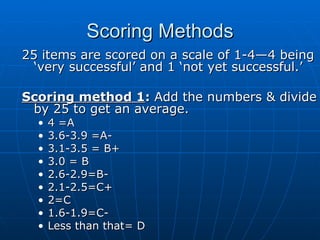
Scoring Methods 25 items are scored on a scale of 1-4—4 being ‘very successful’ and 1 ‘not yet successful.’ Scoring method 1 :  Add the numbers & divide by 25 to get an average.  4 =A 3.6-3.9 =A- 3.1-3.5 = B+ 3.0 = B 2.6-2.9=B- 2.1-2.5=C+ 2=C 1.6-1.9=C- Less than that= D
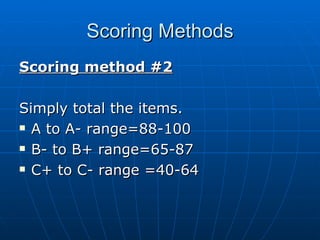
Scoring Methods Scoring method #2 Simply total the items. A to A- range=88-100 B- to B+ range=65-87 C+ to C- range =40-64
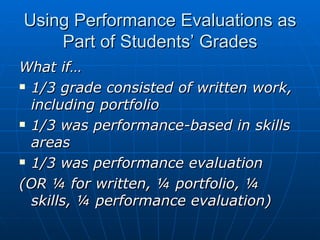
Using Performance Evaluations as Part of Students’ Grades What if… 1/3 grade consisted of written work, including portfolio 1/3 was performance-based in skills areas 1/3 was performance evaluation (OR ¼ for written, ¼ portfolio, ¼ skills, ¼ performance evaluation)
Questions? Contact information: Lynne Porter  [email_address]

Using Rubrics in the Classroom - Lynne Porter

  • 1.
    Today’s Agenda Definerubrics. Understand how and when rubrics are used. Understand advantages of rubrics. Write a rubric. Distinguish a variety of rubrics. Evaluate student samples using a rubric. Identify strategies for using rubrics in the classroom.
  • 2.
    What is arubric? Group activity You go to a restaurant, are served, and go to pay the bill. How much of a tip do you leave? Identify characteristics of waitperson who earns 10%, 15%, 20%. Write on chart paper and post (15 minutes).
  • 3.
    How are rubricsused? To assess student performance To show students what is expected of them To instruct To give students a model/guide against which they can assess their own work and set goals for progress To evaluate students against real world standards
  • 4.
    How are rubricsused? To provide an objective measurement system for ‘soft skills’ and other work perceived to be subjective, such as writing and personal skills To model how the real world works—i.e., performance evaluations
  • 5.
    Using Rubrics Publish—andpost—rubrics. Involve students in designing rubrics. Ask students to evaluate their work against rubrics and identify what they need to improve.
  • 6.
    Using Rubrics Whiningrubric Care plan Writing rubric
  • 7.
    Designing Rubrics Identifyaspects of performance and what the performance looks like at each level. Describe what the student does or what the product looks like.
  • 8.
    Resources for DevelopingRubrics: Students! Websites: www.ncsu.edu/midlink/ho.html Information on rubrics http://intranet.cps.k12.il.us/assessments/ Performance assessment strategies, ideas, and information www.landmark-project.com / classweb/tools/rubric_builder.php A great site for designing rubrics
  • 9.
    Resources http:// www.ncwiseowl.org/webquest/spider/Rubrics.html Rubric development resource site http://rubistar.4teachers.org Rubric templates for educators http://school.discovery.com/schrockguide/assess.html Makes rubrics
  • 10.
    California Career TechnicalEducation Model Curriculum Standards 11 Foundation Standards uniform in all industry sectors mastery needed for success in all careers reflect SCANS and Career Prep Standards
  • 11.
    California Career TechnicalEducation Foundation Curriculum Standards 1.0 Academics 2.0 Communication 3.0 Career Planning and Management 4.0 Technology 5.0 Problem Solving and Critical Thinking 6.0 Health and Safety
  • 12.
    California Career TechnicalEducation Foundation Curriculum Standards 7.0 Responsibility and Flexibility 8.0 Ethics and Legal Responsibilities 9.0 Leadership and Teamwork 10.0 Technical Knowledge and Skills 11.0 Demonstration and Application
  • 13.
    Assessing Foundation StandardsCommunication Problem solving/critical thinking Safety Responsibility and Flexibility Ethics and Legal Responsibilities Leadership and Teamwork
  • 14.
    Using Performance EvaluationsUse at least twice quarterly for feedback and behavior modification. Ask students to evaluate themselves and identify areas for improvement (goal-setting). Then ‘conference’ with student—just a few each week.
  • 15.
    Using Performance EvaluationsGive positive feedback, followed by three area of focus for next evaluation. Give student a copy. Shake hands.
  • 16.
    Scoring Methods 25items are scored on a scale of 1-4—4 being ‘very successful’ and 1 ‘not yet successful.’ Scoring method 1 : Add the numbers & divide by 25 to get an average. 4 =A 3.6-3.9 =A- 3.1-3.5 = B+ 3.0 = B 2.6-2.9=B- 2.1-2.5=C+ 2=C 1.6-1.9=C- Less than that= D
  • 17.
    Scoring Methods Scoringmethod #2 Simply total the items. A to A- range=88-100 B- to B+ range=65-87 C+ to C- range =40-64
  • 18.
    Using Performance Evaluationsas Part of Students’ Grades What if… 1/3 grade consisted of written work, including portfolio 1/3 was performance-based in skills areas 1/3 was performance evaluation (OR ¼ for written, ¼ portfolio, ¼ skills, ¼ performance evaluation)
  • 19.
    Questions? Contact information:Lynne Porter [email_address]