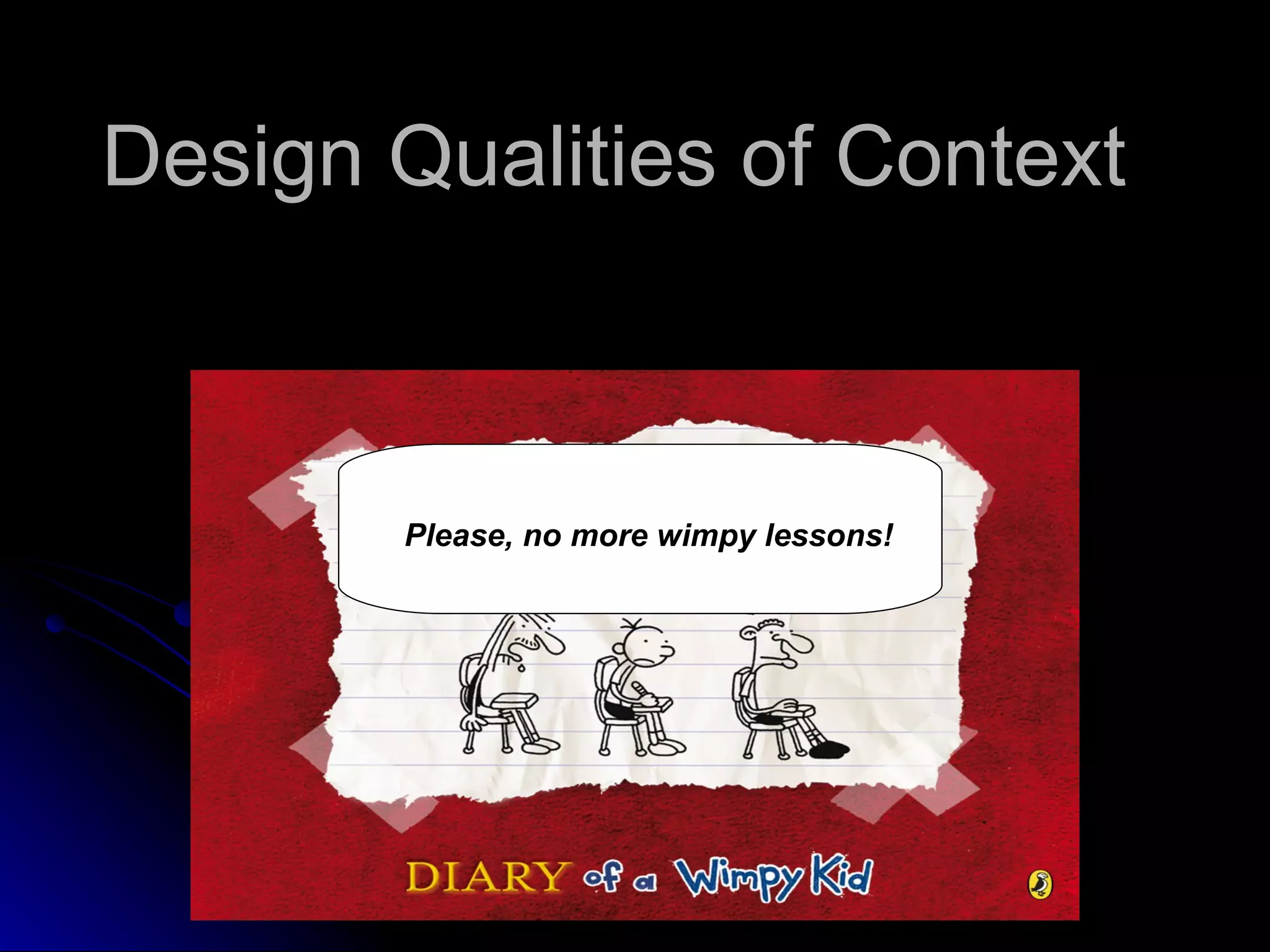
Design Qualities of Context Please, no more wimpy lessons!
Design Quality of Context: Content & Substance What do we want students to know or do? What specific materials are needed to learn? Content sentence:  Use a higher level verb to tell what students will be able to do at the end of the unit.
Evidence of Content & Substance Objectives are written in kid friendly language and reviewed with students. Students know the WHY? State standards are followed. District curriculum is used. Follows scope and sequence.
Reflection Questions Is it clearly stated what student expectations are? How important is this knowledge (TEKS, standardized tests)? How can you persuade students this is important?
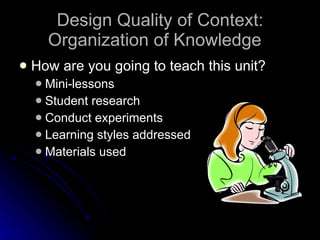
Design Quality of Context: Organization of Knowledge How are you going to teach this unit? Mini-lessons Student research Conduct experiments Learning styles addressed Materials used
Evidence of Organization of Knowledge Graphic organizers Pneumonic devices New knowledge related to old knowledge. Tiered instruction Teacher modeling Integration of curriculum areas Mini-lessons Field trips, experts
Reflection Questions Are student interests taken into account? Are tasks, activities, assignments engaging enough for students who are not interested in the topic? Are curriculum materials available? Are learning styles addressed? Are connections made to prior learning? Is it interdisciplinary?
Design Quality of Context: Clear & Compelling Product Standards Student is clear about what to do, what the product will look like, what standards will be applied to evaluate these products and performances.
Evidence of Clear and Compelling Standards Rubrics Instruction sheet Student checklist/timeline Students involved in rubric development Examples of excellent work Opportunities created for teacher/peer feedback during progress of the work
Reflection Questions Are students very clear of expectations? Are standards relevant beyond just getting a good grade? Are students regularly assessing their work in terms of set standards? Is assessment used to promote students success? Are peer evaluations used: public discussions, exhibitions, products?
Design Quality of Context: Protection from Adverse Consequences The task is designed so students feel free to try without fear of failure.
Evidence of Protection Schedule and plan for all activities Regular checkpoints scheduled Students given schedule Resource teacher available when needed Resources accessible for all students Conferences scheduled Student talents are utilized Choices on how to present work

Design qualities of context

  • 1.
    Design Qualities ofContext Please, no more wimpy lessons!
  • 2.
    Design Quality ofContext: Content & Substance What do we want students to know or do? What specific materials are needed to learn? Content sentence: Use a higher level verb to tell what students will be able to do at the end of the unit.
  • 3.
    Evidence of Content& Substance Objectives are written in kid friendly language and reviewed with students. Students know the WHY? State standards are followed. District curriculum is used. Follows scope and sequence.
  • 4.
    Reflection Questions Isit clearly stated what student expectations are? How important is this knowledge (TEKS, standardized tests)? How can you persuade students this is important?
  • 5.
    Design Quality ofContext: Organization of Knowledge How are you going to teach this unit? Mini-lessons Student research Conduct experiments Learning styles addressed Materials used
  • 6.
    Evidence of Organizationof Knowledge Graphic organizers Pneumonic devices New knowledge related to old knowledge. Tiered instruction Teacher modeling Integration of curriculum areas Mini-lessons Field trips, experts
  • 7.
    Reflection Questions Arestudent interests taken into account? Are tasks, activities, assignments engaging enough for students who are not interested in the topic? Are curriculum materials available? Are learning styles addressed? Are connections made to prior learning? Is it interdisciplinary?
  • 8.
    Design Quality ofContext: Clear & Compelling Product Standards Student is clear about what to do, what the product will look like, what standards will be applied to evaluate these products and performances.
  • 9.
    Evidence of Clearand Compelling Standards Rubrics Instruction sheet Student checklist/timeline Students involved in rubric development Examples of excellent work Opportunities created for teacher/peer feedback during progress of the work
  • 10.
    Reflection Questions Arestudents very clear of expectations? Are standards relevant beyond just getting a good grade? Are students regularly assessing their work in terms of set standards? Is assessment used to promote students success? Are peer evaluations used: public discussions, exhibitions, products?
  • 11.
    Design Quality ofContext: Protection from Adverse Consequences The task is designed so students feel free to try without fear of failure.
  • 12.
    Evidence of ProtectionSchedule and plan for all activities Regular checkpoints scheduled Students given schedule Resource teacher available when needed Resources accessible for all students Conferences scheduled Student talents are utilized Choices on how to present work