1
Thank you for joining.
The webinar will begin shortly.
Using Exam Data for Scholarly Activities
Dan Thompson, M.S., Manager of Instructional Design and Educational Technology
2
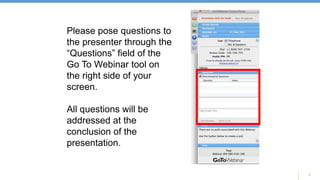
Please pose questions to
the presenter through the
“Questions” field of the
Go To Webinar tool on
the right side of your
screen.
All questions will be
addressed at the
conclusion of the
presentation.
Using Exam Data for
Scholarly Activities
DAN THOMPSON, M.S.
MANAGER OF INSTRUCTIONAL DESIGN
AND EDUCATIONAL TECHNOLOGY
Session Objectives
At the completion of this session, participants will be able to:
◦ Use exam statistics for research projects
◦ Prove their academic successes with exam statistics
◦ Use exam statistics to assist with meeting requirements for promotion and tenure
Evaluation Methods
How do you currently evaluate your teaching? (Select all that apply)
Course evaluations
Teaching portfolio
Exam stats
Reflection
Other (please type method(s) into the comment box)
How does your institution evaluate your curriculum/program? (Select all that apply)
Course evaluations
Professional licensure exams
Faculty feedback
Office of Institutional Advancement
Other (please type method(s) into the comment box)
The Why
Scholarly Activities
◦ Educational Research
◦ Promotion and Tenure
Improve your instructional methods and student outcomes!
The Set-up!
Research:
◦ Identify what you would like to review/study
◦ Effectiveness of specific instructional methods/materials
◦ Other Ed Tech programs
◦ Attendance
◦ Study time/methods
◦ Content sequencing
◦ Categorize exam items
◦ What are categories?
◦ Run “Longitudinal Analysis” reports
The Set-up continued …
Academic Success/Promotion and Tenure:
◦ Categorize exam items by exam and class session
◦ Identify specific teaching methods used in class
Run Longitudinal Reports to:
◦ Learn where you can improve your teaching and student outcomes
◦ Make data driven changes to your instructional methods
◦ Prove that your instruction is evolving to improve student outcomes
- OR -
◦ Prove that your teaching is positively producing student outcomes
Compare with student course evaluation results
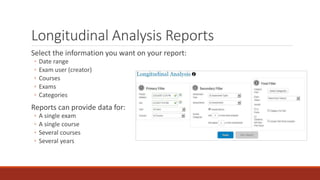
Longitudinal Analysis Reports
Select the information you want on your report:
◦ Date range
◦ Exam user (creator)
◦ Courses
◦ Exams
◦ Categories
Reports can provide data for:
◦ A single exam
◦ A single course
◦ Several courses
◦ Several years
Results
Support your educational research studies with student assessment data!
Improve your studies with quantitative data
Have quantitative proof that your classroom instruction is positively affecting student outcomes
◦ Supporting data for promotion and tenure
◦ Establish process on continuously review and improvement of instructional methods
Thank you!!
Questions/Comments??
dan.thompson@okstate.edu
@danthompsonidts
 http://resources.examsoft.com/authors/dan-thompson
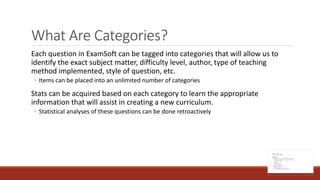
What Are Categories?
Each question in ExamSoft can be tagged into categories that will allow us to
identify the exact subject matter, difficulty level, author, type of teaching
method implemented, style of question, etc.
◦ Items can be placed into an unlimited number of categories
Stats can be acquired based on each category to learn the appropriate
information that will assist in creating a new curriculum.
◦ Statistical analyses of these questions can be done retroactively

Using Exam Data for Scholarly Activities

  • 1.
    1 Thank you forjoining. The webinar will begin shortly. Using Exam Data for Scholarly Activities Dan Thompson, M.S., Manager of Instructional Design and Educational Technology
  • 2.
    2 Please pose questionsto the presenter through the “Questions” field of the Go To Webinar tool on the right side of your screen. All questions will be addressed at the conclusion of the presentation.
  • 3.
    Using Exam Datafor Scholarly Activities DAN THOMPSON, M.S. MANAGER OF INSTRUCTIONAL DESIGN AND EDUCATIONAL TECHNOLOGY
  • 4.
    Session Objectives At thecompletion of this session, participants will be able to: ◦ Use exam statistics for research projects ◦ Prove their academic successes with exam statistics ◦ Use exam statistics to assist with meeting requirements for promotion and tenure
  • 5.
    Evaluation Methods How doyou currently evaluate your teaching? (Select all that apply) Course evaluations Teaching portfolio Exam stats Reflection Other (please type method(s) into the comment box) How does your institution evaluate your curriculum/program? (Select all that apply) Course evaluations Professional licensure exams Faculty feedback Office of Institutional Advancement Other (please type method(s) into the comment box)
  • 6.
    The Why Scholarly Activities ◦Educational Research ◦ Promotion and Tenure Improve your instructional methods and student outcomes!
  • 7.
    The Set-up! Research: ◦ Identifywhat you would like to review/study ◦ Effectiveness of specific instructional methods/materials ◦ Other Ed Tech programs ◦ Attendance ◦ Study time/methods ◦ Content sequencing ◦ Categorize exam items ◦ What are categories? ◦ Run “Longitudinal Analysis” reports
  • 8.
    The Set-up continued… Academic Success/Promotion and Tenure: ◦ Categorize exam items by exam and class session ◦ Identify specific teaching methods used in class Run Longitudinal Reports to: ◦ Learn where you can improve your teaching and student outcomes ◦ Make data driven changes to your instructional methods ◦ Prove that your instruction is evolving to improve student outcomes - OR - ◦ Prove that your teaching is positively producing student outcomes Compare with student course evaluation results
  • 9.
    Longitudinal Analysis Reports Selectthe information you want on your report: ◦ Date range ◦ Exam user (creator) ◦ Courses ◦ Exams ◦ Categories Reports can provide data for: ◦ A single exam ◦ A single course ◦ Several courses ◦ Several years
  • 10.
    Results Support your educationalresearch studies with student assessment data! Improve your studies with quantitative data Have quantitative proof that your classroom instruction is positively affecting student outcomes ◦ Supporting data for promotion and tenure ◦ Establish process on continuously review and improvement of instructional methods
  • 11.
  • 12.
    What Are Categories? Eachquestion in ExamSoft can be tagged into categories that will allow us to identify the exact subject matter, difficulty level, author, type of teaching method implemented, style of question, etc. ◦ Items can be placed into an unlimited number of categories Stats can be acquired based on each category to learn the appropriate information that will assist in creating a new curriculum. ◦ Statistical analyses of these questions can be done retroactively