Rubber
It is the sticky, elastic solid produced from a milky liquid called latex.Can be classified as natural or synthetic rubber.What is rubber?
Natural Rubber
What is Natural Rubber?An elastomer(An Elastic Hydrocarbon Polymer) that was originally derived from latex.
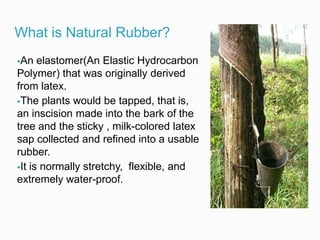
The plants would be tapped, that is, an inscision made into the bark of the tree and the sticky , milk-colored latex sap collected and refined into a usable rubber.
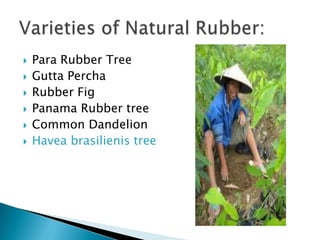
It is normally stretchy,  flexible, and extremely water-proof.Para Rubber TreeGuttaPerchaRubber FigPanama Rubber treeCommon DandelionHaveabrasilienis treeVarieties of Natural Rubber:
ElasticityTensile StrengthFlexibilitySolubilityAbrasion ResistanceProperties:
Have a milk contains an anti-bacterial substance that is a natural dust-mite repellent.Natural rubber manufactured from this unique substance also breathes perfectly and is not temperature-sensitive. As a result it never feels moist or warm to touch.Superior Air circulation creates an environment which naturally prevents mold and mildew growth.Advantages of Natural Rubber:
Retention of shape and firmness for even support year in and year out.Superior durability and elasticity  for mattress longevity.Flexibility combined with stability  for continuous sleep comfort.Excellent natural heat  and moisture regulation.Advantages of Natural Rubber:
Uses:Manufacturing
Textile ApplicationsSynthetic Rubber
Is any type of artificial elastomer, invariably a polymer.An Elastomer is a material with the mechanical property that it can undergo much more elastic deformation under stress than most materials and still return to it’s previous size without permanent deformation.Synthetic rubber serves as a substitute to Natural rubber in many cases, especially when improved material properties are needed.What is Synthetic Rubber:
Synthetic Rubber can be made by a process called polymerization, the process of changing monomers into polymers
PolybutadieneEpichlorohydrinPolyurethaneStyrene-butadineCommon Synthetic Rubbers used:
Vulcanized Rubber
Is a process of converting rubber or related Polymers into more durable via the addition of sulfur or other equivalent curatives.Named after the Roman God of fire, Vulcan.It was invented by Charles Goodyear in 1839.What is Vulcanization?
Cross-linking of Poly(isoprene) and Sulfur
SulfurPeroxidesUrethane crosslinkersMetallic oxidesDueceAcetoxysilaneCommon curing systems used:
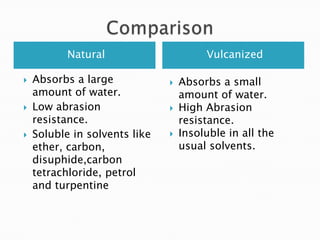
ComparisonVulcanizedNaturalVS
ComaparisonNaturalVulcanizedCrude rubber is sticky and an elastic solid. It becomes soft and sitcky as the temp. Rises. Raw Natural Rubber  has elasticity over a narrow range of temperature from 10-60 Centigrade.Raw Natural Rubber has low tensile strength and abrasion resisitant.Vulcanization prevents the Polymer Chains from moving independtly. As a result, when stress is applied to VR deforms, but upon the release of stress, it reverts back to its shape.Vulcanized Rubber can withstand -40-100 Centigrade.Vulcanized Rubber has better Tensile strength

Rubber

  • 1.
  • 2.
    It is thesticky, elastic solid produced from a milky liquid called latex.Can be classified as natural or synthetic rubber.What is rubber?
  • 3.
  • 4.
    What is NaturalRubber?An elastomer(An Elastic Hydrocarbon Polymer) that was originally derived from latex.
  • 5.
    The plants wouldbe tapped, that is, an inscision made into the bark of the tree and the sticky , milk-colored latex sap collected and refined into a usable rubber.
  • 6.
    It is normallystretchy, flexible, and extremely water-proof.Para Rubber TreeGuttaPerchaRubber FigPanama Rubber treeCommon DandelionHaveabrasilienis treeVarieties of Natural Rubber:
  • 7.
  • 8.
    Have a milkcontains an anti-bacterial substance that is a natural dust-mite repellent.Natural rubber manufactured from this unique substance also breathes perfectly and is not temperature-sensitive. As a result it never feels moist or warm to touch.Superior Air circulation creates an environment which naturally prevents mold and mildew growth.Advantages of Natural Rubber:
  • 9.
    Retention of shapeand firmness for even support year in and year out.Superior durability and elasticity for mattress longevity.Flexibility combined with stability for continuous sleep comfort.Excellent natural heat and moisture regulation.Advantages of Natural Rubber:
  • 10.
  • 11.
  • 12.
    Is any typeof artificial elastomer, invariably a polymer.An Elastomer is a material with the mechanical property that it can undergo much more elastic deformation under stress than most materials and still return to it’s previous size without permanent deformation.Synthetic rubber serves as a substitute to Natural rubber in many cases, especially when improved material properties are needed.What is Synthetic Rubber:
  • 13.
    Synthetic Rubber canbe made by a process called polymerization, the process of changing monomers into polymers
  • 14.
  • 15.
  • 16.
    Is a processof converting rubber or related Polymers into more durable via the addition of sulfur or other equivalent curatives.Named after the Roman God of fire, Vulcan.It was invented by Charles Goodyear in 1839.What is Vulcanization?
  • 17.
  • 18.
  • 19.
  • 20.
    ComaparisonNaturalVulcanizedCrude rubber issticky and an elastic solid. It becomes soft and sitcky as the temp. Rises. Raw Natural Rubber has elasticity over a narrow range of temperature from 10-60 Centigrade.Raw Natural Rubber has low tensile strength and abrasion resisitant.Vulcanization prevents the Polymer Chains from moving independtly. As a result, when stress is applied to VR deforms, but upon the release of stress, it reverts back to its shape.Vulcanized Rubber can withstand -40-100 Centigrade.Vulcanized Rubber has better Tensile strength