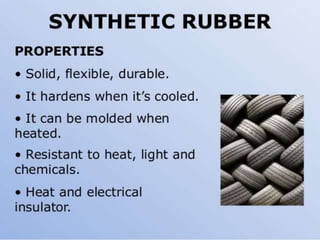
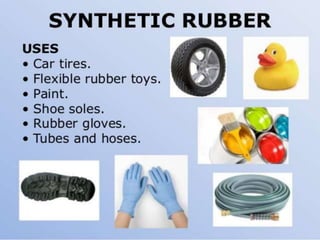
Synthetic Rubbers
PRESENTED BY
Dr. Hussin Al-Shafey
1
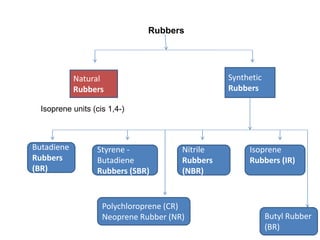
Rubbers
Synthetic
Rubbers
Natural
Rubbers
Isoprene
Rubbers (IR)
Nitrile
Rubbers
(NBR)
Styrene -
Butadiene
Rubbers (SBR)
Butadiene
Rubbers
(BR)
Polychloroprene (CR)
Neoprene Rubber (NR) Butyl Rubber
(BR)
Isoprene units (cis 1,4-)
• In beginning all product from rubber are made
from natural rubber that produced from materials
from natural rubber tree called latex.
• Synthetic rubber are produced from reactions of
low molecular weight materials called monomer
to produced long chain molecule called polymer
• Elastic properties are produced by mix raw rubber
with specific additives during rubber
compounding
Definitions
• When rubber was heated the chemical reactions occur
call vulcanization (crosslinking occur) or curing.
• Process were rubber molecules were tied together at
specific place called crosslinks
• Elastomer are elastic materials that can deformed
when forced being applied and back to the original
shape when release the forced.
• The words elastomer comes from ‘elastic polymer’.
Definitions
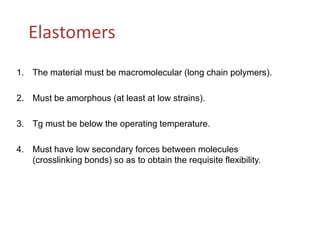
Elastomers
1. The material must be macromolecular (long chain polymers).
2. Must be amorphous (at least at low strains).
3. Tg must be below the operating temperature.
4. Must have low secondary forces between molecules
(crosslinking bonds) so as to obtain the requisite flexibility.
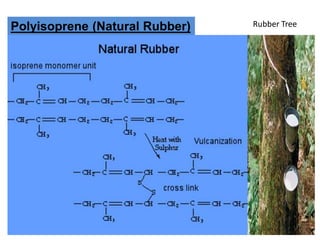
Rubber Tree
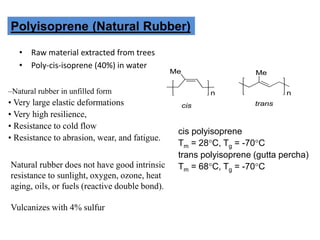
Polyisoprene (Natural Rubber)
• Raw material extracted from trees
• Poly-cis-isoprene (40%) in water
cis polyisoprene
Tm = 28°C, Tg = -70°C
trans polyisoprene (gutta percha)
Tm = 68°C, Tg = -70°C
–Natural rubber in unfilled form
• Very large elastic deformations
• Very high resilience,
• Resistance to cold flow
• Resistance to abrasion, wear, and fatigue.
Natural rubber does not have good intrinsic
resistance to sunlight, oxygen, ozone, heat
aging, oils, or fuels (reactive double bond).
Vulcanizes with 4% sulfur
Me
n
Me
n
cis trans
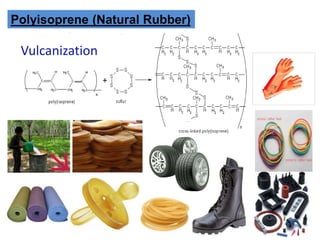
Polyisoprene (Natural Rubber)
Vulcanization
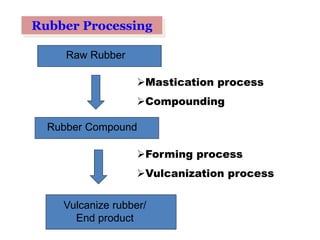
Rubber Processing
Raw Rubber
Vulcanize rubber/
End product
Mastication process
Compounding
Forming process
Vulcanization process
Rubber Compound
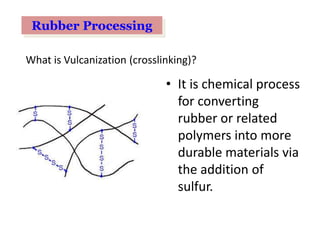
What is Vulcanization (crosslinking)?
• It is chemical process
for converting
rubber or related
polymers into more
durable materials via
the addition of
sulfur.
Rubber Processing
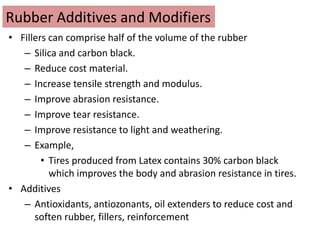
Rubber Additives and Modifiers
• Fillers can comprise half of the volume of the rubber
– Silica and carbon black.
– Reduce cost material.
– Increase tensile strength and modulus.
– Improve abrasion resistance.
– Improve tear resistance.
– Improve resistance to light and weathering.
– Example,
• Tires produced from Latex contains 30% carbon black
which improves the body and abrasion resistance in tires.
• Additives
– Antioxidants, antiozonants, oil extenders to reduce cost and
soften rubber, fillers, reinforcement
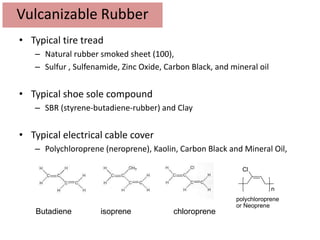
Vulcanizable Rubber
• Typical tire tread
– Natural rubber smoked sheet (100),
– Sulfur , Sulfenamide, Zinc Oxide, Carbon Black, and mineral oil
• Typical shoe sole compound
– SBR (styrene-butadiene-rubber) and Clay
• Typical electrical cable cover
– Polychloroprene (neroprene), Kaolin, Carbon Black and Mineral Oil,
Cl
n
polychloroprene
or Neoprene
Butadiene isoprene chloroprene
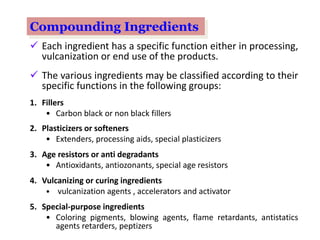
 Each ingredient has a specific function either in processing,
vulcanization or end use of the products.
 The various ingredients may be classified according to their
specific functions in the following groups:
1. Fillers
• Carbon black or non black fillers
2. Plasticizers or softeners
• Extenders, processing aids, special plasticizers
3. Age resistors or anti degradants
• Antioxidants, antiozonants, special age resistors
4. Vulcanizing or curing ingredients
• vulcanization agents , accelerators and activator
5. Special-purpose ingredients
• Coloring pigments, blowing agents, flame retardants, antistatics
agents retarders, peptizers
Compounding Ingredients
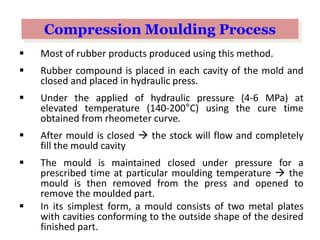
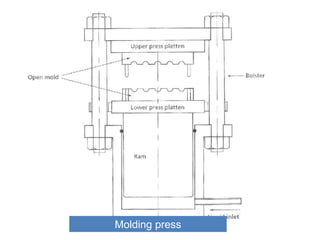
 Most of rubber products produced using this method.
 Rubber compound is placed in each cavity of the mold and
closed and placed in hydraulic press.
 Under the applied of hydraulic pressure (4-6 MPa) at
elevated temperature (140-200°C) using the cure time
obtained from rheometer curve.
 After mould is closed  the stock will flow and completely
fill the mould cavity
 The mould is maintained closed under pressure for a
prescribed time at particular moulding temperature  the
mould is then removed from the press and opened to
remove the moulded part.
 In its simplest form, a mould consists of two metal plates
with cavities conforming to the outside shape of the desired
finished part.
Compression Moulding Process
Molding press
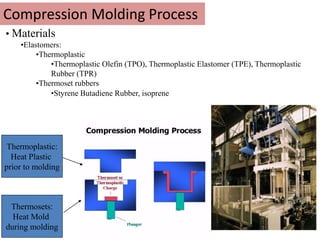
Compression Molding Process
• Materials
•Elastomers:
•Thermoplastic
•Thermoplastic Olefin (TPO), Thermoplastic Elastomer (TPE), Thermoplastic
Rubber (TPR)
•Thermoset rubbers
•Styrene Butadiene Rubber, isoprene
Thermoplastic:
Heat Plastic
prior to molding
Thermosets:
Heat Mold
during molding
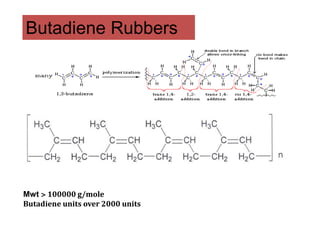
Butadiene Rubbers
Mwt ˃ 100000 g/mole
Butadiene units over 2000 units
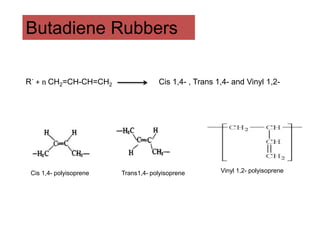
Butadiene Rubbers
R˙ + n CH2=CH-CH=CH2 Cis 1,4- , Trans 1,4- and Vinyl 1,2-
Vinyl 1,2- polyisoprene
Cis 1,4- polyisoprene Trans1,4- polyisoprene
Butadiene Rubbers
•Butadiene could be polymerized using free radical initiators or ionic or
coordination catalysts
•The reaction is carried out in solvent by solution polymerization
•The solvents (hexane, cyclohexane, benzene or toluene) are used to:
- Reduce the rate of reaction
- Control the heat generated
-Lower the viscosity of the polymer in reactor
•Polymerization was run at 20% monomer and 80% solvent
•Polymerization can occur by (Batch process or Continuous process):
-Batch process: monomer, solvent and catalyst are charged to the
reactor and heated to initiate the process to complete polymerization,
The polymer solution is then transferred to another vessel to remove
solvent
-Continuous process: monomer, solvent and catalyst are continuously
fed into bottom of reactors at temperature suitable for polymerization,
The polymerization progress through the reactor and polymer solution is
taken off at the top of reactor without stopping the process
Butadiene Rubbers
The shape of polymers (Butadiene Rubbers) according of
the catalyst was used:
1- ziegler – Nata catalysts streoregular BRs (Cis-)
High cis usually ˃ 90% which give green strength and
increase cut growth resistance
-Green strength: is the strength uncured rubber compound
(important in tire building process)
-Increase cut growth resistance: is the resistance to
propagation of the tear or crack during dynamic operation
like the flexing a tire in use (necessary for tire performance)
2- Anionic initiator in a nonpolar solvent Low cis
about 40% with trans 50% and vinyl 10%
Butadiene Rubbers
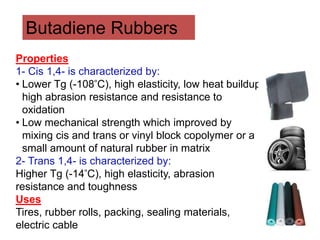
Properties
1- Cis 1,4- is characterized by:
• Lower Tg (-108 ̊C), high elasticity, low heat buildup,
high abrasion resistance and resistance to
oxidation
• Low mechanical strength which improved by
mixing cis and trans or vinyl block copolymer or a
small amount of natural rubber in matrix
2- Trans 1,4- is characterized by:
Higher Tg (-14 ̊C), high elasticity, abrasion
resistance and toughness
Uses
Tires, rubber rolls, packing, sealing materials,
electric cable
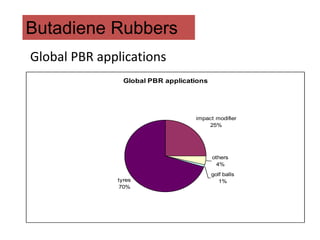
Global PBR applications
impact modifier
25%
others
4%
golf balls
1%
tyres
70%
Butadiene Rubbers
Styrene-Butadiene Rubbers (SBR)
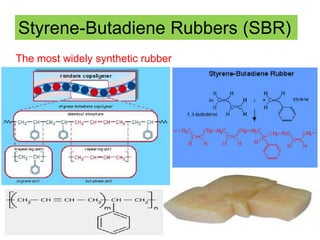
The most widely synthetic rubber
Styrene-Butadiene Rubbers (SBR)
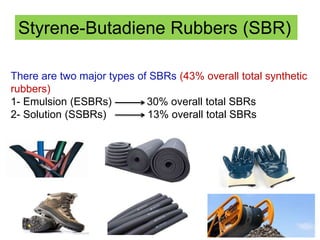
There are two major types of SBRs (43% overall total synthetic
rubbers)
1- Emulsion (ESBRs) 30% overall total SBRs
2- Solution (SSBRs) 13% overall total SBRs
• Random copolymer of butadiene (67-85%) and styrene (33-
15%)
• Tg of typical 75/25 blend is – 60°C
• Not capable of crystallizing under strain and thus requires
reinforcing filler, carbon black, to get good properties.
• One of the least expensive rubbers and generally
processes easily.
• Inferior to natural rubber in mechanical properties
• Superior to natural rubber in wear, heat aging, ozone
resistance, and resistance to oils.
• Applications include tires, footwear, wire, cable insulation,
industrial rubber products, adhesives, paints (latex or
emulsion)
More than half of the world’s synthetic rubber is SBR
World usage of SBR equals natural rubber
Styrene-Butadiene Rubbers (SBR)
1- Emulsion (ESBRs)
•Mixed with reinforcing fillers, oil and vulcanising chemicals to
produced rubber compounds
•Rubber compounds are then shaped and vulcanised under heat and
pressure to produce the finished rubber article
•Often ESBR is blended with other types of raw rubber such as
natural rubber or polybutadiene to modify the properties of the
finished article
•About 70% of ESBR is used for the manufacture of car tires
•ESBRs are used to manufacture conveyor belts, flooring and carpet
underlay, hoses, seals, sheeting, footwear
Styrene-Butadiene Rubbers (SBR)
Production ESBRs
• Emulsion polymerization was carried out by free radical (redox
system) polymerization to produced (cold SBR at 5 ̊C)
and (hot SBR at 50 ̊C)
• For hot SBR potassium persulphate is used as initiaitor in
water as solvent
• Termination is effected by the addition of chemical substance
which kills all free radicals and added before total conversion
(log chain branching and formation of gel)
• The polymerization products gives 60% conversion in cold
polymerization and 70% conversion in hot polymerization
• Cold polymerized ESBRs: butadiene average about 9% cis,
54% trans, 13% vinyl and 24% styrene
• Tg of SBR is about - 50 ̊C and increase by increasing styrene
contents.
Styrene-Butadiene Rubbers (SBR)
2- Solution (SSBRs)
• SSBR was produced by polymerization at 30-80 ̊C using
anionic catalyst (butyllithium) in nonpolar solvent to give a
random copolymer
• SSBR is middle properties between ESBR and BR
• SSBR may be divided into two categories:
-Random copolymer (80%): industry 95%, usually compatible
with oil, blended with the other types of rubbers including
natural rubber and mixed with reinforcing filler (carbon black or
silica )
-Partial block types (20%): used in rubber flooring, carpet
underlay, footwear and in bitumen modification and in
adhesive.
Styrene-Butadiene Rubbers (SBR)
Production SSBRs
• Solution polymerization was carried out by coordination
catalyst
• SSBR produced by coordination catalyst has better tensile
strength than that produced by free radical initiator
• SSBR has better mechanical properties and low Mwt
distribution
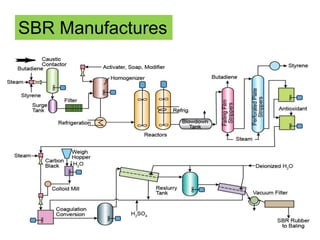
SBR Manufactures
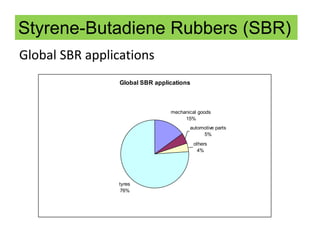
Global SBR applications
mechanical goods
15%
automotive parts
5%
others
4%
tyres
76%
Styrene-Butadiene Rubbers (SBR)
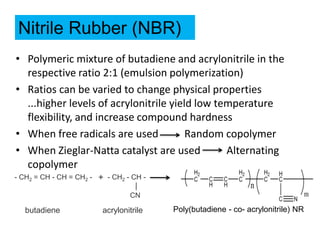
• Polymeric mixture of butadiene and acrylonitrile in the
respective ratio 2:1 (emulsion polymerization)
• Ratios can be varied to change physical properties
...higher levels of acrylonitrile yield low temperature
flexibility, and increase compound hardness
• When free radicals are used Random copolymer
• When Zieglar-Natta catalyst are used Alternating
copolymer
Nitrile Rubber (NBR)
- CH2 = CH - CH = CH2 -
CN
acrylonitrile
butadiene
- CH2 - CH -
+
Poly(butadiene - co- acrylonitrile) NR
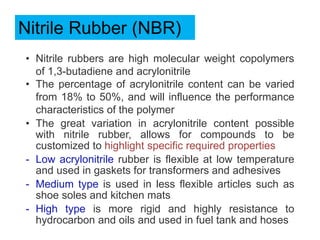
Nitrile Rubber (NBR)
• Nitrile rubbers are high molecular weight copolymers
of 1,3-butadiene and acrylonitrile
• The percentage of acrylonitrile content can be varied
from 18% to 50%, and will influence the performance
characteristics of the polymer
• The great variation in acrylonitrile content possible
with nitrile rubber, allows for compounds to be
customized to highlight specific required properties
- Low acrylonitrile rubber is flexible at low temperature
and used in gaskets for transformers and adhesives
- Medium type is used in less flexible articles such as
shoe soles and kitchen mats
- High type is more rigid and highly resistance to
hydrocarbon and oils and used in fuel tank and hoses
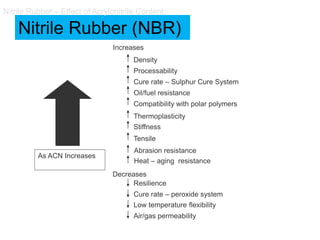
Nitrile Rubber (NBR)
Heat – aging resistance
Abrasion resistance
Tensile
Stiffness
Thermoplasticity
Compatibility with polar polymers
Oil/fuel resistance
Cure rate – Sulphur Cure System
Processability
Density
Increases
Air/gas permeability
Low temperature flexibility
Cure rate – peroxide system
Resilience
Decreases
Nitrile Rubber – Effect of Acrylonitrile Content
As ACN Increases
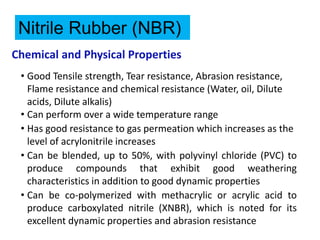
Chemical and Physical Properties
• Good Tensile strength, Tear resistance, Abrasion resistance,
Flame resistance and chemical resistance (Water, oil, Dilute
acids, Dilute alkalis)
• Can perform over a wide temperature range
• Has good resistance to gas permeation which increases as the
level of acrylonitrile increases
• Can be blended, up to 50%, with polyvinyl chloride (PVC) to
produce compounds that exhibit good weathering
characteristics in addition to good dynamic properties
• Can be co-polymerized with methacrylic or acrylic acid to
produce carboxylated nitrile (XNBR), which is noted for its
excellent dynamic properties and abrasion resistance
Nitrile Rubber (NBR)
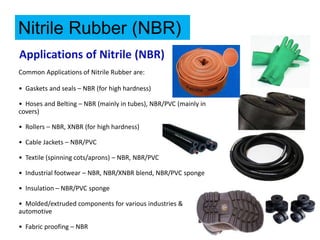
Applications of Nitrile (NBR)
Common Applications of Nitrile Rubber are:
• Gaskets and seals – NBR (for high hardness)
• Hoses and Belting – NBR (mainly in tubes), NBR/PVC (mainly in
covers)
• Rollers – NBR, XNBR (for high hardness)
• Cable Jackets – NBR/PVC
• Textile (spinning cots/aprons) – NBR, NBR/PVC
• Industrial footwear – NBR, NBR/XNBR blend, NBR/PVC sponge
• Insulation – NBR/PVC sponge
• Molded/extruded components for various industries &
automotive
• Fabric proofing – NBR
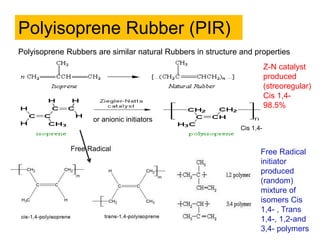
Polyisoprene Rubber (PIR)
or anionic initiators
Cis 1,4-
Polyisoprene Rubbers are similar natural Rubbers in structure and properties
Z-N catalyst
produced
(streoregular)
Cis 1,4-
98.5%
Free Radical
initiator
produced
(random)
mixture of
isomers Cis
1,4- , Trans
1,4-, 1,2-and
3,4- polymers
Free Radical
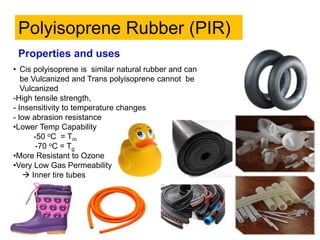
• Cis polyisoprene is similar natural rubber and can
be Vulcanized and Trans polyisoprene cannot be
Vulcanized
-High tensile strength,
- Insensitivity to temperature changes
- low abrasion resistance
•Lower Temp Capability
-50 oC = Tm
-70 oC = Tg
•More Resistant to Ozone
•Very Low Gas Permeability
 Inner tire tubes
Polyisoprene Rubber (PIR)
Properties and uses
Neoprene Rubber (Polychloroprene) (CR)
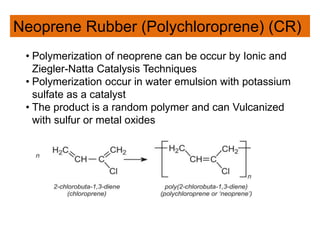
• Polymerization of neoprene can be occur by Ionic and
Ziegler-Natta Catalysis Techniques
• Polymerization occur in water emulsion with potassium
sulfate as a catalyst
• The product is a random polymer and can Vulcanized
with sulfur or metal oxides
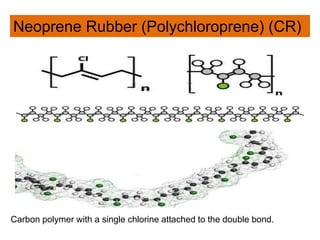
Carbon polymer with a single chlorine attached to the double bond.
Neoprene Rubber (Polychloroprene) (CR)
Characterized by:
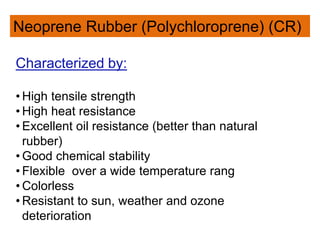
• High tensile strength
• High heat resistance
• Excellent oil resistance (better than natural
rubber)
• Good chemical stability
• Flexible over a wide temperature rang
• Colorless
• Resistant to sun, weather and ozone
deterioration
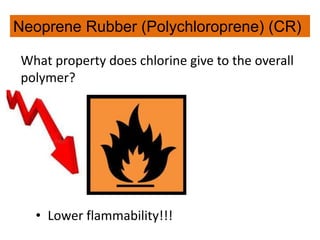
What property does chlorine give to the overall
polymer?
• Lower flammability!!!
Neoprene Rubber (Polychloroprene) (CR)
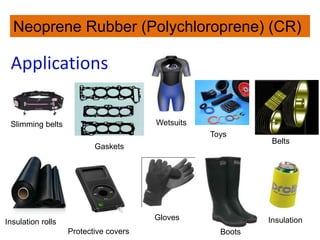
Applications
Protective covers
Gloves
Wetsuits
Belts
Insulation
Gaskets
Boots
Slimming belts
Toys
Insulation rolls
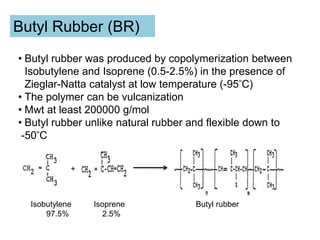
Butyl Rubber (BR)
+
Isobutylene Isoprene Butyl rubber
97.5% 2.5%
• Butyl rubber was produced by copolymerization between
Isobutylene and Isoprene (0.5-2.5%) in the presence of
Zieglar-Natta catalyst at low temperature (-95 ̊C)
• The polymer can be vulcanization
• Mwt at least 200000 g/mol
• Butyl rubber unlike natural rubber and flexible down to
-50 ̊C
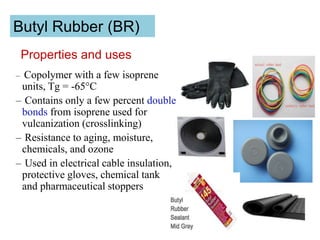
Butyl Rubber (BR)
– Copolymer with a few isoprene
units, Tg = -65°C
– Contains only a few percent double
bonds from isoprene used for
vulcanization (crosslinking)
– Resistance to aging, moisture,
chemicals, and ozone
– Used in electrical cable insulation,
protective gloves, chemical tank
and pharmaceutical stoppers
Properties and uses
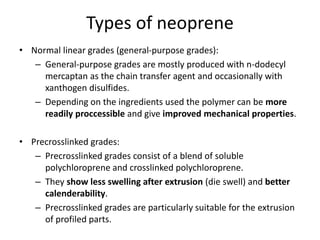
Types of neoprene
• Normal linear grades (general-purpose grades):
– General-purpose grades are mostly produced with n-dodecyl
mercaptan as the chain transfer agent and occasionally with
xanthogen disulfides.
– Depending on the ingredients used the polymer can be more
readily proccessible and give improved mechanical properties.
• Precrosslinked grades:
– Precrosslinked grades consist of a blend of soluble
polychloroprene and crosslinked polychloroprene.
– They show less swelling after extrusion (die swell) and better
calenderability.
– Precrosslinked grades are particularly suitable for the extrusion
of profiled parts.
Types of neoprene
• Sulfur-modified grades:
– Sulfur-modified grades are copolymers of chloroprene and elemental
sulfur.
– Sulfur-modified grades are used in particular for parts exposed to
dynamic stress, such as driving belts, timing belts or conveyor belts
because of their excellent mechanical properties.
– But the polymers are less stable during storage and the vulcanizates
less resistant to aging.
• Slow crystallizing grades:
– Slow crystallizing grades are polymerized with 2,3-dichloro-1,3-
butadiene as a comonomer.
– This comonomer reduces the degree of crystallization by introducing
irregularities into the polymer chain.
– Crystallization resistant grades are used to produce rubber articles,
which have to retain their rubbery properties at very low
temperatures.
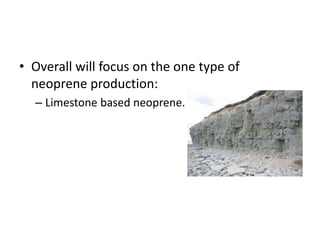
• Overall will focus on the one type of
neoprene production:
– Limestone based neoprene.
Limestone Neoprene
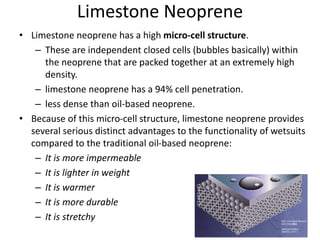
• Limestone neoprene has a high micro-cell structure.
– These are independent closed cells (bubbles basically) within
the neoprene that are packed together at an extremely high
density.
– limestone neoprene has a 94% cell penetration.
– less dense than oil-based neoprene.
• Because of this micro-cell structure, limestone neoprene provides
several serious distinct advantages to the functionality of wetsuits
compared to the traditional oil-based neoprene:
– It is more impermeable
– It is lighter in weight
– It is warmer
– It is more durable
– It is stretchy
Oil-Based Neoprene (comparison)
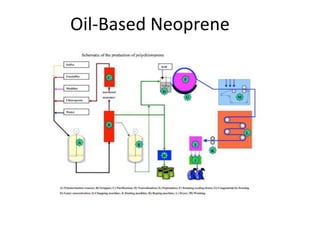
• Low micro-cell structure.
• Oil-based neoprene has a cell penetration of 60-70%
– The amount of bubbles or pockets with in the polymer, oil
based neoprene has low density closed cells.
• Also denser than limestone neoprene.
• Problems associated with inferior-quality neoprene:
– Delamination: blisters between the nylon and rubber which
deteriorates quickly
– Compression: neoprene 'cave-ins', especially around the
knee/elbow areas
– No memory: does not return memory (hold its shape) and the
fit gives out over time
– Splits: neoprene splits unnecessarily within the nylon layers
The Makings!!!
• Yamamoto uses acetylene derived from the
calcium carbonate found in limestone.
• Extracted limestone is fed into a furnace and
heated at a temperature around one-tenth of
that used for refining petroleum
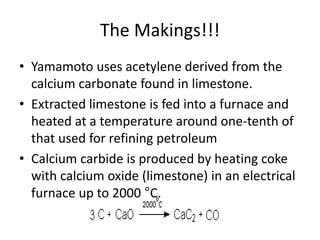
• Calcium carbide is produced by heating coke
with calcium oxide (limestone) in an electrical
furnace up to 2000 °C.
The Makings cont.!!!
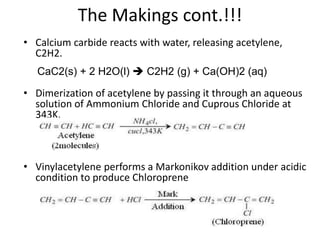
• Calcium carbide reacts with water, releasing acetylene,
C2H2.
• Dimerization of acetylene by passing it through an aqueous
solution of Ammonium Chloride and Cuprous Chloride at
343K.
• Vinylacetylene performs a Markonikov addition under acidic
condition to produce Chloroprene
CaC2(s) + 2 H2O(l)  C2H2 (g) + Ca(OH)2 (aq)
The Makings cont.!!!
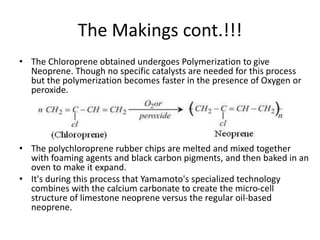
• The Chloroprene obtained undergoes Polymerization to give
Neoprene. Though no specific catalysts are needed for this process
but the polymerization becomes faster in the presence of Oxygen or
peroxide.
• The polychloroprene rubber chips are melted and mixed together
with foaming agents and black carbon pigments, and then baked in an
oven to make it expand.
• It's during this process that Yamamoto's specialized technology
combines with the calcium carbonate to create the micro-cell
structure of limestone neoprene versus the regular oil-based
neoprene.
Oil-Based Neoprene
Elastomers
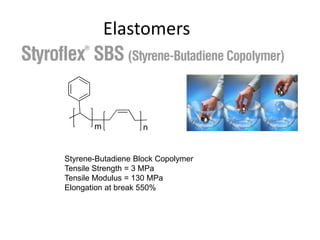
Styrene-Butadiene Block Copolymer
Tensile Strength = 3 MPa
Tensile Modulus = 130 MPa
Elongation at break 550%
n
m
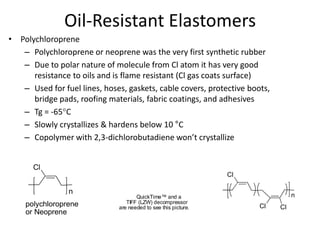
Oil-Resistant Elastomers
• Polychloroprene
– Polychloroprene or neoprene was the very first synthetic rubber
– Due to polar nature of molecule from Cl atom it has very good
resistance to oils and is flame resistant (Cl gas coats surface)
– Used for fuel lines, hoses, gaskets, cable covers, protective boots,
bridge pads, roofing materials, fabric coatings, and adhesives
– Tg = -65°C
– Slowly crystallizes & hardens below 10 °C
– Copolymer with 2,3-dichlorobutadiene won’t crystallize
Cl
n
polychloroprene
or Neoprene
QuickTime™ and a
TIFF (LZW) decompressor
are needed to see this picture.
Cl
Cl
n
Cl

Synthetic_Rubbers_ppt.ppt lecture notes for students

  • 1.
  • 2.
    Rubbers Synthetic Rubbers Natural Rubbers Isoprene Rubbers (IR) Nitrile Rubbers (NBR) Styrene - Butadiene Rubbers(SBR) Butadiene Rubbers (BR) Polychloroprene (CR) Neoprene Rubber (NR) Butyl Rubber (BR) Isoprene units (cis 1,4-)
  • 3.
    • In beginningall product from rubber are made from natural rubber that produced from materials from natural rubber tree called latex. • Synthetic rubber are produced from reactions of low molecular weight materials called monomer to produced long chain molecule called polymer • Elastic properties are produced by mix raw rubber with specific additives during rubber compounding Definitions
  • 4.
    • When rubberwas heated the chemical reactions occur call vulcanization (crosslinking occur) or curing. • Process were rubber molecules were tied together at specific place called crosslinks • Elastomer are elastic materials that can deformed when forced being applied and back to the original shape when release the forced. • The words elastomer comes from ‘elastic polymer’. Definitions
  • 5.
    Elastomers 1. The materialmust be macromolecular (long chain polymers). 2. Must be amorphous (at least at low strains). 3. Tg must be below the operating temperature. 4. Must have low secondary forces between molecules (crosslinking bonds) so as to obtain the requisite flexibility.
  • 6.
  • 7.
    • Raw materialextracted from trees • Poly-cis-isoprene (40%) in water cis polyisoprene Tm = 28°C, Tg = -70°C trans polyisoprene (gutta percha) Tm = 68°C, Tg = -70°C –Natural rubber in unfilled form • Very large elastic deformations • Very high resilience, • Resistance to cold flow • Resistance to abrasion, wear, and fatigue. Natural rubber does not have good intrinsic resistance to sunlight, oxygen, ozone, heat aging, oils, or fuels (reactive double bond). Vulcanizes with 4% sulfur Me n Me n cis trans Polyisoprene (Natural Rubber)
  • 8.
  • 11.
    Rubber Processing Raw Rubber Vulcanizerubber/ End product Mastication process Compounding Forming process Vulcanization process Rubber Compound
  • 12.
    What is Vulcanization(crosslinking)? • It is chemical process for converting rubber or related polymers into more durable materials via the addition of sulfur. Rubber Processing
  • 13.
    Rubber Additives andModifiers • Fillers can comprise half of the volume of the rubber – Silica and carbon black. – Reduce cost material. – Increase tensile strength and modulus. – Improve abrasion resistance. – Improve tear resistance. – Improve resistance to light and weathering. – Example, • Tires produced from Latex contains 30% carbon black which improves the body and abrasion resistance in tires. • Additives – Antioxidants, antiozonants, oil extenders to reduce cost and soften rubber, fillers, reinforcement
  • 14.
    Vulcanizable Rubber • Typicaltire tread – Natural rubber smoked sheet (100), – Sulfur , Sulfenamide, Zinc Oxide, Carbon Black, and mineral oil • Typical shoe sole compound – SBR (styrene-butadiene-rubber) and Clay • Typical electrical cable cover – Polychloroprene (neroprene), Kaolin, Carbon Black and Mineral Oil, Cl n polychloroprene or Neoprene Butadiene isoprene chloroprene
  • 15.
     Each ingredienthas a specific function either in processing, vulcanization or end use of the products.  The various ingredients may be classified according to their specific functions in the following groups: 1. Fillers • Carbon black or non black fillers 2. Plasticizers or softeners • Extenders, processing aids, special plasticizers 3. Age resistors or anti degradants • Antioxidants, antiozonants, special age resistors 4. Vulcanizing or curing ingredients • vulcanization agents , accelerators and activator 5. Special-purpose ingredients • Coloring pigments, blowing agents, flame retardants, antistatics agents retarders, peptizers Compounding Ingredients
  • 16.
     Most ofrubber products produced using this method.  Rubber compound is placed in each cavity of the mold and closed and placed in hydraulic press.  Under the applied of hydraulic pressure (4-6 MPa) at elevated temperature (140-200°C) using the cure time obtained from rheometer curve.  After mould is closed  the stock will flow and completely fill the mould cavity  The mould is maintained closed under pressure for a prescribed time at particular moulding temperature  the mould is then removed from the press and opened to remove the moulded part.  In its simplest form, a mould consists of two metal plates with cavities conforming to the outside shape of the desired finished part. Compression Moulding Process
  • 17.
  • 18.
    Compression Molding Process •Materials •Elastomers: •Thermoplastic •Thermoplastic Olefin (TPO), Thermoplastic Elastomer (TPE), Thermoplastic Rubber (TPR) •Thermoset rubbers •Styrene Butadiene Rubber, isoprene Thermoplastic: Heat Plastic prior to molding Thermosets: Heat Mold during molding
  • 19.
    Butadiene Rubbers Mwt ˃100000 g/mole Butadiene units over 2000 units
  • 20.
    Butadiene Rubbers R˙ +n CH2=CH-CH=CH2 Cis 1,4- , Trans 1,4- and Vinyl 1,2- Vinyl 1,2- polyisoprene Cis 1,4- polyisoprene Trans1,4- polyisoprene
  • 21.
    Butadiene Rubbers •Butadiene couldbe polymerized using free radical initiators or ionic or coordination catalysts •The reaction is carried out in solvent by solution polymerization •The solvents (hexane, cyclohexane, benzene or toluene) are used to: - Reduce the rate of reaction - Control the heat generated -Lower the viscosity of the polymer in reactor •Polymerization was run at 20% monomer and 80% solvent •Polymerization can occur by (Batch process or Continuous process): -Batch process: monomer, solvent and catalyst are charged to the reactor and heated to initiate the process to complete polymerization, The polymer solution is then transferred to another vessel to remove solvent -Continuous process: monomer, solvent and catalyst are continuously fed into bottom of reactors at temperature suitable for polymerization, The polymerization progress through the reactor and polymer solution is taken off at the top of reactor without stopping the process
  • 22.
    Butadiene Rubbers The shapeof polymers (Butadiene Rubbers) according of the catalyst was used: 1- ziegler – Nata catalysts streoregular BRs (Cis-) High cis usually ˃ 90% which give green strength and increase cut growth resistance -Green strength: is the strength uncured rubber compound (important in tire building process) -Increase cut growth resistance: is the resistance to propagation of the tear or crack during dynamic operation like the flexing a tire in use (necessary for tire performance) 2- Anionic initiator in a nonpolar solvent Low cis about 40% with trans 50% and vinyl 10%
  • 23.
    Butadiene Rubbers Properties 1- Cis1,4- is characterized by: • Lower Tg (-108 ̊C), high elasticity, low heat buildup, high abrasion resistance and resistance to oxidation • Low mechanical strength which improved by mixing cis and trans or vinyl block copolymer or a small amount of natural rubber in matrix 2- Trans 1,4- is characterized by: Higher Tg (-14 ̊C), high elasticity, abrasion resistance and toughness Uses Tires, rubber rolls, packing, sealing materials, electric cable
  • 24.
    Global PBR applications GlobalPBR applications impact modifier 25% others 4% golf balls 1% tyres 70% Butadiene Rubbers
  • 25.
    Styrene-Butadiene Rubbers (SBR) Themost widely synthetic rubber
  • 26.
    Styrene-Butadiene Rubbers (SBR) Thereare two major types of SBRs (43% overall total synthetic rubbers) 1- Emulsion (ESBRs) 30% overall total SBRs 2- Solution (SSBRs) 13% overall total SBRs
  • 27.
    • Random copolymerof butadiene (67-85%) and styrene (33- 15%) • Tg of typical 75/25 blend is – 60°C • Not capable of crystallizing under strain and thus requires reinforcing filler, carbon black, to get good properties. • One of the least expensive rubbers and generally processes easily. • Inferior to natural rubber in mechanical properties • Superior to natural rubber in wear, heat aging, ozone resistance, and resistance to oils. • Applications include tires, footwear, wire, cable insulation, industrial rubber products, adhesives, paints (latex or emulsion) More than half of the world’s synthetic rubber is SBR World usage of SBR equals natural rubber Styrene-Butadiene Rubbers (SBR)
  • 28.
    Styrene-Butadiene Rubbers (SBR) 1-Emulsion (ESBRs) •Mixed with reinforcing fillers, oil and vulcanising chemicals to produced rubber compounds •Rubber compounds are then shaped and vulcanised under heat and pressure to produce the finished rubber article •Often ESBR is blended with other types of raw rubber such as natural rubber or polybutadiene to modify the properties of the finished article •About 70% of ESBR is used for the manufacture of car tires •ESBRs are used to manufacture conveyor belts, flooring and carpet underlay, hoses, seals, sheeting, footwear
  • 29.
    Styrene-Butadiene Rubbers (SBR) ProductionESBRs • Emulsion polymerization was carried out by free radical (redox system) polymerization to produced (cold SBR at 5 ̊C) and (hot SBR at 50 ̊C) • For hot SBR potassium persulphate is used as initiaitor in water as solvent • Termination is effected by the addition of chemical substance which kills all free radicals and added before total conversion (log chain branching and formation of gel) • The polymerization products gives 60% conversion in cold polymerization and 70% conversion in hot polymerization • Cold polymerized ESBRs: butadiene average about 9% cis, 54% trans, 13% vinyl and 24% styrene • Tg of SBR is about - 50 ̊C and increase by increasing styrene contents.
  • 30.
    Styrene-Butadiene Rubbers (SBR) 2-Solution (SSBRs) • SSBR was produced by polymerization at 30-80 ̊C using anionic catalyst (butyllithium) in nonpolar solvent to give a random copolymer • SSBR is middle properties between ESBR and BR • SSBR may be divided into two categories: -Random copolymer (80%): industry 95%, usually compatible with oil, blended with the other types of rubbers including natural rubber and mixed with reinforcing filler (carbon black or silica ) -Partial block types (20%): used in rubber flooring, carpet underlay, footwear and in bitumen modification and in adhesive.
  • 31.
    Styrene-Butadiene Rubbers (SBR) ProductionSSBRs • Solution polymerization was carried out by coordination catalyst • SSBR produced by coordination catalyst has better tensile strength than that produced by free radical initiator • SSBR has better mechanical properties and low Mwt distribution
  • 32.
  • 33.
    Global SBR applications GlobalSBR applications mechanical goods 15% automotive parts 5% others 4% tyres 76% Styrene-Butadiene Rubbers (SBR)
  • 34.
    • Polymeric mixtureof butadiene and acrylonitrile in the respective ratio 2:1 (emulsion polymerization) • Ratios can be varied to change physical properties ...higher levels of acrylonitrile yield low temperature flexibility, and increase compound hardness • When free radicals are used Random copolymer • When Zieglar-Natta catalyst are used Alternating copolymer Nitrile Rubber (NBR) - CH2 = CH - CH = CH2 - CN acrylonitrile butadiene - CH2 - CH - + Poly(butadiene - co- acrylonitrile) NR
  • 35.
    Nitrile Rubber (NBR) •Nitrile rubbers are high molecular weight copolymers of 1,3-butadiene and acrylonitrile • The percentage of acrylonitrile content can be varied from 18% to 50%, and will influence the performance characteristics of the polymer • The great variation in acrylonitrile content possible with nitrile rubber, allows for compounds to be customized to highlight specific required properties - Low acrylonitrile rubber is flexible at low temperature and used in gaskets for transformers and adhesives - Medium type is used in less flexible articles such as shoe soles and kitchen mats - High type is more rigid and highly resistance to hydrocarbon and oils and used in fuel tank and hoses
  • 36.
    Nitrile Rubber (NBR) Heat– aging resistance Abrasion resistance Tensile Stiffness Thermoplasticity Compatibility with polar polymers Oil/fuel resistance Cure rate – Sulphur Cure System Processability Density Increases Air/gas permeability Low temperature flexibility Cure rate – peroxide system Resilience Decreases Nitrile Rubber – Effect of Acrylonitrile Content As ACN Increases
  • 37.
    Chemical and PhysicalProperties • Good Tensile strength, Tear resistance, Abrasion resistance, Flame resistance and chemical resistance (Water, oil, Dilute acids, Dilute alkalis) • Can perform over a wide temperature range • Has good resistance to gas permeation which increases as the level of acrylonitrile increases • Can be blended, up to 50%, with polyvinyl chloride (PVC) to produce compounds that exhibit good weathering characteristics in addition to good dynamic properties • Can be co-polymerized with methacrylic or acrylic acid to produce carboxylated nitrile (XNBR), which is noted for its excellent dynamic properties and abrasion resistance Nitrile Rubber (NBR)
  • 38.
    Nitrile Rubber (NBR) Applicationsof Nitrile (NBR) Common Applications of Nitrile Rubber are: • Gaskets and seals – NBR (for high hardness) • Hoses and Belting – NBR (mainly in tubes), NBR/PVC (mainly in covers) • Rollers – NBR, XNBR (for high hardness) • Cable Jackets – NBR/PVC • Textile (spinning cots/aprons) – NBR, NBR/PVC • Industrial footwear – NBR, NBR/XNBR blend, NBR/PVC sponge • Insulation – NBR/PVC sponge • Molded/extruded components for various industries & automotive • Fabric proofing – NBR
  • 39.
    Polyisoprene Rubber (PIR) oranionic initiators Cis 1,4- Polyisoprene Rubbers are similar natural Rubbers in structure and properties Z-N catalyst produced (streoregular) Cis 1,4- 98.5% Free Radical initiator produced (random) mixture of isomers Cis 1,4- , Trans 1,4-, 1,2-and 3,4- polymers Free Radical
  • 40.
    • Cis polyisopreneis similar natural rubber and can be Vulcanized and Trans polyisoprene cannot be Vulcanized -High tensile strength, - Insensitivity to temperature changes - low abrasion resistance •Lower Temp Capability -50 oC = Tm -70 oC = Tg •More Resistant to Ozone •Very Low Gas Permeability  Inner tire tubes Polyisoprene Rubber (PIR) Properties and uses
  • 41.
    Neoprene Rubber (Polychloroprene)(CR) • Polymerization of neoprene can be occur by Ionic and Ziegler-Natta Catalysis Techniques • Polymerization occur in water emulsion with potassium sulfate as a catalyst • The product is a random polymer and can Vulcanized with sulfur or metal oxides
  • 42.
    Carbon polymer witha single chlorine attached to the double bond. Neoprene Rubber (Polychloroprene) (CR)
  • 43.
    Neoprene Rubber (Polychloroprene)(CR) Characterized by: • High tensile strength • High heat resistance • Excellent oil resistance (better than natural rubber) • Good chemical stability • Flexible over a wide temperature rang • Colorless • Resistant to sun, weather and ozone deterioration
  • 44.
    What property doeschlorine give to the overall polymer? • Lower flammability!!! Neoprene Rubber (Polychloroprene) (CR)
  • 45.
    Neoprene Rubber (Polychloroprene)(CR) Applications Protective covers Gloves Wetsuits Belts Insulation Gaskets Boots Slimming belts Toys Insulation rolls
  • 46.
    Butyl Rubber (BR) + IsobutyleneIsoprene Butyl rubber 97.5% 2.5% • Butyl rubber was produced by copolymerization between Isobutylene and Isoprene (0.5-2.5%) in the presence of Zieglar-Natta catalyst at low temperature (-95 ̊C) • The polymer can be vulcanization • Mwt at least 200000 g/mol • Butyl rubber unlike natural rubber and flexible down to -50 ̊C
  • 47.
    Butyl Rubber (BR) –Copolymer with a few isoprene units, Tg = -65°C – Contains only a few percent double bonds from isoprene used for vulcanization (crosslinking) – Resistance to aging, moisture, chemicals, and ozone – Used in electrical cable insulation, protective gloves, chemical tank and pharmaceutical stoppers Properties and uses
  • 49.
    Types of neoprene •Normal linear grades (general-purpose grades): – General-purpose grades are mostly produced with n-dodecyl mercaptan as the chain transfer agent and occasionally with xanthogen disulfides. – Depending on the ingredients used the polymer can be more readily proccessible and give improved mechanical properties. • Precrosslinked grades: – Precrosslinked grades consist of a blend of soluble polychloroprene and crosslinked polychloroprene. – They show less swelling after extrusion (die swell) and better calenderability. – Precrosslinked grades are particularly suitable for the extrusion of profiled parts.
  • 50.
    Types of neoprene •Sulfur-modified grades: – Sulfur-modified grades are copolymers of chloroprene and elemental sulfur. – Sulfur-modified grades are used in particular for parts exposed to dynamic stress, such as driving belts, timing belts or conveyor belts because of their excellent mechanical properties. – But the polymers are less stable during storage and the vulcanizates less resistant to aging. • Slow crystallizing grades: – Slow crystallizing grades are polymerized with 2,3-dichloro-1,3- butadiene as a comonomer. – This comonomer reduces the degree of crystallization by introducing irregularities into the polymer chain. – Crystallization resistant grades are used to produce rubber articles, which have to retain their rubbery properties at very low temperatures.
  • 51.
    • Overall willfocus on the one type of neoprene production: – Limestone based neoprene.
  • 52.
    Limestone Neoprene • Limestoneneoprene has a high micro-cell structure. – These are independent closed cells (bubbles basically) within the neoprene that are packed together at an extremely high density. – limestone neoprene has a 94% cell penetration. – less dense than oil-based neoprene. • Because of this micro-cell structure, limestone neoprene provides several serious distinct advantages to the functionality of wetsuits compared to the traditional oil-based neoprene: – It is more impermeable – It is lighter in weight – It is warmer – It is more durable – It is stretchy
  • 53.
    Oil-Based Neoprene (comparison) •Low micro-cell structure. • Oil-based neoprene has a cell penetration of 60-70% – The amount of bubbles or pockets with in the polymer, oil based neoprene has low density closed cells. • Also denser than limestone neoprene. • Problems associated with inferior-quality neoprene: – Delamination: blisters between the nylon and rubber which deteriorates quickly – Compression: neoprene 'cave-ins', especially around the knee/elbow areas – No memory: does not return memory (hold its shape) and the fit gives out over time – Splits: neoprene splits unnecessarily within the nylon layers
  • 54.
    The Makings!!! • Yamamotouses acetylene derived from the calcium carbonate found in limestone. • Extracted limestone is fed into a furnace and heated at a temperature around one-tenth of that used for refining petroleum • Calcium carbide is produced by heating coke with calcium oxide (limestone) in an electrical furnace up to 2000 °C.
  • 55.
    The Makings cont.!!! •Calcium carbide reacts with water, releasing acetylene, C2H2. • Dimerization of acetylene by passing it through an aqueous solution of Ammonium Chloride and Cuprous Chloride at 343K. • Vinylacetylene performs a Markonikov addition under acidic condition to produce Chloroprene CaC2(s) + 2 H2O(l)  C2H2 (g) + Ca(OH)2 (aq)
  • 56.
    The Makings cont.!!! •The Chloroprene obtained undergoes Polymerization to give Neoprene. Though no specific catalysts are needed for this process but the polymerization becomes faster in the presence of Oxygen or peroxide. • The polychloroprene rubber chips are melted and mixed together with foaming agents and black carbon pigments, and then baked in an oven to make it expand. • It's during this process that Yamamoto's specialized technology combines with the calcium carbonate to create the micro-cell structure of limestone neoprene versus the regular oil-based neoprene.
  • 57.
  • 58.
    Elastomers Styrene-Butadiene Block Copolymer TensileStrength = 3 MPa Tensile Modulus = 130 MPa Elongation at break 550% n m
  • 59.
    Oil-Resistant Elastomers • Polychloroprene –Polychloroprene or neoprene was the very first synthetic rubber – Due to polar nature of molecule from Cl atom it has very good resistance to oils and is flame resistant (Cl gas coats surface) – Used for fuel lines, hoses, gaskets, cable covers, protective boots, bridge pads, roofing materials, fabric coatings, and adhesives – Tg = -65°C – Slowly crystallizes & hardens below 10 °C – Copolymer with 2,3-dichlorobutadiene won’t crystallize Cl n polychloroprene or Neoprene QuickTime™ and a TIFF (LZW) decompressor are needed to see this picture. Cl Cl n Cl