HAFIS P
S6 PS&E
 Rubber is a polymer, which is a word that is derived from the Greek
meaning “many parts”.
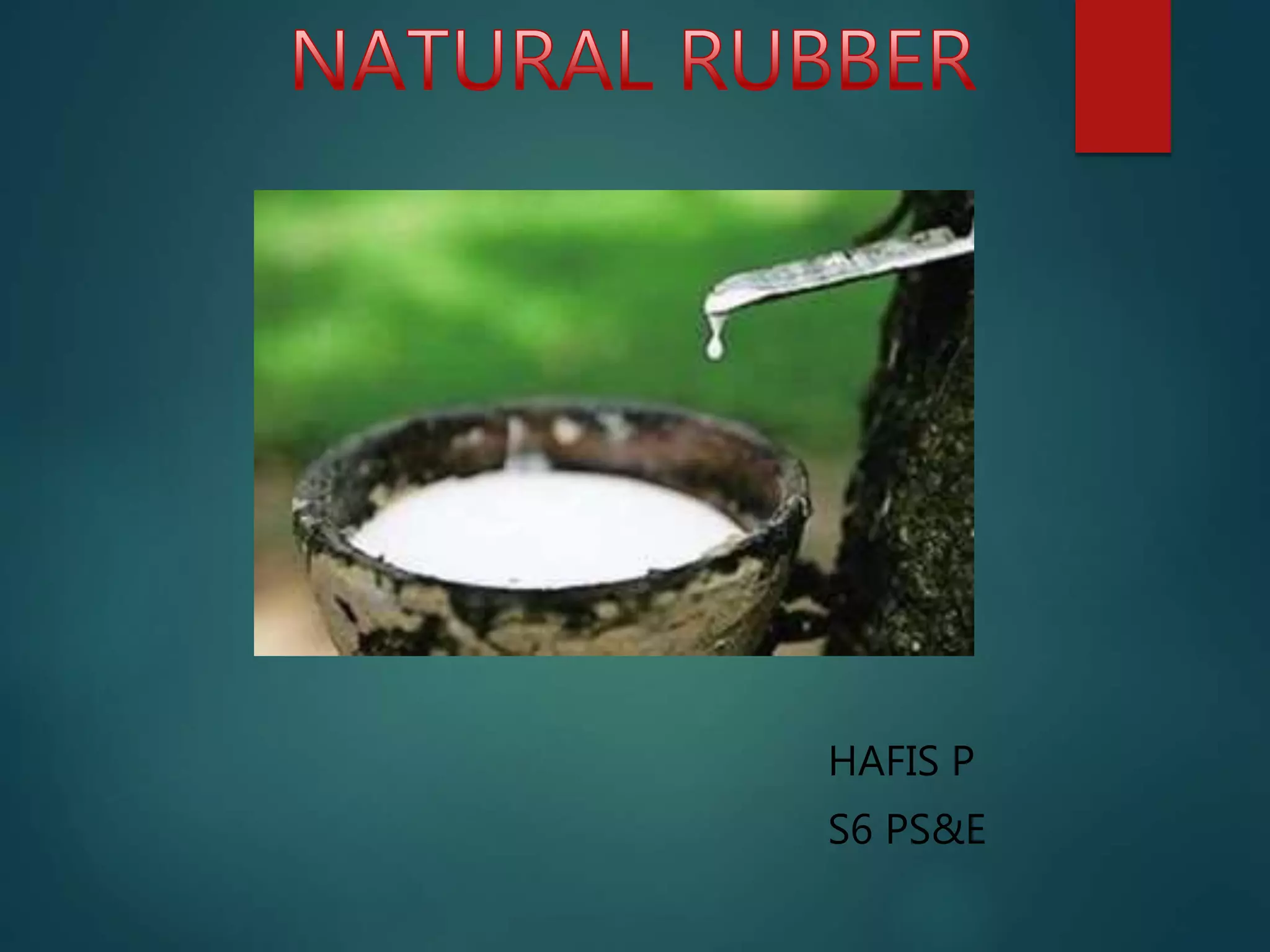
 Natural rubber is a naturally occurring polymer obtained from the latex
of rubber trees.
 Natural rubber (NR) is also known as cis-1,4-poly(isoprene).
 Natural rubber is found in the latex that comes from the rubber trees.
 It is collected in a cup mounted on each tree, by slashing the bark to
reach the latex vessels.
 The liquid is 30-40% rubber.
 The commercial source of natural rubber latex is the Para
rubber tree (Hevea brasiliensis).
 Other plants containing latex include:
Gutta-percha (Palaquium gutta)
Rubber fig (Ficus elastica)
Panama rubber tree (Castilla elastica)
Spurges (Euphorbia spp.)
Common dandelion (Taraxacum officinale)
Russian dandelion (Taraxacum kok-saghyz)
RUBBER TAPPING
 Rubber tapping is the process by which the latex is
collected from a rubber tree. An incision is made in the
tree's bark, which cuts through the latex vessels, from
which the product then flowsis the process by which
the latex is collected from a rubber tree. An incision is
made in the tree's bark, which cuts through the latex
vessels, from which the product then flows
 The physical and chemical properties of the rubber are
influenced by the presence of the non-rubber substances.
 NR is a natural polymeric substance having high molecular
weight, possessing visco-elastic properties.
 Natural rubber is cis-1,4-polyisoprene, i.e. a diene, because of
this, it shows all the reactions of an unsaturated compound.
 It gives addition compounds with hydrogen chloride, halogens,
ozone and several other reactants that combine with olefins.
 An interesting reaction of NR is its combination with sulphur,
called ‘vulcanization’.
 This reaction converts the raw rubber into an elastic material.
 Vulcanized rubber possesses high tensile strength, hardness
and abrasion resistance.
 Because of the unique combination of these properties, NR
finds application in the manufacture of various types of
products.
Physical properties of NR.
Chemical resistance of NR
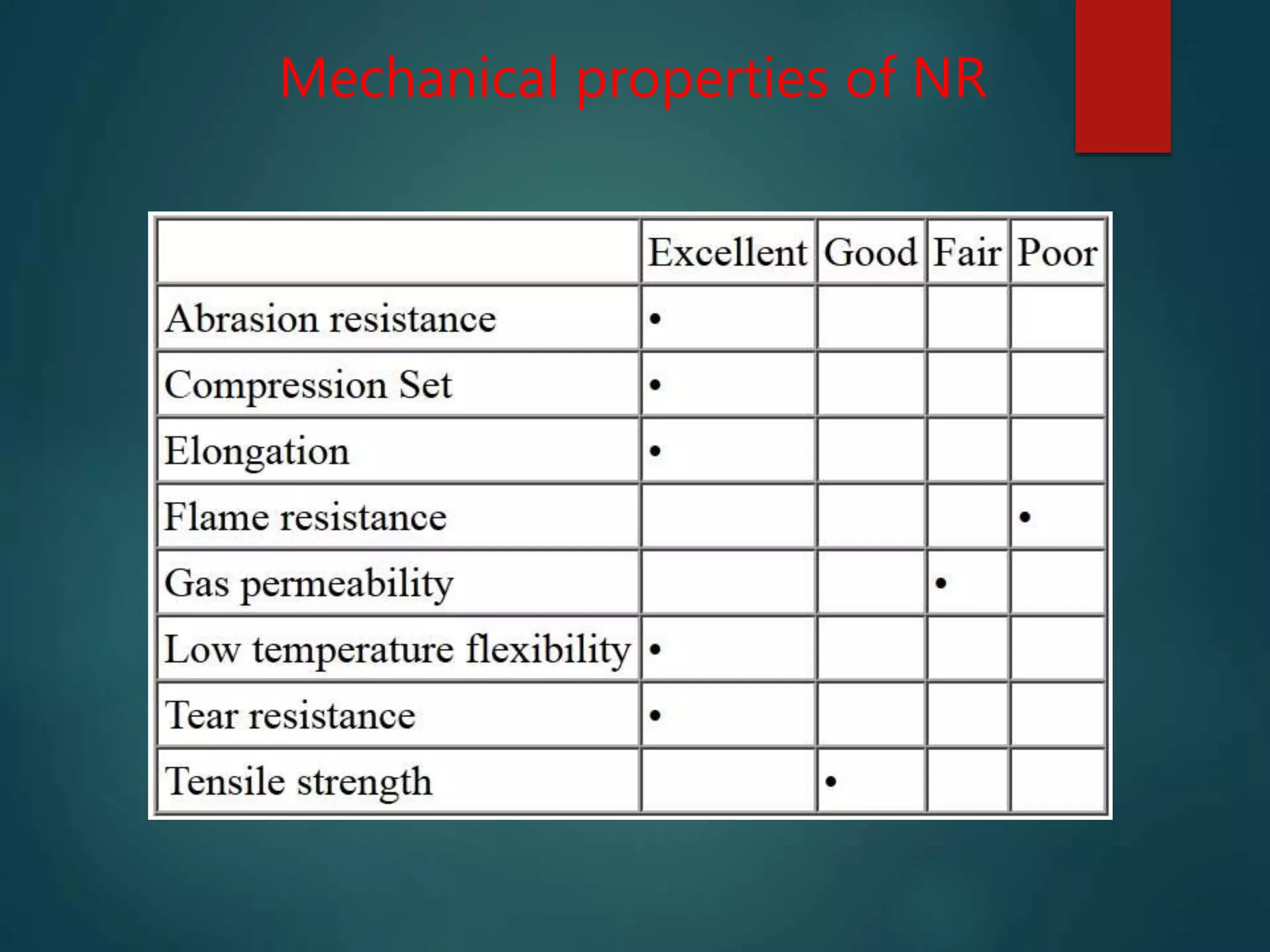
Mechanical properties of NR
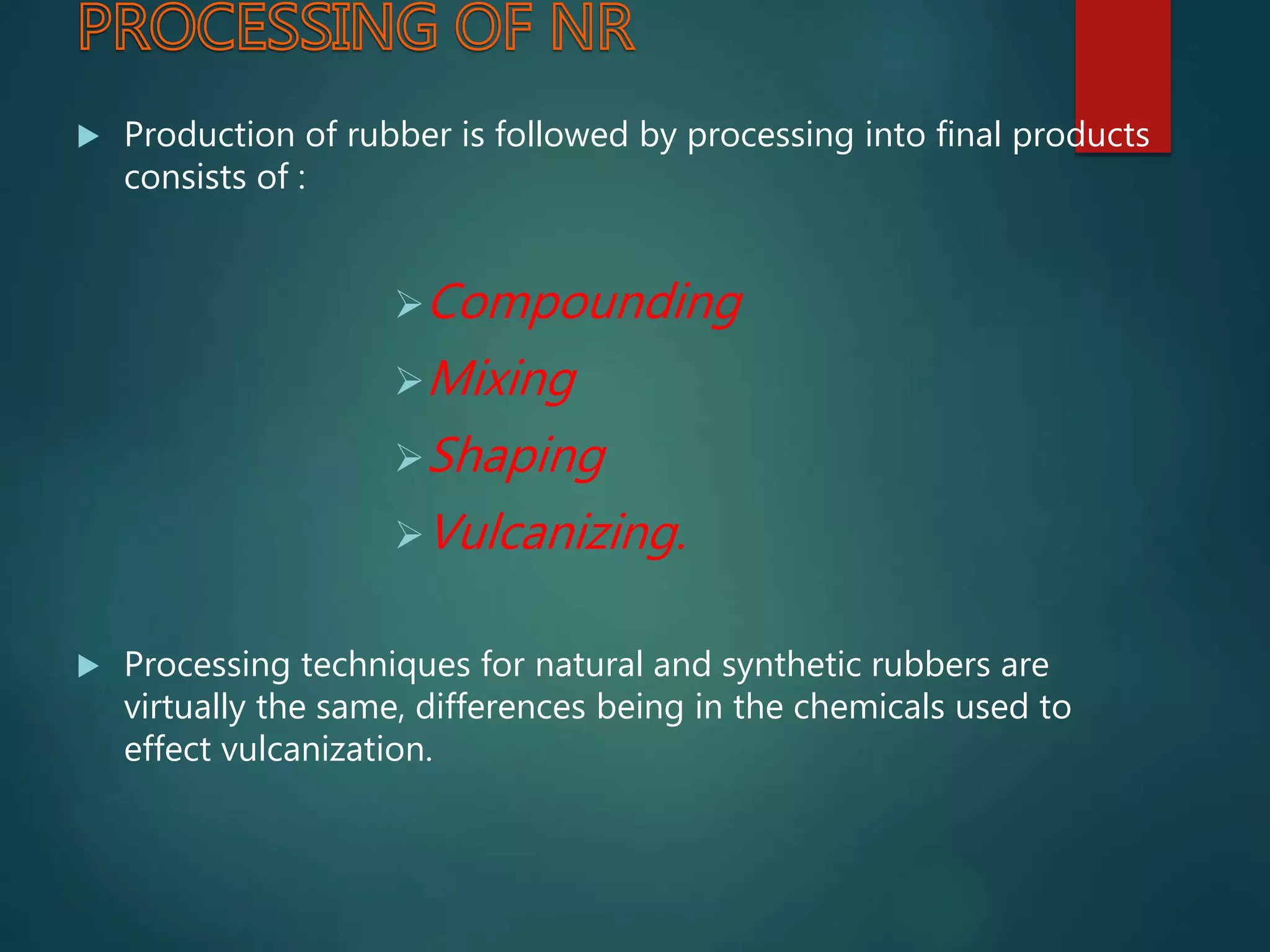
 Production of rubber is followed by processing into final products
consists of :
Compounding
Mixing
Shaping
Vulcanizing.
 Processing techniques for natural and synthetic rubbers are
virtually the same, differences being in the chemicals used to
effect vulcanization.
COMPOUNDING
 Rubber is always compounded with additives to satisfy the given
application in terms of properties, cost, and processability
 Compounding adds chemicals for vulcanization.
 Mainly used reinforcing filler used in NR is carbon black.
 Other additives include antioxidants , antiozonants colouring
pigments, plasticizers and softening oils, blowing agents in the
production of foamed rubber; and mold-release compounds
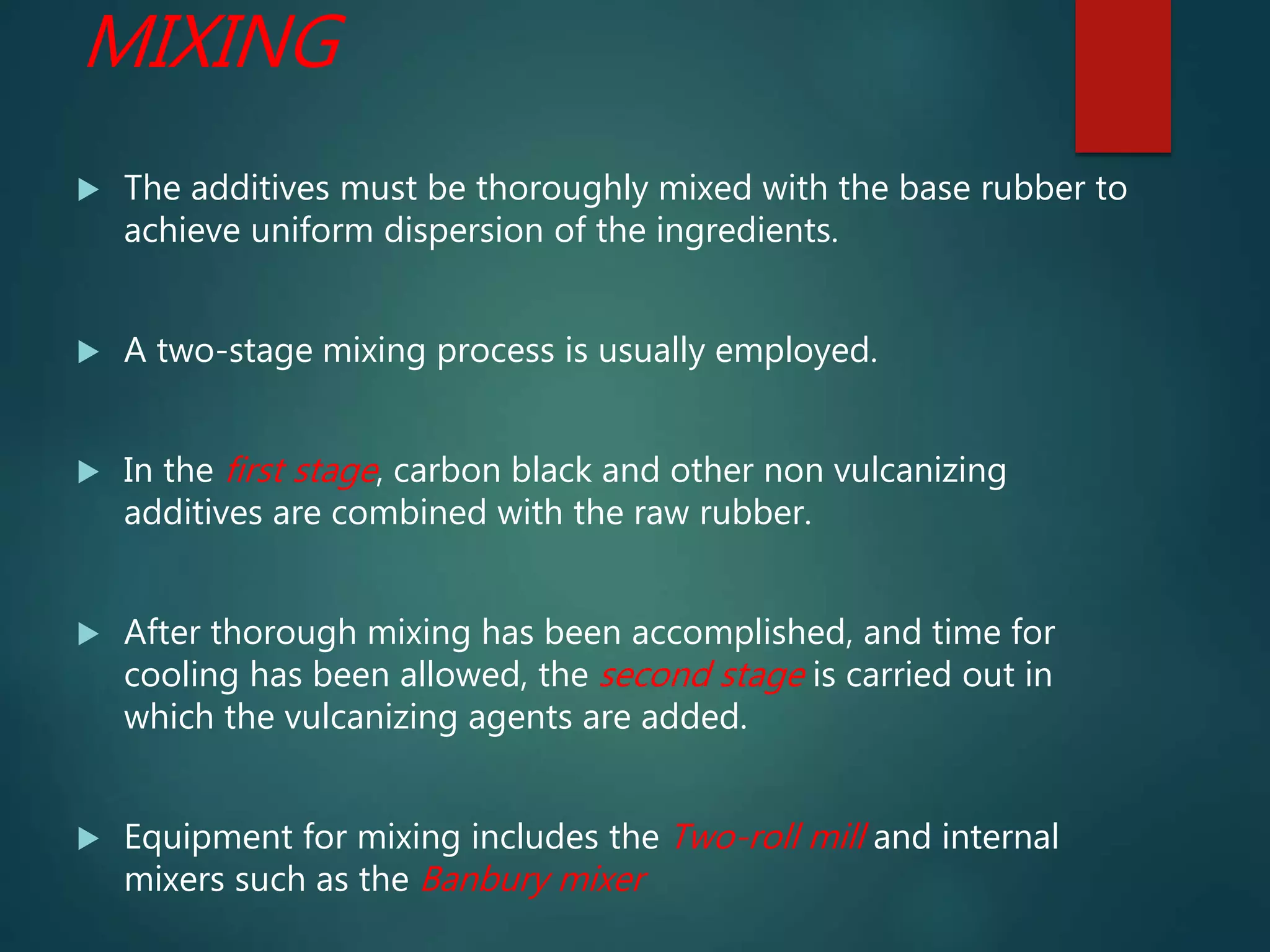
MIXING
 The additives must be thoroughly mixed with the base rubber to
achieve uniform dispersion of the ingredients.
 A two-stage mixing process is usually employed.
 In the first stage, carbon black and other non vulcanizing
additives are combined with the raw rubber.
 After thorough mixing has been accomplished, and time for
cooling has been allowed, the second stage is carried out in
which the vulcanizing agents are added.
 Equipment for mixing includes the Two-roll mill and internal
mixers such as the Banbury mixer
SHAPING
 Shaping processes for rubber products can be divided into four
basic categories:
Extrusion
Calendering
Coating
Molding and Casting
VULCANIZATION
o Vulcanization is a chemical process for converting natural rubber
or related polymers into more durable materials via the addition of
sulphur or other equivalent curatives or accelerators.
 NR Composites and Nanocomposites based on Conventional Fillers
 Carbon Black
 Silica
 Carbon Nanotubes
 Graphene
 NR Composites and Nanocomposites Based on Natural Fillers
 Glass, rayon, aramid, asbestos and cellulose as fibres
 Starch-Reinforced NR Composites and
Nanocomposites
 Reinforced with Natural Mineral Fillers
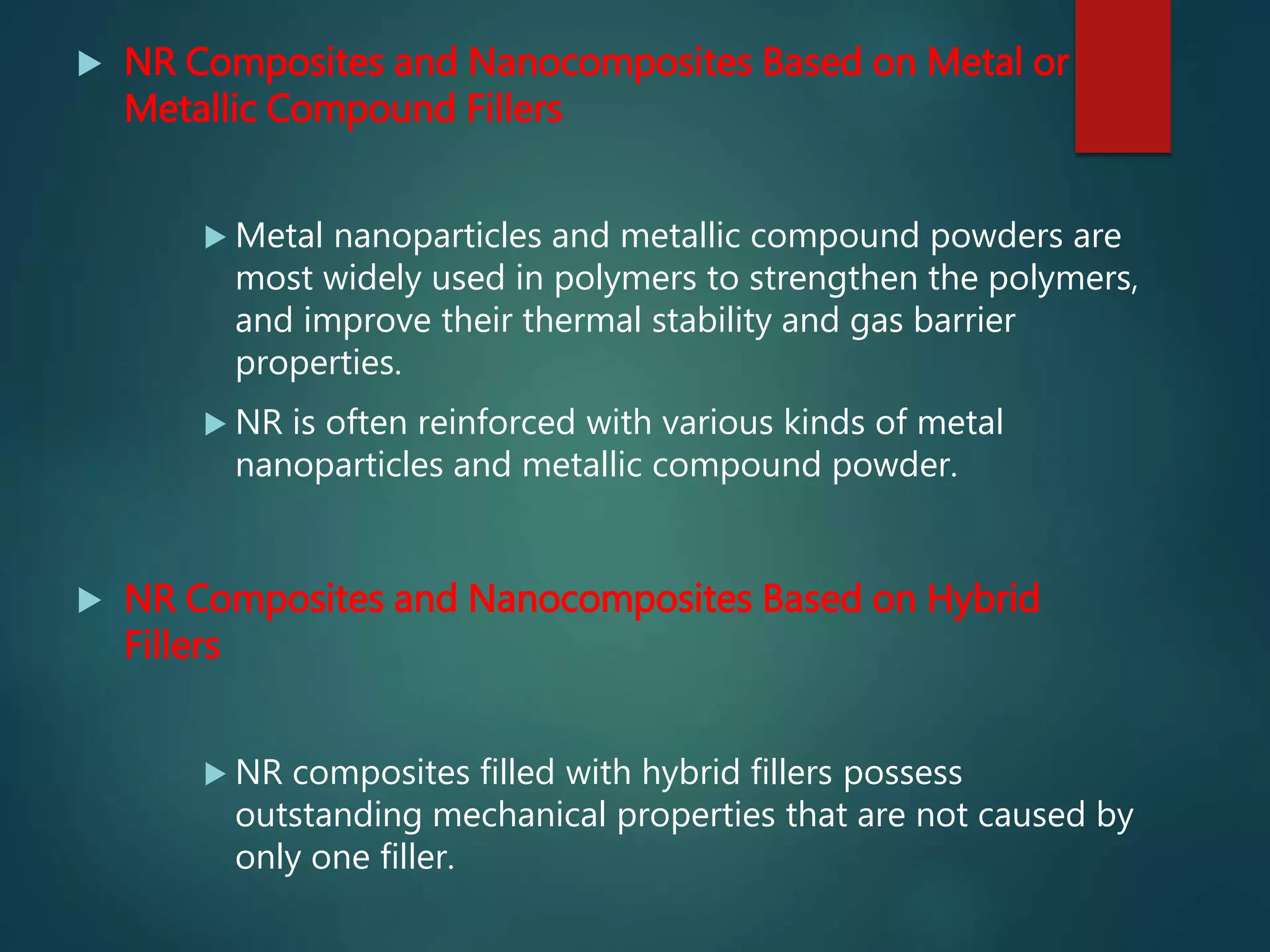
 NR Composites and Nanocomposites Based on Metal or
Metallic Compound Fillers
 Metal nanoparticles and metallic compound powders are
most widely used in polymers to strengthen the polymers,
and improve their thermal stability and gas barrier
properties.
 NR is often reinforced with various kinds of metal
nanoparticles and metallic compound powder.
 NR Composites and Nanocomposites Based on Hybrid
Fillers
 NR composites filled with hybrid fillers possess
outstanding mechanical properties that are not caused by
only one filler.
 Glass Fibre/NR Composite
 Glass fibres are the most common of all reinforcing synthetic
fibres for polymeric matrix composites (PMCs).
 The major advantages of glass fibres are high tensile
strength, low cost, high chemical resistance and excellent
insulating properties.
 The disadvantages are relatively low tensile modulus and
high density, high hardness,sensitivity to abrasion during
handling which tends to decrease its tensile strength,
relatively low fatigue resistance.
 Fibre-reinforced NR composites are manufactured by various
processes, the most common being extrusion, injection
moulding and compression moulding.
Mechanical Properties of Glass Fibre/NR Composites
 The mechanical properties of glass fibre/NR composites strongly
depend on properties of glass fibres.
 It is seen from the table that E-glass fibre has better tensile
properties than A-glass fibre.
 It is expected that E-glass/NR composites will show better tensile
properties than A-glass/NR composites.
 It is often observed that increase in fibre content leads to an
increase in the strength and modulus of a fibre reinforced
polymer matrix composite
 Mechanical properties also depend on fibre orientation.
 It varies for unidirectional and non-unidirectional
arrangements and for long and short fibres also.
 Strength of glass fibre/NR composites can be improved by
modification of NR and glass fibre.
 Modified NR can also give higher strength and better
adhesion properties.
 Modification of glass fibre helps to improve the fibre/matrix
adhesion.
 The main use of natural rubber is in automobiles.
 Sixty per cent of all rubber consumed is for automobile tyres and
tubes.
 In heavy duty tyres, the major portion of the rubber used is NR.
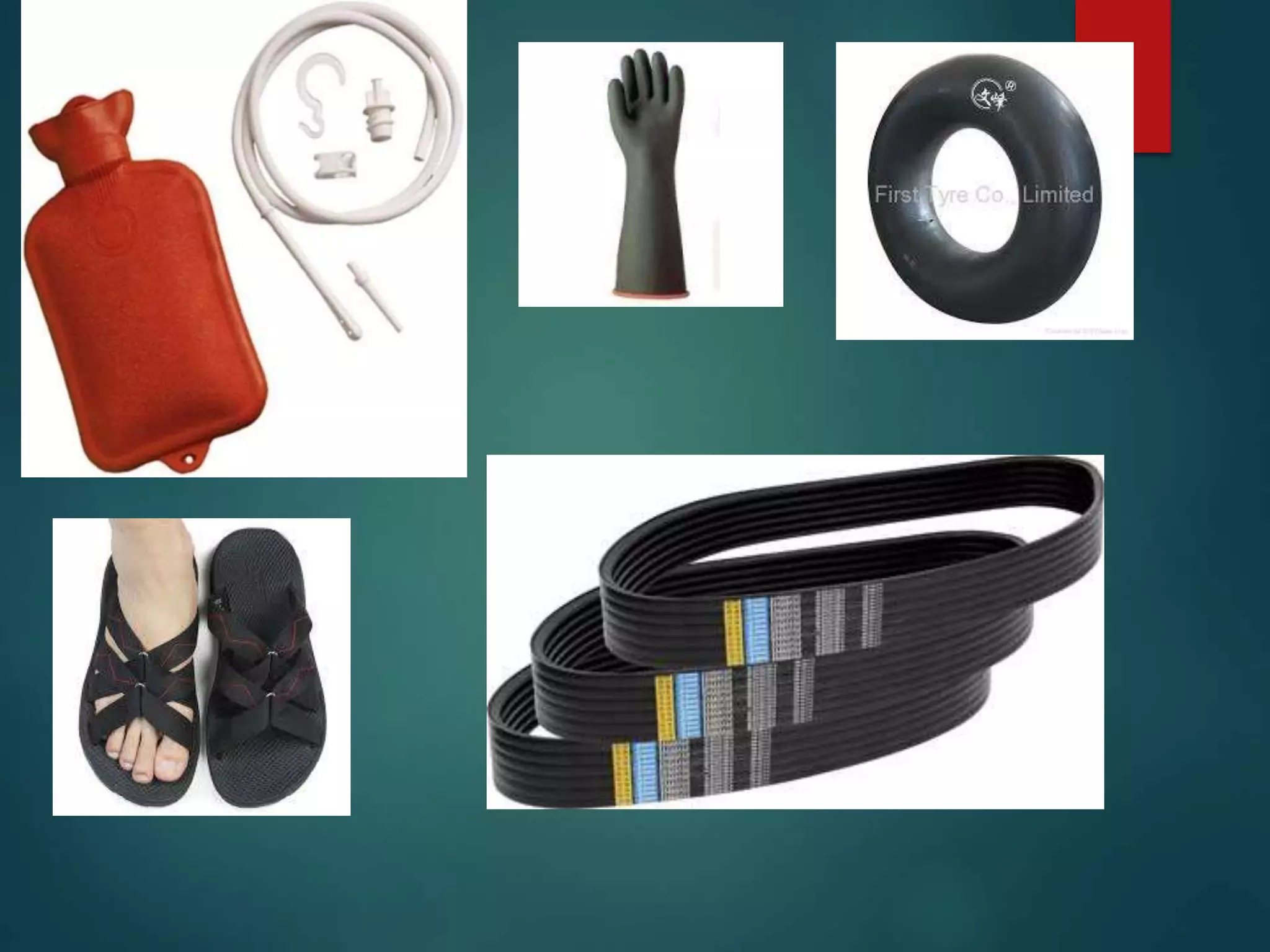
 Uses of NR in hoses, footwear, battery boxes, foam mattresses,
balloons, toys etc., are well known.
 NR now finds extensive use in soil stabilization, in vibration
absorption and in road making.
 Non-tyre rubber items include industrial products (for
example, transmission and elevator belts, hoses and tubes,
industrial lining, and bridge bearings)
 Consumer products (like golf or football balls and other
recreational and sports goods, erasers, footwear and other
apparel)
 Articles for use in the medical and health sector (notably,
condoms, catheters and surgical gloves)
 Latex articles (typically condoms, gloves, threads, adhesives,
and moulded foams) could be included in different categories
in terms of end-use.
 http://www.allsealsinc.com/Natural_Rubber-popup.html
 http://www.tutorvista.com/content/chemistry/chemistry-
ii/carbon-compounds/natural-rubber.php
 http://rubberboard.org.in/ManageCultivation.asp?Id=196
 Natural Rubber Materials: Volume 2: Composites and
Nanocomposites edited by Sabu Thomas, Chin Han Chan, Laly
A Pothen, Jithin Joy, Hanna Maria
 Fundamentals of Modern Manufacturing: Materials, Processes,
and system
Mikell P. Groover
natural rubber composite

natural rubber composite

  • 1.
  • 2.
     Rubber isa polymer, which is a word that is derived from the Greek meaning “many parts”.  Natural rubber is a naturally occurring polymer obtained from the latex of rubber trees.  Natural rubber (NR) is also known as cis-1,4-poly(isoprene).  Natural rubber is found in the latex that comes from the rubber trees.  It is collected in a cup mounted on each tree, by slashing the bark to reach the latex vessels.  The liquid is 30-40% rubber.
  • 4.
     The commercialsource of natural rubber latex is the Para rubber tree (Hevea brasiliensis).  Other plants containing latex include: Gutta-percha (Palaquium gutta) Rubber fig (Ficus elastica) Panama rubber tree (Castilla elastica) Spurges (Euphorbia spp.) Common dandelion (Taraxacum officinale) Russian dandelion (Taraxacum kok-saghyz)
  • 5.
    RUBBER TAPPING  Rubbertapping is the process by which the latex is collected from a rubber tree. An incision is made in the tree's bark, which cuts through the latex vessels, from which the product then flowsis the process by which the latex is collected from a rubber tree. An incision is made in the tree's bark, which cuts through the latex vessels, from which the product then flows
  • 6.
     The physicaland chemical properties of the rubber are influenced by the presence of the non-rubber substances.  NR is a natural polymeric substance having high molecular weight, possessing visco-elastic properties.  Natural rubber is cis-1,4-polyisoprene, i.e. a diene, because of this, it shows all the reactions of an unsaturated compound.  It gives addition compounds with hydrogen chloride, halogens, ozone and several other reactants that combine with olefins.
  • 7.
     An interestingreaction of NR is its combination with sulphur, called ‘vulcanization’.  This reaction converts the raw rubber into an elastic material.  Vulcanized rubber possesses high tensile strength, hardness and abrasion resistance.  Because of the unique combination of these properties, NR finds application in the manufacture of various types of products.
  • 8.
  • 9.
  • 10.
  • 11.
     Production ofrubber is followed by processing into final products consists of : Compounding Mixing Shaping Vulcanizing.  Processing techniques for natural and synthetic rubbers are virtually the same, differences being in the chemicals used to effect vulcanization.
  • 12.
    COMPOUNDING  Rubber isalways compounded with additives to satisfy the given application in terms of properties, cost, and processability  Compounding adds chemicals for vulcanization.  Mainly used reinforcing filler used in NR is carbon black.  Other additives include antioxidants , antiozonants colouring pigments, plasticizers and softening oils, blowing agents in the production of foamed rubber; and mold-release compounds
  • 13.
    MIXING  The additivesmust be thoroughly mixed with the base rubber to achieve uniform dispersion of the ingredients.  A two-stage mixing process is usually employed.  In the first stage, carbon black and other non vulcanizing additives are combined with the raw rubber.  After thorough mixing has been accomplished, and time for cooling has been allowed, the second stage is carried out in which the vulcanizing agents are added.  Equipment for mixing includes the Two-roll mill and internal mixers such as the Banbury mixer
  • 14.
    SHAPING  Shaping processesfor rubber products can be divided into four basic categories: Extrusion Calendering Coating Molding and Casting VULCANIZATION o Vulcanization is a chemical process for converting natural rubber or related polymers into more durable materials via the addition of sulphur or other equivalent curatives or accelerators.
  • 15.
     NR Compositesand Nanocomposites based on Conventional Fillers  Carbon Black  Silica  Carbon Nanotubes  Graphene  NR Composites and Nanocomposites Based on Natural Fillers  Glass, rayon, aramid, asbestos and cellulose as fibres  Starch-Reinforced NR Composites and Nanocomposites  Reinforced with Natural Mineral Fillers
  • 16.
     NR Compositesand Nanocomposites Based on Metal or Metallic Compound Fillers  Metal nanoparticles and metallic compound powders are most widely used in polymers to strengthen the polymers, and improve their thermal stability and gas barrier properties.  NR is often reinforced with various kinds of metal nanoparticles and metallic compound powder.  NR Composites and Nanocomposites Based on Hybrid Fillers  NR composites filled with hybrid fillers possess outstanding mechanical properties that are not caused by only one filler.
  • 17.
     Glass Fibre/NRComposite  Glass fibres are the most common of all reinforcing synthetic fibres for polymeric matrix composites (PMCs).  The major advantages of glass fibres are high tensile strength, low cost, high chemical resistance and excellent insulating properties.  The disadvantages are relatively low tensile modulus and high density, high hardness,sensitivity to abrasion during handling which tends to decrease its tensile strength, relatively low fatigue resistance.  Fibre-reinforced NR composites are manufactured by various processes, the most common being extrusion, injection moulding and compression moulding.
  • 18.
    Mechanical Properties ofGlass Fibre/NR Composites  The mechanical properties of glass fibre/NR composites strongly depend on properties of glass fibres.  It is seen from the table that E-glass fibre has better tensile properties than A-glass fibre.  It is expected that E-glass/NR composites will show better tensile properties than A-glass/NR composites.  It is often observed that increase in fibre content leads to an increase in the strength and modulus of a fibre reinforced polymer matrix composite
  • 19.
     Mechanical propertiesalso depend on fibre orientation.  It varies for unidirectional and non-unidirectional arrangements and for long and short fibres also.  Strength of glass fibre/NR composites can be improved by modification of NR and glass fibre.  Modified NR can also give higher strength and better adhesion properties.  Modification of glass fibre helps to improve the fibre/matrix adhesion.
  • 20.
     The mainuse of natural rubber is in automobiles.  Sixty per cent of all rubber consumed is for automobile tyres and tubes.  In heavy duty tyres, the major portion of the rubber used is NR.  Uses of NR in hoses, footwear, battery boxes, foam mattresses, balloons, toys etc., are well known.  NR now finds extensive use in soil stabilization, in vibration absorption and in road making.
  • 21.
     Non-tyre rubberitems include industrial products (for example, transmission and elevator belts, hoses and tubes, industrial lining, and bridge bearings)  Consumer products (like golf or football balls and other recreational and sports goods, erasers, footwear and other apparel)  Articles for use in the medical and health sector (notably, condoms, catheters and surgical gloves)  Latex articles (typically condoms, gloves, threads, adhesives, and moulded foams) could be included in different categories in terms of end-use.
  • 27.
     http://www.allsealsinc.com/Natural_Rubber-popup.html  http://www.tutorvista.com/content/chemistry/chemistry- ii/carbon-compounds/natural-rubber.php http://rubberboard.org.in/ManageCultivation.asp?Id=196  Natural Rubber Materials: Volume 2: Composites and Nanocomposites edited by Sabu Thomas, Chin Han Chan, Laly A Pothen, Jithin Joy, Hanna Maria  Fundamentals of Modern Manufacturing: Materials, Processes, and system Mikell P. Groover