NATURAL AND SYNTHETIC RUBBER
PRESENTED BY:
Y.MANASA(B130756CH)
YOGESH KUMAR(B130983CH)
AJAY KRISHNAN V(B120652CH)
 Elastomers are used in wide variety of industrial, medical and
household products and major portion of elastomers consumption
goes into tyres next largest product sector is latex goods.
 There are two major types of elastomers; natural rubber a product of
tropical tree Hevea brasiliens is and synthetic rubber- a family of
materials derived from petrochemical feed stocks[Chemistry &
industry 5, August 1996, p.574]. Major producers of natural rubber
are natural rubber producing country are Thailand, Indonesia and
Malaysia, Africa, Latin America, Brazil,Cambodia, Nigeria, Sri Lanka,
Thailand, India.
 Demand for natural is estimated to have been around 10.9 million
tones in 2011 out of which around 45 percent was from Asia. About
92percent of natural rubber is produced from Asian countries. The
demand for natural rubber globally is projected to grow by 3-4percent
through 2014.
 Synthetic rubbers have slowly replaced natural rubbers and have
undergone variousdevelopments for applications in automotives,
chemical industry, energy generationSports,aerospace industry,etc.
Natural rubber, also called India rubber or caoutchouc, as
initially produced, consists of polymers of the organic
compound isoprene, with minor impurities of other organic
compounds plus water. Forms of polyisoprene that are used
as natural rubbers are classified as elastomers. Currently,
rubber is harvested mainly in the form of the latex from
certain trees. The latex is a sticky, milky colloid drawn off by
making incisions into the bark and collecting the fluid in
vessels in a process called "tapping". The latex then is
refined into rubber ready for commercial processing. Natural
rubber is used extensively in many applications and
products, either alone or in combination with other
materials. In most of its useful forms, it has a large stretch
ratio and high resilience, and is extremely waterproof.
 Synthetic rubber, invariably a polymer, is any type of artificial
elastomer mainly synthesised from petroleum byproducts. An
elastomer is a material with the mechanical (or material) property
that it can undergo much more elastic deformation under stress than
most materials and still return to its previous size without
permanent deformation. About 15 billion kilograms of rubbers are
produced annually, and of that amount two thirds is synthetic.
Global revenues generated with synthetic rubbers are likely to rise to
approximately US$56 billion in 2020.
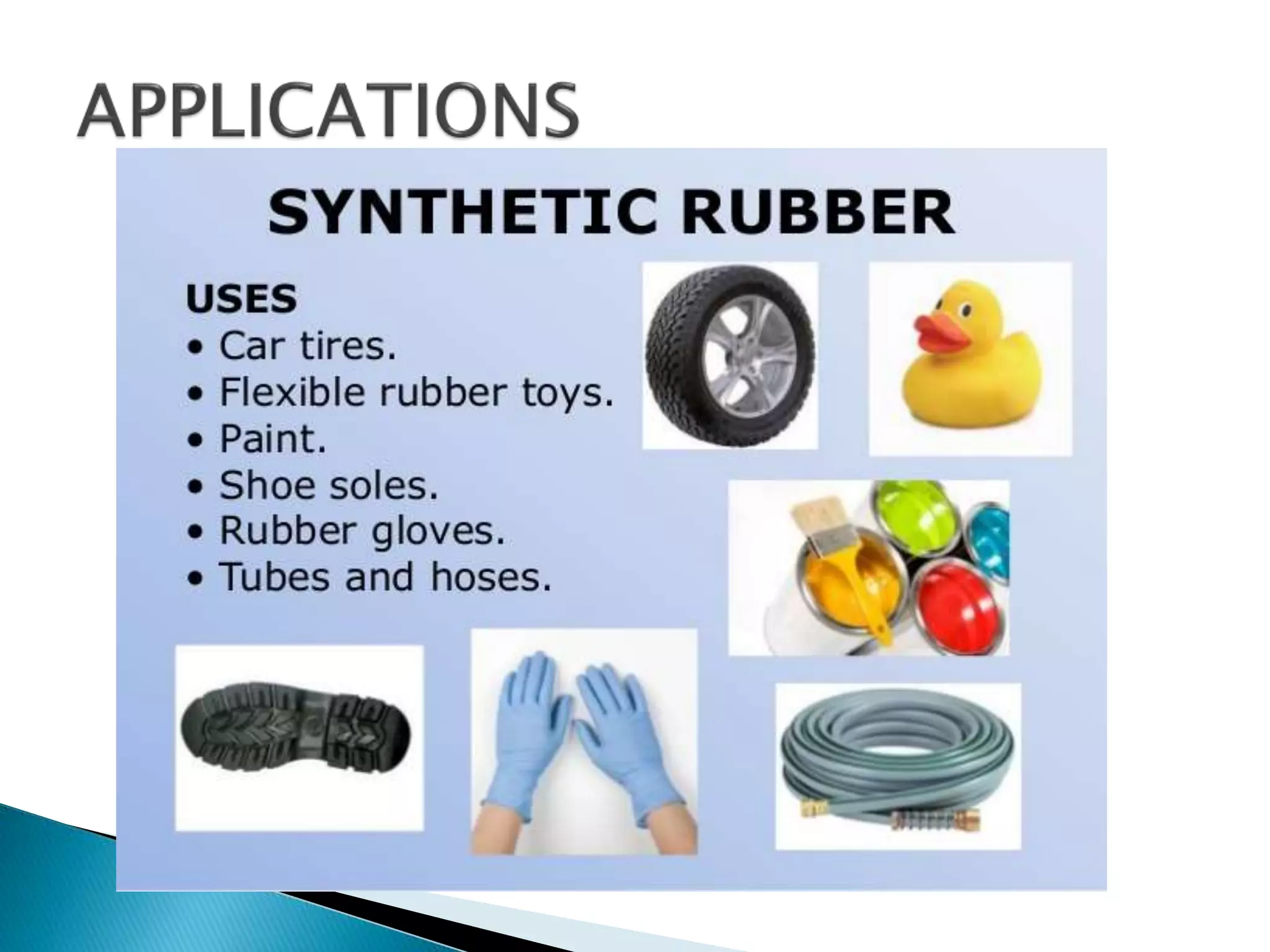
 Synthetic rubber, like natural rubber, has uses in the automotive
industry for tires, door and window profiles, hoses, belts, matting,
flooring and dampeners (antivibration mounts).
 Styrene butadiene rubber is most widely used elastomer in
the world.SBR is used forboth tire and non-tire application
Styrene butadiene rubber known as Buna-S was first prepared
by I.G.
 Farbenindustrie in Germany. There has been significant
development in the process technology of styrene butadiene
rubber manufacture. Amongst the various processes,
emulsion polymerisation of SBR is most commonly used. The
cold process of emulsion polymerisation process has replaced
the hot polymerisation process. In India, first SBR
manufacture was started by Synthetic and Chemicals, Bareilly
in 1963, however, the unit has been closed presently.
 Although butadiene is recovered from cracker plant, it can be
also made from ethanol route.
 Styrene is made from ethyl benzene by alkylation of benzene
with ethylene which can be also recovered from FCC gases.
There are tow conventional routes
to producing solid SBR:
 Hot emulsion polymerization
 Cold emulsion polymerization
 Hot emulsion polymerization is the original SBR process. The
major characteristic of this process is that these grades have
exceptional processing characteristics in terms of low mill
shrinkage, good dimensional stability and good extrusion
characteristics.
 However, high levels of micro-gels are also produced, so
there is a trend towards using the cold emulsion grades
in many applications.
 However, they are still used in applications such as adhesives
and flow modifiers for other elastomers where good flow
properties are required.
 Cold emulsion polymerization produces SBR grades
with superior mechanical properties, especially
tensile strength and abrasion resistance, compared
to the grades produced by the hot emulsion
polymerization process.
 This process has largely replaced the hot emulsion
polymerization process for production of e-SBR
grades.
16 natural and synthetic rubber

16 natural and synthetic rubber

  • 1.
    NATURAL AND SYNTHETICRUBBER PRESENTED BY: Y.MANASA(B130756CH) YOGESH KUMAR(B130983CH) AJAY KRISHNAN V(B120652CH)
  • 2.
     Elastomers areused in wide variety of industrial, medical and household products and major portion of elastomers consumption goes into tyres next largest product sector is latex goods.  There are two major types of elastomers; natural rubber a product of tropical tree Hevea brasiliens is and synthetic rubber- a family of materials derived from petrochemical feed stocks[Chemistry & industry 5, August 1996, p.574]. Major producers of natural rubber are natural rubber producing country are Thailand, Indonesia and Malaysia, Africa, Latin America, Brazil,Cambodia, Nigeria, Sri Lanka, Thailand, India.  Demand for natural is estimated to have been around 10.9 million tones in 2011 out of which around 45 percent was from Asia. About 92percent of natural rubber is produced from Asian countries. The demand for natural rubber globally is projected to grow by 3-4percent through 2014.  Synthetic rubbers have slowly replaced natural rubbers and have undergone variousdevelopments for applications in automotives, chemical industry, energy generationSports,aerospace industry,etc.
  • 3.
    Natural rubber, alsocalled India rubber or caoutchouc, as initially produced, consists of polymers of the organic compound isoprene, with minor impurities of other organic compounds plus water. Forms of polyisoprene that are used as natural rubbers are classified as elastomers. Currently, rubber is harvested mainly in the form of the latex from certain trees. The latex is a sticky, milky colloid drawn off by making incisions into the bark and collecting the fluid in vessels in a process called "tapping". The latex then is refined into rubber ready for commercial processing. Natural rubber is used extensively in many applications and products, either alone or in combination with other materials. In most of its useful forms, it has a large stretch ratio and high resilience, and is extremely waterproof.
  • 6.
     Synthetic rubber,invariably a polymer, is any type of artificial elastomer mainly synthesised from petroleum byproducts. An elastomer is a material with the mechanical (or material) property that it can undergo much more elastic deformation under stress than most materials and still return to its previous size without permanent deformation. About 15 billion kilograms of rubbers are produced annually, and of that amount two thirds is synthetic. Global revenues generated with synthetic rubbers are likely to rise to approximately US$56 billion in 2020.  Synthetic rubber, like natural rubber, has uses in the automotive industry for tires, door and window profiles, hoses, belts, matting, flooring and dampeners (antivibration mounts).
  • 9.
     Styrene butadienerubber is most widely used elastomer in the world.SBR is used forboth tire and non-tire application Styrene butadiene rubber known as Buna-S was first prepared by I.G.  Farbenindustrie in Germany. There has been significant development in the process technology of styrene butadiene rubber manufacture. Amongst the various processes, emulsion polymerisation of SBR is most commonly used. The cold process of emulsion polymerisation process has replaced the hot polymerisation process. In India, first SBR manufacture was started by Synthetic and Chemicals, Bareilly in 1963, however, the unit has been closed presently.  Although butadiene is recovered from cracker plant, it can be also made from ethanol route.  Styrene is made from ethyl benzene by alkylation of benzene with ethylene which can be also recovered from FCC gases.
  • 11.
    There are towconventional routes to producing solid SBR:  Hot emulsion polymerization  Cold emulsion polymerization
  • 12.
     Hot emulsionpolymerization is the original SBR process. The major characteristic of this process is that these grades have exceptional processing characteristics in terms of low mill shrinkage, good dimensional stability and good extrusion characteristics.  However, high levels of micro-gels are also produced, so there is a trend towards using the cold emulsion grades in many applications.  However, they are still used in applications such as adhesives and flow modifiers for other elastomers where good flow properties are required.
  • 13.
     Cold emulsionpolymerization produces SBR grades with superior mechanical properties, especially tensile strength and abrasion resistance, compared to the grades produced by the hot emulsion polymerization process.  This process has largely replaced the hot emulsion polymerization process for production of e-SBR grades.