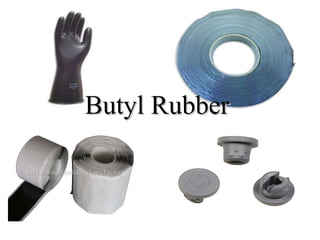
Butyl Rubber
GROUP 14

        ONG HUI JIN 152161

SITI ZAHARAH BT SYED RAMLI 152197

NORASHEILA BT MOHD SAAD 152167
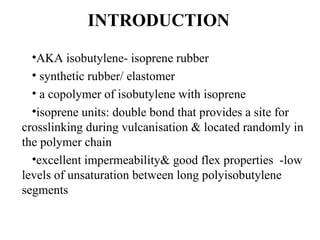
INTRODUCTION
  •AKA isobutylene- isoprene rubber
  • synthetic rubber/ elastomer
  • a copolymer of isobutylene with isoprene
  •isoprene units: double bond that provides a site for
crosslinking during vulcanisation & located randomly in
the polymer chain
  •excellent impermeability& good flex properties -low
levels of unsaturation between long polyisobutylene
segments
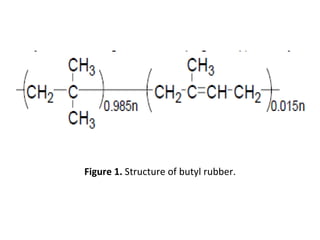
Figure 1. Structure of butyl rubber.
Preparation/synthesis
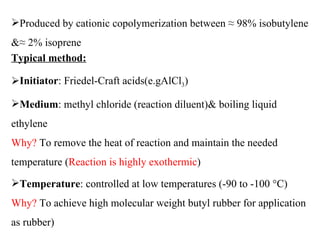
Produced by cationic copolymerization between ≈ 98% isobutylene
&≈ 2% isoprene
Typical method:

Initiator: Friedel-Craft acids(e.gAlCl3)

Medium: methyl chloride (reaction diluent)& boiling liquid
ethylene
Why? To remove the heat of reaction and maintain the needed
temperature (Reaction is highly exothermic)
Temperature: controlled at low temperatures (-90 to -100 °C)
Why? To achieve high molecular weight butyl rubber for application
as rubber)
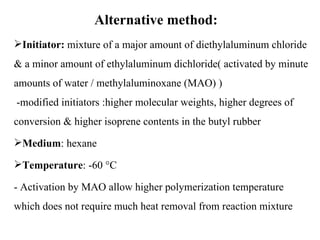
Alternative method:
Initiator: mixture of a major amount of diethylaluminum chloride
& a minor amount of ethylaluminum dichloride( activated by minute
amounts of water / methylaluminoxane (MAO) )
-modified initiators :higher molecular weights, higher degrees of
conversion & higher isoprene contents in the butyl rubber
Medium: hexane

Temperature: -60 °C

- Activation by MAO allow higher polymerization temperature
which does not require much heat removal from reaction mixture
Commercial Butyl Rubber polymerization
process
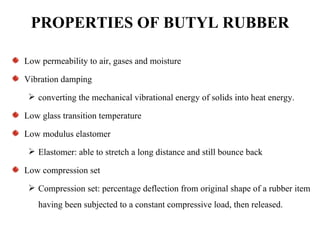
PROPERTIES OF BUTYL RUBBER

Low permeability to air, gases and moisture

Vibration damping
  converting the mechanical vibrational energy of solids into heat energy.

Low glass transition temperature

Low modulus elastomer
  Elastomer: able to stretch a long distance and still bounce back

Low compression set
  Compression set: percentage deflection from original shape of a rubber item
   having been subjected to a constant compressive load, then released.
PROPERTIES OF BUTYL RUBBER cont.

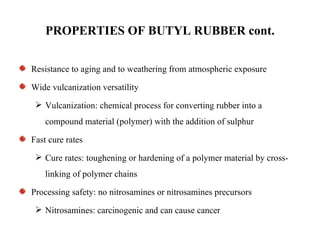
Resistance to aging and to weathering from atmospheric exposure

Wide vulcanization versatility
  Vulcanization: chemical process for converting rubber into a
    compound material (polymer) with the addition of sulphur

Fast cure rates
  Cure rates: toughening or hardening of a polymer material by cross-
    linking of polymer chains

Processing safety: no nitrosamines or nitrosamines precursors
  Nitrosamines: carcinogenic and can cause cancer
PROPERTIES OF BUTYL RUBBER cont.


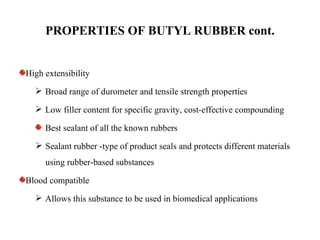
High extensibility
   Broad range of durometer and tensile strength properties

   Low filler content for specific gravity, cost-effective compounding

     Best sealant of all the known rubbers
   Sealant rubber -type of product seals and protects different materials
     using rubber-based substances

Blood compatible
   Allows this substance to be used in biomedical applications
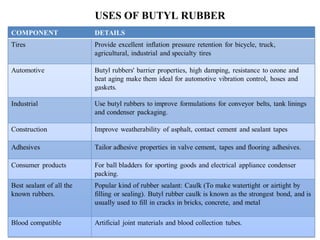
USES OF BUTYL RUBBER
THE END

Group 14 butyl rubber

  • 1.
  • 2.
    GROUP 14 ONG HUI JIN 152161 SITI ZAHARAH BT SYED RAMLI 152197 NORASHEILA BT MOHD SAAD 152167
  • 3.
    INTRODUCTION •AKAisobutylene- isoprene rubber • synthetic rubber/ elastomer • a copolymer of isobutylene with isoprene •isoprene units: double bond that provides a site for crosslinking during vulcanisation & located randomly in the polymer chain •excellent impermeability& good flex properties -low levels of unsaturation between long polyisobutylene segments
  • 4.
    Figure 1. Structureof butyl rubber.
  • 5.
  • 6.
    Produced by cationiccopolymerization between ≈ 98% isobutylene &≈ 2% isoprene Typical method: Initiator: Friedel-Craft acids(e.gAlCl3) Medium: methyl chloride (reaction diluent)& boiling liquid ethylene Why? To remove the heat of reaction and maintain the needed temperature (Reaction is highly exothermic) Temperature: controlled at low temperatures (-90 to -100 °C) Why? To achieve high molecular weight butyl rubber for application as rubber)
  • 7.
    Alternative method: Initiator: mixtureof a major amount of diethylaluminum chloride & a minor amount of ethylaluminum dichloride( activated by minute amounts of water / methylaluminoxane (MAO) ) -modified initiators :higher molecular weights, higher degrees of conversion & higher isoprene contents in the butyl rubber Medium: hexane Temperature: -60 °C - Activation by MAO allow higher polymerization temperature which does not require much heat removal from reaction mixture
  • 8.
    Commercial Butyl Rubberpolymerization process
  • 9.
    PROPERTIES OF BUTYLRUBBER Low permeability to air, gases and moisture Vibration damping  converting the mechanical vibrational energy of solids into heat energy. Low glass transition temperature Low modulus elastomer  Elastomer: able to stretch a long distance and still bounce back Low compression set  Compression set: percentage deflection from original shape of a rubber item having been subjected to a constant compressive load, then released.
  • 10.
    PROPERTIES OF BUTYLRUBBER cont. Resistance to aging and to weathering from atmospheric exposure Wide vulcanization versatility  Vulcanization: chemical process for converting rubber into a compound material (polymer) with the addition of sulphur Fast cure rates  Cure rates: toughening or hardening of a polymer material by cross- linking of polymer chains Processing safety: no nitrosamines or nitrosamines precursors  Nitrosamines: carcinogenic and can cause cancer
  • 11.
    PROPERTIES OF BUTYLRUBBER cont. High extensibility  Broad range of durometer and tensile strength properties  Low filler content for specific gravity, cost-effective compounding Best sealant of all the known rubbers  Sealant rubber -type of product seals and protects different materials using rubber-based substances Blood compatible  Allows this substance to be used in biomedical applications
  • 12.
  • 13.