RUBBER AND RUBBER TECHNOLOGY
CONVERSION OF RUBBER
Kutluhan Utku TÜMEN
2018 / 2019
Rubber and Rubber Technology 1 Materials Engineering
• Since many chemicals (sulfur, activators, fatty acid, accelerator, fillers,
plasticizer, antioxidant) are added to the mixture during the
preparation of the rubber products, a large amount of waste is then
encountered.
• Leakage emissions, solid waste and hazardous wastes are the
environmental effects that occur in the rubber manufacturing process.
Rubber Industry Waste
2
Rubber and Rubber Technology 2 Materials Engineering
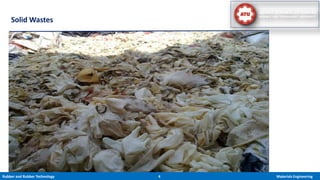
• Solid wastes are produced during the manufacturing process of the
production of rubber products.
• In addition,rubbers that have completed their life are also in this
group.For example , If the tire tooth depth is less than 1.6 mm for
automobiles, it is defined as expired tire.
• Production processes where rubber wastes are formed are mixing,
pre-forming and vulcanizing processes.
• Waste rubber is collected in 3 groups.
- Non-vulcanized rubber
- Vulcanized rubber
- Scraps
Solid Wastes
3
Rubber and Rubber Technology 3 Materials Engineering
4
Solid Wastes
Rubber and Rubber Technology 4 Materials Engineering
Solid Wastes
Rubber and Rubber Technology 5 Materials Engineering
6
Solid Wastes
Rubber and Rubber Technology 6 Materials Engineering
• Several problems arise when storing used tires. These environmental and
community health problems are eliminated through recycling.
• It is necessary to recycle rubber as it increases landfill pollution. The
rubber takes a very long time to decompose and when it is burnt,
poisonous and carcinogenic gases are released increasing the pollution.
So rubber is recycled in industries to assist the economy and it also saves
energy.
• Energy savings can be achieved by the evaluation of old rubbers.
Recycle of Rubber
7
Rubber and Rubber Technology 7 Materials Engineering
Recycle of Rubber
8
Rubber and Rubber Technology 8 Materials Engineering
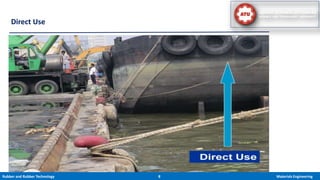
Direct Use
9
Rubber and Rubber Technology 9 Materials Engineering
Direct Use
10
Rubber and Rubber Technology 10 Materials Engineering
Peel – Cut
11
Rubber and Rubber Technology 11 Materials Engineering
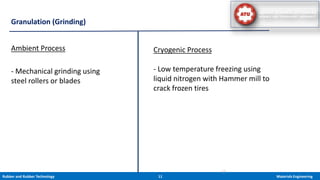
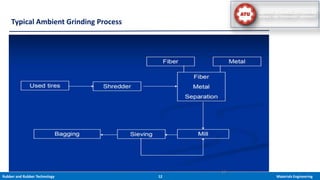
Ambient Process
- Mechanical grinding using
steel rollers or blades
Granulation (Grinding)
Cryogenic Process
- Low temperature freezing using
liquid nitrogen with Hammer mill to
crack frozen tires
12
Rubber and Rubber Technology 12 Materials Engineering
Typical Ambient Grinding Process
13
Rubber and Rubber Technology 13 Materials Engineering
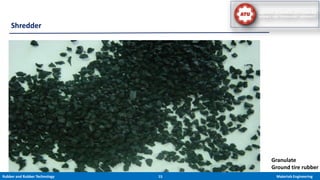
Shredder
14
Rubber and Rubber Technology 14 Materials Engineering
Shredder
15
Rubber and Rubber Technology 15 Materials Engineering
Shredder
Granulate
Ground tire rubber
16
Rubber and Rubber Technology 16 Materials Engineering
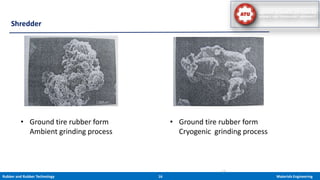
• Ground tire rubber form
Ambient grinding process
• Ground tire rubber form
Cryogenic grinding process
Shredder
17
Rubber and Rubber Technology 17 Materials Engineering
Particle Size Distribution – Ambient vs Cryogenic
18
Rubber and Rubber Technology 18 Materials Engineering
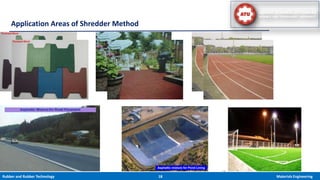
Application Areas of Shredder Method
19
Rubber and Rubber Technology 19 Materials Engineering
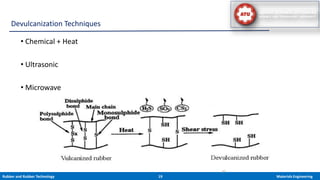
• Chemical + Heat
• Ultrasonic
• Microwave
Devulcanization Techniques
20
Rubber and Rubber Technology 20 Materials Engineering
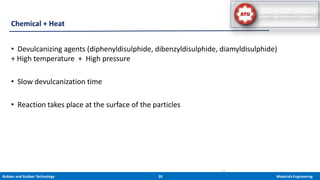
• Devulcanizing agents (diphenyldisulphide, dibenzyldisulphide, diamyldisulphide)
+ High temperature + High pressure
• Slow devulcanization time
• Reaction takes place at the surface of the particles
Chemical + Heat
21
Rubber and Rubber Technology 21 Materials Engineering
Chemical + Heat
22
Rubber and Rubber Technology 22 Materials Engineering
Reclaimed Rubber Slabs
23
Rubber and Rubber Technology 23 Materials Engineering
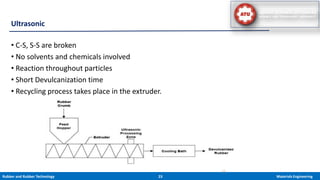
• C-S, S-S are broken
• No solvents and chemicals involved
• Reaction throughout particles
• Short Devulcanization time
• Recycling process takes place in the extruder.
Ultrasonic
24
Rubber and Rubber Technology 24 Materials Engineering
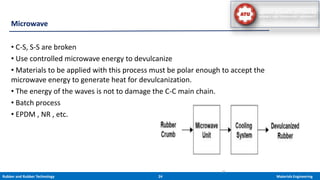
• C-S, S-S are broken
• Use controlled microwave energy to devulcanize
• Materials to be applied with this process must be polar enough to accept the
microwave energy to generate heat for devulcanization.
• The energy of the waves is not to damage the C-C main chain.
• Batch process
• EPDM , NR , etc.
Microwave
25
Rubber and Rubber Technology 25 Materials Engineering
• It provides 100% recycling.
• No chemical additives used in the process.
• With this method, used waste tires will be shred by thermolysis method
(uses localized heat ) and steel wire, carbon black, pyrolytic oil (aromatic oil)
and gas phase products will be obtained.
•The combustion process is spontaneous and highly exothermic, and, once
initiated, it becomes self-supporting. The conversion temperature is in the
range of 1150 ͦC
•Products obtained from waste are used as raw materials in other industrial
establishments.
Pyrolysis System
26
Rubber and Rubber Technology 26 Materials Engineering
Pyrolysis System
27
Rubber and Rubber Technology 27 Materials Engineering
•Ahmed, R., Klundert, Arnold van de, Lardinois, I., Rubber Waste, Options for Smallscale Resource
Recovery, TOOL Publications and WASTE, 1996. A book aimed at small-scale rubber recyclers in
developing countries.
•Scrap Tire and Rubber Recycling Terminology Booklet developed by the ITRA Tire and Rubber Recycling
Advisory Council (TRRAC) (See address in following section). It is a valuable resource to understanding
the tire industry and tire recycling issues.
•Baarle, B. van, Het hervewerken van Rubberafval van Personenevagenbanden (Reuse of Rubber from
Passenger Vehicles), NOVEM / RIVM, The Netherlands 1988.
•http://www.thaiplastics.org/content_attachment/attach/k.%E0%B8%9A%E0%B8%B8%E0%B8%8D%E0%
B8%AB%E0%B8%B2%E0%B8%8D_%E0%B8%AD%E0%B8%B9%E0%B9%88_.pdf
•https://docplayer.biz.tr/20684489-Kaucuk-geri-donusumu.html
28
References
Rubber and Rubber Technology 28 Materials Engineering
THANK YOU
FOR
PARTICIPATING AND LISTENING
29
References

Rubber and Rubber Technology

  • 1.
    RUBBER AND RUBBERTECHNOLOGY CONVERSION OF RUBBER Kutluhan Utku TÜMEN 2018 / 2019
  • 2.
    Rubber and RubberTechnology 1 Materials Engineering • Since many chemicals (sulfur, activators, fatty acid, accelerator, fillers, plasticizer, antioxidant) are added to the mixture during the preparation of the rubber products, a large amount of waste is then encountered. • Leakage emissions, solid waste and hazardous wastes are the environmental effects that occur in the rubber manufacturing process. Rubber Industry Waste 2
  • 3.
    Rubber and RubberTechnology 2 Materials Engineering • Solid wastes are produced during the manufacturing process of the production of rubber products. • In addition,rubbers that have completed their life are also in this group.For example , If the tire tooth depth is less than 1.6 mm for automobiles, it is defined as expired tire. • Production processes where rubber wastes are formed are mixing, pre-forming and vulcanizing processes. • Waste rubber is collected in 3 groups. - Non-vulcanized rubber - Vulcanized rubber - Scraps Solid Wastes 3
  • 4.
    Rubber and RubberTechnology 3 Materials Engineering 4 Solid Wastes
  • 5.
    Rubber and RubberTechnology 4 Materials Engineering Solid Wastes
  • 6.
    Rubber and RubberTechnology 5 Materials Engineering 6 Solid Wastes
  • 7.
    Rubber and RubberTechnology 6 Materials Engineering • Several problems arise when storing used tires. These environmental and community health problems are eliminated through recycling. • It is necessary to recycle rubber as it increases landfill pollution. The rubber takes a very long time to decompose and when it is burnt, poisonous and carcinogenic gases are released increasing the pollution. So rubber is recycled in industries to assist the economy and it also saves energy. • Energy savings can be achieved by the evaluation of old rubbers. Recycle of Rubber 7
  • 8.
    Rubber and RubberTechnology 7 Materials Engineering Recycle of Rubber 8
  • 9.
    Rubber and RubberTechnology 8 Materials Engineering Direct Use 9
  • 10.
    Rubber and RubberTechnology 9 Materials Engineering Direct Use 10
  • 11.
    Rubber and RubberTechnology 10 Materials Engineering Peel – Cut 11
  • 12.
    Rubber and RubberTechnology 11 Materials Engineering Ambient Process - Mechanical grinding using steel rollers or blades Granulation (Grinding) Cryogenic Process - Low temperature freezing using liquid nitrogen with Hammer mill to crack frozen tires 12
  • 13.
    Rubber and RubberTechnology 12 Materials Engineering Typical Ambient Grinding Process 13
  • 14.
    Rubber and RubberTechnology 13 Materials Engineering Shredder 14
  • 15.
    Rubber and RubberTechnology 14 Materials Engineering Shredder 15
  • 16.
    Rubber and RubberTechnology 15 Materials Engineering Shredder Granulate Ground tire rubber 16
  • 17.
    Rubber and RubberTechnology 16 Materials Engineering • Ground tire rubber form Ambient grinding process • Ground tire rubber form Cryogenic grinding process Shredder 17
  • 18.
    Rubber and RubberTechnology 17 Materials Engineering Particle Size Distribution – Ambient vs Cryogenic 18
  • 19.
    Rubber and RubberTechnology 18 Materials Engineering Application Areas of Shredder Method 19
  • 20.
    Rubber and RubberTechnology 19 Materials Engineering • Chemical + Heat • Ultrasonic • Microwave Devulcanization Techniques 20
  • 21.
    Rubber and RubberTechnology 20 Materials Engineering • Devulcanizing agents (diphenyldisulphide, dibenzyldisulphide, diamyldisulphide) + High temperature + High pressure • Slow devulcanization time • Reaction takes place at the surface of the particles Chemical + Heat 21
  • 22.
    Rubber and RubberTechnology 21 Materials Engineering Chemical + Heat 22
  • 23.
    Rubber and RubberTechnology 22 Materials Engineering Reclaimed Rubber Slabs 23
  • 24.
    Rubber and RubberTechnology 23 Materials Engineering • C-S, S-S are broken • No solvents and chemicals involved • Reaction throughout particles • Short Devulcanization time • Recycling process takes place in the extruder. Ultrasonic 24
  • 25.
    Rubber and RubberTechnology 24 Materials Engineering • C-S, S-S are broken • Use controlled microwave energy to devulcanize • Materials to be applied with this process must be polar enough to accept the microwave energy to generate heat for devulcanization. • The energy of the waves is not to damage the C-C main chain. • Batch process • EPDM , NR , etc. Microwave 25
  • 26.
    Rubber and RubberTechnology 25 Materials Engineering • It provides 100% recycling. • No chemical additives used in the process. • With this method, used waste tires will be shred by thermolysis method (uses localized heat ) and steel wire, carbon black, pyrolytic oil (aromatic oil) and gas phase products will be obtained. •The combustion process is spontaneous and highly exothermic, and, once initiated, it becomes self-supporting. The conversion temperature is in the range of 1150 ͦC •Products obtained from waste are used as raw materials in other industrial establishments. Pyrolysis System 26
  • 27.
    Rubber and RubberTechnology 26 Materials Engineering Pyrolysis System 27
  • 28.
    Rubber and RubberTechnology 27 Materials Engineering •Ahmed, R., Klundert, Arnold van de, Lardinois, I., Rubber Waste, Options for Smallscale Resource Recovery, TOOL Publications and WASTE, 1996. A book aimed at small-scale rubber recyclers in developing countries. •Scrap Tire and Rubber Recycling Terminology Booklet developed by the ITRA Tire and Rubber Recycling Advisory Council (TRRAC) (See address in following section). It is a valuable resource to understanding the tire industry and tire recycling issues. •Baarle, B. van, Het hervewerken van Rubberafval van Personenevagenbanden (Reuse of Rubber from Passenger Vehicles), NOVEM / RIVM, The Netherlands 1988. •http://www.thaiplastics.org/content_attachment/attach/k.%E0%B8%9A%E0%B8%B8%E0%B8%8D%E0% B8%AB%E0%B8%B2%E0%B8%8D_%E0%B8%AD%E0%B8%B9%E0%B9%88_.pdf •https://docplayer.biz.tr/20684489-Kaucuk-geri-donusumu.html 28 References
  • 29.
    Rubber and RubberTechnology 28 Materials Engineering THANK YOU FOR PARTICIPATING AND LISTENING 29 References