Rotating Magnetic Field
Submitted to:
Dr. Md. ………
Professor, Dept of EEE
Department of Electrical and Electronics Engineering
Submitted by:
Student name:…..
ID: 000000000
GREEN UNIVERSITY
3
Content
 What is Rotating Magnetic Field?
 Founder of rotating Magnetic field.
 How a rotating magnetic field is produced?
 Three phase Rotating Magnetic Field.
 Applications.
 Conclusion.
4
What is Rotating Magnetic Field?
 A rotating magnetic field is a magnetic field that has moving polarities in which its
opposite poles rotate about a central point or axis. Ideally the rotation changes
direction at a constant angular rate.
 This is a key principle in the operation of the alternating-current
motor.
 So Rotating magnetic field can be defined as field or flux having
constant amplitude but whose axis rotates is a plane at a certain
speed.
5
Inventor of Rotating Magnetic Field
Nikola Tesla (1856-1943)
Founded Rotating Magnetic Field in 1888.
How a rotating magnetic field is produced?
 This, in a nutshell, is the basic principle of all ac motor operation. The
fundamental principle of ac machine operation is that if a three-phase set of
currents, each of equal magnitude and differing in phase by 120°, flows in a
three-phase winding, then it will produce a rotating magnetic field of constant
magnitude.
Three phase Rotating Magnetic Field.
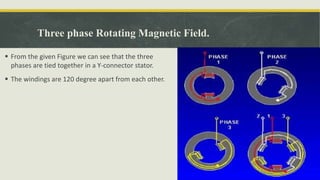
 From the given Figure we can see that the three
phases are tied together in a Y-connector stator.
 The windings are 120 degree apart from each other.
Three phase Rotating Magnetic Field.
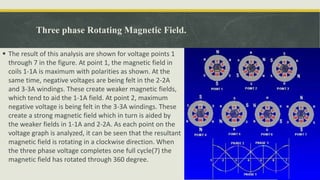
 The result of this analysis are shown for voltage points 1
through 7 in the figure. At point 1, the magnetic field in
coils 1-1A is maximum with polarities as shown. At the
same time, negative voltages are being felt in the 2-2A
and 3-3A windings. These create weaker magnetic fields,
which tend to aid the 1-1A field. At point 2, maximum
negative voltage is being felt in the 3-3A windings. These
create a strong magnetic field which in turn is aided by
the weaker fields in 1-1A and 2-2A. As each point on the
voltage graph is analyzed, it can be seen that the resultant
magnetic field is rotating in a clockwise direction. When
the three phase voltage completes one full cycle(7) the
magnetic field has rotated through 360 degree.
Application
Rotating magnetic fields are often utilized for electromechanical applications such as
 Induction Motors
 Electric generators
 Induction Regulators
Applications on Newton’s Law of Coo

Rptating magnetic field

  • 1.
  • 2.
    Rotating Magnetic Field Submittedto: Dr. Md. ……… Professor, Dept of EEE Department of Electrical and Electronics Engineering Submitted by: Student name:….. ID: 000000000 GREEN UNIVERSITY
  • 3.
    3 Content  What isRotating Magnetic Field?  Founder of rotating Magnetic field.  How a rotating magnetic field is produced?  Three phase Rotating Magnetic Field.  Applications.  Conclusion.
  • 4.
    4 What is RotatingMagnetic Field?  A rotating magnetic field is a magnetic field that has moving polarities in which its opposite poles rotate about a central point or axis. Ideally the rotation changes direction at a constant angular rate.  This is a key principle in the operation of the alternating-current motor.  So Rotating magnetic field can be defined as field or flux having constant amplitude but whose axis rotates is a plane at a certain speed.
  • 5.
    5 Inventor of RotatingMagnetic Field Nikola Tesla (1856-1943) Founded Rotating Magnetic Field in 1888.
  • 6.
    How a rotatingmagnetic field is produced?  This, in a nutshell, is the basic principle of all ac motor operation. The fundamental principle of ac machine operation is that if a three-phase set of currents, each of equal magnitude and differing in phase by 120°, flows in a three-phase winding, then it will produce a rotating magnetic field of constant magnitude.
  • 7.
    Three phase RotatingMagnetic Field.  From the given Figure we can see that the three phases are tied together in a Y-connector stator.  The windings are 120 degree apart from each other.
  • 8.
    Three phase RotatingMagnetic Field.  The result of this analysis are shown for voltage points 1 through 7 in the figure. At point 1, the magnetic field in coils 1-1A is maximum with polarities as shown. At the same time, negative voltages are being felt in the 2-2A and 3-3A windings. These create weaker magnetic fields, which tend to aid the 1-1A field. At point 2, maximum negative voltage is being felt in the 3-3A windings. These create a strong magnetic field which in turn is aided by the weaker fields in 1-1A and 2-2A. As each point on the voltage graph is analyzed, it can be seen that the resultant magnetic field is rotating in a clockwise direction. When the three phase voltage completes one full cycle(7) the magnetic field has rotated through 360 degree.
  • 9.
    Application Rotating magnetic fieldsare often utilized for electromechanical applications such as  Induction Motors  Electric generators  Induction Regulators
  • 10.