Supervised by
…………….
Dept. of EEE
Bangladesh
Green University of Bangladesh
Presentation
on
Torque speed curve
› Torque & Speed
› Several important information
› Characteristic curve
› Plot of speed
› Power converted
Content
› The quantitative measure of the tendency of a force to cause
or change rotational motion is called torque.
› Motors are devices that convert electrical energy into
mechanical energy. The D.C. motors that we have been
dealing with here convert electrical energy into rotational
energy. That rotational energy is then used to lift things,
propel things, turn things, etc... When we supply the specified
voltage to a motor, it rotates the output shaft at some speed.
This rotational speed or angular velocity, is typically
measured in radians/second {rad/s}..
Torque & Speed
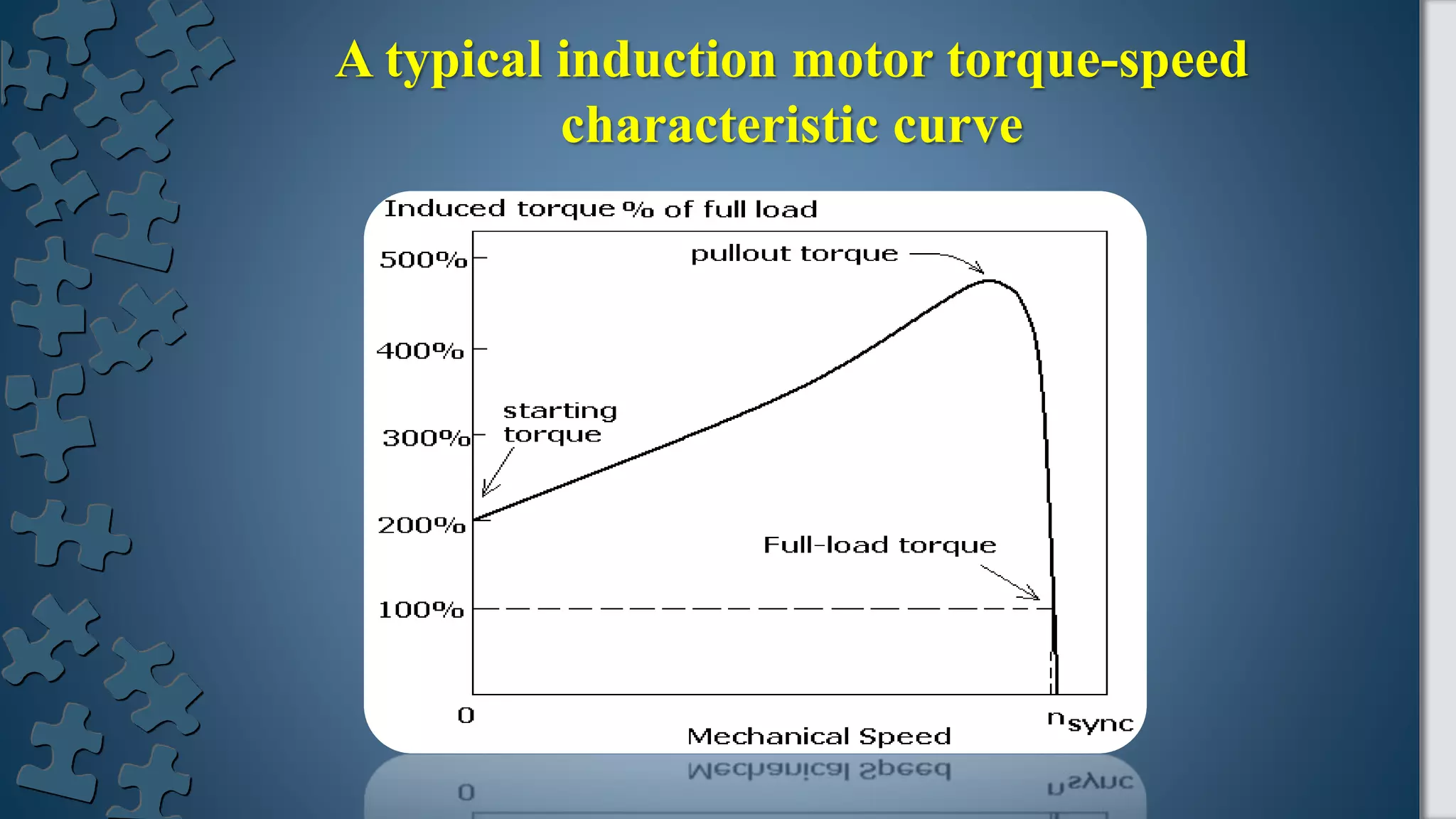
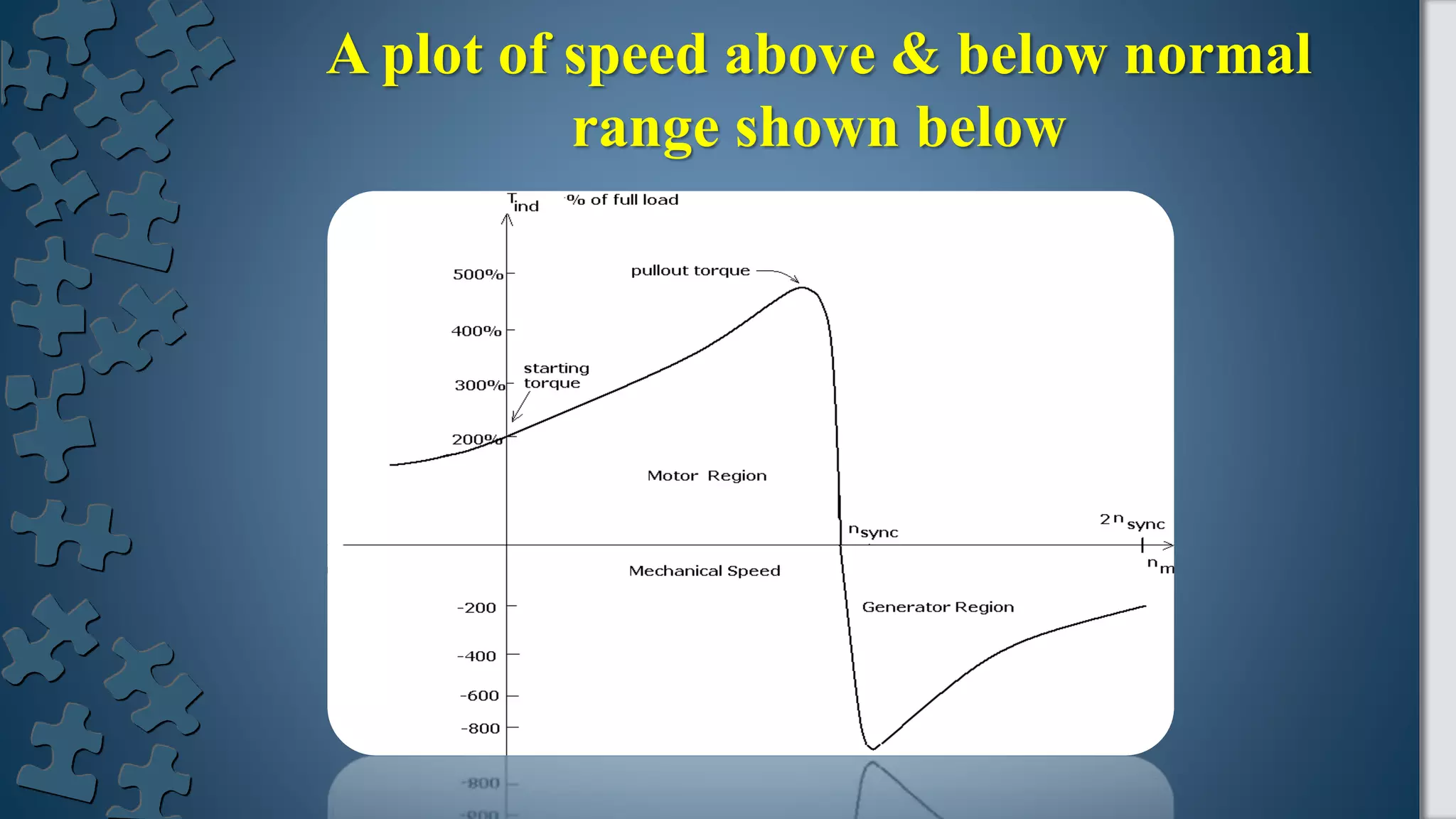
Induced torque of motor is zero at syn. Speed
Torque-speed curve is nearly linear between no load and full load. In
this range rotor resistance is much larger than its reactance so rotor
current, rotor magnetic field & induced torque increase linearly with
increasing slip
There is a maximum possible torque that cannot be exceeded (pullout
torque) is 2 to 3 times rated full-load torque of motor (calculated in
next section)
Starting torque on motor is slightly larger than its full-load torque, so
this motor will start carrying any load that it can supply at full power
Note: that torque on motor for a given slip varies as square of applied
voltage. This is useful in one form of induction motor speed control
that will be described
Torque-speed characteristics curve provides
several important information
A typical induction motor torque-speed
characteristic curve
A plot of speed above & below normal
range shown below
› Note: peak power supplied by induction motor
occurs at a different speed than maximum torque,
and of course no power is converted to mechanical
form when rotor is at zero speed
Power converted to mechanical in an
induction motor
Induced Torque & Power Converted versus motor
Speed in r/min (4 pole induction motor)
Thanks to all

Torque speed curve

  • 1.
  • 2.
    Green University ofBangladesh Presentation on Torque speed curve
  • 3.
    › Torque &Speed › Several important information › Characteristic curve › Plot of speed › Power converted Content
  • 4.
    › The quantitativemeasure of the tendency of a force to cause or change rotational motion is called torque. › Motors are devices that convert electrical energy into mechanical energy. The D.C. motors that we have been dealing with here convert electrical energy into rotational energy. That rotational energy is then used to lift things, propel things, turn things, etc... When we supply the specified voltage to a motor, it rotates the output shaft at some speed. This rotational speed or angular velocity, is typically measured in radians/second {rad/s}.. Torque & Speed
  • 5.
    Induced torque ofmotor is zero at syn. Speed Torque-speed curve is nearly linear between no load and full load. In this range rotor resistance is much larger than its reactance so rotor current, rotor magnetic field & induced torque increase linearly with increasing slip There is a maximum possible torque that cannot be exceeded (pullout torque) is 2 to 3 times rated full-load torque of motor (calculated in next section) Starting torque on motor is slightly larger than its full-load torque, so this motor will start carrying any load that it can supply at full power Note: that torque on motor for a given slip varies as square of applied voltage. This is useful in one form of induction motor speed control that will be described Torque-speed characteristics curve provides several important information
  • 6.
    A typical inductionmotor torque-speed characteristic curve
  • 7.
    A plot ofspeed above & below normal range shown below
  • 8.
    › Note: peakpower supplied by induction motor occurs at a different speed than maximum torque, and of course no power is converted to mechanical form when rotor is at zero speed Power converted to mechanical in an induction motor
  • 9.
    Induced Torque &Power Converted versus motor Speed in r/min (4 pole induction motor)
  • 10.