By Sirinoot Jantharangkul
Ramelteon (RozeremTM
)
:melatonin receptor agonist
approved for insomnia
Ramelteon (RozeremTM
)
:melatonin receptor agonist
approved for insomnia
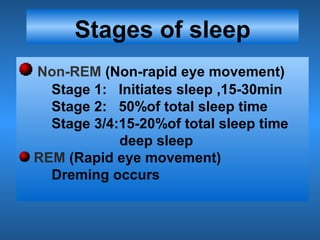
Stages of sleep
Non-REM (Non-rapid eye movement)
Stage 1: Initiates sleep ,15-30min
Stage 2: 50%of total sleep time
Stage 3/4:15-20%of total sleep time
deep sleep
REM (Rapid eye movement)
Dreming occurs
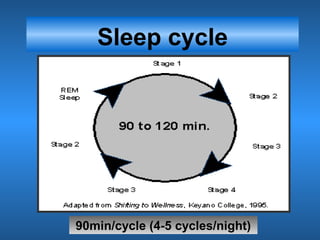
Sleep cycle
90min/cycle (4-5 cycles/night)
Normal sleep
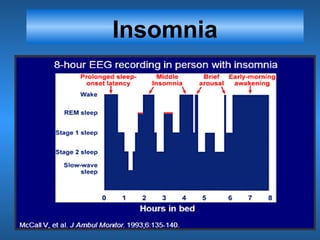
Insomnia
Insomnia
Insomnia: characterizes by one or
more of the following:
Difficulty falling asleep
Waking up frequently during the night
with difficulty returning to sleep
Waking up too early in the morning
Unrefreshing sleep
Types of insomnia
Transient / Intermittent Insomnia
Acute stress or illness
Jet lag
Chronic Insomnia
Primary or psychophysiological
Secondary, refratory to treatment
of medical/ psychiatic disorder
Treatment
Non-pharmacologic therapy
Sleep hygiene information
Stimulus control instructions
Chronotherapy
Treat underlying diseases or causes
Sedative-Hypnotics
Sedative-Hypnotics
Barbiturates
Benzodiazepines (BZDs)
Nonbenzodiazepine drugs
e.g zolpidem,zaleplon,eszopiclone
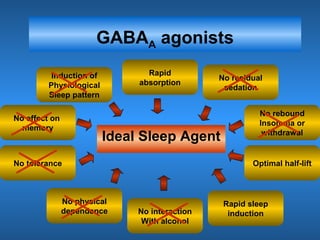
Characteristics of the ideal
sleep agent
No physical
dependence
No tolerance
No effect on
memory
Induction of
Physiological
Sleep pattern
Rapid
absorption
Rapid sleep
induction
No residual
sedation
Optimal half-lift
No rebound
Insomnia or
withdrawal
No interaction
With alcohol
Ideal Sleep Agent
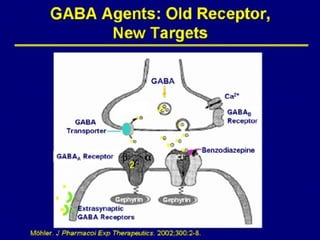
GABAA agonists
Ideal Sleep Agent
Rapid
absorption
No residual
sedation
No rebound
Insomnia or
withdrawal
Optimal half-lift
Rapid sleep
inductionNo interaction
With alcohol
No physical
dependence
No tolerance
No effect on
memory
Induction of
Physiological
Sleep pattern
The Suprachiasmatic Nucleus
(SCN)
SCN
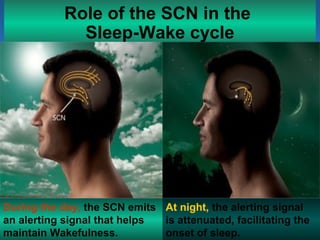
Role of the SCN in the
Sleep-Wake cycle
During the day, the SCN emits
an alerting signal that helps
maintain Wakefulness.
At night, the alerting signal
is attenuated, facilitating the
onset of sleep.
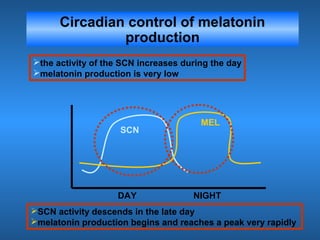
Circadian control of melatonin
production
SCN
MEL
the activity of the SCN increases during the day
melatonin production is very low
SCN activity descends in the late day
melatonin production begins and reaches a peak very rapidly
DAY NIGHT
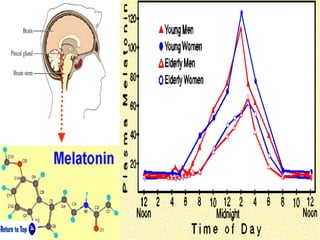
Melatonin
Melatonin is a hormone
(N-acetyl-5 methoxytryptamine)
Produced by the pineal gland
Regulate sleep-wake cycles
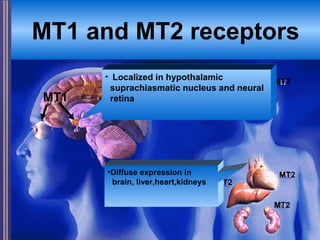
MT1
MT2
MT2
MT2
MT2
• Localized in hypothalamic
suprachiasmatic nucleus and neural
retina
•Diffuse expression in
brain, liver,heart,kidneys
MT1 and MT2 receptors
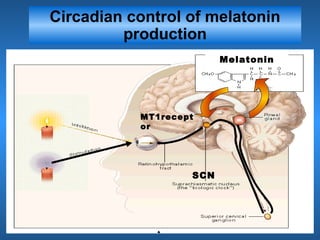
Circadian control of melatonin
production
MT1recept
or
SCN
Melatonin
MT1 Agonists
Promote sleep via MT1
Receptor in SCN regulating
Sleep/wake cycle
Physiological Sleep
MT1
Sleep promotion
melatonin receptor agonist
Ramelteon
(RozeremTM
)
:melatonin receptor agonist
Ramelteon
Generic name: Ramelteon (ram el tee on)
Brand name: Rozerem
Company: Takeda Pharmaceuticals
North America
FDA Approval: 22 July, 2005
Treatment for: Insomnia
Molecular weight : 259.34
Freely soluble in organic solvents and
very slightly soluble in water
RamelteonRamelteon
Mechanism of action
melatonin receptor agonist with high affinity for
melatonin (MT1) receptor
15time more potent than melatonin at MT1receptor
the MT1 receptor is believed to contribute to its
sleep-promoting properties
the maintenance of the circadian rhythm
underlying the normal sleep-wake cycle
Pharmacokinetics
Absorption
absorbed rapidly from the GI tract
peak concentrations occurring at
approximately 0.75 hour
bioavailability is only 1.8%
extensive first-pass metabolism.
Pharmacokinetics
Distribution
In vitro protein binding of ramelteon is
approximately 82% in human serum
mean volume of distribution after
intravenous administration of 73.6 L
Metabolism
primarily of oxidation to hydroxyl and carbonyl
derivatives
through the cytochrome P (CYP)-450 system
major: the CYP1A2 isoenzyme
minor: the CYP2C subfamily and CYP3A4
isoenzyme
secondary metabolism producing glucuronide
conjugates
Elimination
84% in urine
4% in feces
T1/2 1 to 2.6 hours
Drug interactions
fluvoxamine and other CYP450 1A2 inhibitors
rifampin and other strong CYP450 inducer
ketoconazole and other strong CYP450 3A4
inhibitors
fluconazole and other strong CYP450 2C9
inhibitors
Contraindications
Hypersensitivity to ramelteon or any
components of the ramelteon formulation.
Warning
 Not for use in patients with severe hepatic
impairment
 Hypnotics have been associated with cognitive and
behavior changes, including suicidal ideation
 Not recommended in patients with severe sleep
apnea or severe COPD
Warning
 May decrease testosterone levels and
increase prolactin level
 Pregnancy: category C. development
toratogen in the rat
 Lactation: secreted into the milk of lactating
rats
Adverse Events
Ramelteon Placebo
 Headache 7% 7%
 Somnolence 5% 3%
 Dizziness 5% 2%
 Fatigue 4% 3%
 Nausea 3% 2%
 Insomnia exacerbated 3% 2%
 URI 3% 2%
 Diarrhea 2% 2%
 Myalgia 2% 1%
 Depression 2% 1%
 Dysgeusia 2% 1%
 Arthralgia 2% 1%
 Influenza 1% 0
 Blood cortisol decreased 1% 0
Dosage and administration
8 mg PO within 30 minutes of going to bed.
NOTE: Ramelteon should not be taken with or
immediately after a high fat meal.
Storage
Store at 25°C (77°F)
Keep container tightly closed
Protected from moisture and
humidity.
Clinical studies 1
 An efficacy, safety, and dose–response
study of Ramelteon in patients with chroni
c primary insomnia
 Milton Erman, David Seiden, Gary Zammit,
Stephen Sainati, Jeffrey Zhang
 Sleep Medicine xx (2005) 1–8
Purpose
To evaluate the efficacy, safety, and
dose response of Ramelteon, a novel
highly selective MT1/MT2 receptor ag
onist, in patients with chronic primary
insomnia.
Patients and methods
 A randomized, multicenter, double-blind,
placebo-controlled, five-period crossover study d
esign
 107 patients, aged 18–64 years
 randomized into a dosing sequence that included
4, 8, 16, and 32 mg of ramelteon and placebo.
 5- 12day washout period between treatments
 administered 30 min before habitual bedtime
Patients and methods
 Polysomnographic monitoring
 Next-day residual effects
– VAS (mood and feeling)
– DSST (digit symbol substitution test)
– Word-list memory tests (immediate recall and
delayed recall
– Post-sleep questionnaire(alertness and ability
to concentrate)
Efficacy
Table 1 PSG and subjective sleep measures
Placebo Ramelteon Overall effect
4 mg 8 mg 16 mg 32 mg
PSG latency to persistent
sleep(min) 37.7 24.0*** 24.3*** 24.0*** 22.9*** P<0.001
Subjective sleep latency (min) 57.0 50.9 46.7 43.9* 46.5 P=0.040
PSG total sleep time (min) 400.2 411.0* 412.9** 411.2* 418.2***P=0.001
Subjective total sleep time (min)360.6 364.1 370.4 370.9 372.8 P=0.282
Subjective sleep quality 3.8 3.6 3.7 3.7 3.7 P=0.525
PSG WASO (min) 45.5 48.8 47.0 48.3 43.0 P=0.470
Note: All data presented here are least square (LS) means. LS means are from a mixed model with
effects for sequence, subject, period of treatment, with subject as a random effect and treatment
as five groups.Subjective sleep quality was measured by the post-sleep questionnaire using a 7-
point scale; a lower score is better. P values for pairwise comparisons were calculated by using
Dunnetts t tests from the ANOVA model of the overall treatment comparison. ***P≤0.001 for
comparison of active dose with placebo. **P≤0.010 for comparison of active dose with placebo.
*P≤0.050 for comparison of active dose with placebo.
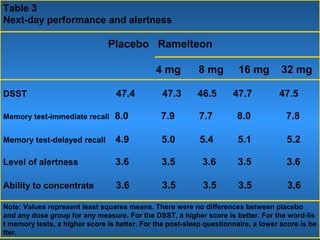
Table 3
Next-day performance and alertness
Placebo Ramelteon
4 mg 8 mg 16 mg 32 mg
DSST 47.4 47.3 46.5 47.7 47.5
Memory test-immediate recall 8.0 7.9 7.7 8.0 7.8
Memory test-delayed recall 4.9 5.0 5.4 5.1 5.2
Level of alertness 3.6 3.5 3.6 3.5 3.6
Ability to concentrate 3.6 3.5 3.5 3.5 3.6
Note: Values represent least squares means. There were no differences between placebo
and any dose group for any measure. For the DSST, a higher score is better. For the word-lis
t memory tests, a higher score is better. For the post-sleep questionnaire, a lower score is be
tter.
Table 4
Summary of most frequently reported adverse events (%)
Placebo Ramelteon
4 mg 8 mg 16 mg 32 mg
All adverse eventsa 19.4 25.2 18.3 19.6 21.4
Headache 4.9 5.8 4.8 4.7 5.8
Somnolence 1.0 0.0 1.9 3.7 1.9
Pharyngolaryngeal pain 1.0 3.9 0.0 0.0 3.9
Nasopharyngitis 2.9 1.0 0.0 1.9 1.0
Nausea 1.9 2.9 1.0 0.9 1.0
Dyspepsia 0.0 1.0 0.0 0.9 2.9
Influenza 2.9 1.0 1.0 0.0 0.0
Abdominal pain 1.0 1.0 1.0 0.9 0.0
Dysmenorrhea 0.0 1.9 1.0 0.0 1.0
Dry mouth 1.0 1.9 0.0 0.0 0.0
Fatigue 0.0 0.0 1.0 0.9 1.9
.
Conclusions
Ramelteon demonstrated a
statistically significant reduction in
LPS and a statistically significant inc
rease in TST, with no apparent next-
day residual effects, in patients with
chronic primary insomnia.
Clinical studies 2
 Ramelteon and triazolam in human: abuse
potential (abstract)
 Griffiths et al.
 Sleep 2005
Patients and methods
 placebo-controlled, crossover clinical study
 14 adults with a history of polydrug or multiple-
drug abuse
 7 treatment separated by a wash-out period
 administered to patients in a randomly-assigned
sequence and included:
-ramelteon (16 mg, 80 mg, 160 mg)
-triazolam (0.25 mg, 0.50 mg, 0.75 mg)
-placebo.
Drug-liking
 Measures of "drug-liking," were assessed
 each day using questionnaires completed
at intervals between 0.5 hours predose,
up to 24 hours after dose administration.
Drug Liking
0
0.5
1
1.5
2
2.5
PB
O
0.25
0.5
0.75
16
80
160
PBO
Triazolam
Ramelteon
RamelteonTriazolam
( drug Effect Questionares Scale: 0-4 )
Druglike
P<0.05
P<0.05
Results
 Triazolam treatment (0.50 mg, 0.75 mg) produced
a dose-related as compared to that of placebo
 Ramelteon did not produce any significant
changes in drug-liking comparative to that of
placebo at any dose.
 patients exhibited no abuse potential at up to 20
times the proposed therapeutic dose of
ramelteon
Conclusions
Ramelteon: selective melatonin receptor agonist
Provides physiological sleep via activation of MT1
receptor play a role sleep/wake cycle
8mg tablets for the treatment of insomnia
characterized by difficulty with sleep onset
has no serious adverse effects including
dependence, abuse ability, memory impairment
and motor impairment
THE END
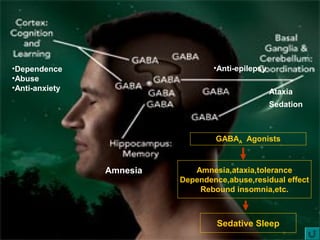
GABAA Agonists
Amnesia,ataxia,tolerance
Dependence,abuse,residual effect
Rebound insomnia,etc.
Sedative Sleep
•Dependence
•Abuse
•Anti-anxiety
Sedation
•Anti-epilepsy
Ataxia
Amnesia
Task performance
 variety of behavioral and cognitive tasks
 including :
DSST
Standing balance tasks
memory tests
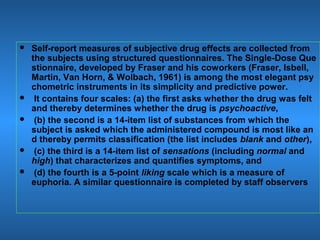
 Self-report measures of subjective drug effects are collected from
the subjects using structured questionnaires. The Single-Dose Que
stionnaire, developed by Fraser and his coworkers (Fraser, Isbell,
Martin, Van Horn, & Wolbach, 1961) is among the most elegant psy
chometric instruments in its simplicity and predictive power.
 It contains four scales: (a) the first asks whether the drug was felt
and thereby determines whether the drug is psychoactive,
 (b) the second is a 14-item list of substances from which the
subject is asked which the administered compound is most like an
d thereby permits classification (the list includes blank and other),
 (c) the third is a 14-item list of sensations (including normal and
high) that characterizes and quantifies symptoms, and
 (d) the fourth is a 5-point liking scale which is a measure of
euphoria. A similar questionnaire is completed by staff observers
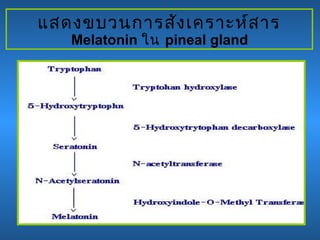
แสดงขบวนการสังเคราะห์สาร
Melatonin ใน pineal gland
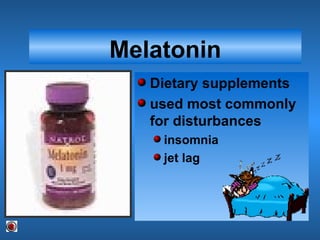
Melatonin
Dietary supplements
used most commonly
for disturbances
insomnia
jet lag
Cost
Drug Interactions
PRECAUTIONS
➤Monitoring: For patients presenting with unexplained
amenorrhea,
galactorrhea, decreased libido, or problems with fertility, consider
assessment of prolactin levels and testosterone levels as
appropriate.
➤Special risk: Ramelteon has not been studied in subjects with
severe sleep apnea or severe chronic obstructive pulmonary
disease
(COPD) and is not recommended for use in those populations.
➤Hazardous tasks: Avoid engaging in hazardous activities that
require concentration (eg, operating a motor vehicle or heavy
machinery) after taking ramelteon. After taking ramelteon,
patients
should confine their activities to those necessary to prepare for
bed.
PGS
 EEG electrodes
 electromyogram (EMG),
 electrooculogram
(EOG, differential recording)
 electrocardiogram

Rozerem (ramelteon)

  • 1.
    By Sirinoot Jantharangkul Ramelteon(RozeremTM ) :melatonin receptor agonist approved for insomnia Ramelteon (RozeremTM ) :melatonin receptor agonist approved for insomnia
  • 2.
    Stages of sleep Non-REM(Non-rapid eye movement) Stage 1: Initiates sleep ,15-30min Stage 2: 50%of total sleep time Stage 3/4:15-20%of total sleep time deep sleep REM (Rapid eye movement) Dreming occurs
  • 3.
  • 4.
  • 5.
  • 6.
    Insomnia Insomnia: characterizes byone or more of the following: Difficulty falling asleep Waking up frequently during the night with difficulty returning to sleep Waking up too early in the morning Unrefreshing sleep
  • 7.
    Types of insomnia Transient/ Intermittent Insomnia Acute stress or illness Jet lag Chronic Insomnia Primary or psychophysiological Secondary, refratory to treatment of medical/ psychiatic disorder
  • 8.
    Treatment Non-pharmacologic therapy Sleep hygieneinformation Stimulus control instructions Chronotherapy Treat underlying diseases or causes Sedative-Hypnotics
  • 9.
  • 10.
    Characteristics of theideal sleep agent No physical dependence No tolerance No effect on memory Induction of Physiological Sleep pattern Rapid absorption Rapid sleep induction No residual sedation Optimal half-lift No rebound Insomnia or withdrawal No interaction With alcohol Ideal Sleep Agent
  • 11.
    GABAA agonists Ideal SleepAgent Rapid absorption No residual sedation No rebound Insomnia or withdrawal Optimal half-lift Rapid sleep inductionNo interaction With alcohol No physical dependence No tolerance No effect on memory Induction of Physiological Sleep pattern
  • 12.
  • 13.
    Role of theSCN in the Sleep-Wake cycle During the day, the SCN emits an alerting signal that helps maintain Wakefulness. At night, the alerting signal is attenuated, facilitating the onset of sleep.
  • 14.
    Circadian control ofmelatonin production SCN MEL the activity of the SCN increases during the day melatonin production is very low SCN activity descends in the late day melatonin production begins and reaches a peak very rapidly DAY NIGHT
  • 15.
    Melatonin Melatonin is ahormone (N-acetyl-5 methoxytryptamine) Produced by the pineal gland Regulate sleep-wake cycles
  • 16.
    MT1 MT2 MT2 MT2 MT2 • Localized inhypothalamic suprachiasmatic nucleus and neural retina •Diffuse expression in brain, liver,heart,kidneys MT1 and MT2 receptors
  • 17.
    Circadian control ofmelatonin production MT1recept or SCN Melatonin
  • 18.
    MT1 Agonists Promote sleepvia MT1 Receptor in SCN regulating Sleep/wake cycle Physiological Sleep MT1 Sleep promotion melatonin receptor agonist
  • 19.
  • 20.
    Ramelteon Generic name: Ramelteon(ram el tee on) Brand name: Rozerem Company: Takeda Pharmaceuticals North America FDA Approval: 22 July, 2005 Treatment for: Insomnia
  • 21.
    Molecular weight :259.34 Freely soluble in organic solvents and very slightly soluble in water RamelteonRamelteon
  • 22.
    Mechanism of action melatoninreceptor agonist with high affinity for melatonin (MT1) receptor 15time more potent than melatonin at MT1receptor the MT1 receptor is believed to contribute to its sleep-promoting properties the maintenance of the circadian rhythm underlying the normal sleep-wake cycle
  • 23.
    Pharmacokinetics Absorption absorbed rapidly fromthe GI tract peak concentrations occurring at approximately 0.75 hour bioavailability is only 1.8% extensive first-pass metabolism. Pharmacokinetics
  • 24.
    Distribution In vitro proteinbinding of ramelteon is approximately 82% in human serum mean volume of distribution after intravenous administration of 73.6 L
  • 25.
    Metabolism primarily of oxidationto hydroxyl and carbonyl derivatives through the cytochrome P (CYP)-450 system major: the CYP1A2 isoenzyme minor: the CYP2C subfamily and CYP3A4 isoenzyme secondary metabolism producing glucuronide conjugates
  • 26.
    Elimination 84% in urine 4%in feces T1/2 1 to 2.6 hours
  • 27.
    Drug interactions fluvoxamine andother CYP450 1A2 inhibitors rifampin and other strong CYP450 inducer ketoconazole and other strong CYP450 3A4 inhibitors fluconazole and other strong CYP450 2C9 inhibitors
  • 28.
    Contraindications Hypersensitivity to ramelteonor any components of the ramelteon formulation.
  • 29.
    Warning  Not foruse in patients with severe hepatic impairment  Hypnotics have been associated with cognitive and behavior changes, including suicidal ideation  Not recommended in patients with severe sleep apnea or severe COPD
  • 30.
    Warning  May decreasetestosterone levels and increase prolactin level  Pregnancy: category C. development toratogen in the rat  Lactation: secreted into the milk of lactating rats
  • 31.
    Adverse Events Ramelteon Placebo Headache 7% 7%  Somnolence 5% 3%  Dizziness 5% 2%  Fatigue 4% 3%  Nausea 3% 2%  Insomnia exacerbated 3% 2%  URI 3% 2%  Diarrhea 2% 2%  Myalgia 2% 1%  Depression 2% 1%  Dysgeusia 2% 1%  Arthralgia 2% 1%  Influenza 1% 0  Blood cortisol decreased 1% 0
  • 32.
    Dosage and administration 8mg PO within 30 minutes of going to bed. NOTE: Ramelteon should not be taken with or immediately after a high fat meal.
  • 33.
    Storage Store at 25°C(77°F) Keep container tightly closed Protected from moisture and humidity.
  • 34.
    Clinical studies 1 An efficacy, safety, and dose–response study of Ramelteon in patients with chroni c primary insomnia  Milton Erman, David Seiden, Gary Zammit, Stephen Sainati, Jeffrey Zhang  Sleep Medicine xx (2005) 1–8
  • 35.
    Purpose To evaluate theefficacy, safety, and dose response of Ramelteon, a novel highly selective MT1/MT2 receptor ag onist, in patients with chronic primary insomnia.
  • 36.
    Patients and methods A randomized, multicenter, double-blind, placebo-controlled, five-period crossover study d esign  107 patients, aged 18–64 years  randomized into a dosing sequence that included 4, 8, 16, and 32 mg of ramelteon and placebo.  5- 12day washout period between treatments  administered 30 min before habitual bedtime
  • 37.
    Patients and methods Polysomnographic monitoring  Next-day residual effects – VAS (mood and feeling) – DSST (digit symbol substitution test) – Word-list memory tests (immediate recall and delayed recall – Post-sleep questionnaire(alertness and ability to concentrate)
  • 38.
    Efficacy Table 1 PSGand subjective sleep measures Placebo Ramelteon Overall effect 4 mg 8 mg 16 mg 32 mg PSG latency to persistent sleep(min) 37.7 24.0*** 24.3*** 24.0*** 22.9*** P<0.001 Subjective sleep latency (min) 57.0 50.9 46.7 43.9* 46.5 P=0.040 PSG total sleep time (min) 400.2 411.0* 412.9** 411.2* 418.2***P=0.001 Subjective total sleep time (min)360.6 364.1 370.4 370.9 372.8 P=0.282 Subjective sleep quality 3.8 3.6 3.7 3.7 3.7 P=0.525 PSG WASO (min) 45.5 48.8 47.0 48.3 43.0 P=0.470 Note: All data presented here are least square (LS) means. LS means are from a mixed model with effects for sequence, subject, period of treatment, with subject as a random effect and treatment as five groups.Subjective sleep quality was measured by the post-sleep questionnaire using a 7- point scale; a lower score is better. P values for pairwise comparisons were calculated by using Dunnetts t tests from the ANOVA model of the overall treatment comparison. ***P≤0.001 for comparison of active dose with placebo. **P≤0.010 for comparison of active dose with placebo. *P≤0.050 for comparison of active dose with placebo.
  • 39.
    Table 3 Next-day performanceand alertness Placebo Ramelteon 4 mg 8 mg 16 mg 32 mg DSST 47.4 47.3 46.5 47.7 47.5 Memory test-immediate recall 8.0 7.9 7.7 8.0 7.8 Memory test-delayed recall 4.9 5.0 5.4 5.1 5.2 Level of alertness 3.6 3.5 3.6 3.5 3.6 Ability to concentrate 3.6 3.5 3.5 3.5 3.6 Note: Values represent least squares means. There were no differences between placebo and any dose group for any measure. For the DSST, a higher score is better. For the word-lis t memory tests, a higher score is better. For the post-sleep questionnaire, a lower score is be tter.
  • 40.
    Table 4 Summary ofmost frequently reported adverse events (%) Placebo Ramelteon 4 mg 8 mg 16 mg 32 mg All adverse eventsa 19.4 25.2 18.3 19.6 21.4 Headache 4.9 5.8 4.8 4.7 5.8 Somnolence 1.0 0.0 1.9 3.7 1.9 Pharyngolaryngeal pain 1.0 3.9 0.0 0.0 3.9 Nasopharyngitis 2.9 1.0 0.0 1.9 1.0 Nausea 1.9 2.9 1.0 0.9 1.0 Dyspepsia 0.0 1.0 0.0 0.9 2.9 Influenza 2.9 1.0 1.0 0.0 0.0 Abdominal pain 1.0 1.0 1.0 0.9 0.0 Dysmenorrhea 0.0 1.9 1.0 0.0 1.0 Dry mouth 1.0 1.9 0.0 0.0 0.0 Fatigue 0.0 0.0 1.0 0.9 1.9 .
  • 41.
    Conclusions Ramelteon demonstrated a statisticallysignificant reduction in LPS and a statistically significant inc rease in TST, with no apparent next- day residual effects, in patients with chronic primary insomnia.
  • 42.
    Clinical studies 2 Ramelteon and triazolam in human: abuse potential (abstract)  Griffiths et al.  Sleep 2005
  • 43.
    Patients and methods placebo-controlled, crossover clinical study  14 adults with a history of polydrug or multiple- drug abuse  7 treatment separated by a wash-out period  administered to patients in a randomly-assigned sequence and included: -ramelteon (16 mg, 80 mg, 160 mg) -triazolam (0.25 mg, 0.50 mg, 0.75 mg) -placebo.
  • 44.
    Drug-liking  Measures of"drug-liking," were assessed  each day using questionnaires completed at intervals between 0.5 hours predose, up to 24 hours after dose administration.
  • 45.
  • 46.
    Results  Triazolam treatment(0.50 mg, 0.75 mg) produced a dose-related as compared to that of placebo  Ramelteon did not produce any significant changes in drug-liking comparative to that of placebo at any dose.  patients exhibited no abuse potential at up to 20 times the proposed therapeutic dose of ramelteon
  • 47.
    Conclusions Ramelteon: selective melatoninreceptor agonist Provides physiological sleep via activation of MT1 receptor play a role sleep/wake cycle 8mg tablets for the treatment of insomnia characterized by difficulty with sleep onset has no serious adverse effects including dependence, abuse ability, memory impairment and motor impairment
  • 48.
  • 49.
    GABAA Agonists Amnesia,ataxia,tolerance Dependence,abuse,residual effect Reboundinsomnia,etc. Sedative Sleep •Dependence •Abuse •Anti-anxiety Sedation •Anti-epilepsy Ataxia Amnesia
  • 50.
    Task performance  varietyof behavioral and cognitive tasks  including : DSST Standing balance tasks memory tests
  • 51.
     Self-report measuresof subjective drug effects are collected from the subjects using structured questionnaires. The Single-Dose Que stionnaire, developed by Fraser and his coworkers (Fraser, Isbell, Martin, Van Horn, & Wolbach, 1961) is among the most elegant psy chometric instruments in its simplicity and predictive power.  It contains four scales: (a) the first asks whether the drug was felt and thereby determines whether the drug is psychoactive,  (b) the second is a 14-item list of substances from which the subject is asked which the administered compound is most like an d thereby permits classification (the list includes blank and other),  (c) the third is a 14-item list of sensations (including normal and high) that characterizes and quantifies symptoms, and  (d) the fourth is a 5-point liking scale which is a measure of euphoria. A similar questionnaire is completed by staff observers
  • 56.
  • 57.
    Melatonin Dietary supplements used mostcommonly for disturbances insomnia jet lag
  • 60.
  • 62.
  • 64.
    PRECAUTIONS ➤Monitoring: For patientspresenting with unexplained amenorrhea, galactorrhea, decreased libido, or problems with fertility, consider assessment of prolactin levels and testosterone levels as appropriate. ➤Special risk: Ramelteon has not been studied in subjects with severe sleep apnea or severe chronic obstructive pulmonary disease (COPD) and is not recommended for use in those populations. ➤Hazardous tasks: Avoid engaging in hazardous activities that require concentration (eg, operating a motor vehicle or heavy machinery) after taking ramelteon. After taking ramelteon, patients should confine their activities to those necessary to prepare for bed.
  • 65.
    PGS  EEG electrodes electromyogram (EMG),  electrooculogram (EOG, differential recording)  electrocardiogram