•
•
•
•
•
•
•
•
•
•
•
•
•
•
•
•
•
•
•
•
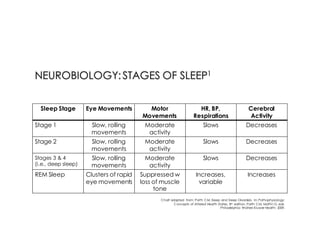
Sleep Stage Eye Movements Motor
Movements
HR, BP,
Respirations
Cerebral
Activity
Stage 1 Slow, rolling
movements
Moderate
activity
Slows Decreases
Stage 2 Slow, rolling
movements
Moderate
activity
Slows Decreases
Stages 3 & 4
(i.e., deep sleep)
Slow, rolling
movements
Moderate
activity
Slows Decreases
REM Sleep Clusters of rapid
eye movements
Suppressed w
loss of muscle
tone
Increases,
variable
Increases
Chart adapted from: Porth CM, Sleep and Sleep Disorders. In: Pathophysiology:
Concepts of Altered Health States. 8th edition. Porth CM, Matfin G, eds.
Philadelphia: Wolters Kluwer Health; 2009.
•
•
•
•
1.
2.
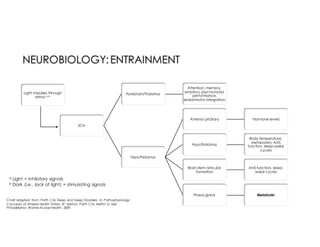
SCN
Forebrain/Thalamus
Attention, memory,
emotion, psychomotor
performance,
sensorimotor integration
Hypothalamus
Anterior pituitary Hormone levels
Hypothalamus
Body temperature,
metabolism, ANS
function, sleep-wake
cycles
Brain stem reticular
formation
ANS function, sleep-
wake cycles
Pineal gland Melatonin
Light impulses through
retina a,b
Chart adapted from: Porth CM, Sleep and Sleep Disorders. In: Pathophysiology:
Concepts of Altered Health States. 8th edition. Porth CM, Matfin G, eds.
Philadelphia: Wolters Kluwer Health; 2009.
a Light = inhibitory signals
b Dark (i.e., lack of light) = stimulating signals
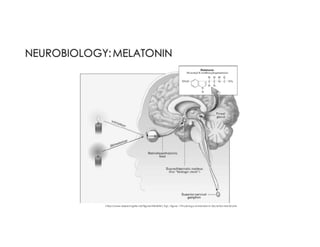
https://www.researchgate.net/figure/40454967_fig1_ Figure- 1-Physio log y-of-Melaton in-Secre tion-Me lat onin
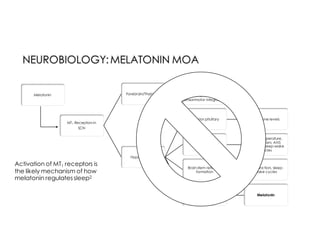
MT1 Receptors in
SCN
Forebrain/Thalamus
Attention, memory,
emotion, psychomotor
performance,
sensorimotor integration
Hypothalamus
Anterior pituitary Hormone levels
Hypothalamus
Body temperature,
metabolism, ANS
function, sleep-wake
cycles
Brain stem reticular
formation
ANS function, sleep-
wake cycles
Pineal gland Melatonin
Melatonin
Activation of MT1 receptors is
the likely mechanism of how
melatonin regulatessleep2
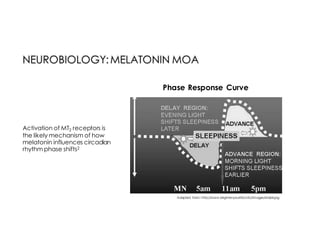
Activation of MT2 receptors is
the likely mechanism of how
melatonin influences circadian
rhythm phase shifts2
Adapted from: http://www.brightenyourlife.info/images/slide4.jpg
Phase Response Curve
•
1.
2.
3.
4.
•
•
•
•
•
•
•
•
•
•
•
•
•
•
•
•
•
•
•
•
•
•
•
•
•
•
•
•
•
•
•
•
•
•
•
•
•
•
•
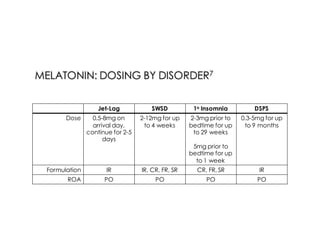
Jet-Lag SWSD 1o Insomnia DSPS
Dose 0.5-8mg on
arrival day,
continue for 2-5
days
2-12mg for up
to 4 weeks
2-3mg prior to
bedtime for up
to 29 weeks
5mg prior to
bedtime for up
to 1 week
0.3-5mg for up
to 9 months
Formulation IR IR, CR, FR, SR CR, FR, SR IR
ROA PO PO PO PO
•
•
•
•
•
•
•
•
•
•
•
•
•
•
•
•
•
•
•
•
•
•
•
•
•
•
•
•
•
•
•
•
•
•
•
•
•
•
•
•
•
•
•
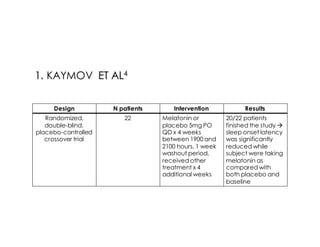
Design N patients Intervention Results
Randomized,
double-blind,
placebo-controlled
crossover trial
22 Melatonin or
placebo 5mg PO
QD x 4 weeks
between 1900 and
2100 hours, 1 week
washout period,
received other
treatment x 4
additional weeks
20/22 patients
finished the study à
sleep onset latency
was significantly
reduced while
subject were taking
melatonin as
compared with
both placebo and
baseline
Strengths Limitations Conclusion
• No ADEs noted
• Study design allowed
patients to select their
baseline bedtime and
duration of sleep à
permitting investigators the
ability to compare their
natural sleep pattern with
that of the imposed sleep
period (2400 to 0800 hours)
• No evidence that melatonin
altered total sleep time
• Melatonin did alter
subjective measures of
sleepiness, fatigue or
alertness
• Small sample size
• Crossover design – each
patient served as his or her
own control
• Not well controlled
• Dose response relationships,
possibility of relapse after
discontinuation, not
explored
• Melatonin 5mg 3-4 hours
prior to bedtime was an
effective treatment for
patients with DSPS
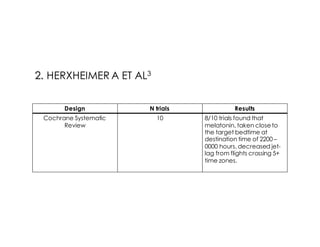
Design N trials Results
Cochrane Systematic
Review
10 8/10 trials found that
melatonin, taken closeto
the target bedtime at
destination time of 2200 –
0000 hours, decreased jet-
lag from flights crossing 5+
time zones.
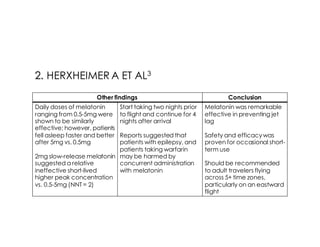
Other findings Conclusion
Daily doses of melatonin
ranging from 0.5-5mg were
shown to be similarly
effective; however, patients
fell asleep faster and better
after 5mg vs. 0.5mg
2mg slow-release melatonin
suggested a relative
ineffective short-lived
higher peak concentration
vs. 0.5-5mg (NNT = 2)
Start taking two nights prior
to flight and continue for 4
nights after arrival
Reports suggested that
patients with epilepsy, and
patients taking warfarin
may be harmed by
concurrent administration
with melatonin
Melatonin was remarkable
effective in preventing jet
lag
Safety and efficacywas
proven for occasional short-
term use
Should be recommended
to adult travelers flying
across 5+ time zones,
particularly on an eastward
flight
Design N patients Intervention
Randomized, double-blind,
placebo-controlled crossover
trial
10 Random order of 0.3mg, 1.0mg
melatonin or placebo 60
minutes prior to bedtime for 7
days.
Study was setup for patient to
receive each intervention dose
with a 5-day washout period in
between
After each 7 day treatment,
nighttime EEG records were
collected
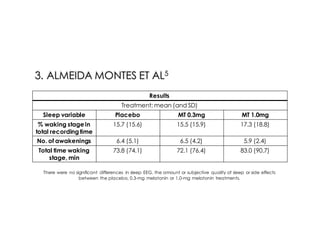
Results
Treatment; mean (and SD)
Sleep variable Placebo MT 0.3mg MT 1.0mg
% waking stage in
total recordingtime
15.7 (15.6) 15.5 (15.9) 17.3 (18.8)
No. of awakenings 6.4 (5.1) 6.5 (4.2) 5.9 (2.4)
Total time waking
stage, min
73.8 (74.1) 72.1 (76.4) 83.0 (90.7)
There were no significant differences in sleep EEG, the amount or subjective quality of sleep or side effects
between the placebo, 0.3-mg melatonin or 1.0-mg melatonin treatments.
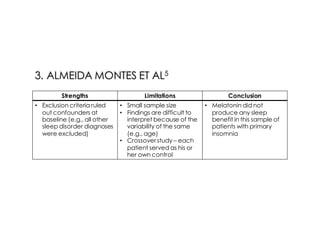
Strengths Limitations Conclusion
• Exclusion criteria ruled
out confounders at
baseline (e.g., all other
sleep disorder diagnoses
were excluded)
• Small sample size
• Findings are difficult to
interpret because of the
variability of the same
(e.g., age)
• Crossover study – each
patient served as his or
her own control
• Melatonin did not
produce any sleep
benefit in this sample of
patients with primary
insomnia
•
•
•
•
•
•
•
•
•
•
•
•
•
•
1.
2.
3.
4.
5.
6.
7.
8.
HTTP://DX.DOI.OR G/10.1016/S0025-6196(11)63555-6
9.
0.1021/TX970202H
10.
11.

Is Melatonin Effective for Sleep - LinkedIn

  • 2.
  • 4.
  • 5.
  • 6.
    Sleep Stage EyeMovements Motor Movements HR, BP, Respirations Cerebral Activity Stage 1 Slow, rolling movements Moderate activity Slows Decreases Stage 2 Slow, rolling movements Moderate activity Slows Decreases Stages 3 & 4 (i.e., deep sleep) Slow, rolling movements Moderate activity Slows Decreases REM Sleep Clusters of rapid eye movements Suppressed w loss of muscle tone Increases, variable Increases Chart adapted from: Porth CM, Sleep and Sleep Disorders. In: Pathophysiology: Concepts of Altered Health States. 8th edition. Porth CM, Matfin G, eds. Philadelphia: Wolters Kluwer Health; 2009.
  • 7.
  • 8.
    SCN Forebrain/Thalamus Attention, memory, emotion, psychomotor performance, sensorimotorintegration Hypothalamus Anterior pituitary Hormone levels Hypothalamus Body temperature, metabolism, ANS function, sleep-wake cycles Brain stem reticular formation ANS function, sleep- wake cycles Pineal gland Melatonin Light impulses through retina a,b Chart adapted from: Porth CM, Sleep and Sleep Disorders. In: Pathophysiology: Concepts of Altered Health States. 8th edition. Porth CM, Matfin G, eds. Philadelphia: Wolters Kluwer Health; 2009. a Light = inhibitory signals b Dark (i.e., lack of light) = stimulating signals
  • 9.
  • 11.
    MT1 Receptors in SCN Forebrain/Thalamus Attention,memory, emotion, psychomotor performance, sensorimotor integration Hypothalamus Anterior pituitary Hormone levels Hypothalamus Body temperature, metabolism, ANS function, sleep-wake cycles Brain stem reticular formation ANS function, sleep- wake cycles Pineal gland Melatonin Melatonin Activation of MT1 receptors is the likely mechanism of how melatonin regulatessleep2
  • 12.
    Activation of MT2receptors is the likely mechanism of how melatonin influences circadian rhythm phase shifts2 Adapted from: http://www.brightenyourlife.info/images/slide4.jpg Phase Response Curve
  • 14.
  • 15.
  • 16.
  • 17.
  • 18.
  • 19.
  • 20.
  • 21.
  • 23.
    Jet-Lag SWSD 1oInsomnia DSPS Dose 0.5-8mg on arrival day, continue for 2-5 days 2-12mg for up to 4 weeks 2-3mg prior to bedtime for up to 29 weeks 5mg prior to bedtime for up to 1 week 0.3-5mg for up to 9 months Formulation IR IR, CR, FR, SR CR, FR, SR IR ROA PO PO PO PO
  • 24.
  • 25.
  • 26.
  • 27.
  • 28.
  • 29.
  • 30.
  • 32.
    Design N patientsIntervention Results Randomized, double-blind, placebo-controlled crossover trial 22 Melatonin or placebo 5mg PO QD x 4 weeks between 1900 and 2100 hours, 1 week washout period, received other treatment x 4 additional weeks 20/22 patients finished the study à sleep onset latency was significantly reduced while subject were taking melatonin as compared with both placebo and baseline
  • 33.
    Strengths Limitations Conclusion •No ADEs noted • Study design allowed patients to select their baseline bedtime and duration of sleep à permitting investigators the ability to compare their natural sleep pattern with that of the imposed sleep period (2400 to 0800 hours) • No evidence that melatonin altered total sleep time • Melatonin did alter subjective measures of sleepiness, fatigue or alertness • Small sample size • Crossover design – each patient served as his or her own control • Not well controlled • Dose response relationships, possibility of relapse after discontinuation, not explored • Melatonin 5mg 3-4 hours prior to bedtime was an effective treatment for patients with DSPS
  • 34.
    Design N trialsResults Cochrane Systematic Review 10 8/10 trials found that melatonin, taken closeto the target bedtime at destination time of 2200 – 0000 hours, decreased jet- lag from flights crossing 5+ time zones.
  • 35.
    Other findings Conclusion Dailydoses of melatonin ranging from 0.5-5mg were shown to be similarly effective; however, patients fell asleep faster and better after 5mg vs. 0.5mg 2mg slow-release melatonin suggested a relative ineffective short-lived higher peak concentration vs. 0.5-5mg (NNT = 2) Start taking two nights prior to flight and continue for 4 nights after arrival Reports suggested that patients with epilepsy, and patients taking warfarin may be harmed by concurrent administration with melatonin Melatonin was remarkable effective in preventing jet lag Safety and efficacywas proven for occasional short- term use Should be recommended to adult travelers flying across 5+ time zones, particularly on an eastward flight
  • 36.
    Design N patientsIntervention Randomized, double-blind, placebo-controlled crossover trial 10 Random order of 0.3mg, 1.0mg melatonin or placebo 60 minutes prior to bedtime for 7 days. Study was setup for patient to receive each intervention dose with a 5-day washout period in between After each 7 day treatment, nighttime EEG records were collected
  • 37.
    Results Treatment; mean (andSD) Sleep variable Placebo MT 0.3mg MT 1.0mg % waking stage in total recordingtime 15.7 (15.6) 15.5 (15.9) 17.3 (18.8) No. of awakenings 6.4 (5.1) 6.5 (4.2) 5.9 (2.4) Total time waking stage, min 73.8 (74.1) 72.1 (76.4) 83.0 (90.7) There were no significant differences in sleep EEG, the amount or subjective quality of sleep or side effects between the placebo, 0.3-mg melatonin or 1.0-mg melatonin treatments.
  • 38.
    Strengths Limitations Conclusion •Exclusion criteria ruled out confounders at baseline (e.g., all other sleep disorder diagnoses were excluded) • Small sample size • Findings are difficult to interpret because of the variability of the same (e.g., age) • Crossover study – each patient served as his or her own control • Melatonin did not produce any sleep benefit in this sample of patients with primary insomnia
  • 39.
  • 40.