VVildagliptinildagliptin
VILDAGLIPTIN:VILDAGLIPTIN:
DPPDPP--IV INHIBITORIV INHIBITOR
By sirinoot Jantharangkul
4827038
VVildagliptinildagliptin
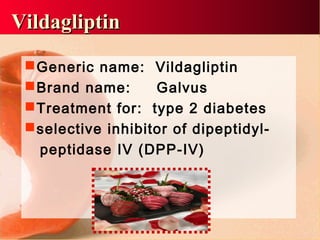
Generic name: Vildagliptin
Brand name: Galvus
Treatment for: type 2 diabetes
selective inhibitor of dipeptidyl-
peptidase IV (DPP-IV)
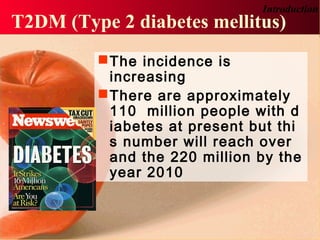
T2DM (Type 2 diabetes mellitus)
The incidence is
increasing
There are approximately
110 million people with d
iabetes at present but thi
s number will reach over
and the 220 million by the
year 2010
Introduction
T2DM (Type 2 diabetes mellitus)
 A disease of progressive β-cell
dysfunction in presence of insulin
resistance
 Leading to gradual loss of glycemic
control
 The pathological loss of β-cell function
may be the result of a number of factors
including
 β-cell secretory defects
 glucotoxicity due to hyperglycemia
 lipotoxicity due to dislipidemia
possibly abnormalities in secretion or
Introduction
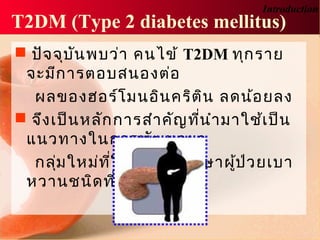
 ปัจจุบันพบว่า คนไข้ T2DM ทุกราย
จะมีการตอบสนองต่อ
ผลของฮอร์โมนอินคริติน ลดน้อยลง
 จึงเป็นหลักการสำาคัญที่นำามาใช้เป็น
แนวทางในการพัฒนายา
กลุ่มใหม่ที่ใช้ในการรักษาผู้ป่วยเบา
หวานชนิดที่ 2 ในปัจจุบัน
Introduction
T2DM (Type 2 diabetes mellitus)
Incretin Hormones
Introduction
Incretin are hormones released from
the gastrointestinal tract
Response to nutrient ingestion that
potentiate glucose-stimulated insulin
secretion from islet beta cells
“ในคนปกติพบว่า อินคริตินฮอร์โมน
มีผลมากถึงร้อยละ 50-70 ที่จะกระตุ้นตับอ่อนให้
สร้างฮอร์โมนอินซูลิน”
The 2 predominant incretins
GIP (glucose-dependent
insulinotropic peptide)
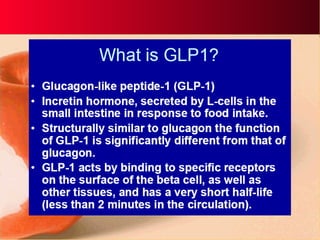
GLP-1 (glucagon like peptide-1)
Incretin Hormones
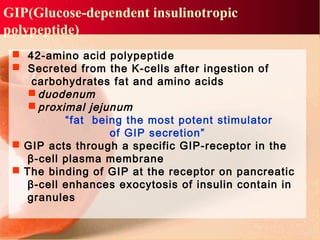
GIP(Glucose-dependent insulinotropic
polypeptide)
 42-amino acid polypeptide
 Secreted from the K-cells after ingestion of
carbohydrates fat and amino acids
 duodenum
 proximal jejunum
“fat being the most potent stimulator
of GIP secretion”
 GIP acts through a specific GIP-receptor in the
β-cell plasma membrane
 The binding of GIP at the receptor on pancreatic
β-cell enhances exocytosis of insulin contain in
granules
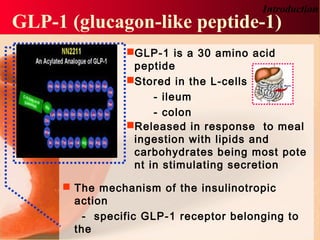
GLP-1 is a 30 amino acid
peptide
Stored in the L-cells
- ileum
- colon
Released in response to meal
ingestion with lipids and
carbohydrates being most pote
nt in stimulating secretion
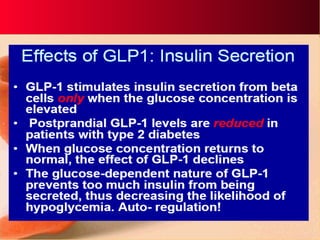
 The mechanism of the insulinotropic
action
- specific GLP-1 receptor belonging to
the
GLP-1 (glucagon-like peptide-1)
Introduction
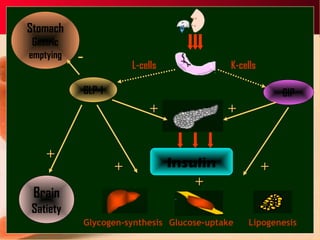
GLP-1 GIP
Insulin
Glycogen-synthesis Glucose-uptake Lipogenesis
++
++
++
++
++
L-cells K-cells
Stomach
Gastric
emptying
Brain
Satiety
-
++
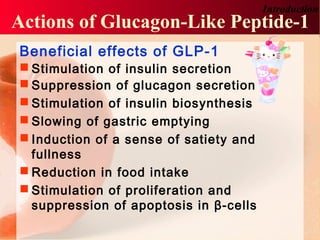
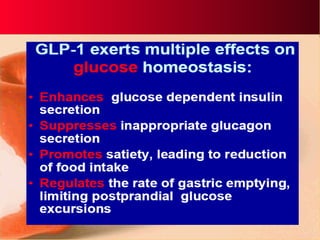
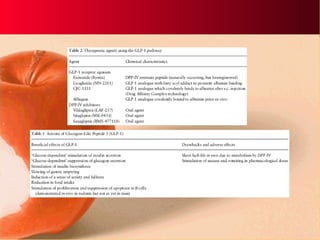
Beneficial effects of GLP-1
 Stimulation of insulin secretion
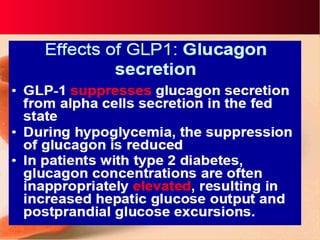
 Suppression of glucagon secretion
 Stimulation of insulin biosynthesis
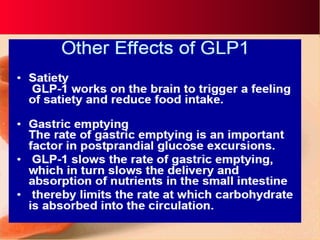
 Slowing of gastric emptying
 Induction of a sense of satiety and
fullness
 Reduction in food intake
 Stimulation of proliferation and
suppression of apoptosis in β-cells
Actions of Glucagon-Like Peptide-1
Introduction
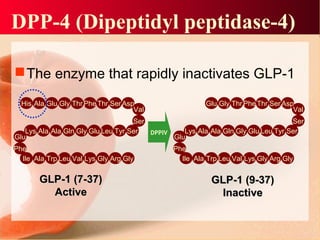
DPP-4 (Dipeptidyl peptidase-4)
The enzyme that rapidly inactivates GLP-1
His Ala Glu Gly ThrPhe Thr SerAsp
Lys Ala Ala Gln Gly Glu Leu Tyr Ser
Ile Ala Trp Leu Val Lys Gly Arg Gly
Val
Ser
Glu
Phe
Glu Gly Thr PheThr SerAsp
Lys Ala Ala Gln Gly Glu Leu Tyr Ser
Ile Ala Trp Leu Val Lys Gly Arg Gly
Val
Ser
Glu
Phe
DPPIV
GLP-1 (9-37)GLP-1 (9-37)
InactiveInactive
GLP-1 (7-37)GLP-1 (7-37)
ActiveActive
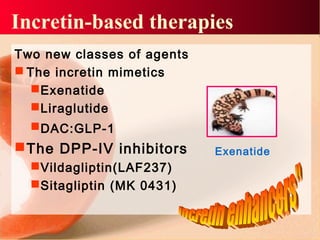
Two new classes of agents
 The incretin mimetics
Exenatide
Liraglutide
DAC:GLP-1
The DPP-IV inhibitors
Vildagliptin(LAF237)
Sitagliptin (MK 0431)
Incretin-based therapies
Exenatide
Vildagliptin
•the first in a new class of oral antidiabetic agents
•known as dipeptidyl peptidase IV inhibitors
(DPP-IV) inhibitors
"incretin enhancers"
(2S)-([(3-hydroxyadamantan-1-yl)
amino]acetyl)-pyrrolidine-2-carbonitrile
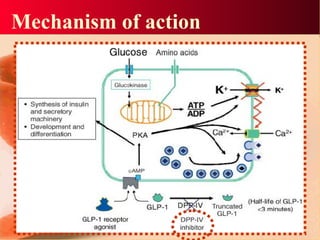
Mechanism of action
Absorption/Distribution
rapidly and almost completely
absorbed (~85% of administered
dose) after oral administration
the pharmacokinetics are not
affected by food
T max : 1–2hours
plasma protein binding 4-17%
PharmacokineticsPharmacokinetics
Metabolism/Elimination
 half-life : 1.5–4.5 hr
 Most of the drug is metabolised with
hydrolysis of the cyano moiety dominating
(55%)
 A fraction (22%) is also excreted
unchanged
by the kidneys.
 minimally metabolised by the major
cytochrome P450 enzymes
PharmacokineticsPharmacokinetics
neither an inhibitor nor an inducer
of P450 enzymes
Drug interactionsDrug interactions
monotherapy and in combination with other antidiabetic treatments has
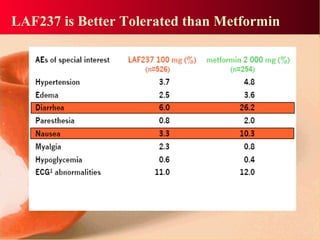
proved to be well tolerated for periods up to 52 weeks
HHypoglycaemiaypoglycaemia is low and similar to that
with metformin or rosiglitazone
 No apparent weight gainweight gain or edemaedema
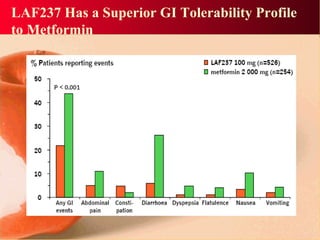
GI side effectsGI side effects is comparable to placebo
and is much less than in metformin-
treated patients
CCardiac adverse eventsardiac adverse events and
HHypertensionypertension with vildagliptin is compar
able to placebo and is also less than with
metformin
Side EffectsSide Effects
Vildagliptin is taken orally and is
likely to be administered once daily
.
Oral 50 and 100 mg in clinical trial
in type 2 DM
No adjustment of dose is necessary
in either heptic or renal
insufficiency
Dosage and administrationDosage and administration
Summary
Vildagliptin is the first of a new
class of drugs for the treatment of
Type 2 diabetes.
This group of drugs will be known as
DPP-IV (dipeptyl peptidase-IV)
inhibitors.
Reduces blood glucose
concentrations by enhancing the eff
ects of
“incretins”
Summary
Well tolerated - low rates of
adverse effects in clinical trials
Not associated with weight gain
ClinicalClinical
studies 1studies 1
ClinicalClinical
studies 1studies 1
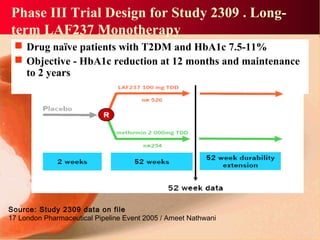
Phase III Trial Design for Study 2309 . Long-
term LAF237 Monotherapy
 Drug naïve patients with T2DM and HbA1c 7.5-11%
 Objective - HbA1c reduction at 12 months and maintenance
to 2 years
Source: Study 2309 data on file
17 London Pharmaceutical Pipeline Event 2005 / Ameet Nathwani
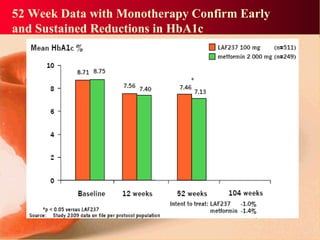
52 Week Data with Monotherapy Confirm Early
and Sustained Reductions in HbA1c
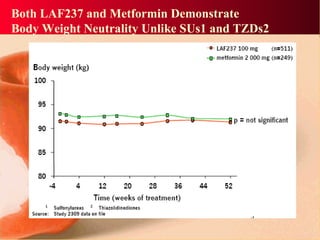
Both LAF237 and Metformin Demonstrate
Body Weight Neutrality Unlike SUs1 and TZDs2
LAF237 is Better Tolerated than Metformin
LAF237 Has a Superior GI Tolerability Profile
to Metformin
ClinicalClinical
studies 2studies 2
ClinicalClinical
studies 2studies 2
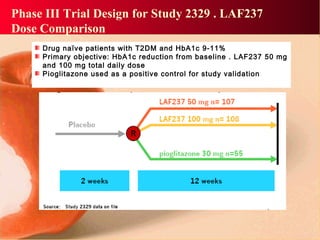
Phase III Trial Design for Study 2329 . LAF237
Dose Comparison
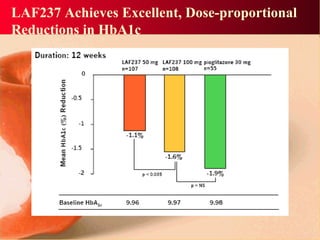
Drug naïve patients with T2DM and HbA1c 9-11%
Primary objective: HbA1c reduction from baseline . LAF237 50 mg
and 100 mg total daily dose
Pioglitazone used as a positive control for study validation
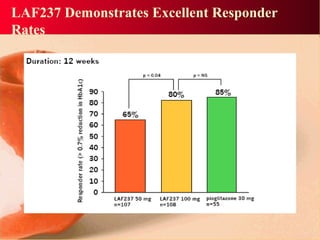
LAF237 Demonstrates Excellent Responder
Rates
LAF237 Achieves Excellent, Dose-proportional
Reductions in HbA1c
ClinicalClinical
studies 3studies 3
ClinicalClinical
studies 3studies 3
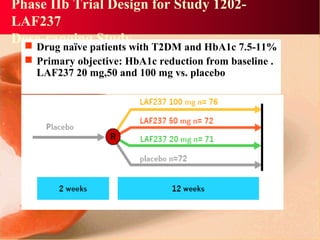
Phase IIb Trial Design for Study 1202-
LAF237
Dose-ranging Study Drug naïve patients with T2DM and HbA1c 7.5-11%
 Primary objective: HbA1c reduction from baseline .
LAF237 20 mg,50 and 100 mg vs. placebo
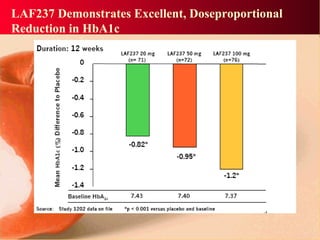
LAF237 Demonstrates Excellent, Doseproportional
Reduction in HbA1c
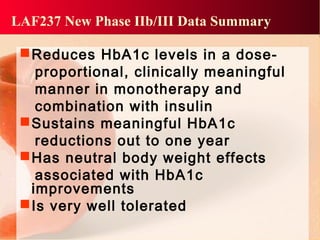
LAF237 New Phase IIb/III Data Summary
Reduces HbA1c levels in a dose-
proportional, clinically meaningful
manner in monotherapy and
combination with insulin
Sustains meaningful HbA1c
reductions out to one year
Has neutral body weight effects
associated with HbA1c
improvements
Is very well tolerated
Is associated with fewer severe
hypoglycemic episodes when
added to insulin
Has the ideal profile as .first
drug of choice. for combination
treatment due to efficacy and s
afety profile, lack of drug-drug i
nteractions and complementary
mechanism of action
LAF237 New Phase IIb/III Data Summary
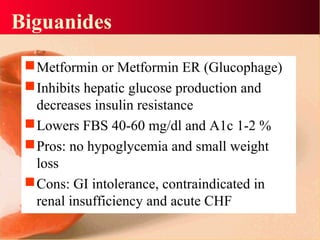
Biguanides
Metformin or Metformin ER (Glucophage)
Inhibits hepatic glucose production and
decreases insulin resistance
Lowers FBS 40-60 mg/dl and A1c 1-2 %
Pros: no hypoglycemia and small weight
loss
Cons: GI intolerance, contraindicated in
renal insufficiency and acute CHF
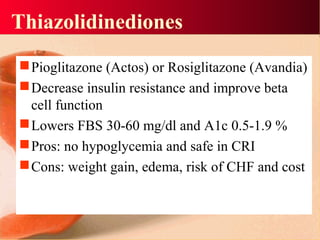
Thiazolidinediones
Pioglitazone (Actos) or Rosiglitazone (Avandia)
Decrease insulin resistance and improve beta
cell function
Lowers FBS 30-60 mg/dl and A1c 0.5-1.9 %
Pros: no hypoglycemia and safe in CRI
Cons: weight gain, edema, risk of CHF and cost
Combination Drugs
SU + metformin (Glucovance, Metaglip)
SU + TZD (Avandaryl)
Metformin + TZD (Avandamet and
Actoplusmet)
Lower A1c 2 – 4 %
Pros: cost savings, convenience, improved
adherence
Cons: limited flexibility
Combination Drugs
SU + metformin (Glucovance, Metaglip)
SU + TZD (Avandaryl)
Metformin + TZD (Avandamet and
Actoplusmet)
Lower A1c 2 – 4 %
Pros: cost savings, convenience, improved
adherence
Cons: limited flexibility
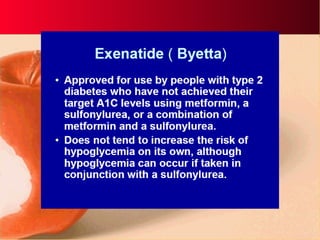
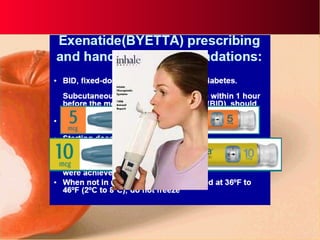
Incretin Mimetics
Exenatide (Byetta)
Mechanism of Action:
- increases insulin secretion
- decreases glucagon secretion
- delays gastric emptying
- promotes satiety and weight loss
- increases beta cell mass
Lowers FBS 10-20 mg/dl, A1c 1%
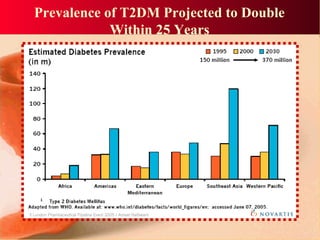
Prevalence of T2DM Projected to Double
Within 25 Years
Incretin Mimetics
Pros: no hypoglycemia, weight loss
Cons: GI intolerance, requires injection and
refrigeration
Newer agents in development
- liraglutide (acylated GLP-1 analogue)
- exenatide-LAR
- vildagliptin, sitagliptin (DPP-IV
inhibitors; orally active, but weight
neutral)
Prandial Regulators
 Meglitinides
- repaglinide (Prandin)
- nateglinide (Starlix)
 Stimulate insulin secretion
 Lower A1c 1-2 % (Prandin) or 0.5-1 % (Starlix)
 Short half-life; dosed tid with meals
 Pros: less hypoglycemia than SU, potential CV
benefit
 Cons: cost, requires frequent dosing
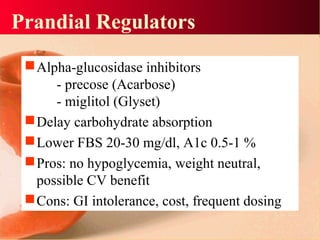
Prandial Regulators
Alpha-glucosidase inhibitors
- precose (Acarbose)
- miglitol (Glyset)
Delay carbohydrate absorption
Lower FBS 20-30 mg/dl, A1c 0.5-1 %
Pros: no hypoglycemia, weight neutral,
possible CV benefit
Cons: GI intolerance, cost, frequent dosing
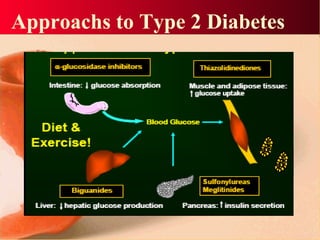
Approachs to Type 2 Diabetes
Insulins
Basal insulins
- glargine (Lantus): peakless, 24 hr
- detemir (Levemir): small peak, ≤ 24 hr
Pros: less hypoglycemia, BS variability and
weight gain than NPH; usually given once daily
Cons: cost
Insulins
Rapid acting insulins
- lispro (Humalog)
- aspart (Novolog)
- glulisine (Apidra)
Pros: improved PPG, less hypoglycemia,
and improved convenience when compared
with regular insulin
Cons: cost
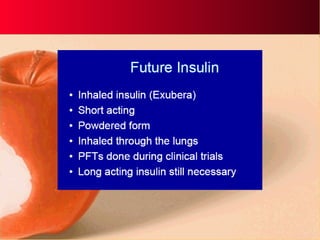
Inhaled Insulin
Exubera (inhaled powdered insulin)
Pros: kinetics similar to rapid acting
injectable insulin analogs, does not
require injection
Cons: inhaler device, contraindicated in
smokers and patients with lung disease,
limited ability to titrate dose, and cost
Insulin Mixtures
Humalog 75/25 and 50/50
Novalog mix 70/30
Pros: improved PPG, less hypoglycemia
and preferred pen delivery compared
with Humulin 70/30
Cons: cost
Pramlintide
 Pramlintide (Symlin); a synthetic amylin
analogue
 Mechanism of Action:
- inhibits glucagon secretion
- slows gastic emptying
- promotes satiety and weight loss
 Pros: lowers PPG, lowers A1c 0.5 % and
promotes weight loss
 Cons: GI intolerance, hypoglycemia, another
injection, and cost
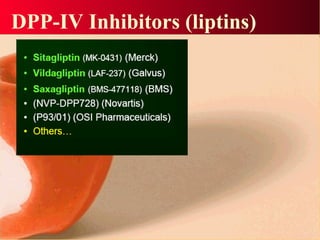
DPP-IV Inhibitors (liptins)
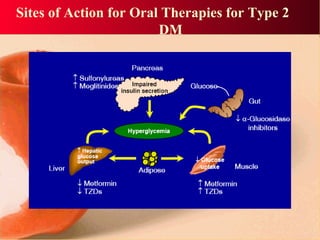
Sites of Action for Oral Therapies for Type 2
DM
Vildagliptin
Vildagliptin
Vildagliptin
Vildagliptin

Vildagliptin

  • 1.
  • 2.
    VVildagliptinildagliptin Generic name: Vildagliptin Brandname: Galvus Treatment for: type 2 diabetes selective inhibitor of dipeptidyl- peptidase IV (DPP-IV)
  • 3.
    T2DM (Type 2diabetes mellitus) The incidence is increasing There are approximately 110 million people with d iabetes at present but thi s number will reach over and the 220 million by the year 2010 Introduction
  • 4.
    T2DM (Type 2diabetes mellitus)  A disease of progressive β-cell dysfunction in presence of insulin resistance  Leading to gradual loss of glycemic control  The pathological loss of β-cell function may be the result of a number of factors including  β-cell secretory defects  glucotoxicity due to hyperglycemia  lipotoxicity due to dislipidemia possibly abnormalities in secretion or Introduction
  • 5.
     ปัจจุบันพบว่า คนไข้T2DM ทุกราย จะมีการตอบสนองต่อ ผลของฮอร์โมนอินคริติน ลดน้อยลง  จึงเป็นหลักการสำาคัญที่นำามาใช้เป็น แนวทางในการพัฒนายา กลุ่มใหม่ที่ใช้ในการรักษาผู้ป่วยเบา หวานชนิดที่ 2 ในปัจจุบัน Introduction T2DM (Type 2 diabetes mellitus)
  • 6.
    Incretin Hormones Introduction Incretin arehormones released from the gastrointestinal tract Response to nutrient ingestion that potentiate glucose-stimulated insulin secretion from islet beta cells “ในคนปกติพบว่า อินคริตินฮอร์โมน มีผลมากถึงร้อยละ 50-70 ที่จะกระตุ้นตับอ่อนให้ สร้างฮอร์โมนอินซูลิน”
  • 7.
    The 2 predominantincretins GIP (glucose-dependent insulinotropic peptide) GLP-1 (glucagon like peptide-1) Incretin Hormones
  • 8.
    GIP(Glucose-dependent insulinotropic polypeptide)  42-aminoacid polypeptide  Secreted from the K-cells after ingestion of carbohydrates fat and amino acids  duodenum  proximal jejunum “fat being the most potent stimulator of GIP secretion”  GIP acts through a specific GIP-receptor in the β-cell plasma membrane  The binding of GIP at the receptor on pancreatic β-cell enhances exocytosis of insulin contain in granules
  • 9.
    GLP-1 is a30 amino acid peptide Stored in the L-cells - ileum - colon Released in response to meal ingestion with lipids and carbohydrates being most pote nt in stimulating secretion  The mechanism of the insulinotropic action - specific GLP-1 receptor belonging to the GLP-1 (glucagon-like peptide-1) Introduction
  • 10.
    GLP-1 GIP Insulin Glycogen-synthesis Glucose-uptakeLipogenesis ++ ++ ++ ++ ++ L-cells K-cells Stomach Gastric emptying Brain Satiety - ++
  • 11.
    Beneficial effects ofGLP-1  Stimulation of insulin secretion  Suppression of glucagon secretion  Stimulation of insulin biosynthesis  Slowing of gastric emptying  Induction of a sense of satiety and fullness  Reduction in food intake  Stimulation of proliferation and suppression of apoptosis in β-cells Actions of Glucagon-Like Peptide-1 Introduction
  • 12.
    DPP-4 (Dipeptidyl peptidase-4) Theenzyme that rapidly inactivates GLP-1 His Ala Glu Gly ThrPhe Thr SerAsp Lys Ala Ala Gln Gly Glu Leu Tyr Ser Ile Ala Trp Leu Val Lys Gly Arg Gly Val Ser Glu Phe Glu Gly Thr PheThr SerAsp Lys Ala Ala Gln Gly Glu Leu Tyr Ser Ile Ala Trp Leu Val Lys Gly Arg Gly Val Ser Glu Phe DPPIV GLP-1 (9-37)GLP-1 (9-37) InactiveInactive GLP-1 (7-37)GLP-1 (7-37) ActiveActive
  • 13.
    Two new classesof agents  The incretin mimetics Exenatide Liraglutide DAC:GLP-1 The DPP-IV inhibitors Vildagliptin(LAF237) Sitagliptin (MK 0431) Incretin-based therapies Exenatide
  • 14.
    Vildagliptin •the first ina new class of oral antidiabetic agents •known as dipeptidyl peptidase IV inhibitors (DPP-IV) inhibitors "incretin enhancers" (2S)-([(3-hydroxyadamantan-1-yl) amino]acetyl)-pyrrolidine-2-carbonitrile
  • 15.
  • 16.
    Absorption/Distribution rapidly and almostcompletely absorbed (~85% of administered dose) after oral administration the pharmacokinetics are not affected by food T max : 1–2hours plasma protein binding 4-17% PharmacokineticsPharmacokinetics
  • 17.
    Metabolism/Elimination  half-life :1.5–4.5 hr  Most of the drug is metabolised with hydrolysis of the cyano moiety dominating (55%)  A fraction (22%) is also excreted unchanged by the kidneys.  minimally metabolised by the major cytochrome P450 enzymes PharmacokineticsPharmacokinetics
  • 18.
    neither an inhibitornor an inducer of P450 enzymes Drug interactionsDrug interactions
  • 19.
    monotherapy and incombination with other antidiabetic treatments has proved to be well tolerated for periods up to 52 weeks HHypoglycaemiaypoglycaemia is low and similar to that with metformin or rosiglitazone  No apparent weight gainweight gain or edemaedema GI side effectsGI side effects is comparable to placebo and is much less than in metformin- treated patients CCardiac adverse eventsardiac adverse events and HHypertensionypertension with vildagliptin is compar able to placebo and is also less than with metformin Side EffectsSide Effects
  • 20.
    Vildagliptin is takenorally and is likely to be administered once daily . Oral 50 and 100 mg in clinical trial in type 2 DM No adjustment of dose is necessary in either heptic or renal insufficiency Dosage and administrationDosage and administration
  • 21.
    Summary Vildagliptin is thefirst of a new class of drugs for the treatment of Type 2 diabetes. This group of drugs will be known as DPP-IV (dipeptyl peptidase-IV) inhibitors. Reduces blood glucose concentrations by enhancing the eff ects of “incretins”
  • 22.
    Summary Well tolerated -low rates of adverse effects in clinical trials Not associated with weight gain
  • 24.
  • 25.
    Phase III TrialDesign for Study 2309 . Long- term LAF237 Monotherapy  Drug naïve patients with T2DM and HbA1c 7.5-11%  Objective - HbA1c reduction at 12 months and maintenance to 2 years Source: Study 2309 data on file 17 London Pharmaceutical Pipeline Event 2005 / Ameet Nathwani
  • 26.
    52 Week Datawith Monotherapy Confirm Early and Sustained Reductions in HbA1c
  • 27.
    Both LAF237 andMetformin Demonstrate Body Weight Neutrality Unlike SUs1 and TZDs2
  • 28.
    LAF237 is BetterTolerated than Metformin
  • 29.
    LAF237 Has aSuperior GI Tolerability Profile to Metformin
  • 30.
  • 31.
    Phase III TrialDesign for Study 2329 . LAF237 Dose Comparison Drug naïve patients with T2DM and HbA1c 9-11% Primary objective: HbA1c reduction from baseline . LAF237 50 mg and 100 mg total daily dose Pioglitazone used as a positive control for study validation
  • 32.
  • 33.
    LAF237 Achieves Excellent,Dose-proportional Reductions in HbA1c
  • 34.
  • 35.
    Phase IIb TrialDesign for Study 1202- LAF237 Dose-ranging Study Drug naïve patients with T2DM and HbA1c 7.5-11%  Primary objective: HbA1c reduction from baseline . LAF237 20 mg,50 and 100 mg vs. placebo
  • 36.
    LAF237 Demonstrates Excellent,Doseproportional Reduction in HbA1c
  • 37.
    LAF237 New PhaseIIb/III Data Summary Reduces HbA1c levels in a dose- proportional, clinically meaningful manner in monotherapy and combination with insulin Sustains meaningful HbA1c reductions out to one year Has neutral body weight effects associated with HbA1c improvements Is very well tolerated
  • 38.
    Is associated withfewer severe hypoglycemic episodes when added to insulin Has the ideal profile as .first drug of choice. for combination treatment due to efficacy and s afety profile, lack of drug-drug i nteractions and complementary mechanism of action LAF237 New Phase IIb/III Data Summary
  • 44.
    Biguanides Metformin or MetforminER (Glucophage) Inhibits hepatic glucose production and decreases insulin resistance Lowers FBS 40-60 mg/dl and A1c 1-2 % Pros: no hypoglycemia and small weight loss Cons: GI intolerance, contraindicated in renal insufficiency and acute CHF
  • 45.
    Thiazolidinediones Pioglitazone (Actos) orRosiglitazone (Avandia) Decrease insulin resistance and improve beta cell function Lowers FBS 30-60 mg/dl and A1c 0.5-1.9 % Pros: no hypoglycemia and safe in CRI Cons: weight gain, edema, risk of CHF and cost
  • 46.
    Combination Drugs SU +metformin (Glucovance, Metaglip) SU + TZD (Avandaryl) Metformin + TZD (Avandamet and Actoplusmet) Lower A1c 2 – 4 % Pros: cost savings, convenience, improved adherence Cons: limited flexibility
  • 47.
    Combination Drugs SU +metformin (Glucovance, Metaglip) SU + TZD (Avandaryl) Metformin + TZD (Avandamet and Actoplusmet) Lower A1c 2 – 4 % Pros: cost savings, convenience, improved adherence Cons: limited flexibility
  • 48.
    Incretin Mimetics Exenatide (Byetta) Mechanismof Action: - increases insulin secretion - decreases glucagon secretion - delays gastric emptying - promotes satiety and weight loss - increases beta cell mass Lowers FBS 10-20 mg/dl, A1c 1%
  • 49.
    Prevalence of T2DMProjected to Double Within 25 Years
  • 50.
    Incretin Mimetics Pros: nohypoglycemia, weight loss Cons: GI intolerance, requires injection and refrigeration Newer agents in development - liraglutide (acylated GLP-1 analogue) - exenatide-LAR - vildagliptin, sitagliptin (DPP-IV inhibitors; orally active, but weight neutral)
  • 51.
    Prandial Regulators  Meglitinides -repaglinide (Prandin) - nateglinide (Starlix)  Stimulate insulin secretion  Lower A1c 1-2 % (Prandin) or 0.5-1 % (Starlix)  Short half-life; dosed tid with meals  Pros: less hypoglycemia than SU, potential CV benefit  Cons: cost, requires frequent dosing
  • 52.
    Prandial Regulators Alpha-glucosidase inhibitors -precose (Acarbose) - miglitol (Glyset) Delay carbohydrate absorption Lower FBS 20-30 mg/dl, A1c 0.5-1 % Pros: no hypoglycemia, weight neutral, possible CV benefit Cons: GI intolerance, cost, frequent dosing
  • 53.
  • 54.
    Insulins Basal insulins - glargine(Lantus): peakless, 24 hr - detemir (Levemir): small peak, ≤ 24 hr Pros: less hypoglycemia, BS variability and weight gain than NPH; usually given once daily Cons: cost
  • 55.
    Insulins Rapid acting insulins -lispro (Humalog) - aspart (Novolog) - glulisine (Apidra) Pros: improved PPG, less hypoglycemia, and improved convenience when compared with regular insulin Cons: cost
  • 56.
    Inhaled Insulin Exubera (inhaledpowdered insulin) Pros: kinetics similar to rapid acting injectable insulin analogs, does not require injection Cons: inhaler device, contraindicated in smokers and patients with lung disease, limited ability to titrate dose, and cost
  • 57.
    Insulin Mixtures Humalog 75/25and 50/50 Novalog mix 70/30 Pros: improved PPG, less hypoglycemia and preferred pen delivery compared with Humulin 70/30 Cons: cost
  • 58.
    Pramlintide  Pramlintide (Symlin);a synthetic amylin analogue  Mechanism of Action: - inhibits glucagon secretion - slows gastic emptying - promotes satiety and weight loss  Pros: lowers PPG, lowers A1c 0.5 % and promotes weight loss  Cons: GI intolerance, hypoglycemia, another injection, and cost
  • 59.
  • 60.
    Sites of Actionfor Oral Therapies for Type 2 DM