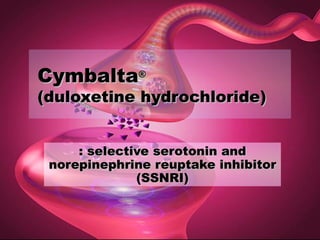
CymbaltaCymbalta®®
(duloxetine hydrochloride)(duloxetine hydrochloride)
:: selective serotonin andselective serotonin and
norepinephrine reuptake inhibitornorepinephrine reuptake inhibitor
(SSNRI)(SSNRI)
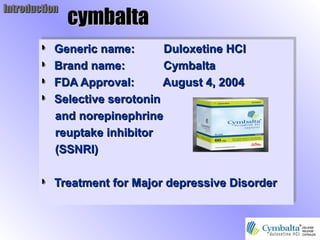
Generic name:Generic name: DDuloxetine HCluloxetine HCl
Brand name: CymbaltaBrand name: Cymbalta
FDA Approval: August 4, 2004FDA Approval: August 4, 2004
SSelective serotoninelective serotonin
andand norepinephrinenorepinephrine
reuptake inhibitorreuptake inhibitor
(SSNRI)(SSNRI)
Treatment forTreatment for Major depressive DisorderMajor depressive Disorder
Generic name:Generic name: DDuloxetine HCluloxetine HCl
Brand name: CymbaltaBrand name: Cymbalta
FDA Approval: August 4, 2004FDA Approval: August 4, 2004
SSelective serotoninelective serotonin
andand norepinephrinenorepinephrine
reuptake inhibitorreuptake inhibitor
(SSNRI)(SSNRI)
Treatment forTreatment for Major depressive DisorderMajor depressive Disorder
cymbaltacymbalta
IntroductionIntroduction
Major depressive DisorderMajor depressive Disorder ((MDD)MDD)
MMD เป็นหนึ่งในกลุ่มโรคความผิดปกติ
ของอารมณ์ ( Mood Disorder)
Mood Disorder การแสดงอาการอาจมี
ลักษณะ
การซึมเศร้า (Depression)
การคลุ้มคลั่ง (Mania)
ทั้งสองแบบสลับกัน (Bipolar)
MDD คือภาวะที่ผู้ป่วยมีอาการซึม
เศร้า(depressive symptom)มากกว่าปกติ
จนเกิดการเสื่อมเสียหน้าที่
พบในหญิงมากกว่าชาย 2 เท่า โรคนี้พบ
มากในช่วงอายุ 25-40 ปี
IntroductionIntroduction
Unipolar
EMOTIONAL SYMPTOMSEMOTIONAL SYMPTOMS
 Sadness
 Loss of interest or
pleasure in activities
 Feeling overwhelmed
 Anxiety
 Poor concentration
 Excessive or
inappropriate guilt
 Recurrent thoughts of
death, suicidal
 thoughts or attempts
EMOTIONAL SYMPTOMSEMOTIONAL SYMPTOMS
 Sadness
 Loss of interest or
pleasure in activities
 Feeling overwhelmed
 Anxiety
 Poor concentration
 Excessive or
inappropriate guilt
 Recurrent thoughts of
death, suicidal
 thoughts or attempts
PHYSICAL SYMPTOMSPHYSICAL SYMPTOMS
 Headaches
 Sleep disturbances
 Fatigue
 Back Pain
 Changes in appetite
PHYSICAL SYMPTOMSPHYSICAL SYMPTOMS
 Headaches
 Sleep disturbances
 Fatigue
 Back Pain
 Changes in appetite
IntroductionIntroduction
Symptoms & Causes
of Depression
EtiologyEtiology
สาเหตุของโรค ปัจจุบันยังไม่ทราบแน่ชัด
แต่สาเหตุต่างๆที่ได้รับการกล่าวถึงได้แก่
Genetic factors
Psychosocial factors
Other biological factors
Catecholamine hypothesis
Down-regulation hypothesis
Cholinergic hypothesis
Major depressive DisorderMajor depressive Disorder
IntroductionIntroduction
Many researchers believeMany researchers believe
depression is caused by an imbalance of two
naturally-occurring chemicals serotonin and norepin
ephrine in the brain and the body
Major depressive DisorderMajor depressive Disorder
IntroductionIntroduction
An imbalance in these chemicals may explain the
emotional and painful physical symptoms of depression
Antidepressant Drugs
 Monoamine oxidase inhibitor (MAOIs)
 Tricyclic antidepressants (TCAs)
 Atypical or second generation
• Serotonin reuptake inhibitors (SRI)
• Norepinephine reuptake inhibitors (NRI)
• Serotonin /Norepinephine reuptake
inhibitors (SNRI)
• Selective SRI (SSRI)
• Selective NRI (SNRI)
• Selective SNRI (SSNRI)
 Monoamine oxidase inhibitor (MAOIs)
 Tricyclic antidepressants (TCAs)
 Atypical or second generation
• Serotonin reuptake inhibitors (SRI)
• Norepinephine reuptake inhibitors (NRI)
• Serotonin /Norepinephine reuptake
inhibitors (SNRI)
• Selective SRI (SSRI)
• Selective NRI (SNRI)
• Selective SNRI (SSNRI)
CymbaltaCymbalta
• molecular weight of 333.88molecular weight of 333.88• molecular weight of 333.88molecular weight of 333.88
•Each capsule contains enteric-coated pelletsEach capsule contains enteric-coated pellets
of 20, 30, or 60mg of duloxetineof 20, 30, or 60mg of duloxetine hydrochloridehydrochloride
•Each capsule contains enteric-coated pelletsEach capsule contains enteric-coated pellets
of 20, 30, or 60mg of duloxetineof 20, 30, or 60mg of duloxetine hydrochloridehydrochloride
Mechanism of actionMechanism of action
PharmacokineticsPharmacokinetics
AbsorptionAbsorption
 OralOrallyly duloxetine is well absorbed.duloxetine is well absorbed.
 C max of duloxetine occurring 6 hoursC max of duloxetine occurring 6 hours
 FoodFood
• not affect the Cmaxnot affect the Cmax
• but delays the time to reach peakbut delays the time to reach peak
concentration from 6 to 10 hoursconcentration from 6 to 10 hours
• decreases the extent of absorption (AUC) bydecreases the extent of absorption (AUC) by
about 10%about 10%
AbsorptionAbsorption
 OralOrallyly duloxetine is well absorbed.duloxetine is well absorbed.
 C max of duloxetine occurring 6 hoursC max of duloxetine occurring 6 hours
 FoodFood
• not affect the Cmaxnot affect the Cmax
• but delays the time to reach peakbut delays the time to reach peak
concentration from 6 to 10 hoursconcentration from 6 to 10 hours
• decreases the extent of absorption (AUC) bydecreases the extent of absorption (AUC) by
about 10%about 10%
DistributionDistribution
 volume of distribution averages aboutvolume of distribution averages about
1640 L1640 L
 highly bound (>90%) to proteins inhighly bound (>90%) to proteins in
human plasmahuman plasma
• albuminalbumin
• α1-acid glycoproteinα1-acid glycoprotein
DistributionDistribution
 volume of distribution averages aboutvolume of distribution averages about
1640 L1640 L
 highly bound (>90%) to proteins inhighly bound (>90%) to proteins in
human plasmahuman plasma
• albuminalbumin
• α1-acid glycoproteinα1-acid glycoprotein
PharmacokineticsPharmacokinetics
MetabolismMetabolism
 extensive metabolism to numerousextensive metabolism to numerous
metabolitesmetabolites
 major biotransformation pathwaysmajor biotransformation pathways
• conjugation and oxidationconjugation and oxidation
• Both CYP2D6 and CYP1A2 catalyze theBoth CYP2D6 and CYP1A2 catalyze the
oxidation of the naphthyl ringoxidation of the naphthyl ring in vitroin vitro
 MetabolitesMetabolites found in plasma includefound in plasma include
• 4-hydroxy duloxetine glucuronide4-hydroxy duloxetine glucuronide
• 5-hydroxy, 6-methoxy duloxetine5-hydroxy, 6-methoxy duloxetine sulfatesulfate
MetabolismMetabolism
 extensive metabolism to numerousextensive metabolism to numerous
metabolitesmetabolites
 major biotransformation pathwaysmajor biotransformation pathways
• conjugation and oxidationconjugation and oxidation
• Both CYP2D6 and CYP1A2 catalyze theBoth CYP2D6 and CYP1A2 catalyze the
oxidation of the naphthyl ringoxidation of the naphthyl ring in vitroin vitro
 MetabolitesMetabolites found in plasma includefound in plasma include
• 4-hydroxy duloxetine glucuronide4-hydroxy duloxetine glucuronide
• 5-hydroxy, 6-methoxy duloxetine5-hydroxy, 6-methoxy duloxetine sulfatesulfate
PharmacokineticsPharmacokinetics
EliminationElimination
 Only trace(<1% of the dose) amountsOnly trace(<1% of the dose) amounts
of unchanged duloxetine are present inof unchanged duloxetine are present in
the urinethe urine
 Most (about 70%) of the duloxetineMost (about 70%) of the duloxetine
dose appears in the urine as metabolitdose appears in the urine as metabolit
es of duloxetinees of duloxetine
 about 20% is excreted in the feces.about 20% is excreted in the feces.
 elimination half-life of about 12 hourselimination half-life of about 12 hours
EliminationElimination
 Only trace(<1% of the dose) amountsOnly trace(<1% of the dose) amounts
of unchanged duloxetine are present inof unchanged duloxetine are present in
the urinethe urine
 Most (about 70%) of the duloxetineMost (about 70%) of the duloxetine
dose appears in the urine as metabolitdose appears in the urine as metabolit
es of duloxetinees of duloxetine
 about 20% is excreted in the feces.about 20% is excreted in the feces.
 elimination half-life of about 12 hourselimination half-life of about 12 hours
PharmacokineticsPharmacokinetics
Inhibitors of CYP1A2Inhibitors of CYP1A2
 co-administered with fluvoxamineco-administered with fluvoxamine
((a potent CYP1A2 inhibitor)a potent CYP1A2 inhibitor)
• AUC was increased approximately 6-foldAUC was increased approximately 6-fold
• Cmax was increased about 2.5-foldCmax was increased about 2.5-fold
• t1/2 was increased approximately 3-foldt1/2 was increased approximately 3-fold
 Other drugs that inhibit CYP1A2Other drugs that inhibit CYP1A2
metabolismmetabolism
• include cimetidine and quinoloneinclude cimetidine and quinolone
antimicrobials such as ciprofloxacin and enoxantimicrobials such as ciprofloxacin and enox
acinacin
Drug interactionsDrug interactions
Inhibitors of CYP2D6Inhibitors of CYP2D6
 Concomitant use of duloxetine with
potent inhibitors of CYP2D6 would be
expected to, and does, result in higher
concentrations of duloxetine
 Paroxetine (20 mg QD)
• increased the concentration of duloxetine
(40 mg QD) by about 60%
• and greater degrees of inhibition are
expected with higher doses of paroxetine
DrugDrug interactionsinteractions
Drugs Highly Bound to PlasmaDrugs Highly Bound to Plasma
ProteinProtein
 Because duloxetine is highly bound toBecause duloxetine is highly bound to
plasma proteinplasma protein
• may cause increased free concentrationsmay cause increased free concentrations
of the other drug, potentially resulting inof the other drug, potentially resulting in
adverse eventsadverse events
Drug interactionsDrug interactions
 Hypersensitivity
 Monoamine Oxidase Inhibitors
 Hypersensitivity
 Monoamine Oxidase Inhibitors
ContraindicationsContraindications
In clinical studiesIn clinical studies
 TThehe most common side effectmost common side effect waswas nauseanausea
• the nausea was mild to moderate, andthe nausea was mild to moderate, and
usually subsided within one to two weeksusually subsided within one to two weeks
 Other most common side effects includedOther most common side effects included
(listed in order of frequency):(listed in order of frequency):
• Dry mouthDry mouth
• ConstipationConstipation
• Decreased appetiteDecreased appetite
• FatigueFatigue
• SleepinessSleepiness
• Increased sweatingIncreased sweating
Side EffectsSide Effects
 Cymbalta should be administeredCymbalta should be administered
• at aat a total dose of 40 mg/daytotal dose of 40 mg/day (given as 20(given as 20
mg BID)mg BID)
• to 60 mg/dayto 60 mg/day (given either once a day or as(given either once a day or as
30 mg BID) without regard to meals30 mg BID) without regard to meals
Dosage andDosage and
administrationadministration
Clinical studiesClinical studiesClinical studiesClinical studies
European Psychiatry (2006)European Psychiatry (2006)
Duloxetine in the treatment ofDuloxetine in the treatment of
major depressivemajor depressive disorder:disorder:
a placebo- and paroxetine-controlled triala placebo- and paroxetine-controlled trial
Duloxetine in the treatment ofDuloxetine in the treatment of
major depressivemajor depressive disorder:disorder:
a placebo- and paroxetine-controlled triala placebo- and paroxetine-controlled trial
ByBy D.G.S. Perahia , F. Wang , C.H. Mallinckrodt ,D.G.S. Perahia , F. Wang , C.H. Mallinckrodt ,
D.J. Walker , M.J. DetkeD.J. Walker , M.J. Detke
 Duloxetine doses of 80 and 120 mg/Duloxetine doses of 80 and 120 mg/
day were assessed for efficacy and sday were assessed for efficacy and s
afety in the treatment of major depreafety in the treatment of major depre
ssive disorderssive disorder (MDD)(MDD)
 Duloxetine doses of 80 and 120 mg/Duloxetine doses of 80 and 120 mg/
day were assessed for efficacy and sday were assessed for efficacy and s
afety in the treatment of major depreafety in the treatment of major depre
ssive disorderssive disorder (MDD)(MDD)
Objective:Objective:
PatientsPatients
 patients agepatients age ≥≥ 1818
 DSM-IV criteria for MDDDSM-IV criteria for MDD
 CGI-S ratingCGI-S rating ≥≥ 4 and HAMD17 total score4 and HAMD17 total score
≥≥ 15 at the screening and baseline study15 at the screening and baseline study
visitsvisits
PatientsPatients
 patients agepatients age ≥≥ 1818
 DSM-IV criteria for MDDDSM-IV criteria for MDD
 CGI-S ratingCGI-S rating ≥≥ 4 and HAMD17 total score4 and HAMD17 total score
≥≥ 15 at the screening and baseline study15 at the screening and baseline study
visitsvisits
Patients and methodsPatients and methods
Study designStudy design
 multi-site, randomized, double-blind,multi-site, randomized, double-blind,
placebo and paroxetine-controlled stuplacebo and paroxetine-controlled stu
dydy
 randomly assigned in a 1:1:1:1 ratiorandomly assigned in a 1:1:1:1 ratio
• placeboplacebo
• duloxetine 80 mg/dayduloxetine 80 mg/day
• duloxetine 120 mg/dayduloxetine 120 mg/day
• paroxetine 20 mg/dayparoxetine 20 mg/day
Study designStudy design
 multi-site, randomized, double-blind,multi-site, randomized, double-blind,
placebo and paroxetine-controlled stuplacebo and paroxetine-controlled stu
dydy
 randomly assigned in a 1:1:1:1 ratiorandomly assigned in a 1:1:1:1 ratio
• placeboplacebo
• duloxetine 80 mg/dayduloxetine 80 mg/day
• duloxetine 120 mg/dayduloxetine 120 mg/day
• paroxetine 20 mg/dayparoxetine 20 mg/day
Patients and methodsPatients and methods
Patients Screened
n=480
Patients Screened
n=480
Randomized
n=392
Randomized
n=392
Placebo
n=90
Placebo
n=90
Duloxetine
80mg
n=93
Duloxetine
80mg
n=93
Paroxetine
20mg
n=97
Paroxetine
20mg
n=97
acute phase
8wk
acute phase
8wk
primary
efficacy
measure
HAMD17 ≥30%
from
baseline
continuation
phase
6-month
continuation
phase
6-month
Placebo
n=71
Placebo
n=71
Duloxetine
80mg
n=71
Duloxetine
80mg
n=71
Duloxetine
20mg
n=103
Duloxetine
20mg
n=103
Duloxetine
20mg
n=81
Duloxetine
20mg
n=81
Paroxetine
20mg
n=70
Paroxetine
20mg
n=70
completed
continuation ph
n=62
completed
continuation ph
n=58
completed
continuation ph
n=62
completed
continuation ph
n=61
Efficacy measures
 primary measures
• HAMD17 total score
 Secondary measures
• HAMD17 subscales
• (anxiety/somatization, core factor,Maier, sleep, and retardation)
• The Montgomery Asberg depression rating scale (MADRS)
• The Hamilton anxiety rating scale (HAMA)
• Patient global impression of improvement scales(PGI-I)
• The Sheehan disability scale (SDS)
• Visual analog scales (VAS) for pain
• The somatic symptom inventory (SSI)
Efficacy measures
 primary measures
• HAMD17 total score
 Secondary measures
• HAMD17 subscales
• (anxiety/somatization, core factor,Maier, sleep, and retardation)
• The Montgomery Asberg depression rating scale (MADRS)
• The Hamilton anxiety rating scale (HAMA)
• Patient global impression of improvement scales(PGI-I)
• The Sheehan disability scale (SDS)
• Visual analog scales (VAS) for pain
• The somatic symptom inventory (SSI)
Patients and methodsPatients and methods
Safety and tolerability assessmentsSafety and tolerability assessments
 RReported adverse eventseported adverse events
 RRecorded at each visitecorded at each visit
• vital signs, and weightvital signs, and weight
• Supine blood pressureSupine blood pressure
• heart rateheart rate
 Laboratory tests (hematology, clinicalLaboratory tests (hematology, clinical
chemistry, and urinalysis)chemistry, and urinalysis)
 The Arizona sexual experiences scaleThe Arizona sexual experiences scale
(ASEX)(ASEX)
Safety and tolerability assessmentsSafety and tolerability assessments
 RReported adverse eventseported adverse events
 RRecorded at each visitecorded at each visit
• vital signs, and weightvital signs, and weight
• Supine blood pressureSupine blood pressure
• heart rateheart rate
 Laboratory tests (hematology, clinicalLaboratory tests (hematology, clinical
chemistry, and urinalysis)chemistry, and urinalysis)
 The Arizona sexual experiences scaleThe Arizona sexual experiences scale
(ASEX)(ASEX)
Patients and methodsPatients and methods
Results: EfficacyResults: Efficacy (acute ph.)(acute ph.)
Fig. 2. (a) HAMD17 change over the 8-week treatment period. Effect of placebo
(N = 99), duloxetine 80 mg/day (N = 93), duloxetine 120 mg/day (N = 102),
and paroxetine 20 mg/day (N = 97) on HAMD17 total scores (mean change
from baseline
Fig. 2. (a) HAMD17 change over the 8-week treatment period. Effect of placebo
(N = 99), duloxetine 80 mg/day (N = 93), duloxetine 120 mg/day (N = 102),
and paroxetine 20 mg/day (N = 97) on HAMD17 total scores (mean change
from baseline
Results:Results: Summary of primary efficacy outcomes (acute ph.)Summary of primary efficacy outcomes (acute ph.)
HAMD17: 17-item Hamilton rating scale for depression; MADRS: Montgomery Asberg depression rating
scale; HAMA: Hamilton anxiety rating scale; CGI-S:
clinical global impression of severity; PGI-I: patient global impression of improvement; LS mean: least-
square mean; S.E.: standard error. Items from the
HAMD17 scale used in the following subscales include: anxiety/somatization (items 10–13, 15, 17), core
factor (items 1–3, 7, 8), Maier (items 1, 2, 7–10); retardation
(items 1, 7, 8, 14), and sleep (items 4–6). *P ≤ 0.05 vs. placebo; **P ≤ 0.01.
a Results from MMRM analysis: mean change from baseline to week 8 ± S.E. Mean at week 8 for PGI-I.
b Administered as 40 mg twice daily (BID).
c Administered as 60 mg twice daily (BID).
d Administered once daily.
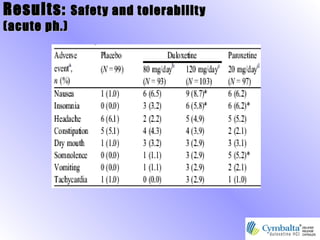
Results:Results: Safety and tolerabilitySafety and tolerability
(acute ph.)(acute ph.)
Summary of primary and secondary efficacy
outcomes: continuation ph.
Results:Results: Safety and tolerability (continuation ph.)Safety and tolerability (continuation ph.)
ConclusionsConclusions
 This study reinforces previous evidence
for the efficacy and safety of duloxetine in
the treatment of MDD in acute therapy.
 Long-term efficacy cannot be
unequivocally concluded from this trial
 Because neither duloxetine dose differed
significantly from placebo in maintenance
of effect during the continuation phase.
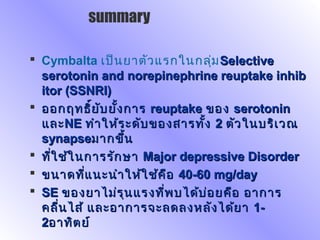
 Cymbalta เป็นยาตัวแรกในกลุ่มSSelectiveelective
serotonin andserotonin and norepinephrinenorepinephrine reuptake inhibreuptake inhib
itor (SSNRI)itor (SSNRI)
 ออกฤทธิ์ยับยั้งการออกฤทธิ์ยับยั้งการ reuptakereuptake ของของ serotoninserotonin
และและNENE ทำาให้ระดับของสารทั้งทำาให้ระดับของสารทั้ง 22 ตัวในบริเวณตัวในบริเวณ
synapsesynapseมากขึ้นมากขึ้น
 ที่ใช้ในการรักษาที่ใช้ในการรักษา Major depressive DisorderMajor depressive Disorder
 ขนาดที่แนะนำาให้ใช้คือขนาดที่แนะนำาให้ใช้คือ 40-6040-60 mg/daymg/day
 SESE ของยาไม่รุนแรงที่พบได้บ่อยคือ อาการของยาไม่รุนแรงที่พบได้บ่อยคือ อาการ
คลื่นไส้ และอาการจะลดลงหลังได้ยาคลื่นไส้ และอาการจะลดลงหลังได้ยา 1-1-
22อาทิตย์อาทิตย์
summary
The
Cymbalta (duloxetine hydrochloride)

Cymbalta (duloxetine hydrochloride)

  • 1.
    CymbaltaCymbalta®® (duloxetine hydrochloride)(duloxetine hydrochloride) ::selective serotonin andselective serotonin and norepinephrine reuptake inhibitornorepinephrine reuptake inhibitor (SSNRI)(SSNRI)
  • 2.
    Generic name:Generic name:DDuloxetine HCluloxetine HCl Brand name: CymbaltaBrand name: Cymbalta FDA Approval: August 4, 2004FDA Approval: August 4, 2004 SSelective serotoninelective serotonin andand norepinephrinenorepinephrine reuptake inhibitorreuptake inhibitor (SSNRI)(SSNRI) Treatment forTreatment for Major depressive DisorderMajor depressive Disorder Generic name:Generic name: DDuloxetine HCluloxetine HCl Brand name: CymbaltaBrand name: Cymbalta FDA Approval: August 4, 2004FDA Approval: August 4, 2004 SSelective serotoninelective serotonin andand norepinephrinenorepinephrine reuptake inhibitorreuptake inhibitor (SSNRI)(SSNRI) Treatment forTreatment for Major depressive DisorderMajor depressive Disorder cymbaltacymbalta IntroductionIntroduction
  • 3.
    Major depressive DisorderMajordepressive Disorder ((MDD)MDD) MMD เป็นหนึ่งในกลุ่มโรคความผิดปกติ ของอารมณ์ ( Mood Disorder) Mood Disorder การแสดงอาการอาจมี ลักษณะ การซึมเศร้า (Depression) การคลุ้มคลั่ง (Mania) ทั้งสองแบบสลับกัน (Bipolar) MDD คือภาวะที่ผู้ป่วยมีอาการซึม เศร้า(depressive symptom)มากกว่าปกติ จนเกิดการเสื่อมเสียหน้าที่ พบในหญิงมากกว่าชาย 2 เท่า โรคนี้พบ มากในช่วงอายุ 25-40 ปี IntroductionIntroduction Unipolar
  • 4.
    EMOTIONAL SYMPTOMSEMOTIONAL SYMPTOMS Sadness  Loss of interest or pleasure in activities  Feeling overwhelmed  Anxiety  Poor concentration  Excessive or inappropriate guilt  Recurrent thoughts of death, suicidal  thoughts or attempts EMOTIONAL SYMPTOMSEMOTIONAL SYMPTOMS  Sadness  Loss of interest or pleasure in activities  Feeling overwhelmed  Anxiety  Poor concentration  Excessive or inappropriate guilt  Recurrent thoughts of death, suicidal  thoughts or attempts PHYSICAL SYMPTOMSPHYSICAL SYMPTOMS  Headaches  Sleep disturbances  Fatigue  Back Pain  Changes in appetite PHYSICAL SYMPTOMSPHYSICAL SYMPTOMS  Headaches  Sleep disturbances  Fatigue  Back Pain  Changes in appetite IntroductionIntroduction Symptoms & Causes of Depression
  • 5.
    EtiologyEtiology สาเหตุของโรค ปัจจุบันยังไม่ทราบแน่ชัด แต่สาเหตุต่างๆที่ได้รับการกล่าวถึงได้แก่ Genetic factors Psychosocialfactors Other biological factors Catecholamine hypothesis Down-regulation hypothesis Cholinergic hypothesis Major depressive DisorderMajor depressive Disorder IntroductionIntroduction
  • 6.
    Many researchers believeManyresearchers believe depression is caused by an imbalance of two naturally-occurring chemicals serotonin and norepin ephrine in the brain and the body Major depressive DisorderMajor depressive Disorder IntroductionIntroduction An imbalance in these chemicals may explain the emotional and painful physical symptoms of depression
  • 7.
    Antidepressant Drugs  Monoamineoxidase inhibitor (MAOIs)  Tricyclic antidepressants (TCAs)  Atypical or second generation • Serotonin reuptake inhibitors (SRI) • Norepinephine reuptake inhibitors (NRI) • Serotonin /Norepinephine reuptake inhibitors (SNRI) • Selective SRI (SSRI) • Selective NRI (SNRI) • Selective SNRI (SSNRI)  Monoamine oxidase inhibitor (MAOIs)  Tricyclic antidepressants (TCAs)  Atypical or second generation • Serotonin reuptake inhibitors (SRI) • Norepinephine reuptake inhibitors (NRI) • Serotonin /Norepinephine reuptake inhibitors (SNRI) • Selective SRI (SSRI) • Selective NRI (SNRI) • Selective SNRI (SSNRI)
  • 8.
    CymbaltaCymbalta • molecular weightof 333.88molecular weight of 333.88• molecular weight of 333.88molecular weight of 333.88 •Each capsule contains enteric-coated pelletsEach capsule contains enteric-coated pellets of 20, 30, or 60mg of duloxetineof 20, 30, or 60mg of duloxetine hydrochloridehydrochloride •Each capsule contains enteric-coated pelletsEach capsule contains enteric-coated pellets of 20, 30, or 60mg of duloxetineof 20, 30, or 60mg of duloxetine hydrochloridehydrochloride
  • 9.
  • 10.
    PharmacokineticsPharmacokinetics AbsorptionAbsorption  OralOrallyly duloxetineis well absorbed.duloxetine is well absorbed.  C max of duloxetine occurring 6 hoursC max of duloxetine occurring 6 hours  FoodFood • not affect the Cmaxnot affect the Cmax • but delays the time to reach peakbut delays the time to reach peak concentration from 6 to 10 hoursconcentration from 6 to 10 hours • decreases the extent of absorption (AUC) bydecreases the extent of absorption (AUC) by about 10%about 10% AbsorptionAbsorption  OralOrallyly duloxetine is well absorbed.duloxetine is well absorbed.  C max of duloxetine occurring 6 hoursC max of duloxetine occurring 6 hours  FoodFood • not affect the Cmaxnot affect the Cmax • but delays the time to reach peakbut delays the time to reach peak concentration from 6 to 10 hoursconcentration from 6 to 10 hours • decreases the extent of absorption (AUC) bydecreases the extent of absorption (AUC) by about 10%about 10%
  • 11.
    DistributionDistribution  volume ofdistribution averages aboutvolume of distribution averages about 1640 L1640 L  highly bound (>90%) to proteins inhighly bound (>90%) to proteins in human plasmahuman plasma • albuminalbumin • α1-acid glycoproteinα1-acid glycoprotein DistributionDistribution  volume of distribution averages aboutvolume of distribution averages about 1640 L1640 L  highly bound (>90%) to proteins inhighly bound (>90%) to proteins in human plasmahuman plasma • albuminalbumin • α1-acid glycoproteinα1-acid glycoprotein PharmacokineticsPharmacokinetics
  • 12.
    MetabolismMetabolism  extensive metabolismto numerousextensive metabolism to numerous metabolitesmetabolites  major biotransformation pathwaysmajor biotransformation pathways • conjugation and oxidationconjugation and oxidation • Both CYP2D6 and CYP1A2 catalyze theBoth CYP2D6 and CYP1A2 catalyze the oxidation of the naphthyl ringoxidation of the naphthyl ring in vitroin vitro  MetabolitesMetabolites found in plasma includefound in plasma include • 4-hydroxy duloxetine glucuronide4-hydroxy duloxetine glucuronide • 5-hydroxy, 6-methoxy duloxetine5-hydroxy, 6-methoxy duloxetine sulfatesulfate MetabolismMetabolism  extensive metabolism to numerousextensive metabolism to numerous metabolitesmetabolites  major biotransformation pathwaysmajor biotransformation pathways • conjugation and oxidationconjugation and oxidation • Both CYP2D6 and CYP1A2 catalyze theBoth CYP2D6 and CYP1A2 catalyze the oxidation of the naphthyl ringoxidation of the naphthyl ring in vitroin vitro  MetabolitesMetabolites found in plasma includefound in plasma include • 4-hydroxy duloxetine glucuronide4-hydroxy duloxetine glucuronide • 5-hydroxy, 6-methoxy duloxetine5-hydroxy, 6-methoxy duloxetine sulfatesulfate PharmacokineticsPharmacokinetics
  • 13.
    EliminationElimination  Only trace(<1%of the dose) amountsOnly trace(<1% of the dose) amounts of unchanged duloxetine are present inof unchanged duloxetine are present in the urinethe urine  Most (about 70%) of the duloxetineMost (about 70%) of the duloxetine dose appears in the urine as metabolitdose appears in the urine as metabolit es of duloxetinees of duloxetine  about 20% is excreted in the feces.about 20% is excreted in the feces.  elimination half-life of about 12 hourselimination half-life of about 12 hours EliminationElimination  Only trace(<1% of the dose) amountsOnly trace(<1% of the dose) amounts of unchanged duloxetine are present inof unchanged duloxetine are present in the urinethe urine  Most (about 70%) of the duloxetineMost (about 70%) of the duloxetine dose appears in the urine as metabolitdose appears in the urine as metabolit es of duloxetinees of duloxetine  about 20% is excreted in the feces.about 20% is excreted in the feces.  elimination half-life of about 12 hourselimination half-life of about 12 hours PharmacokineticsPharmacokinetics
  • 14.
    Inhibitors of CYP1A2Inhibitorsof CYP1A2  co-administered with fluvoxamineco-administered with fluvoxamine ((a potent CYP1A2 inhibitor)a potent CYP1A2 inhibitor) • AUC was increased approximately 6-foldAUC was increased approximately 6-fold • Cmax was increased about 2.5-foldCmax was increased about 2.5-fold • t1/2 was increased approximately 3-foldt1/2 was increased approximately 3-fold  Other drugs that inhibit CYP1A2Other drugs that inhibit CYP1A2 metabolismmetabolism • include cimetidine and quinoloneinclude cimetidine and quinolone antimicrobials such as ciprofloxacin and enoxantimicrobials such as ciprofloxacin and enox acinacin Drug interactionsDrug interactions
  • 15.
    Inhibitors of CYP2D6Inhibitorsof CYP2D6  Concomitant use of duloxetine with potent inhibitors of CYP2D6 would be expected to, and does, result in higher concentrations of duloxetine  Paroxetine (20 mg QD) • increased the concentration of duloxetine (40 mg QD) by about 60% • and greater degrees of inhibition are expected with higher doses of paroxetine DrugDrug interactionsinteractions
  • 16.
    Drugs Highly Boundto PlasmaDrugs Highly Bound to Plasma ProteinProtein  Because duloxetine is highly bound toBecause duloxetine is highly bound to plasma proteinplasma protein • may cause increased free concentrationsmay cause increased free concentrations of the other drug, potentially resulting inof the other drug, potentially resulting in adverse eventsadverse events Drug interactionsDrug interactions
  • 17.
     Hypersensitivity  MonoamineOxidase Inhibitors  Hypersensitivity  Monoamine Oxidase Inhibitors ContraindicationsContraindications
  • 18.
    In clinical studiesInclinical studies  TThehe most common side effectmost common side effect waswas nauseanausea • the nausea was mild to moderate, andthe nausea was mild to moderate, and usually subsided within one to two weeksusually subsided within one to two weeks  Other most common side effects includedOther most common side effects included (listed in order of frequency):(listed in order of frequency): • Dry mouthDry mouth • ConstipationConstipation • Decreased appetiteDecreased appetite • FatigueFatigue • SleepinessSleepiness • Increased sweatingIncreased sweating Side EffectsSide Effects
  • 19.
     Cymbalta shouldbe administeredCymbalta should be administered • at aat a total dose of 40 mg/daytotal dose of 40 mg/day (given as 20(given as 20 mg BID)mg BID) • to 60 mg/dayto 60 mg/day (given either once a day or as(given either once a day or as 30 mg BID) without regard to meals30 mg BID) without regard to meals Dosage andDosage and administrationadministration
  • 20.
    Clinical studiesClinical studiesClinicalstudiesClinical studies European Psychiatry (2006)European Psychiatry (2006)
  • 21.
    Duloxetine in thetreatment ofDuloxetine in the treatment of major depressivemajor depressive disorder:disorder: a placebo- and paroxetine-controlled triala placebo- and paroxetine-controlled trial Duloxetine in the treatment ofDuloxetine in the treatment of major depressivemajor depressive disorder:disorder: a placebo- and paroxetine-controlled triala placebo- and paroxetine-controlled trial ByBy D.G.S. Perahia , F. Wang , C.H. Mallinckrodt ,D.G.S. Perahia , F. Wang , C.H. Mallinckrodt , D.J. Walker , M.J. DetkeD.J. Walker , M.J. Detke
  • 22.
     Duloxetine dosesof 80 and 120 mg/Duloxetine doses of 80 and 120 mg/ day were assessed for efficacy and sday were assessed for efficacy and s afety in the treatment of major depreafety in the treatment of major depre ssive disorderssive disorder (MDD)(MDD)  Duloxetine doses of 80 and 120 mg/Duloxetine doses of 80 and 120 mg/ day were assessed for efficacy and sday were assessed for efficacy and s afety in the treatment of major depreafety in the treatment of major depre ssive disorderssive disorder (MDD)(MDD) Objective:Objective:
  • 23.
    PatientsPatients  patients agepatientsage ≥≥ 1818  DSM-IV criteria for MDDDSM-IV criteria for MDD  CGI-S ratingCGI-S rating ≥≥ 4 and HAMD17 total score4 and HAMD17 total score ≥≥ 15 at the screening and baseline study15 at the screening and baseline study visitsvisits PatientsPatients  patients agepatients age ≥≥ 1818  DSM-IV criteria for MDDDSM-IV criteria for MDD  CGI-S ratingCGI-S rating ≥≥ 4 and HAMD17 total score4 and HAMD17 total score ≥≥ 15 at the screening and baseline study15 at the screening and baseline study visitsvisits Patients and methodsPatients and methods
  • 24.
    Study designStudy design multi-site, randomized, double-blind,multi-site, randomized, double-blind, placebo and paroxetine-controlled stuplacebo and paroxetine-controlled stu dydy  randomly assigned in a 1:1:1:1 ratiorandomly assigned in a 1:1:1:1 ratio • placeboplacebo • duloxetine 80 mg/dayduloxetine 80 mg/day • duloxetine 120 mg/dayduloxetine 120 mg/day • paroxetine 20 mg/dayparoxetine 20 mg/day Study designStudy design  multi-site, randomized, double-blind,multi-site, randomized, double-blind, placebo and paroxetine-controlled stuplacebo and paroxetine-controlled stu dydy  randomly assigned in a 1:1:1:1 ratiorandomly assigned in a 1:1:1:1 ratio • placeboplacebo • duloxetine 80 mg/dayduloxetine 80 mg/day • duloxetine 120 mg/dayduloxetine 120 mg/day • paroxetine 20 mg/dayparoxetine 20 mg/day Patients and methodsPatients and methods
  • 25.
    Patients Screened n=480 Patients Screened n=480 Randomized n=392 Randomized n=392 Placebo n=90 Placebo n=90 Duloxetine 80mg n=93 Duloxetine 80mg n=93 Paroxetine 20mg n=97 Paroxetine 20mg n=97 acutephase 8wk acute phase 8wk primary efficacy measure HAMD17 ≥30% from baseline continuation phase 6-month continuation phase 6-month Placebo n=71 Placebo n=71 Duloxetine 80mg n=71 Duloxetine 80mg n=71 Duloxetine 20mg n=103 Duloxetine 20mg n=103 Duloxetine 20mg n=81 Duloxetine 20mg n=81 Paroxetine 20mg n=70 Paroxetine 20mg n=70 completed continuation ph n=62 completed continuation ph n=58 completed continuation ph n=62 completed continuation ph n=61
  • 26.
    Efficacy measures  primarymeasures • HAMD17 total score  Secondary measures • HAMD17 subscales • (anxiety/somatization, core factor,Maier, sleep, and retardation) • The Montgomery Asberg depression rating scale (MADRS) • The Hamilton anxiety rating scale (HAMA) • Patient global impression of improvement scales(PGI-I) • The Sheehan disability scale (SDS) • Visual analog scales (VAS) for pain • The somatic symptom inventory (SSI) Efficacy measures  primary measures • HAMD17 total score  Secondary measures • HAMD17 subscales • (anxiety/somatization, core factor,Maier, sleep, and retardation) • The Montgomery Asberg depression rating scale (MADRS) • The Hamilton anxiety rating scale (HAMA) • Patient global impression of improvement scales(PGI-I) • The Sheehan disability scale (SDS) • Visual analog scales (VAS) for pain • The somatic symptom inventory (SSI) Patients and methodsPatients and methods
  • 27.
    Safety and tolerabilityassessmentsSafety and tolerability assessments  RReported adverse eventseported adverse events  RRecorded at each visitecorded at each visit • vital signs, and weightvital signs, and weight • Supine blood pressureSupine blood pressure • heart rateheart rate  Laboratory tests (hematology, clinicalLaboratory tests (hematology, clinical chemistry, and urinalysis)chemistry, and urinalysis)  The Arizona sexual experiences scaleThe Arizona sexual experiences scale (ASEX)(ASEX) Safety and tolerability assessmentsSafety and tolerability assessments  RReported adverse eventseported adverse events  RRecorded at each visitecorded at each visit • vital signs, and weightvital signs, and weight • Supine blood pressureSupine blood pressure • heart rateheart rate  Laboratory tests (hematology, clinicalLaboratory tests (hematology, clinical chemistry, and urinalysis)chemistry, and urinalysis)  The Arizona sexual experiences scaleThe Arizona sexual experiences scale (ASEX)(ASEX) Patients and methodsPatients and methods
  • 28.
    Results: EfficacyResults: Efficacy(acute ph.)(acute ph.) Fig. 2. (a) HAMD17 change over the 8-week treatment period. Effect of placebo (N = 99), duloxetine 80 mg/day (N = 93), duloxetine 120 mg/day (N = 102), and paroxetine 20 mg/day (N = 97) on HAMD17 total scores (mean change from baseline Fig. 2. (a) HAMD17 change over the 8-week treatment period. Effect of placebo (N = 99), duloxetine 80 mg/day (N = 93), duloxetine 120 mg/day (N = 102), and paroxetine 20 mg/day (N = 97) on HAMD17 total scores (mean change from baseline
  • 29.
    Results:Results: Summary ofprimary efficacy outcomes (acute ph.)Summary of primary efficacy outcomes (acute ph.) HAMD17: 17-item Hamilton rating scale for depression; MADRS: Montgomery Asberg depression rating scale; HAMA: Hamilton anxiety rating scale; CGI-S: clinical global impression of severity; PGI-I: patient global impression of improvement; LS mean: least- square mean; S.E.: standard error. Items from the HAMD17 scale used in the following subscales include: anxiety/somatization (items 10–13, 15, 17), core factor (items 1–3, 7, 8), Maier (items 1, 2, 7–10); retardation (items 1, 7, 8, 14), and sleep (items 4–6). *P ≤ 0.05 vs. placebo; **P ≤ 0.01. a Results from MMRM analysis: mean change from baseline to week 8 ± S.E. Mean at week 8 for PGI-I. b Administered as 40 mg twice daily (BID). c Administered as 60 mg twice daily (BID). d Administered once daily.
  • 30.
    Results:Results: Safety andtolerabilitySafety and tolerability (acute ph.)(acute ph.)
  • 31.
    Summary of primaryand secondary efficacy outcomes: continuation ph.
  • 32.
    Results:Results: Safety andtolerability (continuation ph.)Safety and tolerability (continuation ph.)
  • 33.
    ConclusionsConclusions  This studyreinforces previous evidence for the efficacy and safety of duloxetine in the treatment of MDD in acute therapy.  Long-term efficacy cannot be unequivocally concluded from this trial  Because neither duloxetine dose differed significantly from placebo in maintenance of effect during the continuation phase.
  • 34.
     Cymbalta เป็นยาตัวแรกในกลุ่มSSelectiveelective serotoninandserotonin and norepinephrinenorepinephrine reuptake inhibreuptake inhib itor (SSNRI)itor (SSNRI)  ออกฤทธิ์ยับยั้งการออกฤทธิ์ยับยั้งการ reuptakereuptake ของของ serotoninserotonin และและNENE ทำาให้ระดับของสารทั้งทำาให้ระดับของสารทั้ง 22 ตัวในบริเวณตัวในบริเวณ synapsesynapseมากขึ้นมากขึ้น  ที่ใช้ในการรักษาที่ใช้ในการรักษา Major depressive DisorderMajor depressive Disorder  ขนาดที่แนะนำาให้ใช้คือขนาดที่แนะนำาให้ใช้คือ 40-6040-60 mg/daymg/day  SESE ของยาไม่รุนแรงที่พบได้บ่อยคือ อาการของยาไม่รุนแรงที่พบได้บ่อยคือ อาการ คลื่นไส้ และอาการจะลดลงหลังได้ยาคลื่นไส้ และอาการจะลดลงหลังได้ยา 1-1- 22อาทิตย์อาทิตย์ summary
  • 35.