


VANDANA SHARMA
M. PHARM
INDEPENDENT PHARMA TUTOR
(8 YEARS)
SHREE GANESHAYA NAMAH SHREE KRISHAN SARNAM MAMAH
STUDY MATERIAL FOR PHARMACY STUDENTS
Parkinson's disease
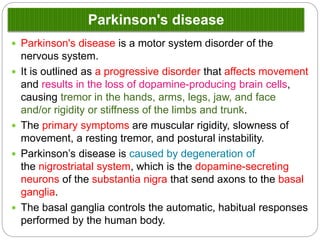
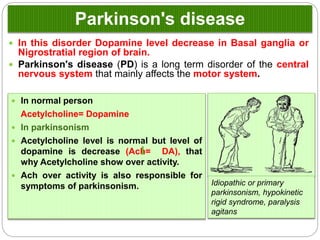
 Parkinson's disease is a motor system disorder of the nervous
system.
 It is outlined as a progressive disorder that affects movement
and results in the loss of dopamine-producing brain cells,
causing tremor in the hands, arms, legs, jaw, and face and/or
rigidity or stiffness of the limbs and trunk.
 The primary symptoms are muscular rigidity, slowness of
movement, a resting tremor, and postural instability.
 Parkinson’s disease is caused by degeneration of
the nigrostriatal system, which is the dopamine-secreting
neurons of the substantia nigra that send axons to the basal
ganglia.
 The basal ganglia controls the automatic, habitual responses
performed by the human body.
Parkinson's disease
 In this disorder Dopamine level decrease in Basal ganglia or
Nigrostratial region of brain.
 Parkinson's disease (PD) is a long term disorder of the central
nervous system that mainly affects the motor system.
Idiopathic or primary
parkinsonism, hypokinetic
rigid syndrome, paralysis
agitans
 In normal person
Acetylcholine= Dopamine
 In parkinsonism
 Acetylcholine level is normal but level of
dopamine is decrease (Ach= DA), that why
Acetylcholine show over activity.
 Ach over activity is also responsible for
symptoms of parkinsonism.
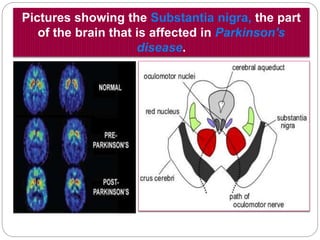
Pictures showing the Substantia nigra, the part of
the brain that is affected in Parkinson's disease.
Diagnosis
 It is difficult to diagnose Parkinson’s disease, as
there is no specific test for it.
 Doctors usually perform other tests in order to rule
out other conditions. Often seen in
the dopaminergic neurons in the brains of patients
who have Parkinson’s disease, are Lewy bodies,
which are abnormal circular structures found within
the cytoplasm. Lewy bodies have a dense protein
core, surrounded by a halo of radiating fibers.
Symptoms
 The main motor symptoms are collectively called "parkinsonism", or
a "parkinsonian syndrome".
 The symptoms generally come on slowly over time.
 Early in the disease, the most obvious are
Shaking, rigidity, slowness of movement, and difficulty with
walking. Thinking and behavioral problems may also occur.
 Dementia becomes common in the advanced stages of the disease.
 Other symptoms include sensory, sleep, and emotional problems.
 Parkinson's disease (PD) is a long term disorder of the central
nervous system that mainly affects the motor system.
Cause
 The cause of Parkinson's disease is believed to involve both genetic and
environmental factors.
 There is also an increased risk in people exposed to certain pesticides, have had
prior head injuries.
 The motor symptoms of the disease result from the death of cells in the substantia
nigra, a region of the midbrain. This results in not enough dopamine in these
areas. The reason for this cell death is poorly understood but involves the build-up
of proteins into Lewy bodies in the neurons.
 Mutations on chromosome 4 can cause Parkinson’s disease. This gene produces a
protein known as a-synuclein. This protein which is normally found in the
presynaptic terminals and is thought to be involved in synaptic transmission in
dopaminergic neurons. The mutation produces what it known as a toxic gain of
function because it produces a protein that results in effects that are toxic to the
cell.
 Parkinson’s disease can also be caused by a mutation on chromosome 6. This
gene has been named parkin. This mutation causes a loss of function, which
makes it a recessive disorder.
Cause
Note
 Over use/over prescription of antipsychotic drug induce
parkinsonism as side effect.
 Drug induced Parkinsonism is treated with Central Anti
cholinergic drugs
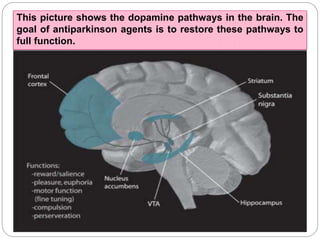
This picture shows the dopamine pathways in the brain. The
goal of antiparkinson agents is to restore these pathways to full
function.
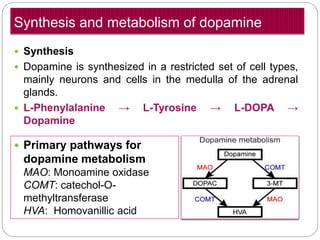
Synthesis and metabolism of dopamine
 Synthesis
 Dopamine is synthesized in a restricted set of cell types,
mainly neurons and cells in the medulla of the adrenal glands.
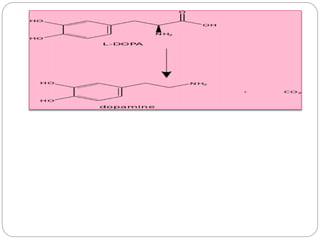
 L-Phenylalanine → L-Tyrosine → L-DOPA → Dopamine
 Primary pathways for
dopamine metabolism
MAO: Monoamine oxidase
COMT: catechol-O-
methyltransferase
HVA: Homovanillic acid
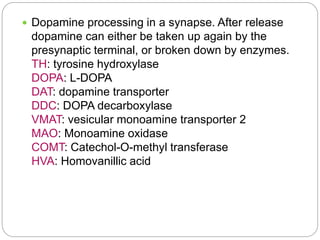
 Dopamine processing in a synapse. After release
dopamine can either be taken up again by the
presynaptic terminal, or broken down by enzymes.
TH: tyrosine hydroxylase
DOPA: L-DOPA
DAT: dopamine transporter
DDC: DOPA decarboxylase
VMAT: vesicular monoamine transporter 2
MAO: Monoamine oxidase
COMT: Catechol-O-methyl transferase
HVA: Homovanillic acid
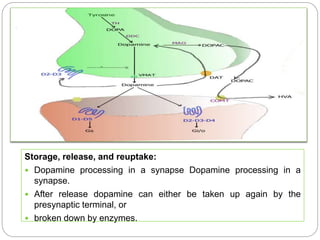
Storage, release, and reuptake:
 Dopamine processing in a synapse Dopamine processing in a synapse.
 After release dopamine can either be taken up again by the
presynaptic terminal, or
 broken down by enzymes.
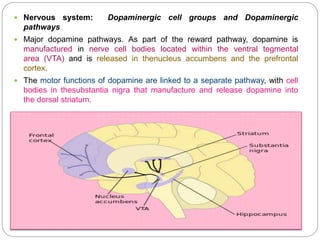
 Nervous system: Dopaminergic cell groups and Dopaminergic pathways
 Major dopamine pathways. As part of the reward pathway, dopamine is
manufactured in nerve cell bodies located within the ventral tegmental
area (VTA) and is released in thenucleus accumbens and the prefrontal cortex.
 The motor functions of dopamine are linked to a separate pathway, with cell
bodies in thesubstantia nigra that manufacture and release dopamine into
the dorsal striatum.
Anti parkinson medication
 An antiparkinson medication is a type of
drug which is intended to treat and relieve the
symptoms of Parkinson's disease.
 Most of these agents act by either increasing
dopamine activity or
reducing acetylcholine activity in the central
nervous system.
The goal of the most common Anti Parkinson
drugs
 The goal of the most common Antiparkinson drugs
 is to either replace the dopamine levels in the brain, or
mimic the actions of dopamine.
 The main categories of Antiparkinson drugs
are anticholinergic drugs and dopaminergic drugs.
 Anticholinergic drugs block the action of
acetylcholine, compensating for the low levels of
dopamine.
 As stated before, dopaminergic drugs aim to replace
dopamine or inhibit the degradation of dopamine in
the brain.
Classification of Anti Parkinson drugs
 Dopamine precursor: Levodopa
 Peripheral dopa decarboxylase inhibitors: carbidopa, Benserazide
 COMT Inhibitors: tolcapone, Entacapone
 MAO-B Inhibitors: Selegiline
 Dopaminergic agonist: Ergot alkaloid e.g. Bromocriptine
 Dopamine facilitator: Amantadine
 Central Anti-cholinergic: Trihexyphenidyl, Procyclidine, Biperiden
 Anti- histaminic (First generation): Promethazine
 Following drugs are not effective/used, alone/ single in parkinsonism
E.g. Carbidopa, Benserazide and Entcapone(Peripheral COMT
inhibitors)
 Co-careldopa= Carbidopa + Levodopa
 Dopaminergic precursors. Preferred over other medications to prevent
undesirable sympathomimetic side effects.
 Peripheral dopa decarboxylase inhibitors. Prevents peripheral degradation of L-
dopa by Peripheral dopa decarboxylase enzyme and increase effectiveness of L-
dopa and decrease side effect of L-dopa that come due to peripherral
degradation of L-dopa e.g. Nausea and vomiting.
 COMT inhibitors. Preventing the metabolism of dopamine by COMT and hence
increase its brain levels.
 Selective monoamine oxidase B inhibitors. To prevent the metabolism of
dopamine by MAO-B and hence increase its brain levels.
 Dopamine receptor agonists. Directly increase the activity of the dopamine
system.
 Dopamine facilitator. Facilitate dopamine release from nerve ending and
increase dopamine concentration in brain.
 Central Anticholinergics- These drugs reduce the effect of acetylcholine in the
brain by antagonizing cholinergic receptors. This helps restore the
acetylcholine/dopamine balance within the brain.
 Anti- histaminic. Some Antihistaminic have Anti cholinergic activity
MOA of all Anti Parkinson Drugs
L-DOPA
 This standard treatment for Parkinson’s disease is referred to as L-DOPA, is
precursor of dopamine (Dopamine Precursor).
 L-DOPA causes the person’s remaining dopaminergic neurons to produce
and secrete more dopamine, counteracting the effects of Parkinson’s
disease.
 However, eventually the nigrostriatal dopaminergic neurons in the brain
drop to a low enough count where the symptoms of Parkinson’s disease
become worse.
 This is due to the short half-life of L-DOPA in the body; typically 1.5–2 hours.
 L-DOPA also activates DA neurons in the mesolimbic/mesocortical system
and produces side effects such as hallucinations and delusions.
 Once a preliminary diagnosis is made, carbidopa-levodopa can be given as an
antiparkinson medication. If this medication shows improvement, doctors will
likely confirm their diagnosis.
Other side effects are
 Nausea and vomiting- These are most common and dose limiting s/e.
Due to peripheral degradation of L-dopa.
 Taste alteration
 Hypotension
Precaution during L-dopa therapy
 During levodopa therapy patient should avoid protein diet or amino
acid containing diet.
 Levodopa absorb from intestine through amino acid transporters.
 Levodopa and Amino acid compete for same transport for absorption
Decrease levodopa absorption
 Levodopa should not be taken with Vit B6 (Pyridoxyl phosphate)
Vit B6 decrease effectiveness of levodopa(Vit B6 increase its
metamolism by Increasing synthesis of Dopa decarboxylase
metabolizing enzyme )
 (Vit B6 is a cofactor of Dopa decarboxylase)
L-Dopa
(Orally)
B
B
B
Perophertal
dopa
decarboxyla
se
10 to 15%
L-Dopa
Dopamine
D2 Receptor
Present on CTZ
(BBB is not present)
Act on
Inhibited by
Benserazide
& Carbidopa
(Increase
permiation of
L-Dopa in
Brain)
Increase brain
bioavailability of
L-Dopa
Cause
Nausea
and
vomiting
Domperidone
(Block CTZ D2
Receptors)
Decease
N & V
L-Dopa
Central dopa
decarboxylase
Dopamine
Act through
D2 Receptor
Central
COMT
3- Methyl
Tyramine
MAO-B
HVA
Excrete
through
Urine
Inhibited by
Tolcapone
Inhibited by
Selegiline
Peripheral
COMT
HVA Inhibited by Tolcapone
Entcapone
Inhibit
both
COMT
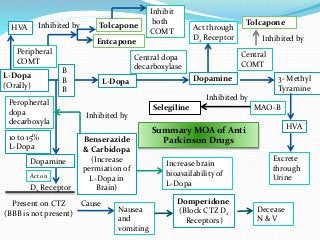
Summary MOA of Anti
Parkinson Drugs
D2 Receptor agonist
 Ergot alkaloid: e.g. Bromocriptine, pergolide
 Directly activate D2 Receptor
Use
 In case of multidrug resistant parkinsonism or levodopa resistance
parkinsonism
S/E of Bromocriptine
 After approx. 10 days- Swelling and redness in joints (sever pain in
joints.
Note
 At low dose Bromocriptine used to suppress undesirable lactation/
milk production/ hyper prolectamea.
Dopamine facilitator:
 Amantadine
Antiparkinson's Drugs

Antiparkinson's Drugs

  • 1.
    VANDANA SHARMA M. PHARM INDEPENDENTPHARMA TUTOR (8 YEARS) SHREE GANESHAYA NAMAH SHREE KRISHAN SARNAM MAMAH STUDY MATERIAL FOR PHARMACY STUDENTS
  • 2.
    Parkinson's disease  Parkinson'sdisease is a motor system disorder of the nervous system.  It is outlined as a progressive disorder that affects movement and results in the loss of dopamine-producing brain cells, causing tremor in the hands, arms, legs, jaw, and face and/or rigidity or stiffness of the limbs and trunk.  The primary symptoms are muscular rigidity, slowness of movement, a resting tremor, and postural instability.  Parkinson’s disease is caused by degeneration of the nigrostriatal system, which is the dopamine-secreting neurons of the substantia nigra that send axons to the basal ganglia.  The basal ganglia controls the automatic, habitual responses performed by the human body.
  • 3.
    Parkinson's disease  Inthis disorder Dopamine level decrease in Basal ganglia or Nigrostratial region of brain.  Parkinson's disease (PD) is a long term disorder of the central nervous system that mainly affects the motor system. Idiopathic or primary parkinsonism, hypokinetic rigid syndrome, paralysis agitans  In normal person Acetylcholine= Dopamine  In parkinsonism  Acetylcholine level is normal but level of dopamine is decrease (Ach= DA), that why Acetylcholine show over activity.  Ach over activity is also responsible for symptoms of parkinsonism.
  • 4.
    Pictures showing theSubstantia nigra, the part of the brain that is affected in Parkinson's disease.
  • 5.
    Diagnosis  It isdifficult to diagnose Parkinson’s disease, as there is no specific test for it.  Doctors usually perform other tests in order to rule out other conditions. Often seen in the dopaminergic neurons in the brains of patients who have Parkinson’s disease, are Lewy bodies, which are abnormal circular structures found within the cytoplasm. Lewy bodies have a dense protein core, surrounded by a halo of radiating fibers.
  • 6.
    Symptoms  The mainmotor symptoms are collectively called "parkinsonism", or a "parkinsonian syndrome".  The symptoms generally come on slowly over time.  Early in the disease, the most obvious are Shaking, rigidity, slowness of movement, and difficulty with walking. Thinking and behavioral problems may also occur.  Dementia becomes common in the advanced stages of the disease.  Other symptoms include sensory, sleep, and emotional problems.  Parkinson's disease (PD) is a long term disorder of the central nervous system that mainly affects the motor system.
  • 7.
    Cause  The causeof Parkinson's disease is believed to involve both genetic and environmental factors.  There is also an increased risk in people exposed to certain pesticides, have had prior head injuries.  The motor symptoms of the disease result from the death of cells in the substantia nigra, a region of the midbrain. This results in not enough dopamine in these areas. The reason for this cell death is poorly understood but involves the build-up of proteins into Lewy bodies in the neurons.  Mutations on chromosome 4 can cause Parkinson’s disease. This gene produces a protein known as a-synuclein. This protein which is normally found in the presynaptic terminals and is thought to be involved in synaptic transmission in dopaminergic neurons. The mutation produces what it known as a toxic gain of function because it produces a protein that results in effects that are toxic to the cell.  Parkinson’s disease can also be caused by a mutation on chromosome 6. This gene has been named parkin. This mutation causes a loss of function, which makes it a recessive disorder.
  • 8.
    Cause Note  Over use/overprescription of antipsychotic drug induce parkinsonism as side effect.  Drug induced Parkinsonism is treated with Central Anti cholinergic drugs
  • 9.
    This picture showsthe dopamine pathways in the brain. The goal of antiparkinson agents is to restore these pathways to full function.
  • 10.
    Synthesis and metabolismof dopamine  Synthesis  Dopamine is synthesized in a restricted set of cell types, mainly neurons and cells in the medulla of the adrenal glands.  L-Phenylalanine → L-Tyrosine → L-DOPA → Dopamine  Primary pathways for dopamine metabolism MAO: Monoamine oxidase COMT: catechol-O- methyltransferase HVA: Homovanillic acid
  • 11.
     Dopamine processingin a synapse. After release dopamine can either be taken up again by the presynaptic terminal, or broken down by enzymes. TH: tyrosine hydroxylase DOPA: L-DOPA DAT: dopamine transporter DDC: DOPA decarboxylase VMAT: vesicular monoamine transporter 2 MAO: Monoamine oxidase COMT: Catechol-O-methyl transferase HVA: Homovanillic acid
  • 12.
    Storage, release, andreuptake:  Dopamine processing in a synapse Dopamine processing in a synapse.  After release dopamine can either be taken up again by the presynaptic terminal, or  broken down by enzymes.
  • 13.
     Nervous system:Dopaminergic cell groups and Dopaminergic pathways  Major dopamine pathways. As part of the reward pathway, dopamine is manufactured in nerve cell bodies located within the ventral tegmental area (VTA) and is released in thenucleus accumbens and the prefrontal cortex.  The motor functions of dopamine are linked to a separate pathway, with cell bodies in thesubstantia nigra that manufacture and release dopamine into the dorsal striatum.
  • 14.
    Anti parkinson medication An antiparkinson medication is a type of drug which is intended to treat and relieve the symptoms of Parkinson's disease.  Most of these agents act by either increasing dopamine activity or reducing acetylcholine activity in the central nervous system.
  • 15.
    The goal ofthe most common Anti Parkinson drugs  The goal of the most common Antiparkinson drugs  is to either replace the dopamine levels in the brain, or mimic the actions of dopamine.  The main categories of Antiparkinson drugs are anticholinergic drugs and dopaminergic drugs.  Anticholinergic drugs block the action of acetylcholine, compensating for the low levels of dopamine.  As stated before, dopaminergic drugs aim to replace dopamine or inhibit the degradation of dopamine in the brain.
  • 16.
    Classification of AntiParkinson drugs  Dopamine precursor: Levodopa  Peripheral dopa decarboxylase inhibitors: carbidopa, Benserazide  COMT Inhibitors: tolcapone, Entacapone  MAO-B Inhibitors: Selegiline  Dopaminergic agonist: Ergot alkaloid e.g. Bromocriptine  Dopamine facilitator: Amantadine  Central Anti-cholinergic: Trihexyphenidyl, Procyclidine, Biperiden  Anti- histaminic (First generation): Promethazine  Following drugs are not effective/used, alone/ single in parkinsonism E.g. Carbidopa, Benserazide and Entcapone(Peripheral COMT inhibitors)  Co-careldopa= Carbidopa + Levodopa
  • 17.
     Dopaminergic precursors.Preferred over other medications to prevent undesirable sympathomimetic side effects.  Peripheral dopa decarboxylase inhibitors. Prevents peripheral degradation of L- dopa by Peripheral dopa decarboxylase enzyme and increase effectiveness of L- dopa and decrease side effect of L-dopa that come due to peripherral degradation of L-dopa e.g. Nausea and vomiting.  COMT inhibitors. Preventing the metabolism of dopamine by COMT and hence increase its brain levels.  Selective monoamine oxidase B inhibitors. To prevent the metabolism of dopamine by MAO-B and hence increase its brain levels.  Dopamine receptor agonists. Directly increase the activity of the dopamine system.  Dopamine facilitator. Facilitate dopamine release from nerve ending and increase dopamine concentration in brain.  Central Anticholinergics- These drugs reduce the effect of acetylcholine in the brain by antagonizing cholinergic receptors. This helps restore the acetylcholine/dopamine balance within the brain.  Anti- histaminic. Some Antihistaminic have Anti cholinergic activity MOA of all Anti Parkinson Drugs
  • 18.
    L-DOPA  This standardtreatment for Parkinson’s disease is referred to as L-DOPA, is precursor of dopamine (Dopamine Precursor).  L-DOPA causes the person’s remaining dopaminergic neurons to produce and secrete more dopamine, counteracting the effects of Parkinson’s disease.  However, eventually the nigrostriatal dopaminergic neurons in the brain drop to a low enough count where the symptoms of Parkinson’s disease become worse.  This is due to the short half-life of L-DOPA in the body; typically 1.5–2 hours.  L-DOPA also activates DA neurons in the mesolimbic/mesocortical system and produces side effects such as hallucinations and delusions.  Once a preliminary diagnosis is made, carbidopa-levodopa can be given as an antiparkinson medication. If this medication shows improvement, doctors will likely confirm their diagnosis.
  • 19.
    Other side effectsare  Nausea and vomiting- These are most common and dose limiting s/e. Due to peripheral degradation of L-dopa.  Taste alteration  Hypotension
  • 20.
    Precaution during L-dopatherapy  During levodopa therapy patient should avoid protein diet or amino acid containing diet.  Levodopa absorb from intestine through amino acid transporters.  Levodopa and Amino acid compete for same transport for absorption Decrease levodopa absorption  Levodopa should not be taken with Vit B6 (Pyridoxyl phosphate) Vit B6 decrease effectiveness of levodopa(Vit B6 increase its metamolism by Increasing synthesis of Dopa decarboxylase metabolizing enzyme )  (Vit B6 is a cofactor of Dopa decarboxylase)
  • 21.
    L-Dopa (Orally) B B B Perophertal dopa decarboxyla se 10 to 15% L-Dopa Dopamine D2Receptor Present on CTZ (BBB is not present) Act on Inhibited by Benserazide & Carbidopa (Increase permiation of L-Dopa in Brain) Increase brain bioavailability of L-Dopa Cause Nausea and vomiting Domperidone (Block CTZ D2 Receptors) Decease N & V L-Dopa Central dopa decarboxylase Dopamine Act through D2 Receptor Central COMT 3- Methyl Tyramine MAO-B HVA Excrete through Urine Inhibited by Tolcapone Inhibited by Selegiline Peripheral COMT HVA Inhibited by Tolcapone Entcapone Inhibit both COMT Summary MOA of Anti Parkinson Drugs
  • 22.
    D2 Receptor agonist Ergot alkaloid: e.g. Bromocriptine, pergolide  Directly activate D2 Receptor Use  In case of multidrug resistant parkinsonism or levodopa resistance parkinsonism S/E of Bromocriptine  After approx. 10 days- Swelling and redness in joints (sever pain in joints. Note  At low dose Bromocriptine used to suppress undesirable lactation/ milk production/ hyper prolectamea.
  • 23.