Tarceva®
( erlotinib )
By
Sirinoot Jantharangkul
Tarceva
• Generic name: Erlotinib
• Brand name: Tarceva®
• FDA Approval Date: November 18,
2004
Tarceva
• Indicated for :the treatment of locally
advanced or metastatic non-small cell
lung cancer that has failed prior
chemotherapy
• Human Epidermal Growth Factor
Receptor Type 1/Epidermal Growth
Factor Receptor (HER1/EGFR) tyrosine
kinase inhibitor
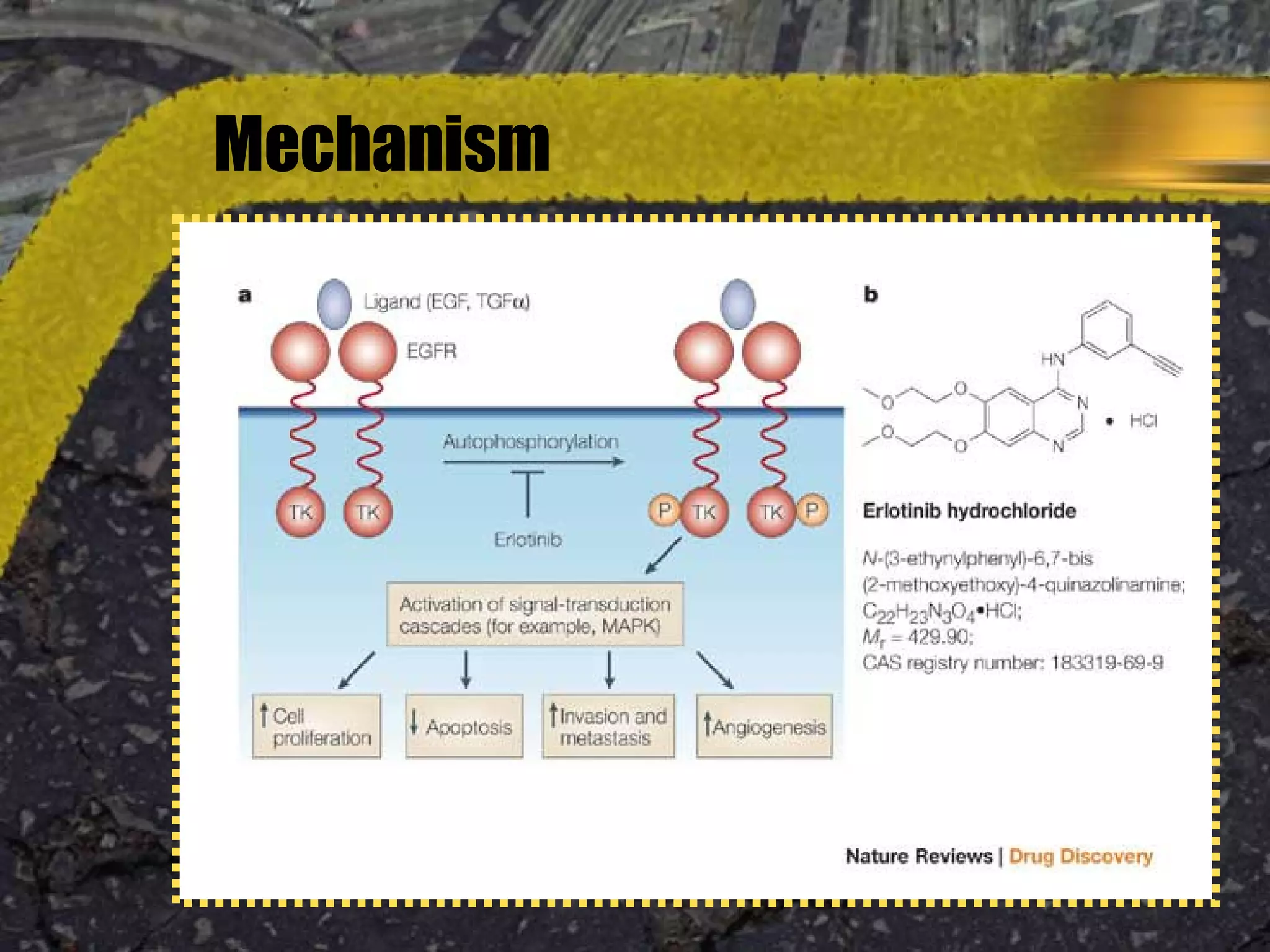
• Inhibits intracellular phosphorylation of
tyrosine kinase associated with EGFR
Introduction
Introduction
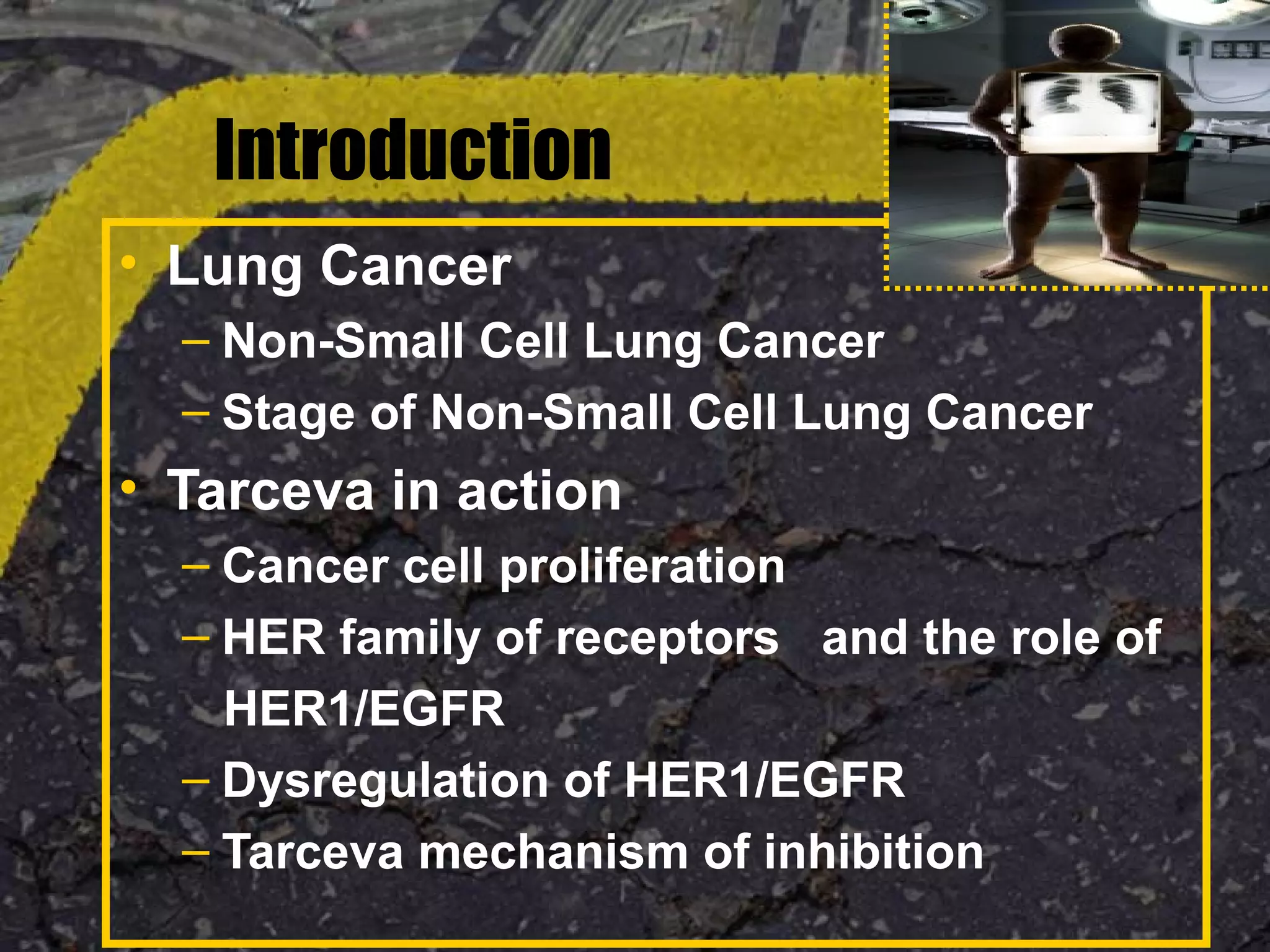
• Lung Cancer
– Non-Small Cell Lung Cancer
– Stage of Non-Small Cell Lung Cancer
• Tarceva in action
– Cancer cell proliferation
– HER family of receptors and the role of
HER1/EGFR
– Dysregulation of HER1/EGFR
– Tarceva mechanism of inhibition
Introduction
Lung Cancer
• Two general types of lung cancer
exist:
– Non-small cell lung cancer (NSCLC)
– Small cell lung cancer
• The most common type
of lung cancer is NSCLC.
Approximately 147,000
new cases of NSCLC were
reported in the United States in 2004.
Introduction
Main types of NSCLC
• There are three main
types of NSCLC:
– Adenocarcinoma
(including
bronchioloalveolar
carcinoma)
– Squamous cell
carcinoma
– Large cell
undifferentiated
carcinoma
Introduction
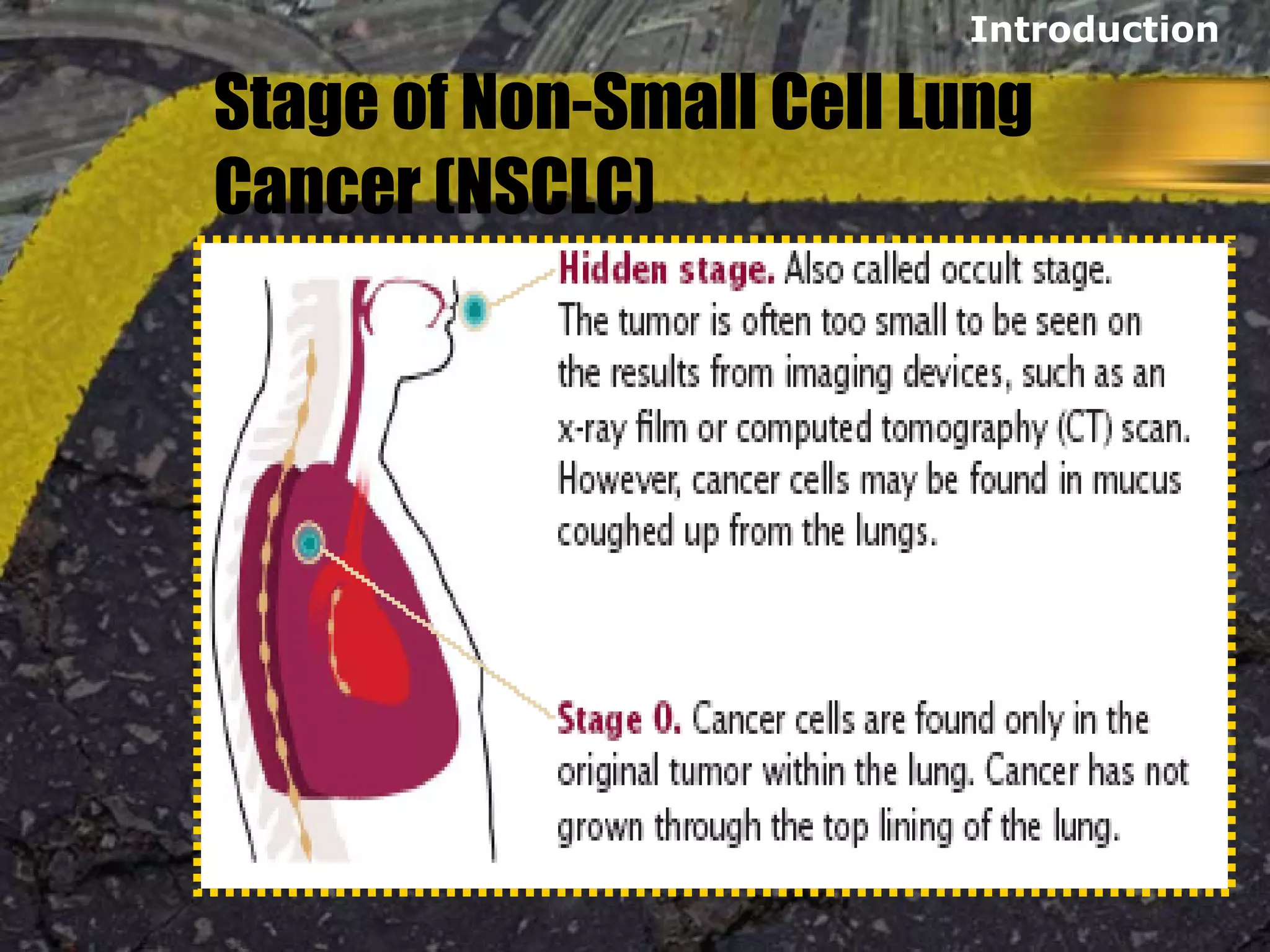
Stage of Non-Small Cell Lung
Cancer (NSCLC)
Introduction
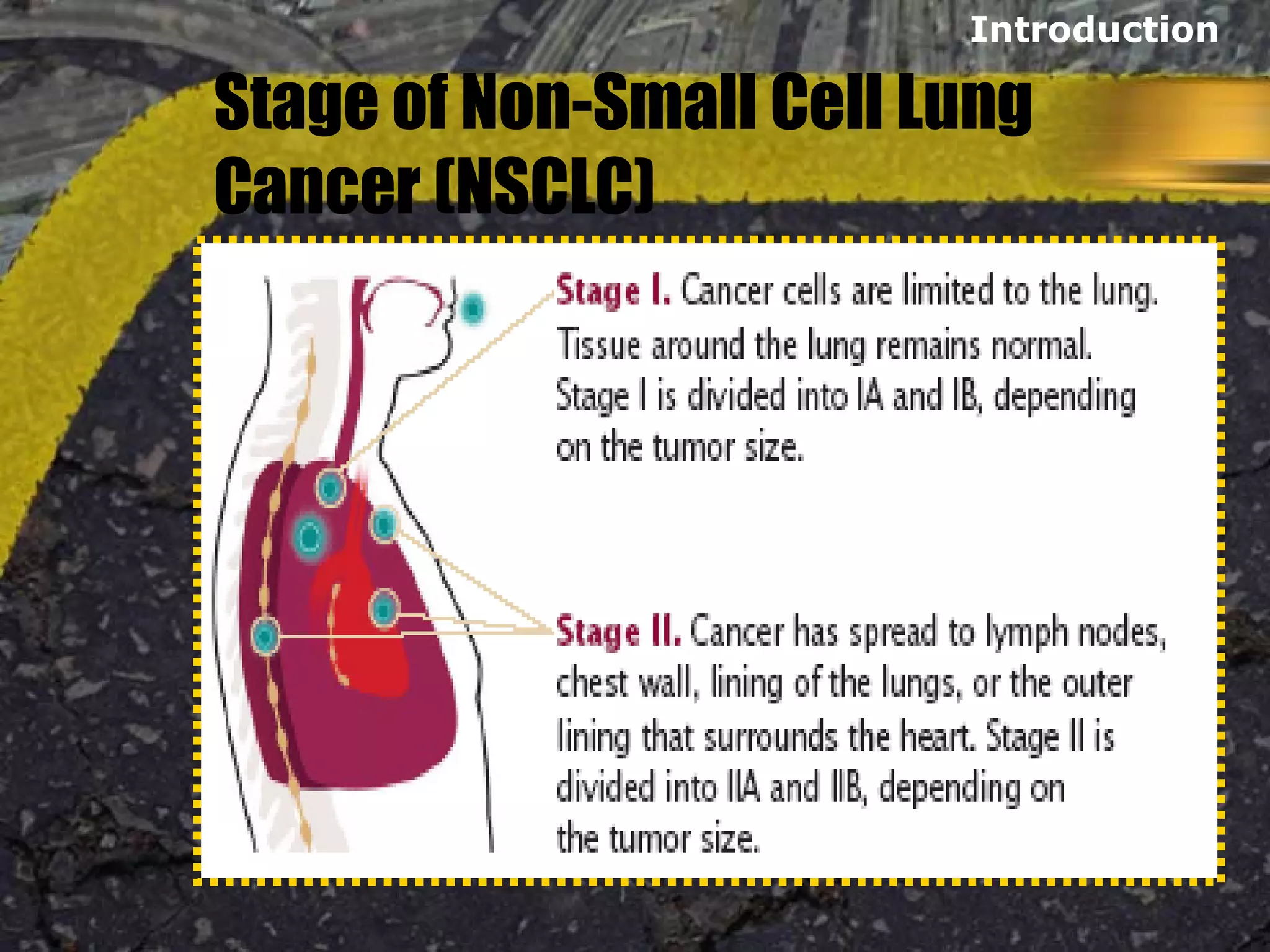
Stage of Non-Small Cell Lung
Cancer (NSCLC)
Introduction
Tarceva in action
• Cancer cell proliferation
• The Human Epidermal Receptor
(HER) family of receptors
and the role of HER1/Epidermal
Growth Factor Receptor (EGFR)
• Dysregulation of HER1/EGFR
• Tarceva mechanism of inhibition
Introduction
Cancer cell proliferationCancer cell proliferation
Introduction
HER family of receptorsHER family of receptors
Introduction
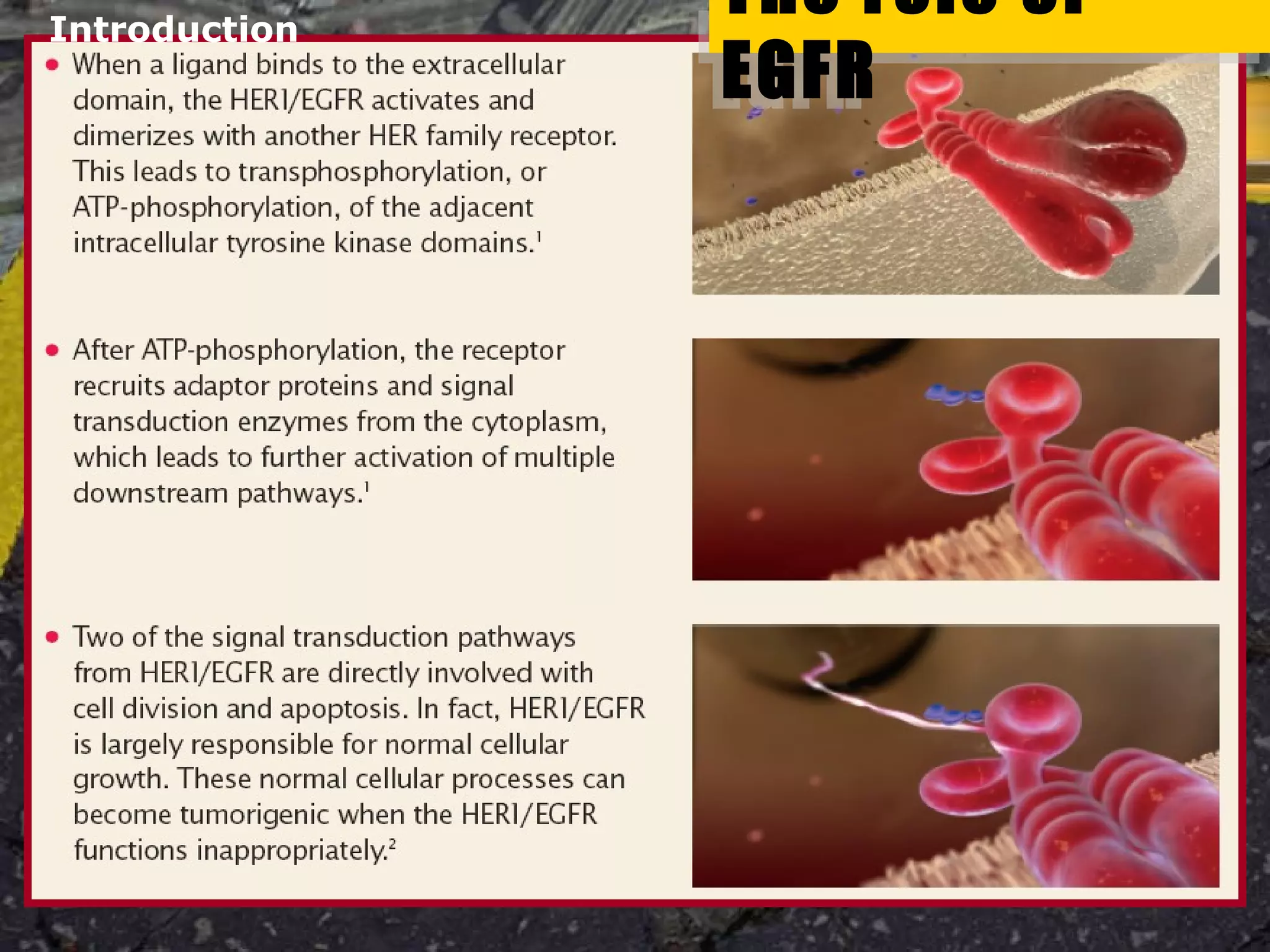
The role of EGFR
The role of
EGFR
The role of
EGFR
Introduction
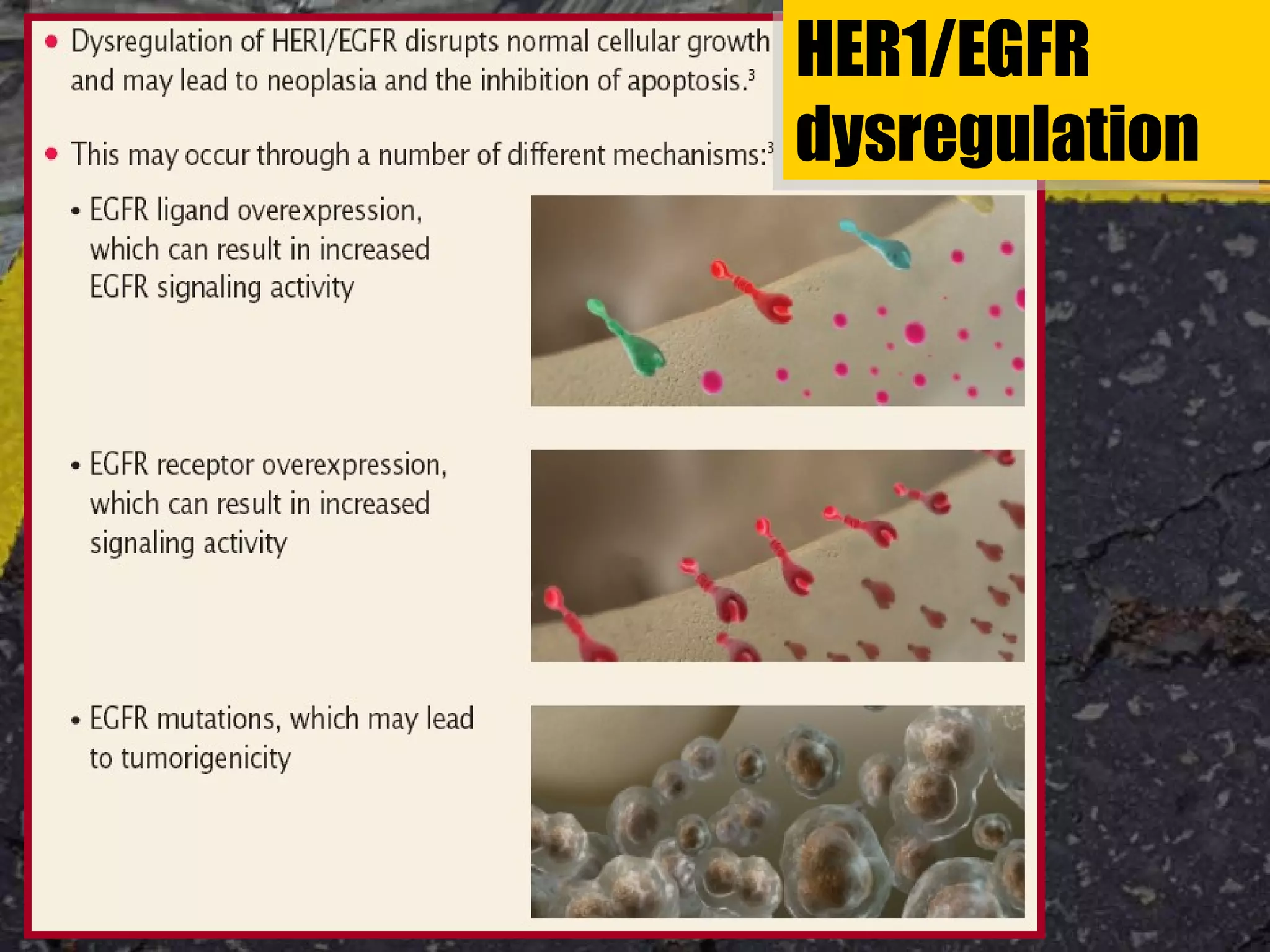
HER1/EGFR
dysregulation
HER1/EGFR
dysregulation
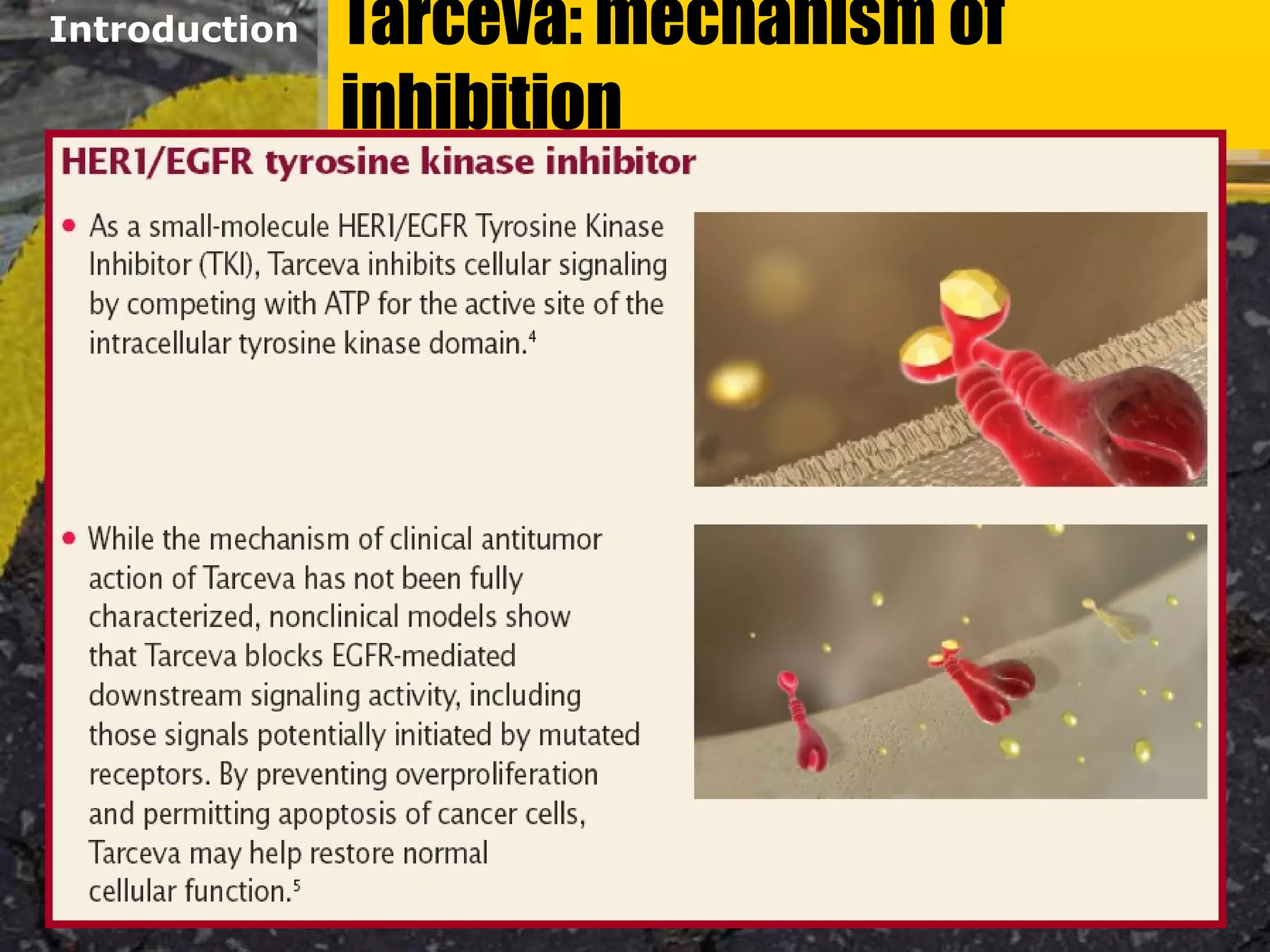
Tarceva: mechanism of
inhibition
Tarceva: mechanism of
inhibition
Introduction
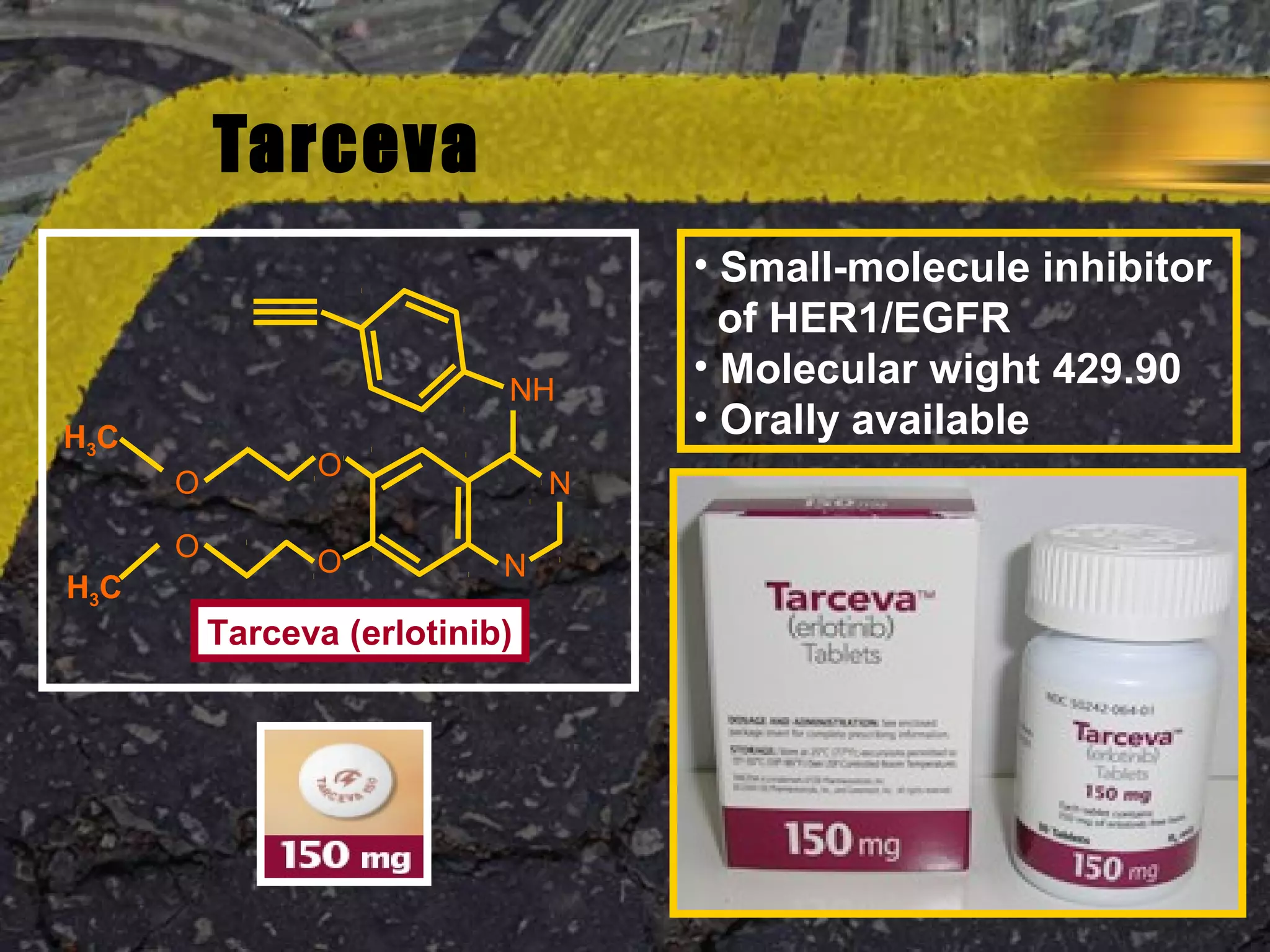
Tarceva
O
O
H3C
H3C
O
O
NH
N
N
Tarceva (erlotinib)
• Small-molecule inhibitor
of HER1/EGFR
• Molecular wight 429.90
• Orally available
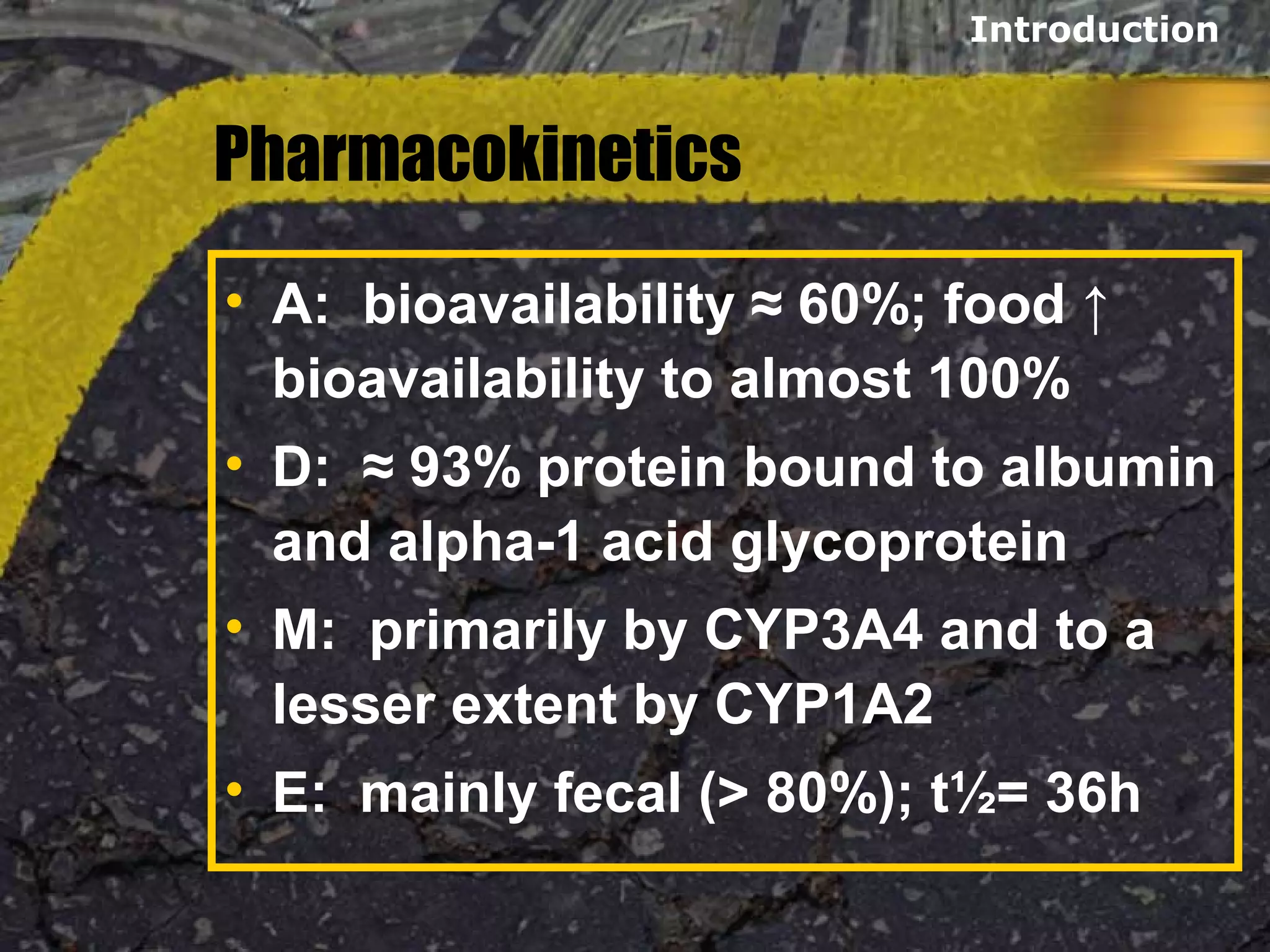
Pharmacokinetics
• A: bioavailability ≈ 60%; food ↑
bioavailability to almost 100%
• D: ≈ 93% protein bound to albumin
and alpha-1 acid glycoprotein
• M: primarily by CYP3A4 and to a
lesser extent by CYP1A2
• E: mainly fecal (> 80%); t½= 36h
Introduction
Drug Interactions
• CYP3A4 inhibitors expected to
increase exposure to erlotinib:
ketoconazole increased AUC by
67%
• CYP3A4 inducers expected to
decrease exposure to erlotinib:
rifampicin increased clearance by
3-fold and reduced AUC by 67%
Adverse Effects
• Common adverse effects
– Rash (75) [17]
– Diarrhea (54) [18]
– Anorexia (52) [38]
– Dyspnea (41) [35]
– Infection (24) [15]
– Stomatitis (17) [3]
– Pruritus (13) [5]
*(treatment) [placebo]
Monitoring
• Monitor for acute onset of new or
progressive pulmonary symptoms
such as dyspnea, cough, or fever
• If interstitial lung disease is
diagnosed, discontinue erlotinib
• Consider dose adjustment with
severe LFT changes (AST,ALT, Bili,
Alk Phos)
Prescription Information
• Standard dose is 150 mg po daily
taken at least one hour before or
two hours after the ingestion of
food
• Cost: #30 150 mg tablets $2125.02
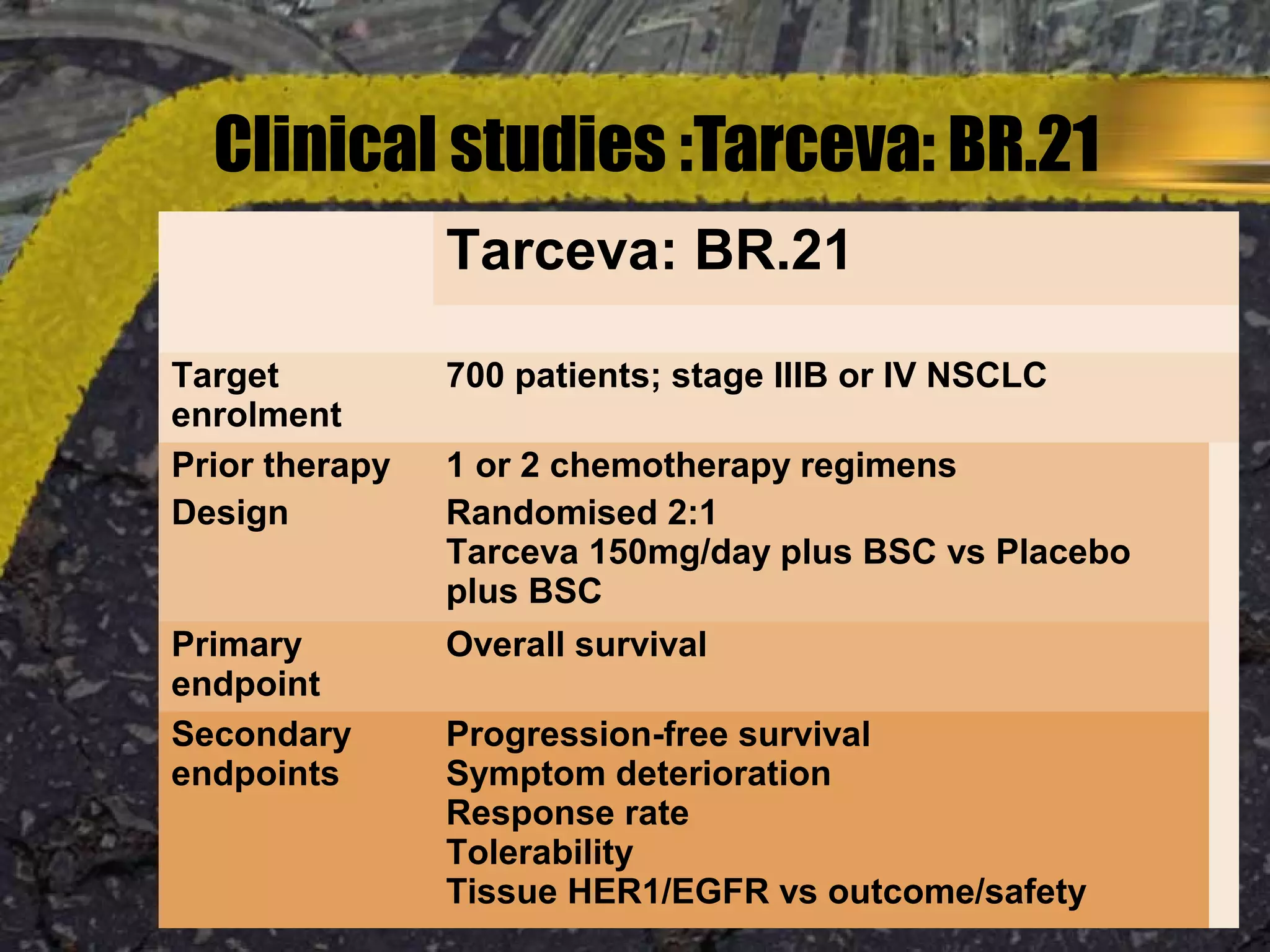
Clinical studies :Tarceva: BR.21
Tarceva: BR.21
Target
enrolment
700 patients; stage IIIB or IV NSCLC
Prior therapy 1 or 2 chemotherapy regimens
Design Randomised 2:1
Tarceva 150mg/day plus BSC vs Placebo
plus BSC
Primary
endpoint
Overall survival
Secondary
endpoints
Progression-free survival
Symptom deterioration
Response rate
Tolerability
Tissue HER1/EGFR vs outcome/safety
BR.21 Progression Free Survival
Percentage
0
20
40
60
80
100
0.0
488
243
5.0
153
34
10.0
52
6
15.0
8
1
Months
___ Erlotinib: 2.2 m
___ Placebo: 1.8 m
*HR 0.61, p
<0.0001
BR.21 Overall Survival
Percentage
0
20
40
60
80
100
0.0
488
243
10.0
188
59
20.0
12
4
___ Erlotinib: 6.7 m
___ Placebo: 4.7 m
*HR 0.71, p
<0.0001
Months
BR.21 Survival by Smoking
History
Percentage
0
20
40
60
80
100
0.0
358
187
10.0
116
46
20.0
7
3
_____ Erlotinib Never Smoked
_____ Erlotinib Current/past Smoker
_____ Placebo Never Smoked
_____ Placebo Current/past smoker
Months
Selected BR.21 Adverse Events
76
17
55
19
40
34
19
3
0
10
20
30
40
50
60
70
80
AllGrades,%
Rash Diarrhea Nausea Stomatitis
erlotinib
placebo
Prolonged Time to Deterioration of QoL
Symptoms
Percentage
0
20
40
60
80
100
Time (months)
# At Risk(OSI-774)
# At Risk(Placebo)
0.0
298
153
5.0
59
20
10.0
20
6
15.0
6
0
20.0
0
0
Percentage
0
20
40
60
80
100
Time(months)
#AtRisk(OSI-774)
0.0
348
179
5.0
65
16
10.0
26
5
15.0
3
0
SUMMARYSTATISTICS:
Log-Ranktestforequalityofgroups: p=0.0098
OSI-774 PlaceboPercentage
0
20
40
60
80
100
Time(months)
#AtRisk(OSI-774)
#AtRisk(Placebo)
0.0
353
179
5.0
78
20
10.0
28
5
15.0
5
0
___ Erlotinib
___ Placebo
Cough : p=0.04
Dyspnea : p=0.01
Pain : p=0.02
BR.21 Summary
• In patients who have failed standard
chemotherapy for NSCLC, erlotinib
significantly improves
– Response rates and progression free
survival
– Overall survival
– Disease related QoL and overall QoL
• Prolongation of survival was seen in
most subsets of patients
Summary
• Tarceva™, erlotinib, is a Human Epidermal
Growth Receptor Type 1/ Epidermal growth
Factor Receptor (HER1/EGFR) tyrosine
kinase inhibitor.
• Tarceva™ is indicated for the treatment of
patients with locally advanced or metastatic
nonsmall cell lung cancer (NSCLC) after
failure of at least one prior chemotherapy
regimen.
Summary
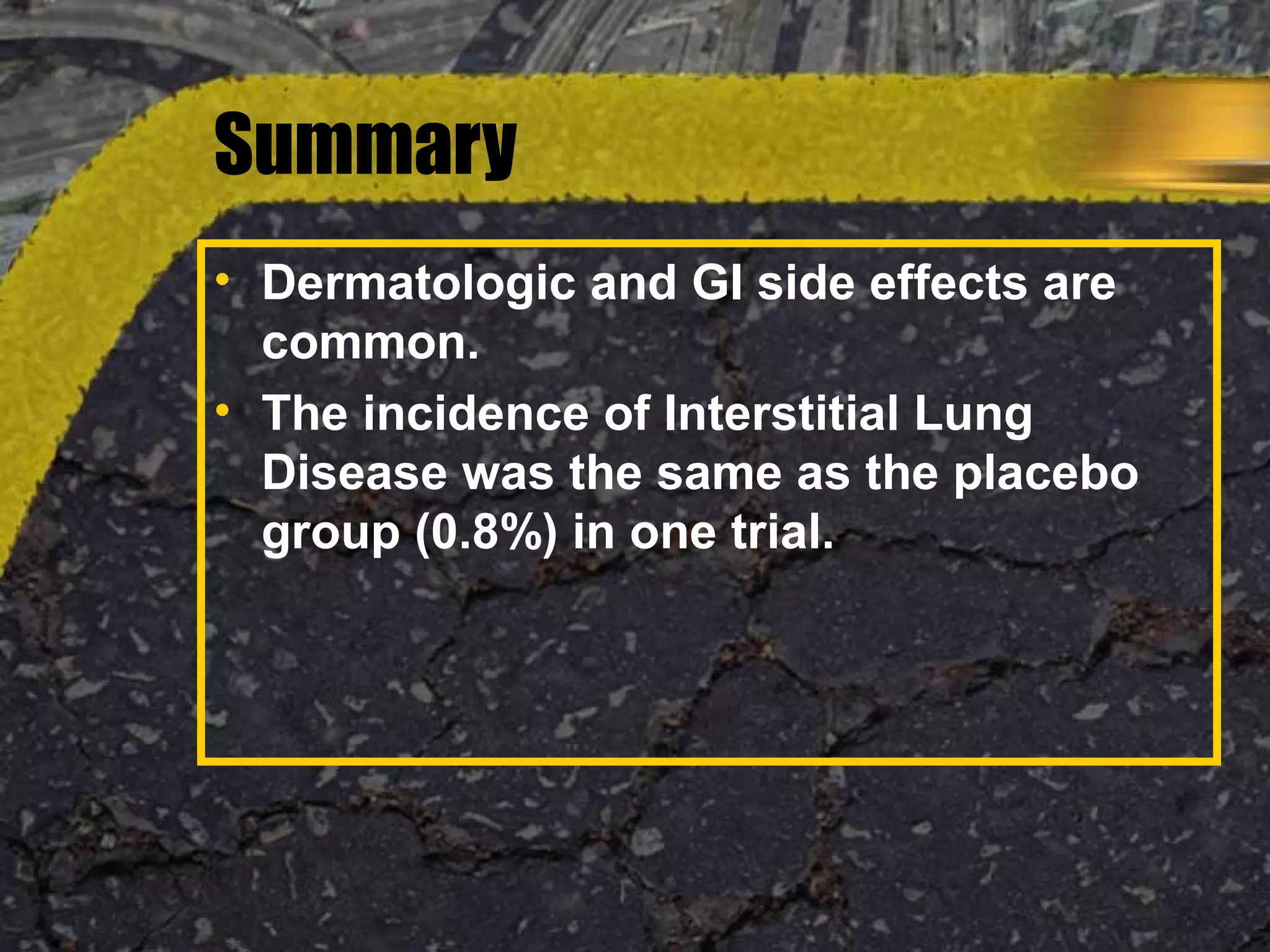
• Dermatologic and GI side effects are
common.
• The incidence of Interstitial Lung
Disease was the same as the placebo
group (0.8%) in one trial.
References
1. http://www.tarceva,com. Accessed on
2/27/05
2. Tarceva™ package insert. Genentech. 2004
Downloaded from www.tarceva.com 2/27/05
3. http://www.drugstore.com. Accessed on
3/6/05
Common Approaches to Targeting
HER1/EGFR
Introduction
Anti-HER1/EGFR-
blocking antibodies
Anti-ligand-
blocking
antibodies
TK
inhibitors
Ligand–
toxin
conjugates
Antibody–
toxin
conjugates
Mechanism

Tarceva ( erlotinib )

  • 1.
  • 2.
    Tarceva • Generic name:Erlotinib • Brand name: Tarceva® • FDA Approval Date: November 18, 2004
  • 3.
    Tarceva • Indicated for:the treatment of locally advanced or metastatic non-small cell lung cancer that has failed prior chemotherapy • Human Epidermal Growth Factor Receptor Type 1/Epidermal Growth Factor Receptor (HER1/EGFR) tyrosine kinase inhibitor • Inhibits intracellular phosphorylation of tyrosine kinase associated with EGFR Introduction
  • 4.
    Introduction • Lung Cancer –Non-Small Cell Lung Cancer – Stage of Non-Small Cell Lung Cancer • Tarceva in action – Cancer cell proliferation – HER family of receptors and the role of HER1/EGFR – Dysregulation of HER1/EGFR – Tarceva mechanism of inhibition Introduction
  • 5.
    Lung Cancer • Twogeneral types of lung cancer exist: – Non-small cell lung cancer (NSCLC) – Small cell lung cancer • The most common type of lung cancer is NSCLC. Approximately 147,000 new cases of NSCLC were reported in the United States in 2004. Introduction
  • 6.
    Main types ofNSCLC • There are three main types of NSCLC: – Adenocarcinoma (including bronchioloalveolar carcinoma) – Squamous cell carcinoma – Large cell undifferentiated carcinoma Introduction
  • 7.
    Stage of Non-SmallCell Lung Cancer (NSCLC) Introduction
  • 8.
    Stage of Non-SmallCell Lung Cancer (NSCLC) Introduction
  • 9.
    Tarceva in action •Cancer cell proliferation • The Human Epidermal Receptor (HER) family of receptors and the role of HER1/Epidermal Growth Factor Receptor (EGFR) • Dysregulation of HER1/EGFR • Tarceva mechanism of inhibition Introduction
  • 10.
    Cancer cell proliferationCancercell proliferation Introduction
  • 11.
    HER family ofreceptorsHER family of receptors Introduction
  • 12.
    The role ofEGFR The role of EGFR The role of EGFR Introduction
  • 13.
  • 14.
    Tarceva: mechanism of inhibition Tarceva:mechanism of inhibition Introduction
  • 16.
    Tarceva O O H3C H3C O O NH N N Tarceva (erlotinib) • Small-moleculeinhibitor of HER1/EGFR • Molecular wight 429.90 • Orally available
  • 17.
    Pharmacokinetics • A: bioavailability≈ 60%; food ↑ bioavailability to almost 100% • D: ≈ 93% protein bound to albumin and alpha-1 acid glycoprotein • M: primarily by CYP3A4 and to a lesser extent by CYP1A2 • E: mainly fecal (> 80%); t½= 36h Introduction
  • 18.
    Drug Interactions • CYP3A4inhibitors expected to increase exposure to erlotinib: ketoconazole increased AUC by 67% • CYP3A4 inducers expected to decrease exposure to erlotinib: rifampicin increased clearance by 3-fold and reduced AUC by 67%
  • 19.
    Adverse Effects • Commonadverse effects – Rash (75) [17] – Diarrhea (54) [18] – Anorexia (52) [38] – Dyspnea (41) [35] – Infection (24) [15] – Stomatitis (17) [3] – Pruritus (13) [5] *(treatment) [placebo]
  • 20.
    Monitoring • Monitor foracute onset of new or progressive pulmonary symptoms such as dyspnea, cough, or fever • If interstitial lung disease is diagnosed, discontinue erlotinib • Consider dose adjustment with severe LFT changes (AST,ALT, Bili, Alk Phos)
  • 21.
    Prescription Information • Standarddose is 150 mg po daily taken at least one hour before or two hours after the ingestion of food • Cost: #30 150 mg tablets $2125.02
  • 22.
    Clinical studies :Tarceva:BR.21 Tarceva: BR.21 Target enrolment 700 patients; stage IIIB or IV NSCLC Prior therapy 1 or 2 chemotherapy regimens Design Randomised 2:1 Tarceva 150mg/day plus BSC vs Placebo plus BSC Primary endpoint Overall survival Secondary endpoints Progression-free survival Symptom deterioration Response rate Tolerability Tissue HER1/EGFR vs outcome/safety
  • 23.
    BR.21 Progression FreeSurvival Percentage 0 20 40 60 80 100 0.0 488 243 5.0 153 34 10.0 52 6 15.0 8 1 Months ___ Erlotinib: 2.2 m ___ Placebo: 1.8 m *HR 0.61, p <0.0001
  • 24.
    BR.21 Overall Survival Percentage 0 20 40 60 80 100 0.0 488 243 10.0 188 59 20.0 12 4 ___Erlotinib: 6.7 m ___ Placebo: 4.7 m *HR 0.71, p <0.0001 Months
  • 25.
    BR.21 Survival bySmoking History Percentage 0 20 40 60 80 100 0.0 358 187 10.0 116 46 20.0 7 3 _____ Erlotinib Never Smoked _____ Erlotinib Current/past Smoker _____ Placebo Never Smoked _____ Placebo Current/past smoker Months
  • 26.
    Selected BR.21 AdverseEvents 76 17 55 19 40 34 19 3 0 10 20 30 40 50 60 70 80 AllGrades,% Rash Diarrhea Nausea Stomatitis erlotinib placebo
  • 27.
    Prolonged Time toDeterioration of QoL Symptoms Percentage 0 20 40 60 80 100 Time (months) # At Risk(OSI-774) # At Risk(Placebo) 0.0 298 153 5.0 59 20 10.0 20 6 15.0 6 0 20.0 0 0 Percentage 0 20 40 60 80 100 Time(months) #AtRisk(OSI-774) 0.0 348 179 5.0 65 16 10.0 26 5 15.0 3 0 SUMMARYSTATISTICS: Log-Ranktestforequalityofgroups: p=0.0098 OSI-774 PlaceboPercentage 0 20 40 60 80 100 Time(months) #AtRisk(OSI-774) #AtRisk(Placebo) 0.0 353 179 5.0 78 20 10.0 28 5 15.0 5 0 ___ Erlotinib ___ Placebo Cough : p=0.04 Dyspnea : p=0.01 Pain : p=0.02
  • 28.
    BR.21 Summary • Inpatients who have failed standard chemotherapy for NSCLC, erlotinib significantly improves – Response rates and progression free survival – Overall survival – Disease related QoL and overall QoL • Prolongation of survival was seen in most subsets of patients
  • 29.
    Summary • Tarceva™, erlotinib,is a Human Epidermal Growth Receptor Type 1/ Epidermal growth Factor Receptor (HER1/EGFR) tyrosine kinase inhibitor. • Tarceva™ is indicated for the treatment of patients with locally advanced or metastatic nonsmall cell lung cancer (NSCLC) after failure of at least one prior chemotherapy regimen.
  • 30.
    Summary • Dermatologic andGI side effects are common. • The incidence of Interstitial Lung Disease was the same as the placebo group (0.8%) in one trial.
  • 31.
    References 1. http://www.tarceva,com. Accessedon 2/27/05 2. Tarceva™ package insert. Genentech. 2004 Downloaded from www.tarceva.com 2/27/05 3. http://www.drugstore.com. Accessed on 3/6/05
  • 32.
    Common Approaches toTargeting HER1/EGFR Introduction Anti-HER1/EGFR- blocking antibodies Anti-ligand- blocking antibodies TK inhibitors Ligand– toxin conjugates Antibody– toxin conjugates
  • 34.