Sleep disorders
Anatomy:
Sleep and wakefulness is a tightly regulated process. Reciprocal connections in
the brain produce consolidated periods of wakefulness and sleep that are
entrained by environmental light to occur at specific times of the 24-hour cycle.
Promotionof wakefulness
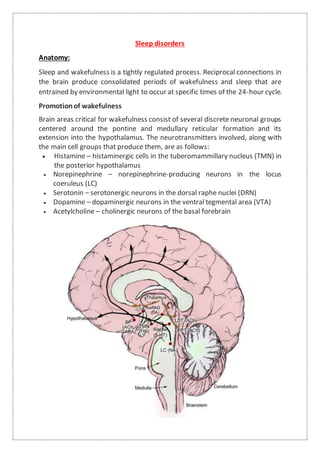
Brain areas critical for wakefulness consist of several discrete neuronal groups
centered around the pontine and medullary reticular formation and its
extension into the hypothalamus. The neurotransmitters involved, along with
the main cell groups that produce them, are as follows:
 Histamine – histaminergic cells in the tuberomammillary nucleus (TMN) in
the posterior hypothalamus
 Norepinephrine – norepinephrine-producing neurons in the locus
coeruleus (LC)
 Serotonin – serotonergic neurons in the dorsal raphe nuclei (DRN)
 Dopamine – dopaminergic neurons in the ventral tegmental area (VTA)
 Acetylcholine – cholinergic neurons of the basal forebrain
Each region and neurotransmitter contributes to the promotion of wakefulness,
but chronic lesions of any one system do not disruptwakefulness. This suggests
a redundant system, wherein the absence of one neurotransmitter may be
compensated by the other systems.
Promotionof sleep
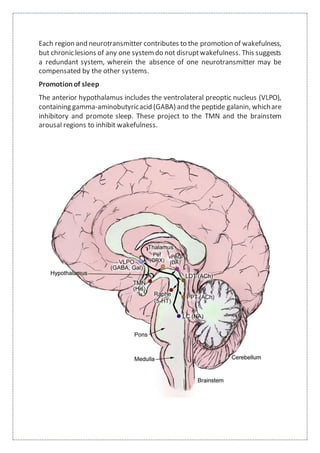
The anterior hypothalamus includes the ventrolateral preoptic nucleus (VLPO),
containing gamma-aminobutyricacid (GABA) and the peptide galanin, whichare
inhibitory and promote sleep. These project to the TMN and the brainstem
arousal regions to inhibit wakefulness.
Melatoninandthe circadianprocess
The suprachiasmatic nucleus (SCN) is entrained to the external environment by
the cycle of light and darkness. The retinal ganglion cells transmit light signals
via the retinohypothalamic tract to stimulate the SCN. A multisynaptic pathway
from the SCN projects to the pineal gland, which produces melatonin.
Melatonin synthesis is inhibited by light and stimulated by darkness. The
nocturnal rise in melatonin begins between 8 and 10 pm and peaks between 2
and 4 am, then declines graduallyoverthe morning.Melatonin acts via 2 specific
melatonin receptors: MT1 attenuates the alerting signal, and MT2 phase shifts
the SCNclock. The novelsleep-promotingdrug ramelteon acts specifically at the
MT1 and MT2 receptors to promote sleep but is structurally unrelated to
melatonin. It has a relatively a short half- life (2.6 hours)
Neurochemistry of sleep:
 NREM sleep appears to be controlled by the basal forebrain, the area
surroundingthesolitarytractin themedulla and the dorsalraphenucleus,
which is primarily serotonergic.
 Sleep is reduced when there are decreases in serotonin or destruction of
the dorsal raphe nucleus in the brainstem, which contains most of the
brain’s serotonergic bodies.
 REM sleep appears to be turned on by cholinergic cells in the
mesencephalic, medullary, and pontine gigantocellular regions.
 REM sleep appearsto be turned off by the dorsalraphenucleus, the locus
coeruleus,and the nucleus parabrachialislateralis, the latter two of which
are primarily noradrenergic.
 The ascendingreticular activating systemand the posterior hypothalamus
facilitate arousal and wakefulness.
 Dopamine has an alerting effect; decreases in dopamine promote
sleepiness.
 Neurochemicals involved in wakefulness include norepinephrine and
acetylcholine in the cortex and histamine and neuropeptides such as
substance P and corticotropin-releasing factor in the hypothalamus.
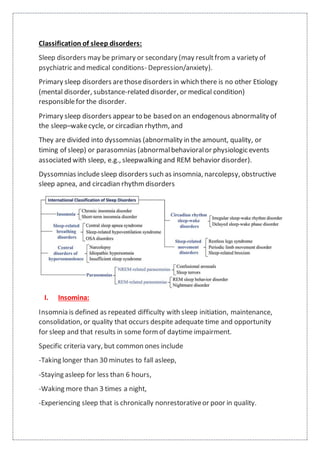
Classification of sleep disorders:
Sleep disorders may be primary or secondary (may resultfrom a variety of
psychiatric and medical conditions- Depression/anxiety).
Primary sleep disorders arethosedisorders in which there is no other Etiology
(mental disorder, substance-related disorder, or medical condition)
responsiblefor the disorder.
Primary sleep disorders appear to be based on an endogenous abnormality of
the sleep–wakecycle, or circadian rhythm, and
They are divided into dyssomnias (abnormality in the amount, quality, or
timing of sleep) or parasomnias (abnormalbehavioralor physiologic events
associated with sleep, e.g., sleepwalking and REM behavior disorder).
Dyssomnias includesleep disorders such as insomnia, narcolepsy, obstructive
sleep apnea, and circadian rhythm disorders
I. Insomina:
Insomnia is defined as repeated difficulty with sleep initiation, maintenance,
consolidation, or quality that occurs despite adequate time and opportunity
for sleep and that results in some form of daytime impairment.
Specific criteria vary, but common ones include
-Taking longer than 30 minutes to fall asleep,
-Staying asleep for less than 6 hours,
-Waking more than 3 times a night,
-Experiencing sleep that is chronically nonrestorativeor poor in quality.
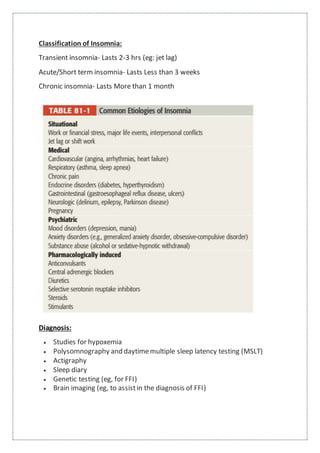
Classification of Insomnia:
Transient insomnia- Lasts 2-3 hrs (eg: jet lag)
Acute/Short term insomnia- Lasts Less than 3 weeks
Chronic insomnia- Lasts More than 1 month
Diagnosis:
 Studies for hypoxemia
 Polysomnography and daytimemultiple sleep latency testing (MSLT)
 Actigraphy
 Sleep diary
 Genetic testing (eg, for FFI)
 Brain imaging (eg, to assist in the diagnosis of FFI)
Treatment:
General approach totreatment:
Management of all patients with insomnia should include identifying the cause
of the insomnia, patient education on sleep hygiene, and stress management.
Transient insomnia, which occurs as a result of an acute stressor, is expected
to resolve quickly and should be treated with good sleep hygiene and careful
use of sedative-hypnotics.
Short-terminsomnia, associated with situational, personal, or medical stress
can be treated similarly.
Chronic insomnia requires carefulassessmentfor possibleunderlying medical
causes, nonpharmacologic techniques, and careful useof sedative-hypnotics.
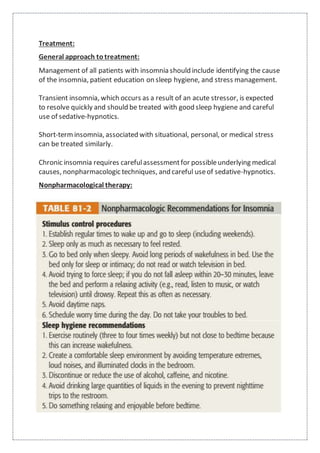
Nonpharmacological therapy:
Pharmacological therapy:
1.Benzodiazepines
Miscellaneous
2.Antihistamines- Diphenhydramine, Doxylamine, Hydroxyzine
3.Sedating Antidepressants-Trazodone(25-100mg),Amitriptyline, Doxepin,
Nortriptyline, Mirtazapine
4.Ramelteon
5.Valerian
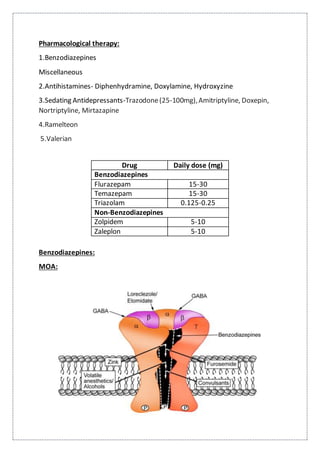
Benzodiazepines:
MOA:
Drug Daily dose (mg)
Benzodiazepines
Flurazepam 15-30
Temazepam 15-30
Triazolam 0.125-0.25
Non-Benzodiazepines
Zolpidem 5-10
Zaleplon 5-10
Benzodiazepines exhibit their action by targeting the GABAA receptor, present
mainly on the postsynaptic membrane. They selectively bind with high affinity
at specific sites located at the interface of α and γ subunitsof GABAA receptors
in such a way that the binding of GABA to GABAA receptor is facilitated. This
results in the opening of chloride channels linked to GABAA receptors which in
turn causes hyperpolarisation and reduction in membrane excitability.
They also cause a reduction in the turnover of 5-HT and noradrenaline.
At higher doses they also block Na+ channels and thus reduce the electrical
excitability of cell membrane (useful in Status epilepticus).
ADRs:
Common- dizziness, drowsiness, ataxia, vertigo, anterograde amnesia,
impairment of psychomotor activities
Hangover effects- weakness, blurring of vision
Paradoxical reactions
Contraindications:
-In pregnant women
-Patient with narrow angle glaucoma
-Pre-existing respiratory depression or coma
-Severe hepatic impairment
Non-Benzodiazepines:
MOA:
Though structurally dissimilar from benzodiazepines, these drugs possess high
affinity for a1 subunitof the GABAA receptors (ω-receptor). Hence these agents
exert GABA facilitatory action and also reduce the amount of GABA require to
elicit an inhibitory response.
Drug ADRs
Zolpidem Retrograde amnesia, hallucinations, delusions, ataxia,
Impaired motor activity
Zaleplon -

Insomnia

  • 1.
    Sleep disorders Anatomy: Sleep andwakefulness is a tightly regulated process. Reciprocal connections in the brain produce consolidated periods of wakefulness and sleep that are entrained by environmental light to occur at specific times of the 24-hour cycle. Promotionof wakefulness Brain areas critical for wakefulness consist of several discrete neuronal groups centered around the pontine and medullary reticular formation and its extension into the hypothalamus. The neurotransmitters involved, along with the main cell groups that produce them, are as follows:  Histamine – histaminergic cells in the tuberomammillary nucleus (TMN) in the posterior hypothalamus  Norepinephrine – norepinephrine-producing neurons in the locus coeruleus (LC)  Serotonin – serotonergic neurons in the dorsal raphe nuclei (DRN)  Dopamine – dopaminergic neurons in the ventral tegmental area (VTA)  Acetylcholine – cholinergic neurons of the basal forebrain
  • 2.
    Each region andneurotransmitter contributes to the promotion of wakefulness, but chronic lesions of any one system do not disruptwakefulness. This suggests a redundant system, wherein the absence of one neurotransmitter may be compensated by the other systems. Promotionof sleep The anterior hypothalamus includes the ventrolateral preoptic nucleus (VLPO), containing gamma-aminobutyricacid (GABA) and the peptide galanin, whichare inhibitory and promote sleep. These project to the TMN and the brainstem arousal regions to inhibit wakefulness.
  • 3.
    Melatoninandthe circadianprocess The suprachiasmaticnucleus (SCN) is entrained to the external environment by the cycle of light and darkness. The retinal ganglion cells transmit light signals via the retinohypothalamic tract to stimulate the SCN. A multisynaptic pathway from the SCN projects to the pineal gland, which produces melatonin. Melatonin synthesis is inhibited by light and stimulated by darkness. The nocturnal rise in melatonin begins between 8 and 10 pm and peaks between 2 and 4 am, then declines graduallyoverthe morning.Melatonin acts via 2 specific melatonin receptors: MT1 attenuates the alerting signal, and MT2 phase shifts the SCNclock. The novelsleep-promotingdrug ramelteon acts specifically at the MT1 and MT2 receptors to promote sleep but is structurally unrelated to melatonin. It has a relatively a short half- life (2.6 hours) Neurochemistry of sleep:  NREM sleep appears to be controlled by the basal forebrain, the area surroundingthesolitarytractin themedulla and the dorsalraphenucleus, which is primarily serotonergic.  Sleep is reduced when there are decreases in serotonin or destruction of the dorsal raphe nucleus in the brainstem, which contains most of the brain’s serotonergic bodies.  REM sleep appears to be turned on by cholinergic cells in the mesencephalic, medullary, and pontine gigantocellular regions.  REM sleep appearsto be turned off by the dorsalraphenucleus, the locus coeruleus,and the nucleus parabrachialislateralis, the latter two of which are primarily noradrenergic.  The ascendingreticular activating systemand the posterior hypothalamus facilitate arousal and wakefulness.  Dopamine has an alerting effect; decreases in dopamine promote sleepiness.  Neurochemicals involved in wakefulness include norepinephrine and acetylcholine in the cortex and histamine and neuropeptides such as substance P and corticotropin-releasing factor in the hypothalamus.
  • 4.
    Classification of sleepdisorders: Sleep disorders may be primary or secondary (may resultfrom a variety of psychiatric and medical conditions- Depression/anxiety). Primary sleep disorders arethosedisorders in which there is no other Etiology (mental disorder, substance-related disorder, or medical condition) responsiblefor the disorder. Primary sleep disorders appear to be based on an endogenous abnormality of the sleep–wakecycle, or circadian rhythm, and They are divided into dyssomnias (abnormality in the amount, quality, or timing of sleep) or parasomnias (abnormalbehavioralor physiologic events associated with sleep, e.g., sleepwalking and REM behavior disorder). Dyssomnias includesleep disorders such as insomnia, narcolepsy, obstructive sleep apnea, and circadian rhythm disorders I. Insomina: Insomnia is defined as repeated difficulty with sleep initiation, maintenance, consolidation, or quality that occurs despite adequate time and opportunity for sleep and that results in some form of daytime impairment. Specific criteria vary, but common ones include -Taking longer than 30 minutes to fall asleep, -Staying asleep for less than 6 hours, -Waking more than 3 times a night, -Experiencing sleep that is chronically nonrestorativeor poor in quality.
  • 5.
    Classification of Insomnia: Transientinsomnia- Lasts 2-3 hrs (eg: jet lag) Acute/Short term insomnia- Lasts Less than 3 weeks Chronic insomnia- Lasts More than 1 month Diagnosis:  Studies for hypoxemia  Polysomnography and daytimemultiple sleep latency testing (MSLT)  Actigraphy  Sleep diary  Genetic testing (eg, for FFI)  Brain imaging (eg, to assist in the diagnosis of FFI)
  • 6.
    Treatment: General approach totreatment: Managementof all patients with insomnia should include identifying the cause of the insomnia, patient education on sleep hygiene, and stress management. Transient insomnia, which occurs as a result of an acute stressor, is expected to resolve quickly and should be treated with good sleep hygiene and careful use of sedative-hypnotics. Short-terminsomnia, associated with situational, personal, or medical stress can be treated similarly. Chronic insomnia requires carefulassessmentfor possibleunderlying medical causes, nonpharmacologic techniques, and careful useof sedative-hypnotics. Nonpharmacological therapy:
  • 7.
    Pharmacological therapy: 1.Benzodiazepines Miscellaneous 2.Antihistamines- Diphenhydramine,Doxylamine, Hydroxyzine 3.Sedating Antidepressants-Trazodone(25-100mg),Amitriptyline, Doxepin, Nortriptyline, Mirtazapine 4.Ramelteon 5.Valerian Benzodiazepines: MOA: Drug Daily dose (mg) Benzodiazepines Flurazepam 15-30 Temazepam 15-30 Triazolam 0.125-0.25 Non-Benzodiazepines Zolpidem 5-10 Zaleplon 5-10
  • 8.
    Benzodiazepines exhibit theiraction by targeting the GABAA receptor, present mainly on the postsynaptic membrane. They selectively bind with high affinity at specific sites located at the interface of α and γ subunitsof GABAA receptors in such a way that the binding of GABA to GABAA receptor is facilitated. This results in the opening of chloride channels linked to GABAA receptors which in turn causes hyperpolarisation and reduction in membrane excitability. They also cause a reduction in the turnover of 5-HT and noradrenaline. At higher doses they also block Na+ channels and thus reduce the electrical excitability of cell membrane (useful in Status epilepticus). ADRs: Common- dizziness, drowsiness, ataxia, vertigo, anterograde amnesia, impairment of psychomotor activities Hangover effects- weakness, blurring of vision Paradoxical reactions Contraindications: -In pregnant women -Patient with narrow angle glaucoma -Pre-existing respiratory depression or coma -Severe hepatic impairment Non-Benzodiazepines: MOA: Though structurally dissimilar from benzodiazepines, these drugs possess high affinity for a1 subunitof the GABAA receptors (ω-receptor). Hence these agents exert GABA facilitatory action and also reduce the amount of GABA require to elicit an inhibitory response. Drug ADRs Zolpidem Retrograde amnesia, hallucinations, delusions, ataxia, Impaired motor activity Zaleplon -