

Self Care Deficit Theory
Dorothea Orem
Prof. (Dr.) Smriti Arora
Amity College of Nursing
Amity University Haryana
smritiamit@msn.com
Background
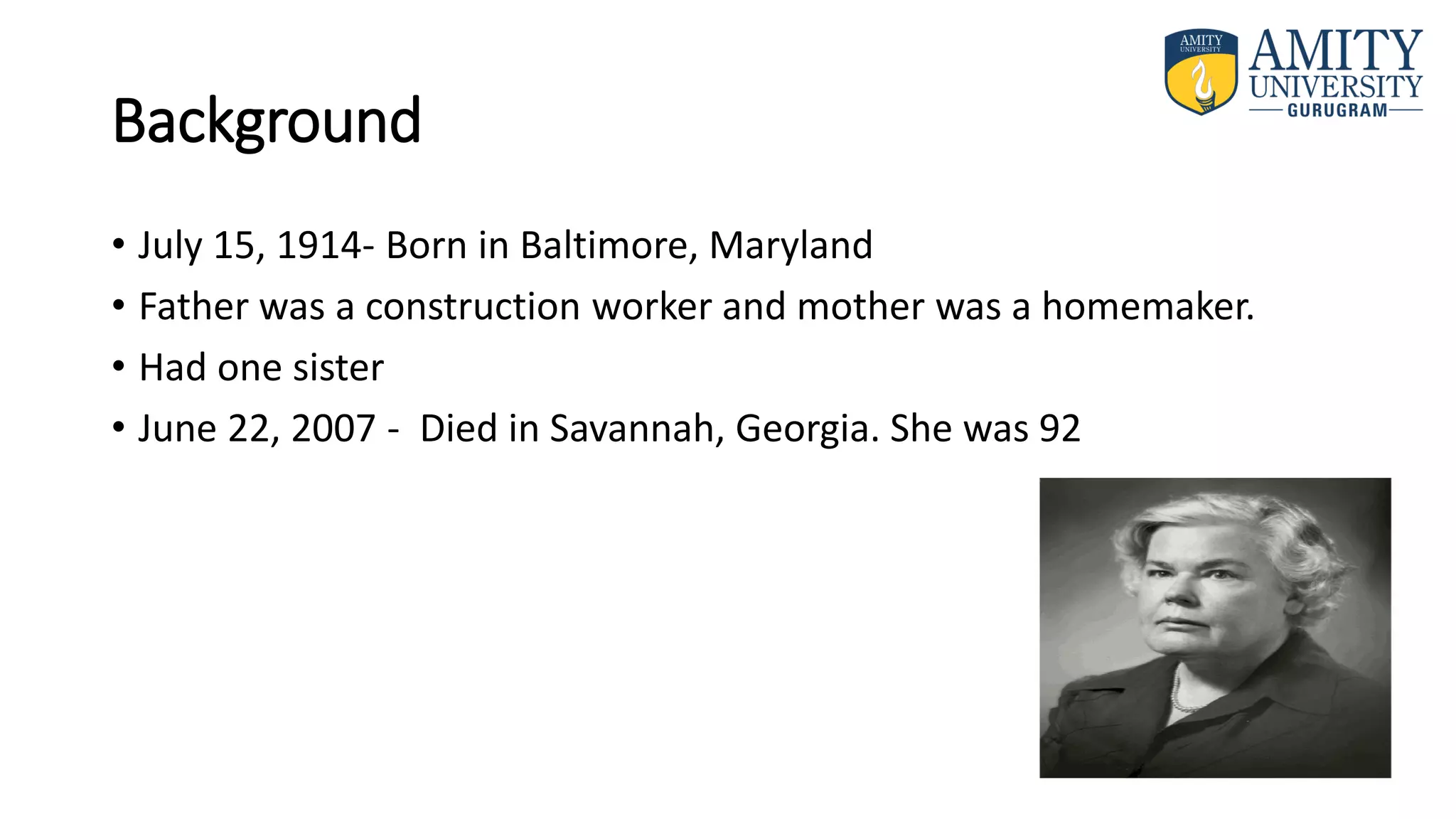
• July 15, 1914- Born in Baltimore, Maryland
• Father was a construction worker and mother was a homemaker.
• Had one sister
• June 22, 2007 - Died in Savannah, Georgia. She was 92
Introduction
• The self-care deficit nursing theory is a grand nursing theory that was
developed between 1959 and 2001 by Dorothea Orem.
• The theory is also referred to as the Orem's Model of Nursing.
• It is particularly used in rehabilitation and primary care settings, where the
patient is encouraged to be as independent as possible.
• She tried to explain the role of nurse by mentioning terms such as nursing
system (wholly compensatory, partly compensatory, supportive and
educative system) and nursing agency (abilities).
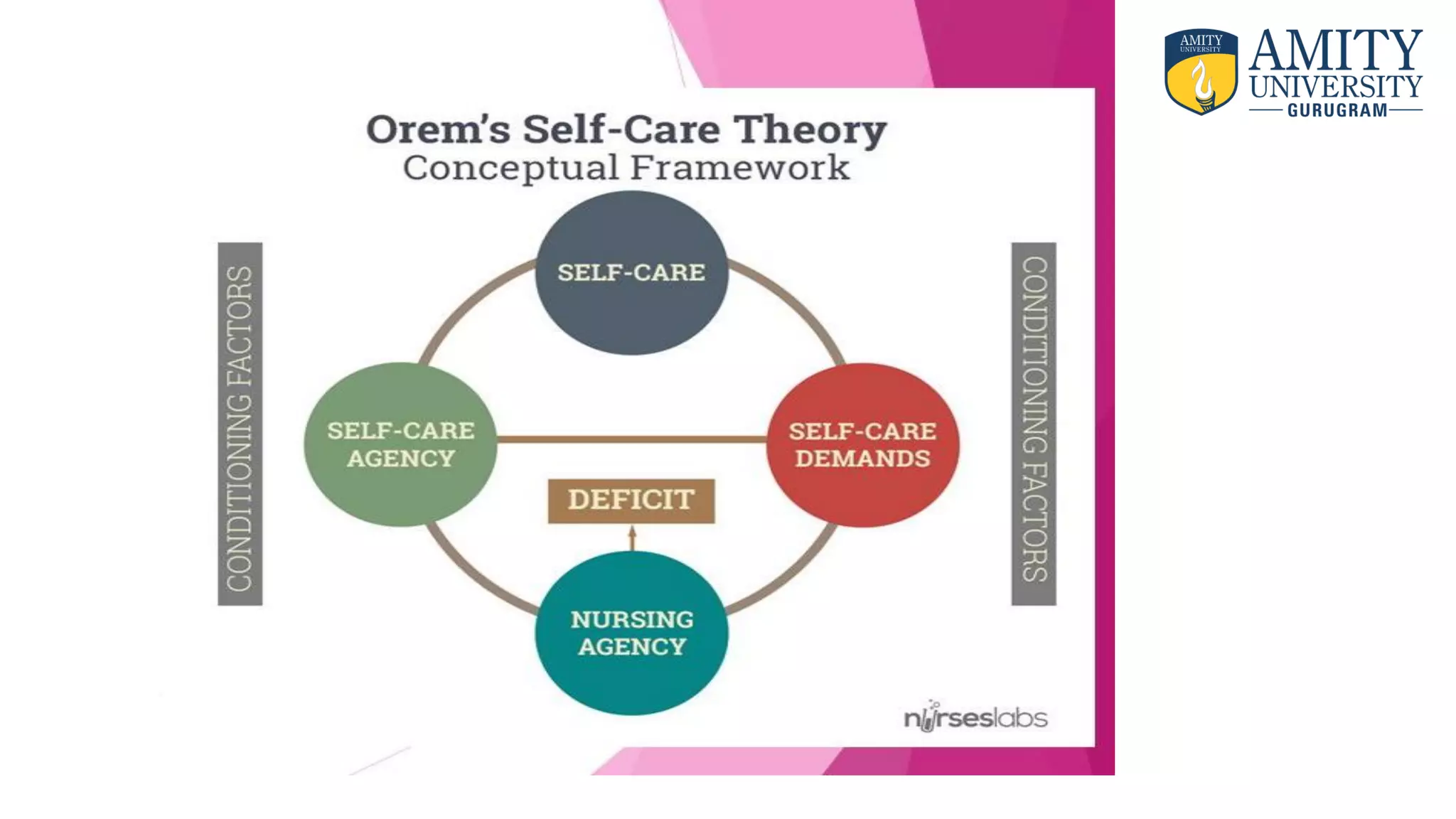
• She defined sick patient as self-care deficit who have fewer agencies
(abilities) and more demands (universal, developmental, health related and
therapeutic).
Introduction
• This theory was conceived and developed during a time when Nursing
lacked definition and identity within the medical community.
• This theory, not only, helped to move nursing from vocation to
profession, it “is one of the most commonly used in practice”
Self-Care Deficit Theory
Dorothea Orem’s Self-Care Deficit Theory focuses on each “individual’s
ability to perform self-care, defined as ‘the practice of activities that
individuals initiate and perform on their own behalf in maintaining life,
health, and well-being.’”
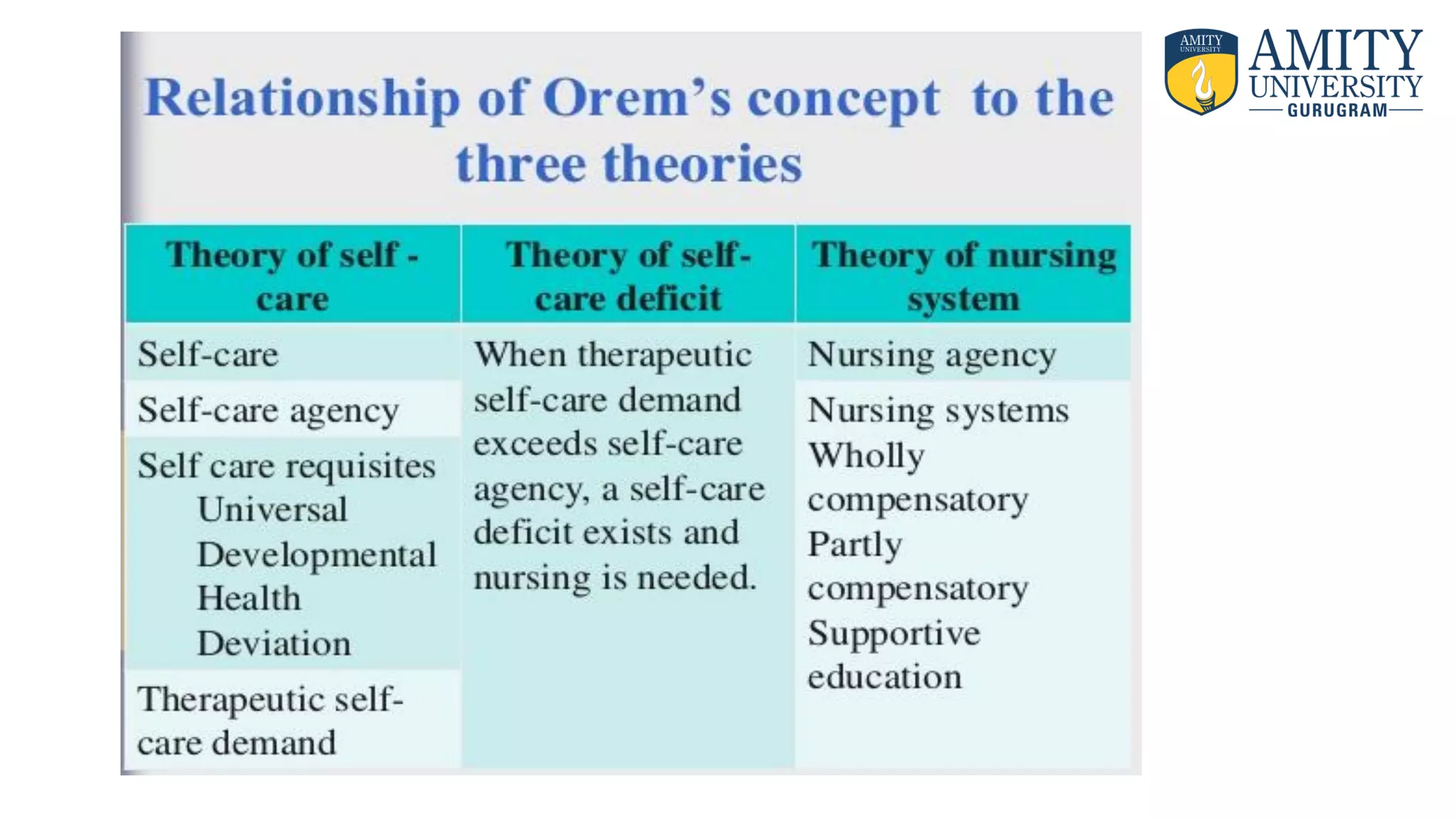
The Self-Care or Self-Care Deficit Theory of Nursing is composed of
three interrelated theories:
(1) the theory of self-care,
(2) the self-care deficit theory, and
(3) the theory of nursing systems, which is further classified into
wholly compensatory, partial compensatory and supportive-educative.
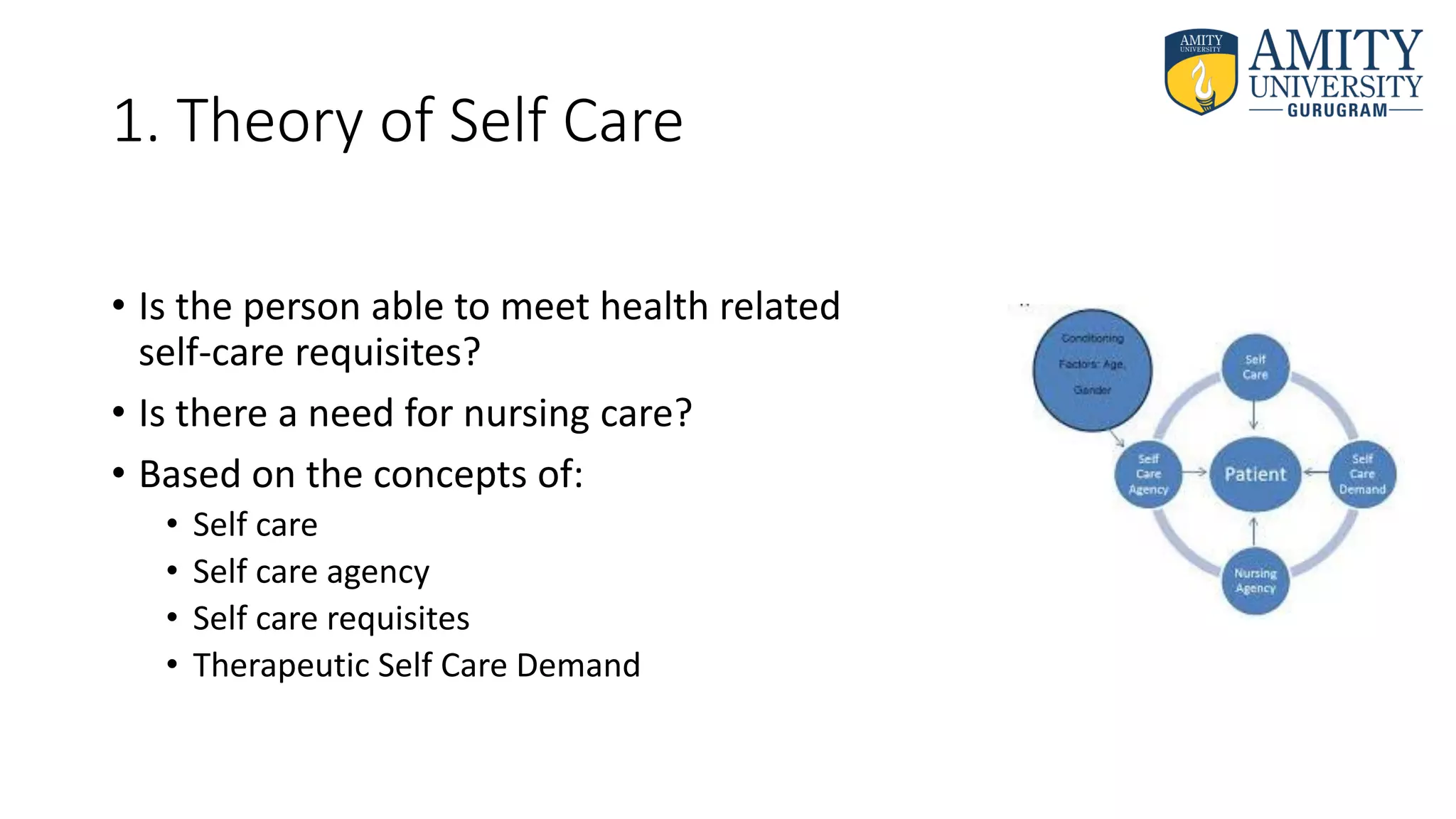
1. Theory of Self Care
• Is the person able to meet health related
self-care requisites?
• Is there a need for nursing care?
• Based on the concepts of:
• Self care
• Self care agency
• Self care requisites
• Therapeutic Self Care Demand
1. Theory of Self Care
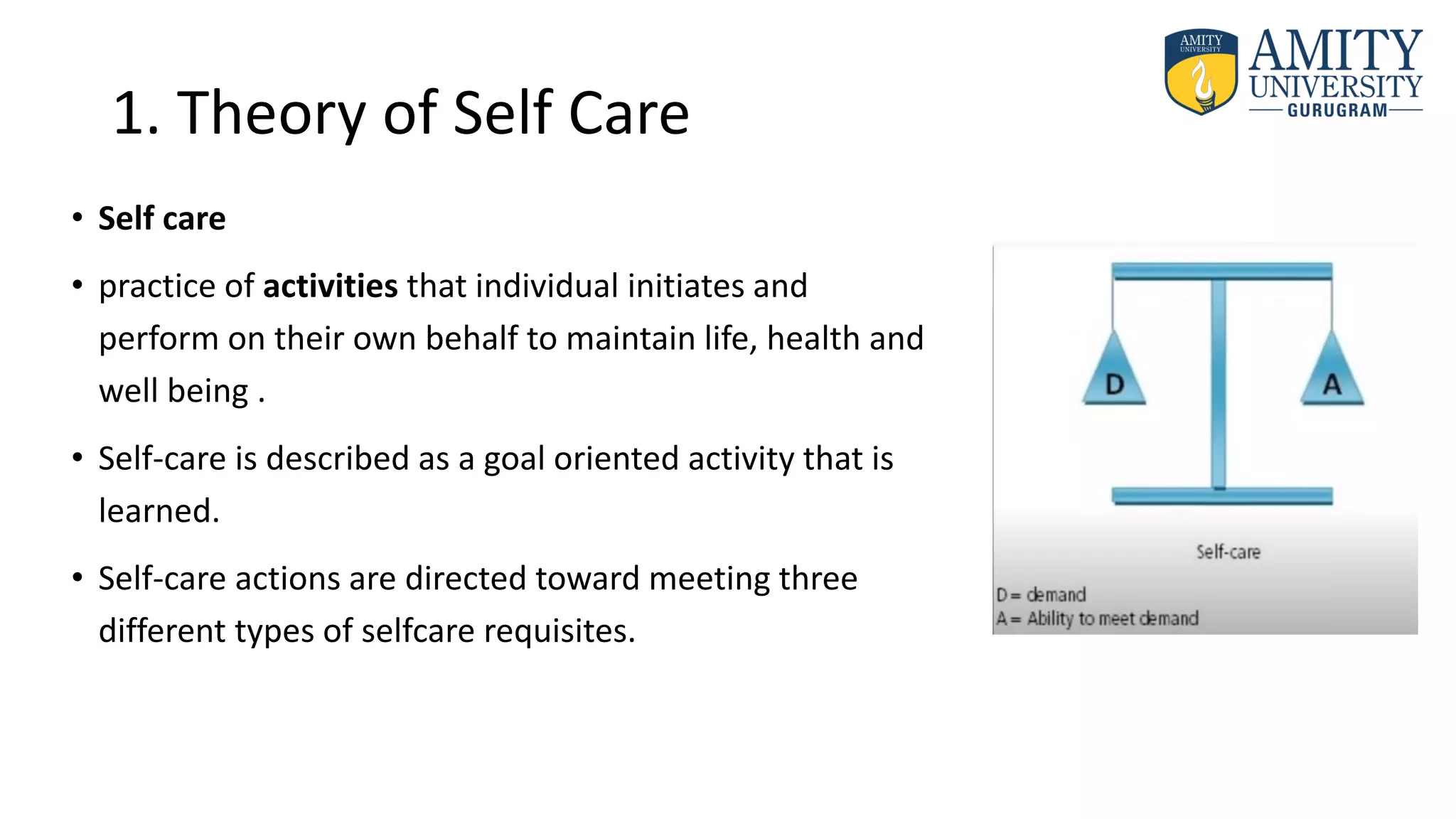
• Self care
• practice of activities that individual initiates and
perform on their own behalf to maintain life, health and
well being .
• Self-care is described as a goal oriented activity that is
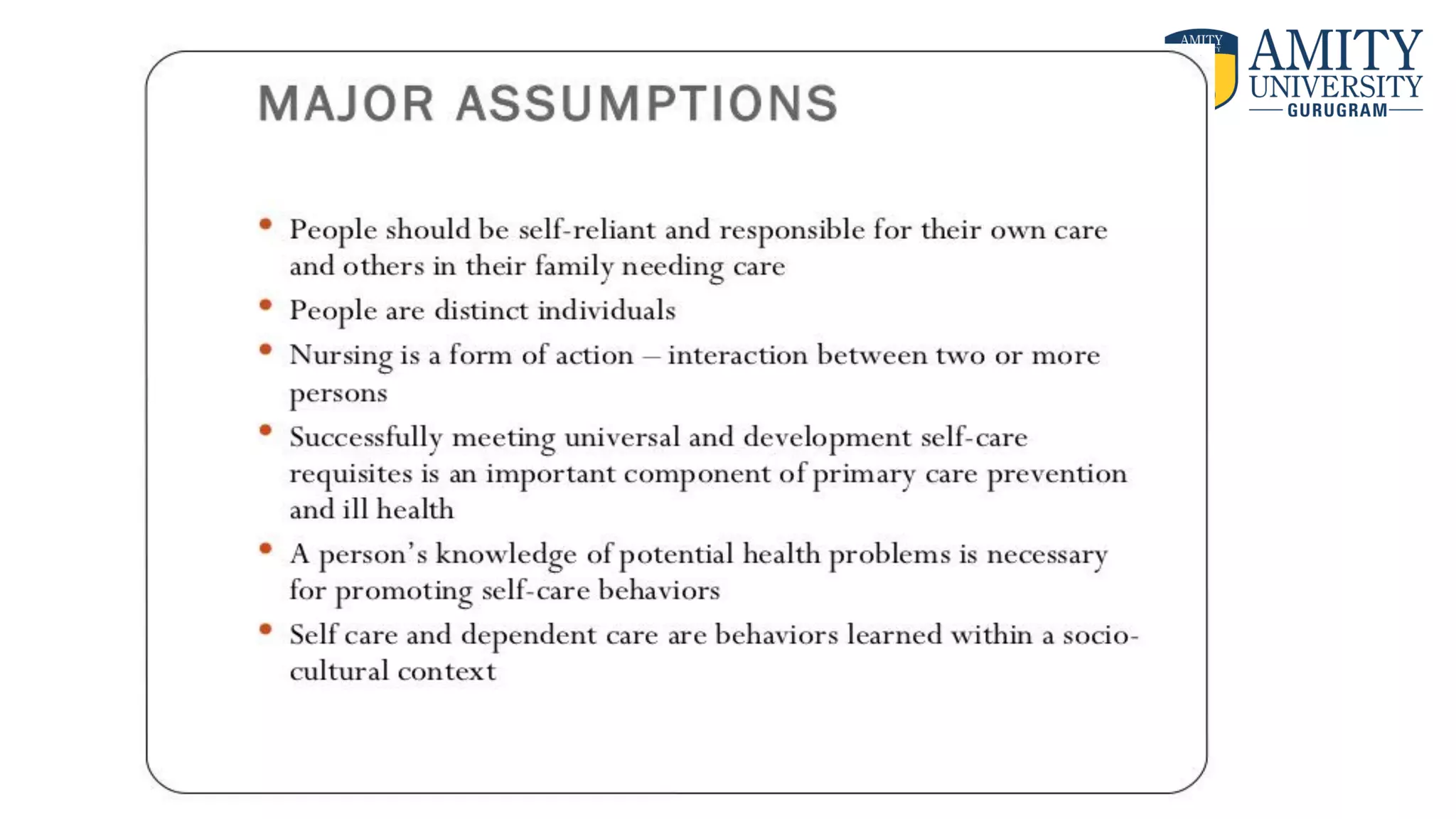
learned.
• Self-care actions are directed toward meeting three
different types of selfcare requisites.
Self-care agency
• is viewed as the specialized capabilities in terms of knowledge and
skills an individual needs in order to participate or engage in self-care.
• The individual’s ability to perform self-care activities consists of two
agents:
• Self-care Agent: person who provides the self-care
• Dependent Care Agent: person other than the individual who provides the
care (such as a parent).
• Affected by basic conditioning factors - age, developmental state, life
experience, socio-cultural orientation, health and available resources.
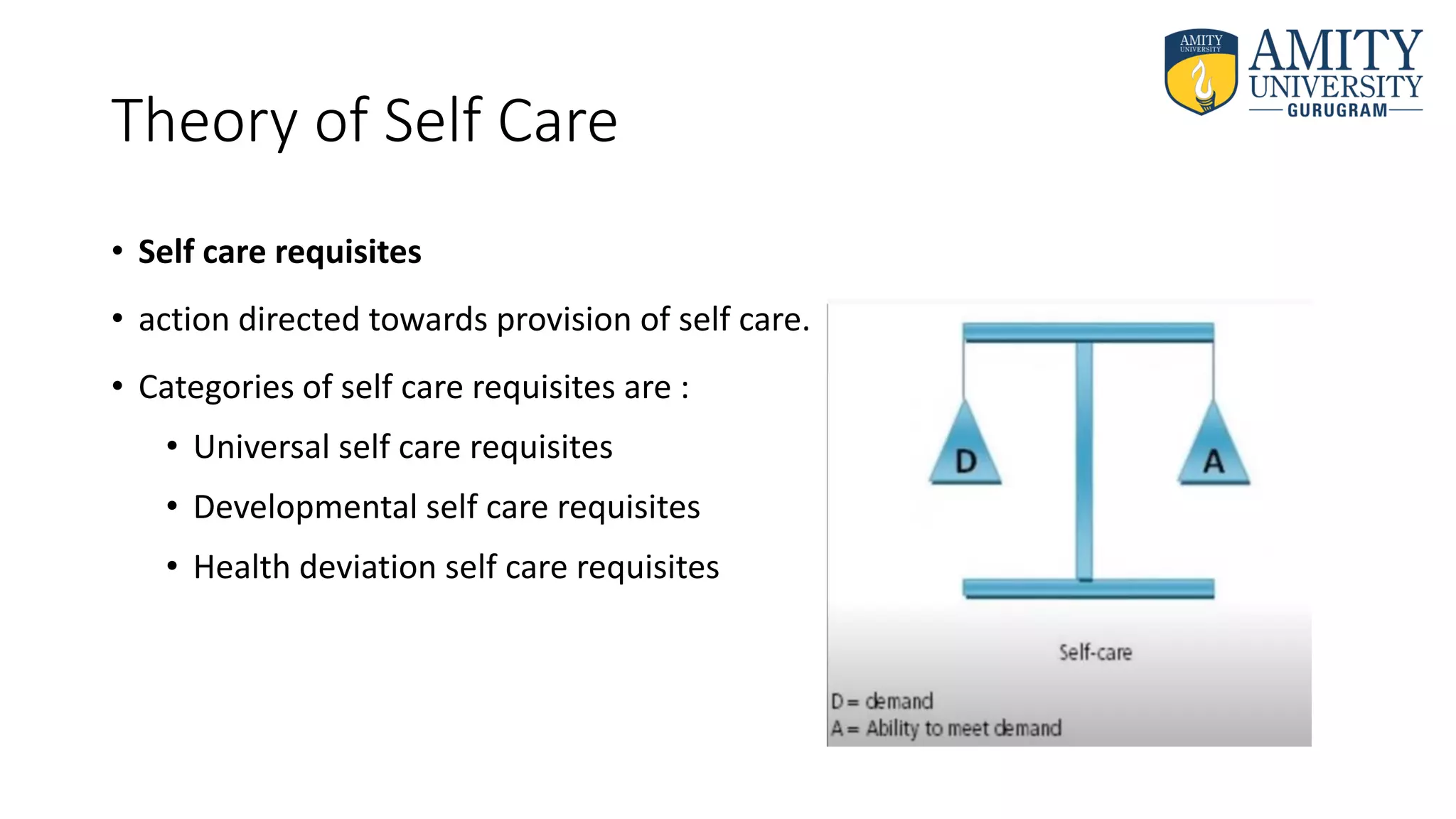
Theory of Self Care
• Self care requisites
• action directed towards provision of self care.
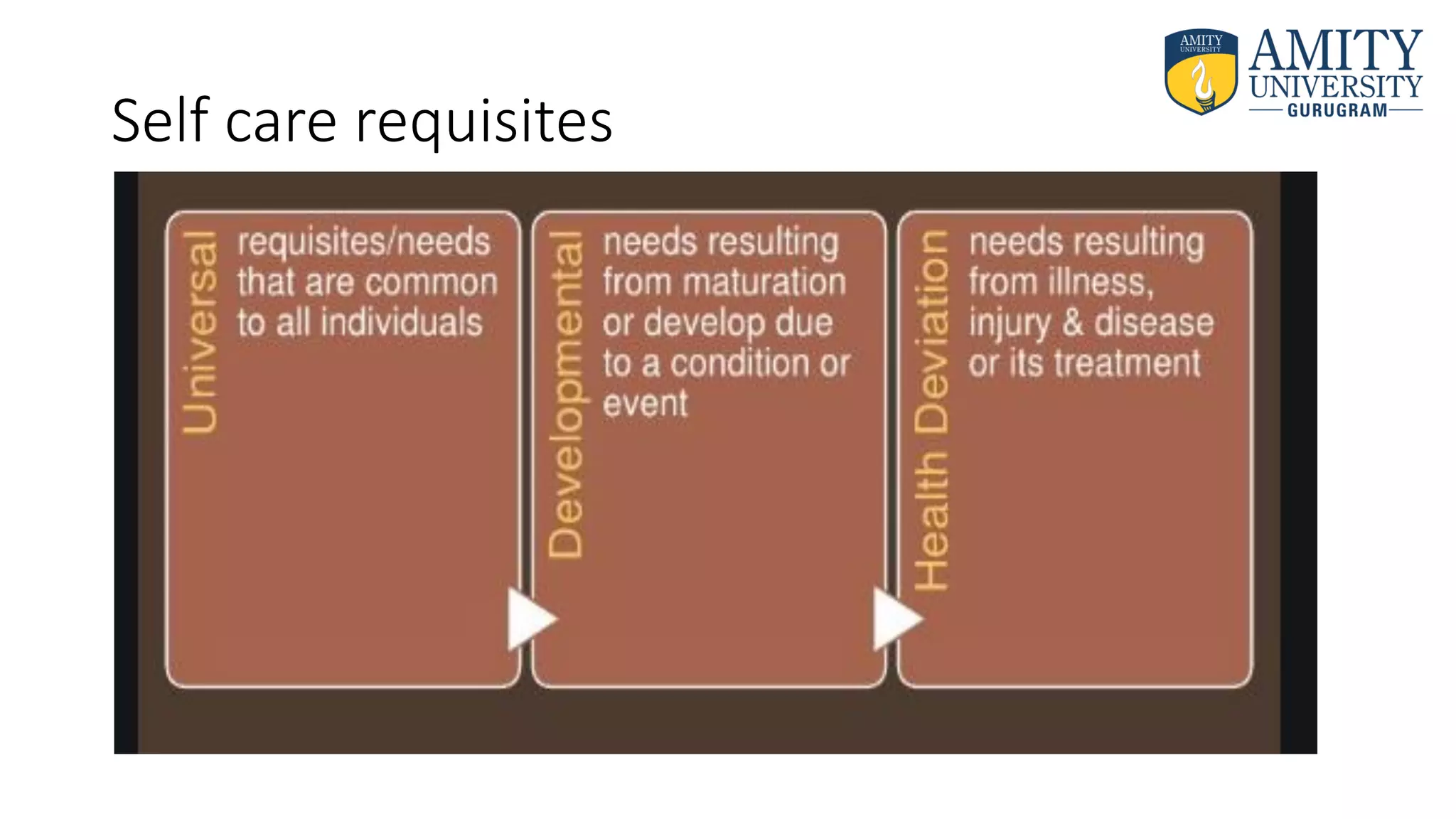
• Categories of self care requisites are :
• Universal self care requisites
• Developmental self care requisites
• Health deviation self care requisites
Self care requisites
Self care requisites (3)
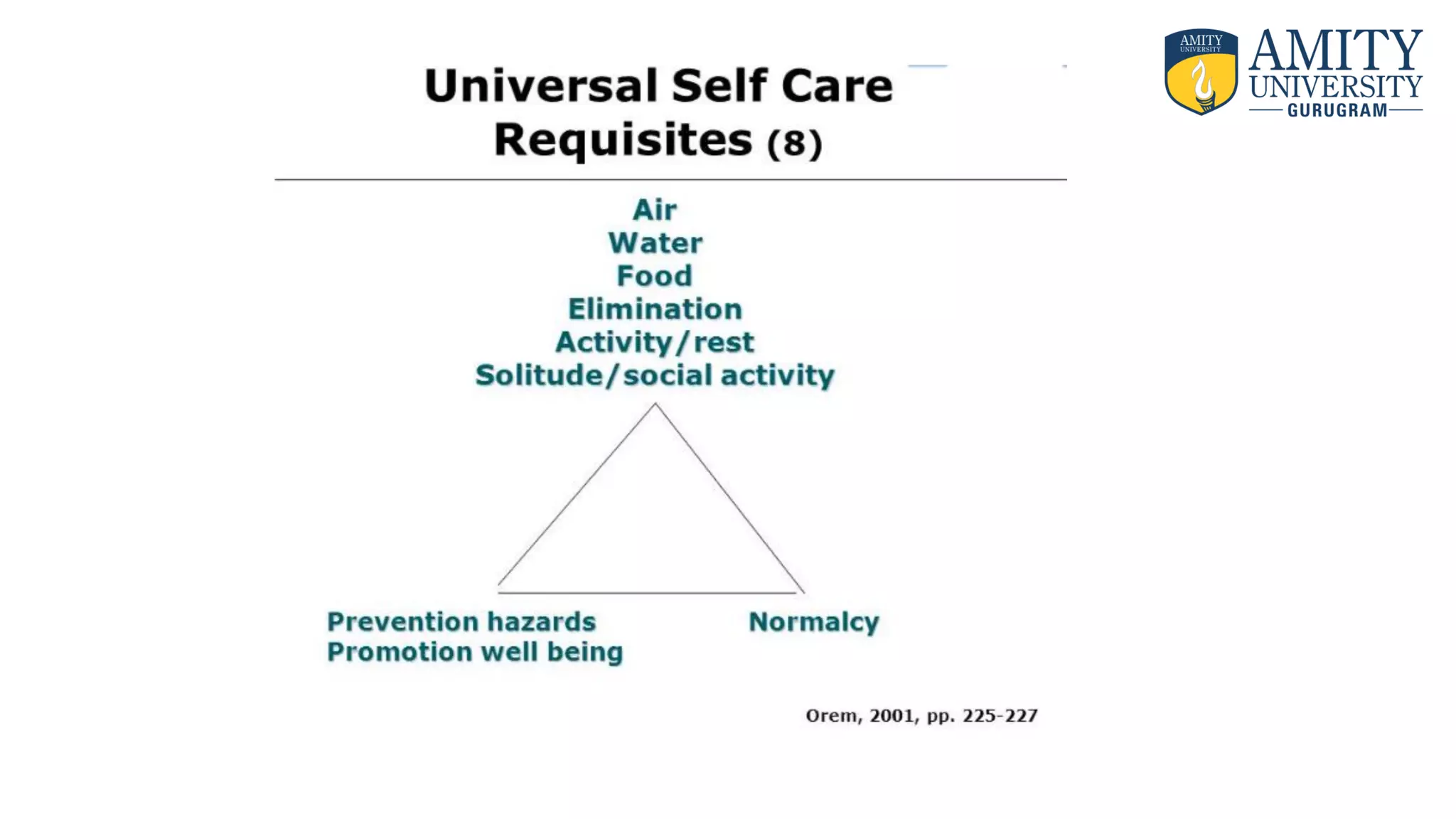
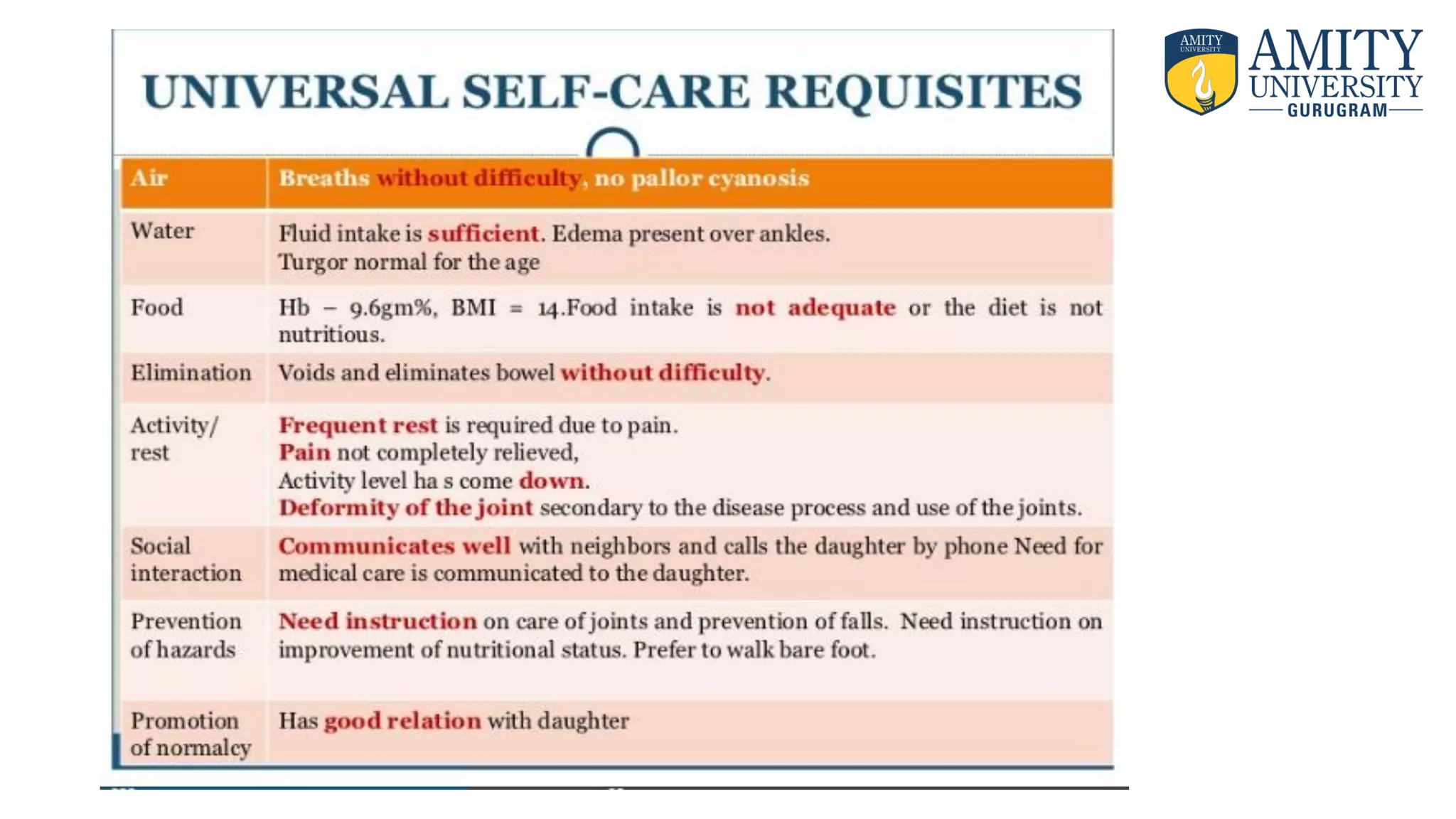
1. Universal self care requisites
• Associated with life processes and the maintenance of the integrity of
human structure and functioning
• Orem identifies these requisites as:
• Maintenance of sufficient intake of air, water, food
• Provision of care associated with elimination process
• Balance between activity and rest, between solitude and social interaction
• Prevention of hazards to human life, well being
• Promotion of human functioning
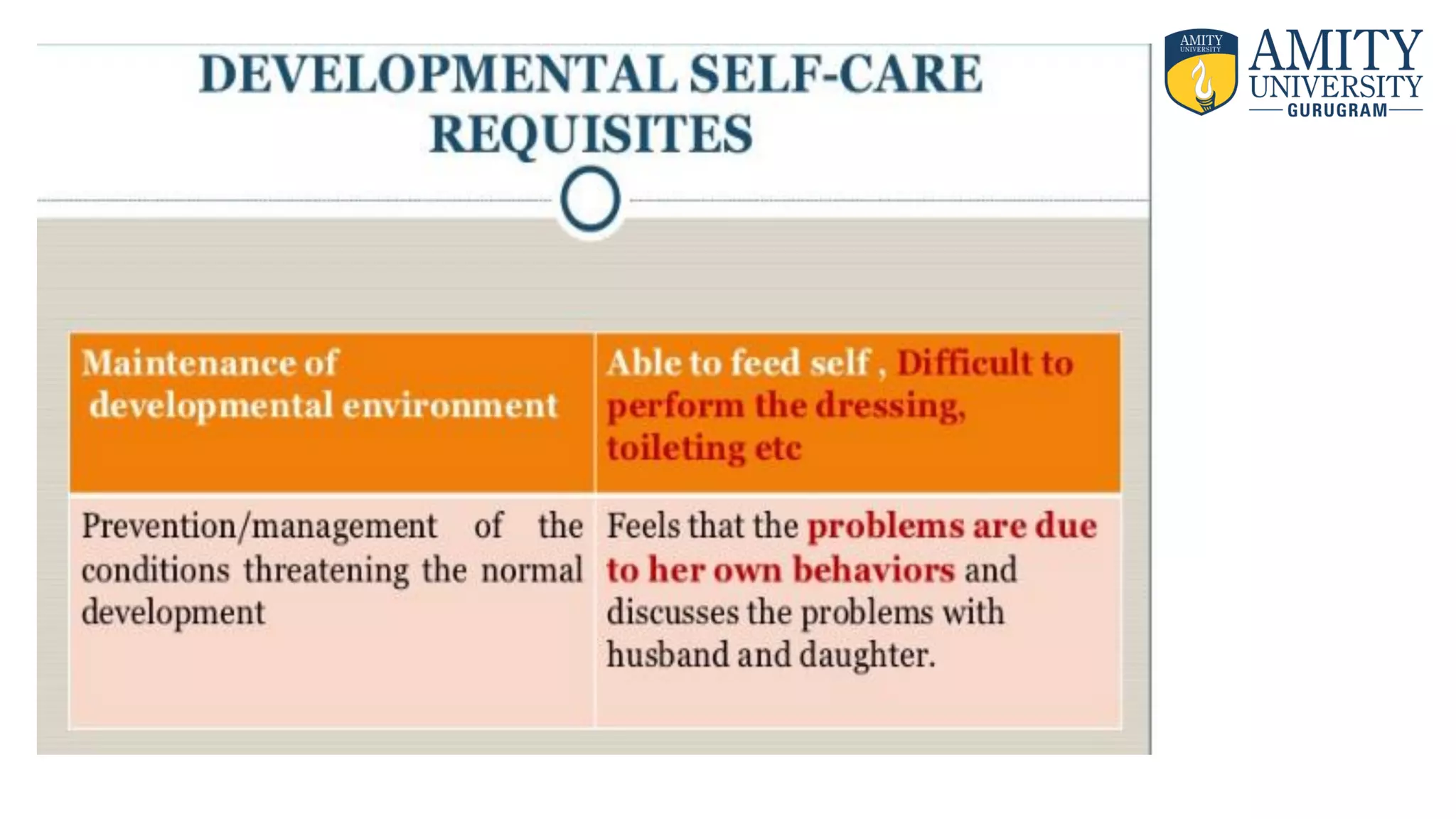
2. Developmental self care requisites
• Needs associated with developmental processes/ derived from a
condition or associated with an event
• E.g. adjusting to a new job
• adjusting to body changes
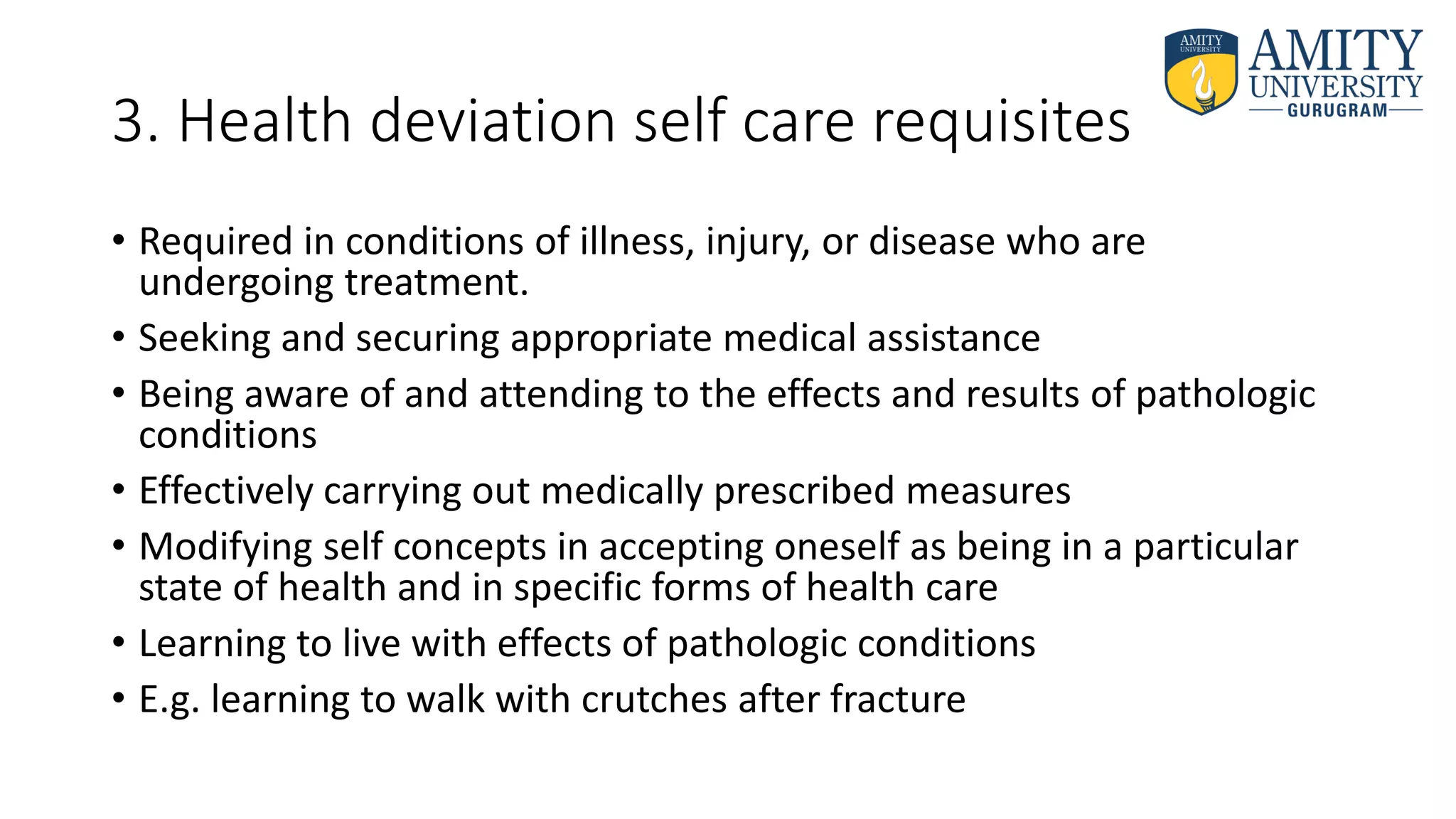
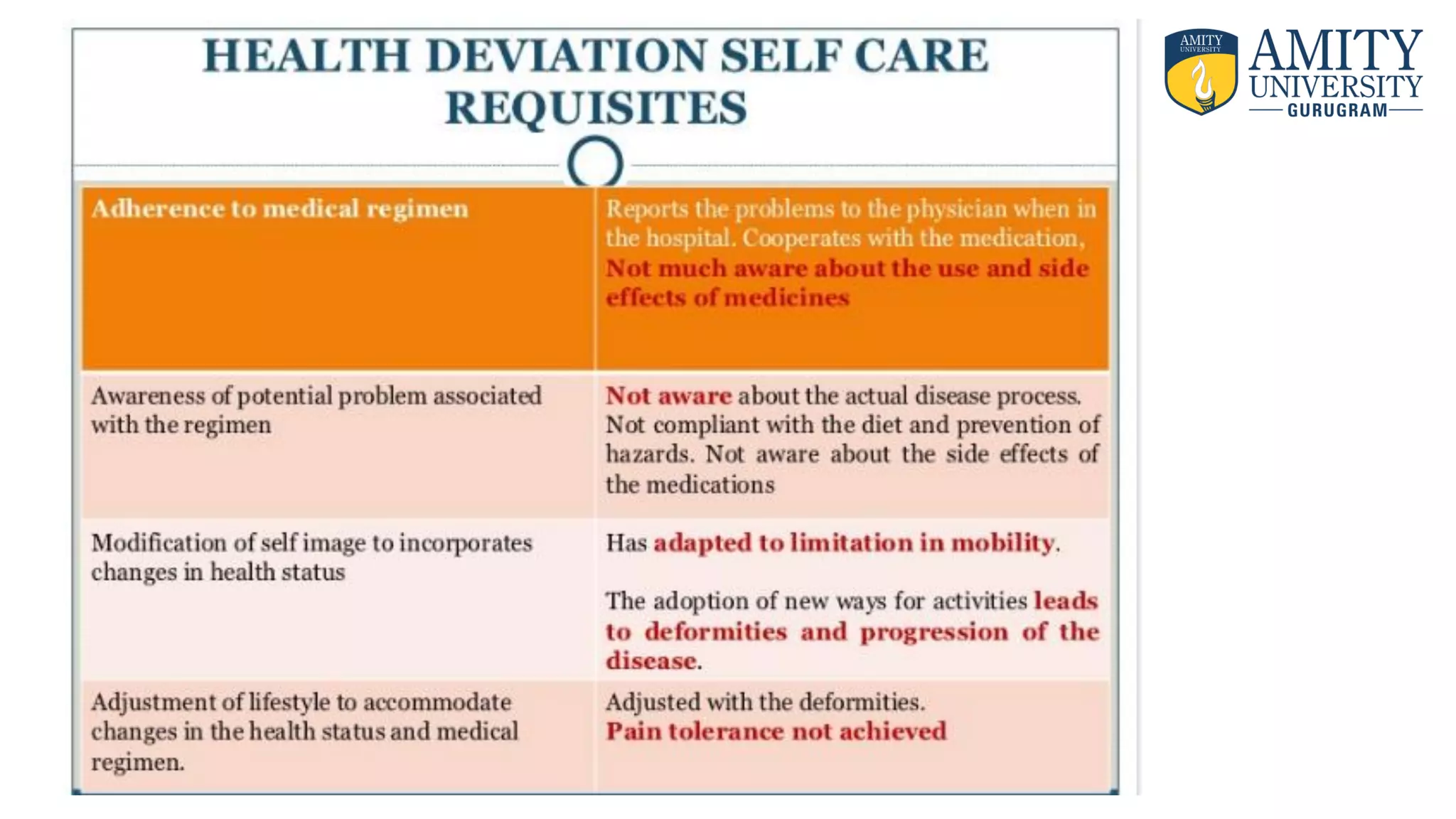
3. Health deviation self care requisites
• Required in conditions of illness, injury, or disease who are
undergoing treatment.
• Seeking and securing appropriate medical assistance
• Being aware of and attending to the effects and results of pathologic
conditions
• Effectively carrying out medically prescribed measures
• Modifying self concepts in accepting oneself as being in a particular
state of health and in specific forms of health care
• Learning to live with effects of pathologic conditions
• E.g. learning to walk with crutches after fracture
2. Theory of Self Care Deficit
Major Concepts of the Self-Care Deficit
Theory
• Nursing- Nursing is an art, through which the practitioner of nursing, gives
specialized assistance to persons with disabilities, which makes more than
ordinary assistance necessary to meet needs for self-care. The nurse also
intelligently participates in the medical care, which the individual receives
from the physician.
• Humans - Humans are defined as “men, women, and children cared for
either singly or as social units,” and are the “material object” of nurses and
others who provide direct care.
• Environment- The environment has physical, chemical and biological
features. It includes the family, culture, and community.
Major Concepts of the Self-Care Deficit
Theory
• Health- Health is “being structurally and functionally whole or
sound.” Also, health is a state that encompasses both the health of
individuals and of groups, and human health is the ability to reflect on
one’s self, to symbolize experience, and to communicate with others.
• Self-Care- it is the performance or practice of activities that
individuals initiate and perform on their own behalf to maintain life,
health, and well-being.
• Self-Care Agency- it is the human’s ability or power to engage in self-
care and is affected by basic conditioning factors.
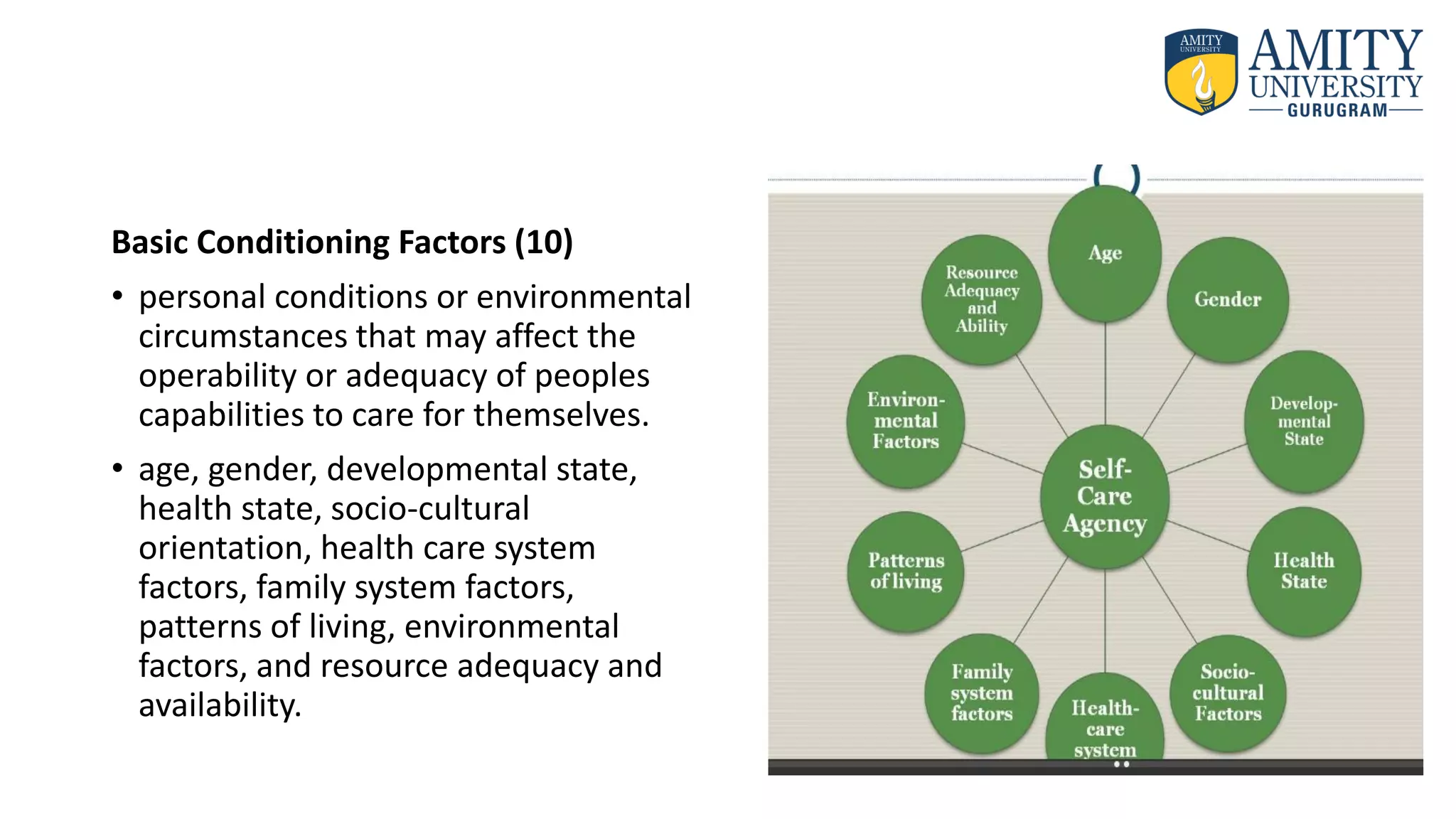
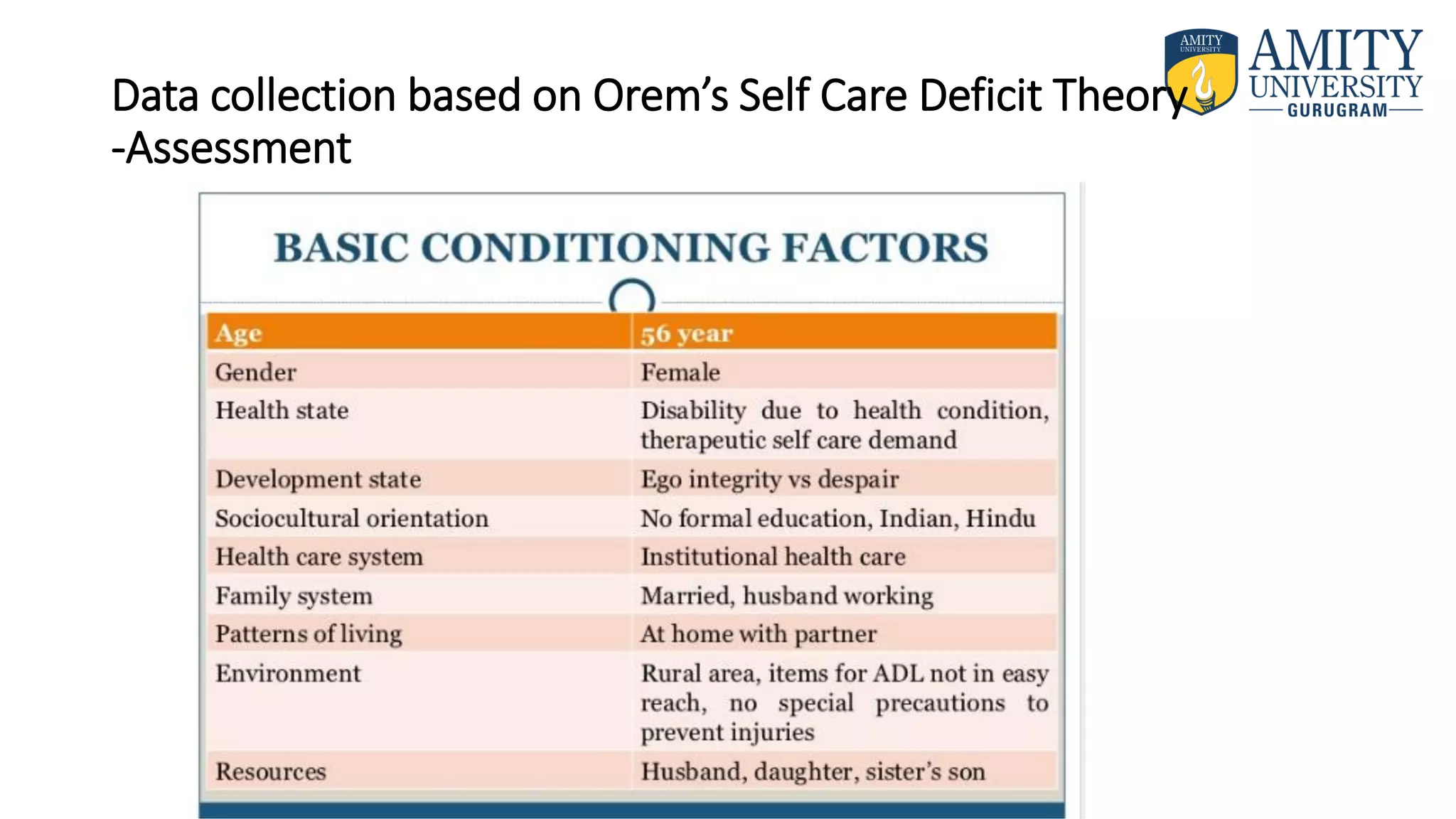
Basic Conditioning Factors (10)
• personal conditions or environmental
circumstances that may affect the
operability or adequacy of peoples
capabilities to care for themselves.
• age, gender, developmental state,
health state, socio-cultural
orientation, health care system
factors, family system factors,
patterns of living, environmental
factors, and resource adequacy and
availability.
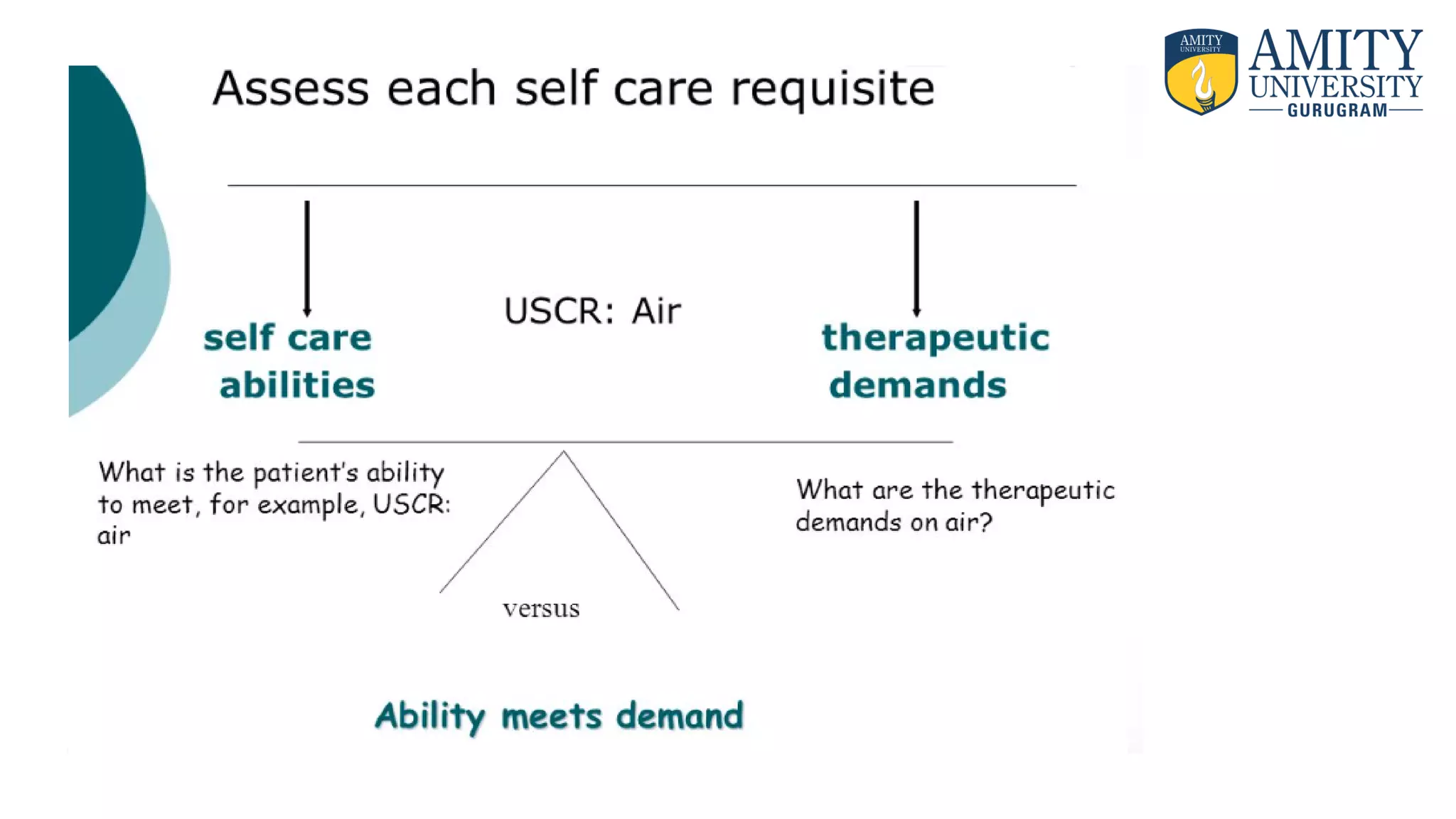
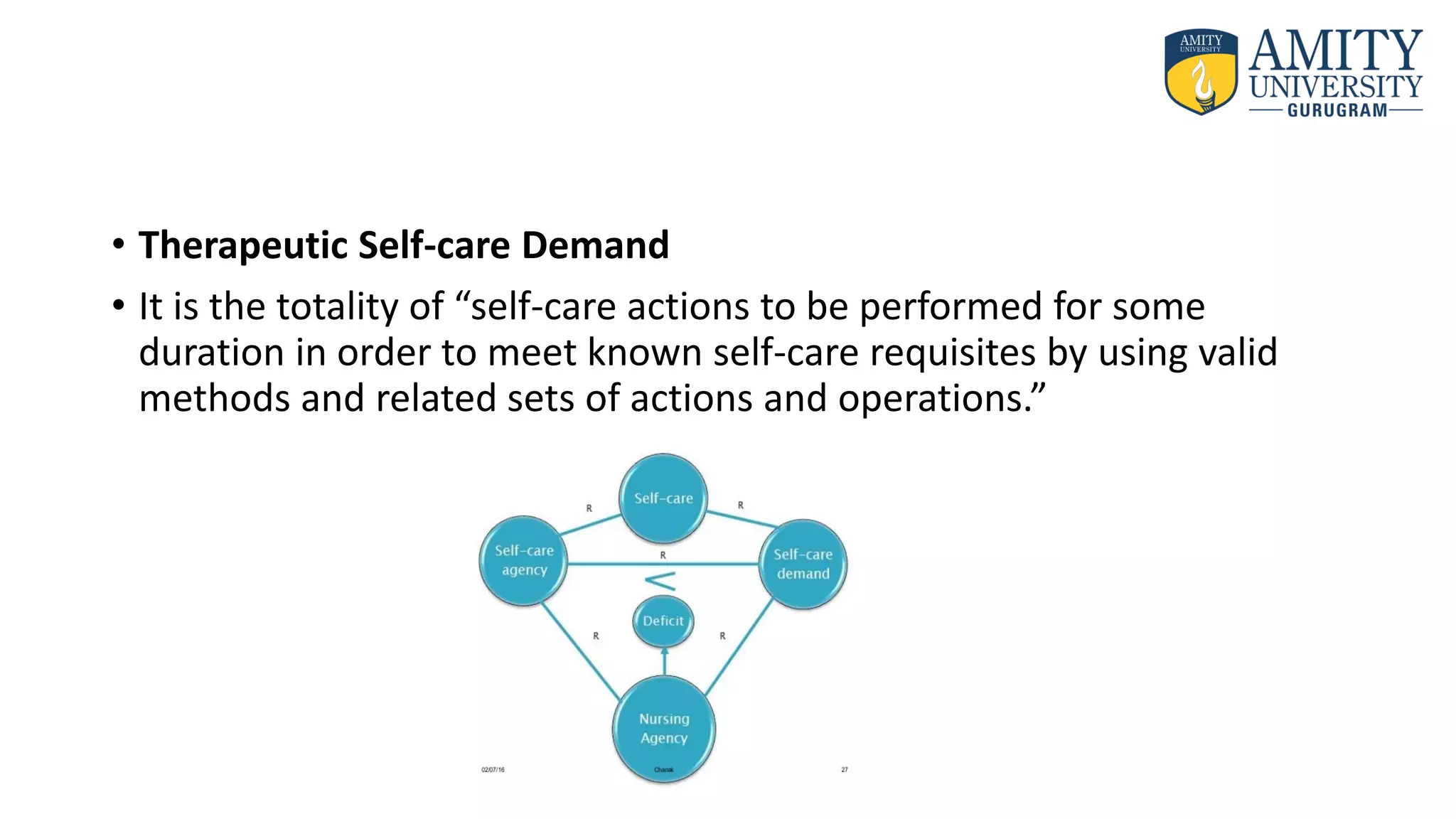
• Therapeutic Self-care Demand
• It is the totality of “self-care actions to be performed for some
duration in order to meet known self-care requisites by using valid
methods and related sets of actions and operations.”
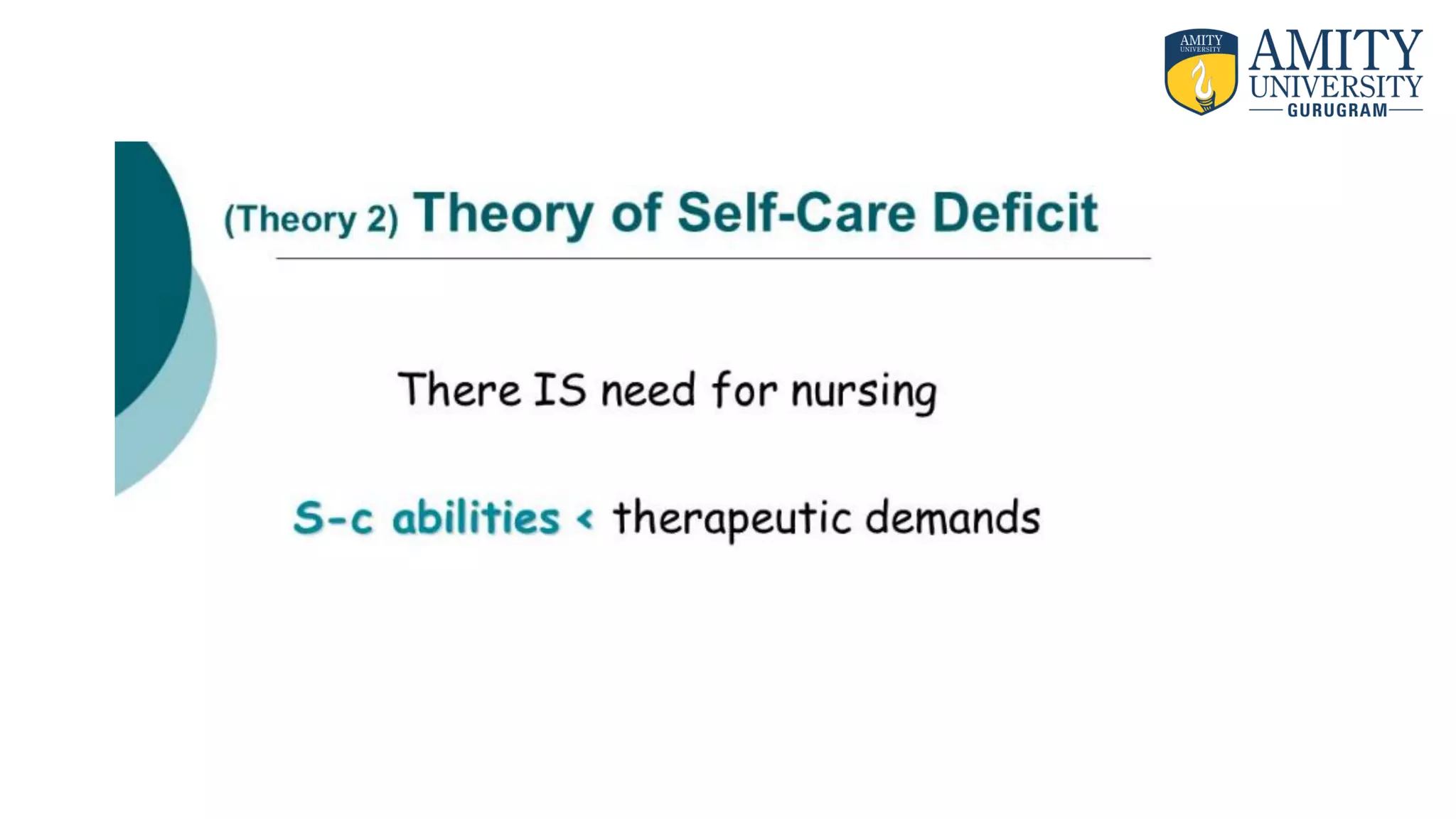
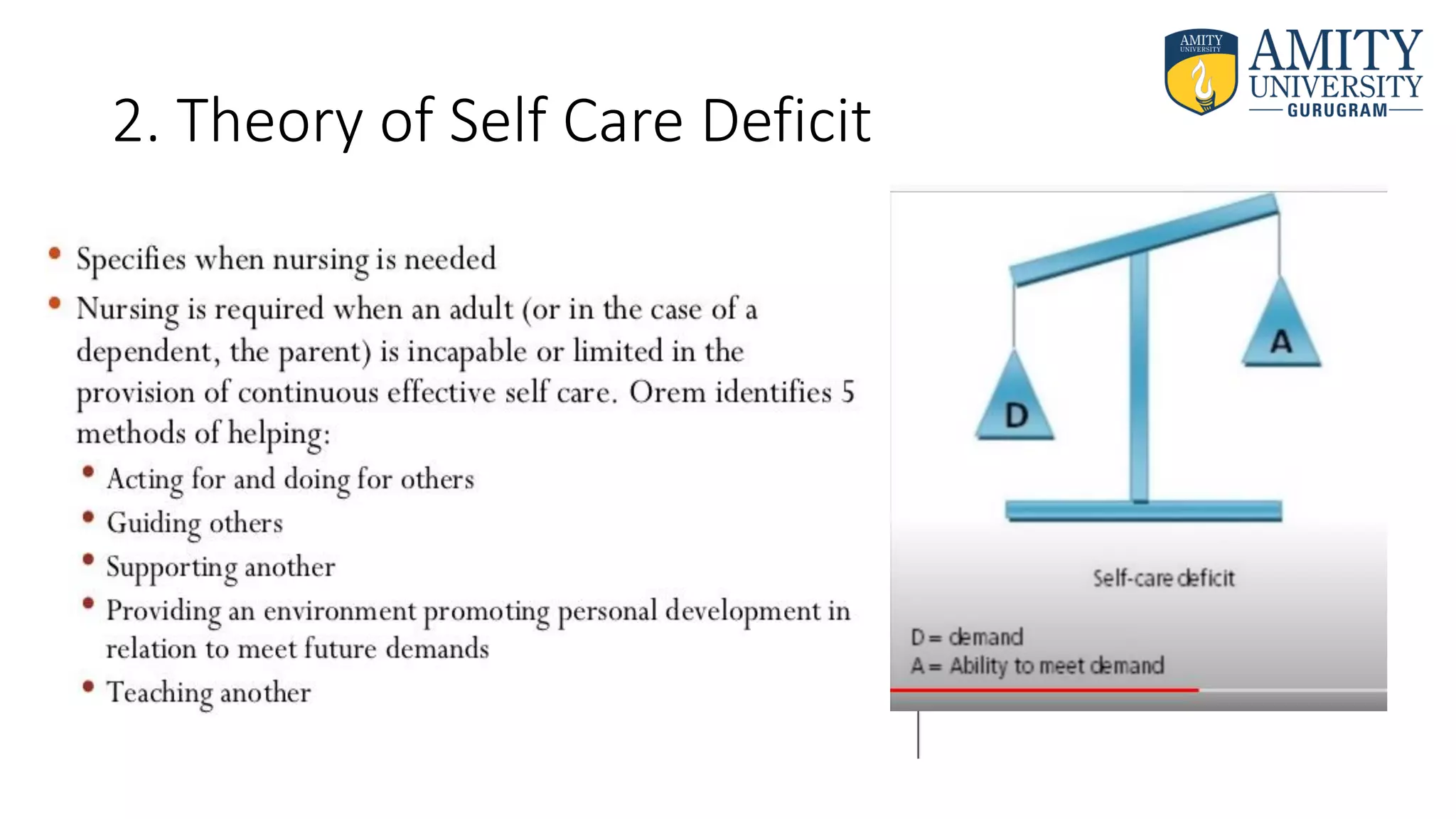
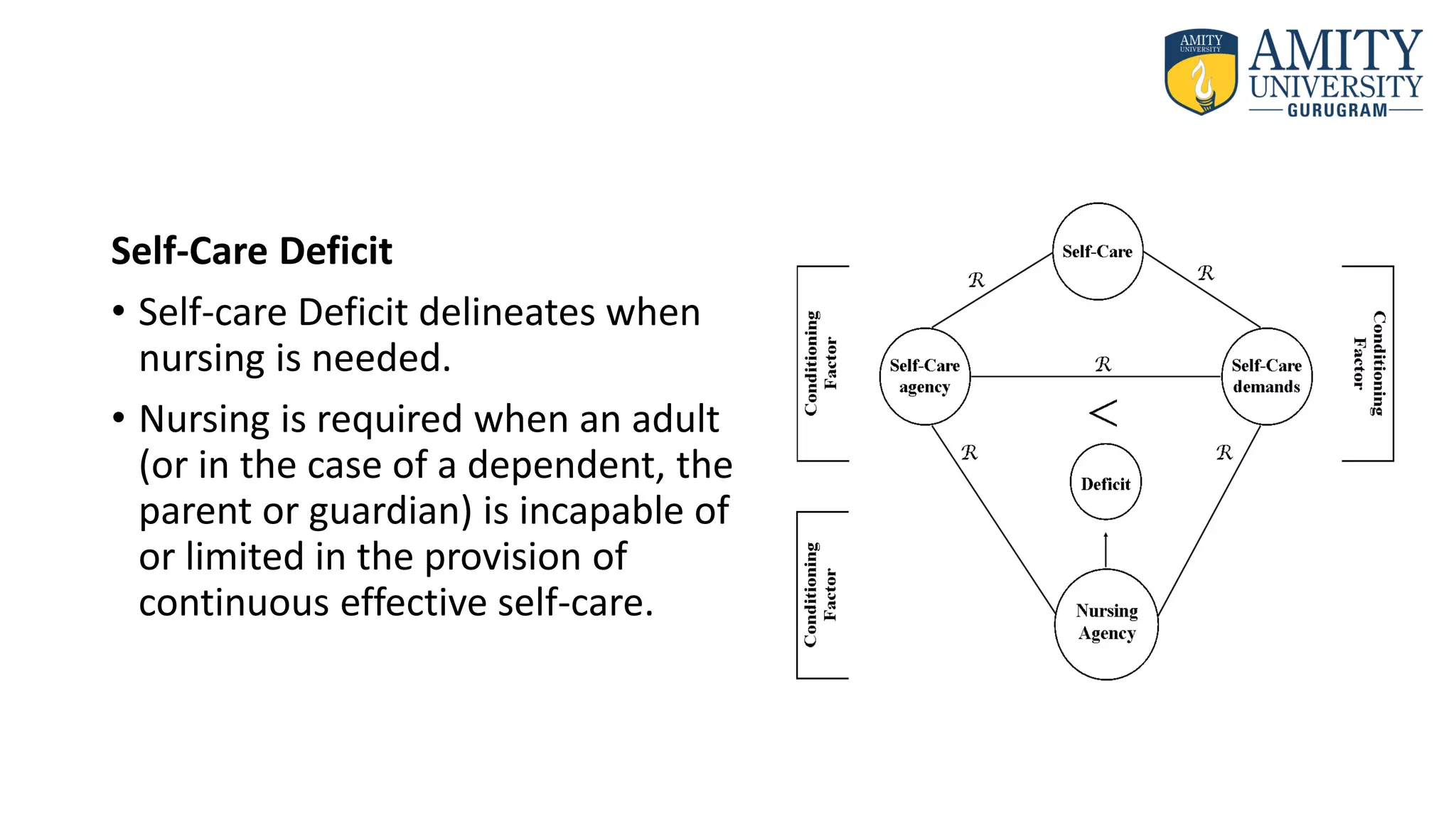
Self-Care Deficit
• Self-care Deficit delineates when
nursing is needed.
• Nursing is required when an adult
(or in the case of a dependent, the
parent or guardian) is incapable of
or limited in the provision of
continuous effective self-care.
3. Theory of Nursing Systems
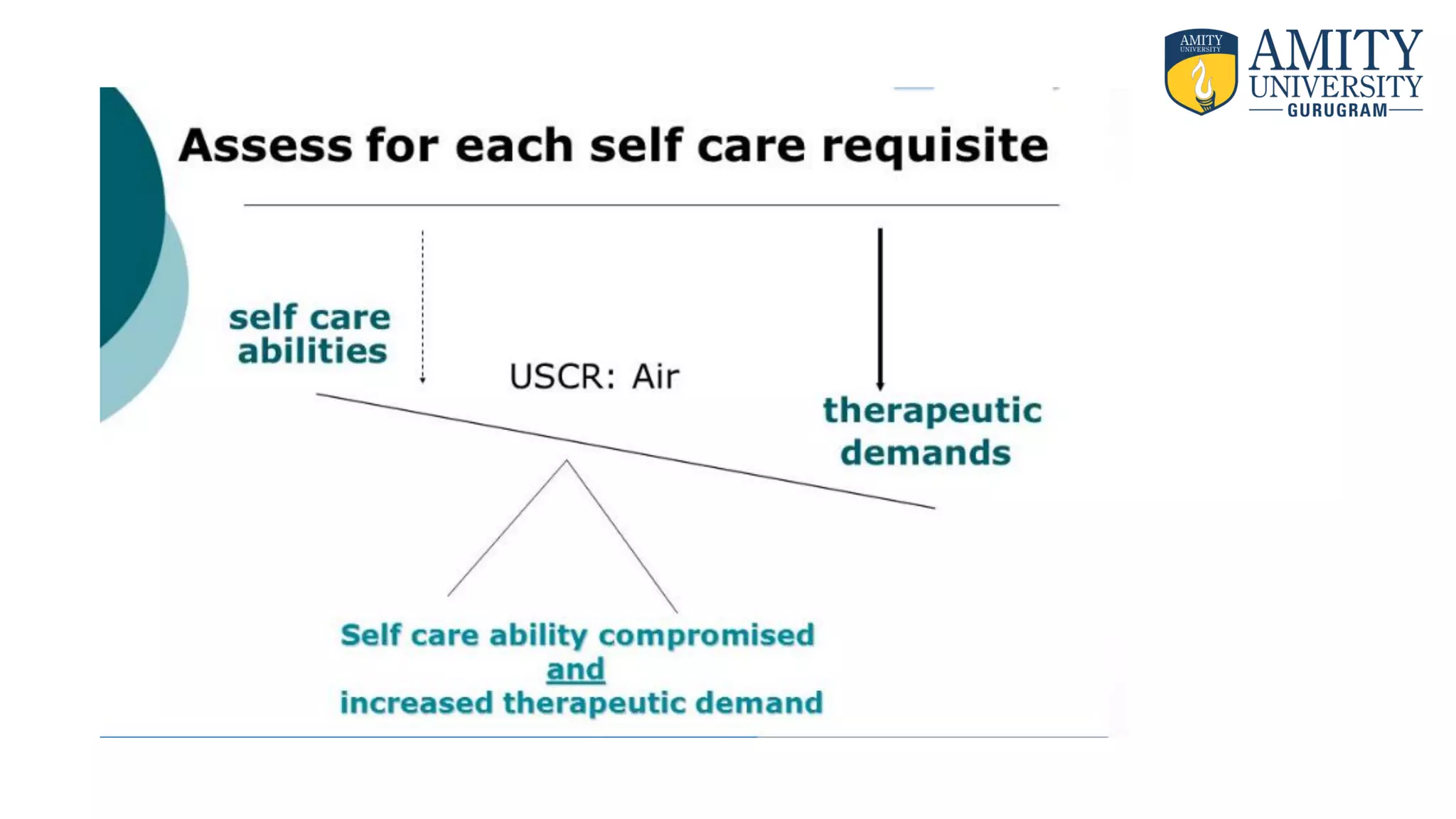
• This system is activated when the client’s therapeutic self-care demand
exceeds available self-care agency, leading to the need for nursing.
• Nursing System is the product of a series of relations between nurse and
client.
• This describes:
• How the patient’s self care needs will be met by the nurse, the patient, or both
• Nursing responsibilities
• Roles of nurse and patient
• Rationales for nurse patient relationship
• Types of actions needed to meet patient’s demands
• Designed by the nurse
• Based on the assessment of patient’s ability to perform self care activities
• Nursing Agency
• Nursing Agency is a complex property or attribute of people educated
and trained as nurses that enables them to act, to know, and to help
others, to meet their therapeutic self-care demands by exercising or
developing their own self-care agency.
Nursing System
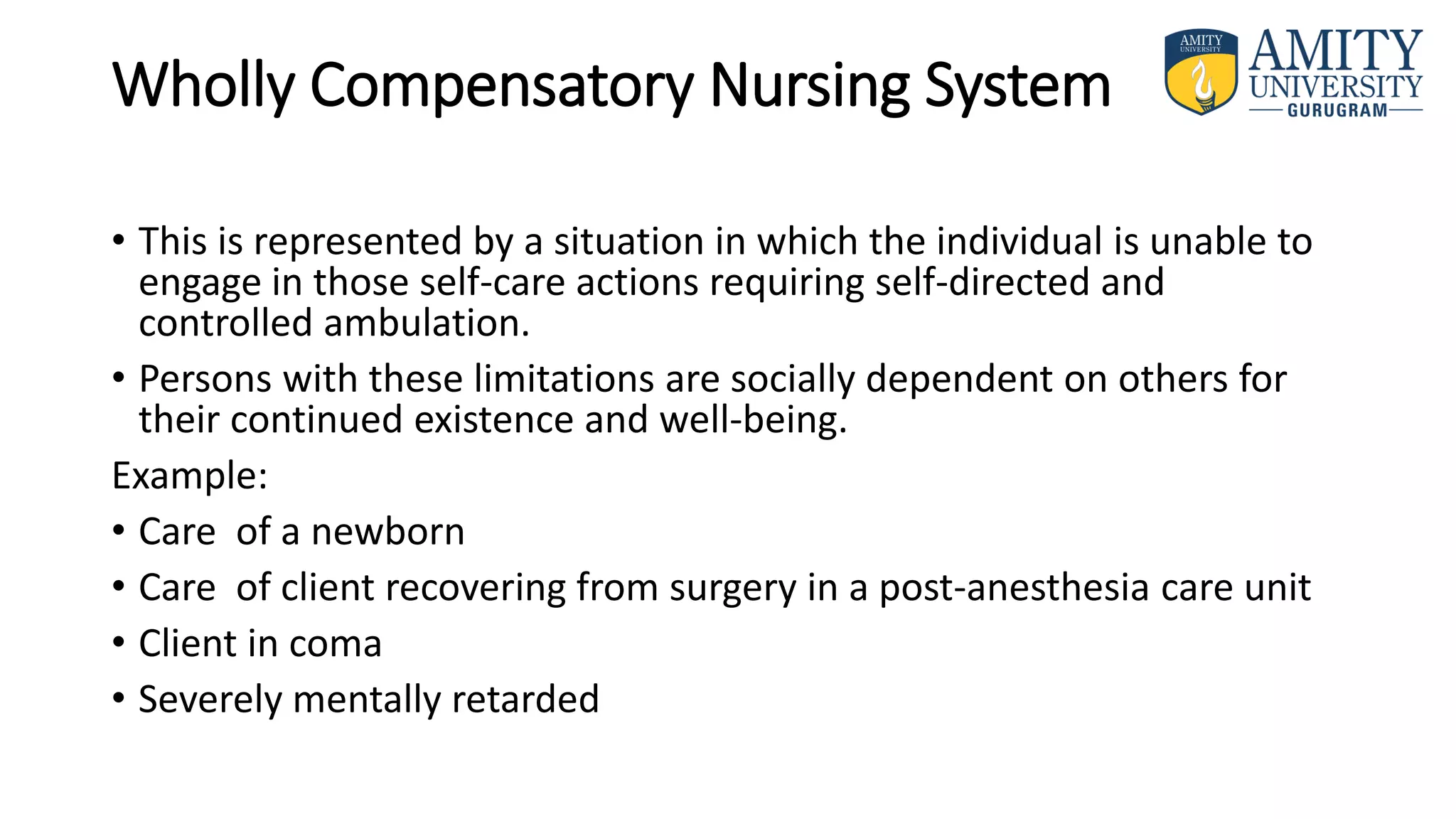
• Identifies 3 classifications of nursing system
to meet the self care requisites of the
patient:-
• Wholly compensatory system
• Partly compensatory system
• Supportive – educative system
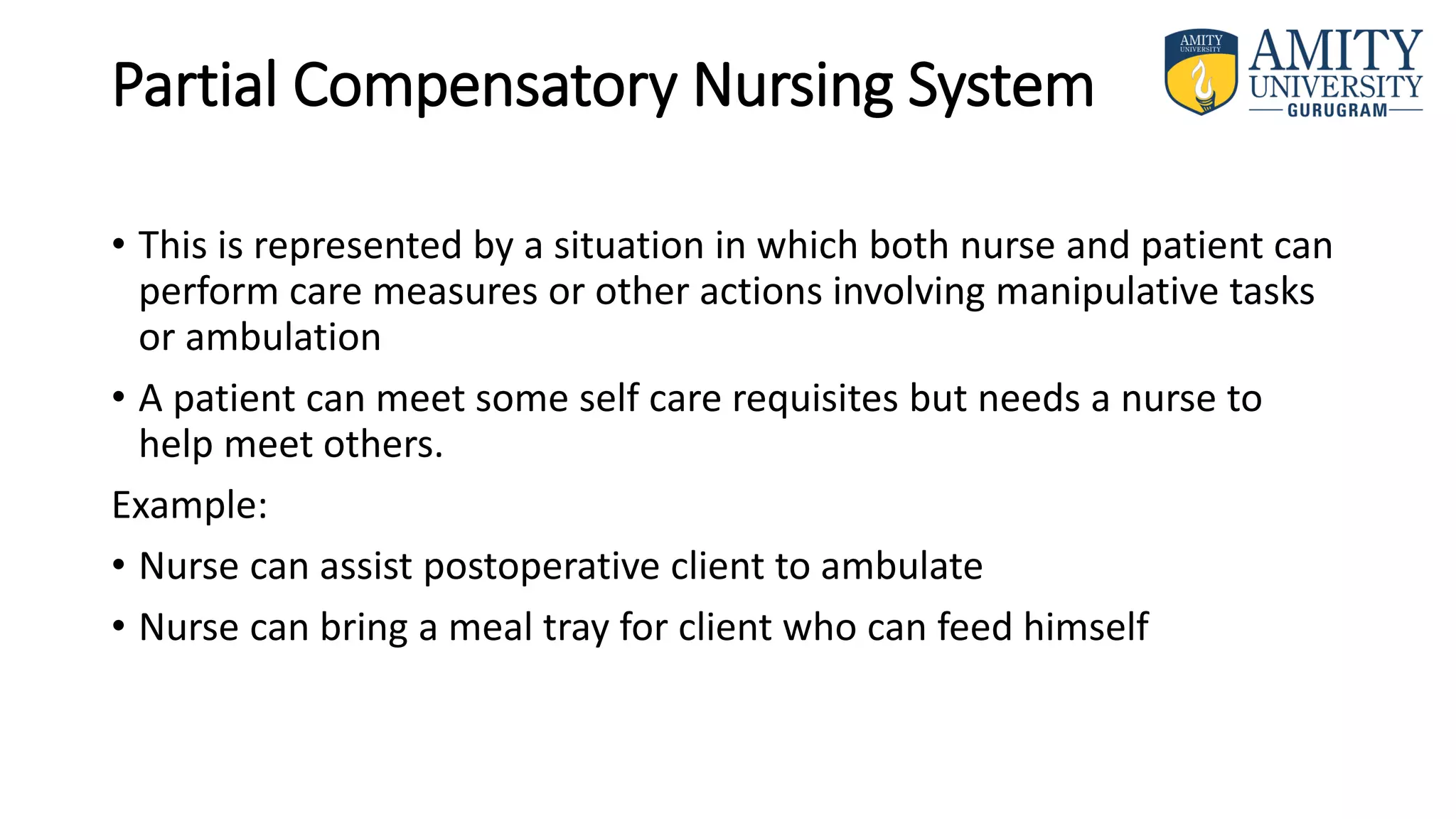
Wholly Compensatory Nursing System
• This is represented by a situation in which the individual is unable to
engage in those self-care actions requiring self-directed and
controlled ambulation.
• Persons with these limitations are socially dependent on others for
their continued existence and well-being.
Example:
• Care of a newborn
• Care of client recovering from surgery in a post-anesthesia care unit
• Client in coma
• Severely mentally retarded
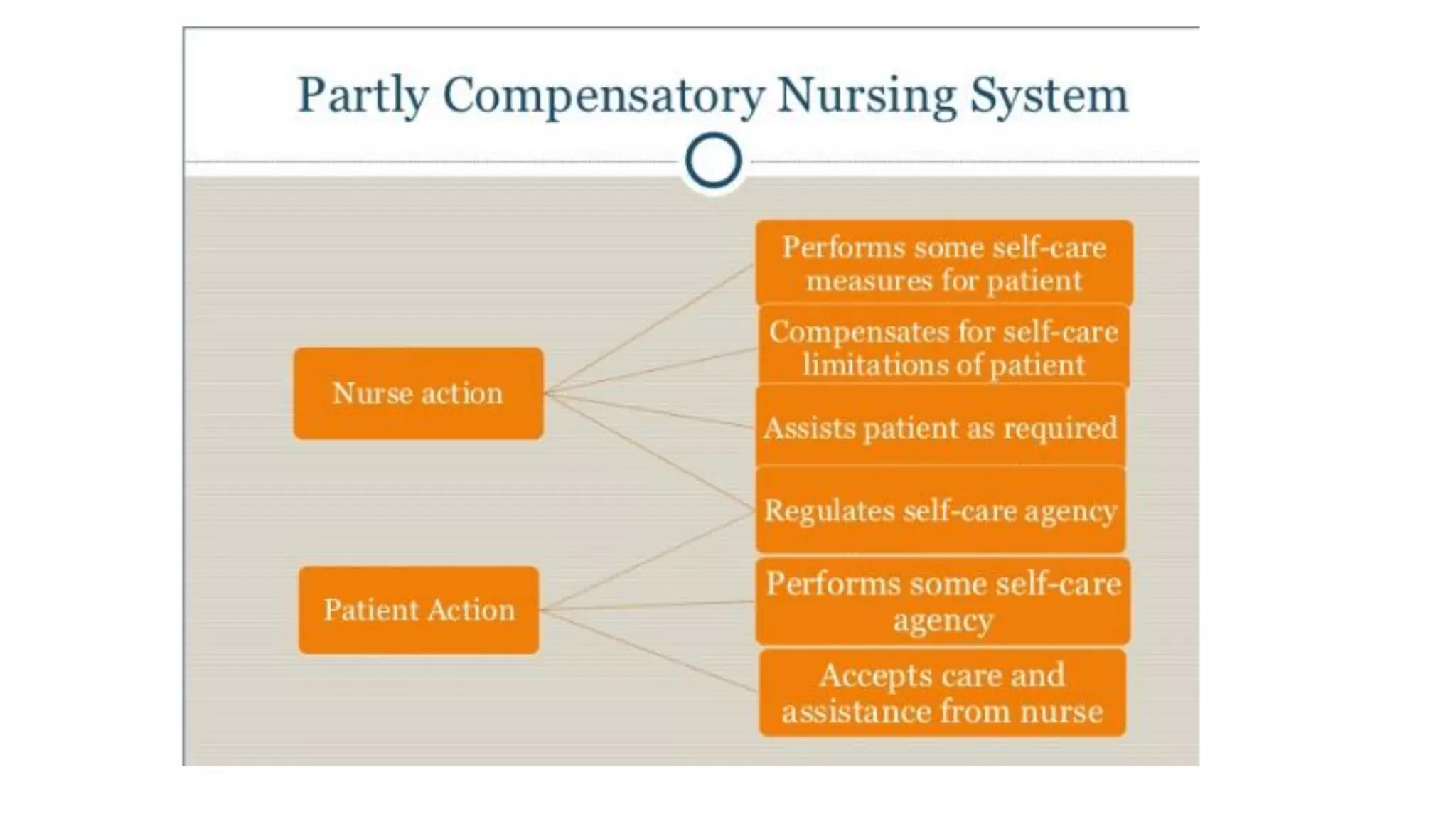
Partial Compensatory Nursing System
• This is represented by a situation in which both nurse and patient can
perform care measures or other actions involving manipulative tasks
or ambulation
• A patient can meet some self care requisites but needs a nurse to
help meet others.
Example:
• Nurse can assist postoperative client to ambulate
• Nurse can bring a meal tray for client who can feed himself
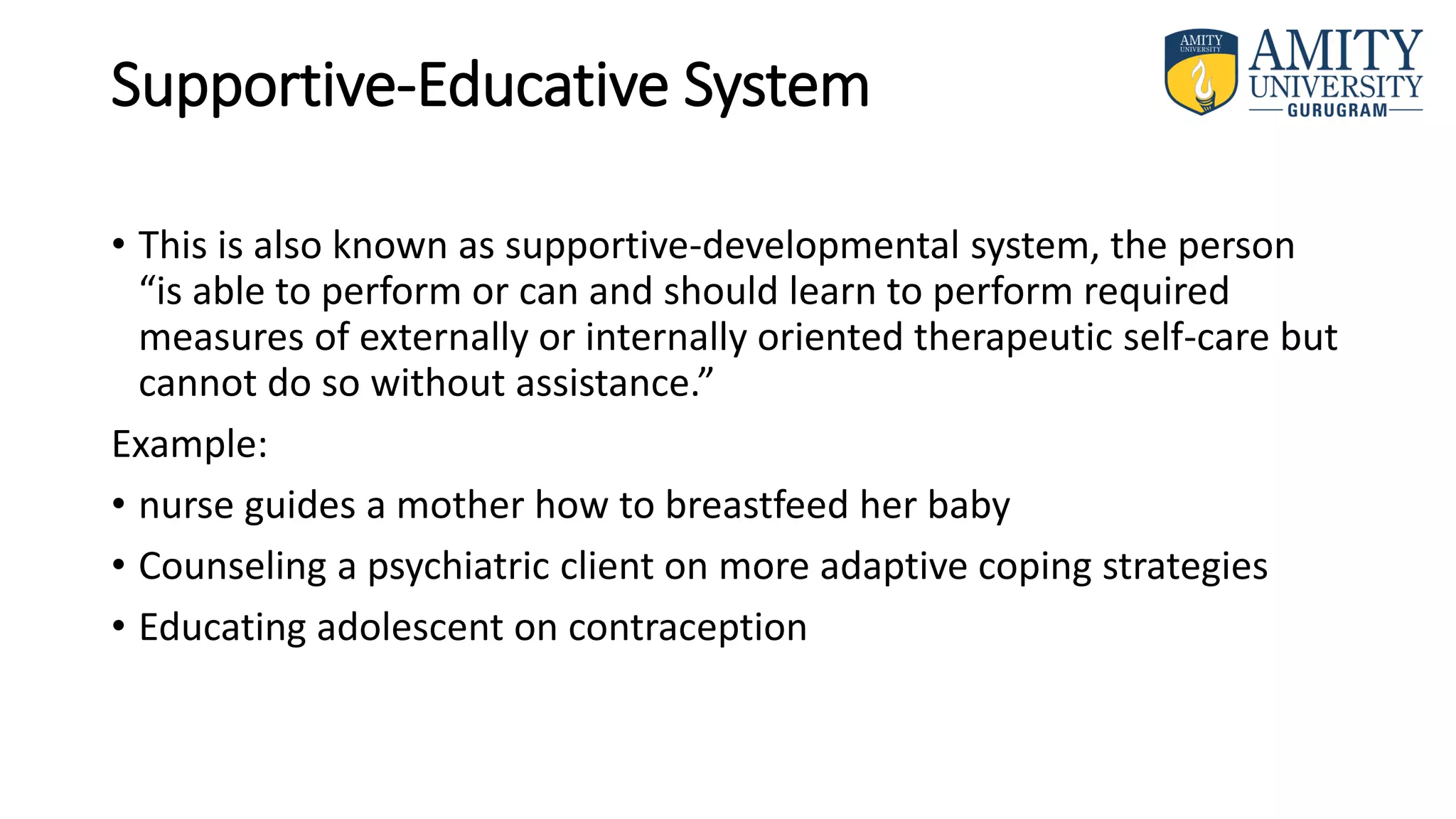
Supportive-Educative System
• This is also known as supportive-developmental system, the person
“is able to perform or can and should learn to perform required
measures of externally or internally oriented therapeutic self-care but
cannot do so without assistance.”
Example:
• nurse guides a mother how to breastfeed her baby
• Counseling a psychiatric client on more adaptive coping strategies
• Educating adolescent on contraception
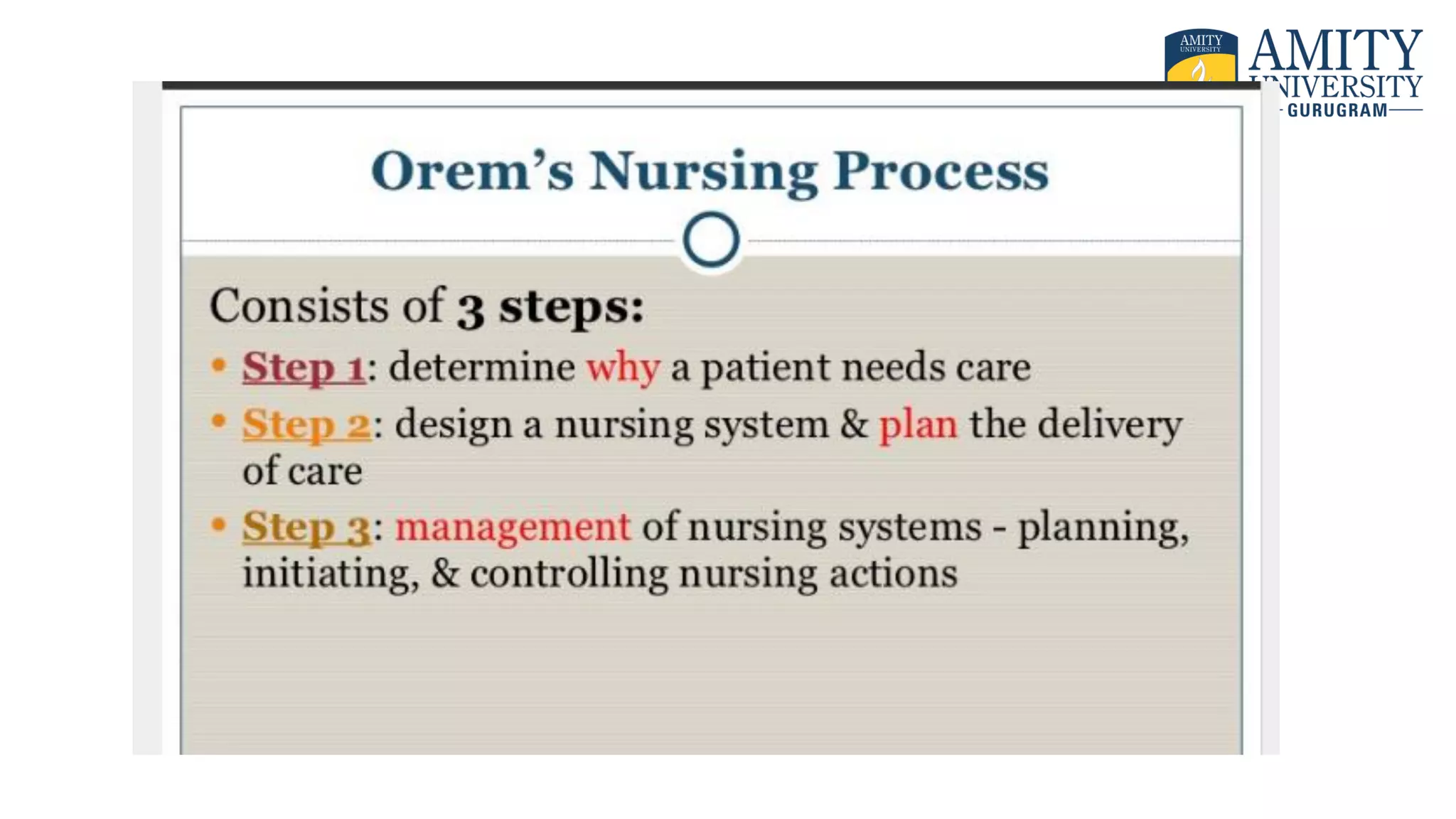
NCP based on Orem’s Theory
To determining self-care deficits
To define the roles of persons or nurse to meet the self-care demands.
Assessment
Step 1 – Collect Data in Six Areas
1. The person’s health status
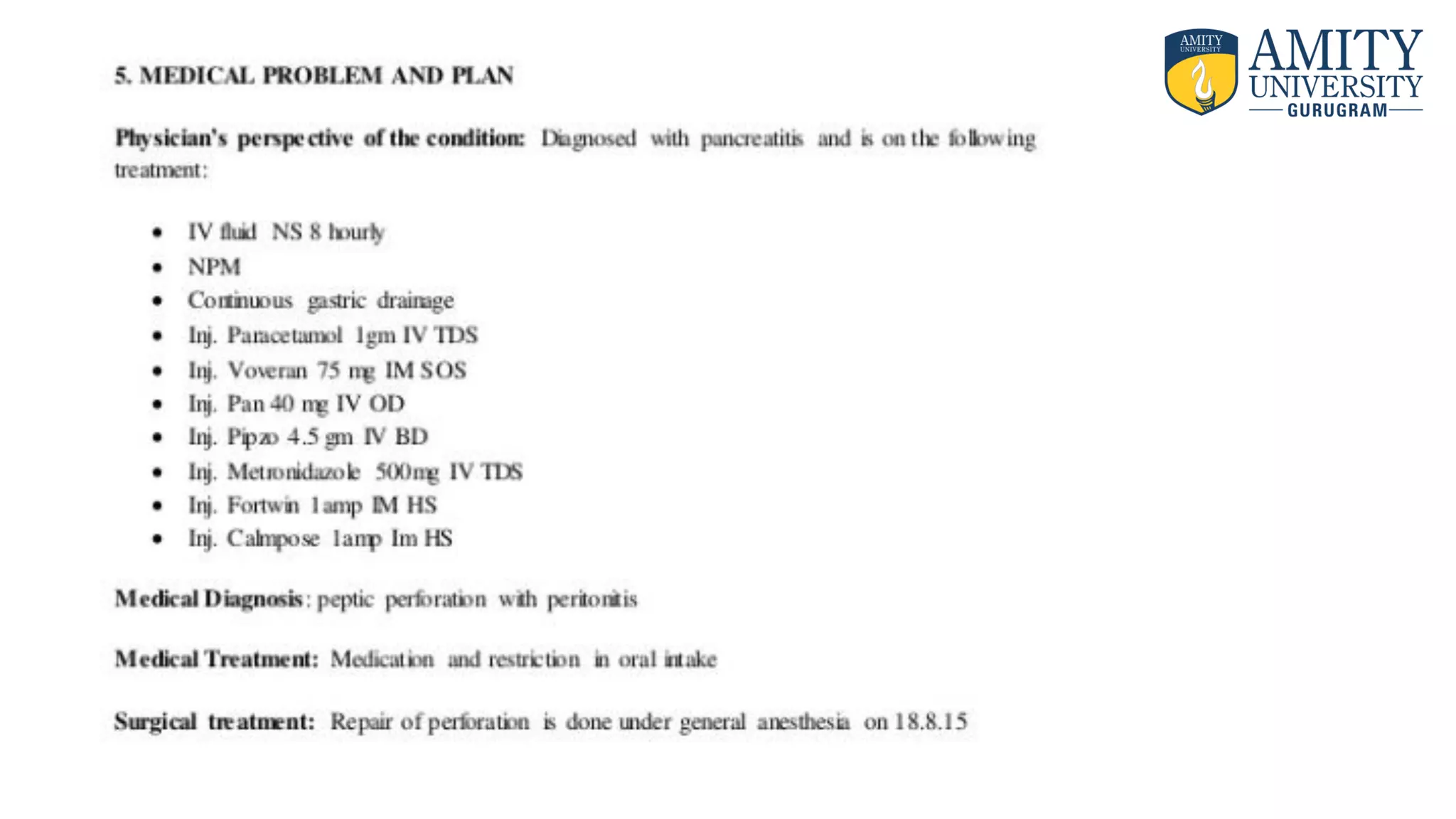
2. The physician’s perspective of the person’s health status
3. The person’s perspective of his or health
4. The health goals within the context of life history, lifestyle, and
health status
5. The person’s requirements for self-care
6. The person’s capacity to perform self-care
Planning
Step 2
• The nurse designs a system that is wholly or partly compensatory or
supportive-educative.
• Selection of combination of ways of helping that will be effective and
efficient in compensating for/overcoming patient’s self-care deficits.
Implementation & Evaluation
Step 3
• Nurse assists the patient or family in self-care matters to achieve
identified and described health and health-related results.
• Actions are directed by etiology component of nursing diagnosis.
Data collection based on Orem’s Self Care Deficit Theory
-Assessment
Assessment
• Three self care requisites
• Universal
• Developmental
• Health Deviation
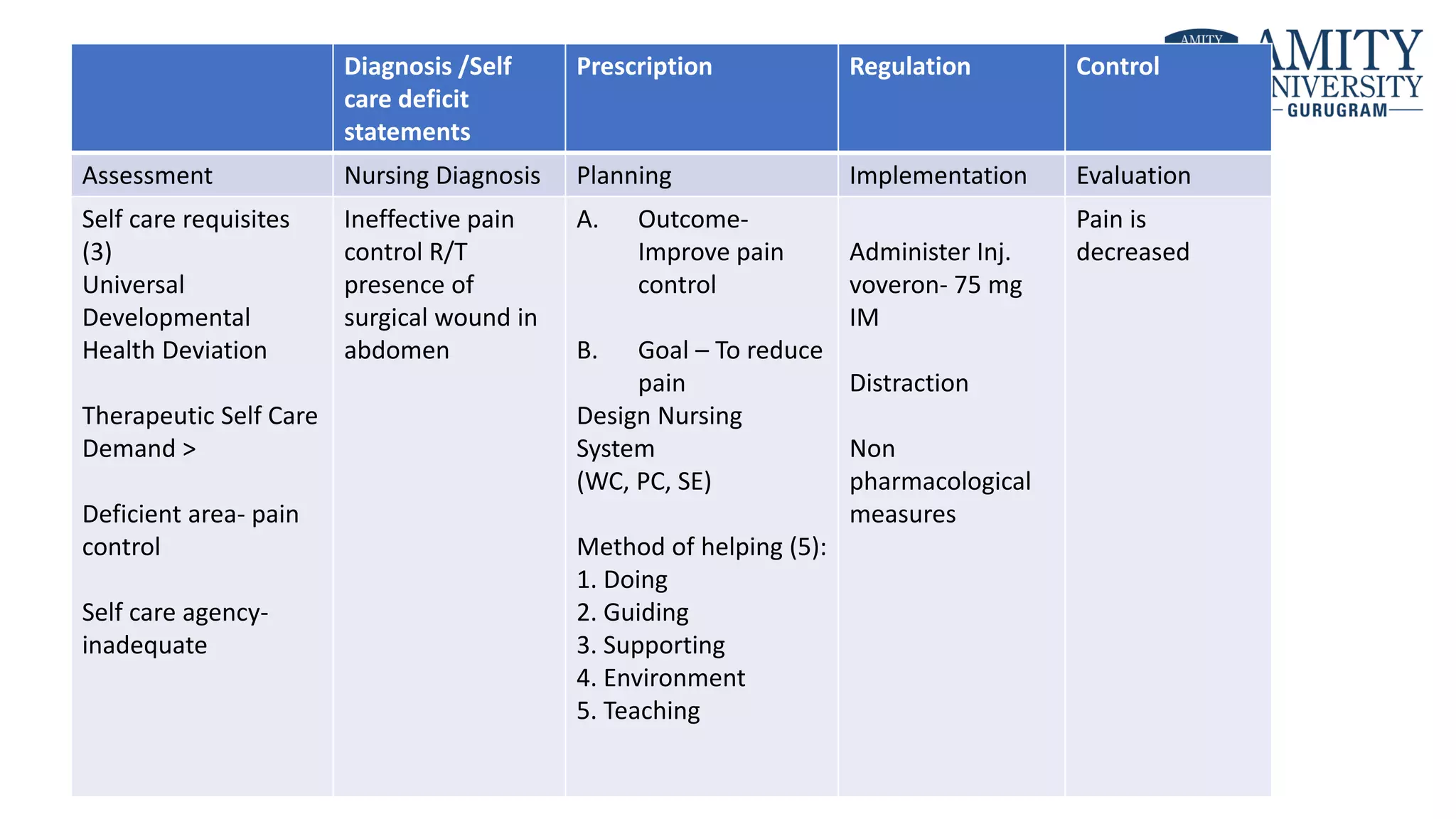
Diagnosis /Self
care deficit
statements
Prescription Regulation Control
Assessment Nursing Diagnosis Planning Implementation Evaluation
Self care requisites
(3)
Universal
Developmental
Health Deviation
Therapeutic Self Care
Demand >
Deficient area- pain
control
Self care agency-
inadequate
Ineffective pain
control R/T
presence of
surgical wound in
abdomen
A. Outcome-
Improve pain
control
B. Goal – To reduce
pain
Design Nursing
System
(WC, PC, SE)
Method of helping (5):
1. Doing
2. Guiding
3. Supporting
4. Environment
5. Teaching
Administer Inj.
voveron- 75 mg
IM
Distraction
Non
pharmacological
measures
Pain is
decreased
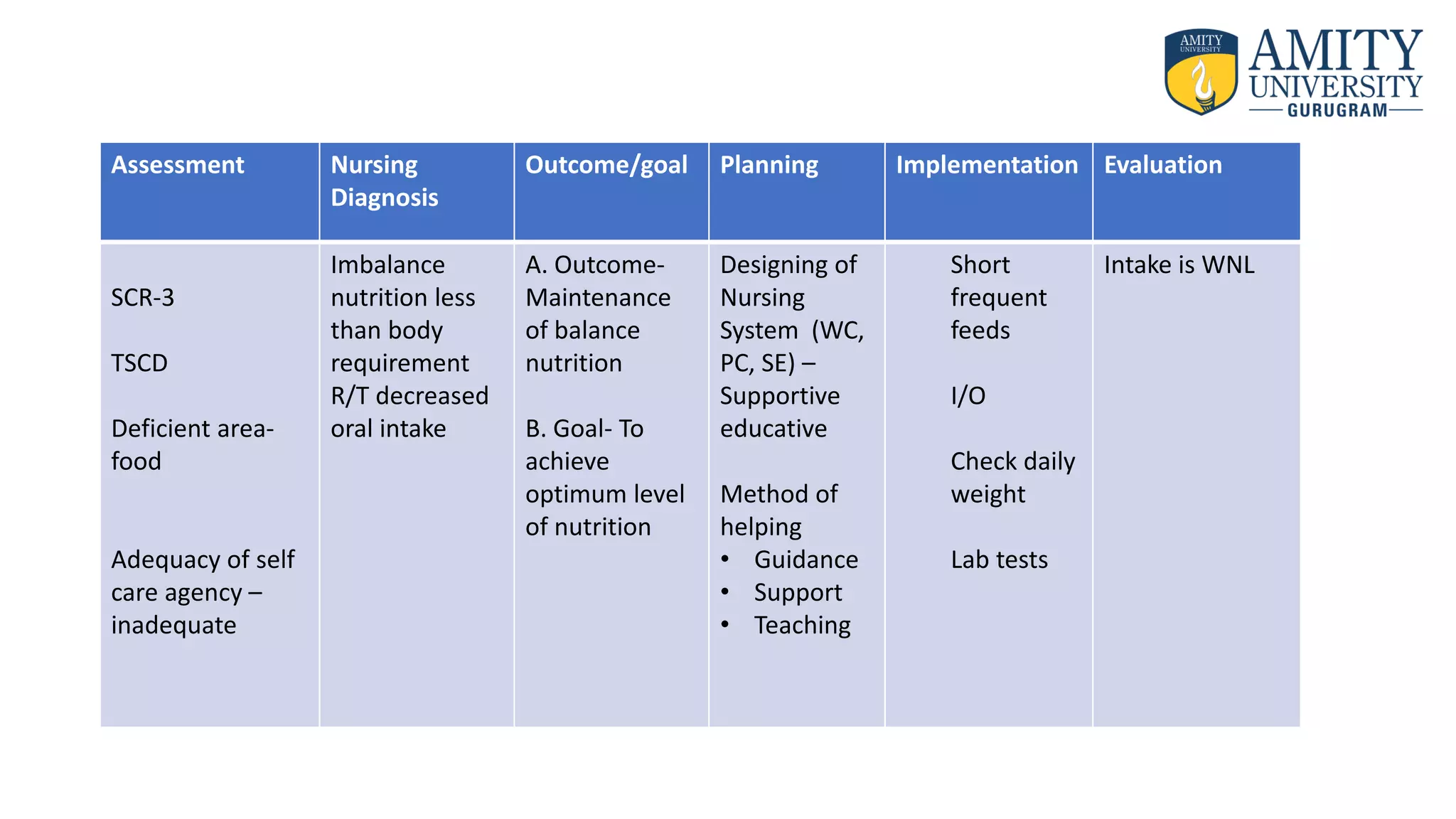
Assessment Nursing
Diagnosis
Outcome/goal Planning Implementation Evaluation
SCR-3
TSCD
Deficient area-
food
Adequacy of self
care agency –
inadequate
Imbalance
nutrition less
than body
requirement
R/T decreased
oral intake
A. Outcome-
Maintenance
of balance
nutrition
B. Goal- To
achieve
optimum level
of nutrition
Designing of
Nursing
System (WC,
PC, SE) –
Supportive
educative
Method of
helping
• Guidance
• Support
• Teaching
Short
frequent
feeds
I/O
Check daily
weight
Lab tests
Intake is WNL
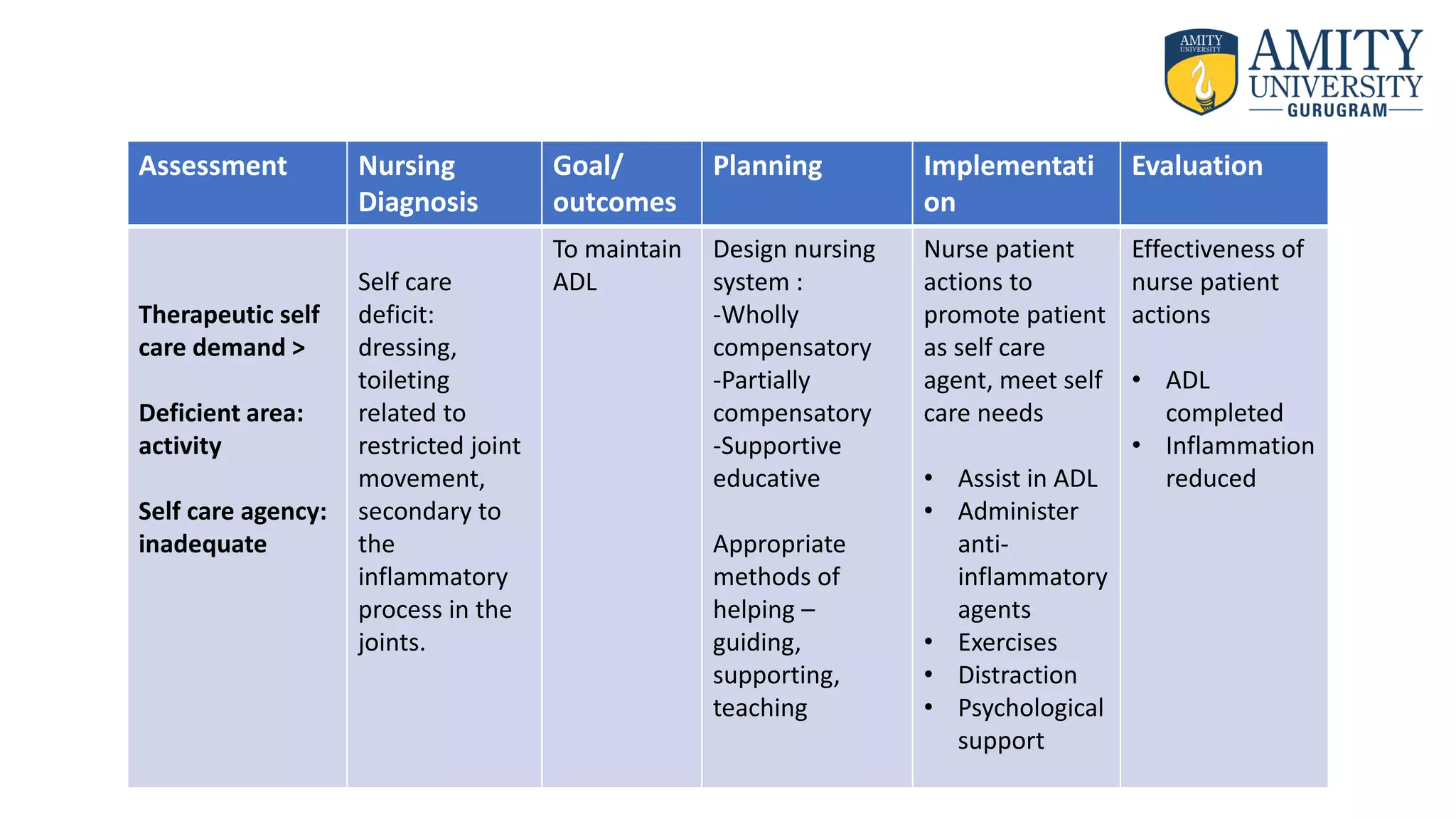
Assessment Nursing
Diagnosis
Goal/
outcomes
Planning Implementati
on
Evaluation
Therapeutic self
care demand >
Deficient area:
activity
Self care agency:
inadequate
Self care
deficit:
dressing,
toileting
related to
restricted joint
movement,
secondary to
the
inflammatory
process in the
joints.
To maintain
ADL
Design nursing
system :
-Wholly
compensatory
-Partially
compensatory
-Supportive
educative
Appropriate
methods of
helping –
guiding,
supporting,
teaching
Nurse patient
actions to
promote patient
as self care
agent, meet self
care needs
• Assist in ADL
• Administer
anti-
inflammatory
agents
• Exercises
• Distraction
• Psychological
support
Effectiveness of
nurse patient
actions
• ADL
completed
• Inflammation
reduced
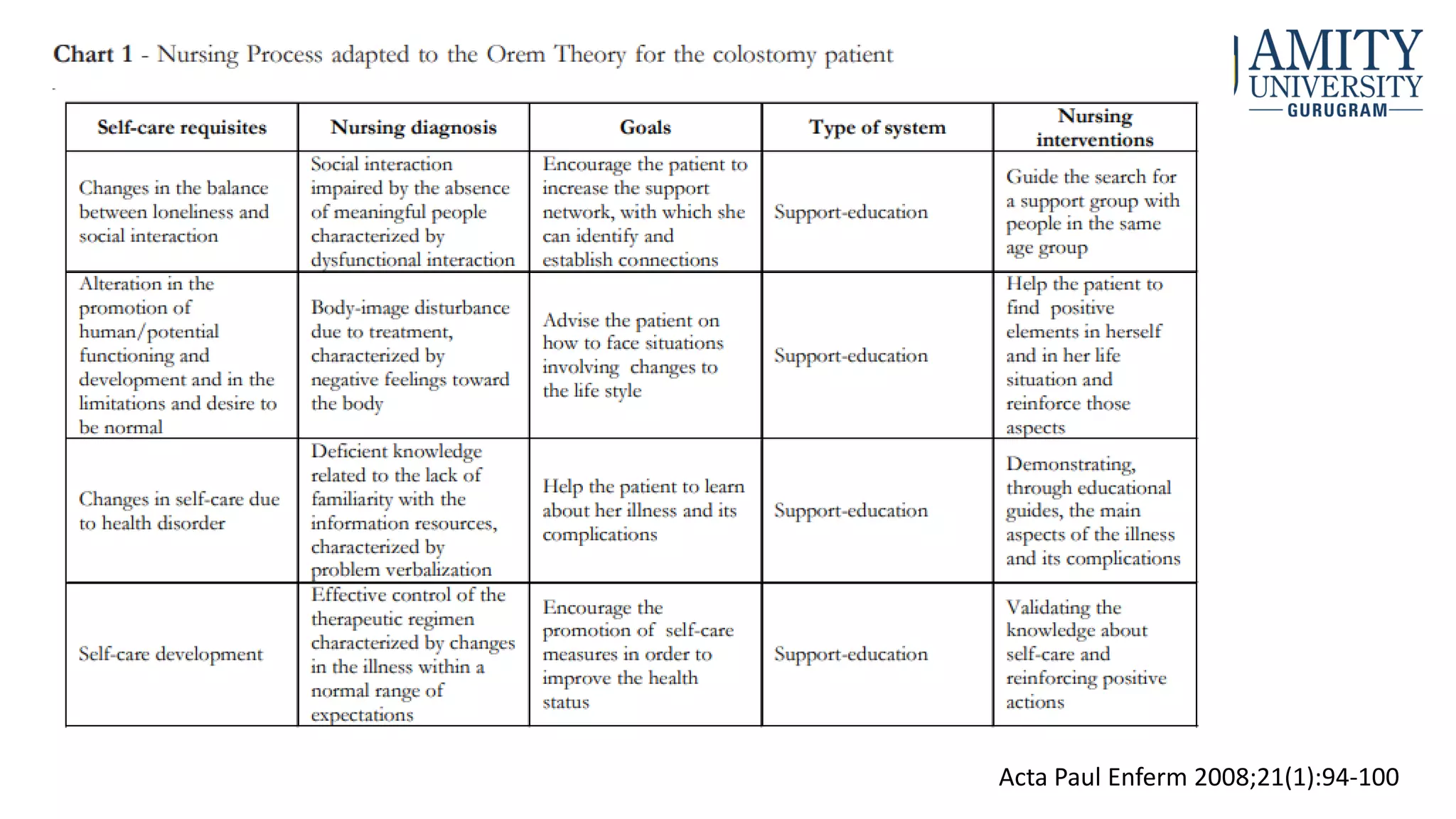
Acta Paul Enferm 2008;21(1):94-100
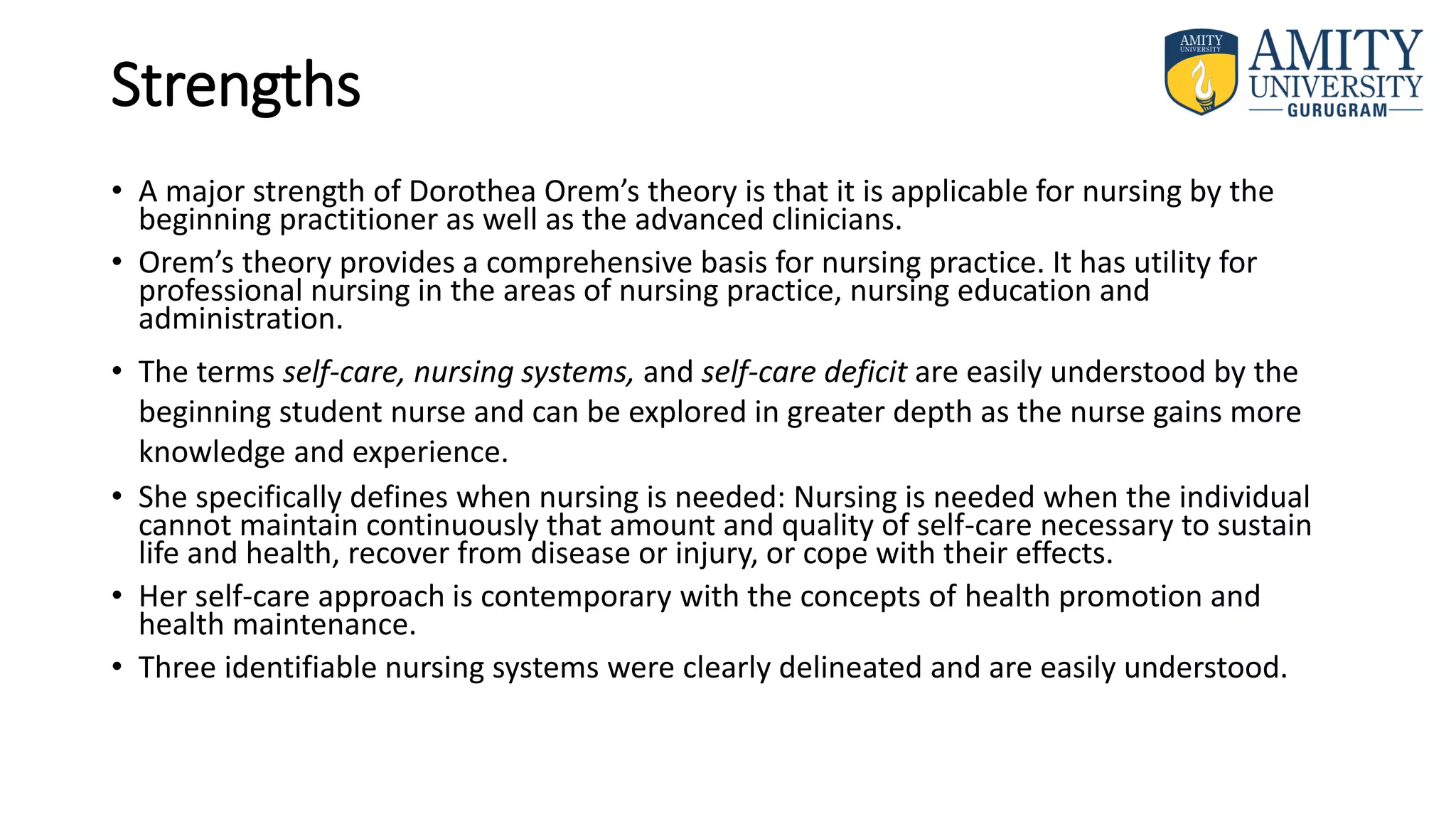
Strengths
• A major strength of Dorothea Orem’s theory is that it is applicable for nursing by the
beginning practitioner as well as the advanced clinicians.
• Orem’s theory provides a comprehensive basis for nursing practice. It has utility for
professional nursing in the areas of nursing practice, nursing education and
administration.
• The terms self-care, nursing systems, and self-care deficit are easily understood by the
beginning student nurse and can be explored in greater depth as the nurse gains more
knowledge and experience.
• She specifically defines when nursing is needed: Nursing is needed when the individual
cannot maintain continuously that amount and quality of self-care necessary to sustain
life and health, recover from disease or injury, or cope with their effects.
• Her self-care approach is contemporary with the concepts of health promotion and
health maintenance.
• Three identifiable nursing systems were clearly delineated and are easily understood.
Summary
• Orem’s theory provides a comprehensive base to nursing practice.
• Orem’s theory of self-care deficits explains how nurses can and
should intervene to help patients maintain autonomy.
• Orem’s contribution to the field of nursing is substantial.
• Nurses diagnose self-care deficits, and this allows them to craft
solutions for their patients
References
• https://nurseslabs.com/dorothea-orems-self-care-theory/
• http://currentnursing.com/nursing_theory/self_care_deficit_theory.h
tml
• https://www.slideshare.net/Shrootishah/orems-theory
• https://online.regiscollege.edu/blog/the-pivotal-role-of-orems-self-
care-deficit-theory/
• https://pdfs.semanticscholar.org/5761/17009ae992dc2e2ee652cb66
c03020d633f2.pdf
Thanks

Orems Self Care Deficit Theory

  • 1.
    Self Care DeficitTheory Dorothea Orem Prof. (Dr.) Smriti Arora Amity College of Nursing Amity University Haryana smritiamit@msn.com
  • 2.
    Background • July 15,1914- Born in Baltimore, Maryland • Father was a construction worker and mother was a homemaker. • Had one sister • June 22, 2007 - Died in Savannah, Georgia. She was 92
  • 5.
    Introduction • The self-caredeficit nursing theory is a grand nursing theory that was developed between 1959 and 2001 by Dorothea Orem. • The theory is also referred to as the Orem's Model of Nursing. • It is particularly used in rehabilitation and primary care settings, where the patient is encouraged to be as independent as possible. • She tried to explain the role of nurse by mentioning terms such as nursing system (wholly compensatory, partly compensatory, supportive and educative system) and nursing agency (abilities). • She defined sick patient as self-care deficit who have fewer agencies (abilities) and more demands (universal, developmental, health related and therapeutic).
  • 6.
    Introduction • This theorywas conceived and developed during a time when Nursing lacked definition and identity within the medical community. • This theory, not only, helped to move nursing from vocation to profession, it “is one of the most commonly used in practice”
  • 9.
    Self-Care Deficit Theory DorotheaOrem’s Self-Care Deficit Theory focuses on each “individual’s ability to perform self-care, defined as ‘the practice of activities that individuals initiate and perform on their own behalf in maintaining life, health, and well-being.’” The Self-Care or Self-Care Deficit Theory of Nursing is composed of three interrelated theories: (1) the theory of self-care, (2) the self-care deficit theory, and (3) the theory of nursing systems, which is further classified into wholly compensatory, partial compensatory and supportive-educative.
  • 10.
    1. Theory ofSelf Care • Is the person able to meet health related self-care requisites? • Is there a need for nursing care? • Based on the concepts of: • Self care • Self care agency • Self care requisites • Therapeutic Self Care Demand
  • 11.
    1. Theory ofSelf Care • Self care • practice of activities that individual initiates and perform on their own behalf to maintain life, health and well being . • Self-care is described as a goal oriented activity that is learned. • Self-care actions are directed toward meeting three different types of selfcare requisites.
  • 12.
    Self-care agency • isviewed as the specialized capabilities in terms of knowledge and skills an individual needs in order to participate or engage in self-care. • The individual’s ability to perform self-care activities consists of two agents: • Self-care Agent: person who provides the self-care • Dependent Care Agent: person other than the individual who provides the care (such as a parent). • Affected by basic conditioning factors - age, developmental state, life experience, socio-cultural orientation, health and available resources.
  • 13.
    Theory of SelfCare • Self care requisites • action directed towards provision of self care. • Categories of self care requisites are : • Universal self care requisites • Developmental self care requisites • Health deviation self care requisites
  • 14.
  • 15.
    Self care requisites(3) 1. Universal self care requisites • Associated with life processes and the maintenance of the integrity of human structure and functioning • Orem identifies these requisites as: • Maintenance of sufficient intake of air, water, food • Provision of care associated with elimination process • Balance between activity and rest, between solitude and social interaction • Prevention of hazards to human life, well being • Promotion of human functioning
  • 17.
    2. Developmental selfcare requisites • Needs associated with developmental processes/ derived from a condition or associated with an event • E.g. adjusting to a new job • adjusting to body changes
  • 18.
    3. Health deviationself care requisites • Required in conditions of illness, injury, or disease who are undergoing treatment. • Seeking and securing appropriate medical assistance • Being aware of and attending to the effects and results of pathologic conditions • Effectively carrying out medically prescribed measures • Modifying self concepts in accepting oneself as being in a particular state of health and in specific forms of health care • Learning to live with effects of pathologic conditions • E.g. learning to walk with crutches after fracture
  • 22.
    2. Theory ofSelf Care Deficit
  • 23.
    Major Concepts ofthe Self-Care Deficit Theory • Nursing- Nursing is an art, through which the practitioner of nursing, gives specialized assistance to persons with disabilities, which makes more than ordinary assistance necessary to meet needs for self-care. The nurse also intelligently participates in the medical care, which the individual receives from the physician. • Humans - Humans are defined as “men, women, and children cared for either singly or as social units,” and are the “material object” of nurses and others who provide direct care. • Environment- The environment has physical, chemical and biological features. It includes the family, culture, and community.
  • 24.
    Major Concepts ofthe Self-Care Deficit Theory • Health- Health is “being structurally and functionally whole or sound.” Also, health is a state that encompasses both the health of individuals and of groups, and human health is the ability to reflect on one’s self, to symbolize experience, and to communicate with others. • Self-Care- it is the performance or practice of activities that individuals initiate and perform on their own behalf to maintain life, health, and well-being. • Self-Care Agency- it is the human’s ability or power to engage in self- care and is affected by basic conditioning factors.
  • 25.
    Basic Conditioning Factors(10) • personal conditions or environmental circumstances that may affect the operability or adequacy of peoples capabilities to care for themselves. • age, gender, developmental state, health state, socio-cultural orientation, health care system factors, family system factors, patterns of living, environmental factors, and resource adequacy and availability.
  • 26.
    • Therapeutic Self-careDemand • It is the totality of “self-care actions to be performed for some duration in order to meet known self-care requisites by using valid methods and related sets of actions and operations.”
  • 27.
    Self-Care Deficit • Self-careDeficit delineates when nursing is needed. • Nursing is required when an adult (or in the case of a dependent, the parent or guardian) is incapable of or limited in the provision of continuous effective self-care.
  • 28.
    3. Theory ofNursing Systems • This system is activated when the client’s therapeutic self-care demand exceeds available self-care agency, leading to the need for nursing. • Nursing System is the product of a series of relations between nurse and client. • This describes: • How the patient’s self care needs will be met by the nurse, the patient, or both • Nursing responsibilities • Roles of nurse and patient • Rationales for nurse patient relationship • Types of actions needed to meet patient’s demands • Designed by the nurse • Based on the assessment of patient’s ability to perform self care activities
  • 29.
    • Nursing Agency •Nursing Agency is a complex property or attribute of people educated and trained as nurses that enables them to act, to know, and to help others, to meet their therapeutic self-care demands by exercising or developing their own self-care agency.
  • 30.
    Nursing System • Identifies3 classifications of nursing system to meet the self care requisites of the patient:- • Wholly compensatory system • Partly compensatory system • Supportive – educative system
  • 31.
    Wholly Compensatory NursingSystem • This is represented by a situation in which the individual is unable to engage in those self-care actions requiring self-directed and controlled ambulation. • Persons with these limitations are socially dependent on others for their continued existence and well-being. Example: • Care of a newborn • Care of client recovering from surgery in a post-anesthesia care unit • Client in coma • Severely mentally retarded
  • 33.
    Partial Compensatory NursingSystem • This is represented by a situation in which both nurse and patient can perform care measures or other actions involving manipulative tasks or ambulation • A patient can meet some self care requisites but needs a nurse to help meet others. Example: • Nurse can assist postoperative client to ambulate • Nurse can bring a meal tray for client who can feed himself
  • 35.
    Supportive-Educative System • Thisis also known as supportive-developmental system, the person “is able to perform or can and should learn to perform required measures of externally or internally oriented therapeutic self-care but cannot do so without assistance.” Example: • nurse guides a mother how to breastfeed her baby • Counseling a psychiatric client on more adaptive coping strategies • Educating adolescent on contraception
  • 37.
    NCP based onOrem’s Theory To determining self-care deficits To define the roles of persons or nurse to meet the self-care demands.
  • 39.
    Assessment Step 1 –Collect Data in Six Areas 1. The person’s health status 2. The physician’s perspective of the person’s health status 3. The person’s perspective of his or health 4. The health goals within the context of life history, lifestyle, and health status 5. The person’s requirements for self-care 6. The person’s capacity to perform self-care
  • 40.
    Planning Step 2 • Thenurse designs a system that is wholly or partly compensatory or supportive-educative. • Selection of combination of ways of helping that will be effective and efficient in compensating for/overcoming patient’s self-care deficits.
  • 41.
    Implementation & Evaluation Step3 • Nurse assists the patient or family in self-care matters to achieve identified and described health and health-related results. • Actions are directed by etiology component of nursing diagnosis.
  • 42.
    Data collection basedon Orem’s Self Care Deficit Theory -Assessment
  • 43.
    Assessment • Three selfcare requisites • Universal • Developmental • Health Deviation
  • 48.
    Diagnosis /Self care deficit statements PrescriptionRegulation Control Assessment Nursing Diagnosis Planning Implementation Evaluation Self care requisites (3) Universal Developmental Health Deviation Therapeutic Self Care Demand > Deficient area- pain control Self care agency- inadequate Ineffective pain control R/T presence of surgical wound in abdomen A. Outcome- Improve pain control B. Goal – To reduce pain Design Nursing System (WC, PC, SE) Method of helping (5): 1. Doing 2. Guiding 3. Supporting 4. Environment 5. Teaching Administer Inj. voveron- 75 mg IM Distraction Non pharmacological measures Pain is decreased
  • 49.
    Assessment Nursing Diagnosis Outcome/goal PlanningImplementation Evaluation SCR-3 TSCD Deficient area- food Adequacy of self care agency – inadequate Imbalance nutrition less than body requirement R/T decreased oral intake A. Outcome- Maintenance of balance nutrition B. Goal- To achieve optimum level of nutrition Designing of Nursing System (WC, PC, SE) – Supportive educative Method of helping • Guidance • Support • Teaching Short frequent feeds I/O Check daily weight Lab tests Intake is WNL
  • 50.
    Assessment Nursing Diagnosis Goal/ outcomes Planning Implementati on Evaluation Therapeuticself care demand > Deficient area: activity Self care agency: inadequate Self care deficit: dressing, toileting related to restricted joint movement, secondary to the inflammatory process in the joints. To maintain ADL Design nursing system : -Wholly compensatory -Partially compensatory -Supportive educative Appropriate methods of helping – guiding, supporting, teaching Nurse patient actions to promote patient as self care agent, meet self care needs • Assist in ADL • Administer anti- inflammatory agents • Exercises • Distraction • Psychological support Effectiveness of nurse patient actions • ADL completed • Inflammation reduced
  • 51.
    Acta Paul Enferm2008;21(1):94-100
  • 52.
    Strengths • A majorstrength of Dorothea Orem’s theory is that it is applicable for nursing by the beginning practitioner as well as the advanced clinicians. • Orem’s theory provides a comprehensive basis for nursing practice. It has utility for professional nursing in the areas of nursing practice, nursing education and administration. • The terms self-care, nursing systems, and self-care deficit are easily understood by the beginning student nurse and can be explored in greater depth as the nurse gains more knowledge and experience. • She specifically defines when nursing is needed: Nursing is needed when the individual cannot maintain continuously that amount and quality of self-care necessary to sustain life and health, recover from disease or injury, or cope with their effects. • Her self-care approach is contemporary with the concepts of health promotion and health maintenance. • Three identifiable nursing systems were clearly delineated and are easily understood.
  • 54.
    Summary • Orem’s theoryprovides a comprehensive base to nursing practice. • Orem’s theory of self-care deficits explains how nurses can and should intervene to help patients maintain autonomy. • Orem’s contribution to the field of nursing is substantial. • Nurses diagnose self-care deficits, and this allows them to craft solutions for their patients
  • 55.
    References • https://nurseslabs.com/dorothea-orems-self-care-theory/ • http://currentnursing.com/nursing_theory/self_care_deficit_theory.h tml •https://www.slideshare.net/Shrootishah/orems-theory • https://online.regiscollege.edu/blog/the-pivotal-role-of-orems-self- care-deficit-theory/ • https://pdfs.semanticscholar.org/5761/17009ae992dc2e2ee652cb66 c03020d633f2.pdf
  • 56.