Dr Paterson Mastered in Public Health Nursing,
completed Doctor of nursing science degree at Boston
University – dissertation on comfort.
Dr Zderad Mastered in Psychiatry, Doctorate
at Georgetown University in philosophy with dissertation
on Empathy.
Met in the 1950’s while working at Catholic
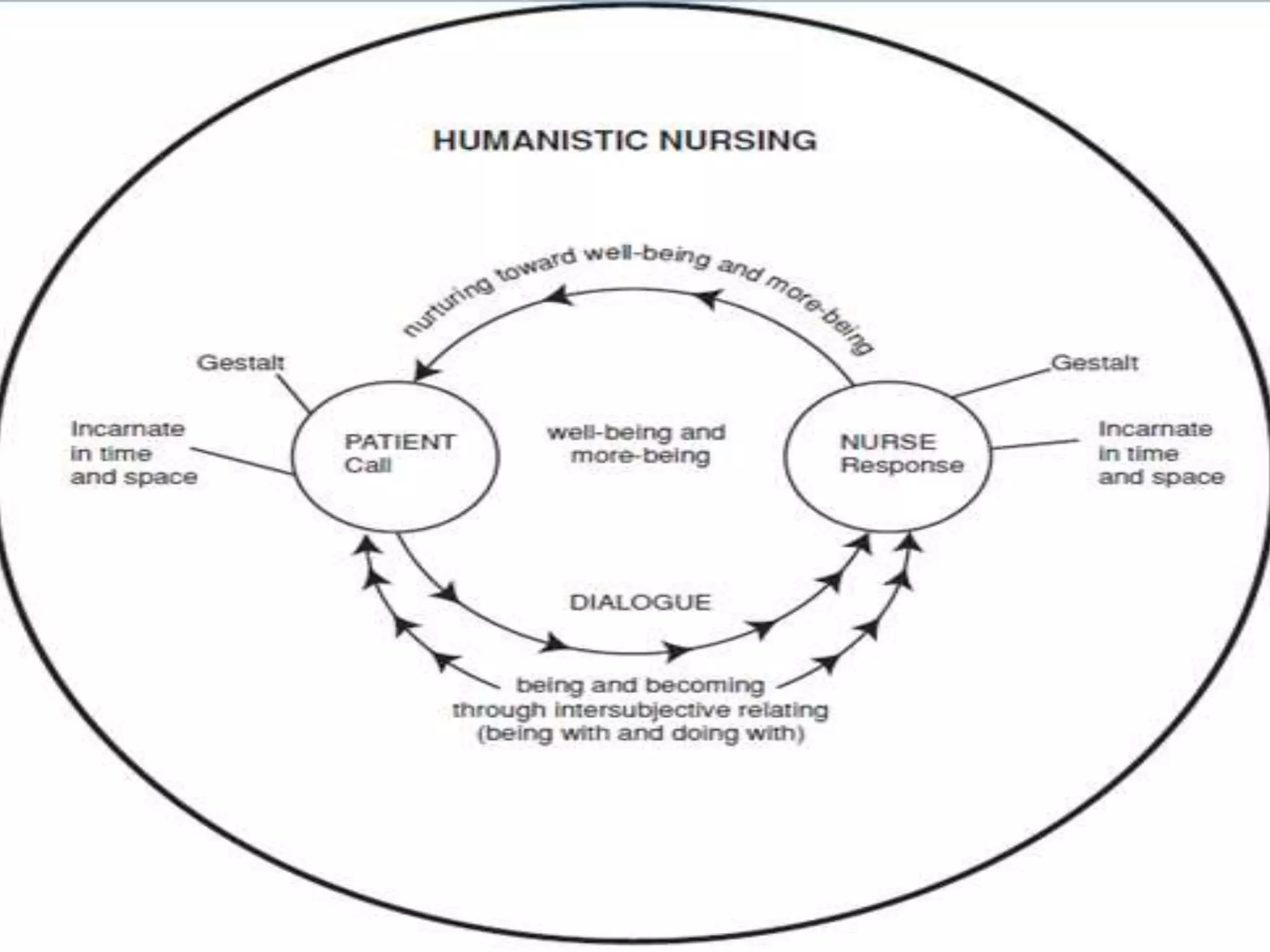
University, where their task was to create a new
program that would include Psychiatric and
Community Health components as part of the
graduate program.
Friendship that has lasted over 35years.
Shared experiences, ideas and insight to form a
concept that evolved into the Formal Theory of
Humanistic Nursing.
Josephine G. Paterson and Loretta T. Zderad first
published their book Humanistic Nursing in 1976.
Their initial commitment to creativity conceptualize
nursing constructs developed into “Nursology”, a
phenomenological approach to studying nursing as an
existentialexperience.
“Human experience”
MAJOR CONCEPTS
• Humanistic nursing theory is ‘Multidimensional ’ and
it is an ‘Interactive Theory’.
• In Humanistic nursing theory the components
identified as humans are the patient (can refer to the
person, family, community ) and the nurse.
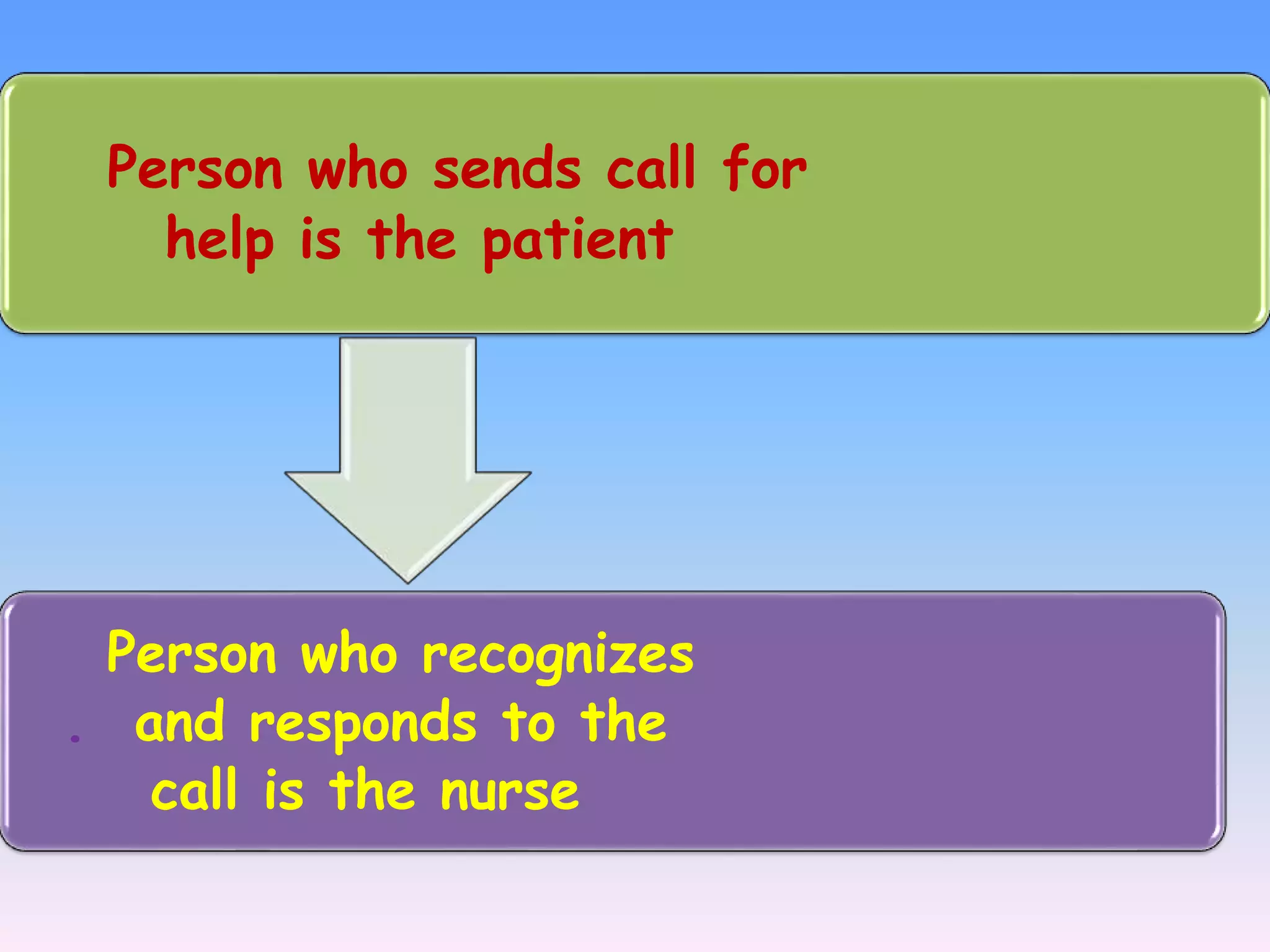
Person who sends call for
help is the patient
Person who recognizes
. and responds to the
call is the nurse
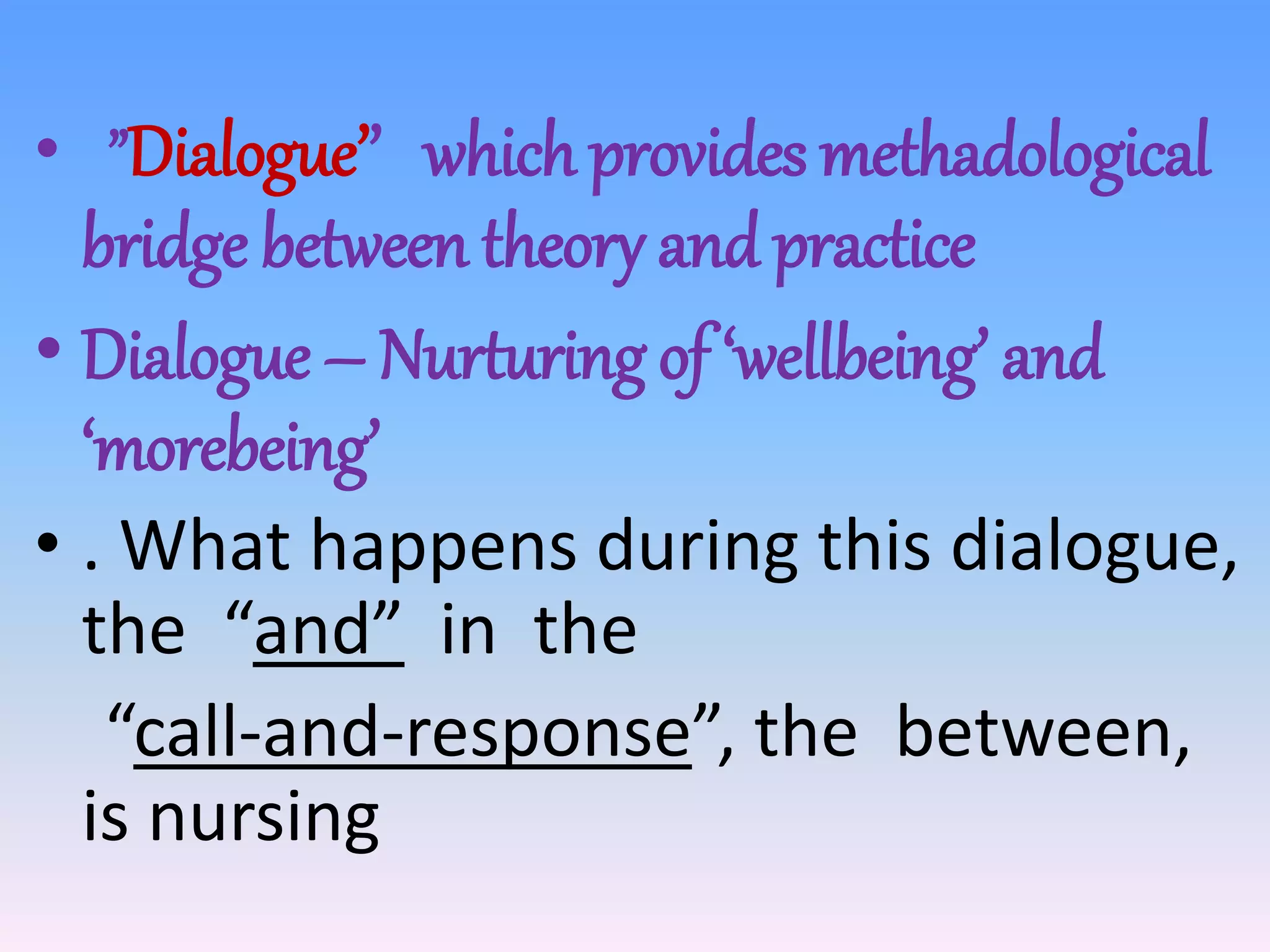
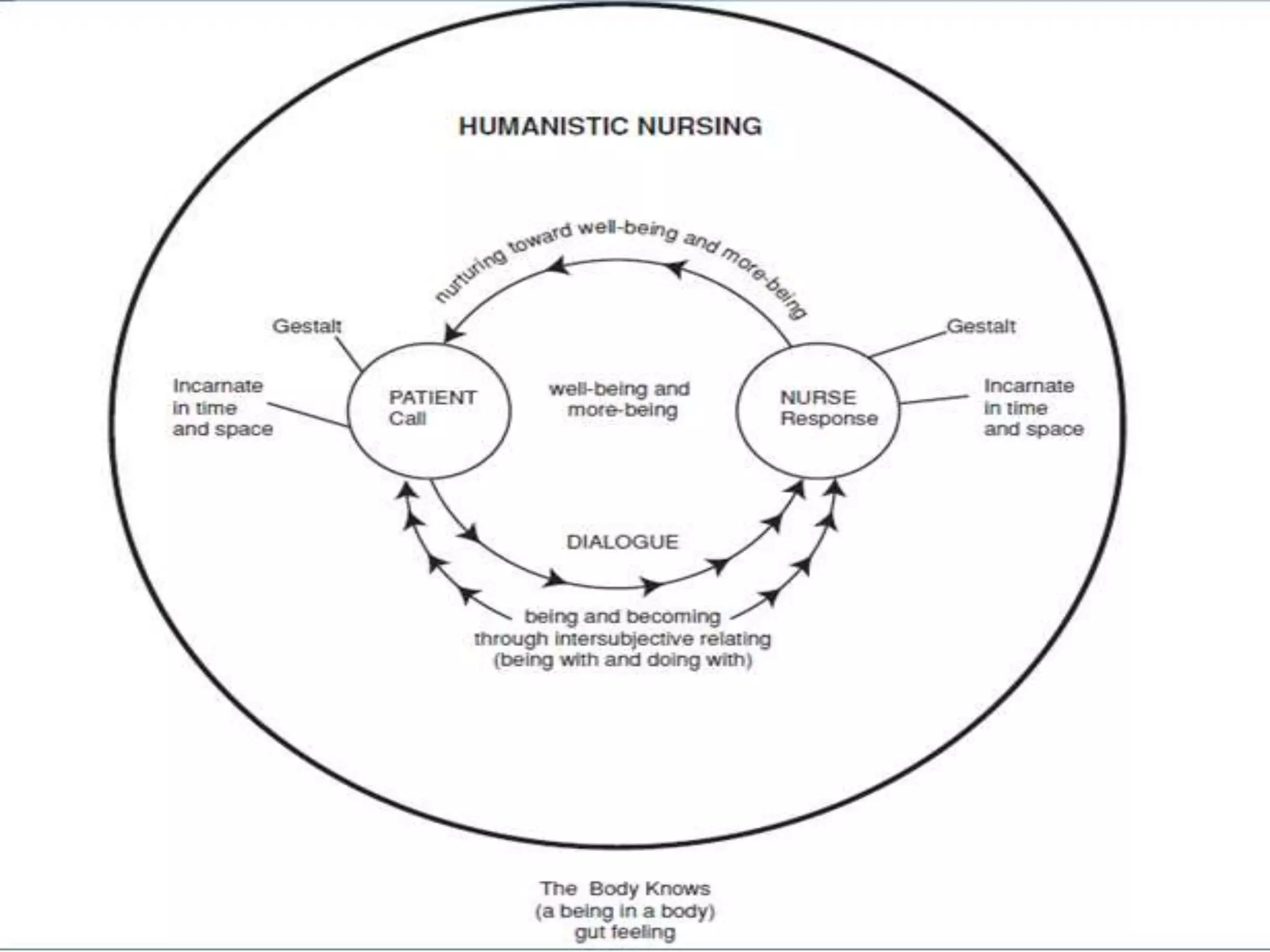
• ”Dialogue’’ which provides methadological
bridge between theory and practice
• Dialogue – Nurturing of ‘wellbeing’ and
‘morebeing’
• . What happens during this dialogue,
the “and” in the
“call-and-response”, the between,
is nursing
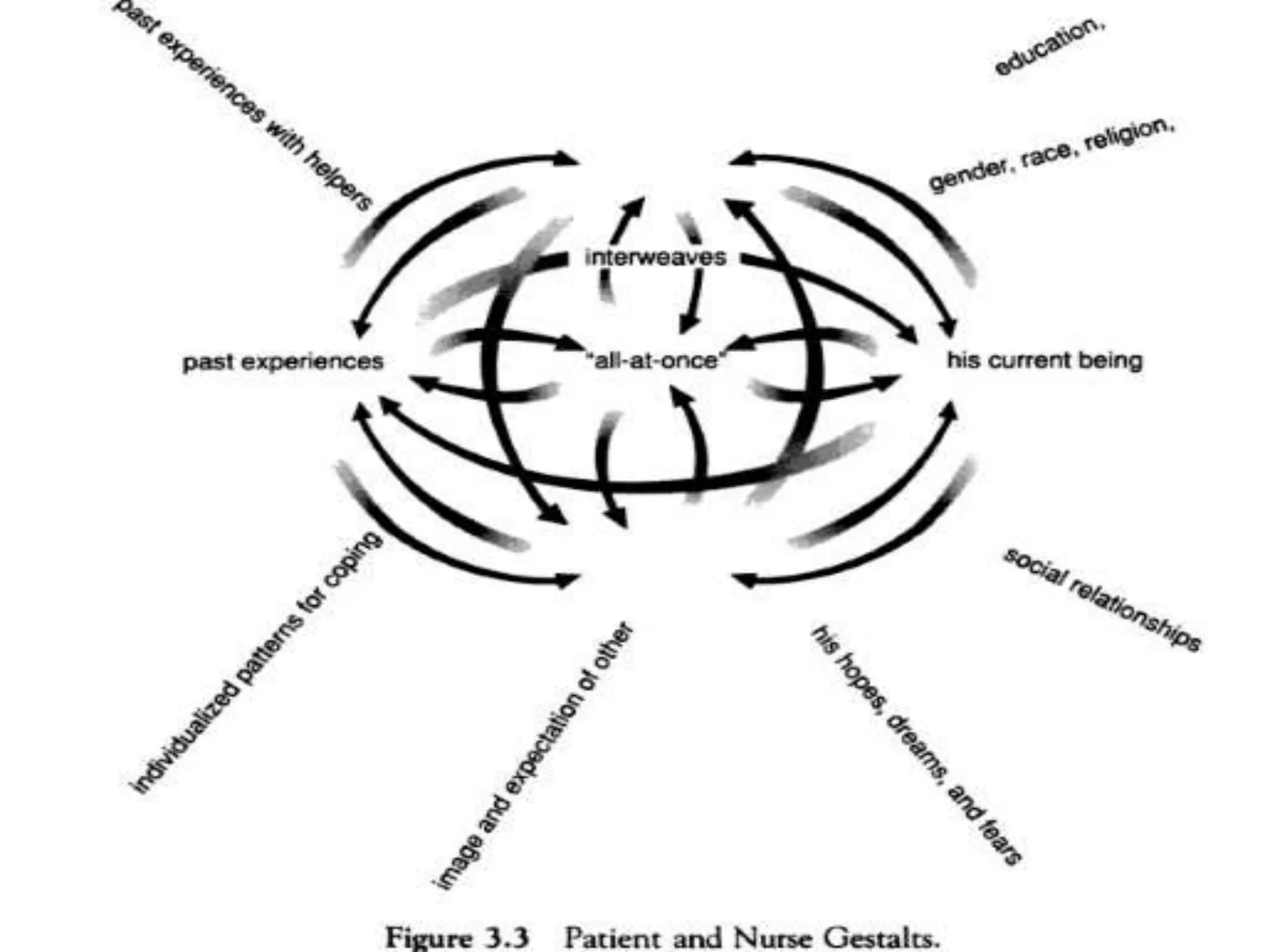
• Although the call and response is between
the nurse and the patient, it is important to
understand that all else that makes the
individual person to interact.
• The nurse interweaves her professional
identity and professional education, with all
her other life experiences to create her own
tapestry, which she projects through her
nursing responses.
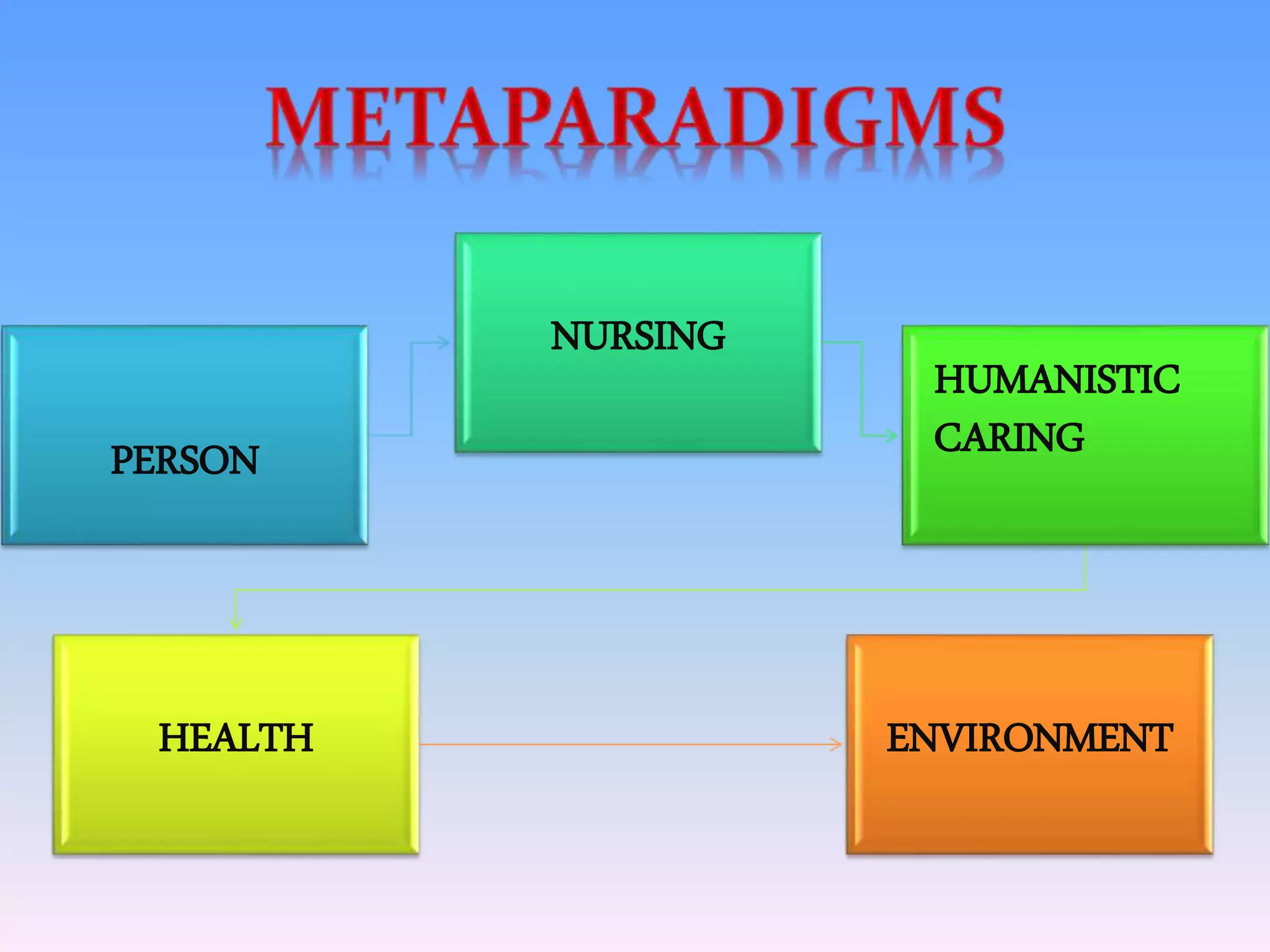
PERSON
NURSING
HUMANISTIC
CARING
HEALTH ENVIRONMENT
Person is viewed as an “Incarnate being”
always becoming in relation with man and
things in a world of time and space’’
Person have the capability of self reflection.
Nursing is conceptualized as a lived human act
, a response to a human act ,a response to
human situation.
The dialogical quality of nursing is emphasized;
nursing is viewed as a transaction between
persons.
• Transactional relationship whose
meaningfulness demands conceptualization
founded on a nurse’s existential awareness of
self and the other.
• Humanistic nursing aims at the development
of human potential , at wellbeing and more
being
• Nursing’s concern is said to be ‘not merely with
a person’s wellbeing but within his morebeing;
with helping him become more as humanly
possible in his particular life situation.
• Wellbeing and Morebeing, that health is
conceptualized as somewhat more than the
freedom from disease.
View person as actually living in two worlds.
o An angular, inner world, also described as a
biased or shaded reality.
o The objective world , of persons and things.
Openness to and acceptance of the other’s
inner world is essential for true interaction
between persons.
The existential literature, descriptions of what
man has come to know and understand in his
experience, has evolved from the use of the
phenomenological approach.
In phenomenology a statement’s validity is
based on whether or not it describes the
phenomenon accurately.
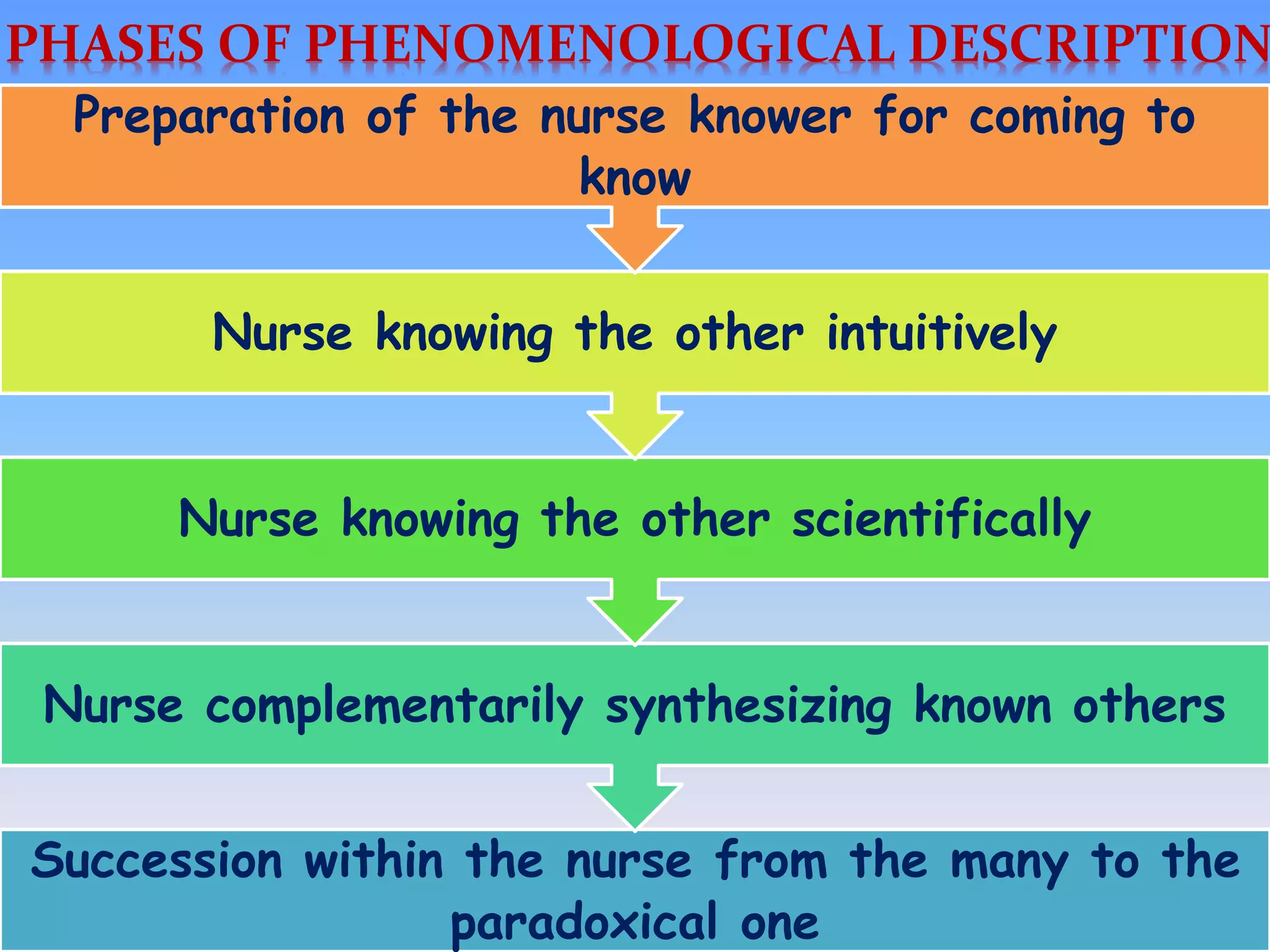
Succession within the nurse from the many to the
paradoxical one
Nurse complementarily synthesizing known others
Nurse knowing the other scientifically
Nurse knowing the other intuitively
Preparation of the nurse knower for coming to
know
PHASES OF PHENOMENOLOGICAL DESCRIPTION
1.Preparation of the nurse
knower for coming to know
Understandingownviewpoint/anglehelpstomakesenseandaid
inacquiringmeaningofexperience
”Angularviewinvolvesthegestaltofthehuman.
Shestruggleswithunderstandingandidentifyingherown
“angularview”
Beingopentonewanddifferentideas/understandingsisa
necessarypositioninbeingabletogettoknowtheother
intuitively
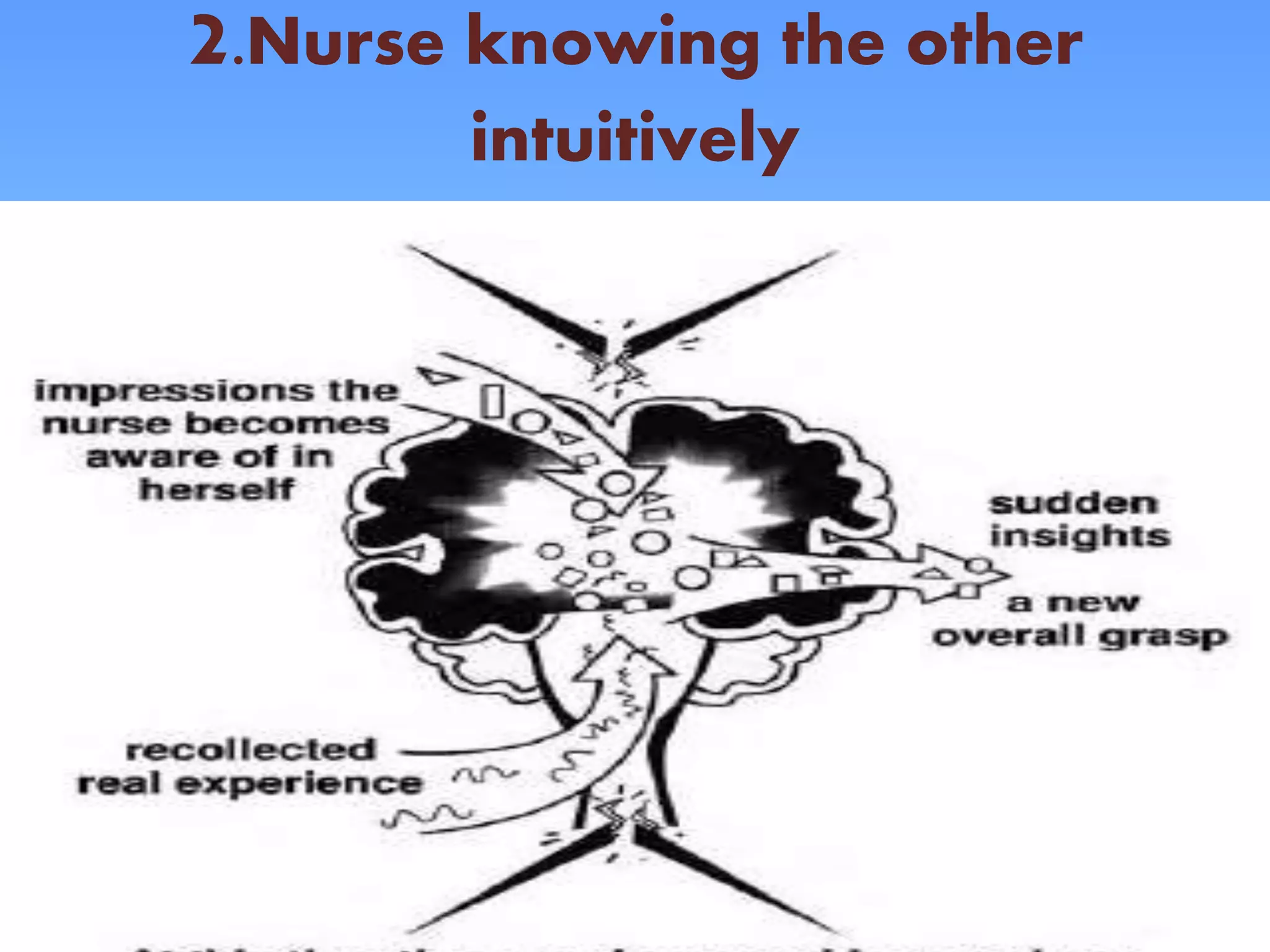
2.Nurse knowing the other
intuitively
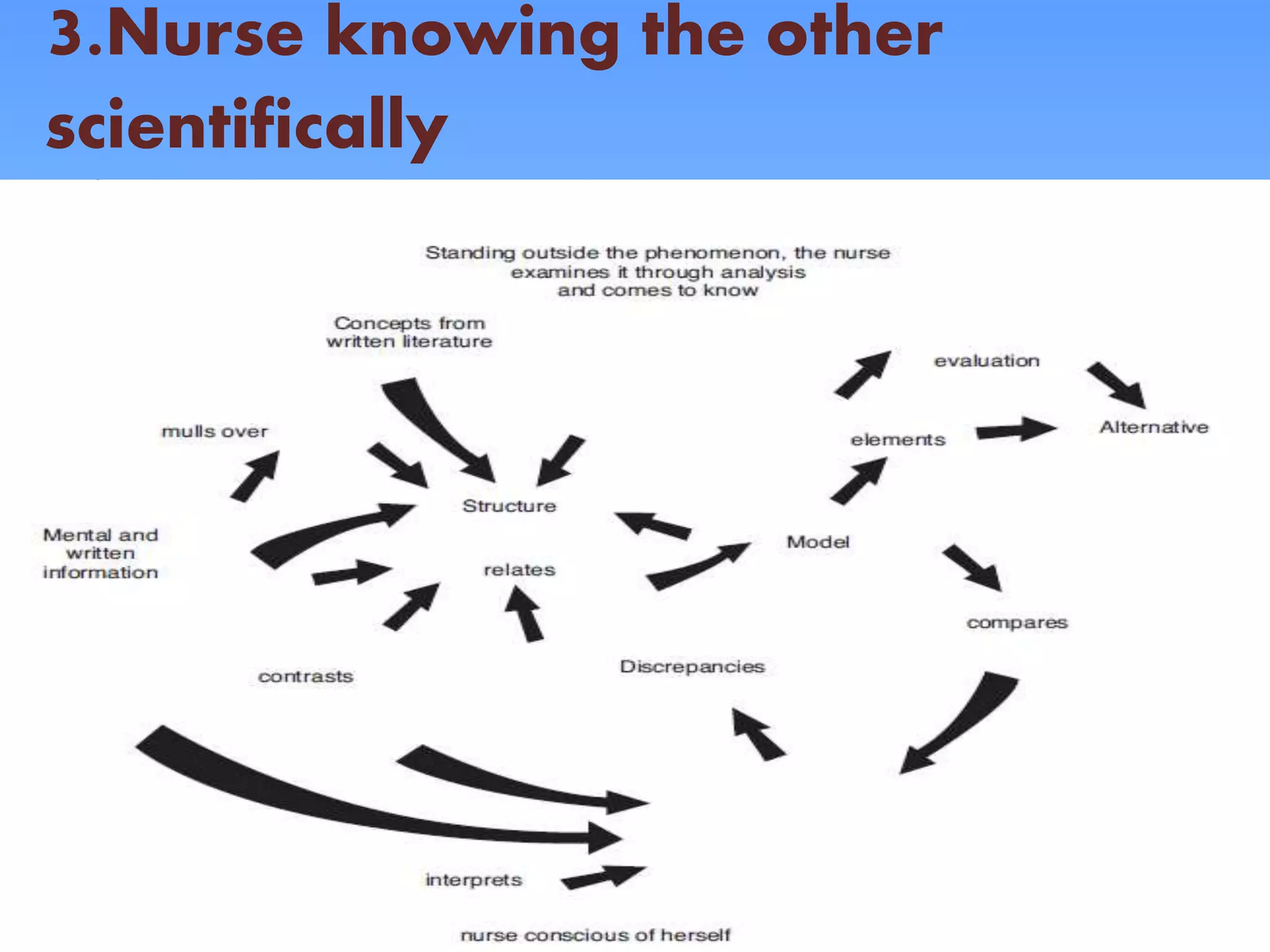
3.Nurse knowing the other
scientifically
4.Nurse complementarily synthesizing
known others
• Theabilityofthenursetodeveloporseethemselvesasa
sourceofknowledge,
tocontinuallydevelopthenursing
communitythrougheducation,andincreased
understandingoftheir learnedexperiences.
5.Succession within the nurse from
the many to the paradoxical one
• Allowsforreflection,correctionandexpansionof
ownangularinterpretation
• Impliesuniversalunderstandingfromthesimplest
tomostcomplexdialogueandinteractionsbetween
thenurseandassimilatespatientexperience.
• ThePhenomenologicalmethodisproposedasa
descriptiveapproachforparticipantsinthe
nursingsituationtostudy,interpret,andattest
thenatureandmeaningofthelivedevents.
• Agroupresearchprojectthatwasconductedin
theclinicalsettingofapsychiatric hospital by
Paterson and Zderad(1988)
Anefforttobetterunderstandwhysomepatients
stayedinthedayhospitalandothersleft, the
nursingstaffconductedaphenomenologicalstudy
thatinvestigatedtheexperiencesofpatientsasthey
enterandbecomeengagedintreatmentinaday
hospitalsystem.
Theinitialstepintheprocess,inDr.Paterson’sandDr.
Zderad’sterms,istopreparethenurseknowerforcoming
toknow.
Literaturewashandedoutonthisand
meetingswereheldtodiscussthearticlesandany
questionsaboutthem.Theyalsosharedtheirfeelingsabout
thismethod,theirconcerns,andotherexperiencesrelated
tothisstudy.
Astheydidthis,theybegantoestablishan
atmosphereofopennessandtrust.
• . Once the descriptions were obtained , they interpreted
with the phenomenological method of reflecting, intuiting,
analyzing, and synthesizing.
They interviewed 15 patients over a period of
8 months, on their day of admission and every 4 weeks
thereafter until discharge.
They found from interviews that there were many anxiety-
producing experiences on the first day in the day hospital, but
very few anxiety-reducing experiences that offered the patient
comfort and support
• After reviewing the interviews of a patient who had a
particularly difficult course of treatment, one of the
nurses who was on her treatment team remarked,
“We weren’t listening to what she was telling us—we
just didn’t hear the pain. ”Another nurse had a
similar insight into a patient’s experiences
In future interactions with this patient the nurse was
empathic and supportive rather than judgmental and
angry.
• The bounded concern for attention to
physical status gives support for application of
the theory
• The difficulty of continuous “active presence “
with the whole of the nurse’s being is
addressed by the theorists
• Have limited applicability in situations in
which the nurse as helper interacts with a
child or comatose patient
Humanistic nursing theory : application to
hospice and palliative care .
Wu HL, Volker DL
2011 Jul 20
DISCUSSION
Theoretical concepts relevant to hospice and
palliative nursing included call-and-response ,inter-
subjective transaction, and uniqueness –otherness.
• IMPLICATIONS FOR NURSING
The philosophical perspectives of Humanistic
Nursing Theory are relevant to the practice of
hospice and palliative care nursing . By being with
and doing with hospice and palliative nurses can
work with patients to achieve their final goal in the
last phase.
• CONCLUSION
. Use of core concepts from Humanistic
Nursing Theory can provide a unifying language for
planning care and description of investigations.
Future research efforts in hospice and palliative
nursing should define and evaluate these concepts
for efficacy in practice settings.
REFERENCE
1. Fitzpatrick J, Whall A. Conceptual models of nursing:
analysis and application. Bowie (ML): Robert J Brady
co; p. 181-200.
2. Marilyn EP. Nursing theories and nursing practice.
Philadelphia (AS): FA Davis Company; p. 152-67
3. Josephine Paterson and Loretta Zderad . The Project
Gutenberg eBook: Humanistic Nursing. 2008; p. 3-112
4. Ellis R. Annual review of nursing research: philosophic
inquiry. New York: Springer Publishing Company; p.
211-228
Thank you

Humanistic nursing theory. ppt

  • 2.
    Dr Paterson Masteredin Public Health Nursing, completed Doctor of nursing science degree at Boston University – dissertation on comfort. Dr Zderad Mastered in Psychiatry, Doctorate at Georgetown University in philosophy with dissertation on Empathy.
  • 3.
    Met in the1950’s while working at Catholic University, where their task was to create a new program that would include Psychiatric and Community Health components as part of the graduate program. Friendship that has lasted over 35years. Shared experiences, ideas and insight to form a concept that evolved into the Formal Theory of Humanistic Nursing.
  • 4.
    Josephine G. Patersonand Loretta T. Zderad first published their book Humanistic Nursing in 1976. Their initial commitment to creativity conceptualize nursing constructs developed into “Nursology”, a phenomenological approach to studying nursing as an existentialexperience. “Human experience”
  • 5.
    MAJOR CONCEPTS • Humanisticnursing theory is ‘Multidimensional ’ and it is an ‘Interactive Theory’. • In Humanistic nursing theory the components identified as humans are the patient (can refer to the person, family, community ) and the nurse.
  • 6.
    Person who sendscall for help is the patient Person who recognizes . and responds to the call is the nurse
  • 7.
    • ”Dialogue’’ whichprovides methadological bridge between theory and practice • Dialogue – Nurturing of ‘wellbeing’ and ‘morebeing’ • . What happens during this dialogue, the “and” in the “call-and-response”, the between, is nursing
  • 13.
    • Although thecall and response is between the nurse and the patient, it is important to understand that all else that makes the individual person to interact. • The nurse interweaves her professional identity and professional education, with all her other life experiences to create her own tapestry, which she projects through her nursing responses.
  • 14.
  • 15.
    Person is viewedas an “Incarnate being” always becoming in relation with man and things in a world of time and space’’ Person have the capability of self reflection.
  • 16.
    Nursing is conceptualizedas a lived human act , a response to a human act ,a response to human situation. The dialogical quality of nursing is emphasized; nursing is viewed as a transaction between persons.
  • 17.
    • Transactional relationshipwhose meaningfulness demands conceptualization founded on a nurse’s existential awareness of self and the other. • Humanistic nursing aims at the development of human potential , at wellbeing and more being
  • 18.
    • Nursing’s concernis said to be ‘not merely with a person’s wellbeing but within his morebeing; with helping him become more as humanly possible in his particular life situation. • Wellbeing and Morebeing, that health is conceptualized as somewhat more than the freedom from disease.
  • 19.
    View person asactually living in two worlds. o An angular, inner world, also described as a biased or shaded reality. o The objective world , of persons and things. Openness to and acceptance of the other’s inner world is essential for true interaction between persons.
  • 20.
    The existential literature,descriptions of what man has come to know and understand in his experience, has evolved from the use of the phenomenological approach. In phenomenology a statement’s validity is based on whether or not it describes the phenomenon accurately.
  • 21.
    Succession within thenurse from the many to the paradoxical one Nurse complementarily synthesizing known others Nurse knowing the other scientifically Nurse knowing the other intuitively Preparation of the nurse knower for coming to know PHASES OF PHENOMENOLOGICAL DESCRIPTION
  • 22.
    1.Preparation of thenurse knower for coming to know Understandingownviewpoint/anglehelpstomakesenseandaid inacquiringmeaningofexperience ”Angularviewinvolvesthegestaltofthehuman. Shestruggleswithunderstandingandidentifyingherown “angularview” Beingopentonewanddifferentideas/understandingsisa necessarypositioninbeingabletogettoknowtheother intuitively
  • 23.
    2.Nurse knowing theother intuitively
  • 24.
    3.Nurse knowing theother scientifically
  • 25.
    4.Nurse complementarily synthesizing knownothers • Theabilityofthenursetodeveloporseethemselvesasa sourceofknowledge, tocontinuallydevelopthenursing communitythrougheducation,andincreased understandingoftheir learnedexperiences.
  • 26.
    5.Succession within thenurse from the many to the paradoxical one • Allowsforreflection,correctionandexpansionof ownangularinterpretation • Impliesuniversalunderstandingfromthesimplest tomostcomplexdialogueandinteractionsbetween thenurseandassimilatespatientexperience.
  • 27.
  • 28.
    • Agroupresearchprojectthatwasconductedin theclinicalsettingofapsychiatric hospitalby Paterson and Zderad(1988) Anefforttobetterunderstandwhysomepatients stayedinthedayhospitalandothersleft, the nursingstaffconductedaphenomenologicalstudy thatinvestigatedtheexperiencesofpatientsasthey enterandbecomeengagedintreatmentinaday hospitalsystem.
  • 29.
  • 30.
    • . Oncethe descriptions were obtained , they interpreted with the phenomenological method of reflecting, intuiting, analyzing, and synthesizing. They interviewed 15 patients over a period of 8 months, on their day of admission and every 4 weeks thereafter until discharge. They found from interviews that there were many anxiety- producing experiences on the first day in the day hospital, but very few anxiety-reducing experiences that offered the patient comfort and support
  • 31.
    • After reviewingthe interviews of a patient who had a particularly difficult course of treatment, one of the nurses who was on her treatment team remarked, “We weren’t listening to what she was telling us—we just didn’t hear the pain. ”Another nurse had a similar insight into a patient’s experiences In future interactions with this patient the nurse was empathic and supportive rather than judgmental and angry.
  • 32.
    • The boundedconcern for attention to physical status gives support for application of the theory • The difficulty of continuous “active presence “ with the whole of the nurse’s being is addressed by the theorists • Have limited applicability in situations in which the nurse as helper interacts with a child or comatose patient
  • 33.
    Humanistic nursing theory: application to hospice and palliative care . Wu HL, Volker DL 2011 Jul 20 DISCUSSION Theoretical concepts relevant to hospice and palliative nursing included call-and-response ,inter- subjective transaction, and uniqueness –otherness.
  • 34.
    • IMPLICATIONS FORNURSING The philosophical perspectives of Humanistic Nursing Theory are relevant to the practice of hospice and palliative care nursing . By being with and doing with hospice and palliative nurses can work with patients to achieve their final goal in the last phase. • CONCLUSION . Use of core concepts from Humanistic Nursing Theory can provide a unifying language for planning care and description of investigations. Future research efforts in hospice and palliative nursing should define and evaluate these concepts for efficacy in practice settings.
  • 36.
    REFERENCE 1. Fitzpatrick J,Whall A. Conceptual models of nursing: analysis and application. Bowie (ML): Robert J Brady co; p. 181-200. 2. Marilyn EP. Nursing theories and nursing practice. Philadelphia (AS): FA Davis Company; p. 152-67 3. Josephine Paterson and Loretta Zderad . The Project Gutenberg eBook: Humanistic Nursing. 2008; p. 3-112 4. Ellis R. Annual review of nursing research: philosophic inquiry. New York: Springer Publishing Company; p. 211-228
  • 37.