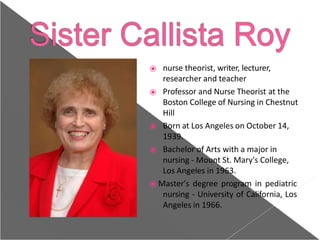
⦿ nurse theorist, writer, lecturer,
researcher and teacher
⦿ Professor and Nurse Theorist at the
Boston College of Nursing in Chestnut
Hill
⦿ Born at Los Angeles on October 14,
1939.
⦿ Bachelor of Arts with a major in
nursing - Mount St. Mary's College,
Los Angeles in 1963.
⦿ Master's degree program in pediatric
nursing - University of California, Los
Angeles in 1966.
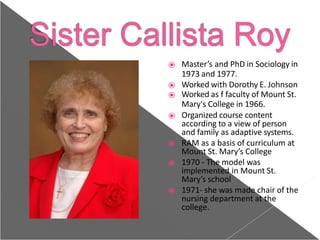
⦿ Master’s and PhD in Sociology in
1973 and 1977.
⦿ Worked with Dorothy E. Johnson
⦿ Worked as f faculty of Mount St.
Mary's College in 1966.
⦿ Organized course content
according to a view of person
and family as adaptive systems.
⦿ RAM as a basis of curriculum at
Mount St. Mary’s College
⦿ 1970 - The model was
implemented in Mount St.
Mary’s school
⦿ 1971- she was made chair of the
nursing department at the
college.
⦿Roy’s Adaptation Model for Nursing was derived
in 1964 from Harry Helson’s Adaptation
Theory – adaptive responses are a function of
the incoming stimulus and the adaptive level
⦿Roy combines Helson’s work with Rapport’s
definition of system and views the
person as an adaptive system.
⦿ After the development of her theory, Roy developed
the model as a framework for nursing practice,
research, and education.
⦿ According to Roy, more than 1500 faculty and
students have contributed to the theoretical
development of the adaptation model.
⦿ The model uses concepts from AH Maslow to
explore beliefs and values of persons. Roy’s holistic
approach to nursing is based in humanism.
⦿A pilot research study and a survey research
study from 1976 to 1977 led to some tentative
confirmations of the model.
⦿From this beginning, the adaptation model has
been supported through research in practice and
in education.
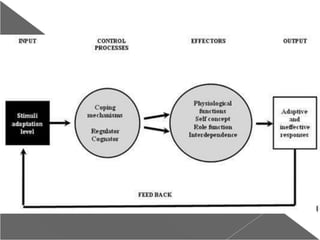
⦿A set of units so related or connected as to form
a unity or whole and characterized by inputs,
outputs, and control and feedback processes.
⦿A constantly changing point, made up of focal,
contextual and residual stimuli, which represent
the person’s own standard of the range of stimuli
to which one can respond with ordinary adaptive
responses.
⦿The occurrences of situations of inadequate
response to need deficits or excesses.
⦿Seen not as nursing diagnosis, but areas of
concern for the nurse related to adapting person
or group (Within each adaptive mode)
⦿Focal Stimulus – the degree of change or stimulus most
immediately confronting the person and the one to which
the person must make an adaptive response, that is, the
factor that precipitates behavior
⦿Contextual Stimuli – all other stimuli present that
contribute to the behavior caused or precipitated by the focal
stimuli
⦿Residual Stimuli – factors that may be affecting
behavior but whose efforts are not validated
⦿Regulator – subsystem coping mechanism
which responds automatically through neural-
chemical-endocrine processes.
⦿Cognator - subsystem coping mechanism
which responds to complex processes of
perception and information processing,
judgment, and emotion.
⦿Adaptive Responses – responses that
promote integrity of the person in terms of goals
of survival, growth, reproduction, and mastery
⦿Ineffective Responses – responses that do
not contribute to adaptive goals, that is, survival,
growth, reproduction, and mastery
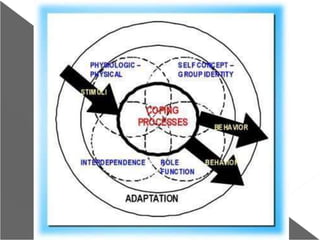
1. Physiological Mode – involve the body’s basic
needs and ways of dealing with adaptation in
regard to fluid and electrolytes; exercise and rest;
elimination; nutrition; circulation and oxygen; and
regulation, which includes the senses, temperature
and endocrine regulation
2. Self-Concept Mode – the composite of beliefs
and feelings that one holds about oneself at a given
time. It is formed from perceptions, particularly of
other’s reactions, and directs one’s behavior.
(physical self and personal self)
3. Role Performance Mode – role function is the
performance of duties based on given positions
in society.
4. Interdependence Mode – involves one’s
relations with significant others and support
systems. In this mode one maintains psychic
integrity by meeting needs for nurturance and
affection.
⦿The person is a bio-psycho-social being.
⦿The person is in constant interaction with a
changing environment.
⦿Tocope with a changing world, person uses both
innate and acquired mechanisms which are
biological, psychological and social in origin.
⦿Health and illness are inevitable dimensions of
the person’s life.
⦿ To respond positively to environmental changes, the
person must adapt.
⦿ The person’s adaptation is a function of the stimulus
he is exposed to and his adaptation level
⦿ The person’s adaptation level is such that it
comprises a zone indicating the range of stimulation
that will lead to a positive response.
⦿ The person has 4 modes of adaptation: physiologic
needs, self- concept, role function and inter-
dependence.
Nursing
• A “theoretical system of
knowledge which prescribes a
process of analysis and action
related to the care of the ill or
potentially ill person.”
• Roy differentiates nursing as a
science from nursing as a
practice discipline.
Person
• A “biopsychosocial being in constant
interaction with a changing environment.”
• The recipient of nursing care, as a living,
complex, adaptive system with internal
processes (cognator and regulator) acting
to maintain adaptation in the four
adaptive modes (physiological needs, self-
concept, role function, and
interdependence.)
• The person as a living system is “a whole
made up of parts of subsystems that
function as a unity for some purpose.”
Health
• A “state and a process of
being and becoming an
integrated and whole person.
Lack of integration
represents lack of health.”
Environment
• “all the conditions, circumstances,
and influences surrounding and
affecting the development and
behavior of persons or groups. ”
• The input into the person as an
adaptive system involving both
internal and external factors (may be
slight or large, positive or negative)
• Any environmental change demands
increasing energy to adapt to the
situation. Factors in the environment
that affect the person are categorized
as focal, contextual, and residual
stimuli.
Outcome Theory - well articulated
conception of man as a nursing client and of
nursing as an external regulatory mechanism.
⦿ Both deductive and inductive
⦿ Deductive – derived from Helson’s Theory. Helson developed the
concepts of focal, contextual, and residual stimuli, which Roy defined
within nursing to form a typology of factors related to adaptation
levels of persons. Roy also uses other concepts and theory outside
the discipline of nursing and relates these to her adaptation theory.
⦿ Inductive – she developed the four adaptive modes from research
and practice experiences of herself, her colleagues, and her students.
Roy built on the conceptual framework of adaptation and as a result
developed a step-by-step model by which nurse use the nursing
process to administer nursing care to promote adaptation in
situations of health and illness.

⦿ Useful for it outlines the features of the discipline and
provides direction for practice
⦿ The model considers goals, values, the client, and
practitioner interventions
⦿ Using Roy’s six-step nursing process, the nurse:
1. Asesses behaviors
2. Asseses stimuli
3. Diagnosis
4. Sets goals to promote adaptation
5. Nursing interventions
6. Evaluation
⦿The model is a valuable tool to analyze overlap
and distinctions between the professions of
nursing and medicine.
⦿Throughout the 1970’s and 1980’s, Roy’s model
has been implemented as a basis for curriculum
development in associate degree diploma,
baccalaureate, and higher degree programs in
many countries.
⦿The model does generate many testable
hypothesis related to practice and theory.
Middle range theories have been derived from RAM
› Samarel, N., Fawcett, J., Krippendorf, K., Piacentino, J.C., Eliasof, B., Hughes,
P., Kowitski, C., and Ziegler, E. (1998). Women's perception of group
support and adaptation to breast cancer. Journal of Advanced Nursing.
28(6), 1259-1268.
› Yeh, C. H. (2001). Adaptation in children with cancer: research with Roy's
model. Nursing Science Quarterly. 14, 141-148.
› Zhan, L. (2000). Cognitive adaptation and self-consistency in hearing-
impaired older persons: testing Roy's adaptation model. Nursing Science
Quarterly. 13(2), 158-165.
⦿ Clarity - logical; claims to follow a holistic view
but leaves out “spiritual, humanistic, and
existential aspects of being a person”
⦿Simplicity – has several major concepts and
subconcepts and numerous relational
statements; complex
⦿ Generality – generalizable to all settings in nursing
practice, but is limited in scope because it primarily
addresses the concept of person-environment
adaptation and focuses primarily on the client
⦿ Empirical Precision – Testable hypothesis have been
derived from the model
⦿ Derivable Consequences – has a clearly defined
nursing process and can be useful in guiding clinical
practice; capable of generating new information
through hypothesis-testing
⦿ www.currentnursing.com
⦿Tomey, A.M., (1994). Nursing Theorists and Their
Work. 3rd ed. Missouri: Mosby
03sistercallistaroysadaptationtheory-140630112605-phpapp02.pptx

03sistercallistaroysadaptationtheory-140630112605-phpapp02.pptx

  • 2.
    ⦿ nurse theorist,writer, lecturer, researcher and teacher ⦿ Professor and Nurse Theorist at the Boston College of Nursing in Chestnut Hill ⦿ Born at Los Angeles on October 14, 1939. ⦿ Bachelor of Arts with a major in nursing - Mount St. Mary's College, Los Angeles in 1963. ⦿ Master's degree program in pediatric nursing - University of California, Los Angeles in 1966.
  • 3.
    ⦿ Master’s andPhD in Sociology in 1973 and 1977. ⦿ Worked with Dorothy E. Johnson ⦿ Worked as f faculty of Mount St. Mary's College in 1966. ⦿ Organized course content according to a view of person and family as adaptive systems. ⦿ RAM as a basis of curriculum at Mount St. Mary’s College ⦿ 1970 - The model was implemented in Mount St. Mary’s school ⦿ 1971- she was made chair of the nursing department at the college.
  • 5.
    ⦿Roy’s Adaptation Modelfor Nursing was derived in 1964 from Harry Helson’s Adaptation Theory – adaptive responses are a function of the incoming stimulus and the adaptive level ⦿Roy combines Helson’s work with Rapport’s definition of system and views the person as an adaptive system.
  • 6.
    ⦿ After thedevelopment of her theory, Roy developed the model as a framework for nursing practice, research, and education. ⦿ According to Roy, more than 1500 faculty and students have contributed to the theoretical development of the adaptation model. ⦿ The model uses concepts from AH Maslow to explore beliefs and values of persons. Roy’s holistic approach to nursing is based in humanism.
  • 7.
    ⦿A pilot researchstudy and a survey research study from 1976 to 1977 led to some tentative confirmations of the model. ⦿From this beginning, the adaptation model has been supported through research in practice and in education.
  • 9.
    ⦿A set ofunits so related or connected as to form a unity or whole and characterized by inputs, outputs, and control and feedback processes.
  • 10.
    ⦿A constantly changingpoint, made up of focal, contextual and residual stimuli, which represent the person’s own standard of the range of stimuli to which one can respond with ordinary adaptive responses.
  • 11.
    ⦿The occurrences ofsituations of inadequate response to need deficits or excesses. ⦿Seen not as nursing diagnosis, but areas of concern for the nurse related to adapting person or group (Within each adaptive mode)
  • 12.
    ⦿Focal Stimulus –the degree of change or stimulus most immediately confronting the person and the one to which the person must make an adaptive response, that is, the factor that precipitates behavior ⦿Contextual Stimuli – all other stimuli present that contribute to the behavior caused or precipitated by the focal stimuli ⦿Residual Stimuli – factors that may be affecting behavior but whose efforts are not validated
  • 13.
    ⦿Regulator – subsystemcoping mechanism which responds automatically through neural- chemical-endocrine processes. ⦿Cognator - subsystem coping mechanism which responds to complex processes of perception and information processing, judgment, and emotion.
  • 14.
    ⦿Adaptive Responses –responses that promote integrity of the person in terms of goals of survival, growth, reproduction, and mastery ⦿Ineffective Responses – responses that do not contribute to adaptive goals, that is, survival, growth, reproduction, and mastery
  • 15.
    1. Physiological Mode– involve the body’s basic needs and ways of dealing with adaptation in regard to fluid and electrolytes; exercise and rest; elimination; nutrition; circulation and oxygen; and regulation, which includes the senses, temperature and endocrine regulation 2. Self-Concept Mode – the composite of beliefs and feelings that one holds about oneself at a given time. It is formed from perceptions, particularly of other’s reactions, and directs one’s behavior. (physical self and personal self)
  • 16.
    3. Role PerformanceMode – role function is the performance of duties based on given positions in society. 4. Interdependence Mode – involves one’s relations with significant others and support systems. In this mode one maintains psychic integrity by meeting needs for nurturance and affection.
  • 18.
    ⦿The person isa bio-psycho-social being. ⦿The person is in constant interaction with a changing environment. ⦿Tocope with a changing world, person uses both innate and acquired mechanisms which are biological, psychological and social in origin. ⦿Health and illness are inevitable dimensions of the person’s life.
  • 19.
    ⦿ To respondpositively to environmental changes, the person must adapt. ⦿ The person’s adaptation is a function of the stimulus he is exposed to and his adaptation level ⦿ The person’s adaptation level is such that it comprises a zone indicating the range of stimulation that will lead to a positive response. ⦿ The person has 4 modes of adaptation: physiologic needs, self- concept, role function and inter- dependence.
  • 20.
    Nursing • A “theoreticalsystem of knowledge which prescribes a process of analysis and action related to the care of the ill or potentially ill person.” • Roy differentiates nursing as a science from nursing as a practice discipline.
  • 21.
    Person • A “biopsychosocialbeing in constant interaction with a changing environment.” • The recipient of nursing care, as a living, complex, adaptive system with internal processes (cognator and regulator) acting to maintain adaptation in the four adaptive modes (physiological needs, self- concept, role function, and interdependence.) • The person as a living system is “a whole made up of parts of subsystems that function as a unity for some purpose.”
  • 22.
    Health • A “stateand a process of being and becoming an integrated and whole person. Lack of integration represents lack of health.”
  • 23.
    Environment • “all theconditions, circumstances, and influences surrounding and affecting the development and behavior of persons or groups. ” • The input into the person as an adaptive system involving both internal and external factors (may be slight or large, positive or negative) • Any environmental change demands increasing energy to adapt to the situation. Factors in the environment that affect the person are categorized as focal, contextual, and residual stimuli.
  • 27.
    Outcome Theory -well articulated conception of man as a nursing client and of nursing as an external regulatory mechanism.
  • 28.
    ⦿ Both deductiveand inductive ⦿ Deductive – derived from Helson’s Theory. Helson developed the concepts of focal, contextual, and residual stimuli, which Roy defined within nursing to form a typology of factors related to adaptation levels of persons. Roy also uses other concepts and theory outside the discipline of nursing and relates these to her adaptation theory. ⦿ Inductive – she developed the four adaptive modes from research and practice experiences of herself, her colleagues, and her students. Roy built on the conceptual framework of adaptation and as a result developed a step-by-step model by which nurse use the nursing process to administer nursing care to promote adaptation in situations of health and illness.
  • 30.
    ⦿ Useful forit outlines the features of the discipline and provides direction for practice ⦿ The model considers goals, values, the client, and practitioner interventions ⦿ Using Roy’s six-step nursing process, the nurse: 1. Asesses behaviors 2. Asseses stimuli 3. Diagnosis 4. Sets goals to promote adaptation 5. Nursing interventions 6. Evaluation
  • 31.
    ⦿The model isa valuable tool to analyze overlap and distinctions between the professions of nursing and medicine. ⦿Throughout the 1970’s and 1980’s, Roy’s model has been implemented as a basis for curriculum development in associate degree diploma, baccalaureate, and higher degree programs in many countries.
  • 32.
    ⦿The model doesgenerate many testable hypothesis related to practice and theory.
  • 33.
    Middle range theorieshave been derived from RAM › Samarel, N., Fawcett, J., Krippendorf, K., Piacentino, J.C., Eliasof, B., Hughes, P., Kowitski, C., and Ziegler, E. (1998). Women's perception of group support and adaptation to breast cancer. Journal of Advanced Nursing. 28(6), 1259-1268. › Yeh, C. H. (2001). Adaptation in children with cancer: research with Roy's model. Nursing Science Quarterly. 14, 141-148. › Zhan, L. (2000). Cognitive adaptation and self-consistency in hearing- impaired older persons: testing Roy's adaptation model. Nursing Science Quarterly. 13(2), 158-165.
  • 34.
    ⦿ Clarity -logical; claims to follow a holistic view but leaves out “spiritual, humanistic, and existential aspects of being a person” ⦿Simplicity – has several major concepts and subconcepts and numerous relational statements; complex
  • 35.
    ⦿ Generality –generalizable to all settings in nursing practice, but is limited in scope because it primarily addresses the concept of person-environment adaptation and focuses primarily on the client ⦿ Empirical Precision – Testable hypothesis have been derived from the model ⦿ Derivable Consequences – has a clearly defined nursing process and can be useful in guiding clinical practice; capable of generating new information through hypothesis-testing
  • 36.
    ⦿ www.currentnursing.com ⦿Tomey, A.M.,(1994). Nursing Theorists and Their Work. 3rd ed. Missouri: Mosby