Job analysis
Instructor: Dr. Nedal Aeshah
Presented by : Ola Al-Omoush
Zarqa University
Faculty of Nursing
Course title:
Management and leadership in nursing (2) Theory
After completing this lecture, the
students will be able to:
• Define and distinguish between job evaluation, job
analysis, job description and job specifications.
• List components and methods of job analysis.
• Identify the stages of job analysis process.
• List and explain the techniques of collecting data for
job analysis purposes.
• Explain how job description format written.
• Define the meaning, purpose ad content of job
description and job specification.
• Identify the definition, process, principles and method
of job evaluation.
Outline:
• Introduction.
• Definition, purpose, process and content of
job analysis.
• Definition, purpose and how to write of job
description.
• Definition, purpose and content of job
specification.
• Definition, principle, process and method of
job evaluation.
Introduction
• A typical management understands that for
any organization successes, questions about
what must be done, how it must be done, the
best person to do it, and how the person can
find satisfaction doing it, must be given
definite and appropriate answers.
Introduction
• This attempt to give answers to these
questions is the job analysis.
Job analysis
• It is a detailed and systematic study and
presentation of information such as skills,
knowledge, abilities, and responsibilities
relating to the operation of a specific job.
• It is this information that differentiates one
job from another and determines the success
of a worker in performing his or her duties
A comprehensive job analysis will
show (McCormick, 1970)
1)The job-oriented activities, which is the exact
activities to be performed.
2) The relationship of a worker with others .
3)Behaviors performed during the work .
4) Equipment, materials to be used in performing
the job.
5)Job context .
6)Personal data related to the job.
7)Personal attributes.
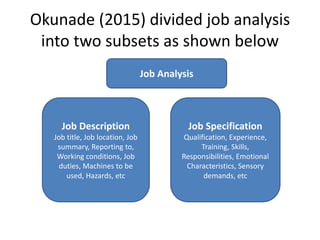
Okunade (2015) divided job analysis
into two subsets as shown below
Job Analysis
Job Description
Job title, Job location, Job
summary, Reporting to,
Working conditions, Job
duties, Machines to be
used, Hazards, etc
Job Specification
Qualification, Experience,
Training, Skills,
Responsibilities, Emotional
Characteristics, Sensory
demands, etc
Method of job analysis
For a specific job to be properly analyzed, there
is need to apply appropriate techniques and
methods in gathering information about such
job. Such techniques and methods include:
1- Personal observation.
2-Personal interview
3-Data collection through questionnaire
4-Review of records.
1. Personal observation:
• Observes the employees who are actually
doing the job, Watches out for the materials
and equipment used.
• Takes note of the working conditions and
probable hazards, and tries to appreciate all
that the work involves.
• personal observation is the major source of
getting information for job analysis
Type of personal observation
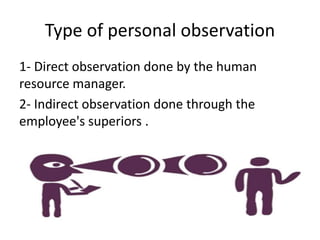
1- Direct observation done by the human
resource manager.
2- Indirect observation done through the
employee's superiors .
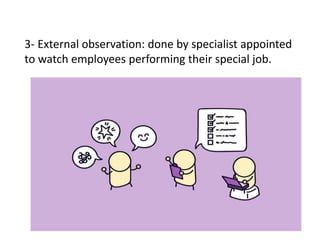
3- External observation: done by specialist appointed
to watch employees performing their special job.
2. Personal interviews:
• Interview method, though time-consuming
and relatively costly, could be used in place of
observation.
• It can also be used to complement personal
observation in the case where observation
does not provide the human resource
manager with sufficient information needed
for analysis.
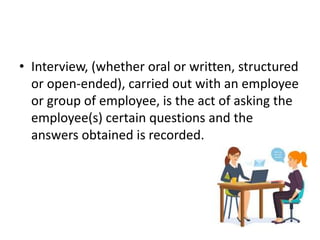
• Interview, (whether oral or written, structured
or open-ended), carried out with an employee
or group of employee, is the act of asking the
employee(s) certain questions and the
answers obtained is recorded.
3. Data collection
• In gathering information for job analysis,
questionnaires, whether structured or open-
ended, are sent out to job-holders for
completion and are returned to the human
resource manager for analysis, interpretation,
and presentation.
4. Review of long records:
• Information for job analysis could also be
obtained from the daily record of duties
maintained by the employees.
• It is pertinent to note that this method is the
least used method due to its limitation of not
providing data on supervisor relationship, the
equipment used, and working conditions.
Moreover, it is time-consuming.
Purposes and uses of job analysis
• 1. Determination of labor needs.
• 2. Recruitment and Selection.
• 3. Salary Administration.
• 4. Job Re-engineering ( industrial & human)
Job analysis provides information which
enables the changing of jobs in order to
permit personnel with specific characteristics
and qualifications to perform them. .
Purposes and uses of job analysis
• 5. Employee Training and Management
Development.
• 6. Performance Appraisal.
• 7. Health and Safety.
Job Description
• Job description is setting forth in clear terms
and in writing the duties, functions,
responsibilities, and demands of a specific job.
• It explains the title and location of the job,
details of the tasks the employee will do,
hazards involved, the working conditions,
relationships, as well as how employee will do
the job.
The highlights of a typical job
description:
• 1. Job identification: This includes the job title,
its code number, alternative title, department,
division, and location.
• 2. Job Summary: A concise statement of the
major functions and activities of the job,
which serves as additional identification
information when a job title is not adequate
• 3. Job duties/responsibilities: these may
include responsibility for production process
and equipment. It also specifies how a Job is
performed. Materials and Equipment to be
used are also indicated. Therefore, This is
regarded as the heart of a job because it
specifies what a typical worker does and how
worker performs it.
• 4. Relation to other jobs: This is where the
relationship between worker clearly specified
“superiors, colleagues, and subordinates”.
Determine the organizational chart and work
flow, which shows the hierarchy, or chain of
authority within the organization.
• 5. Supervision: The supervisor of an employee,
the extent of supervision involved general,
intermediate or close supervision are clearly
stated.
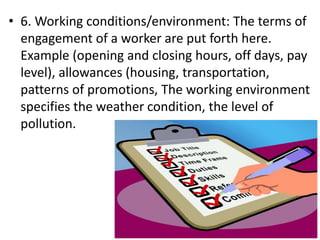
• 6. Working conditions/environment: The terms of
engagement of a worker are put forth here.
Example (opening and closing hours, off days, pay
level), allowances (housing, transportation,
patterns of promotions, The working environment
specifies the weather condition, the level of
pollution.
Purpose of job description:
• To provide a successful interview.
• Helps in job grading and classification.
• To define promotional steps.
• To establish a common understanding of a job
between employers and employees.
• To define the limits of authority
• To facilitate job placement
• Provide a hiring specifications
• Provide a performance indicators
Job Specification
• job specification is simply the expression of
job description in terms of personnel qualities.
It is a list of human requirements needed to
perform the job well .
• In other words, it is the minimum acceptable
personnel characteristics or qualities
necessary for the efficient and effective
performance of a job.
Content of Job Specification :
• (a) Physical characteristics: like health
condition, strength, endurance, age-range,
body size, height, weight, vision, voice and
motor co-ordination.
• (b) Psychological characteristics : like Qualities
under here include manual dexterity,
judgment, resourcefulness, analytical ability,
social skills and mental concentration.
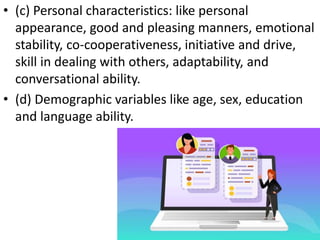
• (c) Personal characteristics: like personal
appearance, good and pleasing manners, emotional
stability, co-cooperativeness, initiative and drive,
skill in dealing with others, adaptability, and
conversational ability.
• (d) Demographic variables like age, sex, education
and language ability.
Purpose of Job specification
• Understand the specific details of a job.
• Gives important details related to the job like
education & skills.
• lays down the guidelines basis of which the
company can recruit and select the best possible
candidate.
• can be used for screening of resumes & shortlist
only those candidates who are the closest fit to
the job.
• gives specific details about what kind of skill sets
are required to complete the job.
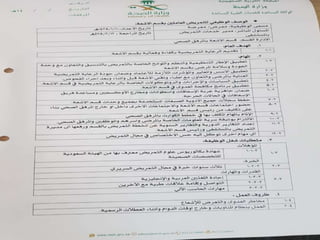
Example : job description and
specification
........Downloads ‫الوظيفي‬ ‫الوصف‬
-
‫التمريض‬
-
‫وزاره‬
‫الصحه‬
. pdf
Job evaluation
• Job evaluation is defined as the systematic
process of assessing the value of each job in
relation to other jobs in an organization.
• It is intended to provide a rational, orderly
hierarchy of jobs based on their worth to the
company by analyzing the difficulty of the
work performed and the importance of the
work to the organization.
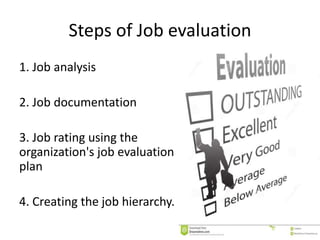
Steps of Job evaluation
1. Job analysis
2. Job documentation
3. Job rating using the
organization's job evaluation
plan
4. Creating the job hierarchy.
Step # 1. Job Analysis:
• Job analysis is the process of collecting and
evaluating relevant information about jobs. The
data collected should clarify the nature of the
work being performed (principal tasks, duties,
and responsibilities) as well as the level of the
work being performed. Information should
include the types and extent of knowledge, skill,
mental and physical efforts required, as well as
the conditions under which the work is typically
performed.
Step # 2. Job Documentation:
• Job documentation is the process of recording
job content information, usually in the form of
a written job description, one of the most
important products of job analysis. Most job
description of the duties, examples of work
typically performed, and a statement
identifying the knowledge, abilities, skills, and
other characteristics that are required to
satisfactorily perform the duties.
Step # 3. Rating the Job:
• In the third step, a job’s assigned duties are
assessed using the job evaluation plan, or
instrument selected by the organization.
Step # 4. Creating the Job Hierarchy:
• The result of a job evaluation plan is a
hierarchical ordering of jobs in terms of their
relative worth to the organization. the resulting
top-down list should reflect an ordering of
position that makes sense to and is meaningful
for a particular organization.
• Before finalizing this hierarchical list, it is
important that the evaluation be studied carefully
in relation to another.
Principles of Job evaluation
• Rate the job but not the employee.
• Elements / tasks selected should be easily understood.
• Employee concerned and supervisors should be
educated and convinced about the program.
• Supervisors should be encouraged to participate in
rating the jobs.
• Encourage employee cooperation to participate in the
rating program.
• Should be a collective effort, chance for equal
representation from all departments.
Methods of Job evaluation
1-Qualitative methods are:
A- Ranking
B- Job Classification or
grading
2-Quantitative methods are:
A-Factor-Comparison
B-Point-Ranking
1-Qualitative methods
A. Ranking method:
-This is the simplest and an inexpensive job evaluation
method, wherein the jobs are ranked from he highest to the
lowest on the basis of their importance in the organization.
-In this method, the overall job is compared with the other set
of jobs and then is given a rank on the basis of its content and
complexity in performing it.
-But however it is not free from the limitations, it is may not
be fruitful in the case of big organizations.
1-Qualitative methods
B- Job Classification & Grading
- Under this method the job grades or classes are
predetermined and then each job is assigned to these
and is evaluated accordingly.
- The advantage of this method is that it is less
subjective as compared to the raking method and is
acceptable to the employees.
- The major limitation of this method is that the jobs
may differ with respect to their content and the
complexity and by placing all under one category the
results may be overestimated or underestimated.
2-Quantitative methods
A-Factor-Comparison Method
• Under this method, the job is evaluated, and the ranks
are given on the basis of a series of factors like mental
effort, physical effort, skills required, supervisory
responsibilities and working conditions.
• These factors are assumed to be constant for each set
of jobs. Thus, each job is compared against each other
on this basis and is ranked accordingly.
• The advantage of this method is that it is consistent
and less subjective, thus appreciable by all.
• But however it is the most complex and an expensive
method.
2-Quantitative methods
B- Point-Ranking Method
• Under this method, each job’s key factor is identified and
then the sub-factors are determined. These sub-factors are
then assigned the points by its importance.
• For example, the key factor to perform a job is skills, and
then it can be further classified into sub-factors such as
training required, communication skills, social skills,
persuasion skills, etc.
• The point ranking method is less subjective and is error free
as it sees the job from all the perspectives.
• But however it is a complex method and is time consuming
since the points and wage scale has to be decided for each
factor and the sub factor
Any Questions??
References
• Chapter 2 (job design and analysis-Wilfrid Laurier
University –Course:Human resourse)
• https://www.economicsdiscussion.net/human-
resource-management/job-evaluation/job-
evaluation/32350
• https://www.managementstudyguide.com/job-
evaluation-principles.htm
• https://www.slideshare.net/ishajoshi503/job-
evaluation-human-resource-management
• https://www.moh.gov.jo/EchoBusV3.0/SystemAs
sets/PDFs/PDFs%20AR/JobDescription

Job analysis and description

  • 2.
    Job analysis Instructor: Dr.Nedal Aeshah Presented by : Ola Al-Omoush Zarqa University Faculty of Nursing Course title: Management and leadership in nursing (2) Theory
  • 3.
    After completing thislecture, the students will be able to: • Define and distinguish between job evaluation, job analysis, job description and job specifications. • List components and methods of job analysis. • Identify the stages of job analysis process. • List and explain the techniques of collecting data for job analysis purposes. • Explain how job description format written. • Define the meaning, purpose ad content of job description and job specification. • Identify the definition, process, principles and method of job evaluation.
  • 4.
    Outline: • Introduction. • Definition,purpose, process and content of job analysis. • Definition, purpose and how to write of job description. • Definition, purpose and content of job specification. • Definition, principle, process and method of job evaluation.
  • 5.
    Introduction • A typicalmanagement understands that for any organization successes, questions about what must be done, how it must be done, the best person to do it, and how the person can find satisfaction doing it, must be given definite and appropriate answers.
  • 6.
    Introduction • This attemptto give answers to these questions is the job analysis.
  • 7.
    Job analysis • Itis a detailed and systematic study and presentation of information such as skills, knowledge, abilities, and responsibilities relating to the operation of a specific job. • It is this information that differentiates one job from another and determines the success of a worker in performing his or her duties
  • 8.
    A comprehensive jobanalysis will show (McCormick, 1970) 1)The job-oriented activities, which is the exact activities to be performed. 2) The relationship of a worker with others . 3)Behaviors performed during the work . 4) Equipment, materials to be used in performing the job. 5)Job context . 6)Personal data related to the job. 7)Personal attributes.
  • 9.
    Okunade (2015) dividedjob analysis into two subsets as shown below Job Analysis Job Description Job title, Job location, Job summary, Reporting to, Working conditions, Job duties, Machines to be used, Hazards, etc Job Specification Qualification, Experience, Training, Skills, Responsibilities, Emotional Characteristics, Sensory demands, etc
  • 10.
    Method of jobanalysis For a specific job to be properly analyzed, there is need to apply appropriate techniques and methods in gathering information about such job. Such techniques and methods include: 1- Personal observation. 2-Personal interview 3-Data collection through questionnaire 4-Review of records.
  • 11.
    1. Personal observation: •Observes the employees who are actually doing the job, Watches out for the materials and equipment used. • Takes note of the working conditions and probable hazards, and tries to appreciate all that the work involves. • personal observation is the major source of getting information for job analysis
  • 12.
    Type of personalobservation 1- Direct observation done by the human resource manager. 2- Indirect observation done through the employee's superiors .
  • 13.
    3- External observation:done by specialist appointed to watch employees performing their special job.
  • 14.
    2. Personal interviews: •Interview method, though time-consuming and relatively costly, could be used in place of observation. • It can also be used to complement personal observation in the case where observation does not provide the human resource manager with sufficient information needed for analysis.
  • 15.
    • Interview, (whetheroral or written, structured or open-ended), carried out with an employee or group of employee, is the act of asking the employee(s) certain questions and the answers obtained is recorded.
  • 16.
    3. Data collection •In gathering information for job analysis, questionnaires, whether structured or open- ended, are sent out to job-holders for completion and are returned to the human resource manager for analysis, interpretation, and presentation.
  • 17.
    4. Review oflong records: • Information for job analysis could also be obtained from the daily record of duties maintained by the employees. • It is pertinent to note that this method is the least used method due to its limitation of not providing data on supervisor relationship, the equipment used, and working conditions. Moreover, it is time-consuming.
  • 18.
    Purposes and usesof job analysis • 1. Determination of labor needs. • 2. Recruitment and Selection. • 3. Salary Administration. • 4. Job Re-engineering ( industrial & human) Job analysis provides information which enables the changing of jobs in order to permit personnel with specific characteristics and qualifications to perform them. .
  • 19.
    Purposes and usesof job analysis • 5. Employee Training and Management Development. • 6. Performance Appraisal. • 7. Health and Safety.
  • 20.
    Job Description • Jobdescription is setting forth in clear terms and in writing the duties, functions, responsibilities, and demands of a specific job. • It explains the title and location of the job, details of the tasks the employee will do, hazards involved, the working conditions, relationships, as well as how employee will do the job.
  • 21.
    The highlights ofa typical job description: • 1. Job identification: This includes the job title, its code number, alternative title, department, division, and location. • 2. Job Summary: A concise statement of the major functions and activities of the job, which serves as additional identification information when a job title is not adequate
  • 22.
    • 3. Jobduties/responsibilities: these may include responsibility for production process and equipment. It also specifies how a Job is performed. Materials and Equipment to be used are also indicated. Therefore, This is regarded as the heart of a job because it specifies what a typical worker does and how worker performs it.
  • 23.
    • 4. Relationto other jobs: This is where the relationship between worker clearly specified “superiors, colleagues, and subordinates”. Determine the organizational chart and work flow, which shows the hierarchy, or chain of authority within the organization. • 5. Supervision: The supervisor of an employee, the extent of supervision involved general, intermediate or close supervision are clearly stated.
  • 24.
    • 6. Workingconditions/environment: The terms of engagement of a worker are put forth here. Example (opening and closing hours, off days, pay level), allowances (housing, transportation, patterns of promotions, The working environment specifies the weather condition, the level of pollution.
  • 25.
    Purpose of jobdescription: • To provide a successful interview. • Helps in job grading and classification. • To define promotional steps. • To establish a common understanding of a job between employers and employees. • To define the limits of authority • To facilitate job placement • Provide a hiring specifications • Provide a performance indicators
  • 26.
    Job Specification • jobspecification is simply the expression of job description in terms of personnel qualities. It is a list of human requirements needed to perform the job well . • In other words, it is the minimum acceptable personnel characteristics or qualities necessary for the efficient and effective performance of a job.
  • 27.
    Content of JobSpecification : • (a) Physical characteristics: like health condition, strength, endurance, age-range, body size, height, weight, vision, voice and motor co-ordination. • (b) Psychological characteristics : like Qualities under here include manual dexterity, judgment, resourcefulness, analytical ability, social skills and mental concentration.
  • 28.
    • (c) Personalcharacteristics: like personal appearance, good and pleasing manners, emotional stability, co-cooperativeness, initiative and drive, skill in dealing with others, adaptability, and conversational ability. • (d) Demographic variables like age, sex, education and language ability.
  • 29.
    Purpose of Jobspecification • Understand the specific details of a job. • Gives important details related to the job like education & skills. • lays down the guidelines basis of which the company can recruit and select the best possible candidate. • can be used for screening of resumes & shortlist only those candidates who are the closest fit to the job. • gives specific details about what kind of skill sets are required to complete the job.
  • 30.
    Example : jobdescription and specification ........Downloads ‫الوظيفي‬ ‫الوصف‬ - ‫التمريض‬ - ‫وزاره‬ ‫الصحه‬ . pdf
  • 32.
    Job evaluation • Jobevaluation is defined as the systematic process of assessing the value of each job in relation to other jobs in an organization. • It is intended to provide a rational, orderly hierarchy of jobs based on their worth to the company by analyzing the difficulty of the work performed and the importance of the work to the organization.
  • 33.
    Steps of Jobevaluation 1. Job analysis 2. Job documentation 3. Job rating using the organization's job evaluation plan 4. Creating the job hierarchy.
  • 34.
    Step # 1.Job Analysis: • Job analysis is the process of collecting and evaluating relevant information about jobs. The data collected should clarify the nature of the work being performed (principal tasks, duties, and responsibilities) as well as the level of the work being performed. Information should include the types and extent of knowledge, skill, mental and physical efforts required, as well as the conditions under which the work is typically performed.
  • 35.
    Step # 2.Job Documentation: • Job documentation is the process of recording job content information, usually in the form of a written job description, one of the most important products of job analysis. Most job description of the duties, examples of work typically performed, and a statement identifying the knowledge, abilities, skills, and other characteristics that are required to satisfactorily perform the duties.
  • 36.
    Step # 3.Rating the Job: • In the third step, a job’s assigned duties are assessed using the job evaluation plan, or instrument selected by the organization.
  • 37.
    Step # 4.Creating the Job Hierarchy: • The result of a job evaluation plan is a hierarchical ordering of jobs in terms of their relative worth to the organization. the resulting top-down list should reflect an ordering of position that makes sense to and is meaningful for a particular organization. • Before finalizing this hierarchical list, it is important that the evaluation be studied carefully in relation to another.
  • 38.
    Principles of Jobevaluation • Rate the job but not the employee. • Elements / tasks selected should be easily understood. • Employee concerned and supervisors should be educated and convinced about the program. • Supervisors should be encouraged to participate in rating the jobs. • Encourage employee cooperation to participate in the rating program. • Should be a collective effort, chance for equal representation from all departments.
  • 39.
    Methods of Jobevaluation 1-Qualitative methods are: A- Ranking B- Job Classification or grading 2-Quantitative methods are: A-Factor-Comparison B-Point-Ranking
  • 40.
    1-Qualitative methods A. Rankingmethod: -This is the simplest and an inexpensive job evaluation method, wherein the jobs are ranked from he highest to the lowest on the basis of their importance in the organization. -In this method, the overall job is compared with the other set of jobs and then is given a rank on the basis of its content and complexity in performing it. -But however it is not free from the limitations, it is may not be fruitful in the case of big organizations.
  • 41.
    1-Qualitative methods B- JobClassification & Grading - Under this method the job grades or classes are predetermined and then each job is assigned to these and is evaluated accordingly. - The advantage of this method is that it is less subjective as compared to the raking method and is acceptable to the employees. - The major limitation of this method is that the jobs may differ with respect to their content and the complexity and by placing all under one category the results may be overestimated or underestimated.
  • 42.
    2-Quantitative methods A-Factor-Comparison Method •Under this method, the job is evaluated, and the ranks are given on the basis of a series of factors like mental effort, physical effort, skills required, supervisory responsibilities and working conditions. • These factors are assumed to be constant for each set of jobs. Thus, each job is compared against each other on this basis and is ranked accordingly. • The advantage of this method is that it is consistent and less subjective, thus appreciable by all. • But however it is the most complex and an expensive method.
  • 43.
    2-Quantitative methods B- Point-RankingMethod • Under this method, each job’s key factor is identified and then the sub-factors are determined. These sub-factors are then assigned the points by its importance. • For example, the key factor to perform a job is skills, and then it can be further classified into sub-factors such as training required, communication skills, social skills, persuasion skills, etc. • The point ranking method is less subjective and is error free as it sees the job from all the perspectives. • But however it is a complex method and is time consuming since the points and wage scale has to be decided for each factor and the sub factor
  • 46.
  • 47.
    References • Chapter 2(job design and analysis-Wilfrid Laurier University –Course:Human resourse) • https://www.economicsdiscussion.net/human- resource-management/job-evaluation/job- evaluation/32350 • https://www.managementstudyguide.com/job- evaluation-principles.htm • https://www.slideshare.net/ishajoshi503/job- evaluation-human-resource-management • https://www.moh.gov.jo/EchoBusV3.0/SystemAs sets/PDFs/PDFs%20AR/JobDescription