ADAPTATION
MODEL
- Julla Galanto Garganza
Topics Covered
1. Getting
to Know
the
Theorist
2. Types of
Stimulus
3. Coping
Processes
4.
Adaptive
Modes
5. Nursing
Processes
ADAPTATION
MODEL
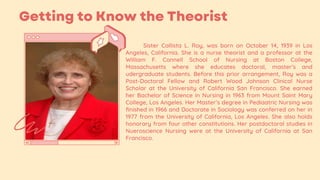
Sister Callista L. Roy, was born on October 14, 1939 in Los
Angeles, California. She is a nurse theorist and a professor at the
William F. Connell School of Nursing at Boston College,
Massachusetts where she educates doctoral, master’s and
udergraduate students. Before this prior arrangement, Roy was a
Post-Doctoral Fellow and Robert Wood Johnson Clinical Nurse
Scholar at the University of California San Francisco. She earned
her Bachelor of Science in Nursing in 1963 from Mount Saint Mary
College, Los Angeles. Her Master’s degree in Pediaatric Nursing was
finished in 1966 and Doctorate in Sociology was conferred on her in
1977 from the University of California, Los Angeles. She also holds
honorary from four other constitutions. Her postdoctoral studies in
Nueroscience Nursing were at the University of California at San
Francisco.
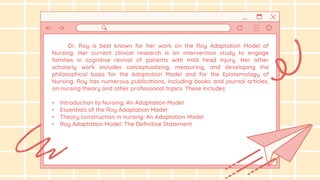
Dr. Roy is best known for her work on the Roy Adaptation Model of
Nursing. Her current clinical research is an intervention study to engage
families in cognitive revival of patients with mild head injury. Her other
scholarly work includes conceptualizing, measuring, and developing the
philosophical basis for the Adaptation Model and for the Epistemology of
Nursing, Roy has numerous publications, including books and journal articles,
on nursing theory and other professional topics. These includes:
• Introduction to Nursing: An Adaptation Model
• Essentials of the Roy Adaptation Model
• Theory construction in nursing: An Adaptation Model
• Roy Adaptation Model: The Definitive Statement
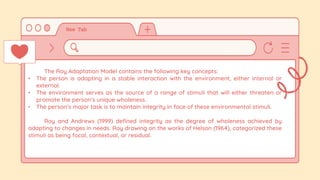
The Roy Adaptation Model contains the following key concepts:
• The person is adapting in a stable interaction with the environment, either internal or
external.
• The environment serves as the source of a range of stimuli that will either threaten or
promote the person’s unique wholeness.
• The person’s major task is to maintain integrity in face of these environmental stimuli.
Roy and Andrews (1999) defined integrity as the degree of wholeness achieved by
adapting to changes in needs. Roy drawing on the works of Helson (1964), categorized these
stimuli as being focal, contextual, or residual.
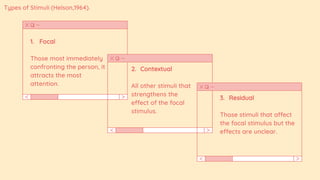
Types of Stimuli (Helson,1964).
1. Focal
Those most immediately
confronting the person, it
attracts the most
attention.
2. Contextual
All other stimuli that
strengthens the
effect of the focal
stimulus.
3. Residual
Those stimuli that affect
the focal stimulus but the
effects are unclear.
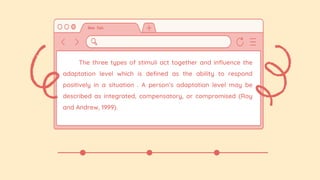
The three types of stimuli act together and influence the
adaptation level which is defined as the ability to respond
positively in a situation . A person’s adaptation level may be
described as integrated, compensatory, or compromised (Roy
and Andrew, 1999).
The Adaptation Level is modulated by a person’s coping mechanism
and control processes. Thus, a person does not respond passively to
environmental stimuli. There are two categories of coping mechanisms
according to Roy namely the regulator and the cognator subsystems.
• REGULATOR SUBSYSTEMS transpires through neutral, chemical and
endocrine processes like the increase in vital signs- sympathetic response
to stress.
• COGNATOR SUBSYSTEM on the other hand, occurs through cognitive-
emotive processess. For instance are the effects of prolonged
hospitalization for a four-year old child.
Furthermore, Roy identified two control processes namely the stabilizer
subsystem and the innovator subsystem. These two coincides with the
regulator and cognitor subsystems when a person responds to a stimulus.
• INNOVATOR SUBSYSTEMS on the other hand, allows the person to change
to higher levels of potential through cognitive and emotional strategies.
Roy’s theory of the person as an Adaptive System claim that the four
adaptive modes are interrelated through perception. An adaptive or
ineffective response in one mode can influence adaptation in the other
modes.
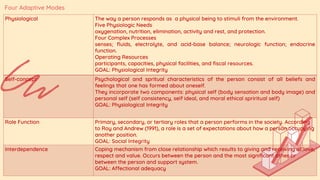
Physiological The way a person responds as a physical being to stimuli from the environment.
Five Physiologic Needs
oxygenation, nutrition, elimination, activity and rest, and protection.
Four Complex Processes
senses; fluids, electrolyte, and acid-base balance; neurologic function; endocrine
function.
Operating Resources
participants, capacities, physical facilities, and fiscal resources.
GOAL: Physiological Integrity
Self-concept Psychological and spritual characteristics of the person consist of all beliefs and
feelings that one has formed about oneself.
They incorporate two components: physical self (body sensation and body image) and
personal self (self consistency, self ideal, and moral ethical spriritual self)
GOAL: Physiological Integrity
Role Function Primary, secondary, or tertiary roles that a person performs in the society. According
to Roy and Andrew (1991), a role is a set of expectations about how a person occupying
another position.
GOAL: Social Integrity
Interdependence Coping mechanism from close relationship which results to giving and receiving of love,
respect and value. Occurs between the person and the most significant other or
between the person and support system.
GOAL: Affectional adequacy
Four Adaptive Modes
Adaptive or ineffective responses result from these coping mechanisms.
Adaptive responses support the integrity of the person and the goals of
adaptation. The major task of the person is to become accustomed with
enviromental stimuli in order to achieve survival, growth, development, and
mastery. Ineffective response neither promote integrity nor contribute to the
goals of adaptation (Andrew and Roy 1999).
Adaptation is done through two main coping subsystems, namely the
regulator and cognator. Roy did not explain further the mechanism of
regulator and cognator because its mechanism cannot be directly observed
and unknown. However, its behaviour are manifested in the four adaptive
modes.
According to Roy and Andrwes (1999), health is a state and a process of
being and becoming an integrated and whole person. It is an indication of how
well an individual has adapted to environmental stimuli. Therefore the goal of
nursing is to help the person attain adaptation by helping the person to
survive, grow, reproduce and master.
The Nursing Process, as utilized by Roy in her theory, is a goal-oriented,
problem-solving approach to guide the provision of comprehensive,
competent nursing care to a person or group of persons. It relates directly to
the view of the person as an adaptive system (Andrew and Roy 1991). The
goal of nursing in the RAM is to promote adaptation in each of the four
adaptive modes.
Definition: A problem-solving approach for gathering data, identifying
the capacities and needs of the human adaptive system, selecting and
implementing approaches for nursing care, and evaluation the outcome of
care provided.
Directions: Say HEP-HEP if the statement is TRUE and HOORAY if the
statement is FALSE. NOTE: With Action! No actions considered wrong!
1. Adaptation model talks about positive adaptation level of the patient in a
specific environment. And nurses are considered facilitators to move the
patient from survival to transformation.
2. There are 4 types of stimulus, namely pshychological, self-concept, role
function, and interdependence.
3. The following are key concepts of Roy Adaptation Model:
• The person is adapting in a stable interaction with the environment,
either internal or external.
• The environment serves as the source of a range of stimuli that will
either threaten or promote the person’s unique wholeness.
• The person’s major task is to maintain integrity in face of these
environmental stimuli.
4. REGULATOR SUBSYSTEMS talks about a patients adopting level using
his/her thinking and feelings.
5. INNOVATOR SUBSYSTEMS on the other hand, allows the person to change
to higher levels of potential through cognitive and emotional strategies.
6. The adaptive modes are focal, contextual and residual.
7. the goal of nursing is to help the person attain adaptation by helping the
person to survive, grow, reproduce and master.
9. The Nursing Process examples are; assessments, diagnoses, planning,
implementation, and evaluation.
10. What is the importance of RAM and its relation to Nursing Practice?
8. Nursing Process is a goal-oriented, problem-solving approach to guide the
provision of comprehensive, competent nursing care to a person or group of
persons.
-Magtanong Pangit!
9-SISTER-CALLISTA-ROY-MODEL-Recovered.pptx

9-SISTER-CALLISTA-ROY-MODEL-Recovered.pptx

  • 1.
  • 2.
    Topics Covered 1. Getting toKnow the Theorist 2. Types of Stimulus 3. Coping Processes 4. Adaptive Modes 5. Nursing Processes
  • 3.
  • 4.
    Sister Callista L.Roy, was born on October 14, 1939 in Los Angeles, California. She is a nurse theorist and a professor at the William F. Connell School of Nursing at Boston College, Massachusetts where she educates doctoral, master’s and udergraduate students. Before this prior arrangement, Roy was a Post-Doctoral Fellow and Robert Wood Johnson Clinical Nurse Scholar at the University of California San Francisco. She earned her Bachelor of Science in Nursing in 1963 from Mount Saint Mary College, Los Angeles. Her Master’s degree in Pediaatric Nursing was finished in 1966 and Doctorate in Sociology was conferred on her in 1977 from the University of California, Los Angeles. She also holds honorary from four other constitutions. Her postdoctoral studies in Nueroscience Nursing were at the University of California at San Francisco.
  • 5.
    Dr. Roy isbest known for her work on the Roy Adaptation Model of Nursing. Her current clinical research is an intervention study to engage families in cognitive revival of patients with mild head injury. Her other scholarly work includes conceptualizing, measuring, and developing the philosophical basis for the Adaptation Model and for the Epistemology of Nursing, Roy has numerous publications, including books and journal articles, on nursing theory and other professional topics. These includes: • Introduction to Nursing: An Adaptation Model • Essentials of the Roy Adaptation Model • Theory construction in nursing: An Adaptation Model • Roy Adaptation Model: The Definitive Statement
  • 6.
    The Roy AdaptationModel contains the following key concepts: • The person is adapting in a stable interaction with the environment, either internal or external. • The environment serves as the source of a range of stimuli that will either threaten or promote the person’s unique wholeness. • The person’s major task is to maintain integrity in face of these environmental stimuli. Roy and Andrews (1999) defined integrity as the degree of wholeness achieved by adapting to changes in needs. Roy drawing on the works of Helson (1964), categorized these stimuli as being focal, contextual, or residual.
  • 7.
    Types of Stimuli(Helson,1964). 1. Focal Those most immediately confronting the person, it attracts the most attention. 2. Contextual All other stimuli that strengthens the effect of the focal stimulus. 3. Residual Those stimuli that affect the focal stimulus but the effects are unclear.
  • 8.
    The three typesof stimuli act together and influence the adaptation level which is defined as the ability to respond positively in a situation . A person’s adaptation level may be described as integrated, compensatory, or compromised (Roy and Andrew, 1999).
  • 9.
    The Adaptation Levelis modulated by a person’s coping mechanism and control processes. Thus, a person does not respond passively to environmental stimuli. There are two categories of coping mechanisms according to Roy namely the regulator and the cognator subsystems. • REGULATOR SUBSYSTEMS transpires through neutral, chemical and endocrine processes like the increase in vital signs- sympathetic response to stress. • COGNATOR SUBSYSTEM on the other hand, occurs through cognitive- emotive processess. For instance are the effects of prolonged hospitalization for a four-year old child.
  • 10.
    Furthermore, Roy identifiedtwo control processes namely the stabilizer subsystem and the innovator subsystem. These two coincides with the regulator and cognitor subsystems when a person responds to a stimulus. • INNOVATOR SUBSYSTEMS on the other hand, allows the person to change to higher levels of potential through cognitive and emotional strategies. Roy’s theory of the person as an Adaptive System claim that the four adaptive modes are interrelated through perception. An adaptive or ineffective response in one mode can influence adaptation in the other modes.
  • 11.
    Physiological The waya person responds as a physical being to stimuli from the environment. Five Physiologic Needs oxygenation, nutrition, elimination, activity and rest, and protection. Four Complex Processes senses; fluids, electrolyte, and acid-base balance; neurologic function; endocrine function. Operating Resources participants, capacities, physical facilities, and fiscal resources. GOAL: Physiological Integrity Self-concept Psychological and spritual characteristics of the person consist of all beliefs and feelings that one has formed about oneself. They incorporate two components: physical self (body sensation and body image) and personal self (self consistency, self ideal, and moral ethical spriritual self) GOAL: Physiological Integrity Role Function Primary, secondary, or tertiary roles that a person performs in the society. According to Roy and Andrew (1991), a role is a set of expectations about how a person occupying another position. GOAL: Social Integrity Interdependence Coping mechanism from close relationship which results to giving and receiving of love, respect and value. Occurs between the person and the most significant other or between the person and support system. GOAL: Affectional adequacy Four Adaptive Modes
  • 12.
    Adaptive or ineffectiveresponses result from these coping mechanisms. Adaptive responses support the integrity of the person and the goals of adaptation. The major task of the person is to become accustomed with enviromental stimuli in order to achieve survival, growth, development, and mastery. Ineffective response neither promote integrity nor contribute to the goals of adaptation (Andrew and Roy 1999). Adaptation is done through two main coping subsystems, namely the regulator and cognator. Roy did not explain further the mechanism of regulator and cognator because its mechanism cannot be directly observed and unknown. However, its behaviour are manifested in the four adaptive modes.
  • 13.
    According to Royand Andrwes (1999), health is a state and a process of being and becoming an integrated and whole person. It is an indication of how well an individual has adapted to environmental stimuli. Therefore the goal of nursing is to help the person attain adaptation by helping the person to survive, grow, reproduce and master.
  • 14.
    The Nursing Process,as utilized by Roy in her theory, is a goal-oriented, problem-solving approach to guide the provision of comprehensive, competent nursing care to a person or group of persons. It relates directly to the view of the person as an adaptive system (Andrew and Roy 1991). The goal of nursing in the RAM is to promote adaptation in each of the four adaptive modes. Definition: A problem-solving approach for gathering data, identifying the capacities and needs of the human adaptive system, selecting and implementing approaches for nursing care, and evaluation the outcome of care provided.
  • 17.
    Directions: Say HEP-HEPif the statement is TRUE and HOORAY if the statement is FALSE. NOTE: With Action! No actions considered wrong! 1. Adaptation model talks about positive adaptation level of the patient in a specific environment. And nurses are considered facilitators to move the patient from survival to transformation. 2. There are 4 types of stimulus, namely pshychological, self-concept, role function, and interdependence. 3. The following are key concepts of Roy Adaptation Model: • The person is adapting in a stable interaction with the environment, either internal or external. • The environment serves as the source of a range of stimuli that will either threaten or promote the person’s unique wholeness. • The person’s major task is to maintain integrity in face of these environmental stimuli.
  • 18.
    4. REGULATOR SUBSYSTEMStalks about a patients adopting level using his/her thinking and feelings. 5. INNOVATOR SUBSYSTEMS on the other hand, allows the person to change to higher levels of potential through cognitive and emotional strategies. 6. The adaptive modes are focal, contextual and residual. 7. the goal of nursing is to help the person attain adaptation by helping the person to survive, grow, reproduce and master.
  • 19.
    9. The NursingProcess examples are; assessments, diagnoses, planning, implementation, and evaluation. 10. What is the importance of RAM and its relation to Nursing Practice? 8. Nursing Process is a goal-oriented, problem-solving approach to guide the provision of comprehensive, competent nursing care to a person or group of persons.
  • 20.