Row Space, Column Space, Null Space And Rank, Nullity
and Rank-Nullity theorem for matrices.
Prepared by :
1. RAVIKUMAR PATEL (150410111065)
2. RISHABH PATEL (150410111066)
3. SAHAJ SIVADAS (150410111067)
4. SACHAYEETA GOGOI (150410111068)
5. AYUSHI SHAH (150410111069)
SUB : Vector Calculus and Linear Algebra
INDEX
 Row Space
 Column Space
 Null space
 Rank And Nullity
Definition Of Row Space And Column Space:
If A is an m×n matrix, then the subspace of Rn spanned by the row
vectors of A is
called the row space of A, and the subspace of Rm spanned by the
column vectors
is called the column space of A. The solution space of the
homogeneous system of
equation Ax=0, which is a subspace of Rn, is called the nullsapce of A.
11 12 1
21 22 2
1 2
1 11 12 1
2 21 22 2
For an m n matrix
...
...
A=
: : :
...
the vectors
[ ]
[ ]
:
n
n
m m mn
n
n
a a a
a a a
a a a
a a a
a a a

 
 
 
 
 
  


r
r
...
...
m 1 2
n
11 12 1
21 22 2
1 2
1 2
[ ]
in R formed form the rows of Aare called the row vectors of A, and the vectors
, , ...,
: : :
in
m m mn
n
n
n
m m mn
a a a
a a a
a a a
a a a

     
     
       
     
     
          
r
c c c
...
m
R formed from the columns of A are called the column vectors of A.
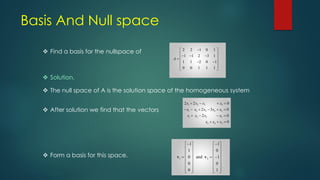
Basis And Null space
 Find a basis for the nullspace of
 Solution.
 The null space of A is the solution space of the homogeneous system
 After solution we find that the vectors
 Form a basis for this space.
2 2 1 0 1
1 1 2 3 1
1 1 2 0 1
0 0 1 1 1
A
 
    
  
 
 
1 2 3 5
1 2 3 4 5
1 2 3 5
3 4 5
2 2 0
2 3 0
2 0
0
x x x x
x x x x x
x x x x
x x x
   
     
   
  
1 2
1 1
1 0
and0 1
0 0
0 1
    
   
   
     
   
   
      
v v
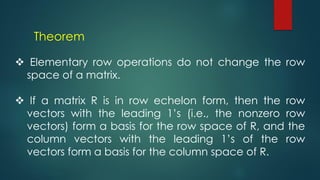
 Elementary row operations do not change the row
space of a matrix.
 If a matrix R is in row echelon form, then the row
vectors with the leading 1’s (i.e., the nonzero row
vectors) form a basis for the row space of R, and the
column vectors with the leading 1’s of the row
vectors form a basis for the column space of R.
Theorem
Example of Bases for Row and Column Spaces
1
2
3
The matrix
1 2 5 0 3
0 1 3 0 0
0 0 0 1 0
0 0 0 0 0
is in row-echelon form. From Theorem 5.5.6 the vectors
[1 -2 5 0 3]
[0 1 3 0 0]
[0 0 0 1 0]
form a
R
 
 
 
 
 
 



r
r
r
1 2 4
basis for the row space of R, and the vectors
1 2 0
0 1 0
, ,
0 0 1
0 0 0
form a basis for the column space of R.
     
     
       
     
     
     
c c c
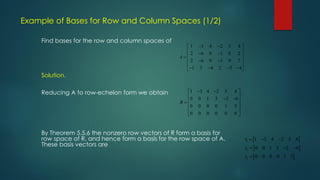
Example of Bases for Row and Column Spaces (1/2)
Find bases for the row and column spaces of
Solution.
Reducing A to row-echelon form we obtain
By Theorem 5.5.6 the nonzero row vectors of R form a basis for
row space of R, and hence form a basis for the row space of A.
These basis vectors are
1 3 4 2 5 4
2 6 9 1 8 2
2 6 9 1 9 7
1 3 4 2 5 4
A
  
   
  
 
    
1 3 4 2 5 4
0 0 1 3 2 6
0 0 0 0 1 5
0 0 0 0 0 0
R
  
   
 
 
 
 
 
 
1
2
3
r 1 3 4 2 5 4
r 0 0 1 3 2 6
r 0 0 0 0 1 5
  
  

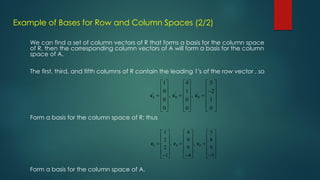
Example of Bases for Row and Column Spaces (2/2)
We can find a set of column vectors of R that forms a basis for the column space
of R, then the corresponding column vectors of A will form a basis for the column
space of A.
The first, third, and fifth columns of R contain the leading 1’s of the row vector , so
Form a basis for the column space of R; thus
Form a basis for the column space of A.
1 4 5
0 1 2
, ,
0 0 1
0 0 0
     
            
     
     
     
' ' '
1 5 5c c c
1 4 5
2 9 8
, ,
2 9 9
1 4 5
     
     
       
     
     
       
1 3 5c c c
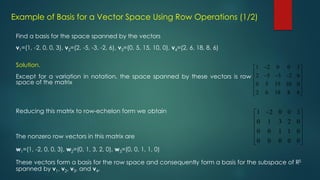
Example of Basis for a Vector Space Using Row Operations (1/2)
Find a basis for the space spanned by the vectors
v1=(1, -2, 0, 0, 3), v2=(2, -5, -3, -2, 6), v3=(0, 5, 15, 10, 0), v4=(2, 6, 18, 8, 6)
Solution.
Except for a variation in notation, the space spanned by these vectors is row
space of the matrix
Reducing this matrix to row-echelon form we obtain
1 2 0 0 3
2 5 3 2 6
0 5 15 10 0
2 6 18 8 6
 
    
 
 
 
1 2 0 0 3
0 1 3 2 0
0 0 1 1 0
0 0 0 0 0
 
 
 
 
 
 
The nonzero row vectors in this matrix are
w1=(1, -2, 0, 0, 3), w2=(0, 1, 3, 2, 0), w3=(0, 0, 1, 1, 0)
These vectors form a basis for the row space and consequently form a basis for the subspace of R5
spanned by v1, v2, v3, and v4.
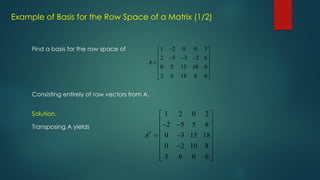
Example of Basis for the Row Space of a Matrix (1/2)
Find a basis for the row space of
Consisting entirely of row vectors from A.
Solution.
Transposing A yields
1 2 0 0 3
2 5 3 2 6
0 5 15 10 0
2 6 18 8 6
A
 
    
 
 
 
1 2 0 2
2 5 5 6
0 3 15 18
0 2 10 8
3 6 0 6
T
A
 
   
  
 
 
  
Example of Basis for the Row Space of a Matrix (2/2)
Reducing this matrix to row-echelon form yields
The first, second, and fourth columns contain the leading 1’s, so the corresponding column
vectors in AT form a basis for the column space of ; these are
Transposing again and adjusting the notation appropriately yields the basis vectors
r1=[1 -2 0 0 3], r2=[2 -5 -3 -2 6], and r3=[2 -5 -3 -2 6]
for the row space of A.
1 2 2
2 5 6
, , and0 3 18
0 2 8
3 6 6
     
           
       
     
     
          
1 2 4c c c
1 2 0 2
0 1 5 10
0 0 0 1
0 0 0 0
0 0 0 0
 
  
 
 
 
  
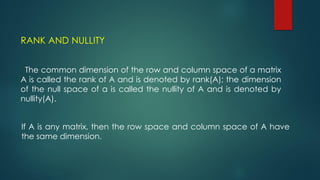
The common dimension of the row and column space of a matrix
A is called the rank of A and is denoted by rank(A); the dimension
of the null space of a is called the nullity of A and is denoted by
nullity(A).
RANK AND NULLITY
If A is any matrix, then the row space and column space of A have
the same dimension.
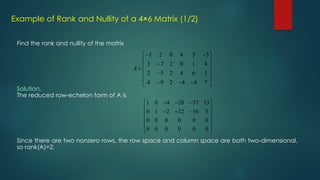
Example of Rank and Nullity of a 4×6 Matrix (1/2)
Find the rank and nullity of the matrix
Solution.
The reduced row-echelon form of A is
Since there are two nonzero rows, the row space and column space are both two-dimensional,
so rank(A)=2.
1 2 0 4 5 3
3 7 2 0 1 4
2 5 2 4 6 1
4 9 2 4 4 7
A
  
  
 
 
   
1 0 4 28 37 13
0 1 2 12 16 5
0 0 0 0 0 0
0 0 0 0 0 0
   
    
 
 
 
Example of Rank and Nullity of a 4×6 Matrix (2/2)
The corresponding system of equations will be
x1-4x3-28x4-37x5+13x6=0
x2-2x3-12x4-16x5+5x6=0
It follows that the general solution of the system is
x1=4r+28s+37t-13u x2=2r+12s+16t-5u x3=r x4=s x5=t x6=u
Or
So that nullity(A)=4.
1
2
3
4
5
6
4 28 37 13
2 12 16 5
1 0 0 0
0 1 0 0
0 0 1 0
0 0 0 1
x
x
x
r s t u
x
x
x
         
                  
         
            
         
         
         
                 
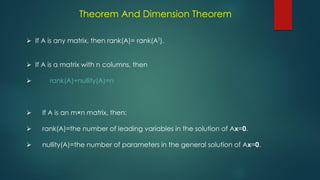
Theorem And Dimension Theorem
 If A is any matrix, then rank(A)= rank(AT).
 If A is a matrix with n columns, then
 rank(A)+nullity(A)=n
 If A is an m×n matrix, then:
 rank(A)=the number of leading variables in the solution of Ax=0.
 nullity(A)=the number of parameters in the general solution of Ax=0.
Example of The Sum of Rank and Nullity
The matrix
has 6 columns, so
rank(A)+nullity(A)=6
This is consistent with Example 1, where we should showed that
rank(A)=2 and nullity(A)=4
1 2 0 4 5 3
3 7 2 0 1 4
2 5 2 4 6 1
4 9 2 4 4 7
A
  
  
 
 
   
References:
 Textbook of Vector Calculus and Linear Algebra (Atul Publications)
 Note: All the excerpts taken from the respective book were used only
for academic purpose. NO commercial purpose was entertained.
Thank – You.
”
- Paul Dirac

Row space, column space, null space And Rank, Nullity and Rank-Nullity theorem for matrices.

  • 1.
    Row Space, ColumnSpace, Null Space And Rank, Nullity and Rank-Nullity theorem for matrices. Prepared by : 1. RAVIKUMAR PATEL (150410111065) 2. RISHABH PATEL (150410111066) 3. SAHAJ SIVADAS (150410111067) 4. SACHAYEETA GOGOI (150410111068) 5. AYUSHI SHAH (150410111069) SUB : Vector Calculus and Linear Algebra
  • 2.
    INDEX  Row Space Column Space  Null space  Rank And Nullity
  • 3.
    Definition Of RowSpace And Column Space: If A is an m×n matrix, then the subspace of Rn spanned by the row vectors of A is called the row space of A, and the subspace of Rm spanned by the column vectors is called the column space of A. The solution space of the homogeneous system of equation Ax=0, which is a subspace of Rn, is called the nullsapce of A.
  • 4.
    11 12 1 2122 2 1 2 1 11 12 1 2 21 22 2 For an m n matrix ... ... A= : : : ... the vectors [ ] [ ] : n n m m mn n n a a a a a a a a a a a a a a a                 r r ... ... m 1 2 n 11 12 1 21 22 2 1 2 1 2 [ ] in R formed form the rows of Aare called the row vectors of A, and the vectors , , ..., : : : in m m mn n n n m m mn a a a a a a a a a a a a                                             r c c c ... m R formed from the columns of A are called the column vectors of A.
  • 8.
    Basis And Nullspace  Find a basis for the nullspace of  Solution.  The null space of A is the solution space of the homogeneous system  After solution we find that the vectors  Form a basis for this space. 2 2 1 0 1 1 1 2 3 1 1 1 2 0 1 0 0 1 1 1 A               1 2 3 5 1 2 3 4 5 1 2 3 5 3 4 5 2 2 0 2 3 0 2 0 0 x x x x x x x x x x x x x x x x                  1 2 1 1 1 0 and0 1 0 0 0 1                                   v v
  • 9.
     Elementary rowoperations do not change the row space of a matrix.  If a matrix R is in row echelon form, then the row vectors with the leading 1’s (i.e., the nonzero row vectors) form a basis for the row space of R, and the column vectors with the leading 1’s of the row vectors form a basis for the column space of R. Theorem
  • 10.
    Example of Basesfor Row and Column Spaces 1 2 3 The matrix 1 2 5 0 3 0 1 3 0 0 0 0 0 1 0 0 0 0 0 0 is in row-echelon form. From Theorem 5.5.6 the vectors [1 -2 5 0 3] [0 1 3 0 0] [0 0 0 1 0] form a R                r r r 1 2 4 basis for the row space of R, and the vectors 1 2 0 0 1 0 , , 0 0 1 0 0 0 form a basis for the column space of R.                                       c c c
  • 11.
    Example of Basesfor Row and Column Spaces (1/2) Find bases for the row and column spaces of Solution. Reducing A to row-echelon form we obtain By Theorem 5.5.6 the nonzero row vectors of R form a basis for row space of R, and hence form a basis for the row space of A. These basis vectors are 1 3 4 2 5 4 2 6 9 1 8 2 2 6 9 1 9 7 1 3 4 2 5 4 A                  1 3 4 2 5 4 0 0 1 3 2 6 0 0 0 0 1 5 0 0 0 0 0 0 R                    1 2 3 r 1 3 4 2 5 4 r 0 0 1 3 2 6 r 0 0 0 0 1 5       
  • 12.
    Example of Basesfor Row and Column Spaces (2/2) We can find a set of column vectors of R that forms a basis for the column space of R, then the corresponding column vectors of A will form a basis for the column space of A. The first, third, and fifth columns of R contain the leading 1’s of the row vector , so Form a basis for the column space of R; thus Form a basis for the column space of A. 1 4 5 0 1 2 , , 0 0 1 0 0 0                                      ' ' ' 1 5 5c c c 1 4 5 2 9 8 , , 2 9 9 1 4 5                                         1 3 5c c c
  • 13.
    Example of Basisfor a Vector Space Using Row Operations (1/2) Find a basis for the space spanned by the vectors v1=(1, -2, 0, 0, 3), v2=(2, -5, -3, -2, 6), v3=(0, 5, 15, 10, 0), v4=(2, 6, 18, 8, 6) Solution. Except for a variation in notation, the space spanned by these vectors is row space of the matrix Reducing this matrix to row-echelon form we obtain 1 2 0 0 3 2 5 3 2 6 0 5 15 10 0 2 6 18 8 6              1 2 0 0 3 0 1 3 2 0 0 0 1 1 0 0 0 0 0 0             The nonzero row vectors in this matrix are w1=(1, -2, 0, 0, 3), w2=(0, 1, 3, 2, 0), w3=(0, 0, 1, 1, 0) These vectors form a basis for the row space and consequently form a basis for the subspace of R5 spanned by v1, v2, v3, and v4.
  • 14.
    Example of Basisfor the Row Space of a Matrix (1/2) Find a basis for the row space of Consisting entirely of row vectors from A. Solution. Transposing A yields 1 2 0 0 3 2 5 3 2 6 0 5 15 10 0 2 6 18 8 6 A              1 2 0 2 2 5 5 6 0 3 15 18 0 2 10 8 3 6 0 6 T A                
  • 15.
    Example of Basisfor the Row Space of a Matrix (2/2) Reducing this matrix to row-echelon form yields The first, second, and fourth columns contain the leading 1’s, so the corresponding column vectors in AT form a basis for the column space of ; these are Transposing again and adjusting the notation appropriately yields the basis vectors r1=[1 -2 0 0 3], r2=[2 -5 -3 -2 6], and r3=[2 -5 -3 -2 6] for the row space of A. 1 2 2 2 5 6 , , and0 3 18 0 2 8 3 6 6                                                  1 2 4c c c 1 2 0 2 0 1 5 10 0 0 0 1 0 0 0 0 0 0 0 0              
  • 16.
    The common dimensionof the row and column space of a matrix A is called the rank of A and is denoted by rank(A); the dimension of the null space of a is called the nullity of A and is denoted by nullity(A). RANK AND NULLITY If A is any matrix, then the row space and column space of A have the same dimension.
  • 17.
    Example of Rankand Nullity of a 4×6 Matrix (1/2) Find the rank and nullity of the matrix Solution. The reduced row-echelon form of A is Since there are two nonzero rows, the row space and column space are both two-dimensional, so rank(A)=2. 1 2 0 4 5 3 3 7 2 0 1 4 2 5 2 4 6 1 4 9 2 4 4 7 A               1 0 4 28 37 13 0 1 2 12 16 5 0 0 0 0 0 0 0 0 0 0 0 0               
  • 18.
    Example of Rankand Nullity of a 4×6 Matrix (2/2) The corresponding system of equations will be x1-4x3-28x4-37x5+13x6=0 x2-2x3-12x4-16x5+5x6=0 It follows that the general solution of the system is x1=4r+28s+37t-13u x2=2r+12s+16t-5u x3=r x4=s x5=t x6=u Or So that nullity(A)=4. 1 2 3 4 5 6 4 28 37 13 2 12 16 5 1 0 0 0 0 1 0 0 0 0 1 0 0 0 0 1 x x x r s t u x x x                                                                                                    
  • 19.
    Theorem And DimensionTheorem  If A is any matrix, then rank(A)= rank(AT).  If A is a matrix with n columns, then  rank(A)+nullity(A)=n  If A is an m×n matrix, then:  rank(A)=the number of leading variables in the solution of Ax=0.  nullity(A)=the number of parameters in the general solution of Ax=0.
  • 20.
    Example of TheSum of Rank and Nullity The matrix has 6 columns, so rank(A)+nullity(A)=6 This is consistent with Example 1, where we should showed that rank(A)=2 and nullity(A)=4 1 2 0 4 5 3 3 7 2 0 1 4 2 5 2 4 6 1 4 9 2 4 4 7 A              
  • 21.
    References:  Textbook ofVector Calculus and Linear Algebra (Atul Publications)  Note: All the excerpts taken from the respective book were used only for academic purpose. NO commercial purpose was entertained.
  • 22.