1 | P a g e
GUJARAT TECHNOLOGICAL UNIVERSITY
Chandkheda , Ahmadabad.
Affiliated
SIGMA INSTITUTE OF TECHNOLOGY AND ENGINEERING
A Report
On
“Dark Indicator”
B.E. – Semester - II
(Computer Engineering)
Submitted by:
Sr. No. Name of Student Enrollment No.
1 Patel Hemin B. 150500107025
2 Patel Harshal N. 150500107024
3 Patel Vandit I. 150500107029
4 Solanki Nishit. 150500107039
Mr. Rakesh Koringa
(Assistant Professor)
Mrs. Kishori Shekokar
(Head of the Department)
Academic year
(2015-16)
2 | P a g e
SIGMA INSTITUTE OF ENGINEERING, VADODARA
COMPUTER ENGINEERING DEPARTMENT
2016
CERTIFICATE
Date:
This is to certify that Project entitled “DARK INDICATOR” has been car-
ried out by PATEL HEMINKUMAR (150500107025), PATEL HARSHAL
(150500107024), PATEL VANDITKUMAR (150500107029), SOLANKI NISHIT
(150500107039) under my guidance in fulfillment of the Workshop Project in-
Computer (2nd
Semester) by Gujarat Technological University, Ahmadabad, dur-
ing the academic year 2015-16.
Internal Guide Head of Department
Mr. Rakesh Koringa Mrs. Kishori Shekokar
Asst. Professor, HOD,
E&C Dept. COM Dept.
SIE-Bakrol. SIE-Bakrol.
Mr. Viral Patel
Assit. Professor,
E&C Dept.
SIE-Bakrol.
3 | P a g e
ACKNOWLEDGEMENT
To learn the basic foundation laying fundamentals of professional carrier is always a matter of
prime importance. Being a student of Computer Department nothing can get better than learning those
fundamentals during the project. We acknowledge the support and help provided by Mr. Rakesh
Koringa (Asst. Professor), Mr. Viral Patel (Asst. Professor) Internal Guide, without their support,
guidance and encouragement, this project couldn’t have been put together.
We are highly indebted to our head of Department Mrs. Kishori Shekokar for providing us
this opportunity to prepare this project. We would also like to thank entire staff of Electronics depart-
ment especially to our teachers who were always there to support us and without that it would be im-
possible for us to complete our project.
Being final year students, making of the project adds a final touch to our carrier. For this op-
portunity that was presented to us, we would like to thank all faculties who were instrumental during
our project. We would also like to thank other members who have helped us directly and indirectly.
We express our sincere thanks to all the staff members of the Department of Electronics and Commu-
nication who have helped us when required.
PATEL HEMINKUMAR (150500107025),
PATEL HARSHAL (150500107024),
PATEL VANDITKUMAR (150500107029),
SOLANKI NISHIT (150500107039).
4 | P a g e
ABSTRACT
This project aims at designing and executing the advanced development in embedded systems
for energy saving of street lights with light depending resistor. Nowadays, human has become too busy
and he is unable to find time even to switch the lights wherever not necessary. This
can be seen more effectively in the case of street lights. The present system is like, the street lights will
be switched on in the evening before the sun sets and they are switched off the next day morning after
there is sufficient light on the roads. But the actual timings for these street lights
to be switched on are when there is absolute darkness. With this, the power will be wasted up to some
extent. This project gives the best solution for electrical power wastage. Also the manual operation of
the lighting system is completely eliminated.
In our project we are using LDR, which varies according to the amount of light falling on its
surface, this give an indication for us whether it is a day/night time. In the present project street lights
are taken into consideration where the above discussed factors are rectified in them. This is achieved
with the help of an embedded system. By using this as the basic principle we can design centralized
intelligent system for the perfect usage of streetlights in any place (Village, Town) can be developed.
5 | P a g e
INDEX
 ACKNOWLEDGMENT..…………………………………………….………….. 03
 ABSTRACT…………………..…………………………………………................ 04
 LIST OF FIGURES…………………………………………………………….… 05
Chapter: 1 INTRODUCTION OF DARK INDICATOR………………………….… 07
Chapter: 2 CIRCUIT DIAGRAM………………………………………...………….. 10
2.1 Description of Circuit Diagram…………………….…........……… 11
Chapter: 3 LIST OF COMPONENTS……………………………………………… 12
Chapter: 4 DESCRIPTIONS OF COMPONENTS……………..………………… 13
4.1 Battery…………………………………………………………….. 14
4.2 Resistor……………………………………………………………. 15
4.3 LED………………………………………………………………. 16
4.4 LDR…………………………………………………….………… 17
4.5 IC555……………………………………………………………. 18
4.6 Capacitor………………………………………………………….. 19
4.7 Buzzer …………………………………………………………….. 20
4.8 Battery Cap………………………………………………………… 21
Chapter: 5 APPLICATIONS AND ADVANTAGES ……………...……………… 22
Chapter: 6 CONCLUSIONS………………………………………………………..… 24
Chapter: 7 REFERENCES………………………………..………………………….. 26
6 | P a g e
LIST OF FIGURES
Figure Number Figure Name
1.1 LDR
1.2 LDR Symbol
1.3 Flowchart
1.4 Circuit
2.1 Circuit Diagram
4.1.1 Battery
4.1.2 Battery
4.2.1 Resistor
4.3.1 LED Figure
4.3.2 LED
4.4.1 LDR
4.5.1 IC555 Diagram
4.5.2 IC555
4.5.3 IC555 Output
4.6.1 Capacitor
4.6.2 Capacitor Symbol
4.7.1 Buzzer
4.7.2 Buzzer Diagram
4.8.1 Battery Cap
4.8.2 Battery Cap
7 | P a g e
3.LIST OF COMPONENTS
8 | P a g e
A light sensor is a module which can sense the presence of light or in other words we can say
that it is a dark indicator.
Means in the dark it gives us a output as 1.
Concept:-
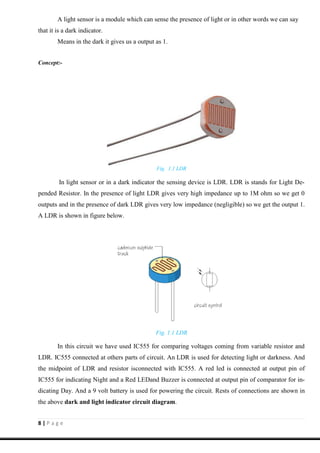
Fig. 1.1 LDR
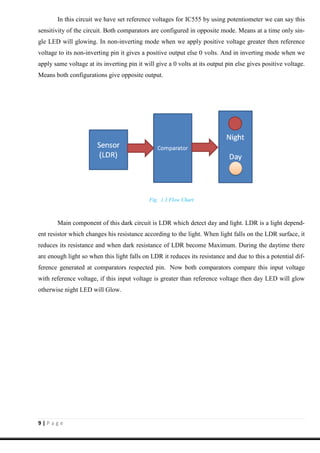
In light sensor or in a dark indicator the sensing device is LDR. LDR is stands for Light De-
pended Resistor. In the presence of light LDR gives very high impedance up to 1M ohm so we get 0
outputs and in the presence of dark LDR gives very low impedance (negligible) so we get the output 1.
A LDR is shown in figure below.
Fig. 1.1 LDR
In this circuit we have used IC555 for comparing voltages coming from variable resistor and
LDR. IC555 connected at others parts of circuit. An LDR is used for detecting light or darkness. And
the midpoint of LDR and resistor isconnected with IC555. A red led is connected at output pin of
IC555 for indicating Night and a Red LEDand Buzzer is connected at output pin of comparator for in-
dicating Day. And a 9 volt battery is used for powering the circuit. Rests of connections are shown in
the above dark and light indicator circuit diagram.
9 | P a g e
In this circuit we have set reference voltages for IC555 by using potentiometer we can say this
sensitivity of the circuit. Both comparators are configured in opposite mode. Means at a time only sin-
gle LED will glowing. In non-inverting mode when we apply positive voltage greater then reference
voltage to its non-inverting pin it gives a positive output else 0 volts. And in inverting mode when we
apply same voltage at its inverting pin it will give a 0 volts at its output pin else gives positive voltage.
Means both configurations give opposite output.
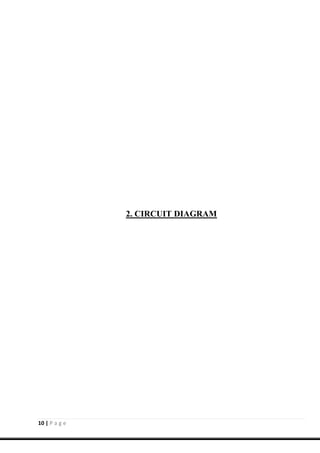
Fig. 1.3 Flow Chart
Main component of this dark circuit is LDR which detect day and light. LDR is a light depend-
ent resistor which changes his resistance according to the light. When light falls on the LDR surface, it
reduces its resistance and when dark resistance of LDR become Maximum. During the daytime there
are enough light so when this light falls on LDR it reduces its resistance and due to this a potential dif-
ference generated at comparators respected pin. Now both comparators compare this input voltage
with reference voltage, if this input voltage is greater than reference voltage then day LED will glow
otherwise night LED will Glow.
10 | P a g e
2. CIRCUIT DIAGRAM
11 | P a g e
DARK INDICATOR
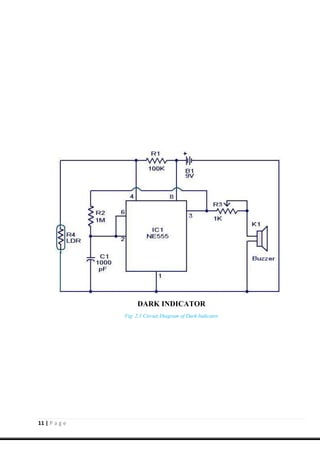
Fig. 2.1 Circuit Diagram of Dark Indicator
12 | P a g e
2.1 Description of Circuit Diagram
In this circuit we have used IC555 for comparing voltages coming from variable resis-
tor and LDR. IC555 connected at others parts of circuit. An LDR is used for detecting light or dark-
ness. And the midpoint of LDR and resistor is connected with IC555. A red led is connected at output
pin of IC555 for indicating Night and a Red LED and Buzzer is connected at output pin of comparator
for indicating Day. And a 9 volt battery is used for powering the circuit.
13 | P a g e
4. DESCRIPTIONS OF COMPONENTS
14 | P a g e
4.1 Battery
The nine-volt battery, or 9-volt battery, in its most common form was introduced for the ear-
ly transistor radios. It has a rectangular prism shape with rounded edges and a polarized snap connect-
or at the top. This type is commonly used in walkie talkies, clocks and smoke detectors. They are also
used as backup power to keep the time in certain electronic clocks. This format is commonly available
in primary carbon-zinc and alkaline chemistry, in primary lithium iron disulfide, and in rechargeable
form in nickel-cadmium, nickel-metal hydride and lithium-ion. Mercury oxide batteries in this form
have not been manufactured in many years due to their mercury content. This type is designat-
ed NEDA 1604 and IEC 6F22 (zinc-carbon) or MN1604 6LR61 (alkaline). The size, regardless of
technology, is commonly designated PP3 (originally a Zn-C type).
Most nine-volt alkaline batteries are constructed of six individual 1.5V LR61 cells enclosed in
a wrapper.[3]
These cells are slightly smaller than LR8D425 AAAA cells and can be used in their place
for some devices, even though they are 3.5 mm shorter. Carbon-zinc types are made with six flat cells
in a stack, enclosed in a moisture-resistant wrapper to prevent drying.
Fig. 4.1.1 Fig. 4.1.2
15 | P a g e
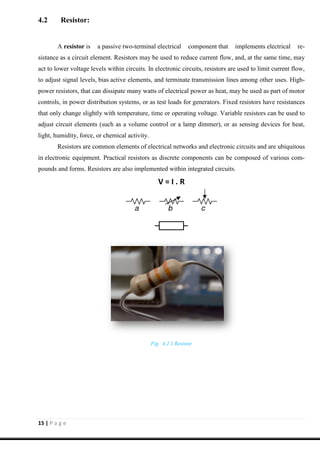
4.2 Resistor:
A resistor is a passive two-terminal electrical component that implements electrical re-
sistance as a circuit element. Resistors may be used to reduce current flow, and, at the same time, may
act to lower voltage levels within circuits. In electronic circuits, resistors are used to limit current flow,
to adjust signal levels, bias active elements, and terminate transmission lines among other uses. High-
power resistors, that can dissipate many watts of electrical power as heat, may be used as part of motor
controls, in power distribution systems, or as test loads for generators. Fixed resistors have resistances
that only change slightly with temperature, time or operating voltage. Variable resistors can be used to
adjust circuit elements (such as a volume control or a lamp dimmer), or as sensing devices for heat,
light, humidity, force, or chemical activity.
Resistors are common elements of electrical networks and electronic circuits and are ubiquitous
in electronic equipment. Practical resistors as discrete components can be composed of various com-
pounds and forms. Resistors are also implemented within integrated circuits.
V = I . R
Fig. 4.2.1 Resistor
16 | P a g e
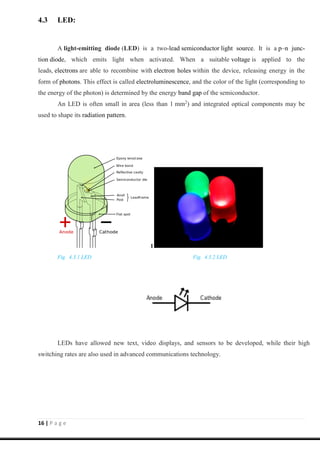
4.3 LED:
A light-emitting diode (LED) is a two-lead semiconductor light source. It is a p–n junc-
tion diode, which emits light when activated. When a suitable voltage is applied to the
leads, electrons are able to recombine with electron holes within the device, releasing energy in the
form of photons. This effect is called electroluminescence, and the color of the light (corresponding to
the energy of the photon) is determined by the energy band gap of the semiconductor.
An LED is often small in area (less than 1 mm2
) and integrated optical components may be
used to shape its radiation pattern.
1
Fig. 4.3.1 LED Fig. 4.3.2 LED
LEDs have allowed new text, video displays, and sensors to be developed, while their high
switching rates are also used in advanced communications technology.
17 | P a g e
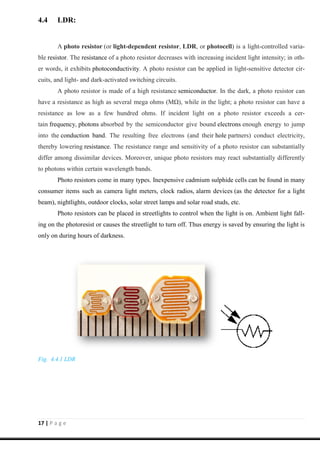
4.4 LDR:
A photo resistor (or light-dependent resistor, LDR, or photocell) is a light-controlled varia-
ble resistor. The resistance of a photo resistor decreases with increasing incident light intensity; in oth-
er words, it exhibits photoconductivity. A photo resistor can be applied in light-sensitive detector cir-
cuits, and light- and dark-activated switching circuits.
A photo resistor is made of a high resistance semiconductor. In the dark, a photo resistor can
have a resistance as high as several mega ohms (MΩ), while in the light; a photo resistor can have a
resistance as low as a few hundred ohms. If incident light on a photo resistor exceeds a cer-
tain frequency, photons absorbed by the semiconductor give bound electrons enough energy to jump
into the conduction band. The resulting free electrons (and their hole partners) conduct electricity,
thereby lowering resistance. The resistance range and sensitivity of a photo resistor can substantially
differ among dissimilar devices. Moreover, unique photo resistors may react substantially differently
to photons within certain wavelength bands.
Photo resistors come in many types. Inexpensive cadmium sulphide cells can be found in many
consumer items such as camera light meters, clock radios, alarm devices (as the detector for a light
beam), nightlights, outdoor clocks, solar street lamps and solar road studs, etc.
Photo resistors can be placed in streetlights to control when the light is on. Ambient light fall-
ing on the photoresist or causes the streetlight to turn off. Thus energy is saved by ensuring the light is
only on during hours of darkness.
Fig. 4.4.1 LDR
18 | P a g e
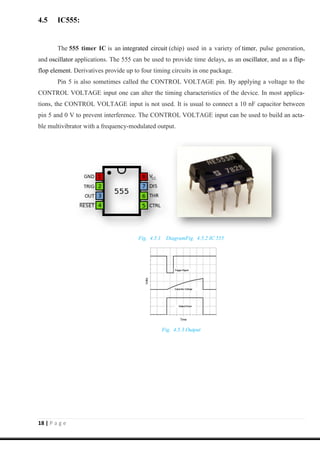
4.5 IC555:
The 555 timer IC is an integrated circuit (chip) used in a variety of timer, pulse generation,
and oscillator applications. The 555 can be used to provide time delays, as an oscillator, and as a flip-
flop element. Derivatives provide up to four timing circuits in one package.
Pin 5 is also sometimes called the CONTROL VOLTAGE pin. By applying a voltage to the
CONTROL VOLTAGE input one can alter the timing characteristics of the device. In most applica-
tions, the CONTROL VOLTAGE input is not used. It is usual to connect a 10 nF capacitor between
pin 5 and 0 V to prevent interference. The CONTROL VOLTAGE input can be used to build an acta-
ble multivibrator with a frequency-modulated output.
Fig. 4.5.1 DiagramFig. 4.5.2 IC 555
Fig. 4.5.3 Output
19 | P a g e
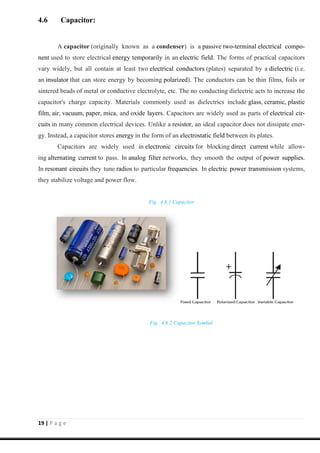
4.6 Capacitor:
A capacitor (originally known as a condenser) is a passive two-terminal electrical compo-
nent used to store electrical energy temporarily in an electric field. The forms of practical capacitors
vary widely, but all contain at least two electrical conductors (plates) separated by a dielectric (i.e.
an insulator that can store energy by becoming polarized). The conductors can be thin films, foils or
sintered beads of metal or conductive electrolyte, etc. The no conducting dielectric acts to increase the
capacitor's charge capacity. Materials commonly used as dielectrics include glass, ceramic, plastic
film, air, vacuum, paper, mica, and oxide layers. Capacitors are widely used as parts of electrical cir-
cuits in many common electrical devices. Unlike a resistor, an ideal capacitor does not dissipate ener-
gy. Instead, a capacitor stores energy in the form of an electrostatic field between its plates.
Capacitors are widely used in electronic circuits for blocking direct current while allow-
ing alternating current to pass. In analog filter networks, they smooth the output of power supplies.
In resonant circuits they tune radios to particular frequencies. In electric power transmission systems,
they stabilize voltage and power flow.
Fig. 4.6.1 Capacitor
Fig. 4.6.2 Capacitor Symbol
20 | P a g e
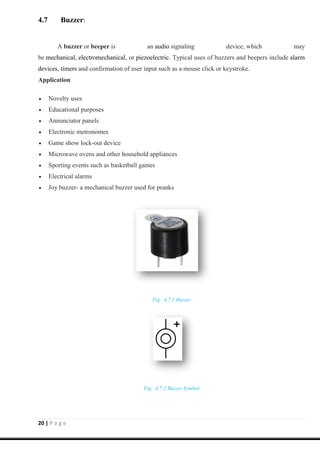
4.7 Buzzer:
A buzzer or beeper is an audio signaling device, which may
be mechanical, electromechanical, or piezoelectric. Typical uses of buzzers and beepers include alarm
devices, timers and confirmation of user input such as a mouse click or keystroke.
Application
 Novelty uses
 Educational purposes
 Annunciator panels
 Electronic metronomes
 Game show lock-out device
 Microwave ovens and other household appliances
 Sporting events such as basketball games
 Electrical alarms
 Joy buzzer- a mechanical buzzer used for pranks
Fig. 4.7.1 Buzzer
Fig. 4.7.2 Buzzer Symbol
21 | P a g e
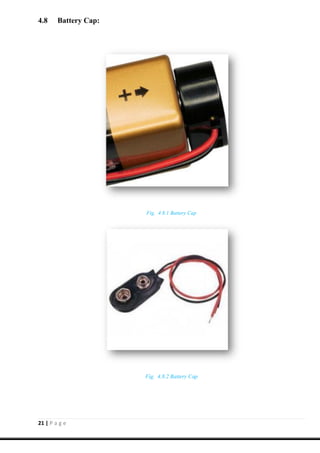
4.8 Battery Cap:
Fig. 4.8.1 Battery Cap
Fig. 4.8.2 Battery Cap
22 | P a g e
5 .APPLICATIONS AND ADVANTAGES
23 | P a g e
 Residential area,
 Industrial area,
 Company,
 Rural area,
 Circuits and Electronics Components.
 Very Use Full Where Not Possible To Turn ON & OFF Light.
 NO Human Required To ON & OFF Light.
 Low Cost.
 Help Protect the Environment
 Wide Ambient Temperature Range.
Enhanced Safety
24 | P a g e
6. CONCLUSION
25 | P a g e
 From the project we know about the Dark indicator how its work and its application and ad-
vantages of the Dark indicator
 In coming days, this will prove a great boon to the world, since it will save a lot of electricity of
power plants that gets wasted in illuminating the street light. As the conventional sources are
depleting very fast then its time think of alternatives.
 Here we designed automatic street light by using LDR. It sense the darkness around surround-
ing and LED glow, whenever light falls on it the LED stops.
26 | P a g e
7. REFERENCES
27 | P a g e
1. http://circuitdigest.com/
2. http://paksc.org/
3. www.wikipedia.co/components
4. Reference Book (Atul Parakashan Basics Electonics)

Dark indicator

  • 1.
    1 | Pa g e GUJARAT TECHNOLOGICAL UNIVERSITY Chandkheda , Ahmadabad. Affiliated SIGMA INSTITUTE OF TECHNOLOGY AND ENGINEERING A Report On “Dark Indicator” B.E. – Semester - II (Computer Engineering) Submitted by: Sr. No. Name of Student Enrollment No. 1 Patel Hemin B. 150500107025 2 Patel Harshal N. 150500107024 3 Patel Vandit I. 150500107029 4 Solanki Nishit. 150500107039 Mr. Rakesh Koringa (Assistant Professor) Mrs. Kishori Shekokar (Head of the Department) Academic year (2015-16)
  • 2.
    2 | Pa g e SIGMA INSTITUTE OF ENGINEERING, VADODARA COMPUTER ENGINEERING DEPARTMENT 2016 CERTIFICATE Date: This is to certify that Project entitled “DARK INDICATOR” has been car- ried out by PATEL HEMINKUMAR (150500107025), PATEL HARSHAL (150500107024), PATEL VANDITKUMAR (150500107029), SOLANKI NISHIT (150500107039) under my guidance in fulfillment of the Workshop Project in- Computer (2nd Semester) by Gujarat Technological University, Ahmadabad, dur- ing the academic year 2015-16. Internal Guide Head of Department Mr. Rakesh Koringa Mrs. Kishori Shekokar Asst. Professor, HOD, E&C Dept. COM Dept. SIE-Bakrol. SIE-Bakrol. Mr. Viral Patel Assit. Professor, E&C Dept. SIE-Bakrol.
  • 3.
    3 | Pa g e ACKNOWLEDGEMENT To learn the basic foundation laying fundamentals of professional carrier is always a matter of prime importance. Being a student of Computer Department nothing can get better than learning those fundamentals during the project. We acknowledge the support and help provided by Mr. Rakesh Koringa (Asst. Professor), Mr. Viral Patel (Asst. Professor) Internal Guide, without their support, guidance and encouragement, this project couldn’t have been put together. We are highly indebted to our head of Department Mrs. Kishori Shekokar for providing us this opportunity to prepare this project. We would also like to thank entire staff of Electronics depart- ment especially to our teachers who were always there to support us and without that it would be im- possible for us to complete our project. Being final year students, making of the project adds a final touch to our carrier. For this op- portunity that was presented to us, we would like to thank all faculties who were instrumental during our project. We would also like to thank other members who have helped us directly and indirectly. We express our sincere thanks to all the staff members of the Department of Electronics and Commu- nication who have helped us when required. PATEL HEMINKUMAR (150500107025), PATEL HARSHAL (150500107024), PATEL VANDITKUMAR (150500107029), SOLANKI NISHIT (150500107039).
  • 4.
    4 | Pa g e ABSTRACT This project aims at designing and executing the advanced development in embedded systems for energy saving of street lights with light depending resistor. Nowadays, human has become too busy and he is unable to find time even to switch the lights wherever not necessary. This can be seen more effectively in the case of street lights. The present system is like, the street lights will be switched on in the evening before the sun sets and they are switched off the next day morning after there is sufficient light on the roads. But the actual timings for these street lights to be switched on are when there is absolute darkness. With this, the power will be wasted up to some extent. This project gives the best solution for electrical power wastage. Also the manual operation of the lighting system is completely eliminated. In our project we are using LDR, which varies according to the amount of light falling on its surface, this give an indication for us whether it is a day/night time. In the present project street lights are taken into consideration where the above discussed factors are rectified in them. This is achieved with the help of an embedded system. By using this as the basic principle we can design centralized intelligent system for the perfect usage of streetlights in any place (Village, Town) can be developed.
  • 5.
    5 | Pa g e INDEX  ACKNOWLEDGMENT..…………………………………………….………….. 03  ABSTRACT…………………..…………………………………………................ 04  LIST OF FIGURES…………………………………………………………….… 05 Chapter: 1 INTRODUCTION OF DARK INDICATOR………………………….… 07 Chapter: 2 CIRCUIT DIAGRAM………………………………………...………….. 10 2.1 Description of Circuit Diagram…………………….…........……… 11 Chapter: 3 LIST OF COMPONENTS……………………………………………… 12 Chapter: 4 DESCRIPTIONS OF COMPONENTS……………..………………… 13 4.1 Battery…………………………………………………………….. 14 4.2 Resistor……………………………………………………………. 15 4.3 LED………………………………………………………………. 16 4.4 LDR…………………………………………………….………… 17 4.5 IC555……………………………………………………………. 18 4.6 Capacitor………………………………………………………….. 19 4.7 Buzzer …………………………………………………………….. 20 4.8 Battery Cap………………………………………………………… 21 Chapter: 5 APPLICATIONS AND ADVANTAGES ……………...……………… 22 Chapter: 6 CONCLUSIONS………………………………………………………..… 24 Chapter: 7 REFERENCES………………………………..………………………….. 26
  • 6.
    6 | Pa g e LIST OF FIGURES Figure Number Figure Name 1.1 LDR 1.2 LDR Symbol 1.3 Flowchart 1.4 Circuit 2.1 Circuit Diagram 4.1.1 Battery 4.1.2 Battery 4.2.1 Resistor 4.3.1 LED Figure 4.3.2 LED 4.4.1 LDR 4.5.1 IC555 Diagram 4.5.2 IC555 4.5.3 IC555 Output 4.6.1 Capacitor 4.6.2 Capacitor Symbol 4.7.1 Buzzer 4.7.2 Buzzer Diagram 4.8.1 Battery Cap 4.8.2 Battery Cap
  • 7.
    7 | Pa g e 3.LIST OF COMPONENTS
  • 8.
    8 | Pa g e A light sensor is a module which can sense the presence of light or in other words we can say that it is a dark indicator. Means in the dark it gives us a output as 1. Concept:- Fig. 1.1 LDR In light sensor or in a dark indicator the sensing device is LDR. LDR is stands for Light De- pended Resistor. In the presence of light LDR gives very high impedance up to 1M ohm so we get 0 outputs and in the presence of dark LDR gives very low impedance (negligible) so we get the output 1. A LDR is shown in figure below. Fig. 1.1 LDR In this circuit we have used IC555 for comparing voltages coming from variable resistor and LDR. IC555 connected at others parts of circuit. An LDR is used for detecting light or darkness. And the midpoint of LDR and resistor isconnected with IC555. A red led is connected at output pin of IC555 for indicating Night and a Red LEDand Buzzer is connected at output pin of comparator for in- dicating Day. And a 9 volt battery is used for powering the circuit. Rests of connections are shown in the above dark and light indicator circuit diagram.
  • 9.
    9 | Pa g e In this circuit we have set reference voltages for IC555 by using potentiometer we can say this sensitivity of the circuit. Both comparators are configured in opposite mode. Means at a time only sin- gle LED will glowing. In non-inverting mode when we apply positive voltage greater then reference voltage to its non-inverting pin it gives a positive output else 0 volts. And in inverting mode when we apply same voltage at its inverting pin it will give a 0 volts at its output pin else gives positive voltage. Means both configurations give opposite output. Fig. 1.3 Flow Chart Main component of this dark circuit is LDR which detect day and light. LDR is a light depend- ent resistor which changes his resistance according to the light. When light falls on the LDR surface, it reduces its resistance and when dark resistance of LDR become Maximum. During the daytime there are enough light so when this light falls on LDR it reduces its resistance and due to this a potential dif- ference generated at comparators respected pin. Now both comparators compare this input voltage with reference voltage, if this input voltage is greater than reference voltage then day LED will glow otherwise night LED will Glow.
  • 10.
    10 | Pa g e 2. CIRCUIT DIAGRAM
  • 11.
    11 | Pa g e DARK INDICATOR Fig. 2.1 Circuit Diagram of Dark Indicator
  • 12.
    12 | Pa g e 2.1 Description of Circuit Diagram In this circuit we have used IC555 for comparing voltages coming from variable resis- tor and LDR. IC555 connected at others parts of circuit. An LDR is used for detecting light or dark- ness. And the midpoint of LDR and resistor is connected with IC555. A red led is connected at output pin of IC555 for indicating Night and a Red LED and Buzzer is connected at output pin of comparator for indicating Day. And a 9 volt battery is used for powering the circuit.
  • 13.
    13 | Pa g e 4. DESCRIPTIONS OF COMPONENTS
  • 14.
    14 | Pa g e 4.1 Battery The nine-volt battery, or 9-volt battery, in its most common form was introduced for the ear- ly transistor radios. It has a rectangular prism shape with rounded edges and a polarized snap connect- or at the top. This type is commonly used in walkie talkies, clocks and smoke detectors. They are also used as backup power to keep the time in certain electronic clocks. This format is commonly available in primary carbon-zinc and alkaline chemistry, in primary lithium iron disulfide, and in rechargeable form in nickel-cadmium, nickel-metal hydride and lithium-ion. Mercury oxide batteries in this form have not been manufactured in many years due to their mercury content. This type is designat- ed NEDA 1604 and IEC 6F22 (zinc-carbon) or MN1604 6LR61 (alkaline). The size, regardless of technology, is commonly designated PP3 (originally a Zn-C type). Most nine-volt alkaline batteries are constructed of six individual 1.5V LR61 cells enclosed in a wrapper.[3] These cells are slightly smaller than LR8D425 AAAA cells and can be used in their place for some devices, even though they are 3.5 mm shorter. Carbon-zinc types are made with six flat cells in a stack, enclosed in a moisture-resistant wrapper to prevent drying. Fig. 4.1.1 Fig. 4.1.2
  • 15.
    15 | Pa g e 4.2 Resistor: A resistor is a passive two-terminal electrical component that implements electrical re- sistance as a circuit element. Resistors may be used to reduce current flow, and, at the same time, may act to lower voltage levels within circuits. In electronic circuits, resistors are used to limit current flow, to adjust signal levels, bias active elements, and terminate transmission lines among other uses. High- power resistors, that can dissipate many watts of electrical power as heat, may be used as part of motor controls, in power distribution systems, or as test loads for generators. Fixed resistors have resistances that only change slightly with temperature, time or operating voltage. Variable resistors can be used to adjust circuit elements (such as a volume control or a lamp dimmer), or as sensing devices for heat, light, humidity, force, or chemical activity. Resistors are common elements of electrical networks and electronic circuits and are ubiquitous in electronic equipment. Practical resistors as discrete components can be composed of various com- pounds and forms. Resistors are also implemented within integrated circuits. V = I . R Fig. 4.2.1 Resistor
  • 16.
    16 | Pa g e 4.3 LED: A light-emitting diode (LED) is a two-lead semiconductor light source. It is a p–n junc- tion diode, which emits light when activated. When a suitable voltage is applied to the leads, electrons are able to recombine with electron holes within the device, releasing energy in the form of photons. This effect is called electroluminescence, and the color of the light (corresponding to the energy of the photon) is determined by the energy band gap of the semiconductor. An LED is often small in area (less than 1 mm2 ) and integrated optical components may be used to shape its radiation pattern. 1 Fig. 4.3.1 LED Fig. 4.3.2 LED LEDs have allowed new text, video displays, and sensors to be developed, while their high switching rates are also used in advanced communications technology.
  • 17.
    17 | Pa g e 4.4 LDR: A photo resistor (or light-dependent resistor, LDR, or photocell) is a light-controlled varia- ble resistor. The resistance of a photo resistor decreases with increasing incident light intensity; in oth- er words, it exhibits photoconductivity. A photo resistor can be applied in light-sensitive detector cir- cuits, and light- and dark-activated switching circuits. A photo resistor is made of a high resistance semiconductor. In the dark, a photo resistor can have a resistance as high as several mega ohms (MΩ), while in the light; a photo resistor can have a resistance as low as a few hundred ohms. If incident light on a photo resistor exceeds a cer- tain frequency, photons absorbed by the semiconductor give bound electrons enough energy to jump into the conduction band. The resulting free electrons (and their hole partners) conduct electricity, thereby lowering resistance. The resistance range and sensitivity of a photo resistor can substantially differ among dissimilar devices. Moreover, unique photo resistors may react substantially differently to photons within certain wavelength bands. Photo resistors come in many types. Inexpensive cadmium sulphide cells can be found in many consumer items such as camera light meters, clock radios, alarm devices (as the detector for a light beam), nightlights, outdoor clocks, solar street lamps and solar road studs, etc. Photo resistors can be placed in streetlights to control when the light is on. Ambient light fall- ing on the photoresist or causes the streetlight to turn off. Thus energy is saved by ensuring the light is only on during hours of darkness. Fig. 4.4.1 LDR
  • 18.
    18 | Pa g e 4.5 IC555: The 555 timer IC is an integrated circuit (chip) used in a variety of timer, pulse generation, and oscillator applications. The 555 can be used to provide time delays, as an oscillator, and as a flip- flop element. Derivatives provide up to four timing circuits in one package. Pin 5 is also sometimes called the CONTROL VOLTAGE pin. By applying a voltage to the CONTROL VOLTAGE input one can alter the timing characteristics of the device. In most applica- tions, the CONTROL VOLTAGE input is not used. It is usual to connect a 10 nF capacitor between pin 5 and 0 V to prevent interference. The CONTROL VOLTAGE input can be used to build an acta- ble multivibrator with a frequency-modulated output. Fig. 4.5.1 DiagramFig. 4.5.2 IC 555 Fig. 4.5.3 Output
  • 19.
    19 | Pa g e 4.6 Capacitor: A capacitor (originally known as a condenser) is a passive two-terminal electrical compo- nent used to store electrical energy temporarily in an electric field. The forms of practical capacitors vary widely, but all contain at least two electrical conductors (plates) separated by a dielectric (i.e. an insulator that can store energy by becoming polarized). The conductors can be thin films, foils or sintered beads of metal or conductive electrolyte, etc. The no conducting dielectric acts to increase the capacitor's charge capacity. Materials commonly used as dielectrics include glass, ceramic, plastic film, air, vacuum, paper, mica, and oxide layers. Capacitors are widely used as parts of electrical cir- cuits in many common electrical devices. Unlike a resistor, an ideal capacitor does not dissipate ener- gy. Instead, a capacitor stores energy in the form of an electrostatic field between its plates. Capacitors are widely used in electronic circuits for blocking direct current while allow- ing alternating current to pass. In analog filter networks, they smooth the output of power supplies. In resonant circuits they tune radios to particular frequencies. In electric power transmission systems, they stabilize voltage and power flow. Fig. 4.6.1 Capacitor Fig. 4.6.2 Capacitor Symbol
  • 20.
    20 | Pa g e 4.7 Buzzer: A buzzer or beeper is an audio signaling device, which may be mechanical, electromechanical, or piezoelectric. Typical uses of buzzers and beepers include alarm devices, timers and confirmation of user input such as a mouse click or keystroke. Application  Novelty uses  Educational purposes  Annunciator panels  Electronic metronomes  Game show lock-out device  Microwave ovens and other household appliances  Sporting events such as basketball games  Electrical alarms  Joy buzzer- a mechanical buzzer used for pranks Fig. 4.7.1 Buzzer Fig. 4.7.2 Buzzer Symbol
  • 21.
    21 | Pa g e 4.8 Battery Cap: Fig. 4.8.1 Battery Cap Fig. 4.8.2 Battery Cap
  • 22.
    22 | Pa g e 5 .APPLICATIONS AND ADVANTAGES
  • 23.
    23 | Pa g e  Residential area,  Industrial area,  Company,  Rural area,  Circuits and Electronics Components.  Very Use Full Where Not Possible To Turn ON & OFF Light.  NO Human Required To ON & OFF Light.  Low Cost.  Help Protect the Environment  Wide Ambient Temperature Range. Enhanced Safety
  • 24.
    24 | Pa g e 6. CONCLUSION
  • 25.
    25 | Pa g e  From the project we know about the Dark indicator how its work and its application and ad- vantages of the Dark indicator  In coming days, this will prove a great boon to the world, since it will save a lot of electricity of power plants that gets wasted in illuminating the street light. As the conventional sources are depleting very fast then its time think of alternatives.  Here we designed automatic street light by using LDR. It sense the darkness around surround- ing and LED glow, whenever light falls on it the LED stops.
  • 26.
    26 | Pa g e 7. REFERENCES
  • 27.
    27 | Pa g e 1. http://circuitdigest.com/ 2. http://paksc.org/ 3. www.wikipedia.co/components 4. Reference Book (Atul Parakashan Basics Electonics)