Laser
SIGMA INSTITUTE OF TECHNOLOGY AND ENGINEERING
COMPUTER ENGG. (B.E) (SEM – 2)
Prepared by :
1. HEMIN PATEL (150500107025)
2. HARSHAL PATEL (150500107024)
3. RADHIK BHOJANI (150500107004)
4. JAYDEEP ATALIYA (150500107002)
5.VANDIT PATEL (150500107029)
SUB : PHYSICS.
 The LASER beam was invented by the physicist MAIMAN in 1960
 One of the most influential technological achievements of the 20th century
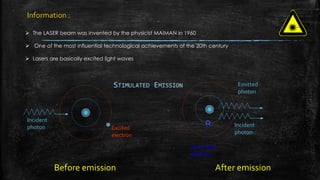
 Lasers are basically excited light waves
STIMULATED EMISSION
Incident
photon Incident
photon
Emitted
photon
Excited
electron
Unexcited
electron
Before emission After emission
Information :
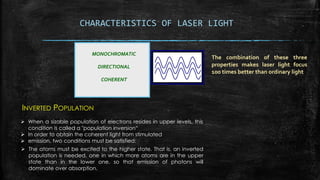
CHARACTERISTICS OF LASER LIGHT
MONOCHROMATIC
DIRECTIONAL
COHERENT
The combination of these three
properties makes laser light focus
100 times better than ordinary light
INVERTED POPULATION
 When a sizable population of electrons resides in upper levels, this
condition is called a "population inversion“
 In order to obtain the coherent light from stimulated
 emission, two conditions must be satisfied:
 The atoms must be excited to the higher state. That is, an inverted
population is needed, one in which more atoms are in the upper
state than in the lower one, so that emission of photons will
dominate over absorption.
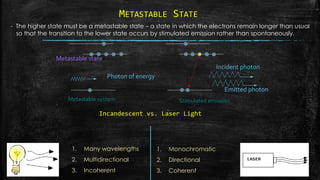
METASTABLE STATE
- The higher state must be a metastable state – a state in which the electrons remain longer than usual
so that the transition to the lower state occurs by stimulated emission rather than spontaneously.
Metastable state
Photon of energy
Metastable system Stimulated emission
Incident photon
Emitted photon
Incandescent vs. Laser Light
1. Many wavelengths
2. Multidirectional
3. Incoherent
1. Monochromatic
2. Directional
3. Coherent
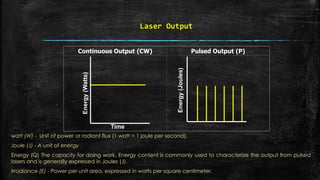
Energy(Watts)
Time
Continuous Output (CW) Pulsed Output (P)
Energy(Joules)
watt (W) - Unit of power or radiant flux (1 watt = 1 joule per second).
Joule (J) - A unit of energy
Energy (Q) The capacity for doing work. Energy content is commonly used to characterize the output from pulsed
lasers and is generally expressed in Joules (J).
Irradiance (E) - Power per unit area, expressed in watts per square centimeter.
Laser Output
 LASER can be considered to be a form of light amplifier, behave according to the basic laws of light,
characteristics:
 - travels in straight lines with a constant velocity in space;
 - it can be located inside the electromagnetic spectrum acc. to its wavelength or frequency;
 - it present a particular chromatic purity;
 - can be transmitted;
 - can be reflected;
 - can be refracted;
 - can be absorbed;
 - it has the capacity of transmitting energy without loss through the air
 - the LASER can be used both as unitary impulses and under continuous form.
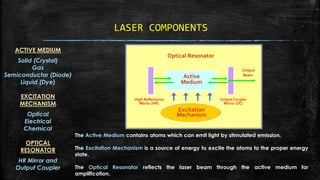
LASER COMPONENTS
ACTIVE MEDIUM
Solid (Crystal)
Gas
Semiconductor (Diode)
Liquid (Dye)
EXCITATION
MECHANISM
Optical
Electrical
Chemical
OPTICAL
RESONATOR
HR Mirror and
Output Coupler
The Active Medium contains atoms which can emit light by stimulated emission.
The Excitation Mechanism is a source of energy to excite the atoms to the proper energy
state.
The Optical Resonator reflects the laser beam through the active medium for
amplification.
High Reflectance
Mirror (HR)
Output Coupler
Mirror (OC)
Active
Medium
Output
Beam
Excitation
Mechanism
Optical Resonator
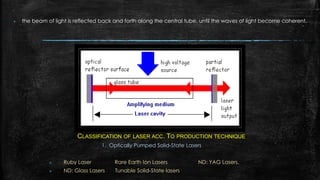
 the beam of light is reflected back and forth along the central tube, until the waves of light become coherent.
CLASSIFICATION OF LASER ACC. TO PRODUCTION TECHNIQUE
1. Optically Pumped Solid-State Lasers
 Ruby Laser Rare Earth Ion Lasers ND: YAG Lasers.
 ND: Glass Lasers Tunable Solid-State lasers
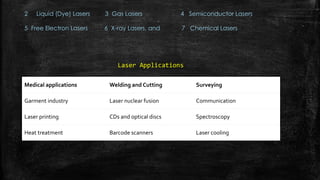
2 Liquid (Dye) Lasers 3 Gas Lasers 4 Semiconductor Lasers
5 Free Electron Lasers 6 X-ray Lasers, and 7 Chemical Lasers
Medical applications Welding and Cutting Surveying
Garment industry Laser nuclear fusion Communication
Laser printing CDs and optical discs Spectroscopy
Heat treatment Barcode scanners Laser cooling
Laser Applications
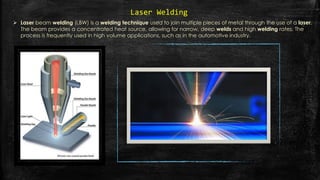
 Laser beam welding (LBW) is a welding technique used to join multiple pieces of metal through the use of a laser.
The beam provides a concentrated heat source, allowing for narrow, deep welds and high welding rates. The
process is frequently used in high volume applications, such as in the automotive industry.
Laser Welding
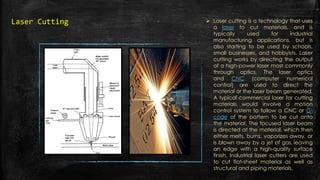
 Laser cutting is a technology that uses
a laser to cut materials, and is
typically used for industrial
manufacturing applications, but is
also starting to be used by schools,
small businesses, and hobbyists. Laser
cutting works by directing the output
of a high-power laser most commonly
through optics. The laser optics
and CNC (computer numerical
control) are used to direct the
material or the laser beam generated.
A typical commercial laser for cutting
materials would involve a motion
control system to follow a CNC or G-
code of the pattern to be cut onto
the material. The focused laser beam
is directed at the material, which then
either melts, burns, vaporizes away, or
is blown away by a jet of gas, leaving
an edge with a high-quality surface
finish. Industrial laser cutters are used
to cut flat-sheet material as well as
structural and piping materials.
Laser Cutting
- Steven Chu

Laser

  • 1.
    Laser SIGMA INSTITUTE OFTECHNOLOGY AND ENGINEERING COMPUTER ENGG. (B.E) (SEM – 2) Prepared by : 1. HEMIN PATEL (150500107025) 2. HARSHAL PATEL (150500107024) 3. RADHIK BHOJANI (150500107004) 4. JAYDEEP ATALIYA (150500107002) 5.VANDIT PATEL (150500107029) SUB : PHYSICS.
  • 2.
     The LASERbeam was invented by the physicist MAIMAN in 1960  One of the most influential technological achievements of the 20th century  Lasers are basically excited light waves STIMULATED EMISSION Incident photon Incident photon Emitted photon Excited electron Unexcited electron Before emission After emission Information :
  • 3.
    CHARACTERISTICS OF LASERLIGHT MONOCHROMATIC DIRECTIONAL COHERENT The combination of these three properties makes laser light focus 100 times better than ordinary light INVERTED POPULATION  When a sizable population of electrons resides in upper levels, this condition is called a "population inversion“  In order to obtain the coherent light from stimulated  emission, two conditions must be satisfied:  The atoms must be excited to the higher state. That is, an inverted population is needed, one in which more atoms are in the upper state than in the lower one, so that emission of photons will dominate over absorption.
  • 4.
    METASTABLE STATE - Thehigher state must be a metastable state – a state in which the electrons remain longer than usual so that the transition to the lower state occurs by stimulated emission rather than spontaneously. Metastable state Photon of energy Metastable system Stimulated emission Incident photon Emitted photon Incandescent vs. Laser Light 1. Many wavelengths 2. Multidirectional 3. Incoherent 1. Monochromatic 2. Directional 3. Coherent
  • 5.
    Energy(Watts) Time Continuous Output (CW)Pulsed Output (P) Energy(Joules) watt (W) - Unit of power or radiant flux (1 watt = 1 joule per second). Joule (J) - A unit of energy Energy (Q) The capacity for doing work. Energy content is commonly used to characterize the output from pulsed lasers and is generally expressed in Joules (J). Irradiance (E) - Power per unit area, expressed in watts per square centimeter. Laser Output
  • 6.
     LASER canbe considered to be a form of light amplifier, behave according to the basic laws of light, characteristics:  - travels in straight lines with a constant velocity in space;  - it can be located inside the electromagnetic spectrum acc. to its wavelength or frequency;  - it present a particular chromatic purity;  - can be transmitted;  - can be reflected;  - can be refracted;  - can be absorbed;  - it has the capacity of transmitting energy without loss through the air  - the LASER can be used both as unitary impulses and under continuous form.
  • 7.
    LASER COMPONENTS ACTIVE MEDIUM Solid(Crystal) Gas Semiconductor (Diode) Liquid (Dye) EXCITATION MECHANISM Optical Electrical Chemical OPTICAL RESONATOR HR Mirror and Output Coupler The Active Medium contains atoms which can emit light by stimulated emission. The Excitation Mechanism is a source of energy to excite the atoms to the proper energy state. The Optical Resonator reflects the laser beam through the active medium for amplification. High Reflectance Mirror (HR) Output Coupler Mirror (OC) Active Medium Output Beam Excitation Mechanism Optical Resonator
  • 8.
     the beamof light is reflected back and forth along the central tube, until the waves of light become coherent. CLASSIFICATION OF LASER ACC. TO PRODUCTION TECHNIQUE 1. Optically Pumped Solid-State Lasers  Ruby Laser Rare Earth Ion Lasers ND: YAG Lasers.  ND: Glass Lasers Tunable Solid-State lasers
  • 9.
    2 Liquid (Dye)Lasers 3 Gas Lasers 4 Semiconductor Lasers 5 Free Electron Lasers 6 X-ray Lasers, and 7 Chemical Lasers Medical applications Welding and Cutting Surveying Garment industry Laser nuclear fusion Communication Laser printing CDs and optical discs Spectroscopy Heat treatment Barcode scanners Laser cooling Laser Applications
  • 10.
     Laser beamwelding (LBW) is a welding technique used to join multiple pieces of metal through the use of a laser. The beam provides a concentrated heat source, allowing for narrow, deep welds and high welding rates. The process is frequently used in high volume applications, such as in the automotive industry. Laser Welding
  • 11.
     Laser cuttingis a technology that uses a laser to cut materials, and is typically used for industrial manufacturing applications, but is also starting to be used by schools, small businesses, and hobbyists. Laser cutting works by directing the output of a high-power laser most commonly through optics. The laser optics and CNC (computer numerical control) are used to direct the material or the laser beam generated. A typical commercial laser for cutting materials would involve a motion control system to follow a CNC or G- code of the pattern to be cut onto the material. The focused laser beam is directed at the material, which then either melts, burns, vaporizes away, or is blown away by a jet of gas, leaving an edge with a high-quality surface finish. Industrial laser cutters are used to cut flat-sheet material as well as structural and piping materials. Laser Cutting
  • 13.