Session ID:
Session Classification:
Ben Rothke, CISSP, CISA
Information Security
Wyndham Worldwide Corp.
DSP-W25B
Intermediate
Deployment Strategies for
Effective Encryption
► encryption internals are built on complex mathematics
and number theory
► your successful encryption program requires a CISSP,
CISA and PMP, not necessarily a PhD
► effective encryption strategy requires attention to detail,
good design, combined with good project
management and documentation
► your encryption strategy must reflect this
Deployment Strategies for
effective encryption
► many roll-outs are nothing more than stop-gap solutions
► Getting it done often takes precedence over key
management, documentation, processes, etc.
► many organizations lack required security expertise
► these and more combine to obstruct encryption from
being ubiquitous
► adds up to a significant need for an effective encryption
deployment strategy
It’s 2013 – where’s the encryption?
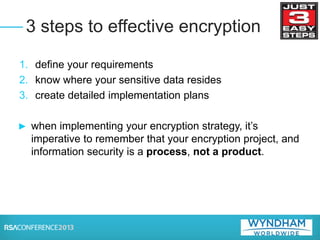
1. define your requirements
2. know where your sensitive data resides
3. create detailed implementation plans
► when implementing your encryption strategy, it’s
imperative to remember that your encryption project, and
information security is a process, not a product.
3 steps to effective encryption
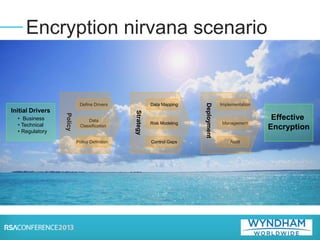
Encryption nirvana scenario
Strategy
Data Mapping
Risk Modeling
Control Gaps
Implementation
Management
Audit
Deployment
Define Drivers
Data
Classification
Policy Definition
Policy
Initial Drivers
• Business
• Technical
• Regulatory
Effective
Encryption
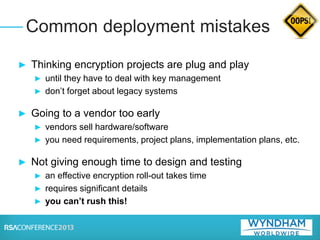
► Thinking encryption projects are plug and play
► until they have to deal with key management
► don’t forget about legacy systems
► Going to a vendor too early
► vendors sell hardware/software
► you need requirements, project plans, implementation plans, etc.
► Not giving enough time to design and testing
► an effective encryption roll-out takes time
► requires significant details
► you can’t rush this!
Common deployment mistakes
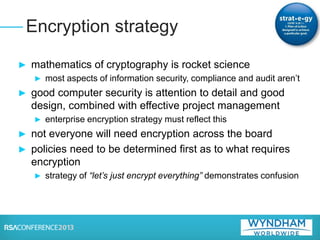
► mathematics of cryptography is rocket science
► most aspects of information security, compliance and audit aren’t
► good computer security is attention to detail and good
design, combined with effective project management
► enterprise encryption strategy must reflect this
► not everyone will need encryption across the board
► policies need to be determined first as to what requires
encryption
► strategy of “let’s just encrypt everything” demonstrates confusion
Encryption strategy
► protect data from loss and exposure
► prevent access to the system itself?
► does software need to access the files after encryption?
► data to be transported securely? via what means?
► how much user burden is acceptable?
► how strong does the encryption need to be?
► do you need to match the solution to the hardware?
► regulatory, contractual, organizational policy
► ask a lot of questions at this point!
► and when you are done, ask a lot more
Analyze your encryption needs
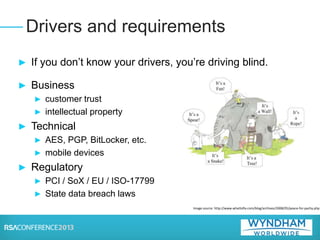
► If you don’t know your drivers, you’re driving blind.
► Business
► customer trust
► intellectual property
► Technical
► AES, PGP, BitLocker, etc.
► mobile devices
► Regulatory
► PCI / SoX / EU / ISO-17799
► State data breach laws
Drivers and requirements
Image source: http://www.whattofix.com/blog/archives/2008/05/peace-for-pachy.php
► Encryption must be supported by policies,
documentation and a formal risk management program
► shows work adequately planned and supervised
► demonstrates internal controls studied and evaluated
► Policy must be
► endorsed by management
► communicated to end-users and business partners / 3rd-parties
that handle sensitive data. If it can’t meet company’s policies,
don’t give others access to the data
► encryption responsibility should be fixed with consequences for
noncompliance
Documentation and policies
► encryption is a process intensive endeavor
► must be well-defined and documented
► if not implemented and configured properly, can cause
system performance degradation, operational hurdles
and locking yourself out of your own data
► improperly configured encryption processes give false
sense of security
► perception that confidentiality of sensitive information is
protected when it’s not
Encryption processes
► Identify all methods of data input/output
► storage media
► smartphones, USB, laptops, removable, SSD, and more
► business partners and other third parties
► understand all applicable regulations and laws
► high-risk areas
► laptops
► wireless
► data backups
► others
It’s all about the data
► define business, technical, and operational requirements
and objectives for encryption
► define policies, architecture, and scope of encryption
requirements
► conduct interviews, review policy documents, analyze
current and proposed encryption strategy to identify
possible security gaps
► determine liabilities
► better requirements definition directly correlates to
successful encryption program
Requirements analysis
► full-disk / host-based encryption (at rest)
► data encrypted at creation, first possible level of data security
► appliance-based
► data leaves host unencrypted, then goes to dedicated appliance for
encryption. Quickest to implement; but can be costly
► storage device encryption
► data transmitted unencrypted to storage device
► easiest integration into existing backup environments
► tape
► data encrypted on tape drive; easy to implement
► provides protection from both offsite and on-premise information loss
► database
► database encrypted tables inside the database, protected by native
DBMS access controls
Understand your encryption options
► Key management is a big deal; don’t underestimate it
► generation, distribution, storage, recovery and
destruction of encryption keys
► encryption is 90% management and policy, 10%
technology
► most encryption failures due to ineffective KM processes
► 80% of 22 SAP testing procedures related to encryption
are about KM
► effective KM policy and design requires significant time
and effort
Key management (KM)
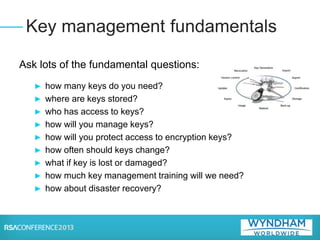
Ask lots of the fundamental questions:
► how many keys do you need?
► where are keys stored?
► who has access to keys?
► how will you manage keys?
► how will you protect access to encryption keys?
► how often should keys change?
► what if key is lost or damaged?
► how much key management training will we need?
► how about disaster recovery?
Key management fundamentals
Immediate steps in the long-term encryption expedition
► prioritize based on specific requirements and
compensating controls
► identify your most sensitive/confidential data and know
where it resides
► organizations that don’t have an effective data classification
program usually fail at their data encryption projects - Gartner
► know which regulatory mandates matter most
► leverage DLP to more effectively identify sensitive
content that resides on the network and at the endpoint
Encryption is a long journey
There’s a book for that
► organizations that do not have an effective data
classification program usually fail at their data encryption
projects
► creating an effective deployment strategy is the
difference between strong encryption and an audit failure
► encryption is about attention to detail, good design
and project management.
Summary
Ben Rothke, CISSP CISA
Manager – Information Security
Wyndham Worldwide
Corporation
www.linkedin.com/in/benrothke
www.twitter.com/benrothke
www.slideshare.net/benrothke

Rothke rsa 2013 - deployment strategies for effective encryption

  • 1.
    Session ID: Session Classification: BenRothke, CISSP, CISA Information Security Wyndham Worldwide Corp. DSP-W25B Intermediate Deployment Strategies for Effective Encryption
  • 2.
    ► encryption internalsare built on complex mathematics and number theory ► your successful encryption program requires a CISSP, CISA and PMP, not necessarily a PhD ► effective encryption strategy requires attention to detail, good design, combined with good project management and documentation ► your encryption strategy must reflect this Deployment Strategies for effective encryption
  • 3.
    ► many roll-outsare nothing more than stop-gap solutions ► Getting it done often takes precedence over key management, documentation, processes, etc. ► many organizations lack required security expertise ► these and more combine to obstruct encryption from being ubiquitous ► adds up to a significant need for an effective encryption deployment strategy It’s 2013 – where’s the encryption?
  • 4.
    1. define yourrequirements 2. know where your sensitive data resides 3. create detailed implementation plans ► when implementing your encryption strategy, it’s imperative to remember that your encryption project, and information security is a process, not a product. 3 steps to effective encryption
  • 5.
    Encryption nirvana scenario Strategy DataMapping Risk Modeling Control Gaps Implementation Management Audit Deployment Define Drivers Data Classification Policy Definition Policy Initial Drivers • Business • Technical • Regulatory Effective Encryption
  • 6.
    ► Thinking encryptionprojects are plug and play ► until they have to deal with key management ► don’t forget about legacy systems ► Going to a vendor too early ► vendors sell hardware/software ► you need requirements, project plans, implementation plans, etc. ► Not giving enough time to design and testing ► an effective encryption roll-out takes time ► requires significant details ► you can’t rush this! Common deployment mistakes
  • 7.
    ► mathematics ofcryptography is rocket science ► most aspects of information security, compliance and audit aren’t ► good computer security is attention to detail and good design, combined with effective project management ► enterprise encryption strategy must reflect this ► not everyone will need encryption across the board ► policies need to be determined first as to what requires encryption ► strategy of “let’s just encrypt everything” demonstrates confusion Encryption strategy
  • 8.
    ► protect datafrom loss and exposure ► prevent access to the system itself? ► does software need to access the files after encryption? ► data to be transported securely? via what means? ► how much user burden is acceptable? ► how strong does the encryption need to be? ► do you need to match the solution to the hardware? ► regulatory, contractual, organizational policy ► ask a lot of questions at this point! ► and when you are done, ask a lot more Analyze your encryption needs
  • 9.
    ► If youdon’t know your drivers, you’re driving blind. ► Business ► customer trust ► intellectual property ► Technical ► AES, PGP, BitLocker, etc. ► mobile devices ► Regulatory ► PCI / SoX / EU / ISO-17799 ► State data breach laws Drivers and requirements Image source: http://www.whattofix.com/blog/archives/2008/05/peace-for-pachy.php
  • 10.
    ► Encryption mustbe supported by policies, documentation and a formal risk management program ► shows work adequately planned and supervised ► demonstrates internal controls studied and evaluated ► Policy must be ► endorsed by management ► communicated to end-users and business partners / 3rd-parties that handle sensitive data. If it can’t meet company’s policies, don’t give others access to the data ► encryption responsibility should be fixed with consequences for noncompliance Documentation and policies
  • 11.
    ► encryption isa process intensive endeavor ► must be well-defined and documented ► if not implemented and configured properly, can cause system performance degradation, operational hurdles and locking yourself out of your own data ► improperly configured encryption processes give false sense of security ► perception that confidentiality of sensitive information is protected when it’s not Encryption processes
  • 12.
    ► Identify allmethods of data input/output ► storage media ► smartphones, USB, laptops, removable, SSD, and more ► business partners and other third parties ► understand all applicable regulations and laws ► high-risk areas ► laptops ► wireless ► data backups ► others It’s all about the data
  • 13.
    ► define business,technical, and operational requirements and objectives for encryption ► define policies, architecture, and scope of encryption requirements ► conduct interviews, review policy documents, analyze current and proposed encryption strategy to identify possible security gaps ► determine liabilities ► better requirements definition directly correlates to successful encryption program Requirements analysis
  • 14.
    ► full-disk /host-based encryption (at rest) ► data encrypted at creation, first possible level of data security ► appliance-based ► data leaves host unencrypted, then goes to dedicated appliance for encryption. Quickest to implement; but can be costly ► storage device encryption ► data transmitted unencrypted to storage device ► easiest integration into existing backup environments ► tape ► data encrypted on tape drive; easy to implement ► provides protection from both offsite and on-premise information loss ► database ► database encrypted tables inside the database, protected by native DBMS access controls Understand your encryption options
  • 15.
    ► Key managementis a big deal; don’t underestimate it ► generation, distribution, storage, recovery and destruction of encryption keys ► encryption is 90% management and policy, 10% technology ► most encryption failures due to ineffective KM processes ► 80% of 22 SAP testing procedures related to encryption are about KM ► effective KM policy and design requires significant time and effort Key management (KM)
  • 16.
    Ask lots ofthe fundamental questions: ► how many keys do you need? ► where are keys stored? ► who has access to keys? ► how will you manage keys? ► how will you protect access to encryption keys? ► how often should keys change? ► what if key is lost or damaged? ► how much key management training will we need? ► how about disaster recovery? Key management fundamentals
  • 17.
    Immediate steps inthe long-term encryption expedition ► prioritize based on specific requirements and compensating controls ► identify your most sensitive/confidential data and know where it resides ► organizations that don’t have an effective data classification program usually fail at their data encryption projects - Gartner ► know which regulatory mandates matter most ► leverage DLP to more effectively identify sensitive content that resides on the network and at the endpoint Encryption is a long journey
  • 18.
  • 19.
    ► organizations thatdo not have an effective data classification program usually fail at their data encryption projects ► creating an effective deployment strategy is the difference between strong encryption and an audit failure ► encryption is about attention to detail, good design and project management. Summary
  • 20.
    Ben Rothke, CISSPCISA Manager – Information Security Wyndham Worldwide Corporation www.linkedin.com/in/benrothke www.twitter.com/benrothke www.slideshare.net/benrothke