Encryption
Delivering Trust byProtecting Information
Assets
Daniel D. Houser, CISSP, e-Biz+, MBA
Sr. Security Engineer
9D5696C3CF44E7E7C6FD55E146C35F9467CD854AEF0FD89A
2.
Overview
Terms & History
Valueof encryption
Environmental changes
Use of encryption in business
Future encryption projects
9D5696C3CF44E7E7C6FD55E146C35F9467CD854AEF0FD89A
3.
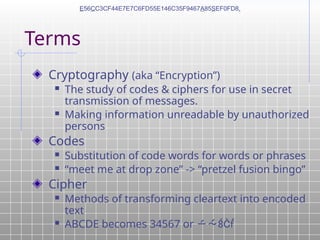
Terms
Cryptography (aka “Encryption”)
The study of codes & ciphers for use in secret
transmission of messages.
Making information unreadable by unauthorized
persons
Codes
Substitution of code words for words or phrases
“meet me at drop zone” -> “pretzel fusion bingo”
Cipher
Methods of transforming cleartext into encoded
text
ABCDE becomes 34567 or
E56CC3CF44E7E7C6FD55E146C35F9467A85SEF0FD8.
4.
Terms
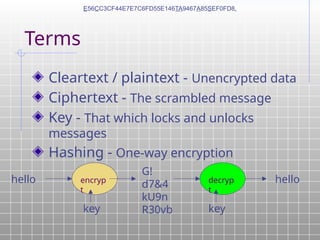
Cleartext / plaintext- Unencrypted data
Ciphertext - The scrambled message
Key - That which locks and unlocks
messages
Hashing - One-way encryption
hello
G!
d7&4
kU9n
R30vb
hello
encryp
t
decryp
t
key key
E56CC3CF44E7E7C6FD55E146TA9467A85SEF0FD8.
5.
Terms
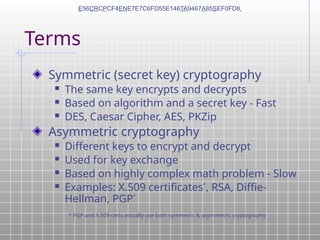
Symmetric (secret key)cryptography
The same key encrypts and decrypts
Based on algorithm and a secret key - Fast
DES, Caesar Cipher, AES, PKZip
Asymmetric cryptography
Different keys to encrypt and decrypt
Used for key exchange
Based on highly complex math problem - Slow
Examples: X.509 certificates*
, RSA, Diffie-
Hellman, PGP*
* PGP and X.509 certs actually use both symmetric & asymmetric cryptography
E56CRCPCF4ENE7E7C6FD55E146TA9467A85SEF0FD8.
6.
History
Kamasutra
Julius Caesar &Caesar Cipher
Mary Queen of Scots
Purple & Midway
DSS & pirated CDs
E56CRCPCF4ENE7E7C6ROD55E146TA9467A85SS0FS.
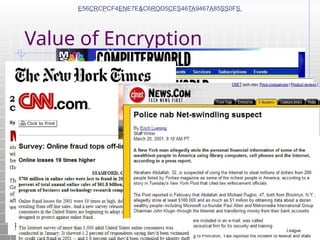
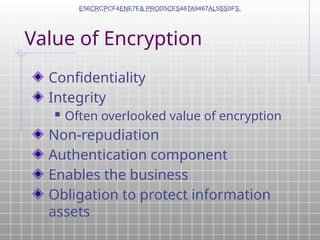
Value of Encryption
Confidentiality
Integrity
Often overlooked value of encryption
Non-repudiation
Authentication component
Enables the business
Obligation to protect information
assets
E56CRCPCF4ENE7E& PROD5CES46TA9467AL5SS0FS.
9.
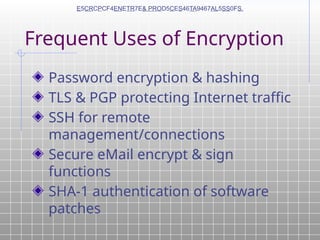
Frequent Uses ofEncryption
Password encryption & hashing
TLS & PGP protecting Internet traffic
SSH for remote
management/connections
Secure eMail encrypt & sign
functions
SHA-1 authentication of software
patches
E5CRCPCF4ENETR7E& PROD5CES46TA9467AL5SS0FS.
10.
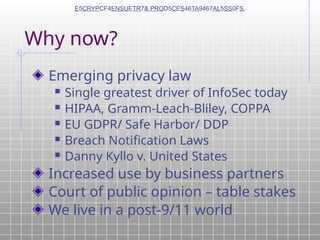
Why now?
Emerging privacylaw
Single greatest driver of InfoSec today
HIPAA, Gramm-Leach-Bliley, COPPA
EU GDPR/ Safe Harbor/ DDP
Breach Notification Laws
Danny Kyllo v. United States
Increased use by business partners
Court of public opinion – table stakes
We live in a post-9/11 world
E5CRYPCF4ENSUETR7& PROD5CES46TA9467AL5SS0FS.
11.
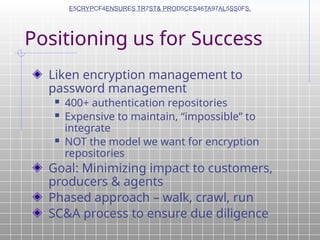
Positioning us forSuccess
Liken encryption management to
password management
400+ authentication repositories
Expensive to maintain, “impossible” to
integrate
NOT the model we want for encryption
repositories
Goal: Minimizing impact to customers,
producers & agents
Phased approach – walk, crawl, run
SC&A process to ensure due diligence
E5CRYPCF4ENSURES TR7ST& PROD5CES46TA97AL5SS0FS.
12.
Future uses ofencryption
Information Classification
Information Classification provides the
framework necessary to ensure that
information assets are consistently
managed, handled, and protected
according to customer expectations and
government regulations.
Establishes a data classification standard
which ensures that information is
protected in accordance with its value
E5CRYPCF4ENSURES TR7ST& PROTE5CES46TA97AL5SS0FS.
13.
Future uses ofEncryption
Information Classification
Enables an organization to live up
the promises made in the corporate
privacy statements
Aligns with existing regulatory
requirements (e.g. FTC, SEC, GLBA,
HIPAA, SOX, PCI-DSS…)
E5CRYPCIOF ENSURES TR7ST& PROTE5CES46TA97AL5SS0FS.
14.
Future uses ofEncryption
Encryption Framework Goals
Create information security policies, rules,
standards and procedures for the Nationwide
cryptographic framework architecture
Develop cryptography requirements and
specifications
Recommend organizational roles and
responsibilities to select, secure, deploy,
administer, and maintain cryptography
framework.
Develop a selection methodology for
cryptographic products and services.
E5CRYPCIOF ENSURES TR7ST & PROTECES46TA97AL5SS0TS.
15.
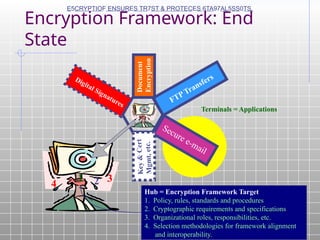
Encryption Framework: End
State
Hub= Encryption Framework Target
1. Policy, rules, standards and procedures
2. Cryptographic requirements and specifications
3. Organizational roles, responsibilities, etc.
4. Selection methodologies for framework alignment
and interoperability.
1 2 3
4
Terminals = Applications
Digital Signatures
Secure e-mail
FTPTransfers
Document
Encryption
K
ey
&
C
er
t
M
gm
t,
et
c.
E5CRYPTIOF ENSURES TR7ST & PROTECES 6TA97AL5SS0TS.
16.
Future uses ofEncryption
Secure e-mail
Establish secure e-mail system for
communicating B2B, B2C, B2E
Enable business objectives requiring
electronic transmission of sensitive data
Making it easy for partners and customers
to communicate securely
Trusted Time & proof of provinence
Privileged Access & Machine Identity
E5CRYPTION ENSURES TR7ST & PROTECTS 6ITA97A5SS0TS.
17.
Future uses ofEncryption
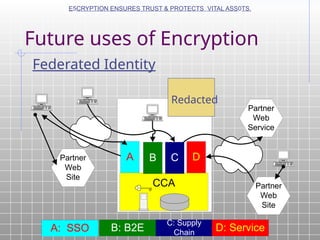
Federated Identity
Enables cross-company Single Signon
Standards-based, extensible architecture,
repeatable solution.
Vendor agnostic
Architecture for future cross-company Web
Services authentication
Powerful tool for leveraging e-business
E5CRYPTION ENSURES TR7ST & PROTECTS 6VITA97ASS0TS.
18.
Future uses ofEncryption
Federated Identity
A
CCA
B: B2E
B
A: SSO
Partner
Web
Site
C: Supply
Chain
C
Partner
Web
Service
D
Partner
Web
Site
D: Service
E5CRYPTION ENSURES TRUST & PROTECTS VITAL ASS0TS.
Redacted
19.
Future uses ofEncryption
Secure file transfer
Digital signatures
Web Services security
Enhancing privacy protection
ENCRYPTION ENSURES TRUST & PROTECTS VITAL ASS0TS.
20.
Recap
Privacy & IdentityTheft – Strong drivers
Business partner & customer
expectations for cryptographic
protection
Encryption provides a vital component
of ensuring trust & protecting vital
access
Multiple encryption projects coming
2003
#5 Steganography examples exist in modern times with embedding documents in .JPG and .BMP files, which are then posted to innocuous web servers, enabling covert communication over a clear channel. Ancient examples included tattooing messages on the heads of slaves, letting their hair grow out, then having them walk to the recipient.
Hashing can be thought of as the process of making hash: potatoes, onions, peppers & sausage are chopped up fine and sauteed. Once you’ve made hash, you can’t return it to the original potato, onion, pepper & sausage links. Examples include SHA, MD5, and checksum algorithms.
Symmetric encryption examples: DES, AES, Caesar cipher, code wheel. However, presents a big problem in key exchange… how do you exchange keys with the recipients of the message? During the Cold War, all warships going to see would have pallets of key materials they would have to load to support them during their tour of duty.
Asymmetric cryptography is revolutionary and very powerful – permits key exchange, because I can sign messages, but permit anyone to decrypt them if I like. Enables digital certificates, “signed” documents, encrypted e-mail, SSL, and a host of other technologies.
#6 Kama-Sutra includes references to “secret writing” as 45th in a list of arts women should know.
Caesar Cipher used by Julias Caesar for sending messages, simple substitution cipher by shifting the alphabet 3 characters to the right. HAL is a 25 position Caesar Cipher of IBM in 2001 – A Space Odyssey.
Mary Queen of Scots used a combination cipher and codes to communicate with co-conspirators against Queen Elizabeth.
#10 “Security is an essential predicate to privacy. You can't have privacy without security, but you can have security without privacy. Basically, my interpretation of the law is that it's quickly evolving towards a zero tolerance for security screw ups (strict liability).” - Kirk Herath, CPO
Health Insurance Portability and Accountability Act of 1996,
Gramm-Leach-Bliley Privacy Act,
Children’s Online Privacy Protection Act,
European Union Directive on Data Protection
Browse over to www.privacylaw.net and read their main page press clippings – painful!
S.B. 1386 regulates any person or business that conducts business in California, and that "owns or licenses" computerized data that includes personal information.
The law defines a "breach of the security of the system" as an "unauthorized acquisition of computerized data that compromises the security, confidentiality, or integrity of personal information maintained" by a person, business, or agency.
If a security breach occurs, the owner or licensor of the data "shall disclose any breach ... to any resident of California whose unencrypted personal information was, or is reasonably believed to have been, acquired by an unauthorized person."