Deployment Strategies for
Effective Encryption
Session E5
Tuesday April 3, 2012
9:45AM - 10:45AM
Ben Rothke, CISSP CISM
Wyndham Worldwide - Manager - Information Security
MIS Training Institute Session E5 - Slide 2
About me
 Ben Rothke, CISSP, CISM, CISA
 Manager - Information Security - Wyndham Worldwide
 All content in this presentation reflect my views
exclusively and not that of Wyndham Worldwide
 Author - Computer Security: 20 Things Every Employee
Should Know (McGraw-Hill)
 Write the Security Reading Room blog
 https://365.rsaconference.com/blogs/securityreading
MIS Training Institute Session E5 - Slide 3
Overview
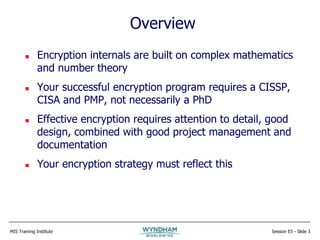
 Encryption internals are built on complex mathematics
and number theory
 Your successful encryption program requires a CISSP,
CISA and PMP, not necessarily a PhD
 Effective encryption requires attention to detail, good
design, combined with good project management and
documentation
 Your encryption strategy must reflect this
MIS Training Institute Session E5 - Slide 4
It’s 2012 – where’s the encryption?
 Many roll-outs nothing more than stop-gap solutions
 Getting it done often takes precedence over key
management, documentation, processes, etc.
 Many organizations lack required security expertise
 These and more combine to obstruct encryption from
being ubiquitous
 Adds up to a significant need for encryption
deployment strategies
MIS Training Institute Session E5 - Slide 5
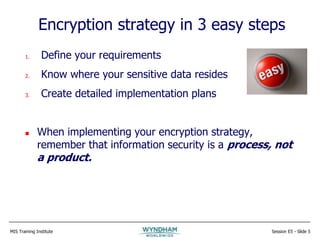
Encryption strategy in 3 easy steps
1. Define your requirements
2. Know where your sensitive data resides
3. Create detailed implementation plans
 When implementing your encryption strategy,
remember that information security is a process, not
a product.
MIS Training Institute Session E5 - Slide 6
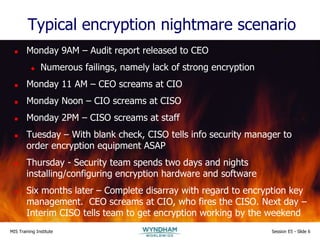
Typical encryption nightmare scenario
 Monday 9AM – Audit report released to CEO
 Numerous failings, namely lack of strong encryption
 Monday 11 AM – CEO screams at CIO
 Monday Noon – CIO screams at CISO
 Monday 2PM – CISO screams at staff
 Tuesday – With blank check, CISO tells info security manager to
order encryption equipment ASAP
 Thursday - Security team spends two days and nights
installing/configuring encryption hardware and software
 Six months later – Complete disarray with regard to encryption key
management. CEO screams at CIO, who fires the CISO. Next day –
Interim CISO tells team to get encryption working by the weekend
MIS Training Institute Session E5 - Slide 7
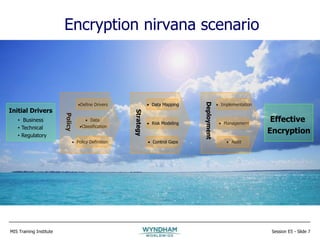
Encryption nirvana scenario
Strategy
 Data Mapping
 Risk Modeling
 Control Gaps
 Implementation
 Management
 Audit
Deployment
Define Drivers
 Data
Classification
 Policy Definition
Policy
Initial Drivers
• Business
• Technical
• Regulatory
Effective
Encryption
MIS Training Institute Session E5 - Slide 8
Encryption challenges
 Operating systems and application vendors haven’t
made it easy and seamless to implement encryption
 Lack of legacy support
 Laws often conflict or fail to provide effective guidance
 Far too few companies have encryption policies and/or
a formal encryption strategy
 Costs / Performance
 up-front and on-going maintenance costs
 performance hit
 added technical staff
MIS Training Institute Session E5 - Slide 9
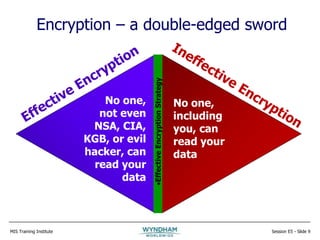
Encryption – a double-edged sword
No one,
not even
NSA, CIA,
KGB, or evil
hacker, can
read your
data
No one,
including
you, can
read your
data
Effective
Encryption
Strategy
MIS Training Institute Session E5 - Slide 10
Common deployment mistakes
 Thinking encryption is plug and play
 Hardware is PnP
 making encryption work is not
 Going to a vendor too early
 vendors sell hardware/software
 you need requirements, project plans,
implementation guides, etc.
MIS Training Institute Session E5 - Slide 11
More common deployment mistakes
 Not being transparent to end users
 if it’s a pain to use, they will ignore/go around it.
 Not giving enough time to design/test
 effective encryption roll-outs take time
 require significant details
 you can’t rush this!
MIS Training Institute Session E5 - Slide 12
Dealing with vendors
 When you drive the
project
 you define the
requirements
 you have chosen them
 vendors provides best
practices / assistance
 vendor input can be
invaluable
 project succeeds
 They are brought in
as the experts
 they are expected to
put out a fire
 they spec out their
product
 you don’t have internal
expertise working with
them
 project fails
MIS Training Institute Session E5 - Slide 13
Technically advanced airplane paradox
 TAA in theory have more available safety, but without
proper training for their pilots, they could be less safe
than airplanes with less available safety
 FAA found that without proper training for the pilots
who fly them, technically advanced airplanes don’t
advance safety at all
 TAA presents challenges that under-prepared pilots
might not be equipped to handle
 Encryption is exactly like a TAA
 Your staff must be trained and prepared
MIS Training Institute Session E5 - Slide 14
Encryption Strategy
 Mathematics of cryptography is rocket science
 But most aspects of information security, compliance
and audit are not!
 Good computer security is attention to detail and good
design, combined with effective project management
 Enterprise encryption strategy must reflect this
 not everyone will need encryption across the board
 policies need to be determined first as to what requires
encryption
MIS Training Institute Session E5 - Slide 15
What should the strategy include?
 laptop encryption
 database encryption
 network encryption
 smart cards
 mobile encryption
 wireless encryption
 smart phones
 iPad/iPod/iPhone
 application encryption
 storage encryption
 PDAs
 USB
 floppies/CD-ROM/DVD
 emerging technologies
MIS Training Institute Session E5 - Slide 16
Strategy prioritization
 Prioritize based on specific requirements and
compensating controls
 start with assumption that data needn’t be encrypted
unless there’s specific requirement to encrypt or
 identify high-risk situation where encrypting data will
avert disaster
 false sense of security
 takes budget away from more pressing encryption
requirements
 increases administrative burden
 locked out of your own data
MIS Training Institute Session E5 - Slide 17
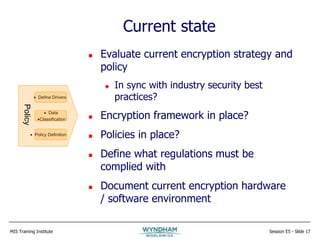
Current state
 Evaluate current encryption strategy and
policy
 In sync with industry security best
practices?
 Encryption framework in place?
 Policies in place?
 Define what regulations must be
complied with
 Document current encryption hardware
/ software environment
 Define Drivers
 Data
Classification
 Policy Definition
Policy
MIS Training Institute Session E5 - Slide 18
Current state
 Evaluate current encryption strategy and policy
 In sync with industry security best practices?
 Encryption framework in place?
 Policies in place?
 Define what regulations must be complied with
 Document current encryption hardware / software
environment
MIS Training Institute Session E5 - Slide 19
Analyze your encryption needs
 protect data from loss and exposure
 prevent access to the system itself?
 does software need to access the files after encryption?
 data to be transported securely? By what means?
 how much user burden is acceptable?
 how strong does the encryption need to be?
 do you need to match the solution to the hardware?
 regulatory, contractual, organizational policy
 ask a lot of questions at this point!
MIS Training Institute Session E5 - Slide 20
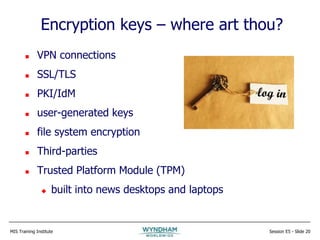
Encryption keys – where art thou?
 VPN connections
 SSL/TLS
 PKI/IdM
 user-generated keys
 file system encryption
 Third-parties
 Trusted Platform Module (TPM)
 built into news desktops and laptops
MIS Training Institute Session E5 - Slide 21
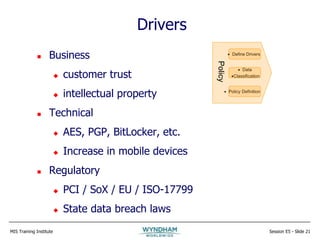
Drivers
 Business
 customer trust
 intellectual property
 Technical
 AES, PGP, BitLocker, etc.
 Increase in mobile devices
 Regulatory
 PCI / SoX / EU / ISO-17799
 State data breach laws
 Define Drivers
 Data
Classification
 Policy Definition
Policy
MIS Training Institute Session E5 - Slide 22
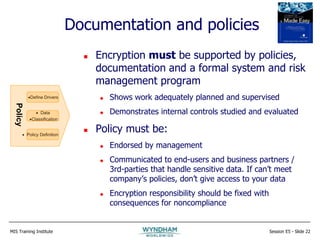
Documentation and policies
 Encryption must be supported by policies,
documentation and a formal system and risk
management program
 Shows work adequately planned and supervised
 Demonstrates internal controls studied and evaluated
 Policy must be:
 Endorsed by management
 Communicated to end-users and business partners /
3rd-parties that handle sensitive data. If can’t meet
company’s policies, don’t give access to your data
 Encryption responsibility should be fixed with
consequences for noncompliance
Define Drivers
 Data
Classification
 Policy Definition
Policy
MIS Training Institute Session E5 - Slide 23
Encryption processes
 Encryption is a process intensive
 Must be well-defined and documented
 If not implemented and configured properly, can cause
system performance degradation or operational hurdles
 Improperly configured encryption processes give false
sense of security
 Perception that confidentiality of sensitive
information is protected when it’s not
MIS Training Institute Session E5 - Slide 24
Data classification
 Provides users with information to guide
security-related information handling
 process must align with business processes
 classification is dynamic
 changes as data objects move from one class
to another
 changes as business strategies, structures
and external forces change
 understand potential for change
 embed appropriate processes to manage it
 Define Drivers
 Data
Classification
 Policy Definition
Policy
MIS Training Institute Session E5 - Slide 25
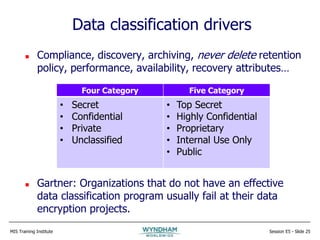
Data classification drivers
 Compliance, discovery, archiving, never delete retention
policy, performance, availability, recovery attributes…
 Gartner: Organizations that do not have an effective
data classification program usually fail at their data
encryption projects.
Four Category Five Category
• Secret
• Confidential
• Private
• Unclassified
• Top Secret
• Highly Confidential
• Proprietary
• Internal Use Only
• Public
MIS Training Institute Session E5 - Slide 26
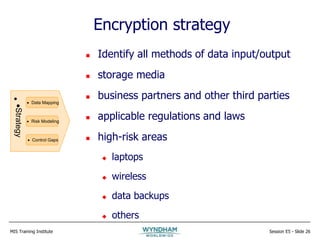
Encryption strategy
 Identify all methods of data input/output
 storage media
 business partners and other third parties
 applicable regulations and laws
 high-risk areas
 laptops
 wireless
 data backups
 others

Strategy
 Data Mapping
 Risk Modeling
 Control Gaps
MIS Training Institute Session E5 - Slide 27
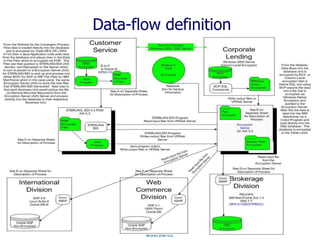
Data discovery
 Identify precisely where data is stored and all data
flows
 System wide audit of all data repositories
 significant undertaking for large enterprises
 process can take months
 Required to comply with PCI?
 confirm you are not storing PCI-prohibited data
 manually review data flows within POS application to
find files where results of card swipe are written
MIS Training Institute Session E5 - Slide 28
Data-flow definition
MIS Training Institute Session E5 - Slide 29
Requirements analysis
 Define business, technical, and operational
requirements and objectives for encryption
 define policies, architecture, and scope of
encryption requirements
 conduct interviews, review policy documents,
analyze current and proposed encryption
strategy to identify possible security gaps
 determine liabilities
 better requirements definition directly
correlates to successful encryption program

Strategy
 Data Mapping
 Risk Modeling
 Control Gaps
MIS Training Institute Session E5 - Slide 30
Legacy systems
 Most legacy systems not designed for encryption
 Legacy encryption options
 retrofitting application so that encryption is built-in to
application functions
 using encryption appliance that sits between app and
database
 off-loading encryption to storage mechanism or database
 Hardest platform – AS/400
MIS Training Institute Session E5 - Slide 31
Full-disk / host-based encryption (at rest)
 Data encrypted at creation
 first possible level of data security
 little chance of encrypted data being intercepted,
accidentally or maliciously
 if intercepted, encryption renders it unreadable
 can significantly increase processing overhead
 requires additional processing power/expense
 highly secure and well-suited to active data files
 large-scale data encryption can be unwieldy and impact
performance
 Vendors: Microsoft, Check Point, PGP, TrueCrypt
MIS Training Institute Session E5 - Slide 32
Full-disk / host-based (at rest)
 Data encrypted at creation
 first possible level of data security
 little chance of encrypted data being intercepted,
accidentally or maliciously
 can significantly increase processing overhead
 requires additional processing power/expense
 highly secure and well-suited to active data files
 large-scale data encryption can be unwieldy and impact
performance
 Vendors: Microsoft, Check Point, PGP, TrueCrypt
MIS Training Institute Session E5 - Slide 33
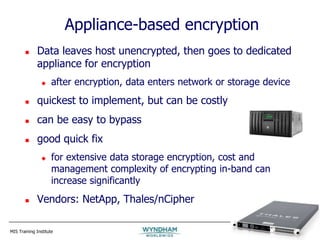
Appliance-based encryption
 Data leaves host unencrypted, then goes to dedicated
appliance for encryption
 after encryption, data enters network or storage device
 quickest to implement, but can be costly
 can be easy to bypass
 good quick fix
 for extensive data storage encryption, cost and
management complexity of encrypting in-band can
increase significantly
 Vendors: NetApp, Thales/nCipher
MIS Training Institute Session E5 - Slide 34
Storage device encryption
 Data transmitted unencrypted to storage device
 easiest integration into existing backup environments
 supports in-device key management
 easy to export encrypted data to tape
 easy to implement and cost-effective
 best suited to static and archived data or encrypting
large quantities of data for transport
 large numbers of devices can be managed from single
key management platform
 Vendors: EMC, IBM, Hitachi
MIS Training Institute Session E5 - Slide 35
Tape-based encryption
 Data can be encrypted on tape drive
 most secure solution
 no performance penalty
 easy to implement
 provides protection from both offsite and on-premise
information loss
 enables secure shipment of data
 allows secure reuse of tapes
 Vendors: Thales, HP, CA, Brocade, NetApp
MIS Training Institute Session E5 - Slide 36
Database encryption
 DBMS-based encryption vulnerable when encryption
key used to encrypt data stored in DB table inside the
DB, protected by native DBMS access controls
 users who have access rights to encrypted data often
have access rights to encryption key
 creates security vulnerability because encrypted text
not separated from means to decrypt it
 also doesn’t provide adequate tracking or monitoring of
suspicious activities
MIS Training Institute Session E5 - Slide 37
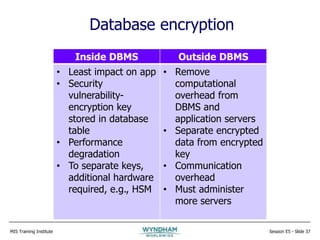
Database encryption
Inside DBMS Outside DBMS
• Least impact on app
• Security
vulnerability-
encryption key
stored in database
table
• Performance
degradation
• To separate keys,
additional hardware
required, e.g., HSM
• Remove
computational
overhead from
DBMS and
application servers
• Separate encrypted
data from encrypted
key
• Communication
overhead
• Must administer
more servers
MIS Training Institute Session E5 - Slide 38
Key Management (KM)
 Generation, distribution, storage, recovery and
destruction of encryption keys
 encryption is 90% management and policy, 10%
technology
 most encryption failures due to ineffective KM
processes
 80% of 22 SAP testing procedures related to encryption
are about KM
 effective KM policy and design requires significant time
and effort
MIS Training Institute Session E5 - Slide 39
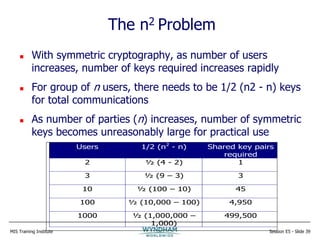
The n2 Problem
 With symmetric cryptography, as number of users
increases, number of keys required increases rapidly
 For group of n users, there needs to be 1/2 (n2 - n) keys
for total communications
 As number of parties (n) increases, number of symmetric
keys becomes unreasonably large for practical use
Users 1/2 (n2
- n) Shared key pairs
required
2 ½ (4 - 2) 1
3 ½ (9 – 3) 3
10 ½ (100 – 10) 45
100 ½ (10,000 – 100) 4,950
1000 ½ (1,000,000 –
1,000)
499,500
MIS Training Institute Session E5 - Slide 40
Key management questions
 how many keys do you need?
 where are keys stored?
 who has access to keys?
 how will you manage keys?
 how will you protect access to encryption keys?
 how often should keys change?
 what if key is lost or damaged?
 how much key management training will we need?
 how about disaster recovery?
MIS Training Institute Session E5 - Slide 41
PCI DSS key management requirements
 PCI DSS v2.0 requirement 3.6
 generation of strong keys
 secure key distribution
 periodic key changes
 destruction of old keys
 dual control of keys
 replacement of compromised keys
 key revocation
MIS Training Institute Session E5 - Slide 42
Key Management
 Keys must be accessible for the data to be accessible
 If too accessible, higher risk of compromise
 Reliability
 Outage in the system will prevent business from
functioning
 Centralized key management
 Can help simplify key management for multiple
applications
MIS Training Institute Session E5 - Slide 43
Key generation and destruction
Generation Destruction
• FIPS 140-2
validated
cryptographic
module
• distribution
• manual
• electronic
• backup/restore
• split knowledge
• Getting rid of keys is
just as detailed as
creating them
• Processes must deal
with keys stored on:
• hard drives
• USB
• EPROM
• Third parties
• facilities must exist to
destroy hard-copies of
key, both on paper
and in hardware
MIS Training Institute Session E5 - Slide 44
OASIS Enterprise Key Management
Infrastructure (EKMI)
 Focused on standardizing management of symmetric
encryption cryptographic keys across the enterprise
within a symmetric KM system
 Working on creation of:
 Symmetric Key Services Markup Language (SKSML)
protocol
 Implementation and operations guidelines for an SKMS
 Audit guidelines for auditing an SKMS
 Interoperability test-suite for SKSML implementations
 www.oasis-open.org/committees/ekmi
MIS Training Institute Session E5 - Slide 45
For more information
 Guideline for Implementing Cryptography in the Federal
Government
 http://csrc.nist.gov/publications/nistpubs/800-21-1/sp800-21-1_Dec2005.pdf
 Cryptographic Toolkit
 http://csrc.nist.gov/groups/ST/toolkit/index.html
 Recommendation for Key Management
 http://csrc.nist.gov/publications/nistpubs/800-57/sp800-57-Part1-revised2_Mar08-2007.pdf
 Encryption Strategies: The Key to Controlling Data
 www.oracle.com/encryption/wp/encryption_strategies_wp.pdf
MIS Training Institute Session E5 - Slide 46
Books
MIS Training Institute Session E5 - Slide 47
 Organizations that do not have an effective data
classification program usually fail at their data
encryption projects
 Creating an effective deployment strategy is the
difference between strong encryption and an audit
failure
 Encryption is about attention to detail, good design
and project management
Summary
MIS Training Institute Session E5 - Slide 48
Contact info
 Ben Rothke, CISSP CISA
Manager – Information Security
Wyndham Worldwide Corporation
www.linkedin.com/in/benrothke
www.twitter.com/benrothke
www.slideshare.net/benrothke

E5 rothke - deployment strategies for effective encryption

  • 1.
    Deployment Strategies for EffectiveEncryption Session E5 Tuesday April 3, 2012 9:45AM - 10:45AM Ben Rothke, CISSP CISM Wyndham Worldwide - Manager - Information Security
  • 2.
    MIS Training InstituteSession E5 - Slide 2 About me  Ben Rothke, CISSP, CISM, CISA  Manager - Information Security - Wyndham Worldwide  All content in this presentation reflect my views exclusively and not that of Wyndham Worldwide  Author - Computer Security: 20 Things Every Employee Should Know (McGraw-Hill)  Write the Security Reading Room blog  https://365.rsaconference.com/blogs/securityreading
  • 3.
    MIS Training InstituteSession E5 - Slide 3 Overview  Encryption internals are built on complex mathematics and number theory  Your successful encryption program requires a CISSP, CISA and PMP, not necessarily a PhD  Effective encryption requires attention to detail, good design, combined with good project management and documentation  Your encryption strategy must reflect this
  • 4.
    MIS Training InstituteSession E5 - Slide 4 It’s 2012 – where’s the encryption?  Many roll-outs nothing more than stop-gap solutions  Getting it done often takes precedence over key management, documentation, processes, etc.  Many organizations lack required security expertise  These and more combine to obstruct encryption from being ubiquitous  Adds up to a significant need for encryption deployment strategies
  • 5.
    MIS Training InstituteSession E5 - Slide 5 Encryption strategy in 3 easy steps 1. Define your requirements 2. Know where your sensitive data resides 3. Create detailed implementation plans  When implementing your encryption strategy, remember that information security is a process, not a product.
  • 6.
    MIS Training InstituteSession E5 - Slide 6 Typical encryption nightmare scenario  Monday 9AM – Audit report released to CEO  Numerous failings, namely lack of strong encryption  Monday 11 AM – CEO screams at CIO  Monday Noon – CIO screams at CISO  Monday 2PM – CISO screams at staff  Tuesday – With blank check, CISO tells info security manager to order encryption equipment ASAP  Thursday - Security team spends two days and nights installing/configuring encryption hardware and software  Six months later – Complete disarray with regard to encryption key management. CEO screams at CIO, who fires the CISO. Next day – Interim CISO tells team to get encryption working by the weekend
  • 7.
    MIS Training InstituteSession E5 - Slide 7 Encryption nirvana scenario Strategy  Data Mapping  Risk Modeling  Control Gaps  Implementation  Management  Audit Deployment Define Drivers  Data Classification  Policy Definition Policy Initial Drivers • Business • Technical • Regulatory Effective Encryption
  • 8.
    MIS Training InstituteSession E5 - Slide 8 Encryption challenges  Operating systems and application vendors haven’t made it easy and seamless to implement encryption  Lack of legacy support  Laws often conflict or fail to provide effective guidance  Far too few companies have encryption policies and/or a formal encryption strategy  Costs / Performance  up-front and on-going maintenance costs  performance hit  added technical staff
  • 9.
    MIS Training InstituteSession E5 - Slide 9 Encryption – a double-edged sword No one, not even NSA, CIA, KGB, or evil hacker, can read your data No one, including you, can read your data Effective Encryption Strategy
  • 10.
    MIS Training InstituteSession E5 - Slide 10 Common deployment mistakes  Thinking encryption is plug and play  Hardware is PnP  making encryption work is not  Going to a vendor too early  vendors sell hardware/software  you need requirements, project plans, implementation guides, etc.
  • 11.
    MIS Training InstituteSession E5 - Slide 11 More common deployment mistakes  Not being transparent to end users  if it’s a pain to use, they will ignore/go around it.  Not giving enough time to design/test  effective encryption roll-outs take time  require significant details  you can’t rush this!
  • 12.
    MIS Training InstituteSession E5 - Slide 12 Dealing with vendors  When you drive the project  you define the requirements  you have chosen them  vendors provides best practices / assistance  vendor input can be invaluable  project succeeds  They are brought in as the experts  they are expected to put out a fire  they spec out their product  you don’t have internal expertise working with them  project fails
  • 13.
    MIS Training InstituteSession E5 - Slide 13 Technically advanced airplane paradox  TAA in theory have more available safety, but without proper training for their pilots, they could be less safe than airplanes with less available safety  FAA found that without proper training for the pilots who fly them, technically advanced airplanes don’t advance safety at all  TAA presents challenges that under-prepared pilots might not be equipped to handle  Encryption is exactly like a TAA  Your staff must be trained and prepared
  • 14.
    MIS Training InstituteSession E5 - Slide 14 Encryption Strategy  Mathematics of cryptography is rocket science  But most aspects of information security, compliance and audit are not!  Good computer security is attention to detail and good design, combined with effective project management  Enterprise encryption strategy must reflect this  not everyone will need encryption across the board  policies need to be determined first as to what requires encryption
  • 15.
    MIS Training InstituteSession E5 - Slide 15 What should the strategy include?  laptop encryption  database encryption  network encryption  smart cards  mobile encryption  wireless encryption  smart phones  iPad/iPod/iPhone  application encryption  storage encryption  PDAs  USB  floppies/CD-ROM/DVD  emerging technologies
  • 16.
    MIS Training InstituteSession E5 - Slide 16 Strategy prioritization  Prioritize based on specific requirements and compensating controls  start with assumption that data needn’t be encrypted unless there’s specific requirement to encrypt or  identify high-risk situation where encrypting data will avert disaster  false sense of security  takes budget away from more pressing encryption requirements  increases administrative burden  locked out of your own data
  • 17.
    MIS Training InstituteSession E5 - Slide 17 Current state  Evaluate current encryption strategy and policy  In sync with industry security best practices?  Encryption framework in place?  Policies in place?  Define what regulations must be complied with  Document current encryption hardware / software environment  Define Drivers  Data Classification  Policy Definition Policy
  • 18.
    MIS Training InstituteSession E5 - Slide 18 Current state  Evaluate current encryption strategy and policy  In sync with industry security best practices?  Encryption framework in place?  Policies in place?  Define what regulations must be complied with  Document current encryption hardware / software environment
  • 19.
    MIS Training InstituteSession E5 - Slide 19 Analyze your encryption needs  protect data from loss and exposure  prevent access to the system itself?  does software need to access the files after encryption?  data to be transported securely? By what means?  how much user burden is acceptable?  how strong does the encryption need to be?  do you need to match the solution to the hardware?  regulatory, contractual, organizational policy  ask a lot of questions at this point!
  • 20.
    MIS Training InstituteSession E5 - Slide 20 Encryption keys – where art thou?  VPN connections  SSL/TLS  PKI/IdM  user-generated keys  file system encryption  Third-parties  Trusted Platform Module (TPM)  built into news desktops and laptops
  • 21.
    MIS Training InstituteSession E5 - Slide 21 Drivers  Business  customer trust  intellectual property  Technical  AES, PGP, BitLocker, etc.  Increase in mobile devices  Regulatory  PCI / SoX / EU / ISO-17799  State data breach laws  Define Drivers  Data Classification  Policy Definition Policy
  • 22.
    MIS Training InstituteSession E5 - Slide 22 Documentation and policies  Encryption must be supported by policies, documentation and a formal system and risk management program  Shows work adequately planned and supervised  Demonstrates internal controls studied and evaluated  Policy must be:  Endorsed by management  Communicated to end-users and business partners / 3rd-parties that handle sensitive data. If can’t meet company’s policies, don’t give access to your data  Encryption responsibility should be fixed with consequences for noncompliance Define Drivers  Data Classification  Policy Definition Policy
  • 23.
    MIS Training InstituteSession E5 - Slide 23 Encryption processes  Encryption is a process intensive  Must be well-defined and documented  If not implemented and configured properly, can cause system performance degradation or operational hurdles  Improperly configured encryption processes give false sense of security  Perception that confidentiality of sensitive information is protected when it’s not
  • 24.
    MIS Training InstituteSession E5 - Slide 24 Data classification  Provides users with information to guide security-related information handling  process must align with business processes  classification is dynamic  changes as data objects move from one class to another  changes as business strategies, structures and external forces change  understand potential for change  embed appropriate processes to manage it  Define Drivers  Data Classification  Policy Definition Policy
  • 25.
    MIS Training InstituteSession E5 - Slide 25 Data classification drivers  Compliance, discovery, archiving, never delete retention policy, performance, availability, recovery attributes…  Gartner: Organizations that do not have an effective data classification program usually fail at their data encryption projects. Four Category Five Category • Secret • Confidential • Private • Unclassified • Top Secret • Highly Confidential • Proprietary • Internal Use Only • Public
  • 26.
    MIS Training InstituteSession E5 - Slide 26 Encryption strategy  Identify all methods of data input/output  storage media  business partners and other third parties  applicable regulations and laws  high-risk areas  laptops  wireless  data backups  others  Strategy  Data Mapping  Risk Modeling  Control Gaps
  • 27.
    MIS Training InstituteSession E5 - Slide 27 Data discovery  Identify precisely where data is stored and all data flows  System wide audit of all data repositories  significant undertaking for large enterprises  process can take months  Required to comply with PCI?  confirm you are not storing PCI-prohibited data  manually review data flows within POS application to find files where results of card swipe are written
  • 28.
    MIS Training InstituteSession E5 - Slide 28 Data-flow definition
  • 29.
    MIS Training InstituteSession E5 - Slide 29 Requirements analysis  Define business, technical, and operational requirements and objectives for encryption  define policies, architecture, and scope of encryption requirements  conduct interviews, review policy documents, analyze current and proposed encryption strategy to identify possible security gaps  determine liabilities  better requirements definition directly correlates to successful encryption program  Strategy  Data Mapping  Risk Modeling  Control Gaps
  • 30.
    MIS Training InstituteSession E5 - Slide 30 Legacy systems  Most legacy systems not designed for encryption  Legacy encryption options  retrofitting application so that encryption is built-in to application functions  using encryption appliance that sits between app and database  off-loading encryption to storage mechanism or database  Hardest platform – AS/400
  • 31.
    MIS Training InstituteSession E5 - Slide 31 Full-disk / host-based encryption (at rest)  Data encrypted at creation  first possible level of data security  little chance of encrypted data being intercepted, accidentally or maliciously  if intercepted, encryption renders it unreadable  can significantly increase processing overhead  requires additional processing power/expense  highly secure and well-suited to active data files  large-scale data encryption can be unwieldy and impact performance  Vendors: Microsoft, Check Point, PGP, TrueCrypt
  • 32.
    MIS Training InstituteSession E5 - Slide 32 Full-disk / host-based (at rest)  Data encrypted at creation  first possible level of data security  little chance of encrypted data being intercepted, accidentally or maliciously  can significantly increase processing overhead  requires additional processing power/expense  highly secure and well-suited to active data files  large-scale data encryption can be unwieldy and impact performance  Vendors: Microsoft, Check Point, PGP, TrueCrypt
  • 33.
    MIS Training InstituteSession E5 - Slide 33 Appliance-based encryption  Data leaves host unencrypted, then goes to dedicated appliance for encryption  after encryption, data enters network or storage device  quickest to implement, but can be costly  can be easy to bypass  good quick fix  for extensive data storage encryption, cost and management complexity of encrypting in-band can increase significantly  Vendors: NetApp, Thales/nCipher
  • 34.
    MIS Training InstituteSession E5 - Slide 34 Storage device encryption  Data transmitted unencrypted to storage device  easiest integration into existing backup environments  supports in-device key management  easy to export encrypted data to tape  easy to implement and cost-effective  best suited to static and archived data or encrypting large quantities of data for transport  large numbers of devices can be managed from single key management platform  Vendors: EMC, IBM, Hitachi
  • 35.
    MIS Training InstituteSession E5 - Slide 35 Tape-based encryption  Data can be encrypted on tape drive  most secure solution  no performance penalty  easy to implement  provides protection from both offsite and on-premise information loss  enables secure shipment of data  allows secure reuse of tapes  Vendors: Thales, HP, CA, Brocade, NetApp
  • 36.
    MIS Training InstituteSession E5 - Slide 36 Database encryption  DBMS-based encryption vulnerable when encryption key used to encrypt data stored in DB table inside the DB, protected by native DBMS access controls  users who have access rights to encrypted data often have access rights to encryption key  creates security vulnerability because encrypted text not separated from means to decrypt it  also doesn’t provide adequate tracking or monitoring of suspicious activities
  • 37.
    MIS Training InstituteSession E5 - Slide 37 Database encryption Inside DBMS Outside DBMS • Least impact on app • Security vulnerability- encryption key stored in database table • Performance degradation • To separate keys, additional hardware required, e.g., HSM • Remove computational overhead from DBMS and application servers • Separate encrypted data from encrypted key • Communication overhead • Must administer more servers
  • 38.
    MIS Training InstituteSession E5 - Slide 38 Key Management (KM)  Generation, distribution, storage, recovery and destruction of encryption keys  encryption is 90% management and policy, 10% technology  most encryption failures due to ineffective KM processes  80% of 22 SAP testing procedures related to encryption are about KM  effective KM policy and design requires significant time and effort
  • 39.
    MIS Training InstituteSession E5 - Slide 39 The n2 Problem  With symmetric cryptography, as number of users increases, number of keys required increases rapidly  For group of n users, there needs to be 1/2 (n2 - n) keys for total communications  As number of parties (n) increases, number of symmetric keys becomes unreasonably large for practical use Users 1/2 (n2 - n) Shared key pairs required 2 ½ (4 - 2) 1 3 ½ (9 – 3) 3 10 ½ (100 – 10) 45 100 ½ (10,000 – 100) 4,950 1000 ½ (1,000,000 – 1,000) 499,500
  • 40.
    MIS Training InstituteSession E5 - Slide 40 Key management questions  how many keys do you need?  where are keys stored?  who has access to keys?  how will you manage keys?  how will you protect access to encryption keys?  how often should keys change?  what if key is lost or damaged?  how much key management training will we need?  how about disaster recovery?
  • 41.
    MIS Training InstituteSession E5 - Slide 41 PCI DSS key management requirements  PCI DSS v2.0 requirement 3.6  generation of strong keys  secure key distribution  periodic key changes  destruction of old keys  dual control of keys  replacement of compromised keys  key revocation
  • 42.
    MIS Training InstituteSession E5 - Slide 42 Key Management  Keys must be accessible for the data to be accessible  If too accessible, higher risk of compromise  Reliability  Outage in the system will prevent business from functioning  Centralized key management  Can help simplify key management for multiple applications
  • 43.
    MIS Training InstituteSession E5 - Slide 43 Key generation and destruction Generation Destruction • FIPS 140-2 validated cryptographic module • distribution • manual • electronic • backup/restore • split knowledge • Getting rid of keys is just as detailed as creating them • Processes must deal with keys stored on: • hard drives • USB • EPROM • Third parties • facilities must exist to destroy hard-copies of key, both on paper and in hardware
  • 44.
    MIS Training InstituteSession E5 - Slide 44 OASIS Enterprise Key Management Infrastructure (EKMI)  Focused on standardizing management of symmetric encryption cryptographic keys across the enterprise within a symmetric KM system  Working on creation of:  Symmetric Key Services Markup Language (SKSML) protocol  Implementation and operations guidelines for an SKMS  Audit guidelines for auditing an SKMS  Interoperability test-suite for SKSML implementations  www.oasis-open.org/committees/ekmi
  • 45.
    MIS Training InstituteSession E5 - Slide 45 For more information  Guideline for Implementing Cryptography in the Federal Government  http://csrc.nist.gov/publications/nistpubs/800-21-1/sp800-21-1_Dec2005.pdf  Cryptographic Toolkit  http://csrc.nist.gov/groups/ST/toolkit/index.html  Recommendation for Key Management  http://csrc.nist.gov/publications/nistpubs/800-57/sp800-57-Part1-revised2_Mar08-2007.pdf  Encryption Strategies: The Key to Controlling Data  www.oracle.com/encryption/wp/encryption_strategies_wp.pdf
  • 46.
    MIS Training InstituteSession E5 - Slide 46 Books
  • 47.
    MIS Training InstituteSession E5 - Slide 47  Organizations that do not have an effective data classification program usually fail at their data encryption projects  Creating an effective deployment strategy is the difference between strong encryption and an audit failure  Encryption is about attention to detail, good design and project management Summary
  • 48.
    MIS Training InstituteSession E5 - Slide 48 Contact info  Ben Rothke, CISSP CISA Manager – Information Security Wyndham Worldwide Corporation www.linkedin.com/in/benrothke www.twitter.com/benrothke www.slideshare.net/benrothke

Editor's Notes

  • #2 MIS Training Institute Section # - Page 1 XXXXXX XXX ©
  • #48 MIS Training Institute Section # - Page 47 XXXXXX XXX ©